
Search History
Popular Searches
English
Dealer Login / Sign Up
SHENZHEN, May 9 – BYD has released its latest operational data for its Flash Charging network. As of May 6, 2026, the company had built 5,924 Flash Charging stations across 311 cities nationwide. The BYD Flash Charge app has surpassed one million registered users. Between March 6 and May 6 – a two-month period – cumulative charging volume exceeded 21 million kWh, equivalent to an average daily volume of approximately 350,000 kWh.
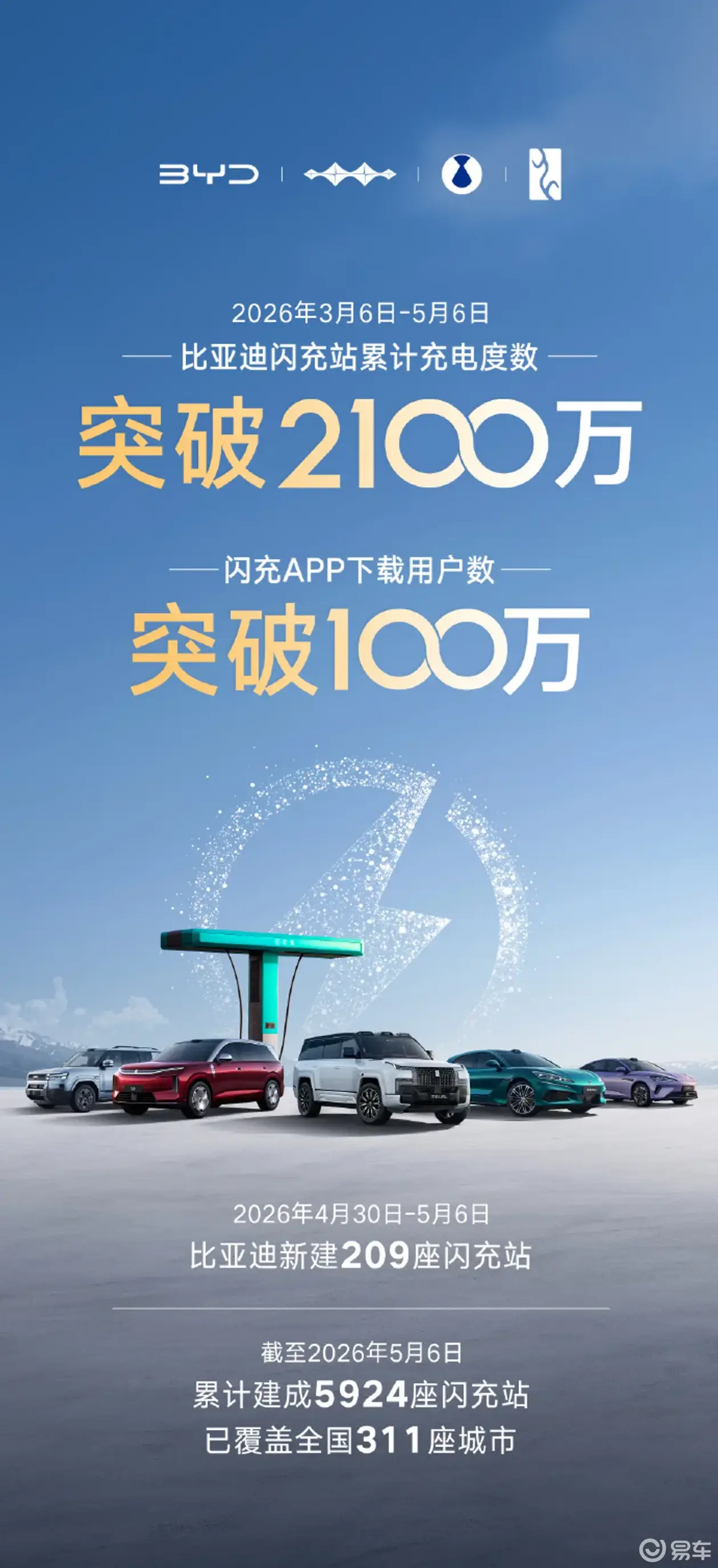
The new figures come just two months after BYD officially unveiled its second-generation Blade Battery and the "Flash Charge China" strategy at a Shenzhen conference in early March, at which the company reported 4,239 stations already in operation – representing a net addition of 1,685 stations over two months. More recently, between April 16 and May 6, BYD added approximately 568 stations, sustaining high-speed expansion. In the single week from April 30 to May 6 alone, BYD added 209 stations, averaging roughly 30 stations per day.
Core Technology: 1,500 kW Chargers – World’s Highest Production Output
The backbone of BYD’s Flash Charging network is its next-generation Flash Charger, unveiled in March 2026, featuring a single-connector peak output of 1,500 kW – the highest output of any production charger currently available. When configured with parallel dual-gun charging, peak power can reach 2,100 kW, approximately three times the output of Tesla’s V4 Supercharger.
The charger employs a world-first T-shaped pulley suspension design, with the connector and cables suspended overhead to avoid dragging on the ground. The "Zero-Gravity" design allows one-handed operation, and the rail system can shift left or right to align with each vehicle’s charging port.
From a technical architecture standpoint, BYD’s Super e-Platform provides the foundation powering the Flash Charging system, with a maximum charging voltage of 1,000V, maximum current of 1,000A, 10C peak charging rate, and a 1MW power threshold. Each Flash Charger is paired with an integrated battery storage system. This arrangement decouples instantaneous ultra-fast charging demand from local grid capacity constraints – the charger accumulates power from a standard grid connection and releases it as high power during charging sessions, making the infrastructure grid-friendly and socially responsible.
Charging Efficiency: 5 Minutes Adds Approximately 400 km of Range
Charging performance for vehicles equipped with the second-generation Blade Battery represents a major leap. Under normal conditions, charging from 10% to 70% State of Charge takes just 5 minutes, adding approximately 400 km of range; from 10% to 97% takes only 9 minutes. Even in extreme cold as low as -30°C, charging from 20% to 97% takes just 12 minutes – only three minutes longer than under normal temperatures.
User Experience: Plug-and-Charge and Free Charging Incentives
The BYD Flash Charge app supports vehicle binding for seamless "plug-and-charge" functionality without complex authentication steps. To accelerate adoption, BYD offers first-year free charging (including electricity and service fees) at its nationwide Flash Charging stations for all Flash Charge-compatible vehicle owners. The company has also launched a "Dream Station" program, permitting four car owners to jointly apply for a station through the app, with qualified sites completed in as little as one week.
Expansion Target: 20,000 Stations by End of 2026
BYD’s “Flash Charge China” strategy targets 20,000 Flash Charging stations nationwide by the end of 2026, comprising 18,000 urban “station-in-station” units (added to existing public charging infrastructure) and 2,000 highway stations. The highway stations aim for an average spacing of approximately 100 km across China’s expressway network. Urban coverage targets a 3 km radius in Tier 1 and Tier 2 cities, 5 km in Tier 3 and Tier 4 cities, and 6 km in Tier 5 and Tier 6 cities.
In late April, Hunan Expressway Group put 40 BYD Flash Charging stations into simultaneous operation across its service areas – the largest single-batch deployment of Flash Charging stations on any provincial expressway network to date. Construction from site entry to full operation took just 20 days. BYD has also engaged in cooperation discussions with Gansu Expressway Service Group, Henan Communications Investment Group, and other provincial highway operators, with further acceleration expected in the second half of 2026.
BYD has also formed strategic technology collaborations with Didi KuaiCharge (10,000 Flash Charging connectors), NewLink (5,000 connectors) and navigation partner AutoNavi Map (Gaode) to integrate its station locations into leading mobility platforms.
Strategic Significance: Energy Infrastructure Completes the EV Ecosystem
BYD is expanding its positioning from vehicle manufacturer toward energy service provider. The 1.5 MW Flash Charging technology compresses charging time to the approximate duration of a conventional fuel stop and effectively eliminates cold-weather charging penalties. Powered by BYD’s large existing owner base and the gradual market rollout of second-generation Blade Battery-equipped models, the Flash Charging network’s utilization rate is poised to accelerate.
Nevertheless, major challenges remain. Achieving the 20,000-station target will require navigating grid capacity upgrades at the city level, developing reliable station-operating procedures, and establishing sustainable pricing and revenue models. Competition between different high-speed recharging routes – third-generation battery swapping, megawatt-level flash charging, ultra-fast liquid-cooled charging – is expected to intensify throughout 2026 and beyond. Earlier projections have suggested that BYD’s 20,000 flash charging stations could surpass the combined projected totals of Li Auto’s approximately 4,800 superchargers and NIO’s planned 4,700-plus battery swap stations by year-end (approximately 9,500 combined). However, the competitiveness of each route hinges not only on station count but also on waiting time, site utilization efficiency, and lifecycle operating costs.
User Adoption Validates the Model
The Flash Charge app surpassing 1 million users reflects genuine owner acceptance and growing usage frequency. This user base also contributed to the recorded cumulative 21 million kWh in charging volume over the two-month period. In an environment where China’s overall NEV sales have seen a temporary slowdown, BYD’s proprietary energy ecosystem generating one million users in such a short span suggests that the integration between manufacturing, vehicle operation, and energy services is beginning to deliver tangible outcomes.
Meeting the 20,000-station target by year-end will require BYD to build over 14,000 new stations in the remaining seven months of 2026 – a construction rate approximately four to five times higher than the 1,685 stations built over the previous two months. Whether the company can achieve this rate of expansion remains to be validated by actual deployment data. However, the Hunan Expressway case (40 stations completed in 20 days) demonstrates that BYD already possesses efficient, large-scale deployment capability.
Outlook for the Hong Kong Market

While mainland China is advancing large-scale ultra-fast charging infrastructure, Hong Kong faces significant space and grid constraints for public charging. BYD’s Flash Charging technology integrates a battery storage system, which could provide a potential technical pathway for high-density, grid-limited urban environments like Hong Kong. However, BYD Hong Kong has not yet announced any timeline for introducing Flash Charging services or for local infrastructure deployment. Whether Hong Kong EV owners will gain access to megawatt-class flash charging in the near term will depend on future infrastructure cooperation agreements.

香港汽車內容平台 🚗 新車・買車・玩車・用車 用香港視角,睇世界嘅車
+ Follow 【新車速報】兩座車又殺返嚟?smart精靈#2今次有啲料喎
鍾意細車嘅香港車迷留意!全新 smart 精靈#2 配置公布,採用 ECA 電動緊湊型架構,搭載 35.8kWh 磷酸鐵鋰電池,CLTC 續航 410km,30%-80% 快充最快15分鐘。
車長約 2.75米、轉彎半徑僅3.35米,仲有前麥弗遜+後五連桿獨立懸架;安全配備最多7個氣袋及 ACC、盲區監測等功能。
0-50km/h 3.8秒,10月12日巴黎車展全球首發!
兩座純電+細車身,放落香港街道會唔會幾對味?
#smart #smart精靈2 #純電車 #BitAutoHongKong 2小时前
【新車速報】兩座車又殺返嚟?smart精靈#2今次有啲料喎
鍾意細車嘅香港車迷留意!全新 smart 精靈#2 配置公布,採用 ECA 電動緊湊型架構,搭載 35.8kWh 磷酸鐵鋰電池,CLTC 續航 410km,30%-80% 快充最快15分鐘。
車長約 2.75米、轉彎半徑僅3.35米,仲有前麥弗遜+後五連桿獨立懸架;安全配備最多7個氣袋及 ACC、盲區監測等功能。
0-50km/h 3.8秒,10月12日巴黎車展全球首發!
兩座純電+細車身,放落香港街道會唔會幾對味?
#smart #smart精靈2 #純電車 #BitAutoHongKong 2小时前  【揀車有路數】日產新車賣比亞迪價?仲有激光雷達
今集試一台好特別嘅日產新車——NX8,中國特供增程SUV。外觀似熟悉嘅日產味,但內籠同科技配備竟然唔晒傳統日產套路,駕乘感受又有幾多轉變?到底仲係咪你認識嗰部日產?一齊試畀你睇。
#日產 #NX8 #增程 #BitAutoHongKong #揀車有路數 1天前
【揀車有路數】日產新車賣比亞迪價?仲有激光雷達
今集試一台好特別嘅日產新車——NX8,中國特供增程SUV。外觀似熟悉嘅日產味,但內籠同科技配備竟然唔晒傳統日產套路,駕乘感受又有幾多轉變?到底仲係咪你認識嗰部日產?一齊試畀你睇。
#日產 #NX8 #增程 #BitAutoHongKong #揀車有路數 1天前  【新車速報】T-Top 回歸?Nissan Z Kaze 概念車現身!
90年代 JDM 味返晒嚟?Nissan 最近喺美國 ZCON 公開 Z Kaze 概念車,以現款 Nissan Z 為基礎,換上全新 T-Top 可拆式車頂,向經典 300ZX 等 Z 系列致敬。
配合碳纖維空力套件、NISMO LMGT2 18吋輪圈,以及 GReddy 排氣、進氣同 intercooler 升級,成部車都充滿 JDM 改裝味。
「Kaze」即係日文「風」,而呢部車係 one-off 概念作品,並非量產車。10月3日仲會現身加州長灘 Japanese Classic Car Show。
如果 T-Top Z 真係量產,你會唔會心動?
#NissanZ #ZKaze #TTop #JDM #BitAutoHongKong 1天前
【新車速報】T-Top 回歸?Nissan Z Kaze 概念車現身!
90年代 JDM 味返晒嚟?Nissan 最近喺美國 ZCON 公開 Z Kaze 概念車,以現款 Nissan Z 為基礎,換上全新 T-Top 可拆式車頂,向經典 300ZX 等 Z 系列致敬。
配合碳纖維空力套件、NISMO LMGT2 18吋輪圈,以及 GReddy 排氣、進氣同 intercooler 升級,成部車都充滿 JDM 改裝味。
「Kaze」即係日文「風」,而呢部車係 one-off 概念作品,並非量產車。10月3日仲會現身加州長灘 Japanese Classic Car Show。
如果 T-Top Z 真係量產,你會唔會心動?
#NissanZ #ZKaze #TTop #JDM #BitAutoHongKong 1天前 Get the latest car news first!
【新車速報】兩座車又殺返嚟?smart精靈#2今次有啲料喎
鍾意細車嘅香港車迷留意!全新 smart 精靈#2 配置公布,採用 ECA 電動緊湊型架構,搭載 35.8kWh 磷酸鐵鋰電池,CLTC 續航 410km,30%-80% 快充最快15分鐘。
車長約 2.75米、轉彎半徑僅3.35米,仲有前麥弗遜+後五連桿獨立懸架;安全配備最多7個氣袋及 ACC、盲區監測等功能。
0-50km/h 3.8秒,10月12日巴黎車展全球首發!
兩座純電+細車身,放落香港街道會唔會幾對味?
#smart #smart精靈2 #純電車 #BitAutoHongKong 2小时前 【揀車有路數】日產新車賣比亞迪價?仲有激光雷達
今集試一台好特別嘅日產新車——NX8,中國特供增程SUV。外觀似熟悉嘅日產味,但內籠同科技配備竟然唔晒傳統日產套路,駕乘感受又有幾多轉變?到底仲係咪你認識嗰部日產?一齊試畀你睇。
#日產 #NX8 #增程 #BitAutoHongKong #揀車有路數 1天前 【新車速報】T-Top 回歸?Nissan Z Kaze 概念車現身!
90年代 JDM 味返晒嚟?Nissan 最近喺美國 ZCON 公開 Z Kaze 概念車,以現款 Nissan Z 為基礎,換上全新 T-Top 可拆式車頂,向經典 300ZX 等 Z 系列致敬。
配合碳纖維空力套件、NISMO LMGT2 18吋輪圈,以及 GReddy 排氣、進氣同 intercooler 升級,成部車都充滿 JDM 改裝味。
「Kaze」即係日文「風」,而呢部車係 one-off 概念作品,並非量產車。10月3日仲會現身加州長灘 Japanese Classic Car Show。
如果 T-Top Z 真係量產,你會唔會心動?
#NissanZ #ZKaze #TTop #JDM #BitAutoHongKong 1天前  BAWToyotaBYDZeekrGACDongfengXPengMGMaxusLeapmotorDenzaIMiCAURDeepalWulingOraJuneyao AutoKYCSkyworthAvatrFotonFordGeelyHongqiJAECOOKGMOMODADFSKTeslaHondaBMWMercedes-BenzsmartMINIPorscheNissanLexusSuzukiVolvoSubaruMazdaKiaHyundaiLand RoverRolls-RoyceFerrariAudiLamborghiniRiddaraSeresFarizonfireflyLingboxKaiyiVoyahHIMAM-HeroIsuzuBentleyPolestarMcLarenMitsubishiMaseratiPeugeotAston MartinAcuraJeepJaguarLotusVolkswagenEpiclandJACLepasLi
 © 2024 Bitauto.com. All Rights Reserved.
Bitauto (www.yiche.com and www.bitauto.com) is one of the most visited automotive websites in China. We provide detailed info on Chinese car brands available in your area. Please note that the information provided on this website is based on publicly available data and is for reference only. It may not be fully updated or accurate at all times.
Help us improve our website


