
Search History
Popular Searches
English
Dealer Login / Sign Up
BEIJING, May 8 – The China Passenger Car Association (CPCA) released preliminary data for April 2026 on May 8, revealing deepening divergence between the overall auto market and the new energy vehicle sector.
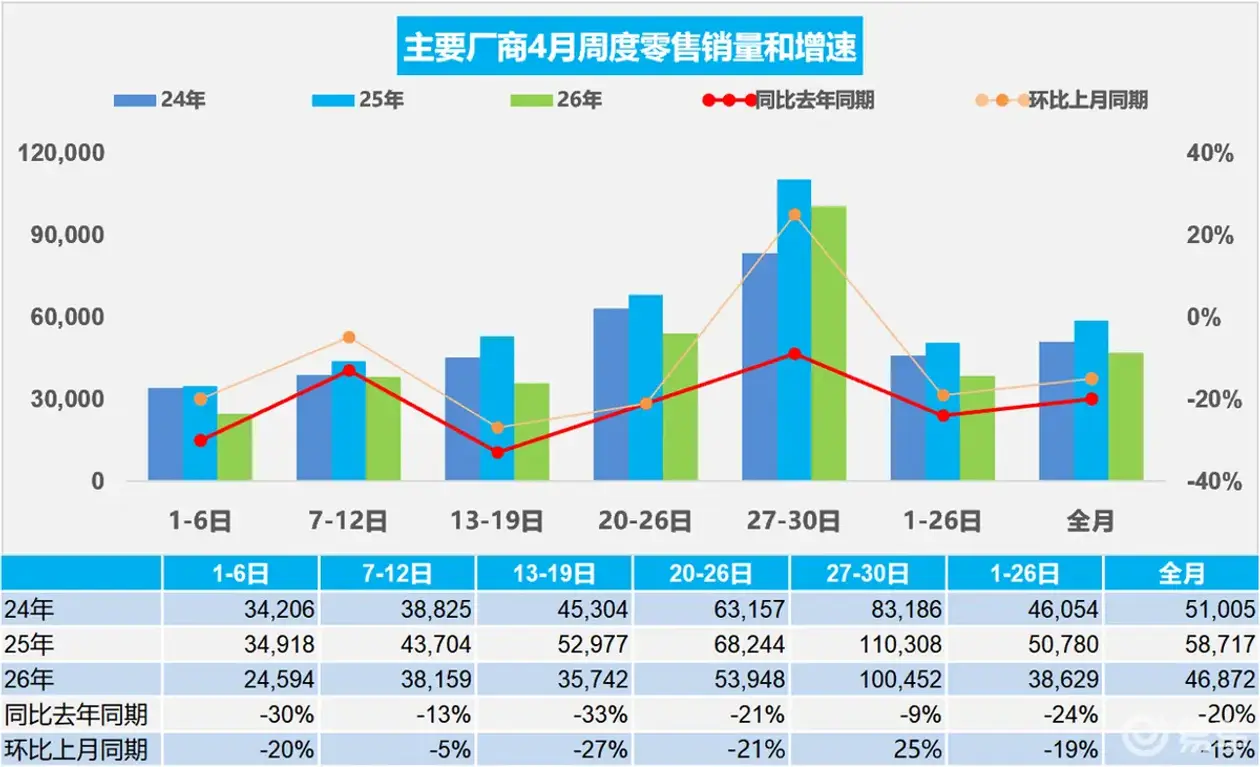
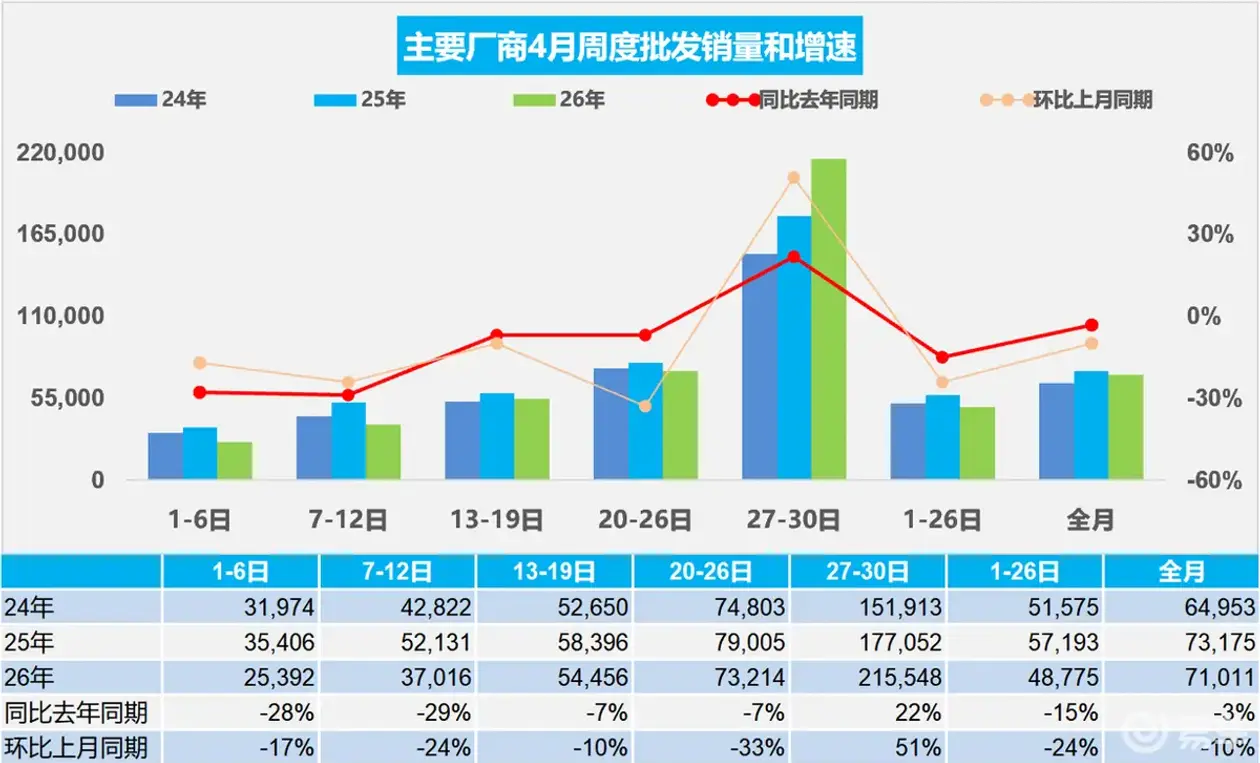
Passenger car retail sales reached 1.406 million units in April, down 20% year-on-year and 15% month-on-month. Cumulative retail sales for the first four months of 2026 stood at 5.628 million units, an 18% decline from the same period last year. At the wholesale level, April shipments totaled 2.13 million units, down 3% year-on-year and 10% month-on-month, with year-to-date wholesale volume reaching 7.997 million units, a 6% drop.
Record NEV Penetration
Despite the overall market contraction, new energy vehicles continued to gain share. April NEV retail sales came in at 883,000 units – down 5% year-on-year but up 4% month-on-month. NEV wholesale volume reached 1.22 million units in April, representing a 7% increase year-on-year and 7% month-on-month.
The NEV retail penetration rate hit a record 62.8% for April, the highest ever recorded for the month. The wholesale NEV penetration rate stood at 57.3%. However, the growth of electric vehicles has yet to fully offset the decline in internal combustion engine vehicles – pure fuel light vehicle production fell 32% year-on-year to 629,000 units, while hybrid and plug-in hybrid production dropped 20% to 305,000 units.
The CPCA noted that while high oil prices continue to push up operating costs, the divergence between fuel vehicles and new energy vehicles has deepened further compared to March. Fuel vehicle retail sales have slowed further, while the NEV sector is outperforming but has yet to compensate for the lost sales volume from the fuel vehicle segment.
Scrappage Subsidies Remain in Place, but Local Funds Tightening
The nationwide vehicle scrappage and trade-in subsidy program remains in effect for all of 2026, offering up to RMB 20,000 for scrapping an old vehicle and purchasing a new NEV, and up to RMB 15,000 for trade-ins. However, many local government subsidy programs – which operate on a first-come, first-served basis – have seen their funding quotas largely exhausted following first-quarter demand, reducing the incentive power for April.
Weekly retail data showed the market bottoming out in the final week of April. The first week averaged just 25,000 daily retail units (down 30% year-on-year), followed by a second-week rebound to 38,000 units (down 13%). The third week fell back to 36,000 units (down 33%). The final week surged to 100,000 daily units (down 9% year-on-year but up 25% month-on-month), driven by new model debuts at the Beijing Auto Show.
Automaker Rankings: BYD Dominates, Leapmotor Surges
At the brand level, BYD maintained its runaway lead with total April sales of 321,123 vehicles, up 7% month-on-month but down 15.5% year-on-year against a high base. Overseas shipments hit a record 134,500 units, up 70.9% year-on-year, accounting for 41.9% of total sales. Chery Group followed with 251,386 units, up 25.2% year-on-year, with overseas sales reaching 177,600 units – a staggering 70.7% of its total. Chery’s NEV sales exceeded 100,000 units for the first time, up 63.8%.
Geely Auto ranked third with 235,164 units, achieving both year-on-year and month-on-month growth. NEV penetration reached 58%, exceeding 50% for the third consecutive month. Zeekr delivered a record 31,787 vehicles, up 132% year-on-year. Changan Auto rounded out the top four with 209,500 units, with NEV sales up 32.2%.
In the startup EV segment, the rankings saw a major shakeup. Leapmotor surged to 71,387 deliveries in April – a 73.9% year-on-year increase and 42.7% month-on-month gain, creating a significant lead over its rivals. Li Auto delivered 34,085 vehicles, up just 0.43% year-on-year but down 17.0% month-on-month, as customers delayed purchases in anticipation of the new L9 Livis flagship model debuting at the Beijing Auto Show.
XPeng delivered 31,011 vehicles – marking its fourth consecutive month of year-on-year decline – as the sales momentum from the low-priced MONA M03 faded before a new growth driver could scale. NIO delivered 29,356 vehicles, up 22.8% year-on-year but down 17.3% month-on-month, with internal sources attributing the dip to a product transition period ahead of the ES9 launch.
Industry Outlook
China’s auto market has now contracted for two consecutive quarters. The speed of the internal combustion engine market’s decline has exceeded most expectations, while NEV sales – though continuing to gain share – have not yet generated enough incremental volume to offset the losses in the fuel vehicle segment. Dealer profitability remains under severe pressure, and channel issues have become a significant concern for the distribution network.
New models unveiled at the late-April Beijing Auto Show – including the NIO ES9, Li Auto L9 Livis, XPeng GX, and Volkswagen ID. ERA 9X – could attract some purchasing power in the latter part of the second quarter. Whether May can reverse the downward trend ultimately depends on the resilience of consumer confidence and macroeconomic conditions.

香港汽車內容平台 🚗 新車・買車・玩車・用車 用香港視角,睇世界嘅車
+ Follow 【新車速報】兩座車又殺返嚟?smart精靈#2今次有啲料喎
鍾意細車嘅香港車迷留意!全新 smart 精靈#2 配置公布,採用 ECA 電動緊湊型架構,搭載 35.8kWh 磷酸鐵鋰電池,CLTC 續航 410km,30%-80% 快充最快15分鐘。
車長約 2.75米、轉彎半徑僅3.35米,仲有前麥弗遜+後五連桿獨立懸架;安全配備最多7個氣袋及 ACC、盲區監測等功能。
0-50km/h 3.8秒,10月12日巴黎車展全球首發!
兩座純電+細車身,放落香港街道會唔會幾對味?
#smart #smart精靈2 #純電車 #BitAutoHongKong 2小时前
【新車速報】兩座車又殺返嚟?smart精靈#2今次有啲料喎
鍾意細車嘅香港車迷留意!全新 smart 精靈#2 配置公布,採用 ECA 電動緊湊型架構,搭載 35.8kWh 磷酸鐵鋰電池,CLTC 續航 410km,30%-80% 快充最快15分鐘。
車長約 2.75米、轉彎半徑僅3.35米,仲有前麥弗遜+後五連桿獨立懸架;安全配備最多7個氣袋及 ACC、盲區監測等功能。
0-50km/h 3.8秒,10月12日巴黎車展全球首發!
兩座純電+細車身,放落香港街道會唔會幾對味?
#smart #smart精靈2 #純電車 #BitAutoHongKong 2小时前  【揀車有路數】日產新車賣比亞迪價?仲有激光雷達
今集試一台好特別嘅日產新車——NX8,中國特供增程SUV。外觀似熟悉嘅日產味,但內籠同科技配備竟然唔晒傳統日產套路,駕乘感受又有幾多轉變?到底仲係咪你認識嗰部日產?一齊試畀你睇。
#日產 #NX8 #增程 #BitAutoHongKong #揀車有路數 1天前
【揀車有路數】日產新車賣比亞迪價?仲有激光雷達
今集試一台好特別嘅日產新車——NX8,中國特供增程SUV。外觀似熟悉嘅日產味,但內籠同科技配備竟然唔晒傳統日產套路,駕乘感受又有幾多轉變?到底仲係咪你認識嗰部日產?一齊試畀你睇。
#日產 #NX8 #增程 #BitAutoHongKong #揀車有路數 1天前  【新車速報】T-Top 回歸?Nissan Z Kaze 概念車現身!
90年代 JDM 味返晒嚟?Nissan 最近喺美國 ZCON 公開 Z Kaze 概念車,以現款 Nissan Z 為基礎,換上全新 T-Top 可拆式車頂,向經典 300ZX 等 Z 系列致敬。
配合碳纖維空力套件、NISMO LMGT2 18吋輪圈,以及 GReddy 排氣、進氣同 intercooler 升級,成部車都充滿 JDM 改裝味。
「Kaze」即係日文「風」,而呢部車係 one-off 概念作品,並非量產車。10月3日仲會現身加州長灘 Japanese Classic Car Show。
如果 T-Top Z 真係量產,你會唔會心動?
#NissanZ #ZKaze #TTop #JDM #BitAutoHongKong 1天前
【新車速報】T-Top 回歸?Nissan Z Kaze 概念車現身!
90年代 JDM 味返晒嚟?Nissan 最近喺美國 ZCON 公開 Z Kaze 概念車,以現款 Nissan Z 為基礎,換上全新 T-Top 可拆式車頂,向經典 300ZX 等 Z 系列致敬。
配合碳纖維空力套件、NISMO LMGT2 18吋輪圈,以及 GReddy 排氣、進氣同 intercooler 升級,成部車都充滿 JDM 改裝味。
「Kaze」即係日文「風」,而呢部車係 one-off 概念作品,並非量產車。10月3日仲會現身加州長灘 Japanese Classic Car Show。
如果 T-Top Z 真係量產,你會唔會心動?
#NissanZ #ZKaze #TTop #JDM #BitAutoHongKong 1天前 Get the latest car news first!
【新車速報】兩座車又殺返嚟?smart精靈#2今次有啲料喎
鍾意細車嘅香港車迷留意!全新 smart 精靈#2 配置公布,採用 ECA 電動緊湊型架構,搭載 35.8kWh 磷酸鐵鋰電池,CLTC 續航 410km,30%-80% 快充最快15分鐘。
車長約 2.75米、轉彎半徑僅3.35米,仲有前麥弗遜+後五連桿獨立懸架;安全配備最多7個氣袋及 ACC、盲區監測等功能。
0-50km/h 3.8秒,10月12日巴黎車展全球首發!
兩座純電+細車身,放落香港街道會唔會幾對味?
#smart #smart精靈2 #純電車 #BitAutoHongKong 2小时前 【揀車有路數】日產新車賣比亞迪價?仲有激光雷達
今集試一台好特別嘅日產新車——NX8,中國特供增程SUV。外觀似熟悉嘅日產味,但內籠同科技配備竟然唔晒傳統日產套路,駕乘感受又有幾多轉變?到底仲係咪你認識嗰部日產?一齊試畀你睇。
#日產 #NX8 #增程 #BitAutoHongKong #揀車有路數 1天前 【新車速報】T-Top 回歸?Nissan Z Kaze 概念車現身!
90年代 JDM 味返晒嚟?Nissan 最近喺美國 ZCON 公開 Z Kaze 概念車,以現款 Nissan Z 為基礎,換上全新 T-Top 可拆式車頂,向經典 300ZX 等 Z 系列致敬。
配合碳纖維空力套件、NISMO LMGT2 18吋輪圈,以及 GReddy 排氣、進氣同 intercooler 升級,成部車都充滿 JDM 改裝味。
「Kaze」即係日文「風」,而呢部車係 one-off 概念作品,並非量產車。10月3日仲會現身加州長灘 Japanese Classic Car Show。
如果 T-Top Z 真係量產,你會唔會心動?
#NissanZ #ZKaze #TTop #JDM #BitAutoHongKong 1天前  BAWToyotaBYDZeekrGACDongfengXPengMGMaxusLeapmotorDenzaIMiCAURDeepalWulingOraJuneyao AutoKYCSkyworthAvatrFotonFordGeelyHongqiJAECOOKGMOMODADFSKTeslaHondaBMWMercedes-BenzsmartMINIPorscheNissanLexusSuzukiVolvoSubaruMazdaKiaHyundaiLand RoverRolls-RoyceFerrariAudiLamborghiniRiddaraSeresFarizonfireflyLingboxKaiyiVoyahHIMAM-HeroIsuzuBentleyPolestarMcLarenMitsubishiMaseratiPeugeotAston MartinAcuraJeepJaguarLotusVolkswagenEpiclandJACLepasLi
 © 2024 Bitauto.com. All Rights Reserved.
Bitauto (www.yiche.com and www.bitauto.com) is one of the most visited automotive websites in China. We provide detailed info on Chinese car brands available in your area. Please note that the information provided on this website is based on publicly available data and is for reference only. It may not be fully updated or accurate at all times.
Help us improve our website


