
Search History
Popular Searches
English
Dealer Login / Sign Up
In a move set to redefine the computational backbone of autonomous systems, Tesla CEO Elon Musk has announced the successful tape-out of the company's fifth-generation, in-house designed Artificial Intelligence chip, dubbed AI5. The revelation, made via Musk's social media platform, marks a critical transition from the design phase to the preparation for mass production for what is arguably one of the most anticipated pieces of hardware in the automotive and robotics industries. This development signals not just an incremental upgrade but a foundational leap intended to power Tesla's most ambitious projects: a fully autonomous Robotaxi network and the Optimus humanoid robot.
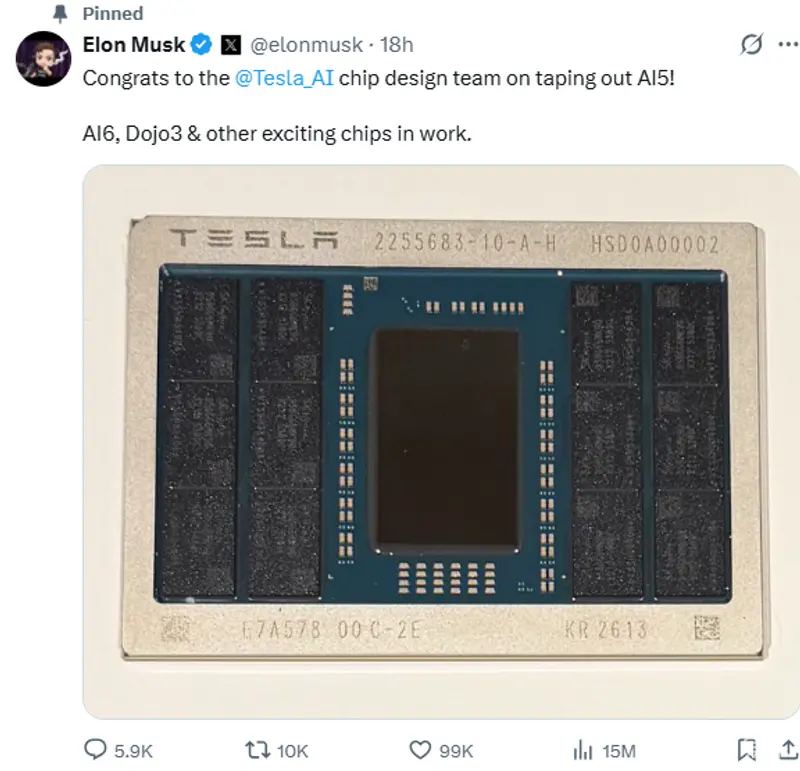
The announcement was characteristically succinct yet loaded with implications. "Congratulations to the Tesla AI chip design team on AI5 tape-out!" Musk declared, adding, "AI6, Dojo3, and other exciting chips are in development." Accompanying the text was an image of the physical chip, revealing a sophisticated packaging design centered around a large core computing die flanked by twelve DRAM memory modules. This visual hint underscores the chip's focus on integrating immense processing power with vast, high-speed memory access—a crucial architecture for real-time AI inference.
Delving into the specifications, the performance metrics disclosed by Tesla and subsequent industry analysis paint a picture of a generational leap that borders on the revolutionary. The single-chip AI computing power, or TOPS (Tera Operations Per Second), is projected to reach between 2000 and 2500. This figure represents a staggering 4 to 8 times increase over the AI4 chip (also known as Hardware 4 or HW4) that currently powers the latest Tesla vehicles with Full Self-Driving (FSD) capabilities. However, raw TOPS is only part of the story. Tesla claims the AI5's overall system performance delivers a 40-fold improvement compared to its predecessor.
This holistic performance surge is fueled by massive enhancements in memory and bandwidth. The AI5's memory capacity sees a nine-fold jump from AI4's 16GB to a substantial 144GB. Simultaneously, memory bandwidth is increased by a factor of five. Perhaps most critically for mobile and energy-constrained applications like cars and robots, Tesla emphasizes the AI5's exceptional power efficiency, stating it achieves 3 to 5 times better performance-per-watt compared to peer chips. This trifecta of raw power, massive memory, and superior efficiency is the holy grail for running the complex neural networks required for real-world autonomy.
The intended application of this formidable silicon has been a subject of intense speculation. Musk provided crucial clarity, responding to inquiries by stating, "Optimus and our supercomputer clusters are the primary targets. AI4 is already sufficient for FSD to achieve safety levels far beyond humans." This statement is profoundly revealing on multiple fronts. Firstly, it positions the AI5 not merely as the next step for consumer vehicles but as the dedicated engine for Tesla's future-facing products. Secondly, it serves as a powerful vote of confidence in the current HW4/AI4 hardware suite, suggesting that the existing fleet has the necessary computational headroom to deliver on the promise of unsupervised FSD.
Musk's clarification delineates a strategic bifurcation in Tesla's hardware roadmap. While the AI5 will undoubtedly be used to accelerate training within Tesla's Dojo and other supercomputer clusters, its architecture is specifically optimized for "AI edge computing." This refers to processing data directly on the device (the car or the robot) rather than relying on constant cloud connectivity. For the envisioned Robotaxi—a vehicle designed to operate continuously without a driver—and the Optimus robot, which must navigate dynamic human environments, low-latency, on-board processing of vast sensor data (cameras, potentially other sensors) is non-negotiable. The AI5, with its edge-optimized design, is built to handle the complex, split-second decision-making required in these unstructured settings.

The progression from AI4 to AI5 also reflects Tesla's evolving understanding of the autonomy problem. As neural networks grow more sophisticated and are trained on exponentially larger datasets from Tesla's global fleet, the hardware must keep pace. The 40x system performance boost and the 9x memory expansion are likely responses to the anticipated scale and complexity of future AI models. These models may move beyond pure vision-based systems to multi-modal AI, or require running multiple, highly detailed world models in parallel for unprecedented planning and prediction accuracy. The AI5 appears to be the hardware foundation for this next software epoch.
Furthermore, the mention of ongoing development for AI6 and Dojo3 underscores Tesla's long-term commitment to vertical integration. By controlling the entire stack from silicon to software, Tesla aims to tightly co-design its hardware and AI algorithms, extracting maximum performance and efficiency—a synergy difficult to achieve with off-the-shelf chip solutions. This in-house capability could become a significant and durable competitive moat, potentially lowering costs over time while accelerating the iteration cycle for its autonomy technology.
The implications for the automotive and tech industries are substantial. For competitors in the autonomous driving space, many of whom rely on combinations of NVIDIA, Qualcomm, or Mobileye chips, Tesla's announcement is a reminder of the blistering pace it sets in hardware development. The AI5's specifications, if realized in production, would set a new high-water mark for on-board automotive compute. It also strengthens Tesla's position in the burgeoning humanoid robot market, where computational power and efficiency are equally critical constraints.
However, the journey from a successful tape-out to reliable, high-yield mass production is a formidable engineering challenge. Tape-out signifies the design is finalized and sent for fabrication, but it precedes the lengthy processes of testing, validation, and yield ramp-up. The industry will be watching closely to see how quickly Tesla can navigate this phase and integrate the AI5 into its future products. The timeline for its deployment in Robotaxi and Optimus will be a key indicator of the progress of those projects.
In conclusion, Elon Musk's announcement of the AI5 tape-out is far more than a routine tech update. It is a strategic declaration of capability and intent. By developing a chip of such monumental performance gains, Tesla is not just preparing for the next version of its car; it is laying the physical groundwork for a future where its AI operates at the heart of two transformative platforms: autonomous transportation and general-purpose robotics. The AI5 represents the tangible hardware bridge between Tesla's present as an electric vehicle maker and its envisioned future as a leader in autonomy and artificial intelligence. As the AI6 and Dojo3 already simmer in the labs, one thing is clear: for Tesla, the silicon revolution is just accelerating.

香港汽車內容平台 🚗 新車・買車・玩車・用車 用香港視角,睇世界嘅車
+ Follow 【揀車有路數】日產新車賣比亞迪價?仲有激光雷達
今集試一台好特別嘅日產新車——NX8,中國特供增程SUV。外觀似熟悉嘅日產味,但內籠同科技配備竟然唔晒傳統日產套路,駕乘感受又有幾多轉變?到底仲係咪你認識嗰部日產?一齊試畀你睇。
#日產 #NX8 #增程 #BitAutoHongKong #揀車有路數 3小时前
【揀車有路數】日產新車賣比亞迪價?仲有激光雷達
今集試一台好特別嘅日產新車——NX8,中國特供增程SUV。外觀似熟悉嘅日產味,但內籠同科技配備竟然唔晒傳統日產套路,駕乘感受又有幾多轉變?到底仲係咪你認識嗰部日產?一齊試畀你睇。
#日產 #NX8 #增程 #BitAutoHongKong #揀車有路數 3小时前  【新車速報】T-Top 回歸?Nissan Z Kaze 概念車現身!
90年代 JDM 味返晒嚟?Nissan 最近喺美國 ZCON 公開 Z Kaze 概念車,以現款 Nissan Z 為基礎,換上全新 T-Top 可拆式車頂,向經典 300ZX 等 Z 系列致敬。
配合碳纖維空力套件、NISMO LMGT2 18吋輪圈,以及 GReddy 排氣、進氣同 intercooler 升級,成部車都充滿 JDM 改裝味。
「Kaze」即係日文「風」,而呢部車係 one-off 概念作品,並非量產車。10月3日仲會現身加州長灘 Japanese Classic Car Show。
如果 T-Top Z 真係量產,你會唔會心動?
#NissanZ #ZKaze #TTop #JDM #BitAutoHongKong 6小时前
【新車速報】T-Top 回歸?Nissan Z Kaze 概念車現身!
90年代 JDM 味返晒嚟?Nissan 最近喺美國 ZCON 公開 Z Kaze 概念車,以現款 Nissan Z 為基礎,換上全新 T-Top 可拆式車頂,向經典 300ZX 等 Z 系列致敬。
配合碳纖維空力套件、NISMO LMGT2 18吋輪圈,以及 GReddy 排氣、進氣同 intercooler 升級,成部車都充滿 JDM 改裝味。
「Kaze」即係日文「風」,而呢部車係 one-off 概念作品,並非量產車。10月3日仲會現身加州長灘 Japanese Classic Car Show。
如果 T-Top Z 真係量產,你會唔會心動?
#NissanZ #ZKaze #TTop #JDM #BitAutoHongKong 6小时前  【新車速報】Skyline 真係要返嚟喇!Nissan CEO:新一代12月登場
等咗咁耐,Skyline 終於有新消息!Nissan CEO Ivan Espinosa 接受《朝日新聞》專訪時透露,新一代 Skyline 將於今年12月亮相,亦係 Nissan 加快新車開發嘅代表作。
新車開發周期縮短至約 26個月,並利用生成式 AI、數碼模擬等工具加快開發流程。Nissan 官方亦已將 Skyline 列入 Heartbeat 車系,代表品牌工程技術、駕駛性能與情感。
至於動力、規格同最終量產設計,目前仍未全面公開。今次 Skyline 回歸,你最期待保留邊樣經典元素?
#Nissan #Skyline #新車速報 #BitAutoHongKong 1天前
【新車速報】Skyline 真係要返嚟喇!Nissan CEO:新一代12月登場
等咗咁耐,Skyline 終於有新消息!Nissan CEO Ivan Espinosa 接受《朝日新聞》專訪時透露,新一代 Skyline 將於今年12月亮相,亦係 Nissan 加快新車開發嘅代表作。
新車開發周期縮短至約 26個月,並利用生成式 AI、數碼模擬等工具加快開發流程。Nissan 官方亦已將 Skyline 列入 Heartbeat 車系,代表品牌工程技術、駕駛性能與情感。
至於動力、規格同最終量產設計,目前仍未全面公開。今次 Skyline 回歸,你最期待保留邊樣經典元素?
#Nissan #Skyline #新車速報 #BitAutoHongKong 1天前 Get the latest car news first!
【揀車有路數】日產新車賣比亞迪價?仲有激光雷達
今集試一台好特別嘅日產新車——NX8,中國特供增程SUV。外觀似熟悉嘅日產味,但內籠同科技配備竟然唔晒傳統日產套路,駕乘感受又有幾多轉變?到底仲係咪你認識嗰部日產?一齊試畀你睇。
#日產 #NX8 #增程 #BitAutoHongKong #揀車有路數 3小时前 【新車速報】T-Top 回歸?Nissan Z Kaze 概念車現身!
90年代 JDM 味返晒嚟?Nissan 最近喺美國 ZCON 公開 Z Kaze 概念車,以現款 Nissan Z 為基礎,換上全新 T-Top 可拆式車頂,向經典 300ZX 等 Z 系列致敬。
配合碳纖維空力套件、NISMO LMGT2 18吋輪圈,以及 GReddy 排氣、進氣同 intercooler 升級,成部車都充滿 JDM 改裝味。
「Kaze」即係日文「風」,而呢部車係 one-off 概念作品,並非量產車。10月3日仲會現身加州長灘 Japanese Classic Car Show。
如果 T-Top Z 真係量產,你會唔會心動?
#NissanZ #ZKaze #TTop #JDM #BitAutoHongKong 6小时前 【新車速報】Skyline 真係要返嚟喇!Nissan CEO:新一代12月登場
等咗咁耐,Skyline 終於有新消息!Nissan CEO Ivan Espinosa 接受《朝日新聞》專訪時透露,新一代 Skyline 將於今年12月亮相,亦係 Nissan 加快新車開發嘅代表作。
新車開發周期縮短至約 26個月,並利用生成式 AI、數碼模擬等工具加快開發流程。Nissan 官方亦已將 Skyline 列入 Heartbeat 車系,代表品牌工程技術、駕駛性能與情感。
至於動力、規格同最終量產設計,目前仍未全面公開。今次 Skyline 回歸,你最期待保留邊樣經典元素?
#Nissan #Skyline #新車速報 #BitAutoHongKong 1天前  BAWToyotaBYDZeekrGACDongfengXPengMGMaxusLeapmotorDenzaIMiCAURDeepalWulingOraJuneyao AutoKYCSkyworthAvatrFotonFordGeelyHongqiJAECOOKGMOMODADFSKTeslaHondaBMWMercedes-BenzsmartMINIPorscheNissanLexusSuzukiVolvoSubaruMazdaKiaHyundaiLand RoverRolls-RoyceFerrariAudiLamborghiniRiddaraSeresFarizonfireflyLingboxKaiyiVoyahHIMAM-HeroIsuzuBentleyPolestarMcLarenMitsubishiMaseratiPeugeotAston MartinAcuraJeepJaguarLotusVolkswagenEpiclandJACLepasLi
 © 2024 Bitauto.com. All Rights Reserved.
Bitauto (www.yiche.com and www.bitauto.com) is one of the most visited automotive websites in China. We provide detailed info on Chinese car brands available in your area. Please note that the information provided on this website is based on publicly available data and is for reference only. It may not be fully updated or accurate at all times.
Help us improve our website


