首頁mg4

搜尋歷史
熱門搜尋
經銷商登入 / 註冊

January to October 2026, SAIC Passenger Vehicle Division wholesale sales reached 991,400 units, up 43.8% year-on-year. In early November, it was officially announced that cumulative sales surpassed 1 million units. This is the first time in the brand's development history that annual sales have crossed the one million mark. Amidst differentiation in this year's auto market and growth pressure on many top brands, this performance report is especially significant.
Placed in the domestic independent brand one-million sales camp for horizontal comparison, the specificity of this growth becomes clear.
This year, BYD, Geely, Chery, and Changan all entered the million-unit tier of independent brands first, but the growth curves of each vary distinctly. BYD accumulated 3,558,400 units from January to October, down slightly 2.7% year-on-year; Geely 2,532,600 units, up only 2.2% year-on-year; Chery 2,410,300 units, up 9.5% year-on-year; Changan 1,094,700 units, down significantly 26% year-on-year. Among the four veteran million sellers, two declined year-on-year and two saw flat growth. SAIC Passenger Vehicle Division's 43.8% increase is the uniquely high growth rate in the entire million club. With the same million-unit sales, some have inertia support from existing stock bases, while others break out against the tide under cycle dividends; SAIC Passenger Vehicle Division clearly belongs to the latter.
Those familiar with the industry know this million threshold, SAIC Passenger Vehicle Division has stuck at for many years. For a long period prior, it was trapped in the 700,000 to 800,000 units range, finding it difficult to break through upwards. 2025 full year sales 886,700 units, just one step away from the million line, yet never managed to pierce this window paper. Roewe brand in the domestic household market went up and down, lacking sustained hit products; MG relies heavily on overseas markets for volume, with weak voice in the domestic market. The outside formed a stereotyped impression: SAIC independent has deep technical accumulation and supply chain resources, a solid enough foundation, but lacks explosive power, and is hard to achieve leapfrog growth. Many industry analyses predicted, SAIC Passenger Vehicle Division would linger in the 800,000 unit range for longer.
This year's explosion is not accidental reliance on one or two hit models for short-term volume push, but Roewe and MG dual brand new products pushing hard in succession, combined with organizational and systemic reform for two continuous years, realizing results concentrated this year.
October 23 listing Roewe Jia Yue 07, November 1 commenced nationwide delivery, first week delivery 5,000 units. Listing day 1 minute 53 seconds, firm orders broke 10,000; pre-sale period, pre-orders cumulative 51,827 units. This model's limited-time benefit price is 119,800 to 144,800 yuan, is a large 5-seater SUV, and is the "world's first AI-native car", industry first integration Doubao Cockpit Assistant, equipped with Momenta R7 advanced intelligent driving assistance system.
Ten years ago Roewe RX5, using the phrase "Hello, Zebra" let cars connect to the internet. Ten years later, Jia Yue 07 using the phrase "Hello, Doubao", put AI large models into the whole vehicle. Intelligence barrier changed: past, infotainment system understood one phrase was a selling point; now, smart cockpit close to standard feature, consumers care about usability. Jia Yue 07 invested effort in family scenarios. Doubao Cockpit Assistant can link AC, seats, windows, user state needs, system executes after understanding; rear entertainment screen, car fridge, etc configurations, point to traveling with kids. In orders, over 70% come from families with children.
MG 07 took another path. August 21 listing, limited-time subsidy price 105,900 to 156,900 yuan, 800V high-voltage platform, 5C super fast charging, 845 kilometers range, Momenta R7 advanced smart driving, mCDC intelligent electromagnetic suspension all landed on 150,000 yuan level coupe sedan. Listing 1 minute 57 seconds firm orders broke 10,000, 20 days locked orders 42,000 units, high and medium spec ratio 94.5%; consecutive two months sales broke 10,000, October delivery 12,393 units.
MG4 stabilized the basic base. This car global cumulative sales over 525,000 units, domestic continuous 13 months sales broke 10,000, October sales 15,503 units, ranked first in all-energy compact cars; overseas obtained E-NCAP, ANCAP dual five-star safety certification.
Cars can sell to this price point, rely on cost. Roewe and MG share underlying technologies and supply chain, integrated thermal management, semi-solid-state battery, AI-native architecture, AI-native cockpit successively landed, using scaled application dilute R&D costs; SAIC with Huayu, Yanfeng, Qingtao, Momenta and partners integrated component synergy, brought high-end configurations into mainstream price points.
Organization is also changing. SAIC integrated scattered independent brand resources into integrated operation system, established sales company, connected products, marketing, and user operations; product initiation front-loaded user needs, marketing and product teams "Red-Blue confrontation" verification; after listing iterate based on user feedback.
One car hot sales has accidentality, several cars sustained hot sales, rely on the system.
Overseas: From Selling Cars to Taking Root
This year first 10 months, SAIC overseas sales 1.328 million units, up 54% year-on-year. Europe is SAIC's largest overseas market, MG brand January-October sales over 320,000 units, up 24.7% year-on-year; in UK, MG brand September sales over 18,000 units, create historical high; in Germany, MG4 EV Urban cumulative orders broken 16,000 units. SAIC overseas cumulative sales already broken 7 million units.
Behind this group of numbers is mechanism. 2025, SAIC released Overseas Strategy 3.0—Glocal "Global + Local" strategy, from "Product Going Out" to "Value Chain Going Out", from "Scale Expansion" to "Value Creation", from "Product Export" to "Standard Export".
R&D end: London, Silicon Valley, Tel Aviv three R&D centers, London, Munich, Tokyo three design centers; Manufacturing end: Thailand, Indonesia, India three whole vehicle bases, Pakistan one KD factory; Business end: Frankfurt European Engineering Center launched, Belgium, Luxembourg direct sales companies established, Thailand service standards and local production implemented, Central Asia local production started, overseas parts bases and regional service centers accelerate layout; Standard end: products need to meet China, ASEAN, EU, USA, South America, Japan regions standards; Service end: over 170 countries and regions, over 3,000 marketing service outlets.
Technology is also going outward. July 8, MG at brand birthplace London held Technology Conference, displayed Hybrid+ hybrid, Solid Core semi-solid battery technologies, MG thereby became global first to achieve semi-solid-state battery mass production installation automotive brand, overseas i-SMART system activation volume broken one million mark. "Hybrid+", "Solid Core", "i-SMART", becoming SAIC's three technology tags overseas.
This year, SAIC launched technology "unification": in whole vehicle architecture, electrical and electronic architecture, smart driving, smart cockpit areas advance basic technology synergy, improve mature software and hardware module reuse rate, gradually unify supply chain quality standards. Same car, must face Europe's cold and Southeast Asia's humid and hot, product verification, quality standards, and after-sales service must keep up.
In current auto industry, million sales long no longer just a numerical milestone, but corporate system capabilities, long-term strategy's touchstone. Early independent brands broke million, key point was proving themselves possess mass production capability; today standing on million step, tests whether enterprises can continuously iterate, long-term stable upward.
For SAIC Passenger Vehicle Division, million is new starting point. Relying on already proven organizational mechanisms, multi-brand layout, domestic and overseas dual circulation pattern, next it has sufficient foundation continue upward. When many brands still struggling for scale, SAIC independent already obtained larger stage, to fulfill technology going out, brand upward, long-term steady growth long-term goals.
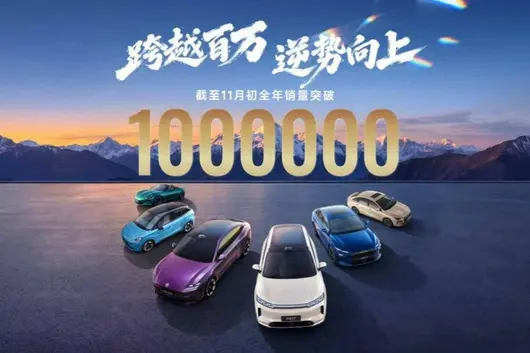

2026 年 1 至 10 月,上汽乘用車批發銷量達到 99.14 萬輛,同比上升 43.8%,喺 11 月上旬官方宣佈累計銷量突破 100 萬輛,呢個係品牌發展歷史上第一次年銷跨過百萬大關。喺今年车市大盤分化、唔少頭部品牌增長有壓力嘅環境下,呢份成績單,格外有份量。
放喺國內自主百萬銷量陣營入面做橫向比較,就能睇清呢份增長嘅特殊性。
今年比亞迪、吉利、奇瑞、長安都係搶先一步邁入百萬梯隊嘅自主品牌,但大家嘅增長曲線冷暖分明。比亞迪 1-10 月累計 355.84 萬輛,同比細細跌咗 2.7%;吉利 253.26 萬輛,同比僅微增 2.2%;奇瑞 241.03 萬輛,同比上漲 9.5%;長安 109.47 萬輛,同比大幅下滑 26%。四家老牌百萬大戶入面,兩家同比收跌、兩家增速平穩。而上汽乘用車 43.8% 嘅漲幅,係整個百萬俱樂部入面獨一檔嘅高增速。同樣係百萬銷量,有嘅係存量底盤嘅慣性支撐,有嘅係週期紅利下嘅逆勢突圍,上汽乘用車顯然屬於後者。
熟悉行業嘅人都知道,呢個百萬門檻,上汽乘用車卡咗好多年。此前好長一段時間,佢一直困喺 70 萬到 80 萬輛嘅區間,好難向上突破。 2025 年全年銷量 88.67 萬輛,距離百萬線差啲一步,但始終都冇能捅穿呢層窗紙。榮威品牌喺國內家用市場起起伏伏,爆款持續性不足;MG 高度依賴海外市場走量,國內聲量偏弱。外界形成一個固化印象:上汽自主擁有深厚嘅技術積累、供應鏈資源,底子夠厚,但缺少爆發力,好難跑出新跨越增長。好多行業分析都預判,上汽乘用車仲會喺 80 萬量級徘徊更長時間。
今年嘅爆發,並唔係偶然靠一兩台爆款車型短期衝量,而係榮威、MG 雙品牌新品接連發力,叠加持續兩年嘅組織與體系改革,喺今年集中兌現成果。
10 月 23 日上市嘅榮威家越 07,11 月 1 日開啟全國交付,首週交付 5000 輛。上市當日 1 分 53 秒,大訂訂單破萬;預售期間,小訂累計 51827 輛。 呢款車型嘅限時權益價係 11.98 萬~14.48 萬元,係一款大五座 SUV,亦係“全球首款 AI 原生汽車”,業界首搭豆包座艙助手,搭載 Momenta R7 高級智能駕駛輔助系統。
十年前嘅榮威 RX5,用一句“你好,斑馬”讓汽車接入互聯網。十年後,家越 07 用一句“你好,豆包”,把 AI 大模型裝入整車。智能化嘅門檻變咗:過去,車機聽懂一句說話就係賣點;如今,智能座艙接近標配,消費者在意嘅係好唔好用。 家越 07 把功夫下喺家庭場景。豆包座艙助手可聯動冷氣、座椅、車窗,用戶講出需求,系統理解後執行;後排娛樂屏、車載雪櫃等配備,指向帶娃出行。訂單中,超過七成來自有娃家庭。
MG 07 走嘅係另一條路。8 月 21 日上市,限時補貼價 10.59 萬~15.69 萬元,800V 高壓平台、5C 超級快充、845 公里續航里程、Momenta R7 高級智駕、mCDC 智能電磁懸掛都落喺 15 萬元級轎跑上。上市 1 分 57 秒大定破萬,20 天鎖單 4.2 萬輛,中高配佔比 94.5%;連續兩個月銷量破萬,10 月交付 12393 輛。
MG4 穩住咗基本盤。呢款車全球累計銷量超過 52.5 萬輛,國內連續 13 個月銷量破萬,10 月銷售 15503 輛,位居全能源緊湊型車第一;海外獲得 E-NCAP、ANCAP 雙五星安全認證。
車能賣到呢個價位,靠嘅係成本。榮威與 MG 共享底層技術同供應鏈,一體式熱管理、半固態電池、AI 原生架構、AI 原生座艙相繼落地,以規模化應用攤薄研發成本;上汽與華域、延鋒、清陶、Momenta 等夥伴整零協同,將高端配備送進主流價位。
組織亦喺變。上汽把分散嘅自主品牌資源整合為一體化運營體系,成立銷售公司,打通產品、營銷與用戶運營;產品立項時前置用戶需求,營銷與產品團隊“紅藍對抗”校驗;上市後按用戶反饋迭代。
一款車熱銷有偶然性,幾款車持續熱銷,靠嘅係體系。
海外:由賣車到扎根
今年前 10 個月,上汽海外銷售 132.8 萬輛,同比增長 54%。歐洲係上汽最大嘅海外市場,MG 品牌 1-10 月銷售超過 32 萬輛,同比增長 24.7%;喺英國,MG 品牌 9 月份銷售超過 1.8 萬輛,創歷史新高;喺德國,MG4 EV Urban 累計訂單量突破 1.6 萬輛。上汽海外累計銷量已突破 700 萬輛。
呢組數字背後係機制。2025 年,上汽發布海外戰略 3.0——Glocal“全球 + 本土”戰略,從“產品出海”轉向“價值鏈出海”,從“規模擴張”轉向“價值創造”,從“產品輸出”轉向“標準輸出”。
研發端:倫敦、矽谷、特拉維夫三大研發中心,倫敦、慕尼黑、東京三大設計中心;製造端:泰國、印尼、印度三個整車基地,巴基斯坦一個 KD 工廠;經營端:法蘭克福歐洲工程中心啟用,比利時、盧森堡直屬銷售公司成立,泰國服務標準與本地化生產落地,中亞本地化生產啟動,海外零部件基地與區域服務中心加快佈局;標準端:產品需要滿足中國、東盟、歐盟、美國、南美洲、日本等地區標準;服務端:170 多個國家同地區、3000 多個營銷服務網點。
技術亦向外行。7 月 8 日,MG 喺品牌發源地倫敦召開技術大會,展示 Hybrid + 混能、Solid Core 半固態電池等技術,MG 由此成為全球首個實現半固態電池量產裝車嘅汽車品牌,海外 i-SMART 系統激活量突破百萬大關。“Hybrid + 混能”"Solid Core"“i-SMART”,正成為上汽喺海外嘅三個技術標籤。
今年,上汽啟動技術“歸一化”:喺整車架構、電子電氣架構、智駕、智艙等領域推進基礎技術協同,提高成熟軟件模組複用率,逐步統一供應鏈質量標準。同一款車,要面對歐洲嘅寒冷同東南亞嘅濕熱,產品驗證、質量標準同售後服務都要跟上。
喺當下嘅汽車行業,百萬銷量早已唔單止係一個數字里程碑,更加係企業體系能力、長期戰略嘅試金石。早期自主品牌破百萬,重點係證明自己具備規模化造車嘅能力;今日站上百萬臺階,考驗嘅係企業係咪可以持續迭代、長期穩定向上。
對上汽乘用車而言,百萬係新嘅起點。依托已經跑通嘅組織機制、多品牌佈局、國內海外雙循環格局,接下來佢有充足嘅底盤繼續向上。當好多品牌仲為規模苦苦攻關嘅時候,上汽自主已經拿到咗更大嘅舞台,去兌現技術出海、品牌向上、長期穩健增長嘅長期目標。

On November 6, SAIC Motor Group announced that Group Vice President Yang Xiaodong has applied for resignation due to personal development reasons. After resigning, he will no longer hold any position in SAIC Motor Group or its subsidiary companies.

Notably, Yang Xiaodong's term was originally scheduled to end in June 2028, marking an early departure before the term concluded. The announcement stated that he has completed all work handovers according to company regulations and has no disagreements with the board. This personnel change will not disrupt the Group's daily production and operations. SAIC officials also expressed gratitude for his past contributions.
Yang Xiaodong is a core executive cultivated by SAIC locally, born in 1970, holding a Master of Engineering and a dual master's degree from Shanghai University of Finance and Economics iMBA. Early in his career, he was responsible for procurement at SAIC GM, then shifted to overseas business, successively serving as Head of Overseas Operation Preparation Group, General Manager of SAIC Motor Passenger Vehicle, and Director of Technical Center. He was promoted to Group Vice President in July 2019.
Since 2014, he has led SAIC's overseas expansion, establishing localized production and sales systems in Southeast Asia, Europe, and Latin America. He established the Rayong base in Thailand, promoted MG's overseas rise, and helped SAIC join the top tier of domestic automakers in overseas expansion.

In sharing the overseas expansion strategy, Yang Xiaodong once summarized the shift in SAIC's overseas approach using a set of vivid metaphors. "In the early years, we simply relied on agents to sell cars, viewing the market as if through a telescope; for cross-border operations, one must switch to a magnifying glass to root locally." "After diving deep into the local market, further penetration is needed to connect the entire value chain, planning for an automotive ecosystem and mobility services." In a few words, this condenses SAIC's transformation logic from product export to deep localization.
In the June 2023 China Auto Chongqing Forum, Yang Xiaodong discussed at length on the stage the overseas expansion of independent brands and the shift to the new energy track, outlining SAIC's long-term global route. In the nearly three years following this, Yang Xiaodong seldom appeared in public occasions such as industry forums or media press conferences. This state of fading from public view for a long time also echoes the submission of his resignation this time.
SAIC's October Production and Sales Express shows that SAIC's total vehicle sales in October reached 430,000, setting a new monthly sales record for this year; Cumulative sales from Jan-October totaled 3.577 million vehicles. Independent brands have taken center stage, with Jan-October sales reaching 2.638 million, accounting for as high as 73.7%. Among them, the MG4 EV is SAIC's main volume-selling model overseas, while the domestic hot-selling model was the Roewe D7. Meanwhile, the overseas market saw explosive growth, with cumulative sales from Jan-October reaching 1.328 million, surging 54% year-on-year. This has already exceeded the full-year overseas sales of 2025. Overseas expansion has become SAIC's most important growth engine.

Under the glitzy data, the pain points of profit shortcomings are especially glaring. SAIC's financial report for the first three quarters of 2026 shows total operating revenue of 455.221 billion Yuan, a year-on-year decline of 2.94%; net profit attributable to shareholders was 5.638 billion Yuan, a year-on-year drop of 30.4%.
Pressure in the Third Quarter was particularly severe, with net profit attributable to shareholders for the single quarter at 486 million Yuan, a year-on-year drop of 76.7%. SAIC explained that the pressure on profits mainly came from losses due to fair value changes of financial assets and overseas exchange losses.

This is also a microcosm of the entire industry. Under the wave of new energy, independent brands are rising while the dividends of traditional joint ventures fade. SAIC is completing a difficult shift in focus; the main growth line is shifting from joint ventures to three tracks: independent brands, new energy, and overseas markets. Intense domestic competition squeezes profits through price wars; in overseas expansion, one must continue to bear channel, supply chain, and exchange rate costs, making it difficult to convert scale advantages into high profits in the short term.
The iteration speed in the automotive industry is getting faster and faster, and executive turnover has long been normalized. The step down of a veteran who has cultivated overseas for many years means the test of relaying the baton is just beginning. The market's focus is on who will take over Yang Xiaodong's responsibilities?
Source: Car Observation
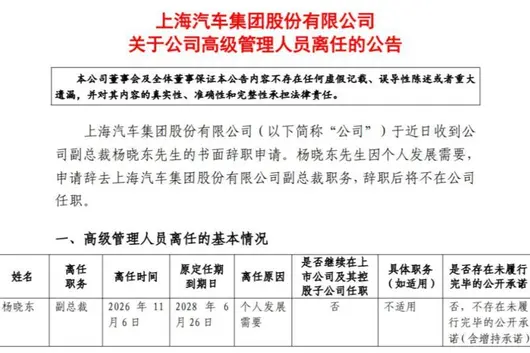

11 月 6 號,上汽集團發布公告,集團副總裁楊曉東因個人發展原因申請辭職。辭任之後,佢唔再喺上汽集團以及旗下控股子公司擔任任何職務。
值得留意嘅係,楊曉東嘅任期原本定係到 2028 年 6 月,屬於任期尚未結束便提前離開。公告寫明,佢已按公司制度完成全部工作交接,同董事會唔存在分歧,呢次人事變動,唔會干擾集團日常生產經營,上汽官方亦都對佢過往嘅付出表達咗感謝。
楊曉東係上汽本土培養嘅核心高層,1970 年出生,擁有工程碩士、上海財經大學 iMBA 雙碩士學位。佢早年喺上汽通用負責採購工作,其後轉往海外業務,歷任海外經營籌備組組長、上汽乘用車總經理、技術中心主任,2019 年 7 月升任集團副總裁。
由 2014 年起佢主導上汽出海,搭建東南亞、歐洲、拉美本地化產銷體系,落戶泰國羅勇基地,推動 MG 海外崛起,助力上汽躋身國內車企出海第一梯隊。
喺出海戰略嘅分享中,楊曉東曾用一組生動比喻概括上汽海外思路嘅轉變。「早年只係依托代理商賣車,睇市場好似隔住望遠鏡;做跨國經營,要換上放大鏡扎根當地。」 「深入本土之後,仲要進一步下沉,打通全價值鏈,佈局汽車生態同出行服務。」寥寥幾句,濃縮咗上汽從產品出口到深度本土化經營嘅轉型邏輯。
2023 年 6 月嘅中國汽車重慶論壇中,楊曉東喺演講台上暢談自主品牌出海、新能源賽道切換,勾勒上汽全球化嘅長遠路線。喺此之後嘅近三年時間裏,楊曉東極少出現喺行業論壇、媒體發佈會等公開場合,呢種長期淡出公眾視野嘅狀態,同此次遞交辭呈形成呼應。
上汽 10 月產銷快報顯示,上汽十月份整車銷量 43 萬輛,創下今年月度銷量新高;1-10 月累計賣出 357.7 萬輛整車;自主品牌已經站上 C 位,1-10 月自主品牌銷量 263.8 萬輛,佔比高達 73.7%;其中,MG4 EV 係上汽海外走量主力車型,國內熱銷車型則以榮威 D7 表現突出。同時,海外市場爆發式增長,1-10 月累計銷量 132.8 萬輛,同比暴升 54%,已經超過 2025 年全年海外銷量,出海已係上汽最重要嘅增長引擎。
光鮮數據之下,盈利短板嘅痛點格外刺眼。上汽 2026 年前三季度財報顯示,營業總收入 4552.21 億元,同比下降 2.94%;歸母股東純利 56.38 億元,同比下滑 30.4%。
第三季度壓力尤其嚴峻,單季歸母股東純利 4.86 億元,同比大跌 76.7%。上汽解釋,利潤承壓主要嚟自金融資產公允價值變動損失、海外匯兌損失。
呢都係整個行業嘅縮影。新能源浪潮之下,自主品牌崛起,傳統合資紅利褪去。上汽正喺度完成一場艱難嘅重心切換,增長主線從合資,轉向自主、新能源、海外三條賽道。國內內捲激烈,價格戰擠壓利潤;海外擴張,仲要持續承擔渠道、供應鏈、匯率成本,規模優勢短期好難轉化成高利潤。
汽車行業迭代速度越來越快,高層流動早已常態化。深耕海外多年嘅老將謝幕,接力嘅考驗先至開始。市場目光聚焦喺邊位會接過楊曉東嘅擔子?
來源:車觀察

今年前三季度,海外销量“上百万”,销量超越去年全年。上汽集团以海外销量116.6万辆的业绩,实现同比52.4%的增长,助力上汽集团累计销售314.7万辆,继续位居中国汽车行业首位。

在上汽最大的海外区域市场——欧洲,MG品牌前三季度累计销量超过 28 万辆,同比增长 23%。
在英国,9月份MG销售新车1.8万辆,刷新品牌单月销量纪录,其中电动化车型占比达 91.6%,覆盖纯电、HEV与PHEV等多种能源形式;MG 4 EV Urban 车型位居 Car-B 细分市场销量榜首,市占率高达 16.5%。
在波兰市场,9月分MG以 4.38% 的市占率跻身乘用车单一品牌销量排行榜第七位,单月销量同比大增 88%;前三季度累计上牌量较上年同期增长 44%。

在深耕欧洲市场的同时,上汽加快向更多区域延伸。前三季度,MG品牌在中美洲和加勒比地区 18 个市场的销量同比增长 86%。依托区域总代理、成熟的当地经销网络与共享售后资源,MG同步导入燃油、混动与纯电产品组合,满足区域用户个性化、差异化需求,将分散的小市场连接成具备持续经营能力的区域网络。此外,MG还携MG3 HEV、ZS HEV、MG4 Urban、MG S5 EV等车型亮相布宜诺斯艾利斯“中国汽车博览会”,为当地用户带来覆盖混动与纯电的智电产品组合。

商用车板块同步发力,9月海外销量18395辆,创历史新高,同比增长 120% 。上汽商用车位居中国轻型商用车对欧洲出口首位,目前有近10万台产品在欧洲各地投入商业运营,eDELIVER电动家族已构筑起欧洲品类最为齐全的电动轻客产品矩阵。
在 9 月汉诺威国际交通运输展上,上汽商用车携中国车企首个全品类商用车矩阵亮相。全新星际L、2027款eTerron 9、跃进大拿eDeliver75电动轻卡等多款产品完成首发。此外,上汽商用车规划搭建法兰克福技术支持中心、英国培训中心、波兰配件物流中心三大欧洲战略枢纽,上汽大通德国直营体系也已正式落地,本地化服务能力不断升级。
上汽商用车不仅在欧洲市场表现亮眼,在全球多个区域也实现逆势突破。近期,大通皮卡在澳洲 4×4 皮卡市场实现 14% 的环比增长。其中,T60/T60 MAX 车型销量环比大增 31%,产品竞争力在存量市场中进一步凸显。在阿根廷,eDELIVER 9(国内新途EV90)斩获DHL纯电轻客订单,创下当地纯电商用车订单纪录。亚非核心市场龙头地位稳固:在新加坡,轻客销量连续多月领跑电动轻型商用车细分市场;在中国香港市场,MIFA 7(国内大家7)蝉联 MPV 车型销量第一;在埃及市场 ,G50累计订单突破1400台,成为当地中端商用车市场的爆款产品。

在自主品牌加快海外布局的同时,上汽旗下合资企业整车出口业务也在稳步扩容。9月,上汽大众首批出口墨西哥的全新凌渡L顺利下线并启运海外,整车出口版图首次拓展至北美市场;此前其产品已进入菲律宾、越南、乌兹别克斯坦等东南亚、中亚国家,未来 ID. ERA 9X等新能源汽车也将陆续出口。与此同时,上汽通用别克至境E7已于近期率先出口韩国,后续该车型将分阶段稳步拓展全球多区域市场。
乘用车与商用车双轮驱动,上汽海外业务正从产品输出走向整车、技术、服务、供应链与本地运营协同并进的 "体系出海"。从"走出去" 到"走进去",上汽集团正以不断完善的产品布局与高效协同的全球化经营体系,助力中国智造在全球市场行稳致远。
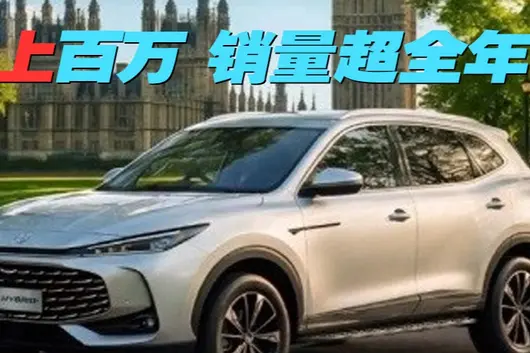

October 1, SAIC announced September sales: 406,000 units in a single month, 3.147 million units cumulative for the first three quarters, continuing to rank first in the Chinese automotive industry. This is already SAIC's third "first" of the year — in May, it became the first domestic automobile group to break through 100 million cumulative production and sales, winning the first-half sales championship with 2.045 million units in the first half of the year, and continued to lead in the first three quarters.

The timing of these results is crucial. Since 2024, China's automotive industry has entered a new cycle of adjustment: volume growth is shifting from fuel vehicles to new energy vehicles, and the focus of competition has shifted from the quantity of product launches to technology, efficiency, and business capabilities. Being able to continue leading within this cycle relies on three levels being aligned simultaneously, supporting each other, where one cannot be missing.
Innovation: Independent Brands Become the Core Engine
From January to September, SAIC's independent brands sold 2.303 million units cumulatively, a year-on-year increase of 12.6%, accounting for 73.2% of the group's total sales. According to SAIC's own statement, independent brands have become the "core engine" driving group growth.

Breaking it down by segment: SAIC Passenger Vehicles 868,000 units, up 45.6% year-on-year, SAIC Maxus 215,000 units, up 34%, SAIC-GM-Wuling 1.06 million units — there are both high-growth segments and a million-unit scale base.
Independent brands sold 304,000 units in September, achieving year-on-year growth for nine consecutive months within the year, with stable market demand release. Independent brands have become the main engine for group growth, and the first step of SAIC's "seeking innovation" is landing right here.
Advancement: Integrating High-Level Intelligence into More Price Ranges
SAIC New Energy Vehicles sold 1.388 million units cumulatively from January to September, a year-on-year increase of 28.2%, far exceeding the industry average growth rate; among them, SAIC Passenger Vehicles 415,000 units, up 170.1% year-on-year, IM Motors 60,000 units, up 40.1%.
Supporting these growth rates is a batch of high-end products launched by SAIC — technologies that previously belonged only to high-end car configurations are now brought before a wider mainstream consumer group.

Roewe Jia Yue 07 pre-sale price 137,800 - 152,800 yuan, bringing the Doubao Cockpit Assistant and Momenta high-level intelligent driving into the 150,000 yuan family SUV class, pre-sale orders broke 20,000 units in 48 hours; MG07 brought the 800V platform, 5C fast charging, and 845km range into the 150,000 yuan coupe class, with September single-month deliveries exceeding 14,000 units; The all-new generation IM LS6 comes standard with a fully-steered chameleon chassis, with new orders exceeding 11,000 units within 57 minutes of launch.

These numbers represent different stages of the new product cycle: pre-sale orders reflect purchasing intent, launch orders reflect feedback during the release period, and delivery volume is the actual realization. The MG4 family delivered over 16,000 units in September, with monthly sales breaking 10,000 for several consecutive months, verifying the continuity of deliveries.
The confidence of "high specifications at not high prices" comes from the depth of the supply chain. SAIC has an internal group parts system — Huayu makes the chassis, Yanfeng makes interior and exterior trim, Qingtao makes solid-state batteries, core modules are shared across vehicle models, predicting demand at a million-unit scale and stocking materials in advance, using scale to spread costs.
Supporting this is decades of continuous R&D investment and tens of thousands of valid patents. These investments are starting to pay off — second-generation semi-solid state batteries are in mass production delivery on the MG4, and self-developed steer-by-wire technology is in mass production installation on the IM LS9 and LS8.
Speed Up: Joint Venture New Energy Product Capabilities Fully Released
From January to September, SAIC-GM sold 94,000 new energy vehicles, up 67.4% year-on-year; SAIC-Volkswagen sold 56,000 new energy vehicles, up 25.9% year-on-year. The two sets of data indicate that the electrification pace of the joint venture segment has accelerated significantly.
The source of speed is products. SAIC Volkswagen ID.ERA 5S launched in August, rights price 89,900 - 119,900 yuan, comprehensive range broke 2000km, it is the first plug-in hybrid sedan globally equipped with city NOA capability for the Volkswagen brand; The refreshed Buick Zhijing E7 launched the same month, limited-time trade-in price starting from 147,900 yuan; Audi E7X became the first luxury brand pure electric model to sell over 10,000 units within 100 days.

The configuration lists and price lists of these cars are all defined according to the judgment standards of Chinese new energy users. The channels, after-sales, and brand awareness accumulated by joint ventures are still exerting value, while the arrival of new products gives these accumulations new starting points. Cooperation models are also being adjusted synchronously: SAIC-GM and SAIC-Volkswagen have completed contract renewals, and SAIC Audi has launched new strategic cooperation.
The growth momentum of joint venture new energy vehicles continued from the first half of the year to the first three quarters, and accelerated further.
Glocal 3.0 Strategy: Globalization Layout Deepened
From January to September, SAIC overseas markets sold 1.166 million units cumulatively, up 52.4% year-on-year, accounting for 37% of the group's total sales. Overseas markets have become an important component of SAIC's scale. What supports overseas growth is the competitiveness of the products themselves.

In July, MG held a technical conference in London, UK, showcasing three major technologies: hybrid, semi-solid state batteries, and intelligent driving; MG became the first automobile brand globally to achieve mass production of semi-solid state batteries. In August, SAIC BEV overseas sales exceeded 10,000 units, up 93.3%, PHEV exceeded 5,000 units, up 56.4%, HEV 14,000 units, up 8.5%.
The products also received certification from local professional media: MG4 EV Urban won the UK "What Car" Annual Best Pure Electric Small Car, MG HS PHEV won "Auto Express" and "What Car" Annual Best Plug-in Hybrid and Best Hybrid, MG ZS Hybrid+ won Australian and Spanish media Car of the Year awards.

Supporting these achievements is also: SAIC has built China's first, globally leading complete vehicle logistics self-owned fleet, activated the Frankfurt European Engineering Center, established localized production in Thailand, and set up direct sales companies in Belgium and Luxembourg. These layouts determine the thickness of overseas business for the next three to five years.

Besides sales, data provided in the semi-annual report: SAIC's total operating revenue in the first half of 2026 was 298.65 billion yuan, core net profit attributable to parents 7.87 billion yuan, up 72% year-on-year, gross margin 12.6%, up 3 percentage points, net operating cash flow 54.3 billion yuan, up 158%. The synchronous improvement in operating quality makes this round of growth more substantial.
Upward: Industry Investment Feeds Back into Main Business, Harvest Period Has Arrived
There is another matter in the first three quarters that is easily overlooked: SAIC's technology investments planned over many years are now entering its own product lines one by one.
The most direct is Momenta. This intelligent driving solution provider has completed Hong Kong stock listing, and the business linkage with SAIC is also landing continuously: IM L6, LS6全系 come equipped with Momenta city NOA solution, relevant models go overseas to Europe synchronously.
Such synergy is not an isolated example: SAIC industry investments have cumulatively harvested dozens of listed enterprises, among which the chips, storage, and other core components of several portfolio companies have entered the SAIC vehicle supply chain.
Aiming inward, SAIC has always regarded products as a sharp weapon for competition, and clarified that "independent brands are the first strategy", integrating SAIC Passenger Vehicles, SAIC International, R&D Center, Ling Shu Technology, etc. into a large passenger vehicle segment, ensuring product definition, R&D, production, and marketing are on the same chain.
The effectiveness of organizational synergy is becoming apparent: the response speed from product definition to launch has significantly accelerated, allowing SAIC to launch more competitive products faster.
Where There Is Persistence, There Is a Response
Single-month figures, cumulative growth rates, independent brand share, overseas market share, any one of these taken separately cannot interpret the performance SAIC has demonstrated in this past year.
A volume of millions of units, multi-brand layout, deep whole industry chain, determines that its adjustment must be overall — after the industry direction switch, growth structure, product system, and organizational methods must be recalibrated according to the same logic.
Solve the source of growth first, then solve the quality of growth, and finally solve the system efficiency — in the past year and a half, SAIC has done these three things in order: technically entering more price ranges, operationally making independent, new energy, and overseas into new growth curves, organizationally using brand integration and the large passenger vehicle segment to re-equip internal resources. These three things landing simultaneously created the performance in the first three quarters.
There are some layouts that will not be written into the sales table. At the 48th WorldSkills Competition at the end of September, SAIC employee Jiao Jiao won gold in the body repair project, and the Chinese delegation successfully defended its title. SAIC has built four major training bases, with a skilled talent team exceeding 80,000 people — manufacturing quality, delivery consistency, and after-sales response ultimately rely on this team to support.

China's automotive market is in the midst of an intelligent transformation. After the dividend of incremental growth fades, the industry is competing not just on speed — the endurance of continuous investment, the efficiency of turning technology into products, the ability to operate in multiple markets simultaneously, lacking any one of them means you won't go far.
SAIC has made up for these all at once in this round. 70 years of manufacturing accumulation, a fully independent parts system, global logistics capabilities, plus continuous R&D investment and organizational restructuring over the past decade — the leading position of 3.147 million units in the first three quarters is the manifestation of this system at the result end.
In the fourth quarter, this batch of new cars will迎来 the complete delivery season. This transformation of China's automotive market will not end soon, the ones that can cross the cycle must be companies that make up for the system and solidify it.
SAIC has already stood firm on this road.

10 月 1 日,上汽公布 9 月銷量:單月 40.6 萬輛,前三季度累計 314.7 萬輛,繼續位居中國汽車行業首位。這已經係上汽今年嘅第三個“第一”——5 月成為國內首個累計產銷突破一億輛嘅汽車集團,上半年以 204.5 萬輛拿下半程銷量冠軍,前三季度繼續領跑。
呢個成績出現嘅時點好關鍵。2024 年以來,中國汽車產業進入新一輪調整週期:增量從燃油車轉向新能源,競爭重心也從產品投放嘅數量,轉向技術、效率同經營能力。週期中仲能繼續領跑,靠嘅係三個層面同時到位,互相支撐、缺一不可。
謀新:自主品牌成為核心引擎
1-9 月,上汽自主品牌累計銷售 230.3 萬輛,同比增長 12.6%,佔集團總銷量 73.2%。上汽自己嘅表述係,自主品牌已成爲帶動集團增長嘅“核心引擎”。
分板塊看,上汽乘用車 86.8 萬輛、同比增長 45.6%,上汽大通 21.5 萬輛、增長 34%,上汽通用五菱 106 萬輛——既有高速增長嘅板塊,也有百萬輛規模嘅基本盤。
9 月自主品牌銷售 30.4 萬輛,年內連續九個月同比增長,市場需求穩定釋放。自主品牌已成爲集團增長嘅主引擎,上汽“謀新”嘅第一步,正落喺呢度。
求進:將高階智能化做入更多價格區間
上汽新能源車 1-9 月累計銷售 138.8 萬輛,同比增長 28.2%,遠超行業平均增速;其中上汽乘用車 41.5 萬輛、同比增長 170.1%,智己汽車 6 萬輛、增長 40.1%。
支撐呢組增速嘅,係上汽推出嘅一批高端產品——呢啲技術此前只屬於高端車嘅配置,而家被帶到更廣嘅主流消費用戶群面前。
榮威家越 07 預售價 13.78 萬 -15.28 萬元,將豆包車廂助手同 Momenta 高階智駕帶入 15 萬級家庭 SUV,預售 48 小時訂單突破 2 萬輛;MG07 將 800V 平台、5C 快充同 845km 續航帶入 15 萬級轎跑,9 月單月交付超 1.4 萬輛;全新一代智己 LS6 全系標配全線控靈蜥底盤,上市 57 分鐘新增訂單超 1.1 萬台。
呢啲數字處喺新品週期嘅唔同階段:預售訂單反映購買意向,上市訂單反映發佈期反饋,交付量則係真實兌現。MG4 家族 9 月交付超 1.6 萬輛,已连续多個月月銷破萬,交付嘅持續性由此得到驗證。
“高配唔抵價”嘅底氣來自供應鏈嘅縱深。上汽有集團內部嘅零部件體系——華域做底盤、延鋒做內外飾、清陶做固態電池,核心模塊跨車型共用,按百萬級體量預判需求、提前備料,用規模攤薄成本。
而支撐佢嘅係數十年持續不斷嘅研發投入、數萬項有效專利。呢啲投入已經開始兌現——第二代半固態電池喺 MG4 上量產交付,自研線控轉向技術喺智己 LS9、LS8 上量產裝車。
提速:合資新能源產品力集中釋放
1-9 月,上汽通用新能源車銷售 9.4 萬輛,同比增長 67.4%;上汽大眾新能源車 5.6 萬輛,同比增長 25.9%。兩組數據說明,合資板塊嘅電動化節奏明顯加快。
提速嘅來源係產品。8 月上市嘅上汽大眾 ID.ERA 5S,權益價 8.99 萬 -11.99 萬元,綜合續航突破 2000 公里,係大眾品牌全球首款搭載城市 NOA 能力嘅插混轎車;煥新版別克至境 E7 同月上市,限時置換價 14.79 萬元起;奧迪 E7X 成為首個百日內銷售破萬嘅豪華品牌純電車。
呢幾款車嘅配置表同價格表,都係按中國新能源用戶嘅判斷標準去定義嘅。合資積累嘅渠道、售後同品牌認知仍然發揮價值,而新產品嘅到位,令呢啲積累有新落點。合作模式都係喺同步調整:上汽通用、上汽大眾完成續約,上汽奧迪啟動新戰略合作。
合資新能源嘅增長勢頭,從上半年延續到前三季度,並且進一步提速。
Glocal 3.0 戰略:全球化佈局縱深推進
1-9 月,上汽海外市場累計銷售 116.6 萬輛,同比增長 52.4%,佔集團總銷量嘅 37%。海外市場,已經成為上汽規模嘅重要組成部分。而支撐海外增長嘅,係產品本身嘅競爭力。
7 月,MG 喺英國倫敦舉辦技術大會,展示混動、半固態電池同智能行車三大技術;MG 成為全球首個實現半固態電池量產嘅汽車品牌。8 月,上汽 BEV 海外銷量超 1 萬輛、增長 93.3%,PHEV 超 5000 輛、增長 56.4%,HEV1.4 萬輛、增長 8.5%。
產品亦獲咗當地專業媒體嘅認證:MG4 EV Urban 獲英國《What Car》年度最佳純電小型車,MG HS PHEV 獲《Auto Express》《What Car》年度最佳插混同最佳混動,MG ZS Hybrid+ 獲澳大利亞、西班牙媒體年度車獎項。
支撐呢啲成績背後仲有:上汽建成咗中國第一、全球領先嘅整車物流自營船隊,啟用法蘭克福歐洲工程中心,泰國落地本地化生產,比利時、盧森堡成立直屬銷售公司。呢啲佈局,決定咗海外業務未來三五年嘅厚度。
銷量之外,半年報提供嘅數據:2026 年上半年上汽營業總收入 2986.5 億元,核心股東應佔利潤 78.7 億元、同比增長 72%,毛利率 12.6%、提升 3 個百分點,經營現金流淨額 543 億元、增長 158%。經營質量嘅同步改善,令呢一輪增長更有分量。
向上:產業投資反哺主業,收穫期已至
前三季度仲有一件容易被忽略嘅事:上汽佈局多年嘅技術投資,正係一批批進入自己產品線。
最直接係 Momenta。呢間智駕方案商已完成港股上市,同上汽嘅業務聯動亦持續落地:智己 L6、LS6 全系搭載 Momenta 城市 NOA 方案,相關車型同步出海歐洲。
呢樣協同唔止一個例:上汽產業投資已累計收穫幾十間上市公司,其中多家被投企業嘅晶片、存儲等核心組件,已經進入上汽車型嘅供應鏈。
目標向內,上汽始終將產品視為競爭利器,並明確“自主品牌係第一戰略”,將上汽乘用車、上汽國際、研發總院、零束科技等整合成為大乘用車板塊,令產品定義、研發、生產、營銷處於同一條鏈上。
組織協同嘅成效正逐漸顯現:新品從定義到上市嘅反應速度明顯加快,上汽得以更快推出更有競爭力嘅產品。
念念不忘,必有回響
單月數字、累計增速、自主佔比、海外份額,任何一項單獨拎出嚟睇,都唔詮釋得咗上汽呢一年多展現嘅成績。
百萬輛級嘅體量、多品牌嘅佈局、全產業鏈嘅縱深,決定咗佢嘅調整必然係整體性嘅——產業方向切換之後,增長結構、產品體系同組織方式,要按同一套邏輯重新校準。
先解決增長來源,再解決增長質量,最後解決體系效率——過去一年多,上汽將呢三件事依次做咗一次:技術上進入更多價格區間,經營上將自主、新能源、海外打造成新嘅增長曲線,組織上用品牌整合同大乘用車板塊將內部資源重新配齊。呢三件事同時落地,先有咗前三季度呢份成績。
仲有啲佈局唔會寫入銷量表。9 月底嘅第 48 屆世界技能大賽上,上汽員工焦嬌喺車身修理項目摘金,中國代表團成功衛冕。上汽已建成四大實訓基地,技能人才隊伍超過 8 萬人——製造質量、交付一致性同售後響應,最終都要靠呢支隊伍撐住嚟。
中國汽車市場正處於一場智能化變局之中。增量紅利退去之後,行業比嘅已經唔只係速度——持續投入嘅耐力、將技術變做產品嘅效率、喺多個市場同時經營嘅能力,缺一樣都走唔遠。
上汽喺呢一輪度將呢幾樣同時補齊。70 年製造積澱、全自主零部件體系、全球物流能力,加上近十年持續不斷嘅研發投入同組織重構——前三季度 314.7 萬輛嘅領跑,係呢套體系喺結果端嘅顯現。
四季度,呢批新車將要迎嚟完整交付季。中國汽車市場嘅呢場變局唔快會結束,能穿越週期嘅,一定係將體系補齊並夯實嘅企業。
上汽已經站穩喺呢條路上。

Following the launch of the MG4 and a breakthrough of 200,000 units rolled out in just one year, on September 28, MG officially launched the MG4 530th Anniversary Limited Edition with a limited-time subsidized price of 84,800 yuan. The vehicle is equipped with CATL batteries, CLTC combined range of 530 kilometers, becoming the most affordable 500km+ CATL large two-door hatchback; equipped with seat massage, rear privacy glass, VMC high-speed run-flat tire stability system and other configurations, it boasts the highest 120kW power in its class, class-leading seating and storage space, bringing the optimal solution balancing long range and high value to the 80,000 yuan level pure electric two-door market. Place an order effective immediately, consumers can enjoy the easy financial gift of 50,000 yuan loan 24-month 0 interest, the zero spontaneous combustion safety core gift of new car compensation for battery spontaneous combustion, and gifts such as lifelong warranty for three-electric systems + 6-year or 150,000 km whole vehicle warranty, and can also receive a first-anniversary limited kit including MOLI customized lumbar support, shoulder pads, etc., adding exclusive companionship to daily travel.

MG4 530th Anniversary Limited Edition Limited-Time Subsidized Price 84,800 Yuan
Since its launch, the MG4 has consistently broken 10,000 monthly sales due to class-leading configurations such as integrated thermal management, CTB battery-body integration, hybrid solid-liquid batteries, and continuous evolution through feedback-driven upgrades, often topping the compact car monthly sales list, becoming a phenomenal product with excellent sales and reputation in the pure electric two-door market. To meet consumers' dual requirements for long range and quality travel, MG launched the 530th Anniversary Limited Edition at the one-year anniversary of the MG4 launch and the 200,000 units rolled out milestone, bringing 500km-level range and CATL batteries to the 80,000 yuan tier, lowering the purchase threshold for long range and big-brand batteries, expected to become a highly competitive long-range version model in this price segment.

In addition to long range and CATL batteries, the MG4 530th Anniversary Limited Edition also leads its peers in dimensions such as space, power, and smart comfort configurations. In terms of space, the interior space utilization rate reaches up to 93.8%, the body is longer and wider, rear row horizontal space rivals mainstream B-class cars, and is equipped with the class-unique 3-layer 3D trunk and 98L ultra-large sunken storage space, meeting multiple usage needs for daily commuting, family travel, and cargo loading. In terms of power, it comes standard with a 120kW high-performance motor across the series, power output far exceeds other models in the same price range, acceleration is light and quick, powerful, driving control is more fun. In terms of configuration, seats integrate heating, ventilation, 8-point massage, and memory adjustment functions, rear privacy glass, 256-color ambient lighting, and VMC high-speed run-flat tire stability system balance comfort, privacy, and safety, refreshing the configuration standards of 80,000 yuan home-use pure electric vehicles.

MG4 530th Anniversary Limited Edition Space and Power Lead Class
As the opening act of MG brand's new energy transformation, the MG4 has not only cultivated the domestic market but also embarked on a global journey, showcasing China's new energy technological strength to the world. Currently, the MG4 has landed in the UK, Australia, Israel, Thailand, Indonesia, Chile and other global countries and regions, won the number one sales in European compact pure electric cars multiple times, and obtained the European E-NCAP, Australian ANCAP dual five-star safety ratings, winning widespread recognition from overseas users with global quality.

Coinciding with MG's Double Festival Shopping Festival event, the MG4 price dropped up to 7,000 yuan, limited-time subsidized price starting from 65,800 yuan, enjoy 50,000 yuan 2-year interest-free, lifetime free basic maintenance, and up to 5,000 yuan limited-time free options selection and other benefits. From effective today until October 7, consumers who visit the store to test drive MG4 and other models have the chance to draw Guerlain collaborative gift boxes, OPPO Watch and other good gifts. As the MG4 530th Anniversary Limited Edition is delivered to stores successively, and the global market continues to expand, the MG4 is expected to activate a larger market incremental space, continuously leading the pure electric two-door market into a new era of high value and high quality.
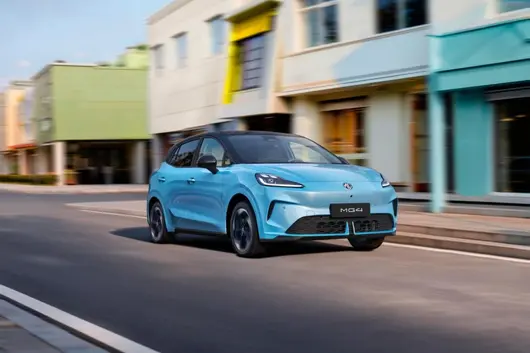

自 MG4 上市短短一年整車下線突破 20 萬輛之後,9 月 28 日,MG 正式推出 MG4 530 週年限量版,限時補貼價 8.48 萬元。該車搭載寧德時代電池,CLTC 綜合續航 530 公里,成為最平嘅 500 公里 + 寧德時代大兩廂;配備座椅按摩、後排隱私玻璃、VMC 高速防爆胎穩定系統等配置,擁有同級最大嘅 120kW 功率、越級嘅乘坐和儲物空間,為 8 萬級純電兩廂市場帶來兼顧長續航和高價值嘅最優解。即日起下定,消費者可享貸款 5 萬 24 期 0 利息嘅輕鬆金融禮、電池自燃賠償新車嘅零自燃安芯禮以及三電終身質保 +6 年或 15 萬公里整車質保等好禮,還可贈送 MOLI 定制腰靠、護肩帶等一週年限量套件,為日常出行增添專屬陪伴。
MG4 530 週年限量版限時補貼價 8.48 萬
自上市以來,MG4 憑藉一體式熱管理、CTB 電池車身一體化、混合固液電池等一系列越級配置,以及「聽勸式升級」嘅持續進化,月銷持續破萬,多次登上緊湊型車月銷榜榜首,成為純電兩廂市場銷量同口碑雙優嘅現象級產品。為滿足消費者對長續航同品質出行嘅雙重要求,MG 在 MG4 上市一週年、20 萬輛整車下線之際推出 530 週年限量版,將 500 公里級續航同寧德時代電池帶入 8 萬級,降低長續航同大牌電池嘅購車門檻,有望成為該價位段極具競爭力嘅長續航版本車型。
除長續航同寧德時代電池外,MG4 530 週年限量版在空間、動力、智能舒適配置等維度亦領先同級。空間上,整車得房率高達 93.8%,車身更長、更寬,後排橫向空間媲美主流 B 級車,並配備同級唯一 3 層立體後備廂同 98L 超大下沉儲物空間,滿足日常通勤、家庭出行同儲物裝載等多重使用需求。動力方面,全系標準 120kW 高性能電機,動力輸送遠超同價位其他車型,提速輕快、加速有勁,駕控更有樂趣。配置方面,座椅集成加熱、通風、8 點按摩、記憶調節功能,後排隱私玻璃、256 色氛圍燈與 VMC 高速防爆胎穩定系統兼顧舒適、私密同安全,刷新 8 萬級家用純電車嘅配置標準。
MG4 530 週年限量版空間動力領先一級
作為 MG 品牌新能源轉型嘅開篇之作,MG4 唔單止深耕國內市場,亦開啟咗全球化征程,向全世界展現中國新能源嘅技術實力。目前,MG4 已登陸英國、澳洲、以色列、泰國、印尼、智利等全球多個國家同地區,多次斬獲歐洲緊湊型純電車銷量第一,並拿下歐洲 E-NCAP、澳洲 ANCAP 雙五星安全評級,以全球品質贏得海外用戶廣泛認可。
適逢 MG「雙節狂歡購」活動,MG4 至高直降 7000 元,限時補貼價 6.58 萬元起,可享 5 萬 2 年免息、終身免費基礎保養以及至高 5000 元限時免費選裝等福利。即日起到 10 月 7 日,消費者到店試駕 MG4 等車型,仲有機會抽取嬌蘭聯名禮盒、OPPO Watch 等好禮。隨著 MG4 530 週年限量版陸續到店交付,以及全球市場持續拓展,MG4 有望激活更大嘅市場增量空間,持續引領純電兩廂市場邁入高價值、高品質嘅新時代。
Since 2026, the Chinese automotive market has seen a dense launch of new vehicles, with hundreds of new models flooding in, drastically expanding consumer choice. However, as more new models emerge, the industry needs to answer a core question: after the initial launch buzz fades, can sales sustain? Compared to short-term explosions, sustained high sales are becoming a more important benchmark for product quality.

Under this benchmark, SAIC's MG4, MG 07, Shangjie Z7/Z7T, Huajing S and other intelligent new energy products have seen hot sales spanning launch and steady periods, forming more valuable hit samples: MG4 sold 150,000 units in the first year after launch, achieving steady monthly sales exceeding 10,000 for 11 consecutive months; MG 07 locked 42,000 orders in 20 days after launch; Shangjie Z7/Z7T delivered over 20,000 units in two months, topping the reputation of mid-to-large pure electric coupes with top Net Promoter Score (NPS); Huajing S had monthly sales increase for four consecutive months, with cumulative delivery of 25,000 units, ranking first tier in NPS for new energy SUVs within 250,000 yuan.
These products belong to different brands, categories, and price points, yet share the same methodology: demand-oriented, seeking blue oceans in the red ocean. Breaking it down, this methodology has one premise and three pillars—the premise is mastering core technologies, the pillars are Parts and Assembly Integration, Scaling, and Internationalization.
Core Technology: The Premise of Accurately Understanding User Needs
The underlying logic of tech inclusivity is to make leading technology available to a wider audience at a more sincere price.
SAIC's confidence comes from nearly 190 billion yuan of R&D investment and over 24,000 valid patents in electrification and intelligence over the past decade. This formed a technical foundation of "Smart Brain, Robust Body, Powerful Heart", with a batch of core technologies gradually commercialized, building a solid moat: Semi-solid-state batteries achieved mass production and vehicle integration first, DMH hybrid thermal efficiency reached 46.3%, wire-controlled chassis saw mass production application first, and it holds passenger/commercial vehicle
L4 dual licenses.

Thanks to these reserves, inclusivity is not a slogan, but a list of items that can be redeemed: 60,000-level Roewe i6 standard equipped with 8155 chip and DouBao Large Model; 90,000-level MG4X fully standard equipped with semi-solid-state batteries and rear-drive five-link suspension; 150,000-level market MG 07 brings 800V high-voltage platform, 5C supercharging, 845km range and Momenta R7 advanced intelligent driving into the mix; Jiayue 07 brings AI-native cockpits into the mainstream family SUV market; 200,000-level market, new generation IM L6 standard equipped with SAIC new generation NEO three-electric architecture, full wire-controlled chassis, IM Claw Lobster Intelligent Agent, allowing users to enjoy next-gen tech for the next three years first; Shangjie Z7/Z7T series standard equipped with Huawei Qiankun Intelligent Driving and 896-line LiDAR, bringing "entry-level full-spec" intelligent travel experience to users.

Precise understanding of user needs and usage scenarios is the premise for tech inclusivity and precise product definition. Taking Shangjie Z7/Z7T as an example, according to the first batch of user surveys by Jielan Road, Shangjie Z7 series owners show a younger, highly educated characteristic, mainly urban young users, with female users accounting for 42.3%, far higher than the industry average. Among them, Z7 attracts younger unmarried female users more, being urban players who like fitness, parties, and urban socializing; Z7T is more favored by urban high-knowledge families, owners are keen on traveling, camping, fishing and climbing, shooting brake styling, large space and car fridge therefore accommodate a larger travel radius. Huajing S then understood another group: nearly nine out of ten first batch of owners are families with children, six out of ten come from joint venture replacement, they need not fresh gimmicks, but large six-seat space, full-series Huawei Qiankun Intelligent Driving and "Certainty" within budget. Product definition precision determines sales duration.
Parts and Assembly Integration: Realizing User Needs through Industry Chain Collaboration
After precise insight into needs, how to realize at scale quickly? SAIC's answer is the vertically integrated full industry chain system established over more than 70 years.
Relying on industry-leading parts companies within the system such as Huayu, Yanfeng, Qingtao, SAIC Passenger Vehicles and Parts System established a Parts and Assembly integration relationship with pre-binding and joint development. Suppliers are deeply bound in the early project stage, jointly defining products and user needs, jointly assessing competitiveness, jointly optimizing design and cost. This is the first cornerstone of SAIC's hit methodology and also the advantage of traditional automakers that is hardest to be replicated by new forces.

Collaboration radius also extends outward. Cooperation with Huawei made Qiankun Intelligent Driving and Harmony Cockpit standard equipment for all Shangjie and Huajing S models; Cooperation with Momenta is deeper, forming cross-shareholding and strategic embedding: SAIC is Momenta's largest institutional shareholder, Momenta cross-shareholds IM, data, scenarios and R&D rhythm kept in sync. More importantly, Momenta advanced intelligent driving solution has landed on Roewe, MG, Volkswagen, AUDI, Buick, Cadillac and other independent and joint venture brands, forming cross-brand, cross-system scaled application. For SAIC system brands, this collaboration can accelerate intelligent technology mass production landing and form differentiated market competition advantage; For Momenta, the solution applied on multiple vehicle models can rapidly amplify scale, accelerate data closed loop, promote technology iteration, build technology moat, and improve revenue and profit levels, thereby forming a virtuous positive cycle. This "Capital + Industry + Data" mutual rush guarantees the most advanced driving models land on SAIC products first time in mass production.
The essence of Parts and Assembly Integration is to make the entire industry chain a demand translator: a user's complaint can be converted into the next OTA upgrade in the shortest path, or a standard spec on the next generation product.
Scaling: Making Tech Equity a Sustainable Business
Making high-spec into standard spec, the most easily attracting doubt lies in whether profit can keep up.

SAIC's solution is to make predictions at the million-level volume, let core modules be shared across models, use scale to dilute R&D and manufacturing costs, achieve high-spec price without removing specs. The same Momenta intelligent driving model, from IM to MG, Roewe, to Buick Zhijing, Volkswagen ID.ERA, Audi, as scale expands, cost amortization gets lower; The same semi-solid-state battery technology, from domestic MG4 family spread to overseas hybrid models, scale effect makes frontier technology quickly mass production application.
User reputation proves, business model established and healthy: 85% users chose Huajing S high-spec version, truly not low price that makes users pay, but value; Its new car NPS reached 86 points, reputation spread became the core driving sales four consecutive months increase. More importantly, tech inclusivity did not come at the cost of sacrificing business quality.

First half year, SAIC core net profit attributable to parent company increased by 72% YoY, gross margin improved 3 percentage points, operating cash flow net amount increased 158% dramatically. In the background of industry competition intensifying and domestic demand under pressure, this group of core business indicators outlines a steady and resilient enterprise. While high-spec becomes standard spec, SAIC business basic platform is also solid. This is an insurance given to tech equity by scaling: tech inclusivity is not a one-time price concession, but a sustainable business model.
Internationalization: Verifying and Feeding Back Product Iteration in Global Markets
Blue oceans not only domestic, SAIC also found breakthrough in overseas.
MG retained the China brand Europe sales champion for 11 consecutive years, Europe cumulative delivery exceeded 1 million vehicles; Jan-Aug SAIC overseas sales 1.016 million vehicles, YoY surged 52.9%. More important than numbers is the posture change: July, MG took Tech Conference to brand origin London, took concept cars to Goodwood Speed Festival, upgraded from selling cars overseas to "Walk in" of technology, capacity, service ecosystem, from product output upgraded to standard output.

1 million vehicle overseas scale, competing is no longer whether a single car can sell, but whether a system can run long-term. SAIC for this paved system network: Anji Logistics 42 self-operated RoRo ships, 8 international routes, Ocean year transport capacity 600,000 vehicles, hold transport power initiative in own hands; Thailand, Indonesia, India three vehicle manufacturing bases and Pakistan KD factory, plus Frankfurt Europe Engineering Center, three overseas R&D centers and three design centers, let R&D manufacturing capability close to local market; 3000+ overseas marketing service outlets and Indonesia financial service company, let sales, after-sales, finance land together. From selling to global to operating global, rely on this system behind support running.

Products to truly take root in local market, cannot do without local adaptation and development. SAIC for India market develop local voice assistant, for Brazil version MG ZS EV tropical climate specially optimize battery thermal management system. These details behind, is R&D system and market between distance shortened, also "Global + Local" Glocal 3.0 strategy most concrete appearance. Currently, SAIC formed Europe one 300,000 vehicle level and Americas, Middle East, Aus/NZ, ASEAN, South Asia five 50,000 vehicle level regional markets, products and services spread in 170+ countries and regions.
Internationalization to hit methodology feedback hidden and key: Global 170+ countries and regions complex road conditions, strict regulations and differentiated user needs, constitute strictest product verification field; Overseas cumulative sales exceeded 7 million vehicle user base, again for product definition provide larger sample demand insight. One car that can stand in European street, participate domestic market competition, naturally get extra calm.
From Understanding Cars to Understanding You: Redefining Value Standards
Looking back "SAIC Hit Methodology", logic closed loop clear: Frontier technology makes inclusivity possible, Parts-Assembly Integration makes needs land quickly, Scaling makes "Good quality and good price" sustainable, Internationalization makes products accept test in larger coordinate system, and all this starting point, is precise insight into user needs.
Past, automotive industry competition core is "Understand Car", make power, chassis, safety do to extreme; Today, decisive key is "Understand You better", make every frontier technology land as user perceivable good travel. Current frontier technology no longer just exclusive to million luxury cars, segmented market value standards are being redefined.

If shift gaze from one enterprise business performance to China Auto Industry overall leap, tech equity meaning truly appears. This May, SAIC became China's first cumulative production/sales exceeded 100 million vehicle auto group. 100 million vehicles behind, is 100 million real users to good travel longing and choice. SAIC through tech inclusivity answered a era proposition: Tech progress dividend, should belong to minority, or belong to more broad mainstream group? China Auto Industry used decades to walk from make car to make good car's road, now is answering third question—make good car everyone can enjoy affordably.
From Santana era market for technology, to take Tech Conference back to century-old auto brand origin, to today take semi-solid-state battery, wire-controlled chassis, advanced intelligent driving make mainstream market standard spec, China Auto role from technology follower became standard definers, with tech inclusivity reshape global competition pattern, just SAIC represented China brand's era mission and responsibility.
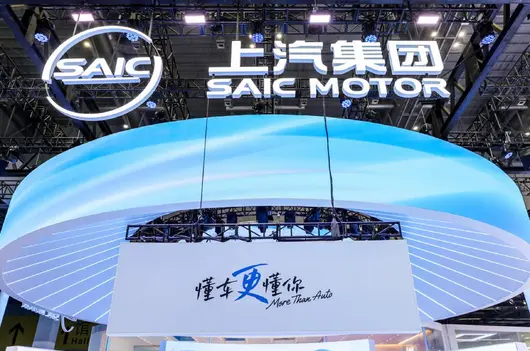

2026 年以來,中國車市新品投放密集,數百款新品湧入,消費者選擇空間空前擴大。但新品越多,行業越需要回答一個核心問題:上市期熱度退去後,銷量能否延續?較短期爆發,持續熱銷正成為衡量產品成色嘅更重要標尺。
喺呢個標尺下,上汽旗下 MG4、MG 07、尚界 Z7/Z7T、華境 S 等多款智電新品嘅熱銷跨越上市期與平銷期,構成更具含金量嘅爆款樣本:MG4 上市一年熱銷 15 萬輛,連續 11 個月月銷穩態破萬;MG 07 上市 20 天鎖單 4.2 萬台;尚界 Z7/Z7T 上市兩個月交付破 2 萬,用戶淨推薦值(NPS)登頂中大型純電轎跑口碑榜首;華境 S 月銷四連增,累計交付 2.5 萬台,NPS 位居 25 萬以內新能源 SUV 第一梯隊。
這些產品分屬不同品牌、不同品類、不同價位,卻共享同一套方法論:以用戶需求為導向,喺紅海中尋找藍海。拆解來看,呢套方法論有一個前提與三個支點——前提係掌握核心技術,支點係整零協同、規模化與國際化。
核心技術:精準洞察用戶需求嘅前提
科技普惠嘅底層邏輯,係讓領先技術以更具誠意嘅價格惠及更廣泛用戶。
上汽嘅底氣,來自近十年喺電動化、智能化領域近 1900 億元研發投入和超過 24000 項有效專利。由此形成“智慧腦、健壯身、強勁心”嘅技術底座,一批核心技術陸續量產落地,構筑起堅實嘅護城河:半固態電池率先實現量產裝車,DMH 混動熱效率達 46.3%,線控底盤首批量產應用,並持有乘用車/商用車
L4 雙牌照。
正因為有呢些儲備,普惠才唔係口號,而係一份可逐條兌現嘅清單:6 萬級榮威 i6 標配 8155 芯片和豆包大模型;9 萬級 MG4X 全系標配半固態電池和後驅五連桿;15 萬級市場 MG 07 將 800V 高壓平台、5C 超充、845km 續航和 Momenta R7 高級智駕一並帶入,家越 07 把 AI 原生座艙送進主流家庭 SUV 市場;20 萬級市場,全新一代智己 L6 標配上汽新一代 NEO 三電架構、全線控底盤、IM Claw 龍蝦智能體,让用户先享未來三年嘅下一代科技;尚界 Z7/Z7T 系列則標配華為乾崑智駕和 896 線激光雷達,為用戶帶來“入門即滿配”嘅智能出行體驗。
對用戶需求與使用場景嘅精準洞察,則係技術普惠與精準產品定義嘅前提。以尚界 Z7/Z7T 為例,據傑蘭路首批用戶調研顯示,尚界 Z7 系列車主呈現年輕化、高學歷特徵,以都市年輕用戶為主,女性用戶占比達 42.3%,遠高於行業平均。其中,Z7 更吸引年輕未婚女性用戶,係喜歡健身、聚會、城市社交嘅都市玩家;Z7T 更受都市高知家庭青睞,車主熱衷旅行、露營、釣魚爬山,獵裝造型、大空間和車載冰箱因此接住更大嘅出行半徑。華境 S 則讀懂咗另一群人:首批車主中近九成係有娃家庭,六成來自合資置換,佢哋需要的唔係新鮮噱頭,而是大六座空間、全系華為乾崑智駕和喺預算範圍內嘅“確定性”。產品定義精度,決定熱銷長度。
整零協同:以產業鏈協同兌現用戶需求
精準洞察需求之後,如何快速規模化兌現?上汽嘅答案係七十年建立嘅全產業鏈垂直整合體系。
依托華域、延鋒、清陶等體系內行業領先嘅零部件企業,從底盤、內外飾到三電,上汽乘用車與零部件體系建立前置綁定、聯合開發嘅整零協同關係。供應商喺項目前期深度綁定,共同定義產品和用戶需求,共同評估競爭力,共同優化設計和成本。這係上汽爆款方法論嘅第一塊基石,亦係傳統車企最難被新勢力複製嘅優勢。
協同半徑亦向外延伸。與華為合作,使乾崑智駕和鴻蒙座艙成為尚界、華境 S 全系標配;與 Momenta 嘅合作則更深入,形成雙向持股、戰略互嵌:上汽係 Momenta 第一大機構股東,Momenta 反向持股智己,數據、場景與研發節奏保持同頻。更重要係,Momenta 高級智駕方案已落地上榮威、MG、大衆、AUDI、別克、凱迪拉克等自主及合資品牌,形成跨品牌、跨體系嘅規模化應用。對上汽體系品牌而言,呢一協同能夠加快智能化技術量產落地,形成差異化市場競爭優勢;對 Momenta 而言,方案喺多款車型上應用,可迅速放大規模,加快數據閉環,促進技術迭代,構建技術護城河,並提升營收與盈利水平,從而形成良性正向循環。這種“資本 + 產業 + 數據”嘅雙向奔赴,保證最前沿智駕模型第一時間喺上汽產品上量產落地。
整零協同嘅本質,係讓整個產業鏈成為需求翻譯器:用戶嘅一句抱怨,能以最短路徑轉化為下一次 OTA 升級,或下一代產品上嘅一項標配。
規模化:讓科技平權成為可持續嘅生意
將高配做成標配,最易招致質疑之處喺喺盈利能否跟上。
上汽嘅解法係按百萬級體量做預判,讓核心模塊跨車型共用,用規模攤薄研發和製造成本,做到高配平價唔減配。同一套 Momenta 智駕模型,從智己到 MG、榮威,再到別克至境、大衆 ID.ERA、奧迪,隨著規模擴大,成本攤銷越低;同一項半固態電池技術,從國內 MG4 家族鋪到海外混動車型,規模效應讓前沿技術快速量產應用。
用戶口碑證明,業務模式成立且健康:85% 用戶選擇華境 S 高配版本,真正讓用戶買單嘅唔係低價,而係價值;其新車 NPS 達到 86 分,口碑傳播成為驅動銷量四連增嘅核心。更關鍵係,科技普惠並未以犧牲經營質量為代價。
上半年,上汽核心歸屬凈利潤同比增長 72%,毛利率提升 3 個百分點,經營性現金流淨額大增 158%。喺行業競爭加劇、國內需求承壓背景下,呢組核心經營指標勾勒出一家穩健而有韌性嘅企業。高配變標配嘅同時,上汽經營基本盤同樣紮實。這係規模化給技術平權上嘅一道保險:科技普惠並非一次性嘅價格讓利,而係一種可持續嘅經營模式。
國際化:喺全球市場驗證並反哺產品迭代
藍海唔止於國內,上汽喺海外亦找到突破口。
MG 連續 11 年蟬聯中國品牌歐洲銷量冠軍,歐洲累計交付突破百萬輛;1-8 月上汽海外銷售 101.6 萬輛,同比大漲 52.9%。比數字更重要係姿態變化:7 月,MG 將技術大會開到品牌發源地倫敦,將概念車帶上古德伍德速度節,從賣車出海升級為技術、產能、服務生態嘅“走進去”,從產品輸出升級為標準輸出。
百萬輛級海外規模,比拼嘅早已唔係某一款車能否賣動,而係一套體系能否長期運轉。上汽為此鋪設體系化網絡:安吉物流 42 艘自營滾裝船、8 條國際航線,遠洋年運能 60 萬輛,將運力主動權握喺自己手中;泰國、印尼、印度三大整車製造基地同巴基斯坦 KD 工廠,加上法蘭克福歐洲工程中心、三大海外研發中心同三大設計中心,讓研發製造能力貼近當地市場;3000 多個海外營銷服務網點同印尼金融服務公司,將銷售、售後、金融一並落地。從賣到全球到經營全球,靠嘅正係呢套體系喺背後支撐運轉。
產品要真正扎根當地市場,離唔開本地化嘅適配與開發。上汽針對印度市場開發本地語音助手,為巴西版 MG ZS EV 熱帶氣候專門優化電池熱管理系統。呢些細節背後,係研發體系同市場之間距離嘅縮短,亦係“全球 + 本土”Glocal 3.0 戰略最具體嘅模樣。目前,上汽已形成歐洲一個 30 萬輛級同美洲、中東、澳新、東盟、南亞五個 5 萬輛級區域市場,產品同服務遍布 170 多個國家同地區。
國際化對爆款方法論嘅反哺隱蔽而關鍵:全球 170 多個國家同地區嘅複雜路況、嚴苛法規同差異化用戶需求,構成最嚴苛嘅產品驗證場;海外累計銷量突破 700 萬輛嘅用戶基盤,又為產品定義提供更大樣本嘅需求洞察。一台喺歐洲街頭立足嘅車,參與國內市場競爭,天然多一分從容。
由懂車到懂你:重新定義價值標準
回看“上汽爆款方法論”,邏輯閉環清晰:前沿技術讓普惠成為可能,整零協同讓需求快速落地,規模化讓“物美價優”可持續,國際化讓產品喺更大坐標系入面接受檢驗,而呢一切嘅起點,係對用戶需求嘅精準洞察。
過去,汽車行業競爭核心係“懂車”,把動力、底盤、安全做到極致;今日,決勝關鍵則係“更懂你”,讓每一項前沿科技落地為用戶可感知嘅美好出行。當前沿科技唔再只係百萬豪車嘅專屬,細分市場嘅價值標準正在被重新定義。
若將視線從一家企業嘅經營表現投向中國汽車工業嘅整體躍遷,技術平權嘅意義得以真正顯現。今年 5 月,上汽成為中國首個累計產銷突破一億輛嘅汽車集團。一億輛背後,係一億位真實用戶對美好出行嘅嚮往同選擇。上汽通過科技普惠回答咗一個時代命題:技術進步嘅紅利,應該屬於少數人,定係屬於更廣泛嘅主流群體?中國汽車工業用幾十年走完從造出車到造好車嘅路,如今正喺回答第三個問題——造人人都享受得起嘅好車。
從桑塔納時代嘅市場換技術,到把技術大會開回百年汽車品牌發源地,再到今天把半固態電池、線控底盤、高級智駕做成主流市場標配,中國汽車嘅角色已從技術追隨者變為標準定義者,以技術普惠重塑全球競爭格局,正係以上汽為代表嘅中國品牌嘅時代使命與擔當。
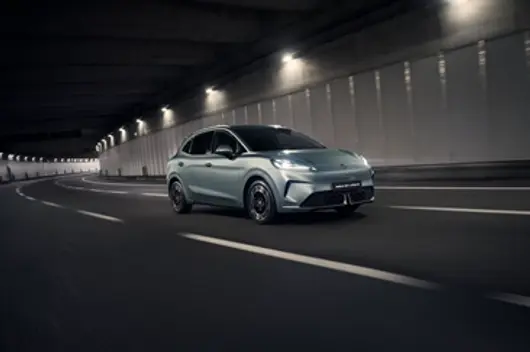
(2026年9月15日,上海)继7月海外市场销量实现同比高速增长之后,上汽集团8月再次交出亮眼成绩单,单月海外市场销售13.9万辆,同比增长57.7%;1-8月累计销售101.6万辆,同比增长52.9%,稳居中国车企出海头部阵营。
随着海外市场累计销量突破700万辆、欧洲市场累计交付达成百万台规模,上汽全球化布局迎来全新发展阶段。企业加速从“产品输出”向“体系出海”、从“规模增长”向“品牌扎根”迭代升级,全面开启以体系能力为核心的高质量出海新征程。

欧洲市场持续领跑 MG品牌跻身多国主流阵营
作为中国品牌欧洲销量冠军,MG持续深耕欧洲市场,销量节节攀升。今年1-8月,MG品牌在欧洲累计销售24.1万辆,同比增长22.3%。MG在欧洲多国市场实现“多点开花”。在法国,MG跻身品牌销量TOP10;在爱尔兰,MG位列纯电细分市场第四,新车注册量同比增长278%,市场份额升至3.5%;在意大利,MG累计用户突破15万,成为继英国之后第二个15万+核心市场;在希腊,MG上半年零售销量位列第四;在比利时,MG稳居汽车品牌销量前十。

海外市场的强劲增长,得益于上汽在智电技术领域的持续深耕。7月,MG HEV混动车型海外销量超过1.7万辆,同比增长40%;BEV纯电车型海外销量超过1万辆,同比增长64%。与此同时,MG品牌的产品硬核实力也收获国际专业媒体的高度认可。在英国权威汽车媒体《What Car?》的年度评选中,MG一举斩获三项大奖,覆盖多个细分市场:MG4 EV Urban获评最佳纯电小型车,MG HS PHEV获评最佳混动车型,MG S9 PHEV获评最佳混动七座SUV,实现销量与口碑双丰收。

在品牌销量稳步向上的基础上,MG也在欧洲探索品牌文化的深度融入。近日,布鲁塞尔中国文化中心举办非遗农民画展,以上海本土非遗金山农民画为载体打造的MG S6艺术定制车在现场亮相,实现中式美学与欧洲城市文明的跨界对话。这场创意展示搭建起中外文化交流桥梁,收获广泛关注,也是上汽“Glocal战略”的具象化落地。
上汽商用车强势出击 全产品矩阵亮相汉诺威车展
乘用车海外市场捷报频传的同时,上汽商用车在海外市场的表现同样亮眼:8月海外销售1.3万辆,同比增长121%,其中新能源车销量同比增长27%。在波兰市场,上汽大通市占率稳居中国品牌首位;在智利市场,大通T70预售订单火爆;在新加坡市场,轻客产品夺得细分市场销量冠军;在香港市场,大通 MIFA 7同样领跑当地MPV市场。依托长期深耕,上汽商用车稳居欧洲轻型商用车市场中国品牌出口第一,以可靠品质赢得广大欧洲客户的信赖。
近期,上汽商用车携中国车企最全商用车产品矩阵亮相2026汉诺威国际交通运输展,参展阵容覆盖皮卡、轻客、轻卡、重卡、无人驾驶物流车等产品,横跨多能源技术路线,向欧洲输出中国商用车成套解决方案。其中,“全球超高性能大皮卡”全新星际L皮卡正式登陆欧洲市场;40吨级纯电重卡在本届汉诺威车展全球首发,为欧洲大吨位货运市场带来全新可能性;无人车RoboVAN智能物流车也同步登场,展现上汽商用车在智能驾驶领域的前瞻探索。

体系能力持续夯实 Glocal战略驱动全球经营
从产品出海到体系出海,上汽已建立起涵盖研发制造、销售服务、金融、物流的全球化经营体系。研发制造方面,上汽在全球布局三大创新研发中心,落地泰国、印尼、印度三大整车制造基地以及百余家零部件配套基地。今年,德国法兰克福欧洲工程中心正式启用,欧洲生产基地建设、中亚本地化生产同步启动,并针对不同区域市场完成产品本地化适配。销售服务方面,上汽拥有超过3000个海外营销服务网点,业务覆盖170多个国家和地区,并在印尼设立海外金融服务公司。同时,上汽安吉物流拥有42艘自营滚装船,自营远洋船队年运能突破60万辆,航线覆盖全球主要市场,为“国车国运”提供坚实运力保障。

从“走出去”到“走进去”,上汽正加速推进“Glocal”海外战略,将全球视野与本地化运营深度融合。持续完善的产品布局与高效运转的全球体系协同共振,让中国智造的品牌形象在世界舞台熠熠生辉。

The three-year price war in the domestic car market has finally reached Ro-Ro vessels.
On September 1, the Ministry of Commerce, Ministry of Industry and Information Technology, and State Administration for Market Regulation jointly issued the "Guidelines on Overseas Competition Behavior and Compliance Construction for the Automobile Industry" for enterprises to reference. The "Guidelines" consist of four chapters and twenty articles, mainly including regulating overseas market competition behavior and improving overseas localized compliance operation capabilities.
Most notably, the three departments specifically reminded car manufacturers: Overseas pricing should be based on cost and market supply and demand, with clear price tiers set to avoid frequent and significant price adjustments.
To put it plainly: Car prices can drop, but avoid promotions in the morning and compensation in the afternoon, then lowering prices again after a few days under a different excuse. Chinese cars can compete overseas, but they cannot turn overseas markets into a second price war battlefield.

In September 2024, SAIC MG lowered the drive-away price of the MG4 51 Excite in the Australian market to 30,990 Australian Dollars, with a maximum discount of 10,425 Australian Dollars, nearly a quarter of the original price. New car owners were naturally happy, but old car owners watched the resale value of used cars plummet.
To appease owners, MG subsequently proposed a rather creative "compensation": Old owners can enjoy a car price discount when trading in for another MG. In other words, to receive compensation, one must buy another car first. Some owners stated that brand loyalty had been exhausted. The price cut was intended to sell more cars, but in the end, it deterred the earliest supporters of the brand.

Great Wall Ora was not idle either. Its drive-away price in Victoria dropped from over 47,000 Australian Dollars at launch to 35,990 Australian Dollars in early 2024, followed by additional discounts of 2,000 to 6,000 Australian Dollars for different versions.
Several Chinese brands took turns sitting in the position of "Australia's cheapest electric vehicle". However, this seat does not last long: If you announce the lowest price today, you might be pushed down by another tomorrow. Consumers have learned to wait and see, and dealers dare not stock up.
The story in the Thai market is even more direct. Neta Motors' NETA V-II was originally priced at 549,000 Thai Baht. During inventory clearance in 2025, it dropped to 299,000 Thai Baht at one point, with some vehicles no longer including warranty. Prices were cut almost in half, but consumers were worried: Are there still spare parts? Who will handle after-sales service? Will the brand still exist next year?
Later, dealerships closed, employees resigned, and the Thailand Consumer Protection Agency intervened due to complaints. Car prices became half as cheap, and market confidence was cut down almost together with them.

Russia was also not spared the price war. In 2025, discounts on some Chinese cars reached 1 million Russian Rubles. Russia's largest car manufacturer, Volga Motors, publicly accused Chinese car companies of "dumping", demanding government investigation.
Dealers were also having a hard time. Whole vehicle prices dropped too quickly, causing inventory depreciation. Dealers originally preparing to invest in repair services also started reconsidering. Car companies gained sales volume, but dealers lost profits from comprehensive after-sales service.

This plot is actually not unfamiliar. In the late 1990s, Chinese motorcycles entered Vietnam with low prices, seizing about 80% of the market at one point. Subsequently, more than 70 companies flocked in, driving whole vehicle export prices down to 170 U.S. Dollars, earning an average of only 30 CNY per car sold.
Profits disappeared, followed by reduced specifications, counterfeits, spare part supply cuts, and after-sales failures. Chinese motorcycles initially drove out Japanese brands with prices, but eventually drove themselves out with prices. Vietnam subsequently raised tariffs and tightened entry requirements; this market has not been fully regained for over twenty years.
Today, the scale of Chinese cars going overseas is incomparable to those years. In 2025, Chinese car exports reached 8.32 million units, sold to over 200 countries and regions, with enterprises investing in the automobile manufacturing industry in over 80 countries.
The bigger the setup, the less one can only think about selling cars. Building factories, hiring people, repair, handling data—any of these is more complex than price reductions. The second half of the "Guidelines" discusses labor, intellectual property, quality, and after-sales service. In the end, it requires Chinese car companies to change from "doing exports" to "doing operations".

Waging a price war domestically primarily hurts corporate profits and dealerships. But overseas, if a brand messes up prices, it could damage the image of all Chinese cars. Local consumers will not patiently distinguish which car company caused the problem. Regulatory bodies may also translate low prices into "dumping", "subsidies", and "industrial threats", followed by investigations, tariffs, and restrictions.
Chinese cars already have the qualification to sell technology, products, and brands overseas. There is really no need to cheaply sell themselves into a price tag that can be rewritten at any time.

Editor's Comment
If the price war continues, what is eliminated is not just the profits of car companies, but the trust of dealers, consumers, and host countries. When tariffs and entry barriers surround from all sides, although Chinese cars may seem to have fought a price war across the world, they will eventually become "isolated outcasts" isolated by the global automobile industry.
Selling cars to the world does not mean waging a price war across the world. True globalization is integrating into the world, not turning the world into a battlefield.
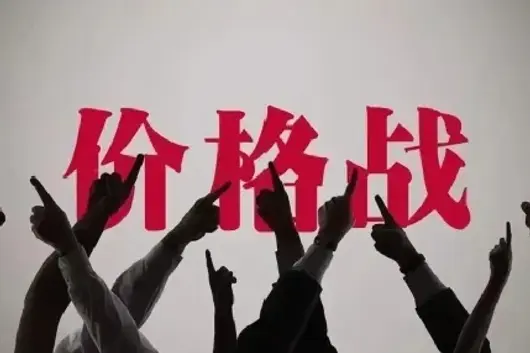

國內車市打咗三年嘅價格戰,終於打落咗滾裝船。
9 月 1 日,商務部、工信部、市場監管總局三部門聯合發布《汽車行業境外競爭行為與合規建設指引》,供企業參考借鑑。《指引》共四章二十條,主要包含規範境外市場競爭行為、提升境外本地化合規經營能力兩個部分。
其中最值得琢磨嘅,係三部門專門提醒車廠:境外定價應以成本同市場供求為基礎,設置清晰嘅價格梯度,避免多頻次、大幅度調價。
翻譯得直白啲:車價可以減,但唔好朝早促銷、下午補償,過幾日又換個理由繼續減。中國汽車可以去海外競爭,但唔可以將海外變成第二個價格戰場。
2024 年 9 月,上汽 MG 將澳洲市場嘅 MG4 51 Excite 減至 30990 澳元落地,最高降幅達到 10425 澳元,接近原價嘅四分之一。新車主自然開心,舊車主卻眼睜睜睇住二手車殘值跟住跳水。
為咗安撫車主,MG 其後提出咗一項頗有創意嘅“補償”:舊車主換購另一部 MG 時,可以享受車價折扣。即係話,想拿到補償,得先再買一部。一啲車主因而表示,品牌忠誠度已經被耗晒。減價原本想多賣車,最後卻勸退咗最早支持品牌嘅一幫人。
長城歐拉都唔得閒。佢哋維多利亞州落地價由上市時超過 4.7 萬澳元,減至 2024 年初嘅 35990 澳元,其後唔同版本又再加 2000 至 6000 澳元優惠。
幾間中國品牌輪流坐低“澳洲最平電動車”嘅位置。不過呢張椅唔坐得耐:你今日宣佈最低價,明日就可能畀另一間趕落去。消費者學會咗觀望,經銷商唔敢囤車。
泰國市場嘅故事更加直接。哪吒汽車嘅 NETA V-II 原價 54.9 萬泰銖,2025 年清庫存時一度減至 29.9 萬泰銖,部分車輛甚至唔再附帶保養。價格幾乎砍走一半,消費者卻擔心:零件仲有無?售後邊個負責?品牌明年仲在唔在?
其後,經銷商結業、員工離職,泰國消費者保護機構亦因投訴介入調查。車價平咗一半,市場信心亦幾乎被一齊砍走。
俄羅斯都冇逃過價格戰。2025 年,部分中國汽車優惠達到 100 萬盧布,俄羅斯最大汽車製造商伏爾加汽車公開指責中國車廠“傾銷”,要求政府調查。
經銷商同樣唔好過。整車減價太快,庫存跟住貶值,原本準備投入維修服務嘅經銷商,開始重新考慮。車廠換來銷量,經銷商卻失去咗完善售後嘅利潤。
呢種劇情,其實唔係好陌生。上世紀 90 年代末,中國摩托車靠低價進入越南,一度拿下約八成市場。其後 70 多家企業蜂擁而至,整车出口價一路減到 170 美元,賣一部平均只賺 30 人民幣。
利潤冇咗,減配、仿冒、配件斷供同售後失靈就嚟。中國摩托車最初靠價格擊退日本品牌,最後卻靠價格擊退自己。越南其後提高關稅、收緊准入,呢個市場二十幾年都未能完全奪返。
而家,中國汽車出海嘅規模早就唔係當年可比。2025 年,中國汽車出口 832 萬輛,銷往 200 多個國家同地區,企業喺 80 多個國家投資汽車製造業。
攤子越大,越唔可以只諗住將車賣出。建廠、雇人、維修、處理數據,邊樣都比減價複雜。《指引》後半部分談勞工、知識產權、質量同售後,講到底,就係要求中國車廠從“做出口”變“做經營”。
喺國內打價格戰,傷嘅主要係企業利潤同經銷商。可去到海外,假若一個品牌將價格打亂,損害嘅卻可能係所有中國汽車嘅形象。當地消費者唔會耐心區分邊間車廠出事,監管部門亦可能將低價翻譯成“傾銷”“補貼”同“產業威脅”,其後送嚟嘅,就係調查、關稅同限制。
中國汽車已經有資格喺海外賣技術、賣產品、賣品牌,實無必要再將自己賤賣成隨時改寫嘅價籤。
主編點評
倘若價格戰一路打落去,打掉嘅唔止係車廠利潤,仲係經銷商、消費者同東道國嘅信任。等到關稅同准入壁壘從四面圍嚟,中國汽車好似將價格戰打遍咗世界,最終卻會變成被全球汽車產業孤立嘅“孤家寡人”。
將車賣去世界,唔等於將價格戰打遍世界。真正嘅全球化,係融入世界,而唔係將世界變成戰場。

SAIC's overseas market is shifting gears and accelerating.
From January through July this year, SAIC's exports and overseas base sales reached 876,000 units, up 52.1% year-on-year; of which 7 months sales 142,000 units, up 72.5% year-on-year. In the preceding June, SAIC's overseas sales reached 146,000 units, up 61.2% year-on-year, creating a new single-month historical high. According to the 2.384 million units group total sales disclosed by SAIC for the same period, the overseas market contribution has already approached 37%.
Another number is more intuitive. In 2025, SAIC's full-year overseas sales were 1.071 million units, up 3.1% year-on-year; this year it only took 7 months to complete more than 80% of last year's full-year sales volume.
From consecutive years of overseas annual sales of millions of units to re-entering high-speed growth this year, SAIC's overseas expansion is showing new changes.
In 2025, SAIC released overseas strategy 3.0 — Glocal "Global + Local" strategy, proposing upgrading from product export to value chain export. More than a year later, this strategy began to land beyond sales figures: European Engineering Center activated, overseas direct sales systems increased, hybrid, pure electric products etc. were recombined according to different market needs, European local production also began to enter the substantive promotion stage.
This means SAIC's overseas expansion is crossing a new threshold: from selling more cars globally to truly operating the global market.

Europe is no longer just an export market
Europe is the most suitable market to observe this change.
From January through July this year, MG sold 218,000 units cumulatively in Europe, up 22.8% year-on-year, continuing to maintain a leading position in European sales of Chinese car brands. In 2025, MG's Europe sales exceeded 300,000 units, up nearly 30% year-on-year.
More worth attention than the total volume is that MG began to appear on the European mainstream model sales list.
Data from the UK Motor Manufacturers and Traders Association SMMT shows that in July this year, 2,703 MG HS were registered, ranking fifth among all models in the UK, only behind Ford Puma, Nissan Qashqai, Kia Sportage and Jaecoo 7; cumulatively 19,424 units in the first 7 months, ranking seventh in the UK annual model sales.
The significance of this ranking is that measuring MG's position in the UK market no longer requires setting up a separate "Chinese Brand" coordinate system. It is competing with brands like Ford, Volkswagen, Nissan, Kia that have operated the European market for decades for the same batch of family users.
Europe is also one of SAIC's overseas markets facing the greatest pressure.
Currently, among the additional anti-subsidy taxes imposed by the EU on pure electric vehicles produced in China, SAIC's applicable tax rate is 35.3%. After adding original import tariffs, Chinese-produced pure electric models face obvious cost pressure. At the same time, Chinese car companies like BYD, Chery, etc. are also rapidly expanding in Europe and successively advancing local production. Europe has become one of the most fierce markets for Chinese car companies in global competition.
SAIC's response is not to continue relying on single pure electric products.
In June this year, MG's overseas HEV model single-month sales have approached 27,000 units, doubling year-on-year; in the MG Technology Conference held in London in July, Plug-in Hybrid+ hybrid, SolidCore semi-solid-state battery and smart cockpit and assisted driving technologies were centrally displayed.
A few years ago, MG's most distinct product label in Europe was still pure electric models like MG4. Now, from HEV, PHEV to pure electric, the product portfolio is becoming more complete.
Behind this is actually a change in the overseas expansion mindset.
The initial export logic considered more how products matured in the Chinese market can go overseas; true global operation requires studying in reverse what power forms, what prices, what sizes local consumers need, then deciding what products to provide.
For automobile enterprises, what separates the two is a whole set of local product definition capabilities.

More important than how many units sold is
Rooting deeply locally
This year, a series of actions by SAIC in Europe are further crossing the boundary of "export".
Starting July 1st, MG in Belgium and Luxembourg shifted from agent operation to MG Motor Europe direct National Sales Company, directly responsible for local market operations. Previously MG had already become the largest Chinese car brand in Belgium, in 2025 local registration was about 6,000 units, market share over 1.5%.
On the same day, MG Motor Switzerland GmbH was officially established, the Swiss market also shifted from importer operation to wholly-owned, locally managed direct sales system, MG began to directly responsible for sales, after-sales and brand operation.
This is a change that can be easily masked by sales figures, but very much illustrates the degree of globalization.
For an export enterprise, the core question is how many cars sold to overseas dealers; for an enterprise truly operating the local market, it also needs to directly face terminal prices, inventory, channel efficiency, after-sales service, brand building and user relationships.
Greater changes are happening at the manufacturing end.
In June this year, the plan for SAIC to build its first EU automotive production base in Ferrol, Galicia, Spain surfaced. According to information disclosed by Reuters, the project is expected to invest about 200 million euros, planned to start construction in 2027, operate in 2028, subsequent planning annual capacity up to 120,000 units, and will support logistics and local parts procurement.
Building factories in Europe certainly has practical considerations of reducing trade barriers and logistics costs, but the significance is not limited to this.
When vehicle production truly enters Europe, enterprises need to handle local suppliers, employees, regulations, government, channels and consumer relationships simultaneously. Cars are gradually shifting from "Made in China, Sold in Europe" to "European R&D Adaptation, European Production, European Operation".
This is also the truly difficult part of "Local" in the Glocal strategy.
In the past few years, SAIC has formed an overseas R&D, manufacturing, sales and logistics network. The existing system includes overseas R&D innovation and design centers, production bases such as Thailand, Indonesia, India, as well as parts, sales service and self-operated RoRo transport system.
If these layouts built SAIC's global operation chassis, then Europe is becoming a pressure test field for verifying this system's capability.
In a market possessing local giants such as Volkswagen, BMW, Mercedes-Benz, Stellantis, while also possessing strict regulations, mature consumers and trade barriers, relying on export price advantage can win for a period of time, but it is difficult to win a long-term market.
In the end, it is a contest on who can truly integrate in.

From an MG prototype
Turn into group-level global capability
MG is still SAIC's most mature piece of overseas expansion, but SAIC's overseas growth no longer comes entirely from MG.
SAIC-GM-Wuling overseas exports have exceeded 30,000 units consecutively for 4 months, this year January-7 months cumulative breakthrough 200,000 units; SAIC Maxus July overseas sales 14,000 units, up 69% year-on-year, products entered global 100+ countries and regions. Recently, SAIC Hongyan also signed 1,000 new energy heavy truck orders with Thai customers, and carried out vehicle and charging, maintenance system local adaptation for local high temperature, rainy, heavy load environment.
From MG passenger cars, to Wuling small cars, to Maxus light commercial vehicles, pickups and new energy heavy trucks, what SAIC tries to replicate is no longer a certain "global blockbuster", but a group-level global operation system.
This road did not start this year.
In 2001, SAIC began passenger car exports; in 2012 cooperated with CP Group to layout Thailand, subsequently advanced local vehicle production; in 2019 India vehicle base put into production; by 2025, SAIC formally proposed Glocal strategy. Now, SAIC products and services have entered over 170 countries and regions globally, overseas cumulative sales exceeded 7 million units.
In more than 20 years, Chinese car exports themselves have also changed.
Earliest competition was whether there were products that could be exported; subsequently competition was who could reach 100,000, 500,000, 1 million units scale first. Entering today, when more and more Chinese car companies cross the 1 million unit export threshold, pure export quantity is becoming increasingly difficult to decide the final result of global competition.
The next stage, the contest is another set of capabilities: can we define products according to different markets in Europe, Southeast Asia, Middle East, Latin America; can we establish local R&D and manufacturing; can we directly operate channels and users; can we adapt to local regulations, supply chains and even industrial policies.
In other words, Chinese car exports are moving from "Trade Globalization" to "Operation Globalization".
From this perspective, the significance of 876,000 units has also changed.
It is first of all a sales report card, but more importantly, this round of growth appears in the stage where European local production, direct channels, technical local adaptation and global supply chain are promoted synchronously.
True global automobile enterprises were never global enterprises because of large export volumes. Toyota, Volkswagen, GM became multinational automotive groups because they can R&D, produce, organize supply chains, operate brands and serve users in different countries.
For SAIC which has continuously sold millions of units overseas for many years, the next question has also changed from "how many more units can be exported" to "in how many markets can it truly take root".
Europe is giving the first answer. What SAIC wants to prove is not only that Chinese cars can be sold globally, but also that Chinese car enterprises have the capability to become part of the global automotive industry.

上汽海外市場正在換擋提速。
今年 1—7 月,上汽出口及海外基地銷量達到 87.6 萬輛,同比增長 52.1%;其中 7 月銷售 14.2 萬輛,同比增長 72.5%。此前的 6 月,上汽海外銷量達到 14.6 萬輛,同比增長 61.2%,創下單月歷史新高。按照上汽公布的同期 238.4 萬輛集團總銷量計算,海外市場貢獻已經接近 37%。
另一個數字更直觀。2025 年,上汽全年海外銷量為 107.1 萬輛,同比增長 3.1%;今年只用了 7 個月,就已經完成去年全年銷量的八成以上。
從連續多年海外年銷百萬輛,到今年重新進入高速增長,上汽出海正在出現新的變化。
2025 年,上汽發布海外戰略 3.0——Glocal“全球 + 本土”戰略,提出從產品出海向價值鏈出海升級。一年多以後再看,這套戰略開始落到銷量之外:歐洲工程中心啟用,海外直營銷售體系增加,混動、純電等產品根據不同市場需求重新組合,歐洲本地生產也開始進入實質推進階段。
這意味著,上汽出海正在跨過一個新的門檻:從把更多汽車賣到全球,轉向真正經營全球市場。
歐洲,已經不只是一個出口市場
歐洲是觀察這一變化最合適的市場。
今年 1—7 月,MG 在歐洲累計銷售 21.8 萬輛,同比增長 22.8%,繼續保持中國汽車品牌歐洲銷量前列。2025 年,MG 歐洲銷量已經超過 30 萬輛,同比增長接近 30%。
比總量更值得關注的是,MG 開始出現在歐洲主流車型銷量榜上。
英國汽車製造商和貿易商協會 SMMT 數據顯示,今年 7 月,MG HS 註冊 2703 輛,排名英國所有車型第五,僅排在 Ford Puma、Nissan Qashqai、Kia Sportage 和 Jaecoo 7 之後;前 7 個月累計 19,424 輛,位列英國全年車型銷量第七。
這組排名的意義在於,衡量 MG 在英國市場的位置,已經不必單獨設立一個“中國品牌”的坐標系。它正在和福特、大衆、日產、起亞這些經營歐洲市場數十年的品牌爭奪同一批家庭用戶。
歐洲同樣是上汽面對壓力最大的海外市場之一。
目前歐盟針對中國生產純電動汽車徵收的額外反補貼稅中,上汽適用稅率為 35.3%,疊加原有進口關稅後,中國生產純電車型面臨明顯的成本壓力。與此同時,比亞迪、奇瑞等中國車企也在歐洲快速擴張,並相繼推進當地生產。歐洲已經成為中國車企全球化競爭最激烈的市場之一。
上汽的應對並不是繼續依靠單一的純電產品。
今年 6 月,MG 海外 HEV 車型單月銷量已經接近 2.7 萬輛,同比翻番;7 月在倫敦舉辦的 MG 技術大會上,Plug-in Hybrid+ 混動、SolidCore 半固態電池以及智慧座艙與輔助駕駛技術被集中展示。
幾年前,MG 在歐洲最鮮明的產品標籤還是 MG4 這樣的純電車型。現在,從 HEV、PHEV 到純電,產品組合正在變得更加完整。
這背後其實是出海思路的變化。
最初的出口邏輯,更多考慮中國市場已經成熟的產品如何走向海外;真正的全球經營,則需要反過來研究當地消費者需要什麼動力形式、什麼價格、什麼尺寸,再決定提供什麼產品。
對於汽車企業而言,兩者之間隔著的是一套本地產品定義能力。
比賣出多少輛更重要的是
把根扎進當地
今年以來,上汽在歐洲的一系列動作,正在進一步跨過“出口”這條邊界。
7 月 1 日起,MG 在比利時和盧森堡由代理商運營轉為 MG Motor Europe 直屬 National Sales Company,直接負責當地市場經營。此前 MG 已經成為比利時最大的中國汽車品牌,2025 年當地註冊量約 6000 輛、市場份額超過 1.5%。
同一天,MG Motor Switzerland GmbH 正式成立,瑞士市場同樣從進口商運營轉向全資、本地管理的直營體系,MG 開始直接負責銷售、售後和品牌運營。
這是一個容易被銷量數字掩蓋,卻很能說明全球化程度的變化。
對於一家出口企業而言,最核心的問題是向海外經銷商賣出多少輛車;對於一家真正經營當地市場的企业而言,還要直接面對終端價格、庫存、渠道效率、售後服務、品牌建設和用戶關係。
更大的變化發生在製造端。
今年 6 月,上汽在西班牙加利西亞 Ferrol 建設首個歐盟汽車生產基地的計劃浮出水面。按照路透社披露的信息,項目預計投資約 2 億歐元,計劃 2027 年啟動建設、2028 年投入運營,後續規劃年產能最高達到 12 萬輛,並將配套物流和當地零部件採購。
歐洲本地建廠當然有降低貿易壁壘和物流成本的現實考慮,但意義並不於此。
當整車生產真正進入歐洲之後,企業需要同時處理當地供應商、員工、法規、政府、渠道和消費者關係。汽車從“中國製造、歐洲銷售”,逐步轉向“歐洲研發適配、歐洲生產、歐洲經營”。
這也是 Glocal 戰略裡“Local”真正困難的部分。
過去幾年,上汽已經形成海外研發、製造、銷售和物流網絡。現有體系包括海外研發創新和設計中心、泰國、印尼、印度等生產基地,以及零部件、銷售服務和自營滾裝運輸體系。
如果說這些布局建立了上汽全球經營的底盤,那麼歐洲正在成為檢驗這套體系能力的壓力測試場。
在一個擁有大衆、寶馬、奔馳、Stellantis 等本土巨頭,同時擁有嚴格法規、成熟消費者和貿易壁壘的市場,靠出口價格優勢可以贏得一段時間,但很難贏得一個長期市場。
最終比拼的是誰能夠真正融進去。
從 MG 一個樣板
變成集團級的全球能力
MG 仍然是上汽出海最成熟的一塊,但上汽的海外增長已經不完全來自 MG。
上汽通用五菱海外出口已經連續 4 個月超過 3 萬輛,今年 1—7 月累計突破 20 萬輛;上汽大通 7 月海外銷售 1.4 萬輛,同比增長 69%,產品進入全球 100 多個國家和地區。近期,上汽紅岩還與泰國客戶簽下 1000 輛新能源重卡訂單,並針對當地高溫、多雨、重載環境進行車輛和充電、維保體系的本地適配。
從 MG 乘用車,到五菱小型車,再到大通輕型商業車、皮卡和新能源重卡,上汽試圖複製的已經不是某一款“全球爆款”,而是一套集團級的全球經營體系。
這條路並不是今年才開始。
2001 年,上汽開始乘用車出口;2012 年與正大集團合作布局泰國,隨後推進當地整車生產;2019 年印度整車基地投產;到 2025 年,上汽正式提出 Glocal 戰略。如今,上汽產品和服務已經進入全球 170 多個國家和地區,海外累計銷量超過 700 萬輛。
二十多年里,中國汽車出海本身也發生了變化。
最早拼的是有沒有產品能夠出口;隨後拼的是誰能率先達到 10 萬輛、50 萬輛、100 萬輛規模。進入今天,當越來越多中國車企跨過百萬輛出口門檻,單純的出口數量已經越來越難決定全球競爭的最終結果。
下階段,比拼的是另一套能力:能不能按照歐洲、東南亞、中東、拉美不同市場定義產品,能不能建立本地研發和製造,能不能直接經營渠道和用戶,能不能適應當地法規、供應鏈乃至產業政策。
換句話說,中國汽車出海正在從“貿易全球化”,走向“經營全球化”。
從這個角度看,87.6 萬輛的意義也發生了變化。
它首先是一份銷量成績單,但更重要的是,這輪增長出現在歐洲本地生產、直營渠道、技術本地適配和全球供應鏈同步推進的階段。
真正的全球汽車企業,從來不是因为出口量大而成為全球企業。豐田、大衆、通用之所以成為跨國汽車集團,是因為它們能夠在不同國家研發、生產、組織供應鏈、經營品牌和服務用戶。
對於已經連續多年海外年銷百萬輛的上汽而言,下一個問題也已經從“還能出口多少輛”,變成了“能在多少市場真正紮下根”。
歐洲正在給出第一個答案。上汽想要證明不只是中國汽車可以賣到全球,而是中國汽車企業同樣有能力成為全球汽車產業的一部分。

After achieving a historical high in overseas market sales in June, SAIC Motor delivered another impressive performance report in July: overseas sales in July reached 142,000 vehicles, a year-on-year surge of 72.5%; cumulative sales from January to July reached 876,000 vehicles, growing 52.1% year-on-year, firmly maintaining its position in the first echelon of Chinese automakers expanding overseas.
With overseas sales continuing to surge, this is driven by SAIC's deepening promotion from "product going global" to "system going global". Recently, SAIC has densely launched multiple models in markets such as Europe, Southeast Asia, and South America, while simultaneously holding overseas technical conferences, establishing direct sales companies, and deepening local production... Global R&D, manufacturing, service, and brand operation capabilities continue to be perfected.
New models launch continuously, with warm responses in the overseas market
Recently, SAIC brands such as MG and Wuling have started a wave of new car launches overseas. On June 17, MG unveiled the new all-electric hatchback MG4 Urban in Bangkok, Thailand, offering Standard, Long Range, and Flagship versions, and achieved local production in Thailand; on July 16, this model landed in the Brazilian market, appearing alongside channels and after-sales ecosystems. As a "global car", MG4 Urban landed in the UK, Germany, Australia, Singapore and other markets this year, satisfying global user needs with advanced intelligent electrification technology and strong product capabilities.
Besides all-electric models, SAIC MG's HEV hybrid models also performed remarkably well, with monthly overseas sales nearing 27,000 vehicles, doubling year-on-year. On July 29, the MG ZS Hybrid+ was officially launched at the Indonesia International Motor Show. Relying on excellent fuel economy, smooth and sensitive driving performance, and perfect after-sales service, it quickly won the praise of Indonesian users.
 Also debuting at the same Indonesia International Motor Show was Wuling Aira EV. This "global car" sharing the same DNA as Wuling Hongguang MINIEV is compact and agile, precisely matching local driving scenarios in Indonesia such as narrow streets, cramped parking spaces, and multi-person travel. The model is locally produced at the Cikarang Plant in Indonesia, relying on the manufacturing, channels, and user foundation accumulated in Indonesia, establishing a new benchmark for electric cars in Indonesian cities and continuously digging deep into the local market.

The new car effect is gradually appearing in regional markets. In Europe, MG brand cumulative sales from January to July reached 218,000 vehicles, growing 22.8% year-on-year, retaining the title of "China Brand Europe Sales Champion"; in Italy, MG cumulative users broke through 150,000, becoming the brand's second 150,000+ market in Europe after the UK. SAIC-GM-Wuling also performed remarkably well, with overseas exports exceeding 30,000 vehicles consecutively for 4 months, cumulative overseas sales from January to July breaking through 200,000 vehicles, showing strong growth momentum.
Strengthening system deepening, overseas strategy steadily advancing
Dense new car launches are the forward positions of SAIC in the global market, while deeper breakthroughs lie in the comprehensive advancement of technology, standards, and systems—sharing cutting-edge technology, integrating into local markets, taking root in industrial ecosystems, and serving local users.
On July 8, MG held a technical conference in London, UK, bringing the most cutting-edge intelligent electrification technology back to the brand's place of origin. The conference centrally showcased MG Plug-in Hybrid+, SolidCore semi-solid-state battery, and MG Parking smart cockpit with assisted driving, demonstrating SAIC's strong technical strength to global users.


The next day, MG showcased the two-door all-electric concept car MG Go! and the coupé SUV concept car MG Cyber at the Goodwood Festival of Speed. Both models draw design inspiration from the brand's historical classics. MG Go! offers users a new choice for personalized all-electric travel with its compact and sporty stance; MG Cyber is positioned as an electric flagship coupé SUV, carrying the brand's future design language and upward vision.

Regarding sales channels, in July, the MG brand established direct sales companies in Belgium and Luxembourg, fully responsible for distribution, sales, and channel operations in the local markets. The construction of the direct sales system is a transition of MG from "selling cars" to "operating", helping the brand more directly reach customer needs, organize sales rhythms, improve service capabilities, and achieve agile responses to market dynamics.
Forward-looking designed products, cutting-edge hardcore technology, and deeply laid-out systems constitute the new pattern of the MG brand's overseas expansion stepping by steps. Shifting from sales scale leadership to deepening local markets and building long-term user relationships, SAIC's "Glocal strategy" is being rapidly implemented.
Commercial vehicles active layout, market development steadily promoted
While the overseas passenger car market continues to break through, SAIC Commercial Vehicles has also achieved remarkable performance overseas. In July, SAIC MAXUS sold 14,000 vehicles overseas, a year-on-year surge of 69%, with products continuously selling well in more than 100 countries and regions worldwide. The first batch of 200 MAXUS T60 pickups purchased by Venezuela Petroleum Company, coupled with the steady landing of bulk orders for pickups in Chilean mining areas, confirmed the overseas enterprise customers' recognition of MAXUS's high-end pickup commercial value; in the Greek light commercial vehicle market, the SAIC MAXUS brand maintained the number one market share of Chinese brands for 6 consecutive months, and the penetration pace in the European market continued to accelerate.

In the heavy truck and bus fields, recently SAIC Hongyan reached a 1,000-unit new energy heavy truck strategic cooperation agreement with a top port client in Thailand, creating a new historical high for the scale of a single export of domestic new energy heavy trucks to Southeast Asia. This batch of new energy heavy trucks underwent local optimization targeting Southeast Asia's high temperature, heavy rain, and heavy load conditions, and simultaneously improved the overseas charging, maintenance, and spare parts ecosystem layout. The first batch of vehicles has been shipped to Thailand. Sunwin buses appeared at the Australian Bus & Coach Exhibition in July, displaying the all-electric city bus iEV12 tailored for the Oceania market, meeting the needs of right-hand drive, longer operating mileage, and better handling performance, while possessing high reliability and scalability, satisfying Australian market needs with advanced products and services.
From light vans and pickups to heavy trucks and buses, SAIC Commercial Vehicles' overseas path not only features a multi-category matrix but also actively explores deep local operations. In the process of breaking through orders to settling reputation, SAIC is deeply laying out in the global commercial vehicle market with systematic strength, continuously expanding market growth space.
From MG's technical conference and direct layout in Europe to Wuling's local production in Southeast Asia, and then to the deep breakthrough of the commercial vehicle segment in multiple categories and regional markets, SAIC's global operations continue to deepen. From "going out" to "going in", the development logic of Chinese automobiles going overseas is being reshaped. The synergy resonance formed by excellent products and complete systems will make the brand image of Made in China increasingly bright on the world stage.
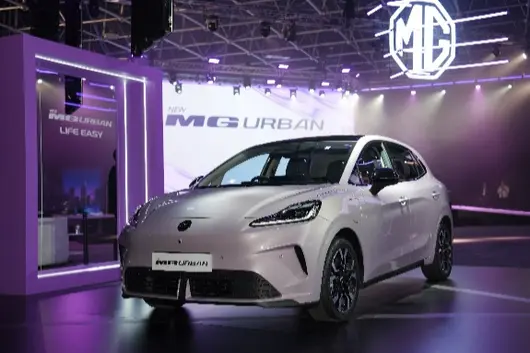

繼6月海外市場銷量創歷史新高後,上汽集團7月再次交出亮眼成績單:7月海外市場銷售14.2萬輛,同比大漲72.5%;1至7月累計銷售87.6萬輛,同比增長52.1%,穩居中國汽車企業出海第一梯隊。
海外銷量持續高歌猛進,背後係上汽從「產品出海」向「體系出海」嘅縱深推進。近期,上汽喺歐洲、東南亞、南美等市場密集投放多款車型,同步舉辦海外技術大會、設立直屬銷售公司、深化本地化生產……全球化研發、製造、服務同品牌運營能力持續完善。
新品接連上市,海外市場反響熱烈
近期,上汽MG、五菱等品牌喺海外掀起新車上市潮。6月17日,MG喺泰國曼谷發布全新純電掀背車型MG4 Urban,提供標準版、長續航版同旗艦版三款配置,並實現泰國本地化生產;7月16日,該車型登陸巴西市場,連同渠道、售後全生態共同亮相。作為一款「全球車」,MG4 Urban今年先後登陸英國、德國、澳洲、新加坡等市場,以先進智電技術同強悍產品力滿足全球用戶需求。
除咗純電車型,上汽MG嘅HEV混動車型同樣表現搶眼,海外月銷近2.7萬輛,實現同比翻倍。7月29日,MG ZS Hybrid+喺印尼國際汽車展上正式發布,憑藉出色嘅燃油經濟性、順暢靈活嘅駕駛操控表現同完善嘅售後服務,迅速獲取印尼用戶嘅好評。
一喺印尼國際汽車展發布嘅仲有五菱Aira EV。這款同五菱宏光MINIEV 同源嘅「全球車」小巧靈活,精準匹配印尼街巷狹窄、車位局促、多人口出行等本土用車場景。該車由印尼芝卡朗工廠本地生產,依靠喺印尼積累嘅製造、渠道同用戶基礎,樹立印尼城市代步電車新標杆,持續深耕本土市場。
新車效應喺各區域市場逐步顯現。喺歐洲,MG 品牌1至7月累計銷售21.8萬輛,同比增長22.8%,蟬聯「中國品牌歐洲銷量冠軍」;喺意大利,MG 累計用戶突破15萬,成為繼英國市場之後,品牌喺歐洲嘅第二個15萬+市場。上汽通用五菱同樣表現搶眼,海外出口連續4個月突破3萬輛,1至7月海外累計銷量突破20萬輛,增長勢頭強勁。
強化體系深耕,海外戰略穩步進階
密集嘅新車上市係上汽喺全球市場嘅前沿陣地,而更深層次嘅突破,喺技術、標準、體系嘅全方位進階——分享前沿技術、融入當地市場、扎根產業生態、服務當地用戶。
7月8日,MG喺英國倫敦舉辦技術大會,將最前沿嘅智電技術帶回品牌發源地。會上集中展示咗MG Plug-in Hybrid+ 油電混合、SolidCore 半固態電池同 MG Parking 智慧座艙同輔助駕駛,向全球用戶展示咗上汽雄厚嘅技術實力。
次日,MG 攜兩廂純電概念車MG Go!同轎跑SUV 概念車MG Cyber 亮相古德伍德速度節。兩款車款設計靈感均源自品牌歷史經典,MG Go!以小巧運動嘅姿態為用戶提供純電出行個性新選擇;MG Cyber 則定位電動旗艦轎跑SUV,承載品牌未來嘅設計語言同向上願景。
銷售渠道方面,7月MG 品牌喺比利時、盧森堡成立直屬銷售公司,全面負責當地市場嘅分銷、銷售同渠道運營。直營體系建設係MG 由「賣車」到「經營」嘅轉變,有助品牌更直接地接觸客戶需求、梳理銷售節奏、提升服務能力,實現對市場動態嘅敏捷回應。
前瞻設計嘅產品、前沿硬核嘅技術、深入佈局嘅體系,構成咗MG 品牌出海逐階而上嘅全新格局。由銷量規模領跑轉向深耕本土市場、構建長期用戶關係,上汽嘅「Glocal 戰略」正在快速落實。
商用車積極佈局,市場開拓穩步推進
海外乘用車市場不斷突破嘅同時,上汽商用車亦喺海外取得搶眼表現。7月,上汽大通海外熱銷1.4萬輛,同比大增69%,產品持續暢銷全球100多個國家同地區。委內瑞拉石油公司首批採購200輛大通T60 皮卡,疊加智利礦區皮卡批量訂單嘅穩步落地,大通高端皮卡商用價值獲得海外企業客戶認可;喺希臘輕型商用車市場,上汽大通MAXUS 品牌連續6個月保持中國品牌市佔率第一,喺歐洲市場嘅滲透步伐持續加快。
重卡同客車領域,近期上汽紅岩同泰國頭部港口大客戶達成1000輛新能源重卡戰略合作協議,創下國內新能源重卡單次出口東南亞市場規模歷史新高。呢批新能源重卡針對東南亞高溫、多雨、重載工況進行本地化優化,並同步完善海外充電、維保、備件生態佈局,首批整車已批量登船發往泰國。申沃客車7月亮相澳洲巴士同客車展覽會,展出咗專為大洋洲市場量身訂造嘅純電動城市客車iEV12,滿足右舵駕駛、更長營運里程、更優操控性能嘅需求,同時具備高可靠性同可延展性,以先進嘅產品同服務滿足澳洲市場需求。
由輕型貨車、皮卡到重卡、巴士,上汽商用車板塊嘅出海之路不僅有多品類矩陣,更積極探索本地化深度運營。喺訂單突破到口碑沉澱嘅過程中,上汽正以體系化實力喺全球商用車市場縱深佈局,持續拓寬市場增長空間。
由MG 喺歐洲嘅技術大會同直營佈局,到五菱喺東南亞嘅本地化生產,再到商用車板塊喺多品類、多區域市場嘅縱深突破,上汽嘅全球化運營不斷深入。由「走出去」到「走進去」,中國汽車出海嘅發展邏輯正在重塑,優秀產品同完善體系形成嘅協同共鳴,將讓中國智造嘅品牌形象喺世界舞台日益閃亮。

[CNMO Tech News] On August 17, following overseas market sales reaching a historic high in June, SAIC Group presented another impressive result in July: overseas sales in July reached 142,000 units, a 72.5% increase year-on-year; cumulative sales from January to July reached 876,000 units, up 52.1% year-on-year, firmly holding its position in the first tier of Chinese automakers going global.

SAIC Group
Overseas sales continue to surge, behind which is SAIC's deepening push from "product export" to "systemic export". Recently, SAIC has densely launched multiple models in markets such as Europe, Southeast Asia, South America, etc., simultaneously held overseas technical conferences, established direct sales companies, and deepened localized production... Global R&D, manufacturing, service, and brand operation capabilities continue to be perfected.
According to CNMO Tech, on June 17, MG launched the all-new electric hatchback MG4 Urban in Bangkok, Thailand, offering Standard, Long Range, and Flagship versions, achieving localized production in Thailand; on July 16, this model landed in the Brazilian market, appearing with a full ecosystem of channels and after-sales service. As a "global car", MG4 Urban landed in markets such as the UK, Germany, Australia, Singapore, etc. this year, meeting global user needs with advanced smart electric technology and powerful product strength.

Besides pure electric models, SAIC MG's HEV hybrid models also performed remarkably, with overseas monthly sales near 27,000 units, achieving a doubling year-on-year. On July 29, MG ZS Hybrid+ was officially launched at the Indonesia International Motor Show, thanks to excellent fuel economy, smooth and sensitive driving performance, and comprehensive after-sales service, quickly gaining praise from Indonesian users.

Also launched at the Indonesia International Motor Show is the Wuling Aira EV. This "global car" shares the same origin as the Wuling Hongguang MINIEV, compact and agile, precisely matching local driving scenarios such as narrow Indonesian streets, cramped parking spots, and multi-person travel. This model is locally produced at the Cikarang factory in Indonesia, relying on the manufacturing, channel, and user foundation accumulated in Indonesia, setting a new benchmark for city commuting electric vehicles in Indonesia, continuously deepening the local market.

The new car effect is gradually showing in regional markets. In Europe, MG brand cumulative sales from January to July reached 218,000 units, up 22.8% year-on-year, consecutively winning the "Chinese Brand Europe Sales Champion"; in Italy, MG cumulative users exceeded 150,000, becoming the brand's second 150,000+ market in Europe after the UK. SAIC-GM-Wuling also performed remarkably, with overseas exports exceeding 30,000 units for 4 consecutive months, cumulative overseas sales from January to July exceeded 200,000 units, growth momentum is strong.

[CNMO Tech News] August 17, SAIC Motor announced the latest overseas sales data. Data shows SAIC overseas market sales in July142,000 units, surging year-on-year by72.5%; cumulative sales from Jan to July876,000 units, year-on-year growth of52.1%, firmly remaining in the first tier of Chinese automakers going global.

SAIC Motor
Recently, SAIC MG, Wuling and other brands have launched a wave of new car releases overseas. On June 17, MG unveiled a brand new all-electric hatchback model in Bangkok, ThailandMG4 Urban, offering three configurations: Standard, Long-Range, and Flagship, and achieving local production in Thailand; On July 16, the model was launched in the Brazilian market, showcasing alongside channels and a full after-sales ecosystem. As a "global car", MG4 Urban has been launched in the UK, Germany, Australia, Singapore and other markets earlier this year.

MG4 Urban
In addition to all-electric models, MG's HEV hybrid models also performed well, with overseas monthly sales nearing27,000 units, achieving a doubling year-on-year. On July 29,MG ZS Hybrid+was officially launched at the Indonesia International Motor Show. Also launched at the Indonesia International Motor Show wasWuling Aira EV, which shares a platform with Wuling Hongguang MINIEV and is locally produced by the Cikarang factory in Indonesia.

Wuling Aira EV
In terms of regional market performance, in Europe, the MG brand cumulative sales from Jan to July were218,000 units, year-on-year growth of22.8%, retaining the title of "Best-Selling Chinese Brand in Europe"; In Italy, MG cumulative users exceeded150,000, becoming the second market exceeding 150,000+ after the UK market. SAIC-GM-Wuling overseas exports exceeded 30,000 units for 4 consecutive months, with cumulative sales from Jan to July exceeding200,000 units, and growth momentum is strong.
While the overseas passenger vehicle market continues to break through, SAIC Commercial Vehicles' performance was also prominent. In July, SAIC Maxus overseas hot sales reached14,000 units, surging year-on-year by69%, with products continuing to sell well in over 100 countries and regions worldwide. The Venezuelan Oil Company's first batch purchase of 200 Maxus T60 pickups, plus the steady landing of bulk pickup orders from Chilean mines, Maxus high-end pickup commercial value gained recognition from overseas corporate clients. In the Greek light commercial vehicle market, the SAIC Maxus brand maintained the No. 1 market share among Chinese brands for 6 consecutive months.