
Search History
Popular Searches
English
Dealer Login / Sign Up
The 2026 Beijing International Automotive Exhibition has become the stage for one of the most anticipated debuts in the luxury electric vehicle segment: the Porsche all-electric Cayenne Turbo. Making its official public debut in China, this model marks a pivotal shift for the iconic SUV lineage, which previously roared with internal combustion engines. Now, it enters the electric era with staggering performance figures that challenge the very definition of an SUV. First unveiled globally in November 2025, the Cayenne Turbo arrives in Beijing with a dual-motor all-wheel-drive system that delivers a breathtaking 0-100 km/h acceleration time of just 2.5 seconds, placing it firmly in hypercar territory.
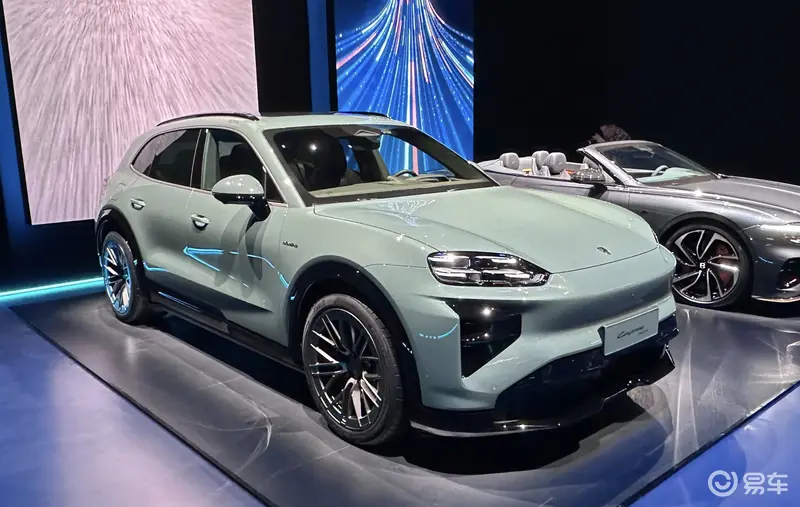
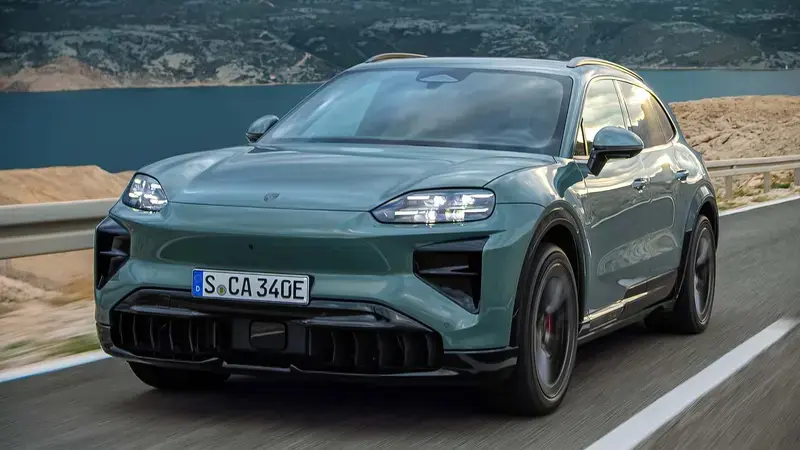
From a design perspective, the all-electric Cayenne Turbo adopts Porsche's latest family language for its EV lineup, most notably at the front. The four-point LED daytime running lights—a hallmark of modern Porsche design—are unmistakable, flanking a sculpted hood that flows seamlessly into pronounced fenders. The front bumper houses a set of vertical slats, forming a louvered active grille that not only enhances aerodynamics but also adds an aggressive, purposeful stance. These elements, combined with a low, wide nose, give the electric Cayenne an athletic and futuristic presence that is both elegant and menacing.
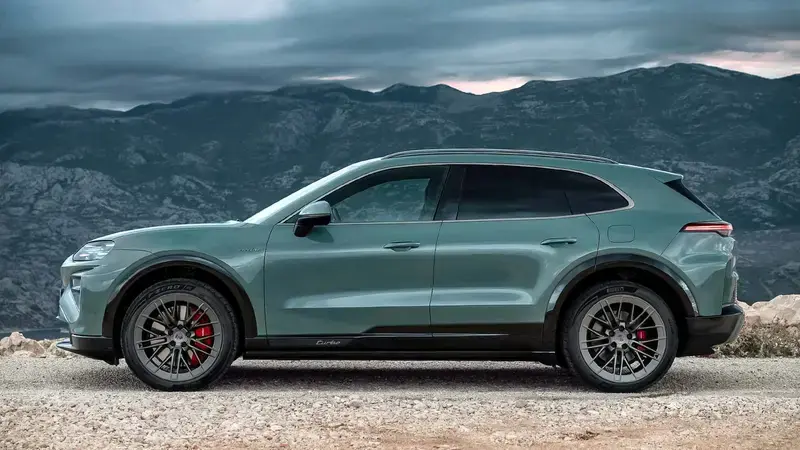
Moving along the profile, the new Cayenne Turbo showcases muscular haunches with prominent black wheel arch extensions that frame a set of massive 22-inch multi-spoke wheels. Behind these wheels lurk carbon-ceramic brake discs, ensuring that the immense power can be reined in with equal authority. The side view reveals a traditional door handle design—a deliberate choice to maintain tactile familiarity—while the robust side sills and sharply defined door creases add a sense of solidity and motion. The overall silhouette retains the classic Cayenne coupe-like roofline, but the proportions feel lower and more planted, hinting at the low center of gravity afforded by the underfloor battery pack.
At the rear, the design hardens into a sharper, more geometric form. A full-width LED taillight bar stretches across the tailgate, echoing the language seen on the Taycan and the latest Macan EV. This light bar is slim and precise, visually widening the vehicle and giving it a tech-forward signature after dark. Below, the rear bumper integrates a pronounced diffuser element, not just for visual drama but for aerodynamic efficiency, channeling air smoothly under the vehicle. The absence of exhaust outlets is the only telltale sign that this is an electric vehicle, but the aggressive bodywork more than compensates for the lack of noise.
Step inside, and the cabin represents a radical departure from previous Cayenne generations.
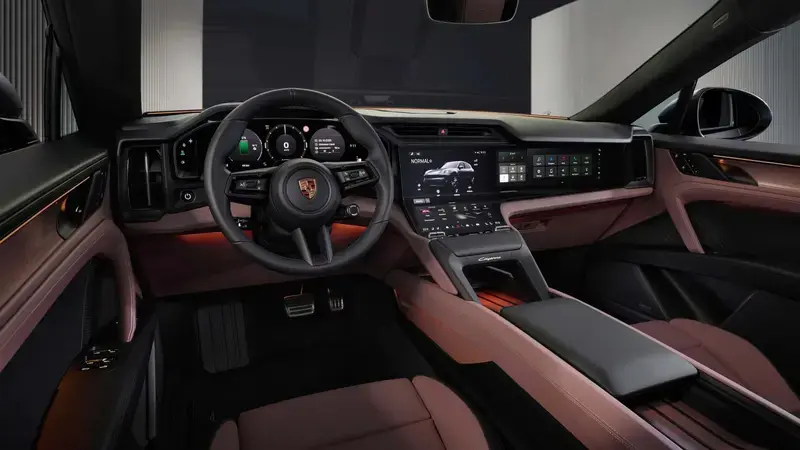
The dashboard architecture is now more sculpted and layered, dominated by a sweeping curved 12.25-inch OLED display that serves as the central infotainment hub. Porsche has wisely retained a substantial number of physical buttons and switches, integrated into the center console and the steering wheel, allowing for intuitive operation without requiring the driver to dive into submenus. This blend of digital sophistication and tactile control is a nod to the brand's driver-focused philosophy.
Further enhancing the cockpit experience, the new Cayenne Turbo features a 14.6-inch digital instrument cluster that replaces the traditional analog gauges, providing a customizable interface for driving data, navigation, and vehicle status. A 14.9-inch passenger-side display is also included, allowing the front occupant to control media, navigation inputs, or even stream content, all while keeping the driver's view unobstructed. For those seeking the ultimate in augmented reality, Porsche offers an optional 87-inch AR-HUD (Heads-Up Display) that projects navigational cues and critical information directly onto the windshield, creating a seamless blend of the real and digital worlds.
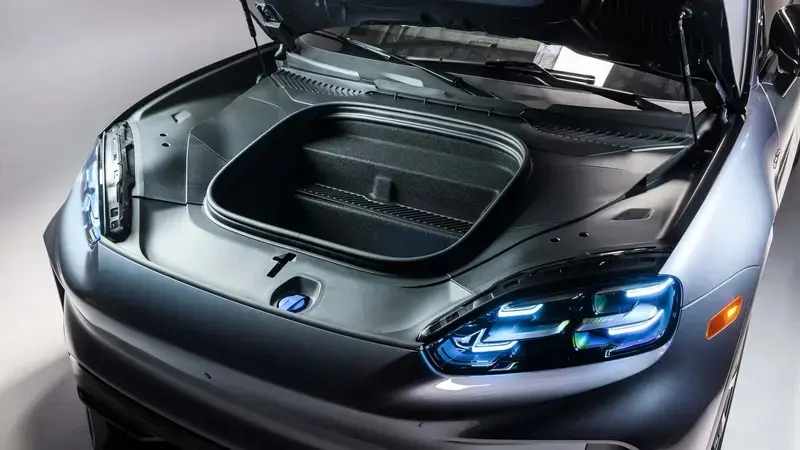
Under the skin, the powertrain is where the Cayenne Turbo makes its most compelling statement. Two distinct versions are available: the Cayenne Electric and the Cayenne Turbo Electric. The standard Electric variant employs a dual-motor all-wheel-drive setup producing 300 kW (408 hp) under normal conditions. Activating Launch Control grants a 10-second overboost, temporarily raising output to 325 kW (442 hp). This version sprints from 0-100 km/h in 4.8 seconds and reaches a top speed of 230 km/h—more than sufficient for daily driving and spirited highway cruising.
However, it is the Turbo Electric variant that steals the headlines. Standard combined output from its dual motors is rated at 630 kW (857 hp). When Launch Control is engaged, this figure skyrockets to a phenomenal 850 kW (1,156 hp), with a staggering peak torque of 1,500 Nm. The result is a 0-100 km/h time of just 2.5 seconds, making it one of the quickest production SUVs ever built. The quarter-mile is dispatched in a mere 9.9 seconds, putting it on par with purpose-built electric hypercars. This level of performance redefines what an SUV can achieve, blending utility with outright speed.
Energy for these powertrains is stored in a substantial 114 kWh battery pack. Porsche has focused on charging efficiency, with the ability to replenish the battery from 10% to 80% in just 16 minutes when connected to a high-power DC fast charger. Additionally, the system supports 11 kW wireless charging, offering a cable-free convenience for home or office use. This quick turnaround time is crucial for alleviating range anxiety in a vehicle of this caliber, ensuring that drivers can spend more time enjoying the performance and less time tethered to a charging station.
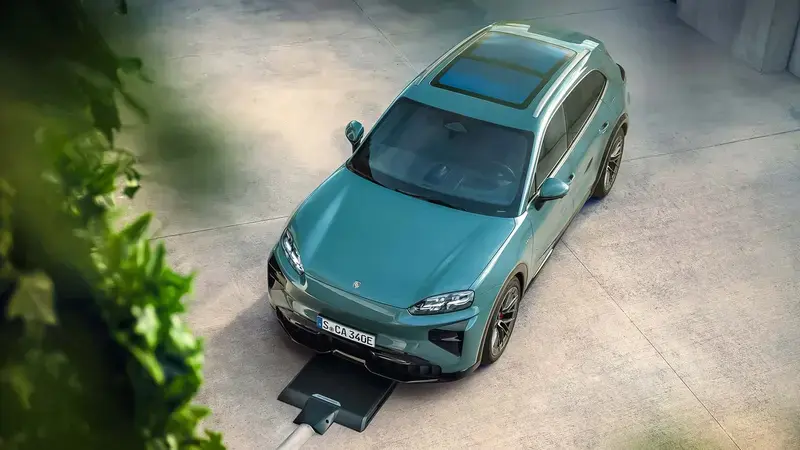
Regenerative braking technology is also a highlight. The Cayenne Turbo features a 600 kW recuperation system derived directly from Porsche's Formula E racing program. In everyday driving, approximately 97% of braking events are handled entirely by the electric motors, recapturing energy and minimizing wear on the mechanical carbon-ceramic brakes. This not only extends brake life but also improves overall efficiency. The system intelligently blends regenerative and friction braking based on driving conditions, providing a seamless and responsive braking feel.
Thermal management is addressed through a sophisticated direct oil cooling system for the electric motors. This involves circulating a specialized fluid directly over all current-carrying components within the drive units. The direct oil cooling significantly improves heat dissipation, allowing the motors to maintain peak performance for longer durations without thermal throttling. This is particularly important for track use or repeated hard acceleration runs, where consistent power delivery is paramount. The combination of Formula E-derived regeneration and advanced motor cooling ensures that the Cayenne Turbo is not just a one-trick pony but a vehicle capable of sustained high-performance driving.
In summary, the Porsche all-electric Cayenne Turbo unveiled at the 2026 Beijing Auto Show is a landmark vehicle. It successfully marries the practicality and luxury expected of a Porsche SUV with the instantaneous torque and silent fury of an electric powertrain. With a 0-100 km/h time of 2.5 seconds, a 1,156 hp output, and charging technology that minimizes downtime, it sets a new benchmark for high-performance electric SUVs. The interior blends digital innovation with ergonomic tradition, and the exterior design confidently signals a new era for the nameplate. For enthusiasts and luxury buyers alike, the electric Cayenne Turbo represents the pinnacle of what an all-electric performance SUV can achieve today.

香港汽車內容平台 🚗 新車・買車・玩車・用車 用香港視角,睇世界嘅車
+ Follow 【揀車有路數】日產新車賣比亞迪價?仲有激光雷達
今集試一台好特別嘅日產新車——NX8,中國特供增程SUV。外觀似熟悉嘅日產味,但內籠同科技配備竟然唔晒傳統日產套路,駕乘感受又有幾多轉變?到底仲係咪你認識嗰部日產?一齊試畀你睇。
#日產 #NX8 #增程 #BitAutoHongKong #揀車有路數 3小时前
【揀車有路數】日產新車賣比亞迪價?仲有激光雷達
今集試一台好特別嘅日產新車——NX8,中國特供增程SUV。外觀似熟悉嘅日產味,但內籠同科技配備竟然唔晒傳統日產套路,駕乘感受又有幾多轉變?到底仲係咪你認識嗰部日產?一齊試畀你睇。
#日產 #NX8 #增程 #BitAutoHongKong #揀車有路數 3小时前  【新車速報】T-Top 回歸?Nissan Z Kaze 概念車現身!
90年代 JDM 味返晒嚟?Nissan 最近喺美國 ZCON 公開 Z Kaze 概念車,以現款 Nissan Z 為基礎,換上全新 T-Top 可拆式車頂,向經典 300ZX 等 Z 系列致敬。
配合碳纖維空力套件、NISMO LMGT2 18吋輪圈,以及 GReddy 排氣、進氣同 intercooler 升級,成部車都充滿 JDM 改裝味。
「Kaze」即係日文「風」,而呢部車係 one-off 概念作品,並非量產車。10月3日仲會現身加州長灘 Japanese Classic Car Show。
如果 T-Top Z 真係量產,你會唔會心動?
#NissanZ #ZKaze #TTop #JDM #BitAutoHongKong 6小时前
【新車速報】T-Top 回歸?Nissan Z Kaze 概念車現身!
90年代 JDM 味返晒嚟?Nissan 最近喺美國 ZCON 公開 Z Kaze 概念車,以現款 Nissan Z 為基礎,換上全新 T-Top 可拆式車頂,向經典 300ZX 等 Z 系列致敬。
配合碳纖維空力套件、NISMO LMGT2 18吋輪圈,以及 GReddy 排氣、進氣同 intercooler 升級,成部車都充滿 JDM 改裝味。
「Kaze」即係日文「風」,而呢部車係 one-off 概念作品,並非量產車。10月3日仲會現身加州長灘 Japanese Classic Car Show。
如果 T-Top Z 真係量產,你會唔會心動?
#NissanZ #ZKaze #TTop #JDM #BitAutoHongKong 6小时前  【新車速報】Skyline 真係要返嚟喇!Nissan CEO:新一代12月登場
等咗咁耐,Skyline 終於有新消息!Nissan CEO Ivan Espinosa 接受《朝日新聞》專訪時透露,新一代 Skyline 將於今年12月亮相,亦係 Nissan 加快新車開發嘅代表作。
新車開發周期縮短至約 26個月,並利用生成式 AI、數碼模擬等工具加快開發流程。Nissan 官方亦已將 Skyline 列入 Heartbeat 車系,代表品牌工程技術、駕駛性能與情感。
至於動力、規格同最終量產設計,目前仍未全面公開。今次 Skyline 回歸,你最期待保留邊樣經典元素?
#Nissan #Skyline #新車速報 #BitAutoHongKong 1天前
【新車速報】Skyline 真係要返嚟喇!Nissan CEO:新一代12月登場
等咗咁耐,Skyline 終於有新消息!Nissan CEO Ivan Espinosa 接受《朝日新聞》專訪時透露,新一代 Skyline 將於今年12月亮相,亦係 Nissan 加快新車開發嘅代表作。
新車開發周期縮短至約 26個月,並利用生成式 AI、數碼模擬等工具加快開發流程。Nissan 官方亦已將 Skyline 列入 Heartbeat 車系,代表品牌工程技術、駕駛性能與情感。
至於動力、規格同最終量產設計,目前仍未全面公開。今次 Skyline 回歸,你最期待保留邊樣經典元素?
#Nissan #Skyline #新車速報 #BitAutoHongKong 1天前 Get the latest car news first!
【揀車有路數】日產新車賣比亞迪價?仲有激光雷達
今集試一台好特別嘅日產新車——NX8,中國特供增程SUV。外觀似熟悉嘅日產味,但內籠同科技配備竟然唔晒傳統日產套路,駕乘感受又有幾多轉變?到底仲係咪你認識嗰部日產?一齊試畀你睇。
#日產 #NX8 #增程 #BitAutoHongKong #揀車有路數 3小时前 【新車速報】T-Top 回歸?Nissan Z Kaze 概念車現身!
90年代 JDM 味返晒嚟?Nissan 最近喺美國 ZCON 公開 Z Kaze 概念車,以現款 Nissan Z 為基礎,換上全新 T-Top 可拆式車頂,向經典 300ZX 等 Z 系列致敬。
配合碳纖維空力套件、NISMO LMGT2 18吋輪圈,以及 GReddy 排氣、進氣同 intercooler 升級,成部車都充滿 JDM 改裝味。
「Kaze」即係日文「風」,而呢部車係 one-off 概念作品,並非量產車。10月3日仲會現身加州長灘 Japanese Classic Car Show。
如果 T-Top Z 真係量產,你會唔會心動?
#NissanZ #ZKaze #TTop #JDM #BitAutoHongKong 6小时前 【新車速報】Skyline 真係要返嚟喇!Nissan CEO:新一代12月登場
等咗咁耐,Skyline 終於有新消息!Nissan CEO Ivan Espinosa 接受《朝日新聞》專訪時透露,新一代 Skyline 將於今年12月亮相,亦係 Nissan 加快新車開發嘅代表作。
新車開發周期縮短至約 26個月,並利用生成式 AI、數碼模擬等工具加快開發流程。Nissan 官方亦已將 Skyline 列入 Heartbeat 車系,代表品牌工程技術、駕駛性能與情感。
至於動力、規格同最終量產設計,目前仍未全面公開。今次 Skyline 回歸,你最期待保留邊樣經典元素?
#Nissan #Skyline #新車速報 #BitAutoHongKong 1天前  BAWToyotaBYDZeekrGACDongfengXPengMGMaxusLeapmotorDenzaIMiCAURDeepalWulingOraJuneyao AutoKYCSkyworthAvatrFotonFordGeelyHongqiJAECOOKGMOMODADFSKTeslaHondaBMWMercedes-BenzsmartMINIPorscheNissanLexusSuzukiVolvoSubaruMazdaKiaHyundaiLand RoverRolls-RoyceFerrariAudiLamborghiniRiddaraSeresFarizonfireflyLingboxKaiyiVoyahHIMAM-HeroIsuzuBentleyPolestarMcLarenMitsubishiMaseratiPeugeotAston MartinAcuraJeepJaguarLotusVolkswagenEpiclandJACLepasLi
 © 2024 Bitauto.com. All Rights Reserved.
Bitauto (www.yiche.com and www.bitauto.com) is one of the most visited automotive websites in China. We provide detailed info on Chinese car brands available in your area. Please note that the information provided on this website is based on publicly available data and is for reference only. It may not be fully updated or accurate at all times.
Help us improve our website


