
Search History
Popular Searches
English
Dealer Login / Sign Up
The official booth map for the 2026 Beijing International Automotive Exhibition was released on April 19. The event will run from April 24 to May 3 at the China International Exhibition Center (Shunyi Hall) and the Capital International Exhibition Convention Center. This marks the first dual‑venue format for the show, with a total exhibition area of 380,000 square metres — the largest in global auto show history. A total of 1,451 vehicles will be displayed, including 181 world premieres and 71 concept cars.
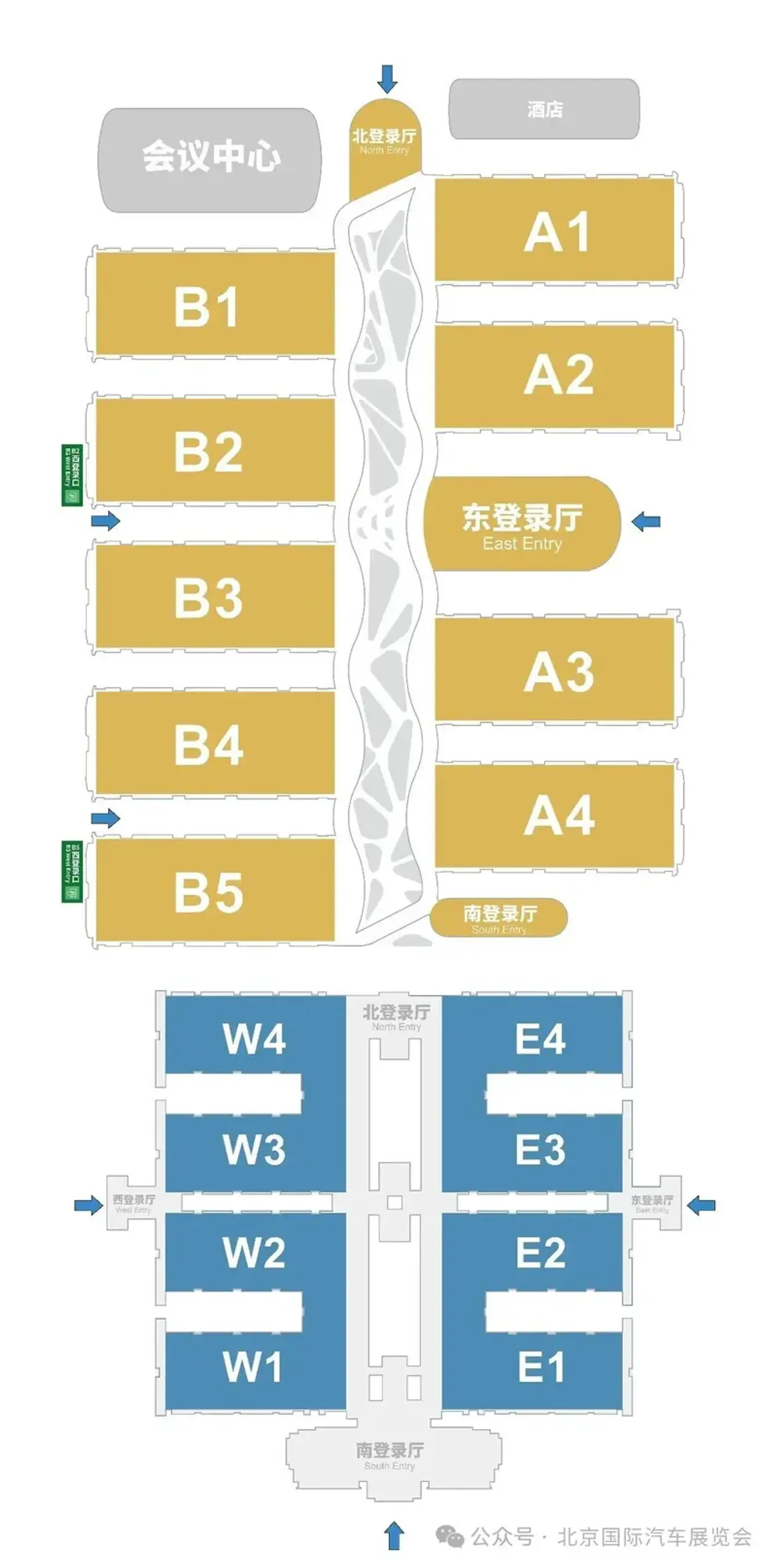
The dual‑venue model links the two exhibition centres via a corridor, creating 380,000 square metres of exhibition space — an increase of 160,000 square metres from the previous edition. A total of 17 halls are spread across both venues, with 13 dedicated to passenger vehicles. The Capital International Exhibition Convention Center is being used for the first time as the “New China International Exhibition Center Phase II”, featuring nine halls and 4,000 underground parking spaces. The venue spans 1.3 kilometres from north to south.
The show runs for 10 days in three phases. April 24–25 are media days, open only to domestic and international journalists. April 26–27 are professional days. April 28–May 3 are public days, coinciding with the Labour Day holiday. Opening hours for professional and public days are 10:00 to 18:00 daily.
The Shunyi venue has eight halls.
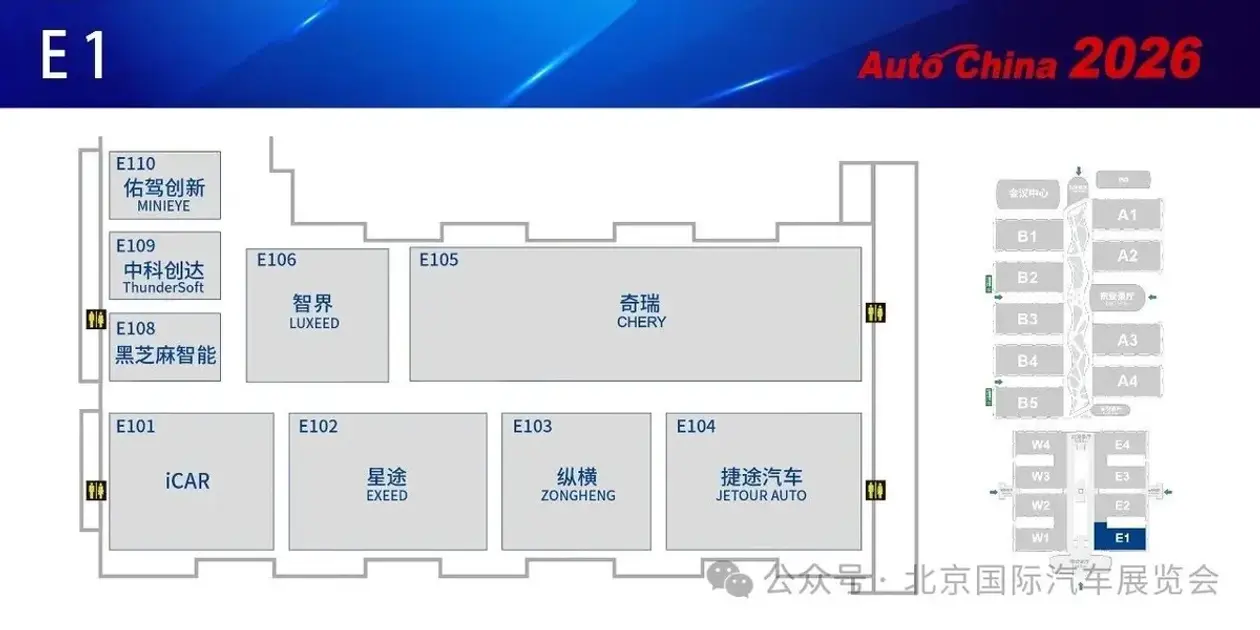
Hall E1 is a dedicated hall for Chery Group, showcasing Chery, iCAR, Exeed, Jetour, and Zongheng — a new luxury hybrid off‑road brand making its Beijing Auto Show debut.
Hall E2 features Nio, Xpeng, and Aito. Nio, Onvo, and Firefly are exhibiting together for the first time. Xpeng is at booth E202, and Aito at E201.
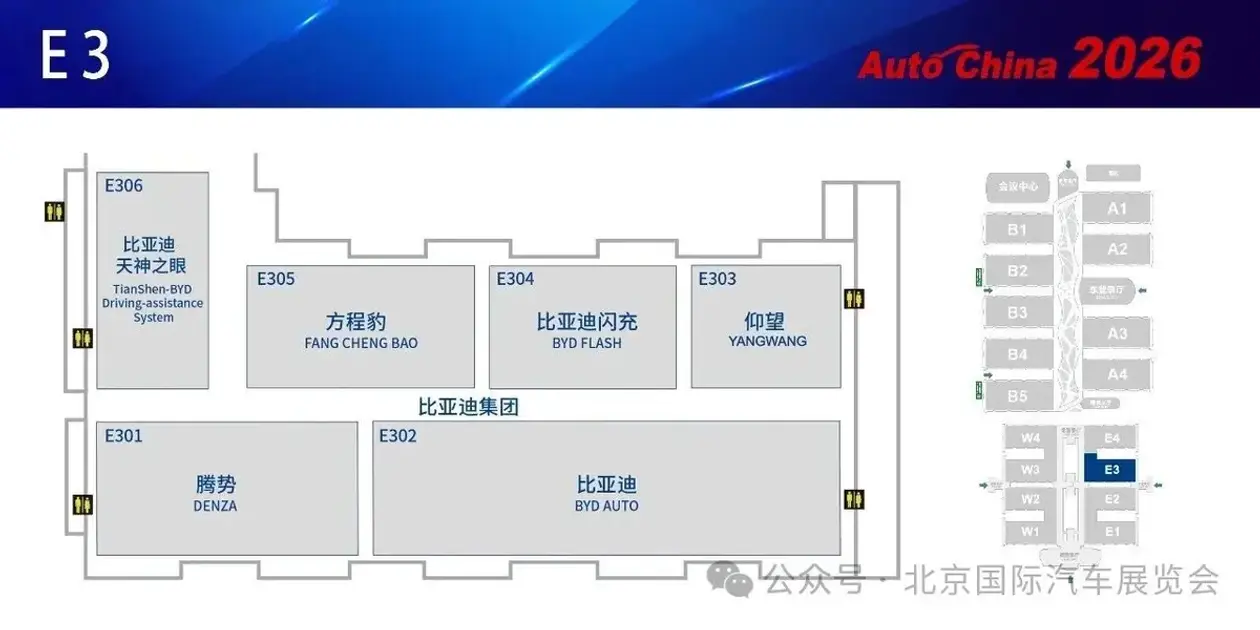
Hall E3 is a BYD Group exclusive, displaying BYD Auto, Denza, Yangwang, and Fang Cheng Bao. BYD Flash Charging and God‘s Eye ADAS have dedicated booths.
Hall E4 is led by BAIC Group, alongside Mercedes‑Benz, Hyundai, and Smart. Mercedes‑Benz is at booth E402.
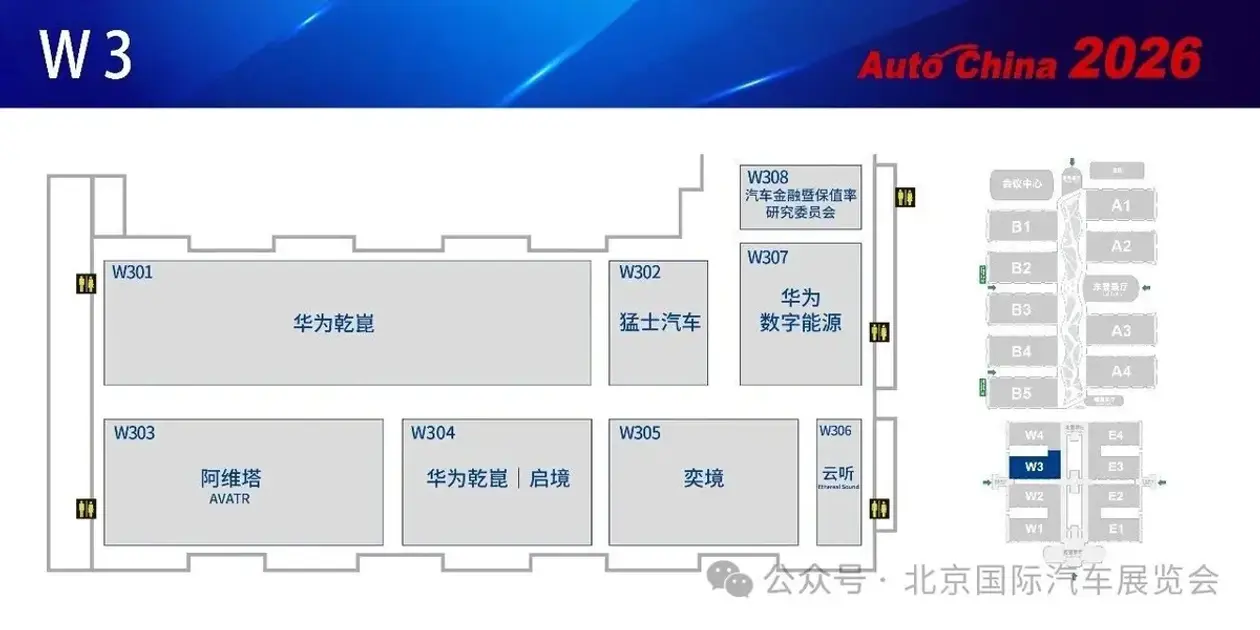
Hall W3 is known as Huawei’s “circle of friends”, featuring Huawei Qiankun, Huawei Digital Energy, Avatr, Yijing, and Qijing. Yijing and Qijing are new “Jing” series brands co‑developed by Huawei with Dongfeng Motor and GAC Group respectively, making their Beijing Auto Show debut.
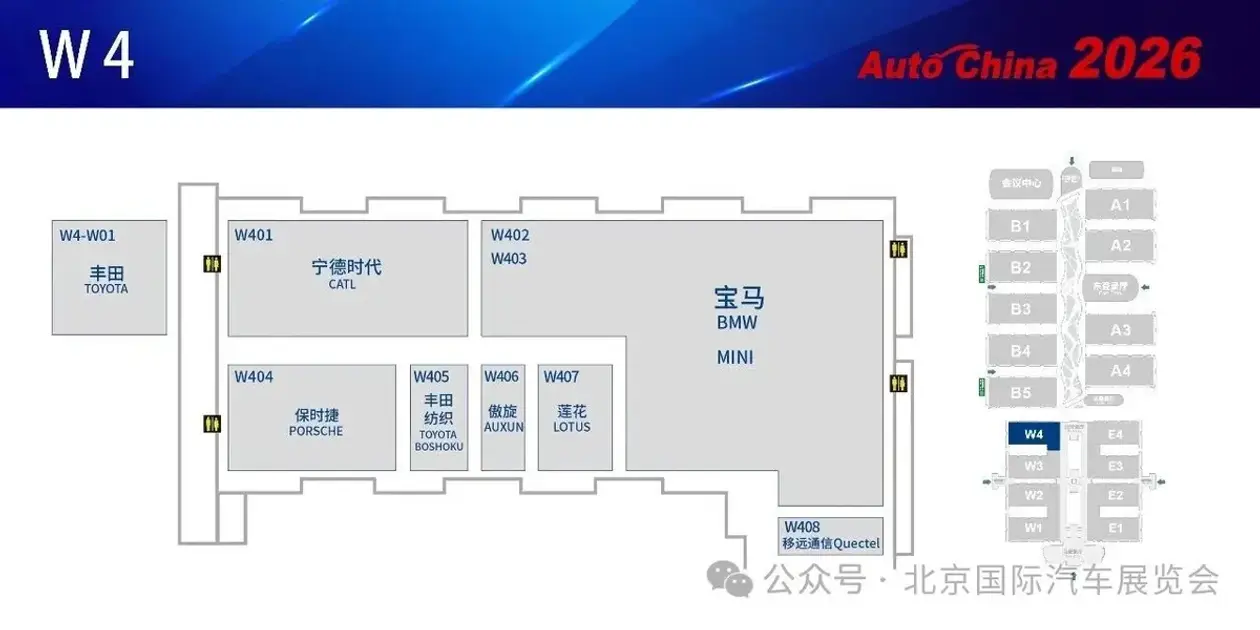
Hall W4 gathers luxury brands including BMW, Porsche, and Lotus. BMW is at booths W402 and W403. CATL has a 1,500 sqm energy technology experience zone.
The new venue has nine halls (A1–A4, B3–B5), primarily featuring new energy vehicle brands.
Hall A1 is dominated by Geely Group and Volkswagen Group. Geely, Geely Galaxy, Lynk & Co, and Zeekr occupy half of Hall A1. Zeekr is at booth A102. FAW‑Volkswagen, SAIC‑Volkswagen, and Volkswagen Anhui share a single booth.
Hall A2 features Hongqi, Cadillac, and Audi. Audi is at booth A205.
Hall A3 hosts GAC Group, Dongfeng Motor, and SAIC‑GM‑Wuling.
Hall A4 brings together Xiaomi EV and Li Auto as neighbours. Xiaomi EV is at booth A402, Li Auto at A401.
Hall B3 is led by Changan Group, alongside Toyota, Lexus, and Lincoln.
Hall B4 features HIMA, Volvo, JAC Group, and Leapmotor. HIMA is at booth B406, Leapmotor at B403.
Hall B5 is a GWM exclusive zone, featuring Haval, GWM Poer, Wey, Tank, Ora, and Soul Motor. Booths are mainly at B501 and B502.
International brands include BMW, MINI, Mercedes‑Benz (including Maybach, AMG and G‑Class), Audi, Volkswagen (including VW Anhui, FAW‑VW, SAIC‑VW), Jetta, Smart, Ford, SAIC‑GM (Buick, Cadillac), Lincoln, Volvo, Toyota, Lexus, Honda, Nissan, Changan Mazda, Hyundai and Beijing Hyundai, Peugeot, and Citroën.
Chinese brands include FAW Hongqi, Dongfeng Motor, Changan Auto Group, BAIC Group, SAIC Group, GAC Group, Geely Auto, Lynk & Co, Great Wall Motor, BYD, Denza, Yangwang, Fang Cheng Bao, Chery Auto, JAC Group, and 212 Off‑Road Vehicle.
New energy brands include HIMA, Nio, Onvo, Firefly, Xpeng, Li Auto, Xiaomi EV, Aito, Zeekr, IM Motors, Shangjie, iCAR, Luxeed, Leapmotor, and Jishi Auto.
Luxury and customisation brands include Porsche, Lotus, Mansory, Aoxuan, Fugu, and Dreame.
A key highlight of this year‘s show is the large‑scale presence of supply chain and component companies in the main exhibition halls. Huawei, CATL, Bosch, Horizon Robotics, Black Sesame, and ECARX are no longer confined to separate component zones but are positioned in prime areas of both venues. The number of countries and regions represented in the component zone has increased from 13 to 21, and the theme has shifted from “Parts & Components” to “Electrification, Intelligence, Digitalisation”.
For visitors, Metro Line 15 to China International Exhibition Center Station is the most convenient option. The Capital International Exhibition Convention Center has 4,000 underground parking spaces for those driving. As the combined venues span 1.3 kilometres, comfortable footwear and ample time are advised.
The 2026 Beijing Auto Show has become the world‘s largest auto show by exhibition area, adopting a dual‑venue format for the first time. From dedicated halls for Chery, BYD, and Huawei, to the convergence of traditional giants and new players, and the debut of supply chain companies in main halls, this year‘s show is not only a visual feast of automotive products but also a vivid reflection of the reshaping of China‘s and the world‘s automotive industry landscape. For Hong Kong car enthusiasts, while visiting Beijing in person requires long travel, coverage from major media will still bring the latest global automotive trends within easy reach.

香港汽車內容平台 🚗 新車・買車・玩車・用車 用香港視角,睇世界嘅車
+ Follow 【新車速報】兩座車又殺返嚟?smart精靈#2今次有啲料喎
鍾意細車嘅香港車迷留意!全新 smart 精靈#2 配置公布,採用 ECA 電動緊湊型架構,搭載 35.8kWh 磷酸鐵鋰電池,CLTC 續航 410km,30%-80% 快充最快15分鐘。
車長約 2.75米、轉彎半徑僅3.35米,仲有前麥弗遜+後五連桿獨立懸架;安全配備最多7個氣袋及 ACC、盲區監測等功能。
0-50km/h 3.8秒,10月12日巴黎車展全球首發!
兩座純電+細車身,放落香港街道會唔會幾對味?
#smart #smart精靈2 #純電車 #BitAutoHongKong 3小时前
【新車速報】兩座車又殺返嚟?smart精靈#2今次有啲料喎
鍾意細車嘅香港車迷留意!全新 smart 精靈#2 配置公布,採用 ECA 電動緊湊型架構,搭載 35.8kWh 磷酸鐵鋰電池,CLTC 續航 410km,30%-80% 快充最快15分鐘。
車長約 2.75米、轉彎半徑僅3.35米,仲有前麥弗遜+後五連桿獨立懸架;安全配備最多7個氣袋及 ACC、盲區監測等功能。
0-50km/h 3.8秒,10月12日巴黎車展全球首發!
兩座純電+細車身,放落香港街道會唔會幾對味?
#smart #smart精靈2 #純電車 #BitAutoHongKong 3小时前  【揀車有路數】日產新車賣比亞迪價?仲有激光雷達
今集試一台好特別嘅日產新車——NX8,中國特供增程SUV。外觀似熟悉嘅日產味,但內籠同科技配備竟然唔晒傳統日產套路,駕乘感受又有幾多轉變?到底仲係咪你認識嗰部日產?一齊試畀你睇。
#日產 #NX8 #增程 #BitAutoHongKong #揀車有路數 1天前
【揀車有路數】日產新車賣比亞迪價?仲有激光雷達
今集試一台好特別嘅日產新車——NX8,中國特供增程SUV。外觀似熟悉嘅日產味,但內籠同科技配備竟然唔晒傳統日產套路,駕乘感受又有幾多轉變?到底仲係咪你認識嗰部日產?一齊試畀你睇。
#日產 #NX8 #增程 #BitAutoHongKong #揀車有路數 1天前  【新車速報】T-Top 回歸?Nissan Z Kaze 概念車現身!
90年代 JDM 味返晒嚟?Nissan 最近喺美國 ZCON 公開 Z Kaze 概念車,以現款 Nissan Z 為基礎,換上全新 T-Top 可拆式車頂,向經典 300ZX 等 Z 系列致敬。
配合碳纖維空力套件、NISMO LMGT2 18吋輪圈,以及 GReddy 排氣、進氣同 intercooler 升級,成部車都充滿 JDM 改裝味。
「Kaze」即係日文「風」,而呢部車係 one-off 概念作品,並非量產車。10月3日仲會現身加州長灘 Japanese Classic Car Show。
如果 T-Top Z 真係量產,你會唔會心動?
#NissanZ #ZKaze #TTop #JDM #BitAutoHongKong 1天前
【新車速報】T-Top 回歸?Nissan Z Kaze 概念車現身!
90年代 JDM 味返晒嚟?Nissan 最近喺美國 ZCON 公開 Z Kaze 概念車,以現款 Nissan Z 為基礎,換上全新 T-Top 可拆式車頂,向經典 300ZX 等 Z 系列致敬。
配合碳纖維空力套件、NISMO LMGT2 18吋輪圈,以及 GReddy 排氣、進氣同 intercooler 升級,成部車都充滿 JDM 改裝味。
「Kaze」即係日文「風」,而呢部車係 one-off 概念作品,並非量產車。10月3日仲會現身加州長灘 Japanese Classic Car Show。
如果 T-Top Z 真係量產,你會唔會心動?
#NissanZ #ZKaze #TTop #JDM #BitAutoHongKong 1天前 Get the latest car news first!
【新車速報】兩座車又殺返嚟?smart精靈#2今次有啲料喎
鍾意細車嘅香港車迷留意!全新 smart 精靈#2 配置公布,採用 ECA 電動緊湊型架構,搭載 35.8kWh 磷酸鐵鋰電池,CLTC 續航 410km,30%-80% 快充最快15分鐘。
車長約 2.75米、轉彎半徑僅3.35米,仲有前麥弗遜+後五連桿獨立懸架;安全配備最多7個氣袋及 ACC、盲區監測等功能。
0-50km/h 3.8秒,10月12日巴黎車展全球首發!
兩座純電+細車身,放落香港街道會唔會幾對味?
#smart #smart精靈2 #純電車 #BitAutoHongKong 3小时前 【揀車有路數】日產新車賣比亞迪價?仲有激光雷達
今集試一台好特別嘅日產新車——NX8,中國特供增程SUV。外觀似熟悉嘅日產味,但內籠同科技配備竟然唔晒傳統日產套路,駕乘感受又有幾多轉變?到底仲係咪你認識嗰部日產?一齊試畀你睇。
#日產 #NX8 #增程 #BitAutoHongKong #揀車有路數 1天前 【新車速報】T-Top 回歸?Nissan Z Kaze 概念車現身!
90年代 JDM 味返晒嚟?Nissan 最近喺美國 ZCON 公開 Z Kaze 概念車,以現款 Nissan Z 為基礎,換上全新 T-Top 可拆式車頂,向經典 300ZX 等 Z 系列致敬。
配合碳纖維空力套件、NISMO LMGT2 18吋輪圈,以及 GReddy 排氣、進氣同 intercooler 升級,成部車都充滿 JDM 改裝味。
「Kaze」即係日文「風」,而呢部車係 one-off 概念作品,並非量產車。10月3日仲會現身加州長灘 Japanese Classic Car Show。
如果 T-Top Z 真係量產,你會唔會心動?
#NissanZ #ZKaze #TTop #JDM #BitAutoHongKong 1天前  BAWToyotaBYDZeekrGACDongfengXPengMGMaxusLeapmotorDenzaIMiCAURDeepalWulingOraJuneyao AutoKYCSkyworthAvatrFotonFordGeelyHongqiJAECOOKGMOMODADFSKTeslaHondaBMWMercedes-BenzsmartMINIPorscheNissanLexusSuzukiVolvoSubaruMazdaKiaHyundaiLand RoverRolls-RoyceFerrariAudiLamborghiniRiddaraSeresFarizonfireflyLingboxKaiyiVoyahHIMAM-HeroIsuzuBentleyPolestarMcLarenMitsubishiMaseratiPeugeotAston MartinAcuraJeepJaguarLotusVolkswagenEpiclandJACLepasLi
 © 2024 Bitauto.com. All Rights Reserved.
Bitauto (www.yiche.com and www.bitauto.com) is one of the most visited automotive websites in China. We provide detailed info on Chinese car brands available in your area. Please note that the information provided on this website is based on publicly available data and is for reference only. It may not be fully updated or accurate at all times.
Help us improve our website


