首頁Sales

搜尋歷史
熱門搜尋
經銷商登入 / 註冊

The global automotive market in the first half of 2026 delivered its results amidst multiple shifts: escalating geopolitical conflicts, repeated supply chain disruptions, and the electrification transition entering a critical phase. Looking at internationally mainstream automakers with announced data, the sales landscape shows significant differentiation: Japanese, German, and American traditional giants generally face pressure and decline, while some Chinese independent brands and automakers focusing on emerging markets achieve resilient growth. This structural reshuffle reflects the profound reshaping of the global automotive industry landscape.
Toyota Retains Sales Crown, Multiple Chinese Brands Reach the Top Tier
According to the official H1 2026 global sales data announced by each automaker, Toyota Motor remained the sales champion for the first half of the year, with global sales of approximately 5.39 million units, a year-over-year decrease of 2.8%. This marks the first time Toyota has seen a year-over-year decline in global H1 sales in two years. The Volkswagen Group ranked second globally with approximately 4.126 million sales, with the year-over-year decline widening to 6.3%, a gap of 1.26 million units from Toyota. The Hyundai Motor Group (combined Hyundai and Kia) had a total H1 sales of approximately 3.579 million units, overall performance relatively stable, holding the third place globally.

(Note: Some automakers have not yet announced H1 sales data)
The Stellantis Group ranked fourth with H1 sales of 2.958 million units, the only traditional giant achieving double-digit positive growth, with a year-over-year increase of 11%, demonstrating surprising resilience and elasticity. Stellantis Group H1 global sales were approximately 1.36 million units in the first quarter, a year-over-year increase of 12%; 1.597 million units in the second quarter, a year-over-year increase of 10%, mainly driven by the North American and European markets.
General Motors delivered approximately 2.721 million units in the first half of the year, a year-over-year decrease of 8.9%. However, benefiting from the high premium of North American pickups and SUVs, its sales revenue instead grew counter-trend slightly to $91.7 billion, showing the rare characteristic of "volume down, profit stable".
Notably, Chinese brands occupy three spots on the top 10 list. BYD's cumulative sales reached 1.809 million units in the first half of the year, a year-over-year decrease of 15.7%. Geely's total sales for the first half of the year were approximately 1.423 million units, including brands such as Geely, Lynk & Co, and Zeekr, a slight year-over-year increase of 1%, with new energy product penetration reaching 56%. During the same period, Chery Group's total sales for the first half of the year reached 1.358 million units, a year-over-year increase of 7.7%, setting a new historical high. Among them, June single-month sales were 256,612 units, a year-over-year increase of 9.8%.
Japanese automaker Suzuki's total sales for the first half of the year were 1.8 million units, a significant year-over-year increase of 110.3%. The company saw sales growth in markets such as India, Indonesia, Pakistan, and Africa, driving its overseas H1 sales to a new record. Nissan's sales for the first half of the year were 1.506 million units, a year-over-year decrease of 6.7%, continuing the sluggish trend of recent years.
Traditional Giants Lose Speed: Loss of China Market Resonates with Middle East Geopolitical Impact
In traditional automakers where performance declined, the sluggish sales in the China market, the spillover effects of Middle East geopolitical conflicts, US tariffs, and the retreat of electric vehicle policies, together formed the "headwinds" suppressing their global performance.
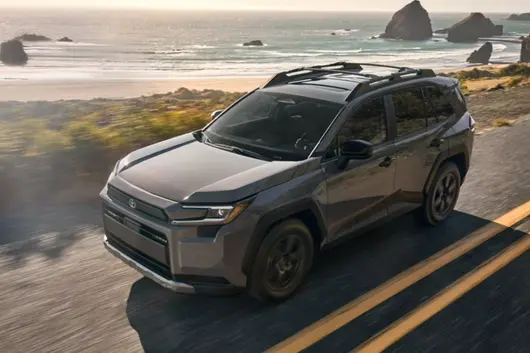
An announcement issued by Toyota Motor at the end of July stated that due to weakening demand in the Chinese market and the drag from model replacement adjustments of the popular model RAV4, the company's global production and sales in the first half of the year saw a decline. From January to June this year, Toyota's sales in the Chinese market plummeted by 17.1%, offsetting demand growth in the North American and Japanese markets. In the announcement, the Toyota Group stated: "North American and Japanese market demand is stable, demand for hybrid models and other models in the North American market remains strong, but was offset by the decline in sales in the Chinese market."

Image Source: Toyota Motor
Geopolitical conflict combined with fierce competition in the Chinese market has begun to impact the profit records set by Toyota in the previous fiscal year. In June this year, sales of Toyota and Lexus brands in the Middle East region decreased by 24% year-over-year, while sales in the Chinese market decreased by 27% year-over-year. At the performance conference in May this year, Toyota stated that the automaker exports approximately 500,000 to 600,000 vehicles to the Middle East annually, and the company estimates that nearly half of the export volume could be impacted by the situation in the Middle East.
However, Toyota also adjusted the combined sales forecast for automobiles upwards by 100,000 units from the previous forecast, to 9.7 million units, a figure higher than the previous fiscal year's total sales of 9.595 million units. Toyota stated that the upward adjustment originated from strong demand in North American and European markets, while alternative logistics channels to the Middle East were completed, driving a recovery in local sales.
Volkswagen Group's performance pressure in the first half of the year was also highly concentrated in the Asia-Pacific market, where the decline in the Chinese market was particularly obvious. Volkswagen delivered 24% less in the Asia-Pacific market in the first half of the year, and deliveries in the Chinese market decreased by 25.9% year-over-year. From the perspective of sub-sectors, the downward trend of pure electric models is particularly significant: from January to June this year, Volkswagen Group's deliveries of pure electric models in China plummeted by 47.9%. Volkswagen also had a difficult situation in the North American market in the first half of the year, with pure electric business performance particularly pronounced. In the first half of the year, the group's sales of pure electric models in North America fell sharply by 68.8%, plummeting from 31,300 units in the same period last year to only 9,800 units in the first half of the year.
General Motors' global deliveries for the first half of the year decreased by 8.9%, but supported by stable prices and strong demand for pickups and SUVs, global sales revenue still climbed slightly, demonstrating the profit moat of the North American market. However, General Motors' performance in the Chinese market was also not optimistic, as its joint venture brands face all-round siege from Chinese local brands.
Chinese Brands: From Domestic Fierce Competition to Global Offense
Represented by automakers such as BYD, Geely, and Chery, Chinese automakers ranked high on the global sales list in the first half of the year, showing an unprecedented scale presence for Chinese brands. These three automakers supported overall sales with explosive growth in overseas markets. The core engine of these brands' growth has shifted from domestic to overseas, and the globalization of Chinese automakers is changing from slogans to reality.

Image Source: BYD
Although BYD's total sales declined in the first half of the year, its structural highlight lies in the continuous breakthrough in overseas markets — cumulative overseas sales of passenger cars and pickups reached 789,000 units, a year-over-year increase of 68%, and the proportion of overseas sales to total sales has exceeded 43%. This means BYD has transformed from a "Chinese new energy giant" into a true "global new energy automaker".
BYD's export destinations in the first half of the year showed a layout characteristic of "Latin America leading, Europe breaking out at multiple points, Oceania, Southeast Asia, and Middle East differentiated expansion". Brazil continues to firmly occupy the position of this automaker's largest overseas market, and the top five countries in Europe also rank in the top ten of BYD's export destinations.
Geely's total sales for the first half of the year were approximately 1.423 million units, with outstanding overseas export performance, cumulative exports of 474,228 units, a year-over-year increase of 158%, a figure that has already exceeded the total export volume for the full year of 2025. June single-month exports were 102,874 units, a year-over-year increase of 157%, a month-on-month increase of 21%, achieving year-over-year and month-on-month double growth for six consecutive months, marking that Geely's export business has entered the stage of scale release. Geely's new energy product export sales in the first half of the year were 277,189 units, a surge of 585% year-over-year, with new energy proportion reaching 59%.
As a leader of Chinese brands going global, Chery Automobile accumulated 943,817 exports in the first half of the year, a year-over-year increase of 71.5%, with export proportion approaching 70%, making it a Chinese brand with high degree of internationalization. In July, Chery's exports of automobiles were 202,533 units, a year-over-year increase of 70.1%, breaking the record for Chinese car single-month exports for five consecutive months, becoming the first Chinese automaker to break through 200,000 exports in a single month.
Summary:
In the second half of the year, the global automotive industry will still move forward heavily burdened: weak demand, continuous heating of trade protection, cost increases brought by Middle East turmoil, and logistics and supply chain disruptions, transnational automakers will continue to promote cost reduction, production capacity contraction, and adjustment of electrification pace. These factors will also lead to the global car market still being full of high uncertainty. But a clear trend has been established: with the rise of Chinese automakers, the global automotive industry is accelerating from "Triopoly of Japan, Germany, and America" to "Multipolar Competition".

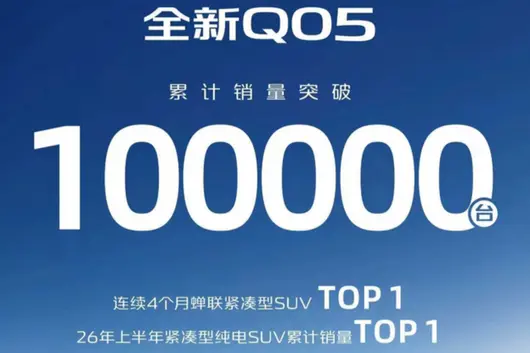
Gasgoo Automotive News August 11, Changan Qiyuan announced, its new Q05 cumulative sales officially exceeded 100,000 units. In July, this model delivered 18,871 units in a single month, ranking first in compact SUV sales for 4 consecutive months, and also won the cumulative sales champion for compact pure electric SUVs in the first half of 2026.
As Changan Qiyuan's main model, the new Q05 is positioned in the 100,000-level pure electric SUV category, with an official starting price of 79,900 yuan. All trims are equipped with CATL battery cells and Golden Shield battery as standard, supporting 3C fast charging, allowing fast energy replenishment to be completed in 15 minutes. The high-spec version is equipped with LiDAR and features a 4nm automotive-grade smart cockpit.

Image source: Changan Qiyuan
In overseas markets, the new Q05 is also accelerating expansion. Previously, this model was launched in Thailand, with orders exceeding 3,000 units in less than half a month after launch. In June, the new car landed in Uzbekistan, completing market expansion from Southeast Asia to Central Asia. Changan will also continue to deepen cooperation with Uzbekistan's local partners, planning to achieve new Q05 CKD local production according to plan next year. At the same time, the car will subsequently enter the markets of Indonesia, South and Central America, and Europe.
Changan Automobile has currently established 79 subsidiaries, 76 factories, and over 19,000 sales and service outlets globally, with nearly 120,000 professional service personnel, and its products are exported to 115 countries and regions.
In July, Changan Qiyuan delivered 39,841 units globally, with the AQ series growing by 103% year-on-year. The new Q05 has become the landmark model for the Qiyuan brand moving from the "Product Launch Period" to the "Sales Realization Period".

[CNMO Technology News] Recently, "Electric Vehicles Going Global" announced the overseas cumulative sales market share of Xpeng Motors from 2020 to the first half of 2026 and the China's New Energy Brands overseas pure electric cumulative sales list. Xpeng Motors firmly ranked first with a cumulative sales volume of 105,245 units. In the first half of 2026, Xpeng Motors' sales in 21 European countries surged by 154% year-on-year.

Xpeng
From the perspective of overseas market share, Xpeng Motors' overseas cumulative sales from 2020 to the first half of 2026 reached 105,245 units. Israel ranked first in sales with 14,189 units, accounting for a 13% share; Norway and Denmark ranked second and third respectively with 11,124 and 9,169 units, with shares of 11% and 9%. France, Germany and other mainstream European automotive markets also contributed considerable sales. Thailand, with 5,297 units, became Xpeng's important foothold in Southeast Asia. Overall, the European market is the focus of Xpeng's overseas expansion, with five of the top six being European countries.

From the perspective of China's New Energy Brands overseas pure electric cumulative sales list, Xpeng Motors firmly ranked first with 105,245 units, significantly leading other brands. Following closely was Leapmotor, with cumulative sales of 77,279 units, ranking second; ORA ranked third with 51,653 units. Cumulative sales for other brands were all under 50,000 units, with specific rankings as follows: AION (44,047 units), ZEEKR (39,899 units), Deepal (31,588 units), Denza (15,427 units), NIO (7,502 units), IM Motors (7,049 units), and Voyah (3,247 units).

According to CNMO Technology, currently, Xpeng's global cumulative sales have exceeded 1.2 million units, with a sales network covering 65 countries and regions, and more than 1,200 stores.


GAC Group officially released July production and sales data on August 4. Overall, the first seven months of this year saw the group's cumulative vehicle sales cross the 886,000 units threshold, achieving a 1.28% year-on-year growth. Notably, cumulative sales of new energy vehicles reached 311,700 units, a surge of 66.20% year-on-year, further increasing the proportion of energy-saving and new energy vehicles in total sales to 63.96%. Meanwhile, the pace of overseas exports for independent brands accelerated significantly, with cumulative exports reaching 145,000 units in the first seven months, a 130% year-on-year soar; this figure has already surpassed the 2025 full-year target. Additionally, in the recently passed July, GAC Group welcomed a major milestone of cumulative production and sales breaking 30 million units.

Focusing on the independent brand segment, its cumulative sales from January to July exceeded 400,000 units, a year-on-year increase of 33.31%. Looking at July alone, independent brand sales exceeded 54,200 units, with a year-on-year growth of 19.91%. By brand, the Hyper Aion BU performed strongly, with cumulative sales reaching 210,400 units in the first seven months, up 62.08% year-on-year; July single-month sales were 28,807 vehicles, up 36.37% year-on-year. As for GAC Trumpchi, cumulative sales this year exceeded 187,100 units, up 9.83% year-on-year, with July sales at 22,739 vehicles. Of note, the newly launched Enjing GT7 delivered 2,658 units in its first full sales month, preliminarily gaining market and consumer recognition.

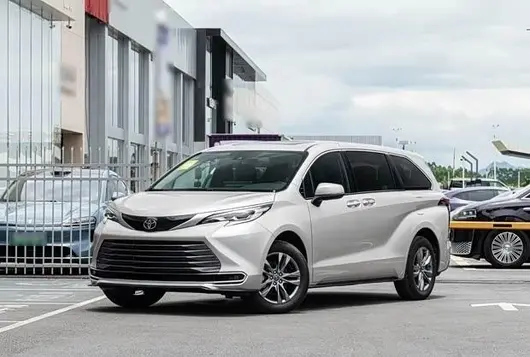
In the joint venture sector, GAC Toyota's cumulative sales from January to July exceeded 402,500 units, with July sales at 46,500 vehicles. The three flagship models composed of Camry, Highlander, and Sienna sold a combined 22,843 units in July, accounting for a high of 49% in the brand's total sales. Meanwhile, the bZ Series continued a stable monthly sales over 10,000 trend, contributing 12,002 vehicles in July, accounting for over 25%; its main model, the bZ3X, had single-month sales of 9,546 vehicles. GAC Honda achieved sales of 11,686 vehicles in July and welcomed a milestone of cumulative sales breaking 11 million units during this period. More importantly, both shareholders of GAC Honda have officially signed a renewal agreement, extending the cooperation period to 2038, aiming to jointly accelerate electrification and intelligence transformation. According to the established plan, GAC Honda will launch 5 new vehicles within the next two years, including two locally developed new energy vehicles and brand new iteration of hybrid products.


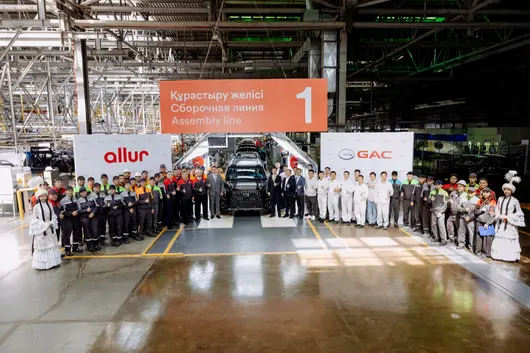
Regarding overseas market expansion, GAC's independent brands reached single-month exports of 23,575 vehicles in July, a 119% year-on-year growth. Reviewing the first seven months, the cumulative export of 145,000 units has already exceeded the annual target. Entering July, GAC's layout in the five major regional markets sped up significantly, focusing on three directions: localization production, new product launch, and policy coordination simultaneously. In the American market, terminal sales increased by 139% year-on-year, with vehicle sales in countries like Uruguay, Costa Rica, Colombia, and Brazil all achieving several-fold growth. Additionally, GAC successfully approved joining Brazil's "Green Mobility and Innovation Plan," marking its deep integration into local green development strategies. In the CIS region, terminal sales increased by 112% year-on-year, and the world's 7th KD factory has officially landed in Kazakhstan, with the first model rolled off the line being the GS8.

Good news continued to spread in the Asia-Pacific market, with terminal sales increasing by 78% year-on-year in July. The Thailand factory has cumulatively achieved over 10,000 complete vehicles rolled off the line, and multiple new models have also landed in the Philippines market. In the Middle East and Africa region, GAC terminal sales increased by 51% year-on-year, and it has officially entered the Morocco market; the first three SUVs launched will cover fuel, hybrid, and plug-in hybrid powertrain types. Meanwhile, GAC maintains a steady breakthrough trend in the European market; especially in the Greek pure electric passenger car market, its market share has increased to 7.7%, ranking second in that market, with model promotion and listing preparation work in multiple countries also being steadily promoted.

In terms of infrastructure, so far, GAC's "9 Verticals and 10 Horizontals" recharging network has covered 31 provinces and 213 cities across the country, achieving the goal of "a station within 1 km in the core urban area". The number of self-operated charging piles exceeds 27,000 units, with supercharging piles breaking 20,000 units. Looking forward to the second half of the year, GAC's product offensive remains strong, planning to heavily launch multiple models including Trumpchi's first hardcore off-road SUV Yue 7, Aion's all-new pure electric coupe RAY 7, and Enjing GX7.

In the July new energy vehicle market, Deep Blue delivered a report card worth attention: global sales of 29,213 units, a year-on-year increase of 7.52%. Cumulative sales from January to July reached 193,369 units, a year-on-year increase of 13.48%. More critically, the brand's global cumulative sales have already surpassed 910,000 units, just one step away from the million milestone. S07 has cumulatively exceeded 300,000 units, S05 has cumulatively exceeded 250,000 units, breaking 30,000 units in a single month for 4 consecutive months. It is indeed rare for a new energy vehicle brand incubated within a central state-owned enterprise system to achieve such speed among Chinese brands. What did Deep Blue do right?

What does the state-owned enterprise system give Deep Blue?
To understand Deep Blue's growth path, one must look back to Changan's strategic layout. Deep Blue's predecessor can be traced back to Changan's "Shangri-La Plan" early exploration. In July 2022, the first model SL03 was launched, and Deep Blue thus became one of the first brands to land in Changan's new energy racing lane. In July 2025, Changan Automobile was officially elevated to Changan Automobile Group, becoming a new central state-owned enterprise. As one of the group's three major digital intelligence new energy brands, Deep Blue's positioning and resource allocation have gained new imaginative space.
The greatest advantage the state-owned enterprise system brings to Deep Blue is the room for error. The new energy vehicle industry is a long-distance race that requires continuous burning of capital. Private enterprises often have to pursue short-term returns in the face of patience in the capital market, while Deep Blue can make long-cycle investments in core technologies. The Origine Super Integrated Electric Drive has cumulatively produced over one million units, with working condition efficiency reaching 94.13%. This number is currently first in the world. The Golden Bell Cover battery won the Second Prize of the National Science and Technology Progress Award twice — this kind of technological breakthrough requiring long-term accumulation is hard to obtain such strong resource tilting in the decision-making logic of private enterprises.

It also did not miss the tactics of the new forces
With the confidence of the system, Deep Blue did not take the old path of traditional state-owned enterprises in products and marketing. The most obvious move was the cooperation with Huawei. Deep Blue S07 is equipped with Huawei Qiankun ADS SE intelligent driving system, becoming the only SUV in the 150,000 yuan-level segment equipped with Huawei intelligent driving. This positioning is very precise — the demand for intelligent driving among consumers in the 150,000 yuan-level segment is already very high, but there are almost none that can provide a Huawei intelligent driving solution at the same price level. Deep Blue made a layout here in advance, forming a differentiated advantage.
The all-new S05 was launched on August 6, with a starting price of 115,900 yuan. It comes standard with a LiDAR across the entire series. Equipping LiDAR starting from the entry-level version is rare in the same class. Deep Blue's thinking is very clear: not using configuration to create differences between high and low trims, but spreading intelligent driving capabilities as basic capabilities. In terms of technical reserves, in the second half of the year, pure electric models will be equipped with 800V high-voltage platforms and 6C supercharging technology.

Overseas layout is also accelerating. The Rayong factory in Thailand has officially started production. S05 ranked first in pure electric SUV registrations in Spain. The global map is advancing from Southeast Asia to Europe. There is also a detail easily overlooked: Deep Blue has announced achieving "phased profitability", being the first among state-owned new energy brands to do so. While most new energy vehicle companies are still struggling in the abyss of losses, Deep Blue has already run through the profitability model, indicating that its cost control and pricing strategy have found a balance point.
After one million, where is the ceiling?
910,000 units to one million units is just one step away, but after one million units, it is an even harder exam. Deep Blue's current main products are concentrated in the 100,000 to 200,000 yuan price range. This is the golden area for volume, but also the battlefield with the thinnest profits. The upward brand pull has not been truly established yet. In the high-end market above 300,000 yuan, Deep Blue has no cards to play. More subtly, within the Changan system, there is Avatr with a higher positioning, and cooperation with Huawei is deeper. How to maintain the brand distinction between Deep Blue and Avatr is a question that Changan Group needs to answer.

Final Thoughts
Looking back at Deep Blue's growth trajectory, its success is not accidental — the state-owned enterprise system's room for error gave the confidence for technical accumulation, the new force's product tactics ensured competitiveness on the market side, and the endorsement of Huawei intelligent driving supplemented the key short board of intelligence. With the superposition of the three, the achievement of today's 910,000 units was born. Deep Blue's sample value as a state-owned new force lies in proving one thing: the system is not a burden, the key lies in how to use it. After 910,000 units, one million units are within sight. What Deep Blue needs to do next is to build a deeper brand moat on top of the scale. On the road of state-owned new energy vehicles, Deep Blue has already walked out a sample worthy of reference.
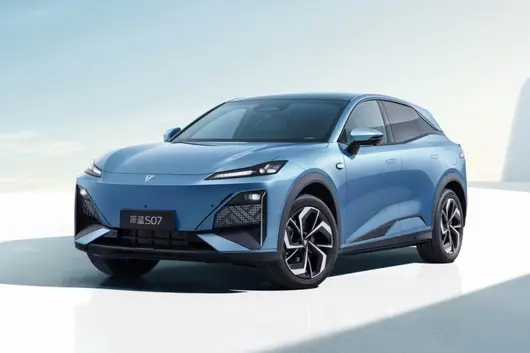
August 4, GAC Group released the July 2026 production and sales summary. Data shows, this July, GAC Group's monthly car production was 103,284 units, down 19.62% YoY; sales were 112,934 units, down 5.48% YoY; Jan-July cumulative production was 900,062 units, down 3.24% YoY; cumulative sales were 886,019 units, up 1.28% YoY.
The new energy segment remains the core driving force. In July, the group's new energy vehicle sales were 51,520 units, up 54.20% YoY; cumulative sales for the first 7 months reached 311,678 units, a YoY increase of 66.20%, with new energy penetration rate rising from about 28% last year to about 35%. Additionally, the combined proportion of fuel-saving and new energy vehicles has risen to 63.96%.

Image Source: GAC Group
Domestic Brand Growth Leads, Joint Venture Camp Shows Divergence
Domestic brands have become the main growth pole of GAC Group. Jan-July, GAC's domestic brand cumulative sales exceeded 400,000 units, up 33.31% YoY; July single-month sales exceeded 54,200 units, up 19.91% YoY.
GAC AION July sales were 28,807 units, up 36.37% YoY; Jan-July cumulative sales 210,386 units, up 62.08% YoY. AION Y series monthly sales maintained over 10,000 level; AION V series listed for two months cumulative deliveries broke 12,000 units, occupying 73.3% share in the 100,000-150,000 RMB class LIDAR smart driving pure electric SUV market. In July, AION officially released the new Ray series models, Hyper S600 also started deliveries simultaneously.
GAC Trumpchi July sales were 22,739 units, down 5.57% YoY, but Jan-July cumulative sales still reached 187,112 units, up 9.83% YoY. This month Trumpchi Wish S7 PHEV launched for sale, fifth-generation GS4 entered the market with starting price of 79,800 RMB.
The high-end smart electric brand Qijing Automotive co-created by GAC and Huawei Kunlun, first model GT7 listed at end of June, July started user delivery, first month sales 2,658 units. Nationwide over 90 cities have established nearly 300 stores, second model GX7 planned release within the year, product matrix gradually taking shape.
Regarding the joint venture sector, GAC Toyota July sales were 46,500 units, down 19.84% YoY; Jan-July cumulative sales 402,500 units, basically flat YoY. Camry, Highlander, Sienna three flagship models July combined sales 22,843 units, accounting for 49% of Toyota brand sales that month. Toyota bZ series new energy vehicles July sales 12,002 units, proportion over 25%, among which Toyota bZ 3X monthly sales 9,546 units, ranking at the forefront of joint venture NEV sales for consecutive months.
GAC Honda July sales were 11,686 units, down 27.11% YoY; Jan-July cumulative sales 80,004 units, down 53.13% YoY. In terms of residual value, Accord ranked first among joint venture mid-size sedans with 55.90% three-year residual value, Breeze ranked second among joint venture compact SUVs with 58.19% three-year residual value.
Worth mentioning, in July, GAC Honda cumulative sales broke 11 million units, both shareholders signed extension agreement extending cooperation period to 2038, and plan to launch 5 new cars in the next two years, including two localized new energy vehicles and iterative hybrid products.
Exports Up 130% YoY, Investment and Charging Ecology Advance Simultaneously
Export business continues high growth trend. July, GAC domestic brand export volume 23,575 units, up 119% YoY; Jan-July cumulative exports 145,000 units, YoY increase reached 130%, already exceeding total export volume of 2025 full year.

GAC GS8 rolled off production line at Kazakhstan production base; Image Source: GAC Group
Looking by region, July Americas market terminal sales up 139% YoY, Uruguay, Costa Rica, Colombia, Brazil markets sales all achieved multiple-fold growth, GAC simultaneously approved to join Brazil "Green Mobility and Innovation Plan". CIS region terminal sales up 112% YoY, global 7th KD factory put into production in Kazakhstan, GS8 model rolled off line. Asia-Pacific market terminal sales up 78% YoY, Thailand Rayong factory cumulative roll-off total vehicles over 10,000; Philippines multiple new cars completed introduction. Middle East and Africa region terminal sales up 51% YoY, July officially entered Morocco market, first batch launched three SUVs, covering fuel, hybrid, plug-in hybrid. Europe side, in Greece pure electric passenger car market, GAC market share increased to 7.7%, ranked second, multiple countries models in launch preparation phase.
As of now, GAC international business has covered 110 countries and regions globally, built 6 overseas production factories, 9 overseas parts warehouses and over 746 sales service outlets, planned to expand to 1000 outlets within the year.
At the industrial chain investment level, GAC Group continues layout around chips, autonomous driving, embodied intelligence, aerospace and other fields. July 27, GAC invested in 2021 domestic DRAM storage chip company CXMT listed on STAR Market, created A-share annual and STAR Market largest fundraising record. Same month, early invested SiC power device manufacturer Basic Semiconductor, autonomous driving company Momenta both listed on HKEX, navigation positioning chip manufacturer Herun Electronics ChiNext IPO accepted.
As of now, GAC has invested in including Horizon Robotics, Yixin Semiconductor, Pony.ai, WeRide, Qingtao Energy etc. over 140 enterprises, accumulated cultivating at least 48 invested enterprises successfully listed.
Charging infrastructure construction accelerating simultaneously. GAC "9 Vertical 10 Horizontal" charging network has covered 31 provinces 213 cities nationwide, achieved core urban area "straight 1 km must have station" density; self-operated charging piles over 27,000, among which supercharging piles broke 20,000. In addition, multiple charging pile products first obtained 3C certification, covering public fast charging, heavy truck charging, destination slow charging etc. scenarios.
According to plan, second half of this year GAC will launch Trumpchi first hard-core off-road SUV, AION new pure electric coupé, Qijing GX7 etc. multiple new models. Facing industry stock competition intensified and new energy penetration rate continuous climbing trend, GAC Group is simultaneously advancing "Stabilize Joint Venture, Strengthen Domestic Brand, Expand Ecology" three major tasks, with overseas expansion and industrial chain deep layout solidify mid-to-long term competitiveness foundation.
In 2026, the Chinese car market, on the surface, is still moving forward, but the underlying tone is not easy. On one hand, NEV penetration continues to rise, with new cars arriving one after another; on the other hand, promotions, price cuts, and benefit increases have basically become the norm.
It is worth noting that selling cars does not mean profit remains. You should know that the most uncomfortable part of this industry is not the lack of sales, but that many enterprises are exchanging profit for market share and cash flow for voice.
Entering July, the market pressure did not suddenly disappear. According to data released by the China Passenger Car Association, from July 1st to 26th, national passenger car retail was 1.123 million units, down 18% year-on-year and 13% month-on-month. From here, it is clear that consumers are more cautious about buying cars, and enterprises can no longer solely rely on a round of marketing hype to push up sales.

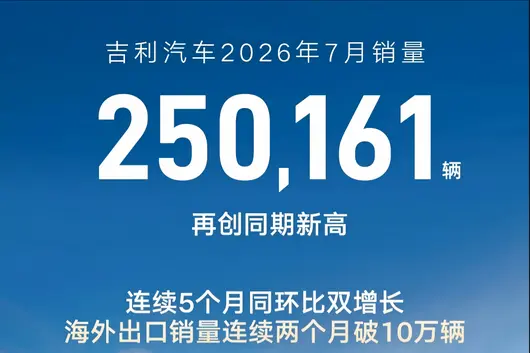
However, precisely against this backdrop, Geely Automobile delivered a July «report card» with quite a sense of contrast. Its single-month sales reached 250,161 units, making Geely Automobile the only company in the industry to achieve month-on-month and year-on-month double growth in sales for five consecutive months. Among them, NEV sales (including Geely Automobile, Lynk & Co, ZEEKR) were 160,165 units, up 23% year-on-year, accounting for 64% of total sales. More worth pondering is that Geely Automobile's overseas exports also reached 106,663 units, up 202% year-on-year and 4% month-on-month, achieving double growth year-on-year and month-on-month for seven consecutive months.
You should know that these are not numbers easily exchanged by «lowering the price a bit more» and «pumping volume more fiercely». Because the market today no longer lacks a car that becomes popular in the short term; it lacks a system that can continuously meet demand: mainstream markets need scale, high-end markets need brand momentum, fuel users cannot be abandoned, and NEV users must be persuaded; the domestic market needs stability, and the overseas market must have new growth.
Therefore, what is truly worth looking at in Geely Automobile's July report card is not the result of 250,000 units itself, but where these 250,000 units come from, what supports them, and whether they can continue. When the industry is generally under pressure, why can Geely Automobile still run its own rhythm? Let's explore it together!
Not just «one best-selling model», but a product matrix that can fight
If you break down Geely Automobile's July sales by company, you will find that its growth logic is not single-line.
Geely Brand sales for the month were 197,942 units, up 2% year-on-year, still constituting the most solid basic base of this automaker. Looking down, Geely Galaxy sold 107,797 units, up 13% year-on-year; China Star Series sales were 90,145 units, up 15% month-on-month; ZEEKR deliveries were 35,837 units, a big jump of 111% year-on-year; Lynk & Co sales were 16,382 units, among which NEV products reached 14,069 units. The meaning of these numbers lies not in every brand having to become «Number One», but in different price bands, energy routes, and usage scenarios having relatively clear successors.

Let's look at Geely Galaxy first. It bears the scale task of the mainstream NEV market. Star Wish July sales were 55,105 units, up 24% year-on-year and 8% month-on-month, cumulative sales breaking 800,000 units. For a volume-selling car, the true test has never been whether it can create hype at launch, but whether it can still retain users after rapid product iteration and frequent price cuts by competitors. Continuous sales performance shows that Galaxy is not just hitting the rhythm in a certain window period; it has begun to possess the ability to output stably.

Next is ZEEKR. 35,837 units of monthly delivery and a 111% year-on-year increase are not just a number change in the high-end NEV market. It exactly shows that in the process of Geely Automobile moving upwards, it did not understand high-endization as «more expensive configuration sheets», but is strengthening the combined force of brand, technology, and product experience. Products such as ZEEKR 9X, Refreshed ZEEKR 009, and 7X have successively progressed for delivery, targeting different battlefields such as high-end SUVs, luxury MPVs, and global pure electric markets. Users of high-end cars are not insensitive to prices, but they care more about whether a car is complete enough—design, performance, intelligence, safety, and service cannot focus on just one item.

Compared to ZEEKR, Lynk & Co undertakes the group's «broader» task. It did not crowd into the same comfortable home-use track with all brands, but continues to strengthen sports and travel attributes. In July, Lynk & Co 07 GT went on sale and 10,000 large orders were broken in 27 minutes, although this data comes from the enterprise disclosure standpoint. But it at least reflects a trend: when NEV products gradually look more and more alike, products that can provide clear driving personality and scene value are actually easier to be remembered.

And besides NEV cars, don't ignore fuel cars. When many people talk about NEV transformation, they habitually view fuel businesses as «old burdens» that need to be discarded as soon as possible. But for an automaker pursuing operating quality, fuel cars are still important cash flow and user foundations. In this regard, Geely China Star continues to consolidate fuel car market competitiveness. China Star July sales reached 90,145 units, up 15% month-on-month; the Double Bin Family sales were 31,152 units, up 68% year-on-year. This means Geely Automobile did not use NEV to hard confront and replace all demand, but retained different user choice rights during the transformation process.
From here, it is not difficult to see that this is where the synergy of Geely's four brands is most valuable: Galaxy is responsible for deepening and expanding the mainstream NEV market, ZEEKR is responsible for breakthroughs in high-end value zones, Lynk & Co defends youthful, sporty, and personalized expressions, and China Star stabilizes the basic base of fuel car users. They are not four teams fighting independently, but jointly undertaking growth tasks in different segmented markets.

More importantly, the value of the matrix is not just «many cars». From the appearance of Galaxy TT and Galaxy Warship 700, to the successive deliveries of new ZEEKR and Lynk & Co products, to the product renewal of China Star, Geely is expanding product boundaries to more scenarios such as sedans, SUVs, MPVs, wagons, and NEV off-roading. If the new product rhythm of some automakers can ultimately be converted into continuous delivery and reputation, this matrix will be upgraded from «coverage» to «moat».

Thus, the answer to the question is already becoming clear. Geely Automobile's counter-trend is not relying on a single car suddenly exploding, but relying on a product system that relays to each other. When market demand becomes more fragmented and pickier, try not to let users flow elsewhere. What needs to be seen next is why this system can not only sell cars domestically but also extend growth overseas.

Exports Break 100,000 in Two Consecutive Months, From «Product Going Overseas» to «Value Going Overseas»
In the past, Chinese car exports were often understood as a business of «sending products overseas»: finding importers, laying out channels, grabbing market share. This road can be run fast, but not necessarily far. Because the competition for NEVs is not just battery capacity and screen size on the configuration sheet; it also has to face charging conditions, after-sales response, financial solutions, regulatory standards, and even user trust in the brand in different countries.

The difference in this round of Geely Automobile's overseas growth lies in it starting to do three things at once: using NEV products to open the mainstream market, using high-end brands to raise the value ceiling, and using local partnerships to turn one-time sales into long-term operations. The three lines are not fighting independently, but are jointly answering the same question: how to enter the core price band of the global car market without relying on low prices.
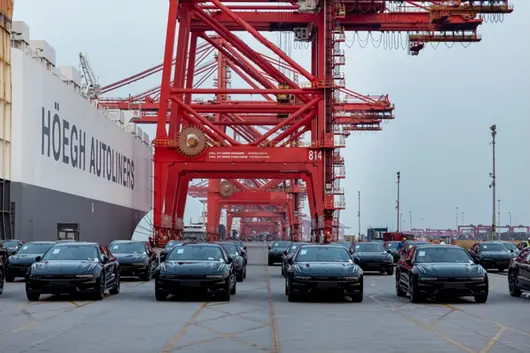
From the data perspective alone, Geely Automobile's overseas exports in July were 106,663 units, achieving month-on-month and year-on-month double growth for seven consecutive months, breaking the 100,000 unit threshold for two consecutive months. The export volume has accounted for 42% of total sales, supporting nearly half of the business. More含金量 (worthiness) is the export structure. Its NEV product exports in July were 62,604 units, surging 616% year-on-year, accounting for 59% of total export volume. In August, Star Wish will enter the broad A0-class Australian market, with a price of 124,000-146,000 RMB, and gross profit margin significantly higher than domestic.
From specific market performance, Geely Automobile's products have already established a foothold in multiple global markets. Geely Star Wish (Geely EX2) ranked first in Thailand EV sales, second in Brazil EV, and second in Mexico pure electric models; Star Ship 7 EM-i (Geely EX5 EM-i) ranked first in Poland C-class PHEV market single model sales, second in Mexico June PHEV segmented market sales, also topping the plug-in hybrid list in Slovenia, Bulgaria and other markets, and ranking second in Mexico plug-in hybrid segmented market.

The overseas expansion of high-end brands is also noteworthy. Since the launch of Lynk & Co 08, global cumulative deliveries have reached nearly 190,000 units, ranking in the top three of Mexico high-end plug-in hybrid SUV and Morocco mid-size plug-in hybrid SUV sales in the first half of the year; ZEEKR ranked first in Australian and Malaysian luxury pure electric brand sales in the first half of the year. ZEEKR 7X ranked first in multiple segmented markets including Australia mid-size SUV over 65,000 AUD, Malaysia luxury EV, Morocco luxury electric SUV, Egypt mid-size luxury electric SUV, and ZEEKR 009 firmly stays at the top of Thailand and Malaysia luxury pure electric MPV sales.
At the same time, ZEEKR's global territory is still expanding rapidly. Among them, ZEEKR 007GT officially landed in 16 European countries; ZEEKR 7X exceeded 1,000 pre-sale orders in South Korea, with high-middle and high-spec ratio as high as 94%; ZEEKR also became the first Chinese high-end automobile brand to land in East Malaysia, and channel networks continue to sink. Geely Automobile's overseas expansion has never been simply «selling cars abroad», but walking the route of localized operations, reducing risks and improving efficiency through win-win cooperation.

Besides product overseas expansion, Geely Automobile continues to promote localized operation capability construction. In July, Geely Automobile reached an agreement with Ford. The two parties will establish a joint venture company at Ford's Valencia, Spain factory to produce NEV models for the European market through capacity sharing. This light asset cooperation model can quickly cut into core European markets without building factories from scratch, and can effectively counter tariffs and geopolitical policy risks. Both domestic and overseas brokerages have consistently expressed看好 (look favorably). Additionally, on the channel end, Geely Automobile is also promoting simultaneously. Geely Automobile has formally signed with Pakistan comprehensive enterprise group Bestway Group, authorizing it as Geely Galaxy's official importer in Pakistan. It will officially enter the Pakistan market in Q3 this year, initially introducing two pure electric SUVs Galaxy E5 and Star Wish, continuously developing emerging markets.

As of July, Geely Automobile has completed 58% of its annual million-export goal, with pace far exceeding industry expectations. With ZEEKR 9X landing in the Middle East and i-HEV hybrid technology going overseas in the second half of the year, this second growth curve of globalization will continue to release profit potential and become an important support for Geely Automobile to traverse the domestic cycle.
Technical Moat
Why can Geely Automobile maintain profitability in an «bleeding» industry environment? Besides brand and market success, the fundamental reason lies in its deep technical moat. When price wars are fought fiercely, Geely Automobile chose a harder but more correct path: using technology premium to counter price involution.

In core NEV technology, Geely Galaxy released the world's first «Thunder 16-in-1 Smart Electric Drive», completing breakthrough iteration of NEV electric drive underlying technology. This system will be equipped on Geely Galaxy TT first, not only successfully winning «Lowest energy consumption record for mass-produced pure electric cars circling Qinghai Lake» and «Longest continuous dual-car drift on wet roads (electric vehicle)» Guinness World Records, but also controlling 100km/h electric consumption at a surprising level of 8.20kWh. This generational advantage in technology gives Geely Automobile absolute pricing power in the 100,000-200,000 mainstream market.

In the manufacturing field, two core technologies of Geely Automobile won the Second Prize of the 2025 National Science and Technology Progress Award. Whether «Heat-treated Quenching and Tempering Aluminum/Magnesium Alloy and Its Application Technology for Integrated Die Casting» or «Key Technologies and Industrialization of High Safety, High Fault Tolerance, High Efficiency Intelligent Electric Electric Chassis», they all broke the long-term monopoly of overseas enterprises in high-performance materials and high-end chassis fields. This means Geely Automobile can not only make good cars, but also make good cars at lower costs and higher efficiency. This manufacturing cost advantage is the confidence for it to dare to «not lose money» in price wars.

In intelligence, Geely Automobile always insists on safety as the bottom line. On July 21, Geely Automobile obtained the industry's first «Automobile Production Organization Combined Driving Assistance Safety Management System Certification Certificate». In today's era of intelligence driving systems flooding, Geely Automobile did not blindly pursue «futures» functions, but established an industry-leading safety standardization system through «Qianli Haohan» intelligence driving system. In the second half of the year, Geely Automobile will also set up a «2030 Lab» to tackle frontier fields such as acoustics, optics, digital chassis, embodied intelligence, etc. This «develop one generation, reserve one generation, apply one generation» technical rhythm ensures Geely Automobile products always lead by half a position.
Final Thoughts:
July 250,000 units, five consecutive months of double growth, overseas breaking 100,000 consecutive months, NEV penetration rate 64%. Geely Automobile's report card placed against the backdrop of the industry's overall decline speaks for itself.
But what is worth thinking about more than numbers is the way of growth. Geely Automobile did not participate in bottomless price wars or rely on pressing inventory to pump volume, but covered layered markets through multi-brand synergy, opened up incremental space through high-value overseas expansion, and built competitive barriers through underlying technology. This is a path of «high-quality growth». It is not about who loses less, but who has stronger blood-making ability. From multi-brand synergy to global layout, from technological innovation to product value improvement, Geely Automobile is building a systemic capability to traverse the cycle. As the industry elimination window approaches, this capability may be the hardest hand to stay at the table. Let us look forward to Geely Automobile bringing us greater surprises in the future!
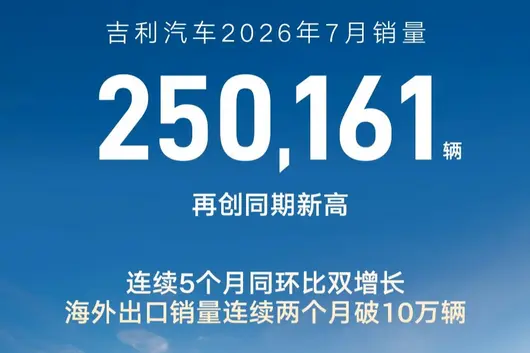

Early August, car makers typically "show off their results". BYD July sales 419,211 units, among them overseas sales 179,841 units, year-on-year increase of 124.3%, accounting for 43% of total sales; Chery Group sales 276,820 units, exports 202,533 units, year-on-year increase of 70.1%, becoming the first Chinese car company to exceed 200,000 monthly exports; Geely Automobile July sales 250,161 units, overseas exports 106,663 units, year-on-year increase of 202%.
Looking at these three sets of data and three representative car companies together, it is not difficult to find that going global has accounted for more than 40% of sales of top car companies.
From the performance of various car companies in the past, the features of going global reflected by this data are not accidental. BYD Chairman Wang Chuanfu has expressed on multiple occasions that BYD's goal is to become a "global new energy enterprise". The 43% proportion in overseas sales in July simply made this goal start to change from a slogan to reality. Chery Holdings Chairman Yin Tongyue also said: "Chery does not want to make easy money at home, but if Chinese cars only run within their own backyard, they will never produce world-class enterprises."

As for the reasons, there are several points worth paying attention to that might explain this. July new energy penetration rate created a historical high of 64.5%, but the retail scale of 1.52 million units itself was at a low level in the off-season. Fuel cars still have about 540,000 monthly sales, accounting for 35.5%. In addition, pure electric continues to strengthen internally within new energy, while plug-in hybrid/extended-range growth has slowed down. The incremental space in the domestic market is narrowing.
Considering the broader context, the attention given by top players to going global can be considered forward-looking preparation. And by this time, going global for more Chinese car companies has no longer been a "choice".
Behind the volume, the change of main battlefield is the general trend
The data of top car companies has raised the volume of going global, which also means that overseas has undoubtedly become the "main battlefield". BYD July overseas sales 179,841 units, accounting for 43% of total sales. January to July overseas cumulative 969,000 units, one step away from 1 million units. 8 RoRo ships fully deployed, annual capacity 1 million units, Thailand, Brazil, Hungary factories started production one after another, Spain's second European factory is under investigation. BYD's going global plan is huge, with the meaning of "going all in".
Chery Group July exports 202,533 units, accounting for 73% of total sales. Refreshing single-month export records for five consecutive months, January to July cumulative exports 1.146 million units, year-on-year increase of 71.2%. According to General Administration of Customs data, Chery is also a "big user" of going global. In 2025, the total export volume of Chinese automobiles is about 8.32 million units, Chery alone contributed 1.344 million units, accounting for more than 16%.

July data this year is even more pointed. Chery Automobile Co., Ltd. (9973.HK) July sales 261,876 units, year-on-year increase of 24.1%, entered the Fortune Global 500 List with the identity of a listed company for the first time, ranking 383rd, Return on Equity (ROE) 36.5%, ranking 30th among globally listed companies, and ranked first among Chinese enterprises. This shows that going global has become a key link for Chery to stand globally.
Geely's setup is also huge. Geely Automobile July exports 106,663 units, year-on-year increase of 202%, exceeding 100,000 units for two consecutive months, overseas proportion 42%. New energy exports 62,604 units, year-on-year surge of 616%, accounting for 59% of total exports. Zeekr brand July deliveries 35,837 units, year-on-year increase of 111%, winning the luxury pure electric sales champion in markets such as Australia, Malaysia, Mexico, etc.

The three top car companies combined went global by about 490,000 units, while the entire domestic narrow passenger car market July retail was also only 1.52 million units. This shows that going global for top car companies is no longer a "supplement", but the "top priority". Li Auto July deliveries 30,468 units, slight decrease of 0.9% year-on-year, but L9 still started local production in Kazakhstan. This is the first step it took overseas, showing that even new forces feel the pressure of "go global or perish".
Of course, trend is one thing, and reality issues cannot be ignored either. Does the "half of the sky" in volume equal the "main battlefield" in quality? This is a question worth further thinking. For example, Chery export proportion is 73%, but domestic monthly sales is only 74,000 units, overseas is three times domestic data. There is a risk here. If policies change suddenly in overseas markets, the impact will be huge.
Going global is really making money, or changing places to "compete"?
Volume is explicit, looking at sales proportion can tell. Profit is implicit, no matter which battlefield, this is an unavoidable issue. From the pricing space perspective, overseas markets indeed have more advantages than domestic. The price war in domestic car market has been fought for several years. July terminal average discount narrowed month-on-month, but overall is still in price competition. BYD Dynasty and Ocean series domestic main sales 100,000-200,000 yuan interval, price pressure is huge, but sold for good money abroad.
Chery's first complete financial report after listing also shows that Chery's average selling price per car overseas is 15,000 yuan more expensive than domestic. In Middle East, Jetour Traveler high-spec version sells to 450,000 yuan, twice as expensive as domestic. BYD's Fang Cheng Bao, Denza and other high-end brands are also accelerating going global, overseas single car average price far higher than domestic.

Geely's situation is also similar. Zeekr brand average price exceeds 300,000 yuan, positioning as luxury brand in Australia, Malaysia and other markets, premium pricing power far higher than domestic. Behind the new energy exports surging 616% year-on-year, it is high value-added products supporting, not low price walking volume. This shows that actually high-quality models overseas still have profit space.
However, hidden costs are also fierce. European Union imposing anti-subsidy duties on Chinese electric vehicles, United States market basically closed to Chinese car companies, tariff barrier costs should be calculated. So far, overseas is indeed worth fighting, but laying out overseas now might become more difficult, costs will also be higher.

After all, going global input is not a small number. BYD self-built 8 RoRo ships, built factories on three continents, input is billions level. Chery South Africa Roslin plant launched, Spain cooperation re-activated EBRO brand; Geely reached Ford Spain Valencia factory joint venture agreement and other operations behind, also money paving the way.
Currently mainstream car companies tried three going global modes, benefits and risk performance are completely different. For example, early Chery was pure product export model, profit margin medium, front investment low, but risk high, tariff and policy fluctuations could disrupt rhythm at any time. BYD walked product + capacity localization model, long term view profit margin higher, but front investment extremely high, testing global supply chain management and cross-cultural operation capabilities. Geely used technical cooperation + capacity sharing model, path lightest, but control ability will also correspondingly weaken.

New forces now have their own understanding. NIO July deliveries 35,934 units, year-on-year increase of 71%, battery swap station network in Europe continued to layout. Leapmotor July deliveries 101,267 units, year-on-year increase of 102%, first time breaking 100,000 units threshold, first half year overseas exports nearly 100,000 units, already exceeded last year full year. XPeng July deliveries 38,027 units, year-on-year increase only 4%, but in Germany completed XPeng Turing AI Smart Driving localization acceptance testing. Overall, new forces walk mostly differentiated route.
Can only say, going global has "profit" to earn, but absolutely not a smooth path. Overseas also need to "compete", but worth it depends on profit.
"Main battlefield" conversion behind, or domestic market incremental "not enough to share"
Going global why being pushed to "main battlefield" position, domestic market incremental space narrowing is fundamental factor. July new energy retail about 980,000 units, among them pure electric proportion about 60%, pure electric internal to new energy continues to strengthen, plug-in hybrid/extended-range growth slowed down. This means, "oil and electric" market share is being squeezed by pure electric quickly, pure electric acceptance is continuously improving.
New forces differentiation also proves this. Leapmotor July deliveries break 100,000 units, becoming domestic first single month deliveries exceed 100,000 units new force brand. Its success relies on covering 60,000-300,000 yuan full price product matrix, and overseas market simultaneous explosion. Li Auto July deliveries 30,468 units, slight decrease of 0.9% year-on-year, decrease of 1.4% month-on-month, only double decrease brand among top new forces. There indeed exists i6 due to supply chain issues reduced production about 4,000 units special situation, showing brand dependence on single model is still risk. NIO July deliveries 35,934 units, decrease of 11.5% month-on-month, even three brands collaboration exerting force, but still did not achieve effective complement between brands.

Another aspect, fuel car toughness is still there. July fuel car retail about 540,000 units, market share 35.5%. Sylphy, Lavida still firmly stable in sedan top three, Japanese SUV year-on-year decline over 10%, but not "cliff-like drop". Fuel car stock user replacement cycle still there, short term will not disappear. All this points to one core contradiction: domestic market "cake" is getting bigger, but cake stealing car companies do not yield to each other, competition is continuously intensifying.
BYD domestic monthly sales 239,000 units, already approaching single car company domestic share limit. Leapmotor at 100,000 unit level volume continue to climb, will face capacity bottleneck and supply chain pressure. XPeng July deliveries 38,027 units, new model MONA L03 orders hot but capacity ramp-up is its next biggest test. Xiaomi Auto July deliveries over 30,000 units, fourth consecutive month stuck at this threshold, Peng Cheng series September only listed deliveries, real volume pushing to fourth quarter.

Domestic auto market incremental space narrowing, stock competition new stage arriving, current Chinese auto market, "domestic demand pressure, foreign trade strength" structure or will be future relatively long term trend. Simply put, domestic market this piece of cake, already not enough to share. Not going global, wait to die; going global, maybe still have live road.
Conclusion
From July sales overseas data view, going global now is already car company "main battlefield". Domestic market growth slowing, fuel car won't die fast, stock competition intensifying, going global is inevitable choice. But overseas pricing space larger is fact, but tariffs, building factories, logistics costs not low, different mode profit structure difference huge. Who can win this "main battlefield" battle, now hard to say. Regardless of next battle situation how, Chinese car companies must be clear is, going global is not picking up money, more does not represent domestic market can relax vigilance, how to balance internal and external relations, choose suitable going global mode, is the key.

Facing a fiercely competitive new energy market, Changan Qiyuan maintained a steady pace in July: July deliveries reached 39,841 units, AQ series year-on-year growth reached 103%, consistently holding the top spot in sales of SOE new energy vehicle brands. Together with brands like Geely Galaxy and Leapmotor, it forms the backbone of the mainstream camp of China's new energy market.

Changan Qiyuan's sustained growth in July is the result of the combined effect of product strength and user reputation. From the continued strong sales of Changan Qiyuan AQ series main models, to the global debut of Changan Qiyuan Q06, to Changan Qiyuan's new Q05 accelerating towards the overseas market, the tag of "SOE New Energy" is changing from brand endorsement to tangible quality recognition in users' hearts.
Global Flagship Changan Qiyuan New Q05 Leads, Champion Matrix Synergizes
As Changan Qiyuan's first global flagship product, Changan Qiyuan New Q05 leverages "Full CATL Power, Premium Dimensions, Ultra Comfort" crossover advantages, with cumulative sales exceeding 100,000 units, continuously leading the compact SUV sub-market. In the overseas market, following launches in Thailand and Uzbekistan, Changan Qiyuan New Q05 further landed in Ethiopia, accelerating the overseas formation of Southeast Asia, Central Asia, and Africa market linkages.
While Changan Qiyuan New Q05 exerts force globally, the AQ series increased by 103% year-on-year in July, forming a synergistic growth "Champion Matrix". Among them, Changan Qiyuan A06 is positioned as the "New Energy Family Sedan Fully Loaded King", with crossover configurations such as 145° Electric Zero-Pressure Rear Seat, 800V 6C Fast Charging, etc., consistently holding the sales champion position for mid-to-large new energy sedans within 200,000; Changan Qiyuan Q07 satisfies family user travel needs with the strength of "Space King", cumulative sales have exceeded 100,000 units since launch, maintaining leadership in the mid-size PHEV SUV market.
Changan Qiyuan Q06 Global Debut, Defining New Standards for Mid-size SUVs with "Flowing Light Aesthetics"
On July 15, the brand-new mid-size SUV Changan Qiyuan Q06 completed its global debut in Shanghai. This model, led by the team of world-renowned design master Klaus, broke the traditional dull impression of mid-size SUVs with its original "Flowing Light Aesthetics" design. Inside the cabin, the concept of "Flowing Light Entering Cabin" creates a high-quality immersive space, integrating technology and comfort.

In the field of intelligent driving, Changan Qiyuan Q06 is equipped with the Tianshu Pilot Ultra Intelligent Driving System, possessing end-to-end city pilot capabilities, making vehicle control closer to the driving feel of experienced drivers. The chassis adopts a luxury car-level chassis suspension with all-aluminum front double wishbones + rear five-link, and the dual-motor rear-drive layout unique to its class, balancing comfort and driving fun.
Conclusion
Steady sales and a perfect product matrix constitute the core foundation of growth. In the future, Changan Qiyuan will continue to rely on Changan Automobile's SOE system strength, with a more competitive product matrix and global layout, continuously meeting users' expectations for high-quality new energy travel.
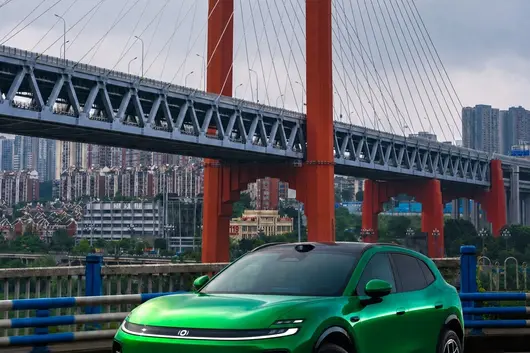

On August 1, Geely Automobile Holdings Limited (0175.HK) announced the latest sales data: July sales reached 250,161 units, with consecutive double growth month-on-month and year-on-year for 5 months, growing 5% year-on-year and 4% month-on-month. Regarding New Energy Vehicles, July sales (including Geely, LYNK & CO, ZEEKR) totaled 160,165 units, growing 23% year-on-year, accounting for 64% of new energy sales.
Globalization strategy is accelerating comprehensively, with overseas exports becoming an important growth driver. July overseas exports reached 106,663 units, a 202% increase year-on-year and 4% month-on-month, achieving consecutive double growth month-on-month and year-on-year for 7 months. New energy product export sales reached 62,604 units, a 616% surge year-on-year, accounting for 59%. Geely continues to promote local operation capabilities in overseas markets, established a joint venture with Ford Motor Company, and accelerated the implementation of the European localization strategy through production capacity sharing.
From the iteration of electric drive technology to the improvement of advanced manufacturing capabilities, and then to the construction of intelligent safety systems, Geely continues to strengthen the technical foundation and promote sales growth with product strength. Geely will establish the 2030 Lab to reserve forward-looking disruptive technologies for the future and achieve industry-leading intelligent experiences.

Diversified product matrix expands growth space Continuous breakthrough into high-value markets
Around different market and user needs, Geely builds a differentiated brand matrix through three major brands, forming a comprehensive product system covering mainstream to high-end, jointly supporting steady growth in enterprise sales.
ZEEKR continues to strengthen market competitiveness in the high-end, with multiple models topping the sales leader in high-end sub-sectors. July deliveries reached 35,837 units, a 111% increase year-on-year. ZEEKR 8X equipped with Qianli Haohan G-ASD H9 version began deliveries in July; ZEEKR 9X ranked first in sales of 500,000 Yuan+ models in the first half of 2026, the five-seat version was officially launched on July 28, and the Hyper version and above high-spec order share exceeds 75%; the refreshed ZEEKR 009 has topped the sales leader of pure electric MPVs above 400,000 Yuan for two consecutive months since its launch, the seven-seat Ultra+ Home Edition order share exceeds 60%; in July, ZEEKR 7X global delivery volume broke 10,000, with cumulative global deliveries nearing 180,000 units; ZEEKR Shooting Brake global delivery volume exceeded 390,000 units, July delivery broke 10,000, among which ZEEKR 007 GT won EuroNCAP for the highest score of the year, becoming the first five-star car of 2026.

LYNK & CO reinforces sports attributes, and new products create the ceiling experience for sports travel. July sales reached 16,382 units, with new energy product sales reaching 14,069 units. LYNK & CO 07 GT was officially launched on July 23, and exceeded 10,000 large orders within 27 minutes after launch. The new car is equipped with advanced configurations such as MRC magnetorheological suspension, Qianli Haohan H7 solution, etc.; equipped with factory original 100kg dynamic load roof rack, electric hidden tow hook, 6kW external discharge, etc., rich outdoor expansion configurations, one-stop satisfying camping, trailer, long-distance self-drive and other diverse travel needs. LYNK & CO continues to broaden the brand automotive sports competition map, LYNK & CO 07 GT rally car made a heavy debut, and will officially enter the rally race this August.

The Geely brand solidifies the high-quality growth foundation, July sales reached 197,942 units, a 2% increase year-on-year.
Among them, the mainstream new energy brand Geely Galaxy serves as the main抓手 for new energy transformation. July sales reached 107,797 units, a 13% increase year-on-year. Multiple core products continue to exert force: Geely Star Wish July sales reached 55,105 units, a 24% increase year-on-year and 8% month-on-month, with historical cumulative sales breaking 800,000 units; Geely Galaxy Starship 7 EM-i sales reached 15,236 units, a 70% increase year-on-year; Geely Galaxy E5 sales reached 11,479 units. Geely Galaxy A7 EM is the most capable electric hybrid sedan in the world, with an extreme driving mileage of 2608.360km, successfully creating the Guinness World Record for "Longest distance driven by a plug-in hybrid mass-produced sedan with full fuel and full electric without energy replenishment".

Multiple new cars from Geely Galaxy made their debut, further expanding the boundaries of new energy product categories. On July 6, the C-class AI pure electric sports sedan Geely Galaxy TT made its global premiere. The new car is empowered by Geely's all-new generation technology, featuring a fastback shape, speed-activated electric spoiler, front double wishbone + rear five-link suspension and other hardcore configurations. On July 21, Geely Galaxy TT Ultra officially started global pre-sale, with a pre-sale price of 209,800 Yuan, limited to 999 units.

As a new category for Geely to open up the new energy off-road track, Galaxy Battleship 700 debuted on July 24. The new car achieves million-level hardcore off-road capabilities through innovation in core technologies such as new energy, architecture, and intelligence, and further achieves an "enjoyment in city and wild" all-scenario travel experience with million-level texture.

Geely China Star continues to consolidate market competitiveness in fuel vehicles. July Geely China Star sales reached 90,145 units, a 15% increase month-on-month. Among them, the Dual Binyue Family grew steadily. July sales reached 31,152 units, a 68% increase year-on-year, and Binyue single-month sales exceeded 30,000 units.
Classic products continue to refresh. Geely China Star new wide-body flagship family sedan — Xingrui L PLUS made its global debut on July 10. The new car is equipped with CMA architecture and the global new generation i-HEV intelligent hybrid technology, achieving a comprehensive subversion in the five dimensions of energy saving, comfort, safety, intelligence, and handling, once again refreshing the new height of value in Chinese family sedans.

New Energy and High-End Products Accelerate Overseas Market Development, Globalization Strategy Moves Towards High-Value Overseas
With the continuous improvement of the globalization product matrix, as well as overseas channels and local systems continuing to optimize, Geely accelerates the promotion of the globalization process. In July, overseas export sales reached 106,663 units, achieving consecutive double growth month-on-month and year-on-year for 7 months, and exceeding 100,000 units in exports for two consecutive months.
New energy products have become an important support for overseas growth. In July, new energy product overseas export sales reached 62,604 units, a 616% surge year-on-year, accounting for 59% of total exports. In June, Geely Star Wish (Geely EX2) ranked first in Thailand EV sales, second in Brazil EV sales, and second in Mexico all-category pure electric sales; Xingjian 7 EM-i (Geely EX5 EM-i) took the first place in single-model sales in the Polish C-class PHEV market and second place in Mexico June PHEV sub-market sales.
International business continues to break through in high-value overseas. The global new energy high-end brand LYNK & CO continues to broaden overseas markets. Since its launch, LYNK & CO 08 cumulative global deliveries have reached nearly 190,000 units, ranking in the top three of Mexico high-end plug-in hybrid SUVs and Morocco mid-size plug-in hybrid SUVs in the first half of the year. ZEEKR anchors the global luxury technology brand positioning, and its influence continues to advance. It took the sales leader in the Australian and Malaysian luxury pure electric brand sales charts in the first half of the year. Among them, ZEEKR 7X topped the sales leader of mid-size SUVs above 65,000 Australian Dollars in Australia, the sales leader of luxury electric vehicles in Malaysia, the sales leader of luxury electric SUVs in Morocco, and the sales leader of mid-size luxury electric SUVs in Egypt; ZEEKR 009 firmly holds the sales leader of luxury MPV electric vehicles in Thailand and Malaysia pure electric MPV sales leader.
In addition, ZEEKR 007 GT was officially launched in 16 European countries; ZEEKR 7X pre-sale orders in the South Korean market broke 1,000 units, with high and medium specs accounting for 94%; ZEEKR expanded its authorized dealer network in Malaysia, becoming the first Chinese high-end automotive brand to land in East Malaysia layout.
In addition to product overseas exports, Geely continues to promote the construction of local operation capabilities, further opening up overseas market growth space by achieving win-win cooperation with local enterprises.
Regarding local production, in July, Geely Automobile reached an agreement with Ford Motor Company. The two parties will establish a joint venture in the Ford Valencia factory in Spain, creating new energy vehicle products for Geely and Ford brands for the European market through production capacity sharing, accelerating the implementation of Geely's European localization strategy.

Regarding sales channels, Geely Automobile and Pakistan comprehensive enterprise group Bestway Group officially signed a cooperation agreement, authorizing them to become the official importer of Geely Galaxy brand in the Pakistan market. It is planned to officially enter the Pakistan market in the third quarter of 2026, and will first release two pure electric SUVs — Galaxy E5 (Geely EX5) and Geely Star Wish (Geely EX2).

Relying on the globalization product matrix and industrial layout, Geely accelerates the promotion of high-value overseas, gradually perfecting local channels and production systems, and accelerating the implementation of the globalization strategy.
Core Technical Capabilities Solidify Growth Foundation, Reserve Forward-Looking Disruptive Technologies for the Future
The continuous improvement of product competitiveness is rooted in Geely's long-term technical accumulation and systematic innovation capabilities.
In new energy technology, Geely Galaxy's global first Thunder 16-in-1 intelligent electric drive was officially launched, completing a breakthrough iteration of new energy electric drive underlying technology, and achieving a comprehensive advancement in technical strength and user experience. This system will be first mounted on Geely Galaxy TT, and with the excellent results of actual test 100km electric consumption 8.20kWh and continuous drift exceeding 46km, successfully won the Guinness World Records for "Lowest energy consumption record for driving mass-produced pure electric sedan around Qinghai Lake" and "Longest continuous double-car drift on slippery road (electric vehicle)", bringing a more energy-saving, more performance, more reliable disruptive experience to users, and setting a new benchmark for global electric drive technology.

In manufacturing capabilities, two core technologies of Geely Automobile Group won the Second Prize of the National Science and Technology Progress Award for 2025. "Heat Treatment Free Toughening Aluminum/Magnesium Alloy and Its Application Technology for Integrated Die Casting" and "High Safety, High Fault Tolerance, High Energy Efficiency Intelligent Electric Chassis Key Technology and Industrialization" not only help the high-quality development of China's automotive industry, but also break the long-term monopoly of foreign enterprises in the core technology field of high-performance materials and high-end chassis. This award not only reflects Geely's deep accumulation in core automotive technology fields such as advanced body manufacturing and intelligent electric chassis, but also sets a new benchmark in the field of Chinese automotive high-end intelligent manufacturing.

In the process of intelligent development, Geely has always adhered to safety as the bottom line. On July 21, Geely obtained the industry's first Automobile Production Organization Combined Driving Assistance Safety Management System Certification Certificate. This not only means that Geely's assisted driving safety guarantee management capability has been recognized by national authoritative institutions, but also an authoritative recognition of Geely's extreme pursuit of product safety, and it also marks that Geely has established an industry-leading standardized system in the field of intelligent connected vehicle safety.

In the second half of this year, Geely will accelerate technology iteration with all-domain AI as the engine, establish the 2030 Lab, strengthen forward-looking technology innovation and research, and tackle frontiers such as acoustics, optics, all-domain safety, power semiconductors, digital chassis, embodied intelligence, data science, large models and agents, reserve forward-looking disruptive technologies for the 2030 strategy, and achieve industry-leading intelligent experiences.
From multi-brand synergy to global layout, from technology innovation to product value enhancement, Geely Automobile is continuously building growth capabilities for the future. In the future, Geely will further leverage systematic advantages, promote continuous improvement of technical strength, product competitiveness and global influence, and firmly move towards the leader of global intelligent safe automobiles.


[CNMO Tech News] July 29, according to data collated and released by @EVOverseas, the ranking of overseas pure electric cumulative sales for ten Chinese new force automakers from 2020 to the first half of 2026 has been announced. The list covers sales data from 39 countries and regions, among which XPeng Auto ranks first with 105,245 units, and is also the only brand on the list with cumulative sales exceeding 100,000 units.

XPeng
Leapmotor Auto ranks second with 77,279 units, forming the first tier of the list alongside XPeng. Ora has cumulative sales of 51,653 units, ranking third, and is also the only brand other than XPeng and Leapmotor to break 50,000 units. The fourth to sixth places are Aion, Zeekr, and Deepal in order, with cumulative sales of 44,047 units, 39,899 units, and 31,588 units respectively. Among them, Aion is still about 6,000 units short of 50,000, while Zeekr is close to 40,000. The results of these three brands are concentrated in the 30,000 to 45,000 units range. Denza ranks seventh with 15,427 units. NIO and IM Motors have relatively close cumulative sales, at 7,502 units and 7,049 units respectively, ranking eighth and ninth; Voyah has cumulative sales of 3,247 units, ranking tenth.


According to analysis, XPeng's significant sales lead is closely linked to its in-depth layout in Europe and Asia-Pacific. Data shows that 60% of XPeng's overseas sales come from Europe. In the first half of this year, 21 European countries sold around 18,000 units, with sales across all 21 countries surging, a year-on-year growth of 154%. At the same time, the Asia-Pacific market is also gaining momentum, with countries such as Thailand, Malaysia, Singapore, and Australia contributing 20% of the sales.


July in Baoding is scorching. But hotter than the weather is the scene at Great Wall Motor's Xushui Proving Ground. Global investors fly in from all over the world, drill into wind tunnel labs to check data, crouch in crash labs to verify safety, then sit into different power versions of the Great Wall Ora 5 to personally test and experience them at the test track.

This is the scene at the Great Wall Motor Global Exploration Day. Superficially it looks like a channel investment promotion, but deep down it is a "goods inspection": before global capital votes with their feet, they first vote with their seats and steering wheels.
This three-day "Great Wall Motor Global Exploration Day" is essentially a cross-border "goods inspection".

1, Ora's "Growth Studies"
In June, the Ora brand sold 10,806 units in a single month, a year-on-year increase of +229.15%, with cumulative series sales exceeding 584,133 units; in Brazil, the first batch of Great Wall Ora 5 units went on sale on June 24th, with 2,000 units sold out in 24 hours, and orders in Thailand exceeded 5,000. Starting in July, they will sequentially enter Australia, South Africa, Indonesia, and South America, a matter worth discussing in depth.

Ora didn't suddenly get it; someone had to admit first that the "pure EV cult" is wrong.
In mid-2025, Lu Wenbin was transferred from General Manager of Haval Technology to General Manager of Ora. He was the seventh boss of the brand. The first thing he did upon taking office, in his own words, was to "break the pure EV cult".
This sounds rather contradictory—Ora has been an EV brand since its establishment in 2018. The slogan "New Energy Vehicles that love women more" once helped it reap the dividends, but it also welded it to the small car + female tracks. When the pure EV penetration rate growth curve entered a plateau and the HEV ratio rose, continuing to sell only pure EVs is equivalent to giving half the market away.
The Great Wall Ora 5's approach is to directly put three sets of powertrains—pure EV/hybrid/fuel—into the same body shell—this is Great Wall's first realization of "one car three powertrains" on the same model. The industry calls this "Powertrain Co-line", which sounds easy to say but involves tens of billions in platform investment. Great Wall's solution is the "Guiyuan Platform"—native compatible with BEV/HEV/PHEV/FCEV/ICE five powertrains, covering SUV, Coupe, Wagon multi-categories.
Lu Wenbin had a sentence worth the whole industry to savor: "Even three years later, range anxiety will still affect some users' choice of pure electric vehicle models."—There is no standard answer globally, only scenario answers. In the past, Chinese car brands going overseas loved to talk about "one car to hit the global market", which is essentially betting domestic blockbusters on overseas luck; Great Wall Ora 5 turns it around. With the same architecture, flexible power combination adjustment, pure EV for Europe, hybrid for Southeast Asia, fuel for emerging markets, configuration without discounts, intelligence without shrinkage. This is the real weight of the four words "Born Global".

2, Technology Depth One Level Deeper
Regarding automotive technology, I am most afraid of seeing "Three Motors Six Modes" "AI Intelligent Switching" piled up as decorations. This time the "Coffee No-Spill Challenge" "Balloon Upright Challenge" at Xushui, looking like gimmicks, actually put the industry's long-standing difficult problems on the table—the "Smoothness" and "Speed" of hybrids are mutually exclusive under traditional configurations.
Let me say it in plain terms: Single-speed series-parallel is smooth at low speeds, but engine direct drive intervention inevitably causes jerks; to be fast, you have to let the engine intervene early, keeping "Smoothness" becomes impossible.
Great Wall's Hi2 Intelligent Hybrid System solution is a 2-speed DHT, 1.5T hybrid dedicated engine plus dual motors, with 2-speed transmission, first creation of P3 motor decoupling mechanism, enter direct drive at 70km/h, motor decouples to reduce loss during cruising. System power 166kW, torque 476N·m, WLTC fuel consumption 4.5L, full tank range exceeds 1,100km.

The key is not the numbers, but how the numbers were achieved. Great Wall Ora 5 traversed Beijing, Shanghai, Tianjin, Chongqing four direct-controlled municipalities, 3,004 km real road, normal AC, mountain climbing, altitude difference 1,445 meters, achieved 3.74L/100km fuel consumption, directly taking the Guinness World Record. It is two different things from those "running 1.X liters without AC at constant speed". Ora calls this "Active Smoothness"—not relying on sacrificing power for smoothness, but using motor torque compensation and two-speed calibration to actively eliminate jerks. This is the difference in engineering philosophy, not the difference in marketing jargon.
Pure EV version is also solid: range 480km/580km, 100km power consumption 11.6kWh, 4nm chip plus Coffee OS 3 intelligent cockpit, high spec with LiDAR, supports mapless city NOA and multi-floor memory parking. The 100,000-level brings down past 200,000-level, 300,000-level intelligent driving.

But the truly valuable detail is "Same Intelligence for Electric and Fuel". Regardless of choosing pure EV, hybrid or fuel, the three powertrains share one electronic electrical architecture, calibration team must serve three torque output characteristics at the same time. Only by achieving this step is the Guiyuan Platform's real technical ace.
3, Overseas Order Boom
2,000 units sold out in 24 hours in Brazil, not an accident but a plan.
Many attribute Brazil's order boom to "cheap". Flip through local records: Great Wall Ora 5 Brazil first launch promotion price 159,000 Reais (about 199,000 RMB), after July tariff increase slightly adjusted to 159,900 Reais, guarding the 160,000 threshold.
Where is this pricing interesting? In Brazil's big cities, middle class buying mainstream fuel compact SUV budget range is 180,000-220,000 RMB, long time monopolized by European, American, Japanese joint ventures, configuration still stays at fabric seats + mechanical gauges. Great Wall uses one imported pure EV SUV, price pressed into fuel car heartland, 204 horsepower (compare to same price Volkswagen T-Cross), standard compact SUV size (compare to same price BYD Dolphin)—Cross-Class Product Power hits same price point.
And Great Wall locked in sale on June 30th night before Brazil pure EV import tariff from 优惠恢复 35%, both competing on business sense and supply chain execution. After 2,000 units cleared in 24 hours urgently released 1,500 units new batch, Volkswagen T-Cross same week urgent price cut 10,000 Reais to 151,500 Reais defense. Brazil best-selling SUV urgent price adjustment and Ora 5 first day sold out occurred in the same week—this scene is more convincing than any sales number.
Thailand side is same: Right-Hand Drive Version rolled off line at Thailand factory, Bangkok Motor Show orders exceeded 5,000, hybrid version directly competes arm wrestling with Japanese brands, Great Wall adds 10 billion Baht investment target 2026 local sales increase 40%. Spain June 30th Madrid Gastrohub launch, over 200 guests, 80 top media, 25 dealers on site, announced continuous three years sponsorship of Spanish Basketball League ACB. Italy media event focused on "Chassis tuned for European roads + Hi2 Hybrid + High-end Interior".
Same car, three faces, each brilliant. European media first time seeing Chinese car not relying on low price, but relying on "Multi-Power Matrix" to knock on door.

4, Young People's First Car
From "More Loves Women" to "Global Fashion Boutique": Real Meaning of Positioning Dimension Upgrade
Behind Great Wall Ora 5 hot sales, the most key change is user portrait drastically expands. In the past Ora was stuck on "Female Exclusive" "Small Car" tags, now with Great Wall Ora 5 all-around model becoming popular, user pool has expanded to "Family First Purchase" and "Quality Trade-in" broad crowd.
"Young People's First Car" this question, in the past standard answer was "Good enough is fine"—limited budget must compromise repeatedly between appearance, space, power, quality. Great Wall Ora 5 logic is "Who says first car can't want it all": Natural Aesthetics Design Language (Dunhuang Green taken from Mogao Caves Mineral Green Pigment, Glacier Grey taken from Iceland Millennium Glacier), one car multiple power, one car multiple posture, one car multiple category, power versions different but design/intelligence/comfort/quality completely consistent.
Dense city users in China choose pure EV commute save worry save money; European old town streets narrow, private parking scarce, home pile installation threshold high, pure EV energy replenishment becomes pain point, hybrid version uses Three Motors Six Modes full speed range switching to save fuel smoothness; South America, South Africa, Indonesia infrastructure different, fuel version backup. Young people finally don't have to compromise for region or infrastructure difference—this is "Choose on Demand, Drive Freely" eight words truly landing appearance.

5, Go Global on Demand
These ten-plus years China car export, from early Chery Geely "Trade-style Export" to two years BYD NIO "Fleet-style Export", main line always "Use domestic blockbusters crush overseas". Great Wall Ora 5 gave new paradigm—not for each market develop separately, but for each market combine separately.
Guiyuan Platform modular concept lets localization adaptation from "Restart Project" downgrade to "Power Switch", R&D marginal cost spread to extremely low, response speed extremely fast. Ora internal calculation, Great Wall Ora 5 purchase cost 5% lower than same class opponent, maintenance cost 15% lower, global standard quality control brings higher resale value and more stable quality.

Financial view look is "New Quality Productivity Going Global", technical view look is "Platform Capability Realization", brand view look is Ora from "More Loves Women" to "Global Fashion Boutique Car Brand" dimension upgrade—Lu Wenbin set eight words "Global, Fashion, Boutique, Car", every one correcting past bias.
Great Wall Ora 5 Sports Version & GT official also published appeared, market future promising.
Final Words
When a company once welded "Female Exclusive" into brand gene car enterprise, dares to peel off label themselves, dares to admit "Pure EV Cult" is wrong, dares to use one car's three faces to knock on door of different continents—this self-revolution courage, more valuable than 10,806 numbers itself.
Xushui Proving Ground that cup of coffee not spilled, Brazil 24 hours cleared 2,000 units orders, Madrid Gym ACB logo and Ora 5 shining side by side, these scenes pieced together, is China car export from "Sell Cheap" to "Sell Right" turning point. Ora 5 may not be this model's end game, but it likely is China car "Go Global on Demand" narrative start.
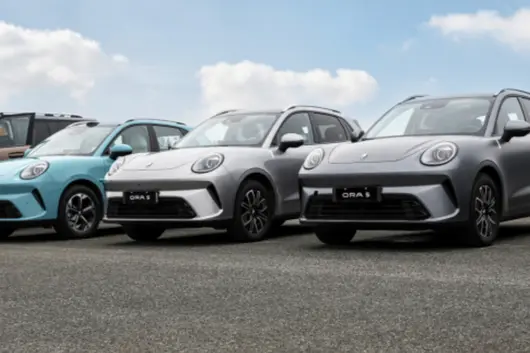

[CNMO Tech News] On July 7, Bitauto Ranking released the first half of 2026 and June Thailand Auto Market Brand Sales Top 10. According to data organized by Bitauto based on official Thailand institutions/associations:

BYD
The top 3 brand sales in the first half are: Toyota, Honda, BYD, sales are respectively: 102,006 vehicles, 41,837 vehicles, 25,890 vehicles;
The top 3 brand sales in June are: Toyota, Honda, BYD, sales are respectively: 16,599 vehicles, 6,233 vehicles, 4,824 vehicles.


In the first half brand sales list, Toyota leads the Thailand market with absolute advantage, first half cumulative sales 102,006 vehicles, year-over-year rise 11.3%, it is the only brand in the list with sales breaking 100,000 units. The second on the list is Honda, sales 41,837 vehicles, year-over-year small growth 1.8%.
CNMO Tech notes that BYD, Chery, MG, AION, and Great Wall made it into the top 10 list: BYD ranks third on the list, the number one Chinese brand, first half sold 25,890 vehicles, year-over-year slight increase 0.9%; Chery presents phenomenal growth, ranks fifth, sales 20,163 vehicles, year-over-year surge 1066.8%, growth rate leads the list with a huge gap, becoming a growth dark horse in Thailand's first half market; MG ranks sixth, sales 16,263 vehicles, year-over-year growth 71.5%; AION ranks eighth, sales 10,393 vehicles, year-over-year growth 83.0%; Great Wall ranks tenth, sales 8,703 vehicles, year-over-year growth 62.5%.
Additionally, Isuzu is one of the few brands in the list with year-over-year decline, sales 22,862 vehicles, year-over-year slight drop 0.4%; Ford's drop is more obvious, sales 8,830 vehicles, year-over-year decline 14.3%.
Once the China Passenger Car Association released the pure electric retail ranking for the first half of 2026, the industry finally saw the true temperature of the market. The top ten seats underwent a complete shake-up, with long-standing top models collectively diving. Seagull, Qin PLUS, and other former top hits fell out of the head lineup, replaced by all-new products concentrated on the market in the past year. Many people say the pure electric market is not doing well, but looking closely at the data reveals that what is not doing well are old products, low price points, and stock models without technology. Truly new products that hit users' core needs are still surging against the trend.

No.1 Geely Star Wish
Geely Star Wish, which took the pure electric sales crown for the first half of the year, has mixed feelings. The result of 194,000 units looks impressive, but actually decreased slightly by 5.3% year-on-year. Against the background of the overall contraction of the entry-level pure electric market, holding onto this volume is already considered a win. This 60,000-level A0-class small car has ranked at the top for 16 consecutive months, the core being that it solves the pain points of commuter cars to the extreme. Rear-drive architecture, independent suspension, CATL cells, and fast-charge configurations are fully loaded on all models. Using superior specifications, it beats competitors at the same price point. Cumulative sales exceeded 800,000 units in less than two years.
Conversely, the 50,000 to 100,000 market is continuing to shrink. Leapmotor and other competitors have entered with lower prices and higher configurations. Plus, car profits are thin as razor blades. Star Wish's domestic market share has basically hit the ceiling. The next incremental growth can only be supported by overseas markets.

No.2 Tesla Model Y
Tesla Model Y, ranked second, sold 172,500 units in the first half of the year, with a slight increase of 0.6% year-on-year. It barely held onto its basic market position amid the blockade of domestic models. As the industry benchmark for the 250,000 to 300,000 pure electric SUV market, Model Y's core competitiveness has never been interior configurations, but mature powertrain systems, a supercharging network spread across the country, and Tesla's brand premium. Many family users choose it for peace of mind and value retention.
However, with new products from Li Auto, Xiaomi, and AITO taking turns siphoning users, Model Y's growth has long entered stagnation. The latest news is that the high-performance version of this car has completed MIIT declaration. It will likely maintain sales with facelifts and price adjustments in the second half of the year, but it is highly probable that its overall market share will continue to be eroded.

No.3 Li Auto i6
Li Auto i6 reached third place with 120,400 units, the brightest dark horse in the first half of the year, and marked that Li Auto's pure electric transformation is fully completed.
This 250,000-level family pure electric SUV completely continues Li Auto's product logic oriented towards family users. It does not compete on paper data like 0-100 km/h acceleration, but makes 800V high-voltage platforms, dual-chamber air suspension, and advanced intelligent driving standard configurations. It maximizes space, comfort, and energy replenishment efficiency, precisely hitting the pain points of urban family users.
Since its launch, this car has had monthly sales exceeding 20,000 for four consecutive months, directly accounting for 62% of Li Auto's total sales, siphoning its own extended-range L series. However, the 200,000 to 300,000 pure electric SUV market is the most competitive track this year. New products are flocking to the market in the second half of the year. It is not easy for the i6 to maintain current sales levels. Later, it will depend on new products like the i8 to take over.

No.4 Xiaomi YU7
Xiaomi YU7, as a popular model, sold 104,600 units in the first half of the year, ranked fourth. As a brand-new car launched only half a year ago, this result has exceeded industry expectations. This mid-size SUV focusing on sports and family, relying on Xiaomi's ecosystem traffic, reached a peak of nearly 38,000 units in the first month after launch, directly breaking the market pattern at the same price level.
However, the subsequent trend can be described as opening high and closing low. After the heat subsided, sales declined month by month until June, relying on the launch of the standard version and employee internal purchase discounts to return to the ten-thousand club. Ultimately, the 200,000-level pure electric SUV track is too competitive. Tesla Model Y is above, and cost-effective brands like Leapmotor are below. YU7's product strength has not pulled an absolute gap. Next, Xiaomi's focus will shift to its extended-range series. YU7 will likely maintain steady sales, making it difficult to replicate the explosion in the early stages after launch.

No.5 BYD Yuan UP
BYD Yuan UP sold 82,700 units in pure retail sales in the first half of the year, increasing by 14.7% year-on-year, making it BYD's new backbone in the entry-level pure electric market. It gained volume because it took over from Yuan PLUS. The old Yuan PLUS saw a cliff-like drop in sales. Yuan UP used lower pricing, newer designs, and BYD's mature powertrain system to quickly fill the market gap for pure electric SUVs under 100,000.
Plus, BYD's service network spread across the country and the reputation of Blade Batteries have extremely strong attraction for mass market users. However, there is bad news: Leapmotor A10 has overtaken Yuan UP in retail volume for two consecutive months. It is advancing step by step with a cost-effective strategy of larger space and higher configurations. In the second half of the year, it will be quite difficult for Yuan UP to continue climbing. It will likely hold its current market share and maintain stable output through capacity ramp-up.

No.6 Xiaomi SU7
Xiaomi SU7 sold 80,500 units in the first half of the year, dropping 48.3% year-on-year, with the ranking falling to sixth. The main reason is that the replacement gap dragged it down. At the beginning of the year, the old SU7 was discontinued to pave the way for the new model. Two months of delivery vacuum directly lowered the total for the first half of the year. After the new generation model was launched in March, it quickly returned to a monthly sales level of 20,000+, remaining the benchmark for 200,000-level pure electric sedans.
As Xiaomi's founding work, SU7 thoroughly opened up the capacity of the niche sports car market, even siphoning users from BMW 3 Series and Tesla Model 3. However, the sports car market itself has a low ceiling. Plus, with more and more competitors, SU7's sales have basically hit the upper limit. Next, it will be more about stabilizing output as the brand's basic market. The stage of explosive growth has passed.

No.7 NIO ES8
NIO ES8 accumulated 78,600 units in retail sales for the first half of the year, ranking seventh, being the absolute sales king in the high-end market above 400,000. The fully new ES8 can fight, the core is hitting the pure electric replacement demand of high-end family users. The swapping system solves energy replenishment anxiety. Luxury and service experience crush same-price BBA fuel cars. Users accounting for more than 97% are exchange/purchase users, of which 60% come from BBA owners.
Less than a year after launch, the new ES8 cumulative delivery broke 120,000 units, ranking the large SUV sales champion for six consecutive months, hard撑着 (proping up) the market capacity of the high-end pure electric market. Next, its own lower-positioned ES9 has already siphoned many users after launch. The 6-seater version has just started reservations. Plus, the high-end market itself has limited capacity. ES8's main goal for the second half of the year is to hold onto the basic market of the high-end market.

No.8 Wuling Hongguang MINI
Once the national god car Hongguang MINI EV sold only 72,800 units in the first half of the year, dropping 57.4% year-on-year, falling directly from the top spot to eighth. It is known as the most tragic fall among old models.
The loss of speed of Hongguang MINI is not caused by a single reason. On one hand, the A00-class microcar market is contracting overall. Adjustment of purchase tax policy has significantly shrunk the cost-performance advantage of low-price cars. On the other hand, user consumption upgrades are obvious. Adding 20,000 can buy a small car with larger space, higher configuration, and longer range. Many users who watched MINI EV finally bought Bingo, Star Wish. Wuling itself is clear about the problem. The fifth-generation model changed to a four-door structure, added fast charging and safety configurations, but it still could not stop the downward trend.

No.9 Changan Qiyuan Q05
Changan Qiyuan Q05 sold 71,600 units in the first half of the year, breaking into ninth, a true comeback dark horse.
This car had little presence last year. After price reduction and configuration increase in April this year, it took off directly. It pulled the entry-level range to 506km, even downgraded laser radar to the 80,000 level. Using a "technology equity" strategy, it precisely hit the pain points of home users. It sat firmly as the pure electric compact SUV sales champion for three consecutive months. Changan's capacity also kept up with the rhythm. After the Nanchang factory was put into production, bottlenecks were gradually relieved. The overseas market also bloomed synchronously. Thailand launched in half a month, and orders broke 3,000. After capacity is fully released in the second half of the year, Qiyuan Q05 sales still have rising space. It is expected to冲击 (attack/strive for) the first echelon of entry-level pure electric.

No.10 MG4
Ranked tenth, MG4 sold 70,800 units in pure retail sales in the first half of the year, purely relying on overseas market endorsement. This 100,000-level pure electric hatchback has been selling well in Europe for several years. It has ranked as the China-brand European sales champion for 11 consecutive years. Overseas sales share far exceeds domestic.
In the domestic market, MG4 began to gain volume gradually after its refresh last year. Rear-drive architecture and five-link independent suspension chassis quality are unique at the same price level. The MG4X version launched this year even downgraded semi-solid-state batteries. The technology普惠 (universal benefit) strategy was very effective. Domestic monthly sales have exceeded 10,000 for 9 consecutive months. However, hatchbacks themselves are a niche market in China. MG's brand voice is far less than mainstream autonomous brands. There will be no big breakthroughs domestically. Next, its incremental growth will still come from overseas. Maintaining steady state domestically is sufficient. It is a model that relies on the global market to amortize costs.

Summary
After reading the top ten ranking, you can see that the pure electric market has long passed the barbaric growth period where any car can be sold by just building it. The logic now is very clear. The low-end market is continuously shrinking. Consumption upgrading is the big trend. Old products that do not iterate quickly will be eliminated quickly. New products that truly hit user needs, have proper configurations, and reasonable prices can still break through against the trend even in an environment where the overall market is declining. Competition in the second half of the year will only be more intense. More new products will be concentrated on the market. The price war will continue. Looking at the ranking by the end of the year, the rankings may have to change one more time.
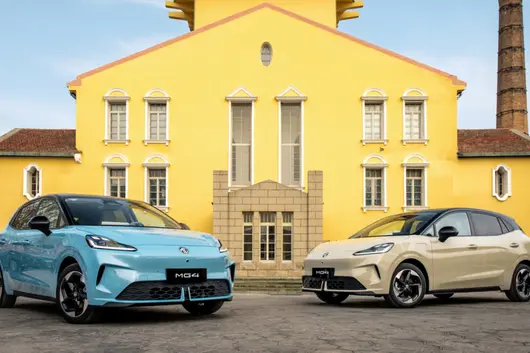
Recently, Geely Holding Group announced its performance for the first half of 2026, once again becoming the focus of industry attention.

Data shows that Geely Holding Group's total sales volume in the first half of 2026 reached 1,934,842 units, setting a new historical record. Among them, new energy vehicle sales reached 1,100,893 units, a year-on-year increase of 10%, with new energy penetration rate further rising to 56.9%. In the first half, Geely Automobile Holdings Limited (0175.HK) sold 1,422,958 units, setting a new high for the same period; new energy vehicle sales (including Geely, Lynk & Co, Zeekr) were 799,454 units, a year-on-year increase of 10%, with a new energy penetration rate of 56%.
According to CPCA data, Geely Automobile's domestic terminal retail sales volume in the first half of the year was 1.021 million units, ranking first in China's passenger car domestic sales for the first half of 2026, and also the only domestic brand to exceed sales of one million units.
However, to truly understand Geely's "new historical record" this time, one cannot only look at the total volume of 1.93 million units, nor stay only at the domestic first place of 1.021 million units. What is more worth asking is: Against the backdrop of slowing industry growth, divergent user demands, and intensifying global competition, what exactly does Geely rely on to beat the market?
It can be said that Geely's performance in the first half of the year was not just a refresh of sales records, but a concentrated realization of its long-term system capabilities once again.
In Geely's first-half performance report, several "Firsts" stood out especially.
Among them, Geely China Star sales reached 581,000 units, firmly holding the first place in domestic brand fuel vehicle sales; Zeekr delivered 178,000 units, a year-on-year increase of 97%, with delivery growth rate ranking first in the luxury new energy market. At the same time, Geely Xingyuan monthly sales broke through 50,000 units, cumulative sales exceeded 750,000 units since listing, continuously reigning as the sales champion across all brands and categories, becoming a genuine national hit.

These "Firsts" seem to come from different tracks, but together reveal an important characteristic of Geely's growth: running fast, and walking steadily. Among them, China Star stabilizes the fuel vehicle base, continuing to maintain leadership in the stock market; Zeekr accelerates upward breakthrough, and Xingyuan continues to scale up in the mainstream new energy market.
Fuel and new energy, mainstream and high-end, scale and value, different sectors are not simply a zero-sum game, but gradually forming a mutually supportive growth structure. This balance is precisely the most worthy part of attention in Geely's first-half performance.
Supporting this balanced growth, on one hand is a multi-brand lineup with clear positioning and wide coverage; on the other hand, it is the continuous deepening of the "One Geely" strategic integration.
Not long ago, Geely Holding Group Chairman Li Shufu publicly stated that they will orderly close, cancel, and merge relevant redundant entities of Geely Automobile Group Co., Ltd., focusing advantageous resources to strengthen the core listed platform of Geely Automobile Holdings Limited. This more precise resource allocation for different market cycles and user needs is also further improving the operating efficiency and anti-cycle ability of the entire group.
From this perspective, what Geely truly deserves attention to is not just how many "Firsts" were captured, but behind these "Firsts", a growth system balancing scale, structure, and efficiency is forming. This ability to hold the base while continuously opening up new volume is the key for Geely to traverse industry cycles and maintain long-term leadership.
Another important growth lever for Geely comes from the overseas market.
From the performance in the first half of the year, Geely's overseas business is entering an accelerated realization period. Its overseas sales reached 474,228 units, a year-on-year increase of 158%, exceeding the total export sales of 2025. More worth noting is that its overseas growth is not mainly relying on traditional fuel vehicles for volume, but simultaneously upgrading towards new energy and high-end. Its new energy product export sales in the first half were 277,000 units, a surge of 585% year-on-year, with new energy proportion reaching 58%. This means Geely's overseas business growth logic is gradually shifting to relying on new energy technology, product experience, and brand value to open up incremental space.

Among them, Geely Galaxy new energy products entered the top sales ranks in multiple overseas markets; Zeekr won championships in niche markets of countries such as Thailand, Malaysia, Mexico.
This global synergy is also reflected in the performance of other brands under Geely Holding Group. Among them, Volvo Cars sold 325,000 units in the first half, of which new energy sales were 161,000 units, a year-on-year increase of 3.8%, with new energy penetration rate 50%. Pure electric model deliveries grew for 9 consecutive months, and new energy transformation continued to breakthrough.
In addition, Polestar Cars sold 30,400 units in the first half, setting a new historical record, achieving sales breakthroughs in major markets such as the UK, Germany, and South Korea. Proton Cars sold 100,300 units in the first half, a year-on-year increase of 39.1%, creating the best sales performance since 2011. It is worth mentioning that the Proton e.MAS 7 PHEV launched in February of this year continued to sell well, leading the Malaysian plug-in hybrid niche market.

Of course, a new historical record is only an interim result. Another issue worth noting is, with Geely having already stood on a new step, what cards does it have in hand for the second half of the year?
From the currently released information, Geely's new product and technology offensive in the second half of the year remains dense. First is Geely Galaxy TT. As a mid-to-large pure electric sedan, its body length reaches 4999mm, wheelbase is 2920mm, and it will match the Qianli Haohan H7 assisted driving solution. From the product positioning perspective, Galaxy TT targets young consumers' needs for sports design, smart experience, and personality expression, and also means Geely Galaxy will further extend to the higher value pure electric sedan market.

While products break through upwards, Geely's technical base is also continuing to upgrade. On July 16, Geely Galaxy's global first "Thunder 16-in-1 Intelligent Electric Drive" is about to be launched, native adapted to 800V high voltage platform, and 16 categories of functional modules including motors, silicon carbide electronic control, whole vehicle thermal management, etc. are highly integrated. The "16-in-1" will also be systemically integrated to further optimize whole vehicle space, weight, energy consumption and cost, continuously enhancing Geely Galaxy's competitive barrier.
Additionally, the imminent arrival of Galaxy Warship 700 also means that Geely will officially enter the new track of plug-in hybrid hard-core SUVs, which combines growth potential and profit margins.
For an enterprise that has already stood at the forefront of the Chinese automobile market, "selling more" is only the first stage; how to improve efficiency while expanding scale, how to maintain business quality during new energy transformation, and how to replicate domestic competitiveness to the global market are the questions that must be answered to become a world-class automobile group. And Geely is steadily walking on this path of advanced development.
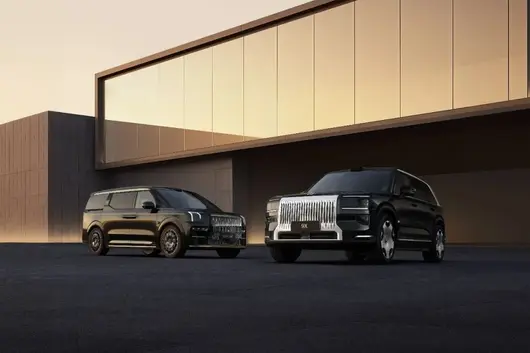

Editor's Note: Geely Group's performance in the first half of the year can be called bright, but in the automotive market where variables are ever-present, its challenges for the second half of the year remain.
On July 15th, Geely Holding Group released the mid-year sales performance report: Total vehicle sales for the group from January to June reached 1.93 million units, setting a new high for the same period in history; among them, new energy vehicle sales reached 1.1 million units, a year-on-year increase of 10%, with the new energy penetration rate climbing to 56.9%. This means that for every 100 cars sold by Geely Holding Group in the first half of the year, nearly 57 were new energy vehicles, and the group as a whole has entered the harvest period of electrification scale.

As the core listed entity under Geely Holdings, Geely Auto's sales reached 1.43 million units in the first half of the year, with new energy sales (including Geely, Lynk & Co, Zeekr) at 799,000 units, a year-on-year increase of 10%, and a new energy penetration rate of 56%. Sales data from the group to the core brand outline a traditional Chinese automaker that started with fuel vehicles, and in the background of intensifying industry stock competition, how to complete a structural transformation through a multi-brand matrix and global layout.
Multi-brand matrix synergy, new energy becomes the main axis of growth
Geely's ability to refresh records in the first half of the year was not pulled by a single brand, but the result of synergy between the three major brands Geely, Lynk & Co, and Zeekr in different sub-segments.
The Geely brand, which targets the mainstream home market, achieved cumulative sales of 1,100,373 units in the first half, of which the China Star series sold 580,580 units, continuing to firmly rank among the top sales of domestic brand fuel vehicles, playing the role of a "ballast" for the basic market. What truly drives the volume increase in new energy is Geely Galaxy—cumulative deliveries in the first half reached 519,793 units, with single-month sales in June at 108,206 units, a year-on-year increase of 20% and a month-on-month increase of 32%. The Star Wish under the Galaxy brand broke 50,000 units in a single month, with cumulative sales since launch exceeding 750,000 units, becoming the core product in Geely's new energy volume-selling camp.

Lynk & Co, positioned in the mid-to-high-end hybrid market, achieved cumulative sales of 144,215 units in the first half, with new energy vehicle sales at 93,597 units, and the proportion of new energy products reaching 65%, stabilizing the mid-to-high-end hybrid sub-market by relying on the EM-P hybrid family promoted by the simultaneous launch of three car models. Zeekr continued its strong performance on the high-end luxury track, delivering 178,370 units in the first half, a significant year-on-year increase of 97%; single-month deliveries in June were 35,169 units, a year-on-year increase of 111%, achieving consecutive five-month year-on-year and month-on-month double growth, with global cumulative deliveries officially breaking through 820,000 units.
From the perspective of the group as a whole, June single-month Geely Auto new energy sales reached 161,449 units, a year-on-year increase of 32% and a month-on-month increase of 21%, with new energy sales proportion of the group's total sales exceeding 67%—equivalent to nearly 7 out of every 10 Geely new cars sold being new energy vehicles. This structural change marks that Geely's "oil and electricity simultaneous promotion" transformation rhythm has entered a new stage dominated by new energy.
It is worth noting that Geely's new energy transformation is not at the expense of abandoning fuel vehicles. The China Star series still maintains strong competitiveness in the fuel vehicle market, and this "fuel ballast, new energy volume" dual-track strategy enabled Geely to hold its basic market share in the domestic auto market in the first half. Data from the China Passenger Car Association shows that in the ranking of narrow passenger vehicle manufacturer retail sales from January to June, Geely ranked first with 1.021 million units and an 11.7% share, being the only domestic brand to break the million-unit mark in the first half.
Overseas business leaps, globalization enters harvest period
If new energy penetration rate is the most eye-catching internal change in Geely's first half, then the explosion of export business is its most prominent external highlight.
Data shows that Geely Auto's first-half overseas export sales reached 474,228 units, a year-on-year increase of 158%—this number has already exceeded Geely's total export volume for the full year of 2025. June single-month overseas export sales broke the 100,000 unit threshold for the first time, reaching 102,874 units, with a year-on-year increase of 157% and a month-on-month increase of 21%, achieving consecutive six-month year-on-year and month-on-month double growth.
A more critical change lies in the export structure. In the first half, Geely's new energy product export sales were 277,189 units, surging 585% year-on-year, accounting for 58% of the total export volume. This means Geely's main overseas products have completed the switch from traditional fuel vehicles to new energy vehicles, with new energy products gradually becoming the core driving force for overseas market growth.
Geely Holding Group's overall global layout also landed at multiple points in the first half: Geely signed Swiss dealers to strengthen the European market, Lynk & Co 900 launched in Vietnam and Qatar, Geely Xingyuan EX2 began local production in Brazil, Binyue Cool launched in South Africa; Zeekr topped the Malaysia luxury pure electric sales list, 007 GT has launched in 16 European countries, flagship model Zeekr 9X plans to go to the Middle East in Q3, and will subsequently expand into US/Europe and Central Asian markets.
Overseas high-end brands also performed steadily. Volvo Cars first-half global sales were 325,000 units, with new energy sales at 161,000 units, a year-on-year increase of 3.8%, with new energy penetration rate reaching 50%, and pure electric vehicle deliveries growing for 9 consecutive months. Polestar first-half sales were 30,400 units, achieving sales breakthroughs in markets such as the UK, Germany, and South Korea, setting a new high for the brand at the same period in history. In the Southeast Asia and commercial vehicle sector, Proton first-half sales were 100,300 units, a year-on-year increase of 39.1%, achieving the best half-year performance since 2011; Farizon New Energy Commercial Vehicles first-half sales were 88,000 units, a year-on-year increase of 41.3%, with overseas export sales ranking at the forefront of the new energy commercial vehicle industry.
Geely Group's performance in the first half of the year can be called bright, but in the automotive market where variables are ever-present, its challenges for the second half of the year remain. Intensifying domestic car market stock competition and unrelenting price war pressure, Geely brand and Lynk & Co brand first-half cumulative sales declined year-on-year by 5% and 6% respectively, indicating that the fuel vehicle basic market still faces contraction pressure; and in the overseas market, geopolitical tensions, trade barriers, and the difficulty of localization operations will also rise synchronously with the expansion of export scale. Whether Geely can continue its growth momentum in the second half depends on the volume pace of Galaxy and Zeekr, the development progress of Middle East and European markets, and the balancing ability of resource allocation between fuel vehicles and new energy.
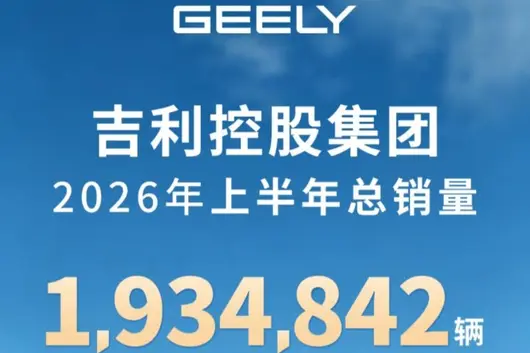

Geely Holding Group total sales reached 1,934,842 units in the first half of 2026, setting a new all-time record. New energy vehicle sales amounted to 1,100,893 units, up 10% year-on-year, with a penetration rate reaching 56.9%. In the first half, Geely Holding Group maintained a high-quality growth trend, accelerated internationalization and new energy transformation comprehensively, demonstrated development resilience across cycles, and outperformed the industry through steady operations.
In the first half, Geely Automobile Holdings Limited (0175.HK) sold 1,422,958 units, reaching a new high for the same period; New energy vehicle sales (including Geely, Lynk & Co, Zeekr) totaled 799,454 units, up 10% year-on-year, with a new energy penetration rate of 56%. Among them, Geely China Star sales reached 581,000 units, firmly holding the No. 1 spot among domestic brand fuel vehicles; Geely Galaxy sales reached 520,000 units, with multiple core products continuing to perform strongly; Lynk & Co sales reached 144,000 units, with new energy products accounting for 65%; Zeekr deliveries reached 178,000 units, up 97% year-on-year, with delivery growth rate ranking No. 1 in luxury new energy.

Geely Automobile's global expansion continued to break through, with overseas sales of 474,228 units in the first half, up 158% year-on-year, already exceeding the full-year 2025 export sales. Geely Automobile's overseas business accelerated towards high-end and new energy integration, with 277,000 units of new energy product exports in the first half, a surge of 585% year-on-year, accounting for 58% of new energy. Geely Galaxy new energy products firmly ranked in the top sales tier in multiple markets, while Zeekr took the championship in niche markets in multiple countries such as Thailand, Malaysia, and Mexico.

Star Wish will be produced at the Geely-Renault Brazil Plant
Volvo Cars (VOLCAR-B.ST) sold 325,000 units in the first half, of which new energy sales were 161,000 units, up 3.8% year-on-year, with a new energy penetration rate of 50%. Pure electric vehicle deliveries grew for 9 consecutive months, with new energy transformation continuing to break through.
Polestar Automotive (PSNY) sold 30,400 units in the first half, setting a new all-time record, achieving sales breakthroughs in major markets such as the UK, Germany, and South Korea.

Proton Cars sold 100,300 units in the first half, up 39.1% year-on-year, achieving the best sales performance since 2011. Besides maintaining steady growth in the fuel vehicle business, Proton also made progress in new energy transformation. The Proton e.MAS 7 PHEV launched in February this year continued to sell well, leading the Malaysia plug-in hybrid niche market.

Farizon New Energy Commercial Vehicle sold 88,000 units in the first half, up 41.3% year-on-year. Overseas export sales firmly ranked No. 1 in the new energy commercial vehicle industry, topping the new energy commercial vehicle markets in countries such as the UK, UAE, and Australia.

On the 40th anniversary of its founding, Geely Holding, led by the "Taizhou Declaration", deeply advanced the "One Geely, Fully Leading" 2030 Strategy. In the first half, facing a complex and changing market environment, Geely Holding Group continued to consolidate its leading position through steady and high-quality development, accelerating the realization of the enterprise vision of "leading the green intelligent mobility ecosystem".
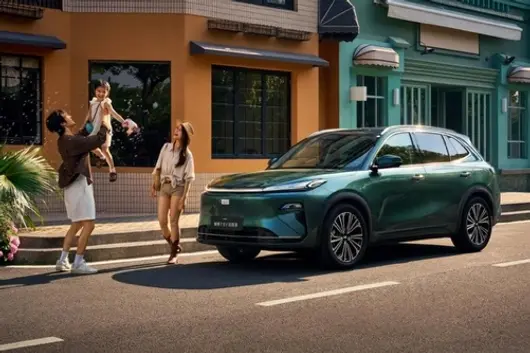


Surprisingly, this year's World Cup soccer tournament actually had a 'negative impact' on car sales.
The market analysis report for June released by the CPCA mentioned that with the World Cup starting, the time and budget of car buyers were diverted. Implicitly, cars aren't selling well, and even the World Cup is to blame.
This is not just passing the buck. In the first half of this year, the China auto market was indeed very difficult, where any minor factor could affect final transactions.
According to data, national passenger car retail sales were 8.701 million units in the first half, a year-on-year drop of 20.2%. The drop in June alone widened to 23.2%. Statistics from CAAM also show that total vehicle sales including exports were 15.017 million units, a year-on-year decline of 4.1%.
Fortunately, just like a football match, halftime does not mean the end. In the first 100 matches of this World Cup, based on 90-minute results, 40 matches had different halftime win/draw/loss outcomes compared to the final result.
The second half for automakers has just begun. Whether they can rewrite the score depends on what cards each company holds. But one thing is unquestionable: Only leading automotive enterprises that seriously 'prepare' and have a stable 'chassis' have the opportunity to continue leading.
More Difficult Than Sales Decline is Profit Squeezing
A retail drop of 20.2% is already enough to catch the eye, but the more troublesome pressure compared to sales decline is hidden in the automakers' profit statements.
Data from the National Bureau of Statistics shows that in the first five months of this year, industrial enterprise profits above a certain scale nationwide increased by 18.8% year-on-year, while automobile manufacturing industry profits fell by 19.8%.
During the same period, the automobile industry achieved revenue of 420.96 billion yuan, a 1.4% year-on-year increase, but the profit margin was only 3.4%. Back in 2017, this figure was around 8%.

Revenue barely grew while profits plummeted, indicating that insufficient demand is only part of the pressure. Price competition continues, raw material prices like lithium carbonate and aluminum have risen, and R&D, channel, and marketing investments are hard to shrink synchronously with sales. For many automakers, even if cars are sold, the profit remaining on the balance sheet is decreasing.
This pressure is more intuitive when falling on specific enterprises.
In the first half, Li Auto delivered a cumulative 193,500 units, down 5.13% year-on-year, and saw single-month sales decline for two consecutive months; XPeng delivered 165,000 units, down 15.8% year-on-year. New force automakers that used to maintain high-speed growth are also beginning to face growth pressure brought by the expansion of sales volume bases and intensified product competition.
The situation on the profit side is even more severe.
On July 12, Seres released performance forecasts, expecting a net loss of 1.5 billion to 1.8 billion yuan in the first half, while the net profit for the same period last year was 2.941 billion yuan. This means its performance decreased by more than 4.4 billion yuan compared to the same period last year. Price hikes in raw materials such as memory chips and lithium carbonate have pushed up costs, compounded by book adjustments of certain existing assets, significantly impacting its profitability.
The pressure is also transmitting to the channel end. In June, the dealer inventory warning index reached 57.2%, continuing to remain above the prosperity-thriving line; more than 70% of dealer stores did not complete their half-year sales targets. Slower inventory turnover and expanded terminal discounts further compressed the profit space for dealers and automakers.
The new energy market is no exception either. The penetration rate of new energy in June has reached 62.8%, but new energy passenger car retail sales still dropped by 14% in the first half. The substitution of new energy for fuel vehicles continues, but no longer naturally equates to the total growth of the auto market.
Insufficient domestic market growth has also made exports an important direction for automakers to seek new growth and diversify operational pressure.
Exports Contribute Growth, Going Overseas Shifts to Local Operation
Data from CAAM shows that in the first half of the year, China's auto exports reached 5.096 million units, a 65.3% year-on-year increase; June alone exports were 1.037 million units, a 75.1% year-on-year increase, with monthly export volume standing at the million-unit level for the first time.
While domestic demand shrinks, exports have become an important fulcrum for many automakers to maintain scale. However, from exporting whole vehicles to building factories overseas to opening channels with international partners, the paths chosen by each company are not the same.
Chery remains the vanguard of exports. In the first half, Chery Group exported 943,800 units, accounting for nearly 70% of total sales; June alone saw exports of 191,100 units, breaking the record for single-month exports by Chinese automakers.
BYD's overseas focus is shifting from whole vehicle exports to local manufacturing. In the first half, BYD sold 789,400 units overseas, a 68% year-on-year increase; June overseas sales accounted for more than 40% of its total monthly sales. With factories in Brazil and Thailand coming into production successively, BYD is gradually spreading capacity 'beyond tariff barriers'.

Geely and Leapmotor's export growth rates are equally outstanding. Geely exported 474,200 units in the first half, a 158% increase year-on-year; first-half export volume has already exceeded that of the full year of 2025. Leapmotor utilized Stellantis' channels and factory layout to go overseas, exporting nearly 100,000 units in the first half, also exceeding the full previous year. Borrowing from a mature global system allowed Leapmotor to save the time needed to build its own channels and capacity.
SAIC's overseas sales in the first half were 735,000 units, a 48.7% year-on-year increase, accounting for about 36% of the group's total sales. Overseas manufacturing, channel, and brand systems accumulated over the years have become an important buffer in this round of domestic market adjustments.
Changan is also accelerating the transformation from product exports to local operations. The 2.0 version of the 'Sea Accepts Rivers' plan released in April proposed long-term, local, and systematic approaches, promoting global business extension into manufacturing, investment, service, and brand operations. With the landing of multiple results such as Brazilian President witnessing the Brazil factory production start, the 20,000th whole vehicle coming off the line at the Thailand factory, and Qiyuan Q05 launching in Uzbekistan, overseas localization layout is gradually showing results. In the first half, Changan delivered 402,000 units overseas, a 35.1% year-on-year increase, accounting for about one-third of the group's delivery volume.
In May, Changan reached a global official cooperation agreement with the Portuguese National Football Team. Carrying out sports marketing in the World Cup year can also be seen as a step where its overseas investment extends from channel construction to brand operations.
As the proportion of overseas sales in the enterprise's total portfolio continues to increase, export numbers are no longer the only standard for measuring the effectiveness of globalization.Tariff policies, certification standards, and consumption habit differences in different markets are significantly distinct. Channels, after-sales, local production, and brand building all require long-term investment, and may not directly translate into profits in the short term.
Therefore, in the second half of the year when evaluating automakers' overseas performance, sales volume is still the foundation, but local operation efficiency, brand recognition, and profit quality will become more important. Whether exports can truly precipitate into long-term growth depends on whether automakers can move from 'selling cars' to 'operating locally'.
Viewing Sales Proportion: Domestic Market Is Still the Main Battlefield
The rapid growth of overseas markets has not changed the basic proportion of the domestic market.
Data from CAAM shows that domestic car sales in the first half were 9.921 million units. Although down 21.1% year-on-year, the scale is still close to twice that of exports, accounting for about two-thirds of total auto sales. Calculated by half-year alone, one percentage point of market share is close to 100,000 units. No mainstream automaker would give up easily.
Domestic market competition is already fierce, but overseas giants have also not chosen to leave.
Data from the CPCA shows that in June, domestic retail of mainstream joint venture brand new energy passenger cars increased by 45% year-on-year. Volkswagen plans to launch more than 20 electrified models in China this year. The locally developed CEA electronic/electrical architecture has entered mass production with the first model, and subsequent models will also be launched successively within the year. As joint venture brands accelerate local R&D and new energy transformation, competition intensity in the domestic market will continue to increase.

Facing internal demand pressure, domestic independent brands are also looking for breakthrough points from different directions such as products, technology, organization, and capacity.
BYD stabilizes the sales basic disk while supplementing infrastructure. June sales reached 403,500 units, achieving year-on-year positive growth again; Megawatt flash charging is also starting to move from conferences to implementation, and charging networks are gradually spreading nationwide.
Geely is asking internal efficiency.Li Shufu proposed 'stopping, merging, transferring, and transforming' redundant entities, compressing repeated brand and R&D investments, and concentrating resources further on main platforms. In the first half, Geely stabilized overall sales volume with 1.423 million units.
New forces in the growth phase have also not stopped expanding. Leapmotor delivered 356,500 units in the first half, a 60% year-on-year increase, becoming the new force with the highest sales volume. The A10 launched in March entered the top three in SUV sales in three months, and the flagship model D19 cut into the fiercely competitive mid-to-large SUV market, promoting volume sales and brand elevation along two lines simultaneously.

Xiaomi delivered more than 180,000 units cumulatively in the first half. Compared to the 550,000 annual target set at the beginning of the year, monthly delivery volume in the second half needs to be increased to above 60,000. Expanding capacity and accelerating deliveries will become the core task of its second half.
Changan Auto achieved deliveries of 1.1956 million units in the first half, with 402,000 units delivered overseas (up 35.1% year-on-year), and new energy deliveries of 456,000 units (up 5.2% year-on-year). In the second half of this year, Changan Auto will concentrate on promoting product launches and technology implementation, continuously promoting the strategic synergy of Avatr and Deepal frontend independence and backend integration, while accelerating the application of self-developed intelligent technology.Currently, the Tiandu intelligent driving assistance function has been successively applied to Qiyuan Q07, A06, and the new Q05. According to the mass production plan announced in May this year, the Qiyuan Q06 launching in the second half will be equipped with Tiandu Pilot on all models, becoming an important node for Changan's self-developed assisted driving solution to further expand its application.

The domestic market still has a semi-annual scale of nearly 10 million units, and replacement demand will not disappear into thin air. The issue is, facing the increasingly dense new car launches and continuously increasing price pressure, automakers not only need to compete for sales but also need to try to repair profits.
In the second half, whether new cars can quickly gain volume, whether technology can be converted into experiences consumers are willing to pay for, and whether scale growth can bring operational efficiency improvements will jointly determine the performance of automakers in the domestic market.
Final Remarks:
In the first half of this year, the pressure on China's auto industry was reflected simultaneously at both sales and profit ends.Exports grew rapidly, providing a new scale fulcrum for automakers; but the domestic market still determines the basic disk of most enterprises and is the most intensely competitive main battlefield in the second half of the year.
The key to follow lies in whether overseas layout can precipitate into continuous orders and local operating capabilities, whether domestic new products can form scale delivery, and whether technology investment can truly be converted into revenue and profit.
For automakers that have completed a certain amount of preliminary layout, subsequent performance depends on whether products, technology, and global reserve can be timely redeemed for sales and income.
For the entire industry, simply pursuing sales volume is no longer enough; delivery speed, cost control, and profit quality will become equally important.
Halftime has passed, but the outcome has not yet been determined.
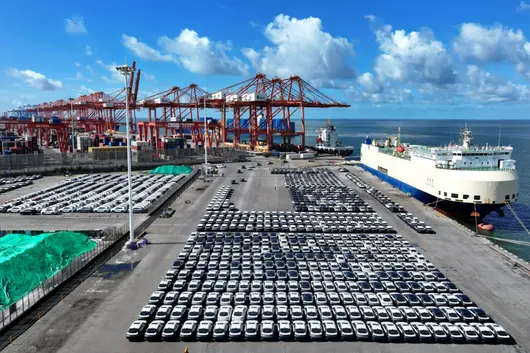

This year is a milestone year for Chinese automakers going global. According to new car sales statistics from the European Automobile Manufacturers Association, in May, sales of Chinese brand cars in Europe surpassed Japanese brands for the first time.
Following this, SAIC Group also sparked a wave of enthusiasm in the UK. On July 8, SAIC MG held a technology conference in London, bringing the most cutting-edge intelligent and electric technology back to the brand's birthplace; On July 9, SAIC MG appeared at the Goodwood Festival of Speed, where two concept cars, the two-door electric compact MG Go! and the coupe SUV Cyber Concept, shone brightly. The heritage of a century-old brand and the strength of a technological ace sparked sparks, as Chinese automakers ignite the global automotive market with intelligent and electric innovation technologies.

Scene of MG UK Technology Conference
At the same time, SAIC's overseas market also submitted an excellent half-year exam report: Sales overseas in June reached 146,000 vehicles, a year-on-year surge of 61.2%, setting a historical high. In the first half of this year, SAIC's overseas market cumulative sales reached 735,000 vehicles, a strong increase of 48.7% year-on-year, ranking among the leaders in the industry. Driven by the "Glocal Strategy", SAIC is transforming from selling cars to full-chain global expansion, continuously deepening overseas value chain construction.
Comprehensive Technological Advancement, Polishing the Product Name Card
At the technical brand level, SAIC is systematically building global intelligent labels for "Hybrid+ Hybrid Technology", "SolidCore Solid/Semi-Solid Battery Technology", and "i-Smart Intelligent Driving Technology". At the UK technology conference, the MG brand showcased MG Plug-in Hybrid+ Hybrid, SolidCore Semi-Solid Battery, and MG Parking Smart Cockpit and Assistive Driving. In addition, MG became the first automotive brand globally to achieve mass production of semi-solid batteries; The IM AD intelligent driving system of IM Motors has covered five continents globally; The global activation volume of the overseas travel i-Smart system has exceeded one million.

Scene of MG UK Technology Conference
At the Goodwood Festival of Speed, the MG brand unveiled globally two concept models: the two-door electric compact MG Go! and the coupe SUV Cyber Concept, stunning the entire audience. The design inspiration for the two models comes from MGB GT, MG 6 R4 Group B Rally Cars, MG EX181 Streamlined Racing Cars, and other classic brand models, showcasing brand heritage and future vision.

MG GO! Concept Car

MG Cyber Concept Concept Car
At the product implementation level, SAIC will achieve massive product global deployment in the next three years: Full powertrains cover ICE, HEV, PHEV, EV four forms, adapting to energy policies and consumption habits of various countries; At the same time, SAIC is creating over ten new overseas models including SUV, sedan, MPV, pickup, comprehensively covering household, commuting, high-end driving, long-distance travel, outdoor and other full scenario needs, connecting global mainstream market segments.
From Frankfurt to London, from technology exhibitions to runways, SAIC MG advances in leaps and bounds, showcasing a new name card of Chinese intelligent manufacturing to the world with more cutting-edge technology and newer models.
Deepening Regional Markets, Serving Global Users
While technology sails overseas, the pace of SAIC deepening the global market is also accelerating. Currently, SAIC's products and services cover over 170 countries and regions worldwide, forming 1 "300,000-class" market (Europe) and 5 "50,000-class" markets (Americas, Middle East, Australia & New Zealand, ASEAN, South Asia), with overseas cumulative sales exceeding 7 million vehicles.
Europe is SAIC's largest overseas market. The MG brand has won the "Chinese Brand European Sales Champion" for 11 consecutive years and has become the first Chinese automotive brand to exceed 1 million cumulative sales in Europe. In the first half of this year, MG brand sales in Europe exceeded 190,000 vehicles, a year-on-year growth of over 20%. On July 1, MG brand established a direct sales company in Belgium and Luxembourg, which is also an important step for SAIC to implement the "Glocal Strategy" and take root in local Europe. From leading Chinese automotive brands in sales scale to deepening the European market and building long-term user relationships, MG is realizing a transformation from "selling cars" to "managing", thereby better improving service capabilities, listening to customer needs, achieving agile responses to market dynamics, and precise control of customer experiences.

MG Brand Appears at Goodwood Festival of Speed
Not only in Europe, SAIC is blooming in multiple points globally by continuously deepening local markets. In Thailand, the MG brand launched the new service strategy "MG SMILE" in May, solving local user concerns such as price transparency, dealer commitment fulfillment, and consumer rights protection with a full-process service standard system, and providing lifetime warranty for three-electric systems for pure electric models. With the support of new service standards and lifetime warranty policies, the new MG URBAN went on sale in Thailand on June 24, bringing high-quality products and services of Chinese intelligent manufacturing to more Thai users.

MG URBAN
In Central Asia, in June this year, multiple models such as SAIC Volkswagen Tiguan L Pro, Passat Pro, Teramont X, Teramont Pro, T-Roc New, Lavida New entered the Uzbekistan market, achieving the "zero breakthrough" for SAIC Volkswagen in the Central Asian market. Previously, the SAIC Group Almaty MG Flagship Store officially opened in April this year, SAIC joined hands with Allur, Kazakhstan's largest automotive production and assembly enterprise to achieve localized production and model adaptation for customer needs. The two brands join hands to explore the Central Asian map, providing more intelligent models and higher-level services for local consumers.
Good news also came from the commercial vehicle sector. Recently, SAIC Hongyan formally reached a strategic cooperation agreement with a top port major customer in Thailand for 1,000 new energy heavy trucks. The first batch of complete vehicles has completed packing and boarded ships in batches, setting off from domestic production bases to Thailand. This also marks that SAIC Hongyan, relying on independent core three-electric technologies, full-scenario customization capabilities, and a comprehensive overseas local service system, breaks the monopoly of foreign brands in the Thai heavy truck market, showcasing the complete industrial chain of Chinese commercial vehicles and the hard power of green intelligent manufacturing to the world.
From monthly sales breaking the best historical record to technology label formation and localization deepening landing, behind SAIC's overseas market report card is the systemic effectiveness of the Glocal Strategy "Global Automotive Brand + Localized System Ecosystem". Facing the future, SAIC will continuously accelerate the transformation from complete vehicle overseas to value chain overseas, writing a new chapter of Chinese intelligent manufacturing in the global automotive industry landscape.
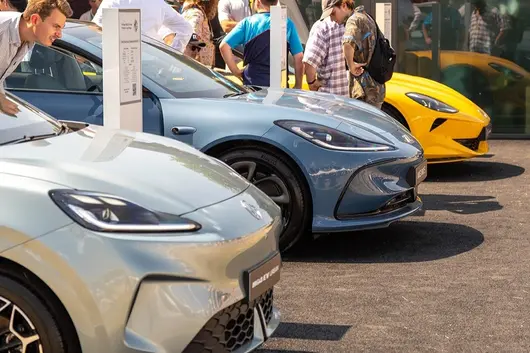

GAC Group released a half-year performance report for 2026. The numbers are quite shocking — net loss for the first half estimated at 4.06 billion to 4.57 billion yuan. The net profit after deducting non-recurring gains and losses was even worse, with a loss of 4.8 billion to 5.6 billion yuan. More than 4 billion yuan, losing over 20 million yuan per day, it doesn't look very ideal.
But look at another set of numbers — GAC sold 773,100 vehicles in the first half, a year-on-year increase of 2.35%. New energy vehicle sales accounted for over 60%. Independent brands sold 346,000 vehicles, a surge of 35.69%. AION was even more fierce, 181,600 vehicles, a year-on-year increase of 67.08%. Overseas exports 121,500 vehicles, a year-on-year increase of 132%, the semi-annual export scale is already close to last year's full year level. Sales are up, new energy transformation is accelerating, and exports are doubling — but the books show an even bigger loss. How is this account calculated?

GAC Group
What does the official say?
GAC's announcement was very straightforward, three reasons:
First, domestic market competition intensified, independent brands continued to increase sales investment, plus changes in product sales structure, and rising upstream raw material costs, leading to a decline in independent brand profits.
Second, joint venture brands are facing operational pressure. Specifically, terminal sales decline, continued increase in sales investment, rising raw materials, etc., are all important factors, and the company's investment income decreased year-on-year.

Reason for Loss
Third, exchange rate fluctuations caused exchange losses, adding another blow. Obviously, GAC Group gave a relatively clear interpretation of the reasons for the loss in the first half.
To translate, it might be that independent brand profits are not as high as before, joint venture brands are under greater pressure, and exchange rates also caused a certain loss to profits.
Combining all the above factors, GAC Group is expected to incur a loss in the first half of 2026. Moreover, the loss amount is expected to reach 4.06 billion to 4.57 billion yuan, which is quite high.
However, Car Universe World believes that if you only focus on the word "loss", you might miss the real story.

Loss Forecast Announcement
Joint Ventures: One "Under Pressure", One "Steady"
GAC Group official data shows, GAC Honda sold 68,300 vehicles in the first half, a year-on-year decline of 55.82%, almost 60% down. June single month 14,000 vehicles, although it increased more than 50% month-on-month, it fell 53% year-on-year.
The joint venture giant that used to sell 700,000 annually, now the average monthly sales of the first half is over 10,000 units. Accord, Fit, Vezel, Integra these classic models, monthly sales generally not as high as before.
Obviously, from the sales perspective, in the first half of 2026, GAC Honda still declined significantly, reaching over 50%, bearing a certain amount of pressure.

Production and Sales Express
But the performance of GAC Toyota is different, the overall performance is still steady. Moreover, under the situation that domestic car market joint venture brands are under pressure overall, its sales volume is stable and rising.
GAC Group official data shows, in the first half of 2025 GAC Toyota sold 356,000 vehicles, monthly average sales close to 60,000 units. Year-on-year increase 3.29%. March, April, May for three consecutive months topped the sales list of joint venture car companies. July 2nd, GAC Toyota also welcomed the 10 millionth mass-produced vehicle rolling off the assembly line, joining the "million-unit level large factory".
Moreover, Car Universe World found, supporting GAC Toyota is not low-price volume-selling cars, but the Camry, Highlander, Sienna three major flagships continuing to exert effort, smart electric hybrid double engine vehicle proportion reached 54% . Boxi brand sold 52,000 units in the first half, Boxi 3X consecutive 10 months holding joint venture pure electric sales champion.
One continues to bear pressure, one steady, this joint venture card, GAC has not finished playing yet.

Boxi 7
Independent and Overseas Markets, The Real Highlights
Car Universe World believes, if there is anything eye-catching in GAC's first-half performance report, it must be the overseas market and the surge in independent sales.
Official data shows, first half of 2026, GAC Trumpchi cumulative sales 164,000 units. Compared to the same period last year, sales increased by 12.36%.
AION rose even harder. Official data shows, first half of 2026, GAC AION cumulative sales 181,000 units. Compared to the same period last year, sales increased by 67.08%.
In terms of overseas markets, first half independent brand exports 121,500 vehicles, year-on-year growth 132%, semi-annual export scale already close to last year's full year. Americas, Asia-Pacific, Middle East, Africa, Europe five major regions simultaneously achieved high-speed growth.

Trumpchi E8
Mexican market, AION ES and AION UT both entered the top ten in new energy BEV sales. Bolivia, GAC brand consecutive months holding China brand passenger car sales champion. Singapore, Thailand, Malaysia, Indonesia — GAC's overseas map is blossoming in multiple points.
GAC's overseas target set at the beginning of the year was 250,000 vehicles for the full year, striving for 300,000 vehicles. First half completed 121,500 vehicles, completion rate close to half. When the domestic market is too hard to compete, overseas became GAC's strongest growth curve.

AION N60
The Account of Transformation, Cannot Look Only at the Present
The "Panyu Action" launched in 2025 is being implemented step by step.
Headquarters moved to Panyu, closer to the production frontline. Feng Xingya said an interesting sentence — "We moved the office to the place closest to the gunfire, so that those who hear the gunfire can call for it." Business Unit (BU) restructuring finished, Hyper AION BU formed first, January 2026 Trumpchi BU also established. GAC independent brands have formed a new operating architecture centered on BU.
Cooperation with Huawei also produced results. Jointly created high-end brand "Qijing" first model GT7, launched in Hangzhou on June 26th. Price 209,900 to 329,900 yuan, launched 24 hours big deposit orders broke 5200 units, Post-90s, Post-00s user proportion over 60%. Pre-sale 5 hours orders broke 10,000. 90 cities nationwide 300 stores gradually launched.
Qijing GT7 is equipped with Huawei Qiankun Intelligent Driving ADS 5. This is GAC's first car with deep cooperation with Huawei, and also a hard battle facing the market after the "Panyu Action".
These moves are all "money" in the short term — R&D needs money, channels need money, brand building needs money. But looking at a longer time dimension, these investments are storing power for the next stage. GAC positioned 2026 as the "Internal Renovation" critical stage, likely this is the meaning — first solidify the foundation, then talk about building high-rise buildings.

AION N60
Conclusion of This Article:
GAC's full-year target set at the beginning of the year was 2 million vehicles, first half completion rate less than 40%. Second half needs to sell nearly 1.23 million vehicles, monthly average over 200,000 vehicles. Under the current situation of joint venture pressure and intensifying new energy competition, how hard this task is, no need to say more.
But Car Universe World believes, the cards GAC holds are not finished playing yet. Joint ventures have GAC Toyota stabilizing, independent brands have AION and Trumpchi rushing, overseas releasing volume, Qijing just started.
How to play these cards, when to play them, perhaps will become an important factor for GAC Group when to walk out of the pain of transformation. These, we still let time give an answer.
Transformation is always bitter first then sweet, and never looking only at the present. What do you think? Let's chat in the comments.
Statement: This article involves relevant events, originating from brand official or authoritative media messages, for reference only, specific based on official information. If there are information, data discrepancies caused by typos, based on official information. Hope everyone looks rationally, do not believe rumors, do not spread rumors.
Article Statement:
This article is original writing of Car Universe World, reviewed by Ling Qing/Liu Shuai, Total Issue 14186, some pictures from the internet, marked source data and related materials are all citations. Car Universe World original copyright owned, infringement will be investigated.