首頁Sales

搜尋歷史
熱門搜尋
經銷商登入 / 註冊

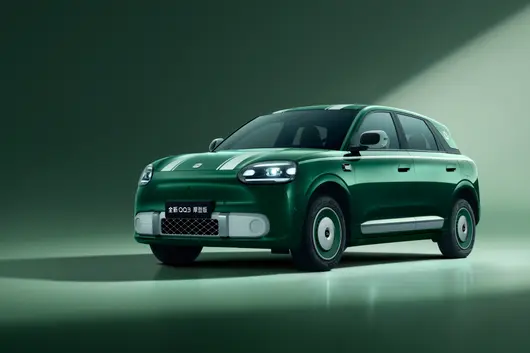
September 22, 2026, the QQ Show and Friends of TA and the new QQ3 Modern Edition launch event was held at Wuhu Jiuzi Plaza. More than the car debut, what garnered more market attention was a set of continuously rising sales figures: the new QQ3 has surpassed 10,000 sales for 5 consecutive months, with August sales reaching 19,103 units, a 64.07% month-over-month increase; since launch, domestic and international orders have exceeded 100,000, with cumulative orders after pre-sales in Thailand and Indonesia quickly breaking through 20,000. In the current market where competition for quality compact cars is intensifying, the new QQ3 is showing a sales trend with strong performance in both domestic and overseas markets, accelerating its globalization.
Sales exceeding 10,000 for 5 consecutive months mean the new QQ3's popularity is not a short-term surge, but reflects sustained and stable market recognition. The August figure of 19,103 units, with a 64.07% month-over-month increase, further confirms that market demand for this quality compact car is accelerating. This momentum is built on the QQ brand's solid foundation — the QQ series cumulative sales have exceeded 1.6 million units, selling in over 100 countries and regions domestically and internationally. Entering the intelligent electric era, the new QQ3 continues the QQ brand's classic genes, with higher quality, smarter intelligence, and more global product expression, converting the market recognition of the classic IP into tangible sales momentum.
Simultaneous popularity in overseas markets is another key dimension of the new QQ3's sales success. After pre-sales in Thailand and Indonesia, cumulative orders for the new QQ3 quickly exceeded 20,000, with domestic and international orders exceeding 100,000 since launch, forming a dual-track sales trend domestically and internationally. From domestic best-seller to international sensation, the new QQ3 is gaining global love from more users, also providing strong support for the QQ brand's global layout.
Behind the sustained sales success lies the substantial investment the new QQ3 has made in quality. Before entering the global market, the new QQ3 has completed global road testing covering 9 major regions and 44 countries, with the longest single-vehicle test mileage exceeding 300,000 km, and has undergone 1,000+ virtual validations, 2,000+ bench validations, and over 3 million km of vehicle validation. The technical exhibition area set up at the launch event, through exhibits such as white bodies, integral hot-formed door rings, eco-friendly PU foaming cotton, etc., presented the new QQ3 Modern Edition's structure, materials, and design details to users. From the Rock-solid body with 82% high-strength steel content, the 1300 MPa integral hot-formed door ring, to the Rhino battery with CATL cells and six-dimensional electric safety certification, the new QQ3 addresses users' demand for daily commuting safety, implementing it in every commute, pick-up/drop-off, parking, and long-distance travel.
Beyond sales figures, user profiles are also worth noting. Users of the QQ series have distinct Self-pleasing individual characteristics; as of August, female users accounted for 56%. Among owners, there are co-creation users who love modifications and know the young circle, as well as life explorers who take the QQ3 outdoors, and quality testers who deeply experience the vehicle and participate in OTA optimization feedback. With the initial user word-of-mouth continuing to buzz, the new QQ3 is forming a virtuous cycle of "Sales Growth — Word-of-Mouth Expansion — More Sales".
This launch event used "QQ3 Happy Show" as the core concept. Sun Li, Global Spokesperson for Chery Brand / Chery QQ, came to the scene, posing with the new QQ3 Modern Edition, and personally delivered new cars to fans. Stand-up comedians Feng Zihao, Bu Jingyun, and Daozhu resonated with the QQ brand's happy gene through relaxed and hilarious language. The site also centrally presented 6 modified cars and decorated cars, including Chinese-style cars, California Holiday theme, Cat-themed cars, etc., showcasing the QQ3 product temperament of "Playable, Modifiable, Co-creative".
The new QQ3 Modern Edition, based on the new QQ3, takes the Neo Retro design concept as its core, from fully wrapped same-color paint process to Time Badge wheels, Wind Trace Racing Stripes and other exclusive elements, reshaping the modern style of quality compact cars. In terms of configuration, the Modern Edition is equipped with the high-throughput automotive-grade 8155 chip and a 15.6-inch 2.5K ultra-high-definition central control screen, featuring Carmind Large Model, 540° panoramic image, 100+ full-scenario automatic parking, and L2-level assisted driving functions, and 13 class-exclusive configurations including the 70L intelligent electric front trunk and 10-layer cloud comfort seats, building a product value barrier.
Sales exceeding 10,000 for 5 consecutive months, August month-over-month growth of 64.07%, domestic and international orders exceeding 100,000 — the launch of the new QQ3 Modern Edition is based on a set of solid sales data. As the Modern Edition officially reaches users, the globalization acceleration of this quality compact car is expected to take another step up.




The all-new QQ3 Modern Edition is launched, with the press conference held at Wuhu Jiuzi Plaza. This location selection is quite interesting, not an exhibition center, not a hotel ballroom, but a "Lake-Street Integrated" city landmark. Simply put, the message this car wants to convey is clear: it doesn't just want to stay on stage, it wants to drive into real life.

The entire press conference felt more like a "Happy Showground". Guests entered with "QQ SHOW Happy Entry Tickets", passing by the Global Sales Zone, Quality Exhibit Zone, Modified Car Zone, and Modern Edition Display Zone. You could see things usually hidden inside cars like the white body, integrated hot-formed door rings, and eco-friendly PU foam. You could also see 6 modified cars with completely different styles. This "walkable, playable, shareable" flow design is essentially doing one thing: letting users find the answer themselves, rather than the brand forcing conclusions.

Sun Li arrived. As the global ambassador for Chery QQ, her appearance wasn't surprising, but her on-site delivery of new cars to fans shifted the emotional focus of the press conference from a "brand show" to a "user zone". Coupled with the on-stage output from stand-up comedians Bu Jingyun, Feng Zihao, and Daozhu, the language system of the entire event was relaxed, internet-savvy, and unpretentious. This aligns with what the QQ brand has always talked about: its "happy gene".

First, let's talk sales. In August, the all-new QQ3 sold 19,103 units, a 64.07% month-on-month increase, achieving sales over 10,000 for 5 consecutive months. In overseas markets, Thailand and Indonesia pre-sales cumulative orders exceeded 20,000, and since launch, overseas and domestic orders have surpassed 100,000. The QQ series cumulative sales are 1.6 million+, selling well in over 100 countries and regions. These numbers tell one thing: the QQ3 doesn't survive on nostalgia; it is supported by real purchasing power in both domestic and international markets.

Then quality. Before the all-new QQ3 headed to global markets, it completed global road tests covering 9 major regions and 44 countries. The longest test mileage per vehicle exceeded 300,000 kilometers, plus 1,000+ virtual validations, 2,000+ bench validations, and over 3 million kilometers of vehicle validation. Showing the white body and hot-formed door rings directly to users at the press conference isn't common in the industry, but it is effective. Quality is something you can't just talk about; you have to show people.

Design is the most intuitive differentiation for this car. The all-new QQ3 Modern Edition is based on the Neo Retro design concept, integrating retro-futurism on the foundation of square and round aesthetics. Full coverage color-matched paint, time badge wheels, wind track racing decals, Golden Age grille, gilded chrome trim, retro white front and rear bumpers. These elements combined form a complete modern appearance system. The paint used is Kansai and PPG's 6-layer 2K high-quality car paint. Official data states aging gloss loss is controlled within 5%, while the industry standard is 20%. Theoretically, it can last 10 years without fading.

Regarding the interior, Cloud Velvet Beige is the base, houndstooth textures accent the center console and door panels, and velvet covers the roof and A/B pillars. These details on a small car definitely elevate the sense of refinement to a higher level.

The modified car zone is another highlight of this press conference. Chinese Style Small Car, California Holiday, Cat Car, Hand-painted Car, Urban Safari, Outdoor Mountain Tour. The 6 cars correspond to 6 lifestyles. The Chinese Style Small Car takes a low-key Chinese style route, pale fog blue with soft fog pink plus red plum patterns; California Holiday directly applies island car stickers, roof tents, surfboards, and a trunk coffee machine bar; Cat Car uses fur wrapping to create a small kitten shape, and planned a dedicated cat storage area.
The message these modified cars convey is clear: the QQ3 is not just a commuting tool; it is a "single item" that can be redefined by users.

User profiles also confirm this. As of August, women account for 56% of the QQ series users. Among owners, there are co-creation users who love modifications, explorers who take QQ3s outdoors, and quality testers who deeply participate in OTA feedback. The common characteristic of this group is "pleasing oneself"; they buy cars not to meet others' expectations, but to make themselves comfortable.

The answer from the QQ3 Modern Edition is: build on globally verified quality, establish differentiation with recognizable design, open up gameplay with modifications and co-creation, and finally bring these people together with a press conference that isn't pretentious. It didn't try to please everyone, but rather perfected the act of "pleasing oneself".

In a small car market where configuration, price, and parameters are constantly competed on, the QQ3 Modern Edition chose a slightly different path: first make happiness real, then sell the car well.

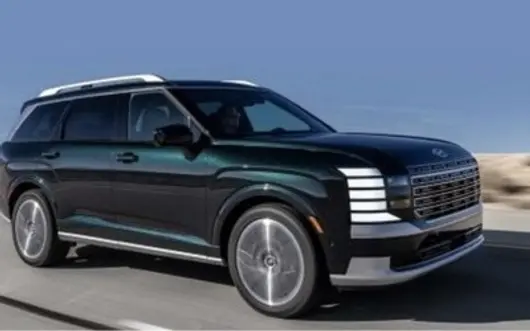
[CNMO Tech News] Indonesia's hybrid car market continues to expand this year. Data shows, from January to August 2024, Indonesia's hybrid car wholesale sales reached 58,040 units, a year-on-year increase of 43.3%. Against this backdrop, Hyundai Palisade Hybrid sold 774 units ranking 9th on the local hybrid car sales list, and Santa Fe Hybrid ranked 14th with 538 units.

Source: Internet
According to data released by the Indonesia Automotive Industry Association, in the first 8 months of this year, Indonesia's total car sales were 859,256 units, with hybrids accounting for about 6.75%. From a market structure perspective, local hybrid car sales growth was mainly driven by large MPVs and SUVs suitable for family use, with significant demand for relevant models.
Looking at specific models, Toyota Innova Zenix Hybrid led with 17,845 units, Veloz Hybrid sales were 15,554 units, ranking second. Followed by Suzuki XL7 Hybrid with 5,572 units; Fronx Hybrid sales 3,294 units; Honda HR-V Hybrid sales 3,225 units. These models constitute the main sales volume of Indonesia's hybrid car market.
Regarding Hyundai Motor, Palisade Hybrid and Santa Fe Hybrid both entered the top tier of local hybrid car sales. Among them, Palisade Hybrid is Hyundai's best-selling hybrid model in the Indonesian market. Based on existing data, the combined sales of these two models amount to 1,312 units, occupying a certain share in the local hybrid car market.

August 2026, Chery Group sold 280,128 cars, up 15.4% year-over-year. Among them, new energy vehicles reached 120,909, up 69.8%, breaking through 100,000 units for 5 consecutive months; exports were 196,984, up 52.1% year-over-year. Cumulative sales from January to August totaled 1,914,481, up 10.8% year-over-year.
The automotive market is fiercely competitive this year, with price wars lasting years showing no signs of fading. Joint ventures are retreating or shrinking, while some new entrants are still burning money to boost volume. In such an environment, Chery maintaining double-digit growth with both export and new energy lines performing well is indeed impressive.
However, looking closely, the core driving force behind these results lies not in marketing or price wars, but on the product side – it is the depth of the product matrix that supports synchronized growth in both domestic and overseas markets.
Stable output from the new energy series relies on "full price coverage"
In August, Chery New Energy sold 120,909 units, a 69.8% year-over-year increase, standing at the 100,000-unit milestone for the 5th consecutive month. Behind this number is not a breakout single model, but stable output from the entire new energy series.

Let's look at a few specific products.
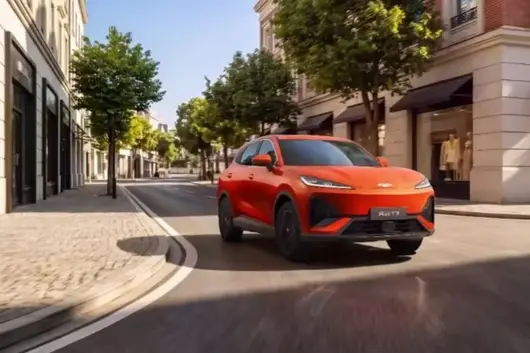
Fengyun T7, a global quality pure electric SUV launched in August. After 2 years of planning, 3 years of R&D, and over 6 million kilometers of global testing and validation, orders surpassed 23,000 within 24 hours of launch. As is well known, pure electric SUVs are currently the most competitive niche market, without a doubt. Being able to win in this red ocean to some extent proves that Fengyun T7's product positioning fits the needs of the target market.

All-new QQ, with sales breaking 10,000 for 5 consecutive months, locking in a spot as a star product in the A0 class. What does A0 class mean? Low unit price, thin margins, many competitors; it is the price segment that best tests cost control and product foundation. The fact that the All-new QQ can stand firm shows that Chery's system capability has been verified in the entry-level market.
Looking upwards, the Luxeed V9 cumulative deliveries exceeded 20,000 units, refreshing the fastest delivery record for the 500,000 RMB new energy MPV segment. The 500,000 RMB tier is a price band domestic brands once didn't dare to touch.
Putting these cars together, you will find: from the tens-of-thousands QQ, to the Fengyun series for mainstream families, to the 500,000 RMB Luxeed, Chery's new energy products cover different price segments, with family users, young users, and high-end users finding what they need. This is how the monthly domestic new energy penetration rate continuously breaks through 60%.
This is the difference between "series-based operations" and "single product blockbusters." Single product blockbusters rely on luck, while series output relies on the system.
Fuel and New Energy, Supporting Overseas Markets
Exports are Chery's real trump card. In August, Chery exported 196,984 units, up 52.1% year-over-year. From January to August this year, cumulative was 1,343,334 units, up 68.1% year-over-year. As of August this year, Chery Automobile cumulative exports have surpassed 7 million units, the first Chinese automaker to achieve this.
Why Chery? I think the answer comes down to two words: pragmatism.

Second, product matrix layered, adapting to local conditions. Consumers in different countries have different road conditions, usage habits, and purchasing budgets. Chery's approach is not to simply move domestic products abroad, but to perform localization adaptation, using a rich vehicle matrix to match market demands in different regions. Low-cost markets have economic products, mature markets have quality products, interconnected.
How is the effect? We can look at Chery's performance in the European market. Data shows, from January to July this year, Chery sold over 208,000 units in 24 European countries, up 201% year-over-year; among them new energy exceeded 101,000 units, up over 3.3 times. In the UK market, JAECOO 7, JAECOO 5, OMODA 5 three models broke into the UK top 10 best-selling vehicle list. According to China Passenger Car Association data, from January to July, Chery New Energy cumulative exports ranked second in the industry.

It is worth noting that Europe is one of the markets with the highest thresholds and most competition globally. This 201% growth rate indicates that Chery's product strength has passed the test of the most picky users.
Additionally, JAECOO 5 became the sales champion in the Australian niche market, and pure electric markets in Indonesia and Thailand; iCAUR V23 ranked first in niche markets in Thailand, South Africa, etc. This shows Chery's products have been validated by the market in multiple countries globally.
Product strength is the true moat
In the end, sales growth is essentially product strength being recognized by global users. Where does product strength come from? From R&D.
Chery is willing to spend on R&D. In 2025, Chery R&D investment was 14.715 billion yuan, up 39.6% year-over-year. This number ranks third among Chinese automakers, second only to BYD and SAIC.
Where was the money spent? Kunpeng Power, fuel, hybrid, pure electric, hydrogen energy four-in-one. Kunpeng Super Power Hybrid C-DM, thermal efficiency greater than 44.5%, fuel consumption per 100km with depleted battery as low as 4.2L, comprehensive range over 1,400 kilometers. On the intelligent level, Chery has Falcon Assist Drive, Lingxi Smart Cockpit, Flying Fish Digital Smart Chassis, etc., and these advanced technologies are already installed on mass-produced cars.

The effect is also visible. In full year 2025, Chery sold 903,847 new energy vehicles, up 54.9% year-over-year. Moreover, among all new products launched in 2025, new energy accounted for over 90%. Looking at Chery's August data again: new energy broke 100,000 for 5 consecutive months, exports up 52.1% year-over-year. This shows Chery's product matrix has continuous ability to generate vitality.
On the other hand, Chery New Energy is currently transitioning from scale expansion to a new stage of value growth. In the first half of 2026, Chery Automobile new energy business revenue reached 59.284 billion yuan, up 63.8% year-over-year, accounting for a share of total revenue rising from 25.6% to 41.4%.
R&D investment turns into technology, technology turns into products, products turn into sales. This closed loop is operational.
In the future, Chery will use intelligent electrification technology to stand firm in the global market. Domestically relying on new energy matrix to hold the position, overseas relying on fuel and new energy walking on two legs to expand the territory.
Product-oriented, let products speak. This sounds simple, but in today's automotive market relying on traffic, buzz, and subsidies, it turns out to be the most solid path. Chery's August scorecard proves one thing: Do products well, and the market will give you the answer.

According to the latest sales data statistics by overseas blogger @piloly, as of August 2026, Tesla's cumulative sales in 14 countries globally this year have all exceeded the full year of 2025.
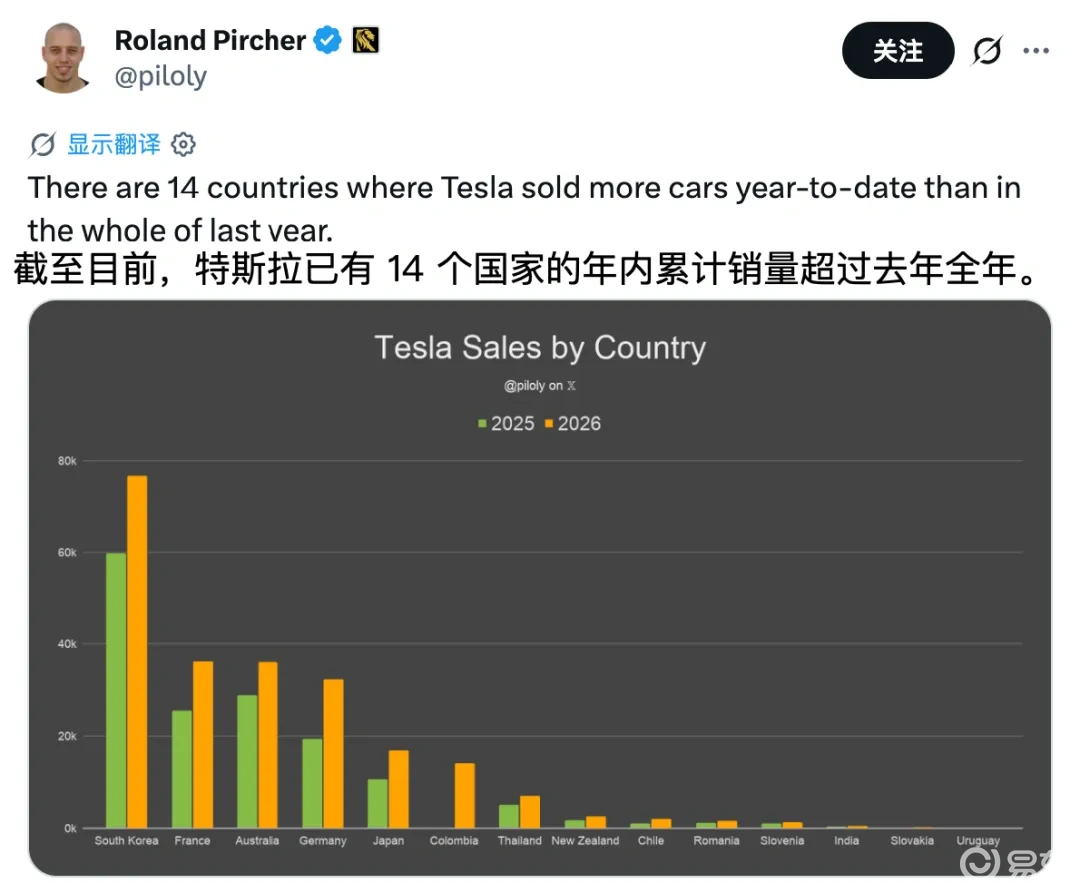
Specifically, these 14 countries include South Korea, France, Australia, Germany, Japan, Colombia, Thailand, New Zealand, etc., covering multiple regions such as Asia, Europe, Oceania, and South America.
Among them, as of August this year, Tesla's cumulative sales in the South Korean market have surpassed 76,000 units, with monthly sales again breaking 10,000, and ranking first in South Korean imported car sales for 7 consecutive months starting from February this year. In August, the Model Y also surpassed multiple popular local South Korean models, becoming the best-selling passenger car locally.
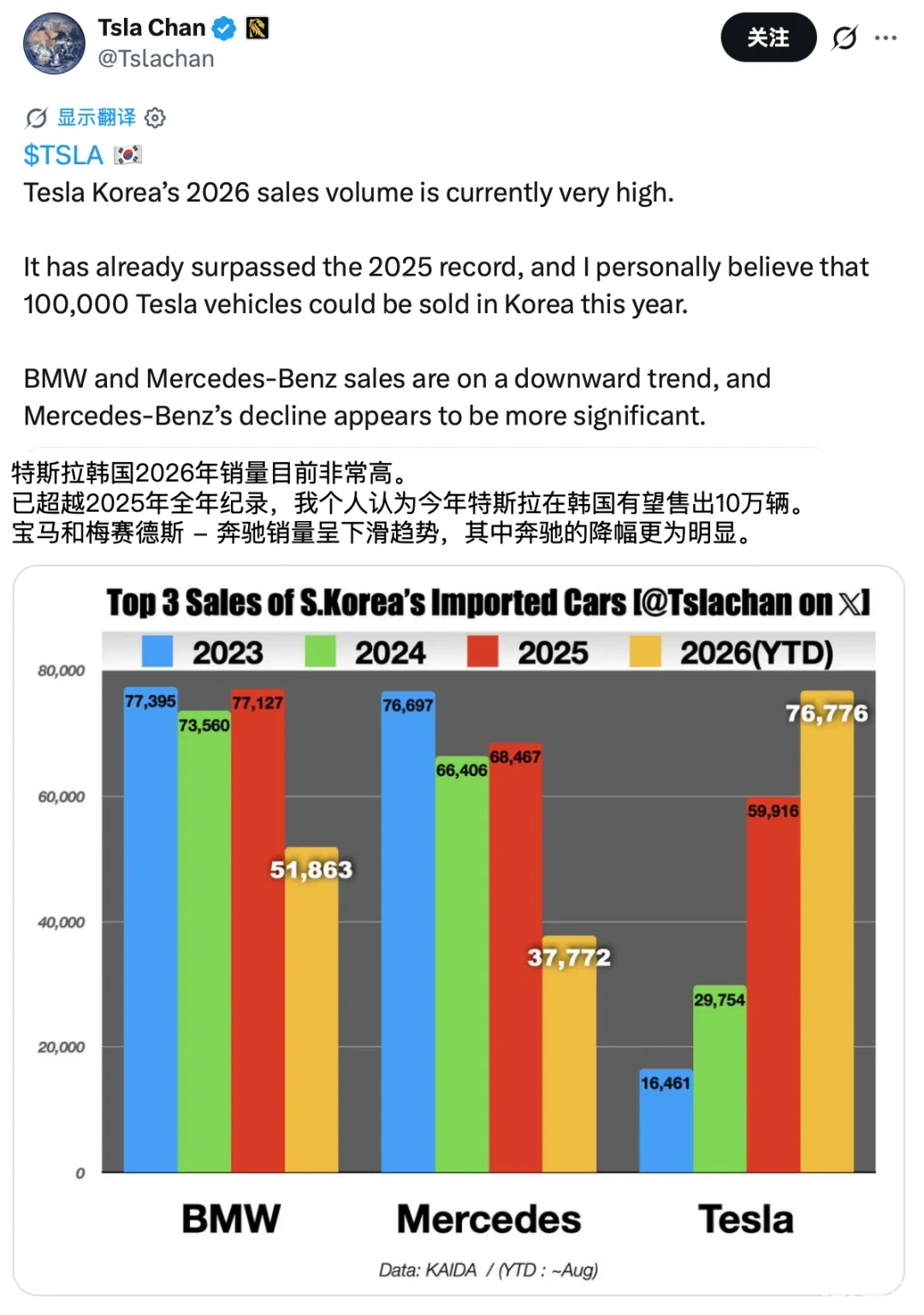
Similar to the South Korean market, the French market was previously dominated for a long time by French local brands such as Renault. Tesla has achieved rapid sales growth with strong product capabilities. From January to August 2026, Tesla's cumulative sales in France reached 36,000 units, a year-on-year growth of 148%. The Model Y became the best-selling model across all categories in France twice in June and August this year.

In the Australian market, Tesla's total delivery volume in August increased by 163% compared to the same period last year. This year, the Model Y became the best-selling model across all categories in the Australian market three times in May, June, and August successively.

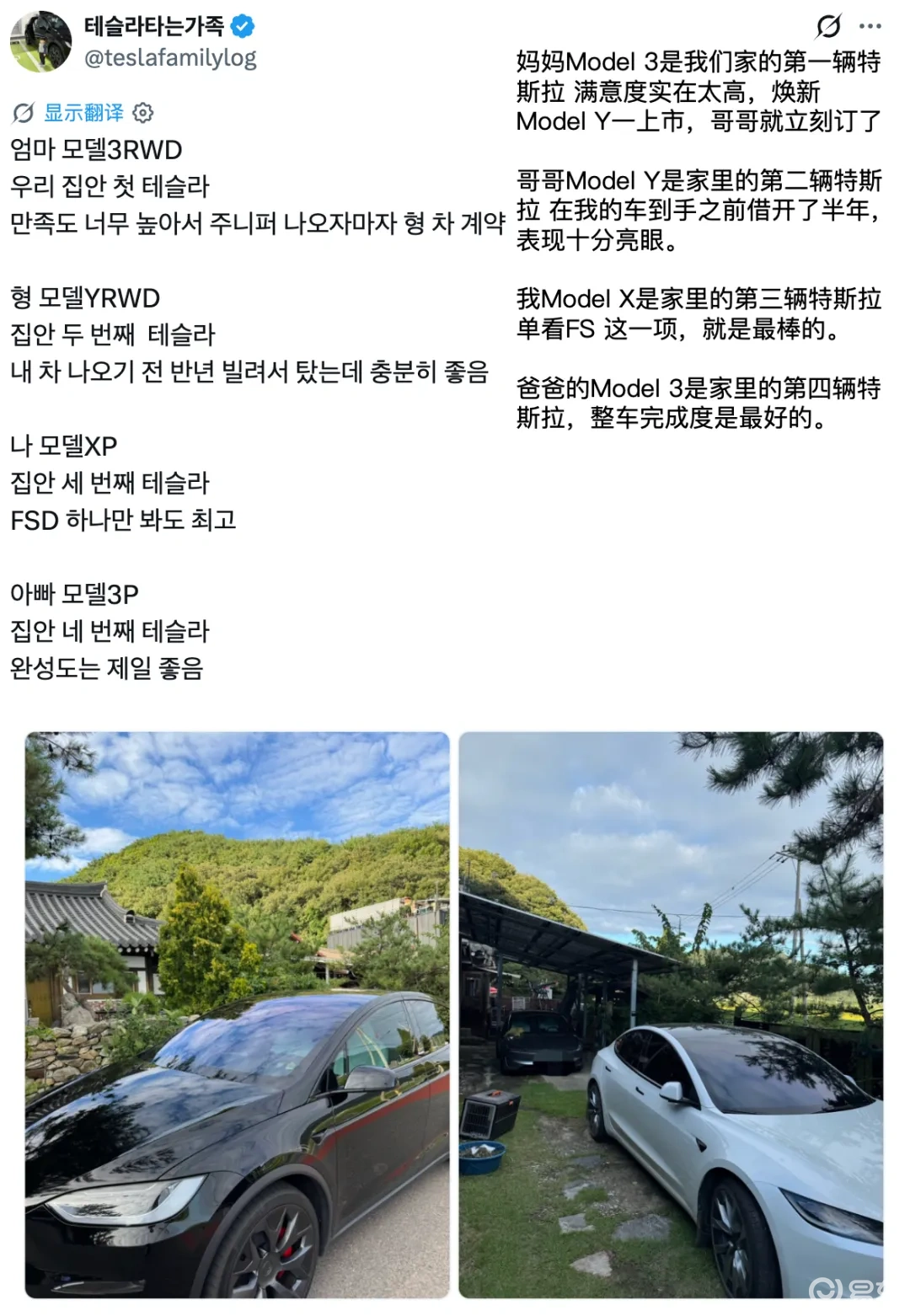
Apart from solid sales data, the real choices of owners also continue to prove Tesla's hot-selling strength. Owner @teslafamilylog shared their family experience: Since mom bought the first Model 3, the whole family quickly became fans of Tesla. He and his brother and dad then purchased 3 more cars successively, and the four cars directly covered the whole family's travel.

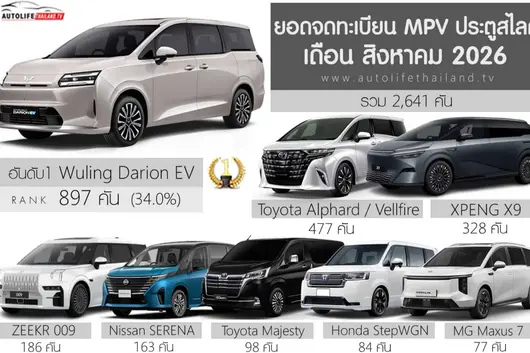
A domestic MPV has been in Thailand for less than half a year, in August it directly claimed the top sales spot, selling 897 units, finally pushing the perennial market leader Toyota Alphard/Vellfire to second place with 477 units. This car is the Wuling Starlight 730, called Starlight Darion EV in Thailand. Let's look at the data, the 2025 Thailand MPV full-year sales champion was the Toyota Alphard 5,438 units, the Starlight 730 was only officially launched in Thailand in March 2026, began delivery at the end of April, until July only sold 157 units, the result of August directly reached 897 units, monthly sales nearly 6 times growth directly surged to first place, this explosive power is too strong. Why can it explode? Actually there are 2 reasons, product fits the market, price is right.

Thailand is a typical multi-member family society, having 3-4 generations go out together is normal, large 7-seater MPV is a must-have. Starlight 730 car length 4.91 meters, wheelbase 2.91 meters, 2+2+3 true 7 seats, electric sliding doors, elderly and children getting on and off car convenient, fully stepped on Thai family demand. In terms of power 150 kW front-drive motor, 69.2 kWh LiFePO4 battery, NEDC range 500 km, charge from 30% to 80% less than 20 minutes, Thailand so hot weather, turn on AC not too worried. Most critical is price, 839,000-899,000 Baht, converted to RMB about 168,000-180,000.

The same level Toyota Alphard in Thailand start price already exceeds 3 million Baht, almost is Starlight 730 three times more, also long-term markup, oil price now fluctuates so much, you say Thai family who not willing to spend little money to do big things, same is large 7-seater MPV, Starlight 730 configuration still higher, price only one third, so August championship not accidental, is natural, Japanese MPV one third price, give to larger space, more complete configuration and lower usage cost, just hit Thai ordinary family pain point, this is Chinese new energy vehicle going global occupy Southeast Asian market logic.

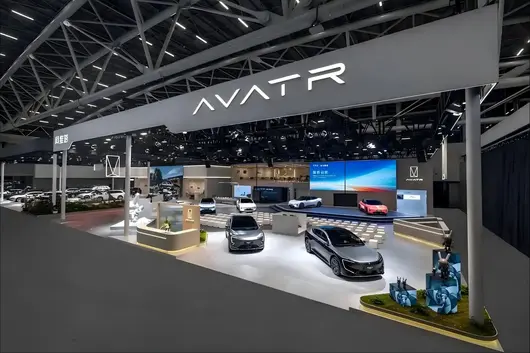
Avatr's recent management adjustments have sparked considerable discussion within the industry.
According to relevant reports, Wang Hui, Executive Vice President of Changan Automobile and Chairman of Avatr Technology, will shift his focus to the group's global business next, leading the Southeast Asian and Central & South American markets; Chen Zhuo, who was promoted to Vice President in June this year, will take on more of Avatr's daily operations and business advancement. It needs to be stated that currently, Wang Hui remains Chairman of Avatr Technology and Executive Vice President of Changan Automobile, overseeing a portion of overseas business.

At first glance, this is a conventional matching of personnel to roles — Wang Hui already has senior experience in overseas business, so doing familiar work is natural; Chen Zhuo, as part of the younger generation of management, taking over a high-end brand also aligns with the training rhythm. However, combined with Avatr's current development stage and Changan's overall performance situation, behind this adjustment lies the current development situation of the brand and the group.
Three-party resources support, brand still in ramp-up phase
As a high-end new energy brand jointly built by Changan, Huawei, and CATL, Avatr's starting point can be said to be quite high. Manufacturing, intelligent technology, and battery — the three core links, all supported by industry top players, market expectations were maxed out when the brand first launched.
But developing to now, the brand is still in the ramp-up investment stage. Financially, cumulative losses from 2022 to 2025 exceeded 13.2 billion yuan, not yet exiting the loss period of the investment phase. In terms of sales, cumulative deliveries in the first half of this year were about 27,619 vehicles, a 51.3% year-on-year decrease. The annual target of 220,000 vehicles set at the beginning of the year was only 12.6% completed in half a year, the progress gap is relatively large. It is worth knowing that the domestic new energy market overall still maintained growth this year, Avatr's development pace has opened a considerable gap with the overall industry trend.
Wang Hui completes multiple strategic frameworks
Internally, he deepened the three-party strategic cooperation, established a full set of integrated development models, and also led the investment matters in Huawei's Yinwang Company. In November 2025, the cooperation with Huawei was upgraded to the HI PLUS joint co-creation model, no longer simply technology supply, but collaborative across the entire value chain from user insights, product definition to R&D, integrated marketing, and team building.

Externally, he clarified the global development logic for Avatr, promoted the brand entering global 34 country markets, and planned to expand the market scope to 46 to 50 countries in 2026.
However, these top-level layouts are currently still in the process of gradual implementation and have not yet been fully converted into tangible terminal sales and operating performance.
And the cooperation with Huawei also has topics that need to be sorted out in the long term. Currently, Huawei cooperates with multiple car companies at different depths. Avatr how to find its own positioning within Huawei's cooperation map, and strive for more adaptive resource allocation, is a matter that needs to be continuously explored in the brand development process.
In terms of capitalization, Avatr's HK listing is also being promoted. In November 2025, the company first submitted a listing application to the Hong Kong Stock Exchange, did not complete the hearing process within the specified time, and the application automatically expired on May 27, 2026; on June 30, the company resubmitted the listing materials, currently in the audit promotion stage, the specific listing schedule has not yet been clarified.
Overseas growth momentum is good, but also faces competition and localization challenges
In the first half of this year, Changan's overseas sales reached 455,000 vehicles, a 51.9% year-on-year increase; overseas revenue was 21.942 billion yuan, a 78.77% year-on-year increase, accounting for the proportion of total revenue from 16.89% in the same period last year to 33.43%. More importantly, the gross profit margin of overseas business reached 20.13%, significantly higher than the domestic business 11.67% level, having become an important growth and profit support for the group.

But behind the good-looking data, there are also many realistic challenges. First is market competition, Southeast Asia, Central & South America and other regions, now Chinese car companies are all accelerating layout, BYD, Geely, Chery, Great Wall and other brands have already entered, market competition continues to intensify, long-term gross profit margins face downward pressure.
Second is the difficulty of localization implementation. When Wang Hui was responsible for Southeast Asian business before, he proposed a target that the localization rate of Thailand factory would reach above 80%. But supply chain building, local talent training, compliance system construction and other work, all need long-term time and capital investment, the process of target landing is not easy. If the localization progress falls short of expectations, cost advantages will also be affected.
So this time letting Wang Hui manage some overseas business is also hoping to leverage his past experience to further consolidate the development foundation of the overseas market and consolidate the growth momentum.
Chen Zhuo takes over, the core is to grasp landing execution
Chen Zhuo, who took over Avatr, was just promoted to group vice president in June this year, and will face multiple realistic topics in the brand development process next.

Current Avatr does not lack top strategic frameworks, nor lacks three-party resource backing, but the operational work to make up is still many: how to narrow losses, how to improve terminal sales, how to smoothly promote the listing process, are all very practical problems. Brand positioning is high-end market, how to convert technical and resource advantages into product power perceived by consumers, how to improve brand volume and channel efficiency, are the key points that operations need to push.
After all, the previous stage was more about setting directions and building frames, next more tests are landing ability and refined operations. Especially in the three-party cooperation mode, how to coordinate the resources of all parties well, improve collaboration efficiency, let cooperation value fully release, very tests the new management team's operation ability.
As a core member of the Changan new generation management, Chen Zhuo's takeover has also injected new execution power into the brand, but from strategic planning to market results, there are still many links that need to be connected in between.
The logic of group layout behind the adjustment
This personnel adjustment, after all, is also a resource re-layout of Changan in the industry adjustment period.
In the first half of this year, Changan Automobile revenue decreased by 9.71% year-on-year, net profit attributable to shareholders decreased by 64.32% year-on-year. Domestic car market competition continues, price war background domestic business gross profit margin narrowed to 11.67%, profit pressure has appeared.

Avatr as Changan layout high-end new energy important carrier, currently still in investment period, not yet into profit contribution stage, continuous capital investment for the group is also a huge consumption.
So the logic of this wave adjustment is also clear: put the executive with the most experience to the overseas market with the highest growth certainty, guard the basic disk; let young managers operate high-end brands, promote landing execution. One side takes care of current performance stability, one side lays out long-term brand upgrade, is a very pragmatic development idea.
For Avatr, the big direction and framework are basically formed, next fight is refined operations and landing ability. This management team adjustment can bring how many changes, finally still has to look at product performance and market feedback.

"Image content | Source: Internet, copyright belongs to the original owner. If there is any infringement, please contact us to delete!"

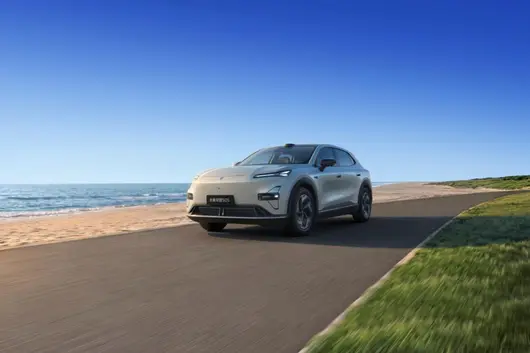
In August 2026, Deepal Cars maintained a steady trend, achieving global sales of 28,659 units, with cumulative global sales surpassing 947,600 units, steadily approaching the million-unit sales milestone. As Deepal's global bestseller, the Deepal S05 achieved 17,474 units in global sales this August, a year-on-year increase of 43.42% and a month-on-month increase of 24.29%. Since launch, monthly sales have exceeded 10,000, cumulative global sales exceeded 260,000 units, firmly establishing itself in the first tier of 150,000-class compact new energy SUVs. The new Deepal S05 is also selling well since launch; this is both a powerful echo of the market's response to Deepal S05's continuous evolution and another proof of technological equity taking root in the mainstream market.

The all-new Deepal S05 brings Lidar and one-piece end-to-end algorithms to the mainstream 150,000-class home market at once, making smart assisted driving that once belonged only to high-end models accessible daily for more families. The new car is equipped with the Tiandu Pilot Smart Driving Assistance System, featuring 27 high-precision perception hardware units including one Lidar across the vehicle. Paired with dual Horizon J6M chips and Tesla's similar one-piece end-to-end algorithm, the vehicle possesses prediction and decision-making capabilities closer to human drivers. The system supports over 90 assisted driving functions, easily covering daily high-frequency scenarios such as urban areas, highways, and parking; the industry-exclusive full-scenario roaming assistance allows easy travel even in map-free environments, further expanding the application boundaries of smart driving assistance.

Inside the cockpit, the new car is equipped with the industry-leading 3nm automotive-grade cockpit chip, matching the process of top global mobile phone chips, leading the industry by 3-5 years; combined with four-map fusion real-scene lane-level navigation, a 15.6-inch 2.5K Sunflower Screen, 18-speaker sky surround sound, and deep-thinking smart AI voice interaction, making family travel both high-tech and fun.
FSD+HRS Advanced Variable Adaptive Suspension, Resolving Family Travel Pain PointsAddressing the ride comfort that young family users care about most, the all-new Deepal S05 comes standard with FSD+HRS advanced variable adaptive suspension, leading the 150,000-class segment. This system can sense road conditions in real-time and automatically adjust damping, providing sufficient support during cornering to suppress roll, and automatically softening when passing bumpy roads to filter vibrations. Combined with HRS hydraulic rebound buffering technology, it effectively eliminates fine bouncing and residual shocks. No nose dive during braking, no body roll during cornering, no bumps on rough roads. Every trip for the whole family is steady and calm, seniors don't get carsick, and children can sit comfortably.

In terms of power, the new car offers two pure electric versions of 520km and 620km (CLTC), with 0-100km acceleration in 6.28 seconds; the entire series comes standard with 3C ultra-fast charging, with 30%-80% charging time not exceeding 15 minutes. Combined with the globally first wide-temperature micro-core high-frequency pulse heating technology and heat pump air conditioning, charging time is reduced by 55% and range increased by 21 km in -30°C environments, allowing users to depart with peace of mind regardless of winter or summer.
New Technology Sports Aesthetics, Interpreting Fashionable Light Luxury TextureDesign and quality are also key to winning over young families with the all-new Deepal S05. The new car continues the Interstellar Wings 2.0 design language, adding full-body flowing light trim lines, fluid dynamic dual waistlines, and 18-inch "Stellar Vortex" sports wheels. Combined with frameless doors and semi-hidden mechanical door handles, it integrates pioneering sports posture with practical safety. Inside the cockpit, a new Nebula Purple interior color is added, forming three interior choices together with Thermal Wave Orange and Star Rock Grey; the entire cabin is 99% covered in high-grade leather, combined with high-grade wood texture decorative panels and 256-color floating surround ambient lighting, making light luxury texture accessible.
Champion Selection, 260,000+ Global Users Confirm QualityGymnastics Olympic Champion and Full Sweep Winner on Uneven Bars, He Kexin, as the first celebrity owner of the all-new Deepal S05, a two-time champion known for "stability" and "accuracy" on the competition field, also upheld champion-level rigorous standards when choosing a car. The all-new Deepal S05 won her high recognition with its solid chassis texture, flexible and practical storage space, and comfortable riding experience. The champion's rigorous selection also becomes the most powerful testament to the product strength of this "Global Fashion Laser Smart SUV".

As a pioneer of Deepal's "Embrace All Rivers" plan, Deepal S05's global map has expanded to 73 countries and regions, with overseas monthly sales steadily breaking 6,000 units. In the overseas market, Deepal S05 successively won authoritative honors such as the German iF Design Award and Thailand's Best Rear-Drive Compact Electric SUV of the Year; domestically, it secured the No. 1 position in J.D. Power 2026 China New Energy Vehicle New Car Quality Research Compact Pure Electric SUV. Multi-dimensional recognition of sales, reputation, and professional honors both domestically and internationally makes Deepal S05 not only a hot-selling product but also a core carrier for Deepal Cars to push Chinese new energy technology to the world.
Continued Hot Sales Since Launch, Starting a New Global JourneyThe continued hot sales of the all-new Deepal S05 since launch are the inevitable result of Deepal Cars' long-term adherence to technological equity and deepening user needs. It not only made upgraded configurations such as Lidar, one-piece end-to-end algorithms, 3nm automotive-grade cockpit chips, and FSD+HRS advanced variable adaptive suspension, change from high-end exclusives to 150,000-class mainstream choices, but also allowed more users to enjoy upgraded experiences at mainstream prices. On the new starting point of Deepal Cars sprinting to one million users within the year, the all-new Deepal S05 will add new momentum for Deepal Cars to accelerate leading the global new energy track.
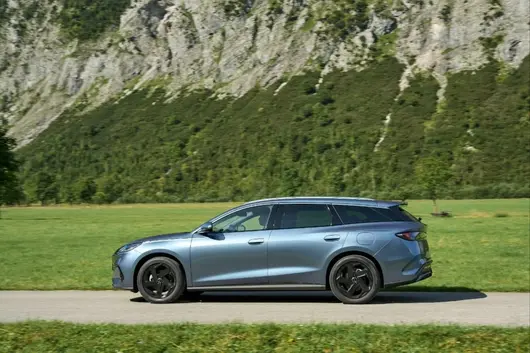
In the past, joint venture cars always dominated China's domestic automotive market. Even after domestic car brands gradually rose, they were long left behind in terms of sales. However, with the emergence of New Energy Vehicles, the landscape of the domestic car market underwent a transformation. After years of development, domestic New Energy Vehicles have surpassed joint venture NEVs in both quantity and sales.
Apart from performing notably in the domestic automotive market, many domestic car brands have opened up overseas markets, selling domestic New Energy Vehicles to the world. For example, BYD Motors, which performed outstandingly in the domestic New Energy Vehicle market, also achieved solid performance in overseas markets. Recently, BYD announced its sales data for overseas markets. As of August, the sales volume of passenger cars and pickup trucks under the BYD brand in overseas markets reached 189,000 units, up 136% year-on-year. Compared to the same period last year, this added a sales volume of over 100,000 units, continuously breaking sales records for five consecutive months. In addition, BYD's total overseas sales from January to August were 1.158 million units, surpassing the 1.0496 million overseas sales data for the entire year of 2025.
Currently, BYD has achieved the top spot in New Energy Vehicle sales in countries such as Thailand, Singapore, Italy, Saudi Arabia, the UAE, South Africa, Brazil, and others. In addition, BYD has gained recognition from high-level officials of multiple countries through its strength. Recently, US Treasury Secretary Bessent mentioned BYD during a speech at the Charlotte Economic Club event, stating, "BYD is the best car worth $70,000 that consumers can buy for $35,000." Besides Bessent's public mention, after experiencing the Yangwang U8, California Governor Newsom also called it a breakthrough technology for the new era. Additionally, Uzbekistan awarded the "Friendship Medal" to BYD; furthermore, Brazilian President Lula, Thai Prime Minister Anutin, former Chilean President Piñera, and other high-level officials from multiple countries praised BYD's innovative technology.
The main reason BYD has been able to obtain positive evaluations from officials of multiple countries is that BYD has achieved independent and controllable capabilities in the core areas of New Energy Vehicles—batteries, electronic controls, and motors. Therefore, pricing is naturally controllable, reshaping the pricing logic of the automotive industry, so BYD can be said to have won global recognition with its product strength!



 Discussing how to evaluate BYD's August 2026 sales exceeding 440,000 units, a year-on-year increase of 17.84%? First, state the viewpoint: this sales figure must be viewed dialectically. Flash charging boosted sales explosion; behind BYD sales exceeding 440,000 units is global market competition driven by technological change.

Overseas markets were the biggest highlight in August. Overseas sales of 189,000 units saw a year-on-year increase of 134.6%, breaking records for five consecutive months. Cumulative overseas sales from January to August of 1.158 million units have already exceeded the full year of 2025. BYD adopted an industrial going-global strategy by building factories in places like Thailand, Hungary, and Brazil. According to the "2026 H1 China Auto Going Global Insight Report" jointly released by CAITC and Yiche, BYD ranked first in market share in the Italian PHEV market in the first half of the year. Dolphin MINI retail sales were close to 30,000 units, firmly maintaining market first place. UK sales in the first half of the year were 38,000 units, nearly doubling compared to the same period, while Australia's June market share reached 13.5%, setting a new historical high, ranking second in sales for three consecutive months, with 3 model lines entering the top 10 for the first time.
 Staying at the top of the new energy sector for 63 consecutive months, what does this record mean? It is the dominance established by BYD starting from April 2021. In over five years, regardless of market fluctuations or fierce competition, BYD has always stood at the top of the industry. BYD employs about 110,000 R&D personnel, making it the automotive enterprise with the most R&D personnel globally. Blade Battery, DM-i Super Hybrid, YiSifang Platform, 2nd Gen Blade Battery, and Flash Charging Technology, every technical innovation is continuously widening BYD's moat.
 Battery Electric Vehicle (BEV) sales leading Plug-in Hybrid (PHEV) significantly for the first time is a positive signal. BEV sales in August were 256,000 units, PHEV were 177,000 units, with BEV accounting for 59%. The increase in BEV proportion indicates that Blade Battery and Flash Charging Technology are mature and charging infrastructure is well-established, but on the other hand, it reflects intensified competition in the PHEV market. From the competitive landscape of the China New Energy Sales List, the data of 440,000 units leading by a large margin shows a lead of nearly 250,000 units over the second-place SAIC. While predicting, we see intensified competition in the new energy market. Geely's August exports were 110,000 units, a 205% year-on-year surge, with cumulative January to August exports of 691,000 units, up 170% year-on-year. Chery's August exports were 197,000 units, accounting for 70.3%, with cumulative exports breaking 7 million units, firmly holding the champion position in Chinese automaker exports.
 Technical innovation is BYD's ace card. 2nd Gen Blade Battery charges well in 5 minutes, fully charged in 9 minutes. 10,000 Flash Charging stations cover 332 cities. In terms of intelligence, Divine Eye 5.0 City Navigation + Intelligent Parking provides dual backup. The underlying competitive moat includes the systematic capabilities of 110,000 R&D personnel and 900,000 employees, and fully independent R&D and large-scale mass production of the entire industry chain including chips. Next, we will watch the capacity ramp-up of Flash Charging Batteries and the application of the 4nm smart driving chip Xuanji A3 in vehicles.
 From the product structure perspective, the gold content of 440,000 units is constantly increasing. August data shows Tang EV broke 10,000 units for the second consecutive month, Qin MAX sales exceeded 10,000 units, Yuan Family sales were 84,000 units, Seal Family 47,000 units, Sea Lion Family three major series monthly sales all broke 10,000 units. Blooming in multiple points indicates BYD has broken the dependence on a single hit model, forming a complete product matrix covering the 70,000 to 300,000 price range. In August, Fang Cheng Bao and Denza combined sales were 58,000 units, more than doubling compared to the same period last year. Fang Cheng Bao sales were 42,000 units, up 155.6% year-on-year, becoming the sales leader among new forces brands with an average price over 200,000. BYD is breaking through upwards.
 The performance of high-end brands is commendable. Fang Cheng Bao 42,000 units, up 155.6% year-on-year, became the sales leader among new forces brands with an average price over 200,000. From the industry chain perspective, BYD's full industry chain vertical integration is a unique advantage. Batteries, motors, electronic controls, and chips are self-controlled and can also be exported. Where are the future growth points? Product reserves are indeed rich. New cars such as Denza Z9S, Da Han, Sea Lion 08, 3rd Gen Tang, Titanium 9, etc., cover the 200,000 to 1,000,000 price range. Of course, there are strong rivals surrounding every sub-market. Whether BYD's complete product matrix can win in every sub-market needs market verification.
 How will sales go next? Xiao Xing made a simple prediction using algorithms. The process of switching from fuel to electricity is accelerating, and the market share of traditional fuel cars is being rapidly eroded. An important turning point for China's automotive industry from trading market for technology to trading technology for market. When BYD's monthly sales exceed 440,000 units, former monarchs like Tesla, Volkswagen, and Toyota must face the rise of China's new energy vehicle enterprises.
 What we see is the shock and attention of foreign media towards BYD entering the top 5 annual sales for the first time. Especially when BYD's first K-car model Sea Otter entered Japan, it caused a sensation among the media. If looking at the year-on-month sales trend changes, we can find the beginning of 2026 looks very similar to 2024. Due to production capacity and market environment factors, although the start was slow, the second half of the year ushered in robust and high-speed growth in production and sales. And looking at the months where BYD's sales exceeded 400,000 units so far, there are 11 in total. Coincidentally, they appeared in the year-end period from September to December in both 2024 and 2025. The reason 2026 is special is that the 400,000 unit sales target was achieved earlier than before; this capacity ramp-up was clearly visible since June. Let's wait and see the development trend of the last four months.
 Overall, BYD's August 2026 performance of 440,000 units, with a year-on-year increase of 17.84%, is a report card with highlights that must be viewed dialectically. Highlights lie in overseas volume explosion, high-end volume increase, technology leadership, and systematic capabilities. BYD's path to global rise depends on whether it can find a new balance point between technical innovation, brand upward movement, overseas deep cultivation, and cost control. The competition in China's new energy vehicles has shifted from grabbing land in the incremental market to close-quarters fighting in the stock market. Flash charging boosted sales explosion; BYD's 440,000 monthly sales achieved a phased victory.

August sales hit 440,000 units, BYD takes China auto sales champion title again
Others worry about orders, it worries about batteries

To be honest, seeing "440,000 units, +17.84% YoY, once again first", this result is not unexpected. The truly worth pondering is another question: 440,000 units, is this BYD's ceiling?

In total volume, BYD sold over 440,000 NEVs in August, ranking #1 in China NEV sales for 63 consecutive months. Dynasty, Ocean bases are stable: Yuan series 84,000, Seal 47,000, Sea Lion three series all exceed 10,000, Tang EV, Qin MAX continue to exceed 10,000.

This is all basic, nothing much to discuss, there are 2 obvious changes.

First is overseas. August 189,000 units, +134.6% YoY, fifth consecutive month breaking record; first 8 months cumulative 1.158 million units, already exceeded full year 2025. Some say "Is it piling cars at the dock" — people thinking like that, probably haven't checked customs export data, nor looked at license plate registrations in Brazil, Thailand. Tang L renamed Atto 8 exported to Mexico, Middle East, Brazil, equivalent to 450,000-500,000 RMB, more expensive than domestic. This is real premium pricing.

Second is premium. Fang Cheng Bao 42,000 units, +155.6% YoY, single month exceeded Zeekr, Li Auto, AITO, Xiaomi, became sales champion among new EV brands with average price over 200,000 RMB; Denza 16,000 units, +33.4%. These two added up, 440,000 units, might not have reached BYD's true ceiling.

Because FinDreams Battery capacity is still being bottlenecked. When Gen 2 Blade first went into mass production, cell yield rate was only 60%~70%, production line capacity was 0 during retrofitting, belonging to dismantling, building, producing simultaneously. 12 bases retrofitting lines simultaneously, relying on core team running back and forth, capacity could only climb steadily. Fast charging boosted sales explosion.
Understood this way makes sense: Demand side orders exploded — sub-brands fighting for battery quotas, execs stationed at factory urging orders; Supply side is squeezing toothpaste — new cars parked in open lots waiting for battery packs, battery arrives then can go off line. Run after capacity and still sell 440,000, exactly shows demand is really hard.
Wait until line retrofit completed, yield rate maxed out, Gen 2 Blade capacity released again, that month sales, is BYD's true trump card.
So the question arises: Wait until that moment truly arrives, what will BYD's monthly sales be? 500,000, or more?



Japanese automakers have felt panic in global competition for the first time.
The first half of 2026 has passed. With more statistical reports emerging, Chinese automakers have created a string of new records. Among them, in ACEA European Association of Motor Vehicle Manufacturers' May statistics, among 31 major countries in Europe, BYD, SAIC, Geely, Chery, and Leapmotor totaled sales of 138,400 new cars, a year-on-year increase of 65%. This surpassed the total of six Japanese brands by more than 5%. Toyota, Nissan, Suzuki, Mazda, Honda, and Mitsubishi totaled 130,400 vehicles, a year-on-year decrease of 3%.

In another statistical perspective, in the narrow EU 27 markets, the month-on-month increase in new car registrations for the 5 major Chinese auto companies in May reached over 60%. Under different perspectives, Chinese auto companies have surpassed Japanese auto companies for the first time in history.
Undoubtedly, the value of this data is clearly higher than before. Because this is not just a comparison in numbers, but a hard confrontation in the world's third-largest market.
Three Tiers, Who Holds the New Overseas Influence?
Not only did they create records collectively, but each automaker also refreshed their upper limits.

Chery Auto, overseas sales account for more than 70% of the group's total sales, and has broken the record for single-month Chinese car exports for 4 consecutive months, additionally single-month exports exceeded 190,000 units for the first time;

BYD Auto, single-month passenger car and pickup overseas sales were 174,900 units, refreshing its internal corporate record, closely chasing Chery;

Geely Auto, first breaking 100,000 units in single-month overseas sales for the first time, 102,900 units in June, and the growth rate is very terrifying. The overseas new energy vehicle sales for the first half of 2026 were 277,200 units, a year-on-year growth rate of 585%;

Changan China, the overseas sales ratio is also gradually increasing. Taking June as an example, total sales were 201,900 units, overseas sales were 91,000 units, occupying nearly half the performance;

Great Wall Motor, the overseas sales ratio has also started to reach around 50%. Overseas sales for the first half of the year were 291,400 units, nearly 50% of total sales of 583,800;

SAIC Group, also refreshed its own sales record in Europe. Among them, the MG brand continued to take the title of European sales champion for Chinese brands, a record held for 11 years.
Aside from traditional large factories, new force automakers are also in a rapid upward trend now.

Leapmotor Auto, overseas sales for the first half of the year were nearly 100,000 units, currently exceeding its 2025 full-year number, and also starting to surpass XPeng Auto to take the top spot in new force overseas sales;

XPeng Auto, overseas sales are rising month by month. Taking June as an example, overseas deliveries can exceed 8,000. Its sales target for the full year of 2026 is set at 90,000 to 100,000 units;
So, from a numerical perspective, Chinese automakers in the overseas market are currently divided into three tiers:
The first tier, Chery is in the lead. Overseas sales 943,800 units, Chinese cars' history half-year export first exceeds 900,000 units. BYD ranks second, half-year overseas sales nearly 790,000 units. SAIC Group ranks third, half-year sales over 730,000 units;

Between the second tier and the first tier, the magnitude differs by about 50%. Geely Auto, sales for the first half of 2026 exceeded 470,000 units. What is worth noting is that its growth is very fast, and full-year sales are expected to exert pressure on SAIC Group. Changan's half-year overseas sales were 402,000 units, and Great Wall Motor's half-year overseas sales were 291,000 units.

The third tier is Leapmotor Auto and XPeng Auto. Leapmotor is expected to expand dealer numbers to 500 in the full year of 2026. XPeng has already expanded overseas sales and service networks to 380 stores in 60 countries and regions. Both are expected to quickly narrow the gap with the second tier.

From a model perspective, Chery's current export sales champion is mainly fuel SUVs Tiggo 7 and Tiggo 8. BYD's first half export sales champion is Yuan PLUS, actually BYD Dolphin.

Geely's export sales champion is Geely Galaxy Starship 7, Geely EX2 (Xingyuan in domestic). Changan's sales champions first include the fuel base of CS55PLUS and CS75PLUS, followed by the new energy segment's Deepal S05 speed in Southeast Asia is not low. Great Wall Motor's main sales model is Haval H6, Great Wall Cannon. Leapmotor's current sales champion is Leapmotor T03, XPeng Auto's sales champion is XPeng G6.
Further considering the dimension of regions and countries, competition intensity is lower than the domestic Chinese market, basically in a low friction intensity, simply put, market focus temporarily does not overlap much. The king of the Middle East is Chery, the king of Eastern Europe is Great Wall, BYD currently holds discourse power in the Brazilian market, the European market sales champion is currently MG Motors, but next as BYD's Hungarian factory is expected to go into operation in the fourth quarter, the 2027 sales champion may change hands.

Although MG is a British brand, consumer cognition is relatively good, but BYD's promotion speed is very terrifying. It is expected that by the end of 2026, it will double compared to the end of 2025, that is, around 2,000 sales points in Europe.
Additionally, Chery Auto is also actively adjusting its strategic deployment. Among them, in the first half of 2026, a pattern of surpassing the Middle East market in the European market has already formed.
So, in summary, Chery, Great Wall, and Changan each hold fuel car discourse power in different markets. BYD, Geely, and MG Motors respectively hold discourse power in different regional sub-segments in pure electric and plug-in hybrid aspects.
Not Just a Fight Over Numbers, Nor Just About Face
The reason why the overseas market grows so rapidly is actually a necessary stage. Early European cars, American cars, Japanese cars, and Korean cars also experienced similar processes. Because all emerging markets will turn from incremental markets to stock markets. To sustain development, automakers need to expand outward. This is not just about manufacturing, the Internet or AI industries are the same.
Of course, the discourse power currently mastered can only mean how the current performance is, it does not mean the trend of 2027 and subsequent.
So, to view the overseas potential of Chinese automakers more profoundly, there is actually a general conclusion mainly around factories (or overseas capacity), sales, and service networks.

Chery Auto, overseas has 10 KD assembly plants, dealer numbers exceed 1,500, dealer outlets nearly 3,000. Additionally, taking over Nissan's Sunderland plant in England is expected to start production as early as April 2027.
BYD Auto, planned up to 13 factories overseas at most, currently put into production in Thailand, Brazil, Uzbekistan. On dealer outlets, based on existing information, by the end of 2026 it is expected to have over 2,500. For the second factory in Europe, currently in the final stage of site selection and decision, some of its senior management accepted interviews stating that personally they prefer acquiring existing idle factories in Europe.
SAIC Group, currently has 4 major manufacturing bases overseas (Thailand, Indonesia, India, etc.). The planned first manufacturing factory in Europe is expected to start production at the end of 2028. On dealer outlets, over 3,000.

Geely Auto, has 20 overseas factories globally, overseas sales and service outlets number over 1,100.
Changan China, has built 9 overseas factories, plans 20 overseas factories, global dealer outlets plan over 14,000.
Great Wall Motor, overseas owns 16 factories, overseas sales channels over 1,500.
Leapmotor Auto, currently Leapmotor International Poland factory has been put into production. 2026 to expand strategic cooperation in Europe, seeking to take over Spain's dual factories, overseas sales and service outlets about 950, 85% layout in Europe.
XPeng Auto, production through Magna in Austria, overseas layout 380 stores.
So the final conclusion is, on planning, the largest scale is Changan China. On efficiency, the best currently are BYD, Chery, and SAIC Group. On potential, the largest are Geely Auto, Leapmotor Auto.
Actually, all of the above is not just who takes their own territory first, but also the explicit exports following the competition in battery, motor, and electronic control systems and intelligence in the Chinese market. And these will further return and support the domestic market.

The explicit advantage is, after experiencing more complex road conditions and usage situations, the maturity of the products is expected to upgrade very quickly in the facelift. For example, the usage environment in Southeast Asia is high temperature and humidity, the UK market's usage environment is cold and damp, the Brazilian market's usage environment is poor road conditions and humidity, and Eastern Europe market is cold and relatively poor road conditions.
Actually, since the first round of large-scale going out, there has been a great feedback on product stability. For example, Great Wall Motor currently has a very tough reputation on quality, Wei Jianjun also has the confidence to shout "Rest Assured" in the launch event.
Of course, besides this, there is also upgrade space in battery, motor, electronic control systems and AI. On battery, motor, electronic control, for example, in many areas of Italy, charging facilities are not perfect. On intelligence, we have to wait for data and regulations to be gradually released. Currently, domestic systems have the opportunity to upgrade further.

Then, overseas markets can solve homogenization and price war and other related problems to a certain extent. For example, in the European market, more and more Chinese automakers are tuning out different designs that meet local aesthetics. Again, for a model like pickup trucks, BYD has started to figure out the way in the Latin American market.
Written at the end:
However, the challenges ahead are not just about price, technology, value-for-money, and other basic topics.
For example, European consumers recently collectively focus on 2 topics. One is the residual value of vehicles, and the other is the speed of new car launches. On residual value, European users prefer leasing, generally after a 2-4 year usage process, renewing a new model with upgrades. So, if the update speed of new cars is as high frequency as in the Chinese market, it has already suppressed the desire to buy outright.
Also, relatively homogenized models will also trigger consumer anxiety. Similarly taking European consumers as an example, recently after XPeng MONA L03 pre-sale, it triggered many discussions on whether to choose XPeng G6.
Additionally, related hot topics include fulfillment capabilities. The OTA plan announced at the launch event, obviously cannot be like what happens around you and me, otherwise on sales it will be talked about word of mouth.
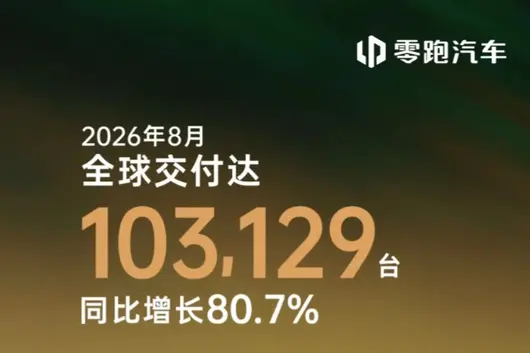
Editor's Note: Leapmotor's monthly sales exceeded the 100,000-unit mark consecutively, with August year-on-year growth exceeding 80%. The growth rate ranked among the leading mainstream new energy vehicle companies, as scale growth and operating quality improved in tandem, showing a positive development momentum.
January-August Sales 560,000 Units, Year-on-Year Growth 70%
On September 1, Leapmotor released the new vehicle delivery data for August 2026. Data shows that Leapmotor's global delivery volume in August reached 103,129 units, an 80.7% year-on-year increase. Following the delivery of 101,267 units in July, Leapmotor exceeded the 100,000-unit monthly delivery threshold for the second consecutive month. Thus far, cumulative deliveries for Leapmotor from January to August 2026 reached 560,900 units, a 70.55% year-on-year increase, with the production and sales scale steadily stepping onto a new level.

Against the industry background of overall adjustment in the domestic new energy market, Leapmotor's high growth rate was particularly notable.
Data previously released by the China Passenger Car Association showed that from January to July 2026, retail sales of domestic new energy passenger vehicles declined by 14.1% year-on-year, with terminal sales for most mainstream brands showing a year-on-year decline.
Under the pressure on the overall industry market, Leapmotor continued to gain share in the mainstream 100,000-200,000 yuan new energy market, leveraging cost advantages from full-domain self-research and high cost-performance product positioning. Its market share steadily increased, making it one of the fastest-growing brands in the new energy market this year.
From a market structure perspective, the domestic market remains Leapmotor's core foundation. Sales of core models continued to rise in their respective segments, becoming the core support for sales growth. Specifically, the A10 exceeded 100,000 units in mass production off the line just 135 days after launch, ranking first in sales of Chinese brand SUVs for consecutive months; the D19, after launch, firmly held the sales champion title for large SUVs within the 400,000 yuan range, with market reputation continuing to improve.
At the same time, overseas markets also performed notably, with export sales achieving rapid year-on-year growth. Leapmotor's export volume reached 96,300 units in the first half of the year, up 372.6% year-on-year, exceeding the total export volume of the entire year of 2025. Channel layouts in key markets such as Europe, Southeast Asia, and the Middle East were gradually implemented, localized operations continued to deepen, and the contribution of globalized business to overall sales continued to rise.
Exceeding 100,000 units for two consecutive months marks that Leapmotor's full-system capabilities in R&D, production, supply chain, channels, etc., have stepped onto a new level, able to stably support a monthly sales scale of 100,000 units, laying a solid foundation for subsequent sustainable growth. From monthly sales of 50,000 units at the beginning of the year to exceeding 100,000 units mid-year, Leapmotor doubled its sales volume scale in less than a year, with a growth rate far exceeding the industry average.
Operating Quality Improvement, Net Profit 210 Million Yuan in First Half
Matching the rapid growth in sales volume, Leapmotor's operating quality is also improving simultaneously. According to Leapmotor Automobiles' 2026 Semi-Annual Performance Report, Leapmotor Automobiles achieved operating income of 38.11 billion yuan in the first half of the year, up 57.2% year-on-year; net profit attributable to parent company was 210 million yuan, significantly up from 30 million yuan in the same period of 2025, continuously achieving semi-annual profitability, showing a good development trend of "scale growth, efficiency improvement".
On the profitability level, Leapmotor Automobiles achieved gross profit of 4.45 billion yuan in the first half of the year, up 29.7% year-on-year; the overall gross margin was 11.7%, down 2.4 percentage points compared to the same period last year, affected by rising raw material prices and changes in vehicle product structure. However, it is worth noting that its profitability level showed a quarterly improvement trend, with gross margin in Q2 2026 increasing by 3.2 percentage points compared to Q1, as the effects of scale economies and cost reduction measures gradually became apparent.
The core driver of profitability improvement came from the cost reduction effects and scale economy release of the full-domain self-research model.

Leapmotor's self-developed Four-leaf Clover Central Integrated Electronic and Electrical Architecture achieved scaled application, effectively reducing overall vehicle R&D costs and component procurement costs; at the same time, the rapid increase in sales volume brought significant scale economies, further diluting fixed costs and R&D investments. On the expense side, company R&D investment was 2.32 billion yuan in the first half of the year, up 22.8% year-on-year, continuously invested in core areas such as intelligent driving and three-electric technologies; sales and administrative expenses grew synchronously, mainly used for channel expansion and brand building, with overall operational efficiency continuing to optimize.
Regarding cash flow, the net cash flow from operating activities generated by the company in the first half of the year was 2.17 billion yuan; as of the end of June 2026, total funds reserves including cash and cash equivalents, restricted cash, and financial assets reached 38.59 billion yuan. Financial conditions were ample, able to support subsequent product R&D, channel expansion, and global layout.
Dual-Wheel Drive of Products and Global Expansion, Annual Target Achievement 53%
The dual improvement of sales and performance is inseparable from the continuous promotion of Leapmotor's product matrix, technology layout, and global strategy.
In terms of products, Leapmotor has already formed four major product matrices: A, B, C, D, covering categories such as sedans, SUVs, MPVs. The price range covers the mainstream consumer interval of 60,000 to 300,000 yuan, and each series of models ranks at the top of its market segment. Core models are highly recognized by consumers due to the product label of "high configuration, affordable price". In terms of technology, Leapmotor adheres to the full-domain self-research route, independently mastering core components accounting for 65% of vehicle cost, has built 18 self-owned component factories, and has constructed a deep technological moat.
On September 16, Leapmotor will hold the 2026 Annual Technology Conference, launching the new generation World Model Assisted Driving System and the latest technological achievements in the three-electric field, continuously releasing innovation potential. At the same time, Leapmotor has achieved vehicle-level technology empowerment for partners such as FAW and Stellantis, supplying core components to more than a dozen domestic and international automakers. The "Whole Vehicle + Tier 1 Component Supply" dual-wheel drive business model continues to run successfully.

Currently, Leapmotor Automobiles' global pace continues to accelerate. Among them, the European market performance was particularly outstanding, with Italy's pure electric market share exceeding 25%, ranking first in sales continuously; German and UK markets also ranked among the top Chinese brands. At the same time, localized assembly projects in Malaysia, Spain, Brazil, and other places were steadily promoted, with operating capabilities continuing to improve.
In the second half of the year, Leapmotor Automobiles will also welcome a new round of product iterations, with multiple models receiving intelligent upgrades, further driving sales growth.
Overall, sales exceeding 100,000 units for two consecutive months validated the feasibility and market competitiveness of Leapmotor's full-domain self-research model. Subsequently, with the implementation of technological results and increased overseas market volume, Leapmotor is expected to achieve a dual improvement in scale and efficiency. Leapmotor Automobiles' 2026 sales target is 1.05 million units, 53% of which is already completed. While maintaining a 100,000-unit scale level, achieving the target is highly possible.

On September 1, Deepal Auto released August sales data. Relying on continuous technical iteration and intelligent advancement, Deepal Auto launched a set of product revitalization combinations in August. The brand-new Deepal S05, brand-new Deepal G318, and Deepal L06 three strategic models exerted force simultaneously in different sub-markets, jointly building the core support for brand sales. Driven by this, Deepal Auto's global sales in August reached 28,659 units; cumulative global sales from January to August reached 222,028 units, a year-on-year growth of 11.77%; among them, cumulative overseas sales reached 52,647 units, a year-on-year growth of 76.98%. As of the end of August, Deepal Auto's cumulative global sales broke through 947,600 units, accelerating towards the million-unit mark.

The brand-new Deepal S05 achieved immediate volume upon launch, technology democratization releasing explosive potential
As the core force of Deepal Auto's globalization strategy, the brand-new Deepal S05 continues the explosive potential of monthly sales exceeding 10,000 units. In August, global sales reached 17,474 units, a year-on-year growth of 43.42%, and a month-on-month growth of 24.29%, leading the pure electric compact SUV market. Behind the eye-catching results is the solid implementation of "technology democratization": LiDAR, single-stage end-to-end algorithms, 3nm automotive-grade cockpit chips, FSD+HRS high-level variable adaptive suspension and other tier-skipping configurations are all equipped at once in the 150,000 Yuan mainstream market, allowing more users to enjoy tier-skipping experiences at mainstream prices. Gymnastics Olympic Champion He Kexin, as the first star owner of the brand-new Deepal S05, testified to the new car's strength with champion-level strict standards, further confirming the quality foundation of this "Global Fashion Laser Smart SUV".

As of now, Deepal S05 has already earned the trust of over 260,000 users, selling to 73 countries and regions globally, with overseas monthly sales stably breaking through 6,000 units. With the support of authoritative honors such as the German iF Design Award and J.D. Power 2026 China New Energy Vehicle New Car Quality Research Compact Pure Electric SUV No. 1, Deepal S05 has become a landmark product for high-value exports of Chinese new energy vehicles.
Deepal L06 Brand-New Special Edition Debut, Adding More Weights on Top of Sporty Driving Fun
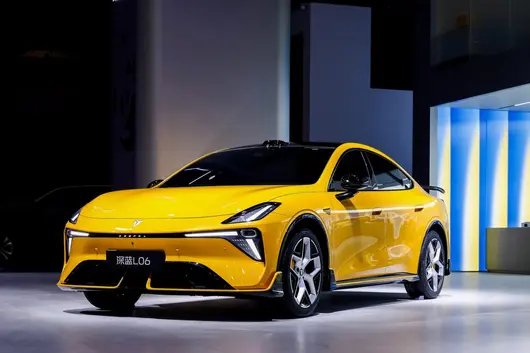
Deepal L06, hailed as the first sports coupe for young people, thanks to the same Magnetorheological suspension as the 3 million Yuan Ferrari and all-scenario beginner-friendly intelligent assistive driving, not only precisely matches the dual needs of young users for control and intelligence, but also forms a sales momentum defying the trend in the 150,000 Yuan market, breaking through 5,000 units in sales for 5 consecutive months, ranking among the sales champions for new energy mid-size cars within 200,000 Yuan in multiple months.
It is worth mentioning that to further meet the advanced needs of young users for sporty driving fun, the Deepal L06 Brand-New Special Edition equipped with a track racing kit made its debut at the Chengdu Auto Show. The car's head 3D wind blades, integrated front splitter, side skirt wind blade decorative parts, and carbon fiber fixed large rear wing allow the vehicle to reach a maximum downforce of up to 1000N. During intense driving, the car body posture is tighter and more controllable, cornering is more enjoyable, and high-speed stability is improved, balancing daily comfort with track presence.

Brand-New Deepal G318 Launches, Activating the 200,000 Yuan Segment Intelligent Box Car Track
The brand-new Deepal G318 officially launched at the Chengdu Auto Show, with a limited-time discounted price of 196,800 Yuan to 236,800 Yuan, injecting a new variable into the 200,000 Yuan box car market. As the only box car in the 200,000 Yuan segment equipped with Huawei Qiansun Dual Intelligence, the new car brings Huawei Qiansun ADS 5 Pro and HarmonyOS Cockpit HarmonySpace 5 to this price range for the first time, precisely meeting the real travel needs of urban families: "90% calm commuting in the city, 10% roaming freely outdoors." Coordinated with the industry's only "Air Suspension+CDC+Magic Carpet" comfort trio, along with dual motor true four-wheel drive, two locking differentials, and ET all-terrain system, the brand-new Deepal G318 makes "Good to drive every day, good for the whole family to sit, occasionally going wild" an accessible daily life for urban families. Recreating a new standard for box cars with "9 Cities 1 Wild", this car will open up incremental space for Deepal Auto in all-around family travel.

LiDAR Accelerating Full-Line Integration, Technical Foundation Supports Sales Quality
Steady sales performance stems from long-term accumulated technical confidence. Currently, Deepal Auto is accelerating the mass production launch of LiDAR and urban intelligent assistive driving systems across all models, with "Intelligence" becoming the brand's most recognizable competitiveness. Meanwhile, the self-developed confidence in electrification is equally solid: The "Battery Boost Charging Technology" patent invention won the China Patent Excellent Award; the Yuanli Super Integrated Electric Drive Technology has evolved through multiple generations, leading the industry; the Jinzhongzhao Battery won the National Science and Technology Progress Second Prize twice; the Micro-Core High-Frequency Pulse Heating Technology won the China Patent Gold Award, with self-developed results becoming the technical support point for user trust.

Solid technology and product foundation also support strong performance in overseas markets. As a pioneer of Changan Automobile's "Haixi" Plan, Deepal Auto has laid out five global regions, covering over 100 countries and regions. This month, Deepal S05 and Deepal S07 landed on overseas markets such as the Indonesia International Auto Show and South Africa Auto Show successively, with global influence continuously rising. In addition, Deepal S07 also won the Silver Award for China Patent Design at the 26th session, with design strength receiving national authoritative recognition.
This August performance report testifies not only to the success of a new product offensive but also reflects Deepal Auto's increasingly steady development rhythm. New product effects, technical advancement, and globalization expansion operate in sync. Every step of growth for Deepal Auto has a clear path and destination. From the continuous practice of technology democratization to the steady expansion of the global map, Deepal is always doing one thing: making high-end intelligent experiences a daily reality for more ordinary people. This is not only the best return Deepal Auto has given to its 947,600 global users but also the confidence of Chinese intelligent manufacturing sailing to the center of the world stage.

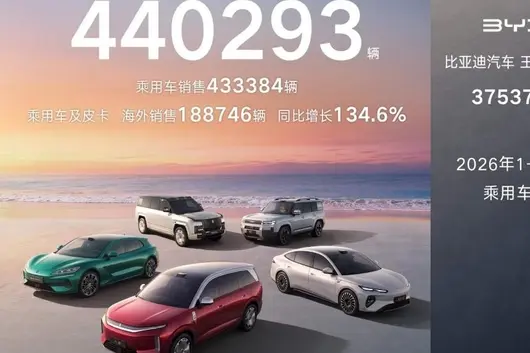
September 1st BYD officially released the August 2026 production and sales report, and the release of this performance report immediately sparked widespread industry attention. Data shows that in August, the overall sales of BYD Group reached 440,293 vehicles, of which passenger car sales were 433,384 units, a year-on-year increase of 16.7%, and a month-on-month increase of 5.4%, refreshing the brand's August sales record for all years. The most eye-catching performance is undoubtedly the overseas market. In August, overseas sales of passenger cars plus pickups reached 188,746 units, soaring 134.6% year-on-year, setting a new historical high for monthly exports. The proportion of overseas sales in total sales has already approached 40%. Going global has evolved from BYD's supplementary business into one of the core engines driving growth. As of now, BYD's cumulative global sales of new energy vehicles have broken through 17.8 million units, continuing to firmly hold the position of the global new energy vehicle sales champion.
 Breaking down by brand, the Dynasty Network plus Ocean Network remain the absolute core base of sales. In August, they sold a total of 375,373 units, accounting for more than 80% of total sales. These two networks cover the mainstream home market from 100,000 to 300,000 level, with sedan, SUV, MPV categories complete. Qin PLUS, Song PLUS, Yuan PLUS, Seal these classic models long time occupy the sales forefront in their respective sub-markets. Recently revised models have been launched successively, product strength further upgraded, plus adjustments to terminal price policies, continue to solidify the basic base of the mass market. For ordinary family consumers, Dynasty and Ocean series models, relying on mature DM hybrid technology, e-Platform 3.0 pure electric architecture, and user-friendly pricing, remain one of the first choices for home new energy vehicles.
 Fang Cheng Bao brand August sales 41,568 units, continue to maintain a stable growth trend. Since the launch of Bao 5 opened the market, Fang Cheng Bao's product matrix has been expanding rapidly. Bao 3, Bao 8 launched successively, covering the tough off-road and SUV market from 100,000s to 300,000 level. Different from traditional tough off-road vehicles, Fang Cheng Bao focuses on DMO super hybrid off-road platform, having both off-road capability and the economy and comfort of city commuting, precisely hit the user needs of many who long for outdoor life but do not want to sacrifice daily commuting experience. Now Fang Cheng Bao has become the absolute main force in the domestic tough off-road new energy market. Subsequently with the launch of Ti 9 and other higher-end models, the brand's ceiling will continue to improve further.
 Denza brand August sales 16,001 units, maintaining the first tier of the high-end new energy market. Denza D9 long time occupies the top of high-end MPV sales, N7, N8 are continuously exerting force in the SUV market, forming an MPV plus SUV product combination. Denza's positioning is very precise, focusing on the 300,000 to 500,000 high-end home and business market, having both BYD's technical endorsement, and services and luxury higher than ordinary BYD brand, precisely accepting the user needs of consumption upgrade. Many people upgrade from ordinary domestic brands, or come from joint venture luxury brands, Denza is always a very important alternative option.
 Yangwang brand August sales 442 units, as a million-level high-end brand, this sales performance is already quite stable. Yangwang U8, U9, U7 three models respectively cover tough off-road, hypercar, luxury sedan market, showed the limit of BYD's technology to the whole world. e4, DiSus, Blade Battery these top technologies, all first verified landing on Yangwang brand, then gradually deployed to lower-priced models, forming technical feedback. Yangwang's significance is not only about how many cars sold, but also lies in that it broke the price ceiling of domestic brands, proving Chinese brands can also make million-level high-end cars.
 In the whole sales data, the most worth deep interpretation is the explosive growth of the overseas market. August 188,700 export volume, year-on-year growth 134.6%, January to August cumulative exports have reached 1.158 million units, only used eight months to surpass the total export volume of all of 2025. This growth rate placed in the overall Chinese auto company going global big picture, is also a leading level. Different from many auto companies' pure whole vehicle export model, BYD follows the route of technology plus capacity full ecosystem going global, building local factories in Thailand, Brazil, Hungary and other countries, gradually shifting from whole vehicle export to local production local sales, not only can avoid tariff barriers, but also can better adapt to local market needs.
At the same time BYD is also outputting domestic technical standards overseas, Blade Battery, e-Platform 3.0, DM hybrid technology, and the latest Megawatt-level fast charging, all being gradually equipped on overseas version models. In main markets such as Europe, Southeast Asia, Latin America, Middle East, BYD's market share is steadily rising, from previous mainly economic small cars, gradually shifting to mid-to-high-end models. The high growth of overseas market also well counteracted the competition pressure of domestic market. When domestic price wars intensify, overseas market has become BYD's important incremental source and profit buffer.
 From the power structure perspective, August pure electric vehicle sales 256,230 units, year-on-year increase 28.38%, month-on-month increase 9.92%; Plug-in hybrid vehicle sales 177,154 units, year-on-year increase 3.05%. Clearly can see, pure electric vehicle growth speed is accelerating, on one hand because overseas market pure electric vehicle demand is booming, on the other hand domestic market pure electric vehicle product matrix is also constantly improving. Seagull, Dolphin, Yuan PLUS these entry-level pure electric vehicle sales stable, Seal, Han EV these mid-to-high-end pure electric also continuously exerting force. Plug-in hybrid models although growth speed slowed, but still remains BYD's basic base. DM technology fuel consumption low, no range anxiety advantages, for many users who find charging inconvenient, still an irreplaceable choice.
Looking at January to August cumulative, BYD Group cumulative sales 2,668,015 units. Although cumulative year-on-year slightly declined, but this is mainly because 2025 same period base is too high. Placed in whole industry view, BYD still firmly ranks first in domestic new energy vehicle sales, and leading advantage is very obvious. More importantly sales structure is changing, overseas proportion continuously rising, high-end brand proportion getting higher and higher, average price per vehicle also steadily rising. Not relying on low price to exchange sales, but transforming towards high quality development.
 Looking forward to the second half of the year, BYD's product rhythm remains dense. Dynasty Network 3rd Gen Tang, Han revised models, Ocean Network Sea Lion 07, Sea Lion 08, Fang Cheng Bao Ti 9, and Denza, Yangwang new models will be launched successively. Domestic market product strength will be further enhanced. Overseas market aspect, as more local factories put into production, and more regional market development, export sales probability will still maintain high growth. Current BYD is no longer pure Chinese auto company, but is growing into a global auto group. Domestic and foreign two markets dual wheel drive, risk resistance ability will become stronger and stronger.
Of course also need to see, global new energy market competition is also becoming more and more intense. Traditional auto companies accelerate electrification transformation, New EV brands also continuously catching up, BYD also cannot take lightly. Technology research, product iteration, channel construction, brand construction, every link cannot loosen. But at least from current sales data view, BYD's strategic rhythm is steady. Multi-brand matrix, full technology route, globalization layout, these long-term layouts are gradually realizing results. Next September and October peak sales season, BYD sales probability will rise to another level. Whole year performance is worth looking forward to.
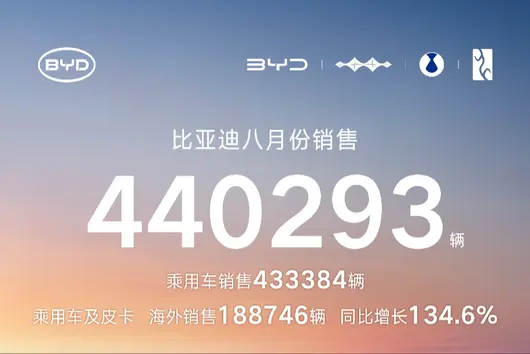

On September 1, Geely Automobile Holdings Limited (0175.HK) announced its August sales report, total monthly sales reached 270,194 vehicles, achieving double year-on-year and month-on-year growth for 6 consecutive months, both rising 8% year-on-year and month-on-month. The new energy sector performed brightly, Geely, Lynk & Co, and Zeekr combined new energy sales reached 175,877 vehicles, up 19% year-on-year, accounting for 65% of new energy sales.

The overseas market has become a powerful engine for Geely's growth, officially entering a new stage of "systematic overseas expansion". August overseas exports reached 110,094 vehicles, surging 205% year-on-year and slightly increasing 3% month-on-month, achieving double growth year-on-year and month-on-year for 8 consecutive months, and also marking the third consecutive month with exports exceeding 100,000 units. Among them, new energy exports reached 70,629 vehicles, up 446% year-on-year, accounting for 64% of total exports, new energy products are becoming the main force for Geely's global market expansion.
At the 2026 Chengdu International Motor Show held from August 21-30, Geely gathered its four major matrices: Zeekr, Lynk & Co, Geely Galaxy, and Geely China Star, showcasing 49 intelligent products together, covering pure electric, hybrid, and fuel power routes, concentrating on demonstrating the technical strength of full-domain AI smart cars.
Three Brands Work Together, Multiple Key Models Show Outstanding Results
Zeekr, as a global luxury tech brand, is showing strong upward momentum, delivering 36,981 vehicles in August, a 110% year-on-year increase. Multiple models under its brand have secured top positions in niche segments: Zeekr 7X monthly sales continue to break 10,000, with global orders exceeding 200,000; Zeekr Shooting Brake sales exceeded 10,000 for three consecutive months, with over 400,000 vehicles delivered globally; Zeekr 9X ranked first in sales of vehicles above 500,000 from January to July; Zeekr 8X, launched only three months ago, ranks first in cumulative sales of hybrid SUVs in the 300,000-500,000 price range; Zeekr 009 secured the championship for both sales and reputation of domestic pure electric MPVs above 400,000 for three consecutive months. At the Chengdu Auto Show, Zeekr presented 14 heavy-hitter products, and its luxury lineup garnered significant attention.

Global new energy high-end brand Lynk & Co sold 17,027 vehicles in August, up 4% month-on-month, among which new energy sales were 15,504 vehicles, up 10% month-on-month. At the Chengdu Auto Show, the new Lynk 20 and the sporty Lynk 20 Fly version debuted, balancing urban trends with sports attributes; Lynk 10, Lynk 07GT, and GT Concept Car were exhibited together, enriching the product matrix. On the racing track, Lynk & Co also achieved results. The 07GT Rally Academy car competed in the 2026 China Car Rally Championship Huairou Station, winning the S7 category and the Lynk & Co Rally Challenge Championship, opening up a new track for Chinese brand hybrid rally racing.

Geely brand sales reached 216,186 vehicles in August, up 5% year-on-year and 9% month-on-year, solidifying the group's growth foundation. Geely Galaxy under Geely sold 119,115 vehicles in August, up 8% and 10% respectively year-on-year and month-on-year. Geely Xingyuan's popularity remains high, selling 60,955 units in August, breaking 50,000 for three consecutive months, with cumulative sales approaching 900,000; Galaxy E5 monthly sales were 14,132 vehicles. Regarding new cars, the Class C AI pure electric sports sedan Galaxy TT started pre-sales, with a starting price of 145,900; AI all-terrain hardcore SUV Galaxy Battleship 700 landed at the Chengdu Auto Show, planned to start pre-sales in September.

The fuel power segment of Geely China Star sold 97,071 vehicles in August, up 8% month-on-month. The Shuangbin Family, China Star High-end Series, and Boyue Family all maintained stable output. The 4th Gen Boyue L i-HEV landed at the Chengdu Auto Show, equipped with the 3rd Gen i-HEV Zhiqing hybrid technology, featuring LiDAR and advanced intelligent driving solutions, solidifying the fuel SUV advantage. The new mid-to-large flagship smart hybrid SUV Xingyue L PLUS was also announced to debut, scheduled to premiere on September 5.

Investing in Full-Domain AI Technology, Hardcore Off-Road Technology Officially Released
Geely is permeating full-domain AI into the entire business chain of design, R&D, manufacturing, and after-sales. On August 28, Geely released AI new energy off-road technology externally, including GTA native new energy off-road architecture, Full-Drive AI Electric-Hybrid Thor EM-T, and AI All-Terrain Digital Chassis, three core innovations. This technology will first land on the Galaxy Battleship 700, reconstructing new energy hard-core off-road standards, balancing off-road capability, energy consumption performance, and intelligent experience.

Globalization Accelerates, Overseas Sales Target Raised to Sprint for Million Milestone
Overseas markets are blooming in multiple points; Zeekr, Lynk & Co, and Geely brands took leading positions in niche markets in multiple countries such as Australia, Malaysia, Tunisia, and Panama. Multiple models achieved bright rankings in markets such as Thailand, Poland, Spain, and Mexico. Channel layout continues to expand, with new markets and stores constantly added in Europe, Latin America, Southeast Asia, and Middle East Africa; Geely Monjaro EM-i global car officially started listing.

Based on strong performance in overseas markets, Geely raised its 2026 overseas sales target from 640,000 to 920,000, going all out to hit the 1 million export target.

Mid-August Geely disclosed 2026 interim performance, total revenue 173.6 billion yuan, core net profit attributable to parent company 9.68 billion yuan, achieving simultaneous improvement in volume, price, and profit. Facing the future, Geely will rely on the "One Geely" strategy, leverage full-domain AI technology advantages, adhere to high-quality development, and continuously release growth potential.
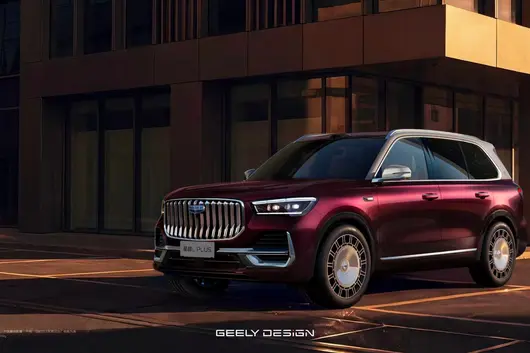

[CNMO Tech News] Recently, BitAuto compiled and released data on brand sales in the Singapore automotive market for July 2026 based on data from official institutions and associations in Singapore.

BYD Auto
Data shows that the Singapore automotive market presented a diversified competitive landscape in July, with Chinese car brands continuing to expand their local market influence. Among them, BYD Auto topped the sales ranking with 1,100 units, while Toyota and Tesla ranked second and third with 582 units and 434 units respectively. Meanwhile, Chinese brands such as MG, GAC Group, Chery, and XPeng also entered the top 10 sales list.

MG Auto
Looking at specific sales rankings, BYD became the automotive brand with the highest sales in the Singapore market in July, with monthly sales reaching 1,100 units, leading the second-place Toyota by over 500 units.

GAC AION N60
Toyota ranked second with 582 units in July. As a globally renowned automotive brand, Toyota maintained stable performance in the Singapore market relying on its long-accumulated brand influence and rich product portfolio. Tesla ranked third with 434 units in sales, becoming one of the highest-selling pure electric car brands.
Mercedes-Benz, Honda, BMW and other traditional luxury and mainstream brands also entered the front of the list. Among them, Mercedes-Benz sales in July were 360 units, Honda sales were 243 units, and BMW sales were 206 units.

Relevant Data
It is worth noting that in July, Chinese car brands occupied multiple spots in the top 10 sales ranking of automotive brands in Singapore. In addition to the first-place BYD Auto, MG ranked sixth with 233 units, GAC Group ranked seventh with 232 units, Chery ranked ninth with 200 units, and XPeng ranked tenth with 169 units.

After achieving a historical high in overseas market sales in June, SAIC Motor delivered another impressive performance report in July: overseas sales in July reached 142,000 vehicles, a year-on-year surge of 72.5%; cumulative sales from January to July reached 876,000 vehicles, growing 52.1% year-on-year, firmly maintaining its position in the first echelon of Chinese automakers expanding overseas.
With overseas sales continuing to surge, this is driven by SAIC's deepening promotion from "product going global" to "system going global". Recently, SAIC has densely launched multiple models in markets such as Europe, Southeast Asia, and South America, while simultaneously holding overseas technical conferences, establishing direct sales companies, and deepening local production... Global R&D, manufacturing, service, and brand operation capabilities continue to be perfected.
New models launch continuously, with warm responses in the overseas market
Recently, SAIC brands such as MG and Wuling have started a wave of new car launches overseas. On June 17, MG unveiled the new all-electric hatchback MG4 Urban in Bangkok, Thailand, offering Standard, Long Range, and Flagship versions, and achieved local production in Thailand; on July 16, this model landed in the Brazilian market, appearing alongside channels and after-sales ecosystems. As a "global car", MG4 Urban landed in the UK, Germany, Australia, Singapore and other markets this year, satisfying global user needs with advanced intelligent electrification technology and strong product capabilities.
Besides all-electric models, SAIC MG's HEV hybrid models also performed remarkably well, with monthly overseas sales nearing 27,000 vehicles, doubling year-on-year. On July 29, the MG ZS Hybrid+ was officially launched at the Indonesia International Motor Show. Relying on excellent fuel economy, smooth and sensitive driving performance, and perfect after-sales service, it quickly won the praise of Indonesian users.
 Also debuting at the same Indonesia International Motor Show was Wuling Aira EV. This "global car" sharing the same DNA as Wuling Hongguang MINIEV is compact and agile, precisely matching local driving scenarios in Indonesia such as narrow streets, cramped parking spaces, and multi-person travel. The model is locally produced at the Cikarang Plant in Indonesia, relying on the manufacturing, channels, and user foundation accumulated in Indonesia, establishing a new benchmark for electric cars in Indonesian cities and continuously digging deep into the local market.

The new car effect is gradually appearing in regional markets. In Europe, MG brand cumulative sales from January to July reached 218,000 vehicles, growing 22.8% year-on-year, retaining the title of "China Brand Europe Sales Champion"; in Italy, MG cumulative users broke through 150,000, becoming the brand's second 150,000+ market in Europe after the UK. SAIC-GM-Wuling also performed remarkably well, with overseas exports exceeding 30,000 vehicles consecutively for 4 months, cumulative overseas sales from January to July breaking through 200,000 vehicles, showing strong growth momentum.
Strengthening system deepening, overseas strategy steadily advancing
Dense new car launches are the forward positions of SAIC in the global market, while deeper breakthroughs lie in the comprehensive advancement of technology, standards, and systems—sharing cutting-edge technology, integrating into local markets, taking root in industrial ecosystems, and serving local users.
On July 8, MG held a technical conference in London, UK, bringing the most cutting-edge intelligent electrification technology back to the brand's place of origin. The conference centrally showcased MG Plug-in Hybrid+, SolidCore semi-solid-state battery, and MG Parking smart cockpit with assisted driving, demonstrating SAIC's strong technical strength to global users.


The next day, MG showcased the two-door all-electric concept car MG Go! and the coupé SUV concept car MG Cyber at the Goodwood Festival of Speed. Both models draw design inspiration from the brand's historical classics. MG Go! offers users a new choice for personalized all-electric travel with its compact and sporty stance; MG Cyber is positioned as an electric flagship coupé SUV, carrying the brand's future design language and upward vision.

Regarding sales channels, in July, the MG brand established direct sales companies in Belgium and Luxembourg, fully responsible for distribution, sales, and channel operations in the local markets. The construction of the direct sales system is a transition of MG from "selling cars" to "operating", helping the brand more directly reach customer needs, organize sales rhythms, improve service capabilities, and achieve agile responses to market dynamics.
Forward-looking designed products, cutting-edge hardcore technology, and deeply laid-out systems constitute the new pattern of the MG brand's overseas expansion stepping by steps. Shifting from sales scale leadership to deepening local markets and building long-term user relationships, SAIC's "Glocal strategy" is being rapidly implemented.
Commercial vehicles active layout, market development steadily promoted
While the overseas passenger car market continues to break through, SAIC Commercial Vehicles has also achieved remarkable performance overseas. In July, SAIC MAXUS sold 14,000 vehicles overseas, a year-on-year surge of 69%, with products continuously selling well in more than 100 countries and regions worldwide. The first batch of 200 MAXUS T60 pickups purchased by Venezuela Petroleum Company, coupled with the steady landing of bulk orders for pickups in Chilean mining areas, confirmed the overseas enterprise customers' recognition of MAXUS's high-end pickup commercial value; in the Greek light commercial vehicle market, the SAIC MAXUS brand maintained the number one market share of Chinese brands for 6 consecutive months, and the penetration pace in the European market continued to accelerate.

In the heavy truck and bus fields, recently SAIC Hongyan reached a 1,000-unit new energy heavy truck strategic cooperation agreement with a top port client in Thailand, creating a new historical high for the scale of a single export of domestic new energy heavy trucks to Southeast Asia. This batch of new energy heavy trucks underwent local optimization targeting Southeast Asia's high temperature, heavy rain, and heavy load conditions, and simultaneously improved the overseas charging, maintenance, and spare parts ecosystem layout. The first batch of vehicles has been shipped to Thailand. Sunwin buses appeared at the Australian Bus & Coach Exhibition in July, displaying the all-electric city bus iEV12 tailored for the Oceania market, meeting the needs of right-hand drive, longer operating mileage, and better handling performance, while possessing high reliability and scalability, satisfying Australian market needs with advanced products and services.
From light vans and pickups to heavy trucks and buses, SAIC Commercial Vehicles' overseas path not only features a multi-category matrix but also actively explores deep local operations. In the process of breaking through orders to settling reputation, SAIC is deeply laying out in the global commercial vehicle market with systematic strength, continuously expanding market growth space.
From MG's technical conference and direct layout in Europe to Wuling's local production in Southeast Asia, and then to the deep breakthrough of the commercial vehicle segment in multiple categories and regional markets, SAIC's global operations continue to deepen. From "going out" to "going in", the development logic of Chinese automobiles going overseas is being reshaped. The synergy resonance formed by excellent products and complete systems will make the brand image of Made in China increasingly bright on the world stage.
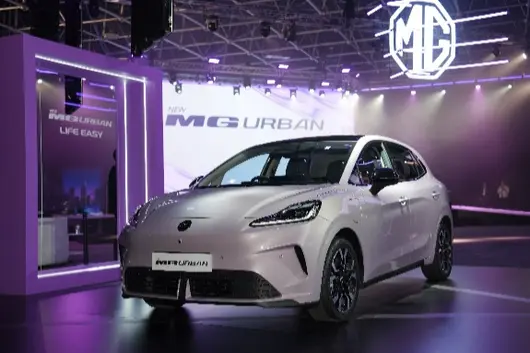
[CNMO Tech News] On August 17, following overseas market sales reaching a historic high in June, SAIC Group presented another impressive result in July: overseas sales in July reached 142,000 units, a 72.5% increase year-on-year; cumulative sales from January to July reached 876,000 units, up 52.1% year-on-year, firmly holding its position in the first tier of Chinese automakers going global.

SAIC Group
Overseas sales continue to surge, behind which is SAIC's deepening push from "product export" to "systemic export". Recently, SAIC has densely launched multiple models in markets such as Europe, Southeast Asia, South America, etc., simultaneously held overseas technical conferences, established direct sales companies, and deepened localized production... Global R&D, manufacturing, service, and brand operation capabilities continue to be perfected.
According to CNMO Tech, on June 17, MG launched the all-new electric hatchback MG4 Urban in Bangkok, Thailand, offering Standard, Long Range, and Flagship versions, achieving localized production in Thailand; on July 16, this model landed in the Brazilian market, appearing with a full ecosystem of channels and after-sales service. As a "global car", MG4 Urban landed in markets such as the UK, Germany, Australia, Singapore, etc. this year, meeting global user needs with advanced smart electric technology and powerful product strength.

Besides pure electric models, SAIC MG's HEV hybrid models also performed remarkably, with overseas monthly sales near 27,000 units, achieving a doubling year-on-year. On July 29, MG ZS Hybrid+ was officially launched at the Indonesia International Motor Show, thanks to excellent fuel economy, smooth and sensitive driving performance, and comprehensive after-sales service, quickly gaining praise from Indonesian users.

Also launched at the Indonesia International Motor Show is the Wuling Aira EV. This "global car" shares the same origin as the Wuling Hongguang MINIEV, compact and agile, precisely matching local driving scenarios such as narrow Indonesian streets, cramped parking spots, and multi-person travel. This model is locally produced at the Cikarang factory in Indonesia, relying on the manufacturing, channel, and user foundation accumulated in Indonesia, setting a new benchmark for city commuting electric vehicles in Indonesia, continuously deepening the local market.

The new car effect is gradually showing in regional markets. In Europe, MG brand cumulative sales from January to July reached 218,000 units, up 22.8% year-on-year, consecutively winning the "Chinese Brand Europe Sales Champion"; in Italy, MG cumulative users exceeded 150,000, becoming the brand's second 150,000+ market in Europe after the UK. SAIC-GM-Wuling also performed remarkably, with overseas exports exceeding 30,000 units for 4 consecutive months, cumulative overseas sales from January to July exceeded 200,000 units, growth momentum is strong.
[CNMO Tech News] August 17, SAIC Motor announced the latest overseas sales data. Data shows SAIC overseas market sales in July142,000 units, surging year-on-year by72.5%; cumulative sales from Jan to July876,000 units, year-on-year growth of52.1%, firmly remaining in the first tier of Chinese automakers going global.

SAIC Motor
Recently, SAIC MG, Wuling and other brands have launched a wave of new car releases overseas. On June 17, MG unveiled a brand new all-electric hatchback model in Bangkok, ThailandMG4 Urban, offering three configurations: Standard, Long-Range, and Flagship, and achieving local production in Thailand; On July 16, the model was launched in the Brazilian market, showcasing alongside channels and a full after-sales ecosystem. As a "global car", MG4 Urban has been launched in the UK, Germany, Australia, Singapore and other markets earlier this year.

MG4 Urban
In addition to all-electric models, MG's HEV hybrid models also performed well, with overseas monthly sales nearing27,000 units, achieving a doubling year-on-year. On July 29,MG ZS Hybrid+was officially launched at the Indonesia International Motor Show. Also launched at the Indonesia International Motor Show wasWuling Aira EV, which shares a platform with Wuling Hongguang MINIEV and is locally produced by the Cikarang factory in Indonesia.

Wuling Aira EV
In terms of regional market performance, in Europe, the MG brand cumulative sales from Jan to July were218,000 units, year-on-year growth of22.8%, retaining the title of "Best-Selling Chinese Brand in Europe"; In Italy, MG cumulative users exceeded150,000, becoming the second market exceeding 150,000+ after the UK market. SAIC-GM-Wuling overseas exports exceeded 30,000 units for 4 consecutive months, with cumulative sales from Jan to July exceeding200,000 units, and growth momentum is strong.
While the overseas passenger vehicle market continues to break through, SAIC Commercial Vehicles' performance was also prominent. In July, SAIC Maxus overseas hot sales reached14,000 units, surging year-on-year by69%, with products continuing to sell well in over 100 countries and regions worldwide. The Venezuelan Oil Company's first batch purchase of 200 Maxus T60 pickups, plus the steady landing of bulk pickup orders from Chilean mines, Maxus high-end pickup commercial value gained recognition from overseas corporate clients. In the Greek light commercial vehicle market, the SAIC Maxus brand maintained the No. 1 market share among Chinese brands for 6 consecutive months.