首頁BYD

搜尋歷史
熱門搜尋
經銷商登入 / 註冊

August 2026, BYD sold 440,300 vehicles, a year-on-year increase of 17.84%. This number itself isn't surprising, after all, BYD has held the top spot in China's new energy vehicle monthly sales for 63 consecutive months. The real highlight lies in the structure.

In August, BYD's overseas sales reached 189,500 units, a surge of 134.45% year-on-year, accounting for 43.03% of total sales. This marks the fifth consecutive month BYD's overseas sales set a historical record. From January to August this year, BYD's overseas cumulative sales reached 1.158 million units, surpassing the 1.0496 million units level of the full year 2025.
Completing last year's full overseas volume in eight months indicates that the overseas market is becoming the biggest variable for BYD's growth. Against the backdrop of slowing domestic market growth, the significance of these 189,500 units is far more worth analyzing than the total of 440,000 units.
What Is Sold Overseas Is Not "Domestic Inventory", But Localized Products
Many people have a misconception about BYD's overseas expansion, thinking it is simply loading cars sold domestically onto ships for export. Actually, it is not like that.
Let's look at several key models: Yuan Plus (called ATTO 3 overseas), Dolphin, Song PLUS, Yuan UP. These are the mainstays of the overseas market, but for every regional market, BYD has implemented deep localization adaptation. This is much harder than simply selling cars.
First, let's talk about ATTO 3. This model underwent a comprehensive evolution in the European, UK, and Australian markets from 2025 to 2026. It was not just a simple logo change, it involved re-adapting at the product capability level. The European market has high standards for safety certification and energy consumption, so BYD had to make adjustments according to the EU certification system. In terms of pricing, ATTO 3's starting price in many European countries is about 38,000 euros, approx. 270,000 RMB; in Australia 45,000 AUD, approx. 208,000 RMB; in Colombia, the starting price is approx. 213,000 RMB. Same product, three markets, three pricing logics. This was not decided casually, calculated based on local purchasing power, competitor prices, and tariff costs.

Next, Southeast Asia. The Rayong factory in Thailand started production in 2024, with an annual capacity of 150,000 units, specially producing right-hand drive models like Dolphin and ATTO 3, covering the entire ASEAN market. Localized delivery share is close to 40%. Why build a factory locally? Transporting RHD cars from domestic sources is costly, local production saves on freight and enjoys tax incentives under Thailand's EV 3.0 policy.

Over in Europe, the Hungary factory is not just for building cars but also positioned as the European headquarters, responsible for EU certification testing, model localization design, and function development. Simply put, BYD is not in Europe to "sell and leave", it is to take root. So you see, BYD's overseas expansion is not just moving domestic models overseas intact, but relying on a mature product system -- e-Platform, Blade Battery, DM-i Hybrid Technology -- for localization matching. The product foundation is its own, but targeted adjustments were made for different regional users' range needs, configuration preferences, and regulatory standards. This is "product export," not "inventory liquidation."
Domestic Competition Intensified to the Extreme, Overseas Opens Second Growth Curve
Why is BYD so aggressive in overseas markets? Because the domestic market has indeed reached the limit of competition.
In 2025, BYD's global sales were 4.602 million units, a year-on-year growth of 7.7%. Compared to the performance of doubling growth in previous years, this growth rate has significantly slowed down. The penetration rate of the domestic new energy vehicle market has passed 60%, and the incremental space is narrowing. The price war has lasted from the beginning to the end of the year, profits are getting thinner. Under these circumstances, "seeking increments overseas" is not an optional question, but a mandatory one.
Of course, BYD is not the only one thinking this way. Currently, multiple automakers are competing in overseas markets. Chery has always been the "leader in going overseas", BYD's 189,500 units overseas in August are already closing in on Chery. The competition between the two in the overseas market is essentially a contest of globalization capabilities among Chinese automakers. Whoever can truly export the product system globally will get the entry ticket to the next decade.

But BYD's approach has its uniqueness. It does not rely on low-price dumping, but on product system output. In terms of pure electric vehicles, BYD's pure electric sales in 2025 exceeded 2.25 million units, a year-on-year increase of 28%, exceeding Tesla's 1.64 million units at the same time. This product capability foundation is the premise for its global localization adaptation. If the product is not good, localization adaptation is empty talk.
The logic of the overseas market is different from the domestic one. In the domestic market, "cost-performance ratio is king", overseas markets value brand, after-sales, and localized services more. BYD building factories, dealership networks, and localized designs overseas is essentially catching up on these lessons. Short-term investment is large and results are slow, but long-term, this is the only path to building brand barriers.
Opportunities Are Real, Challenges Are Also Significant
Saying BYD's overseas expansion is going great is flattery. Objectively speaking, opportunities and challenges coexist.
Opportunities are very significant. BYD new energy vehicles have entered 120 countries and regions globally, January to August overseas sales 1.158 million, year-on-year growth 134.6%, this growth curve is indeed steep. The overseas market's recognition of Chinese new energy products is improving, this is a fact. European consumers are starting to accept Chinese electric vehicles, Southeast Asian and Latin American markets are becoming more open to Chinese brands.

But challenges also exist. Trade barriers are the first hurdle. The EU has imposed additional tariffs on Chinese electric vehicles, the US market is basically closed off, these cannot be solved just by having good products. Localization factory investment is huge; Hungary factory, Thailand factory, Brazil factory, each is a heavy asset investment with a long payback period. Brand recognition also takes time to accumulate; European consumers' bias against "Chinese cars" cannot be eliminated in a day.
However, BYD's product export path does provide a reference sample for independent brand globalization.
Its core has three points: First, the product system must be mature, and the technology foundation must be strong, which is the basis for localization adaptation; Second, cannot simply export, must make localization adjustments for products, configurations, and range for different markets; Third, must be prepared for long-term investment, building factories, building networks, building brands, cannot be rushed.
Final Thoughts
BYD's August overseas sales of 189,500 units is not the end, but a new starting point. Chinese new energy vehicles moving from domestic competition to global competition, this road has just begun. BYD is running ahead, but the road ahead is long. The real test of the overseas market is not whether it can be sold, but whether it can take root. This point is more worthy of attention than single-month sales figures.

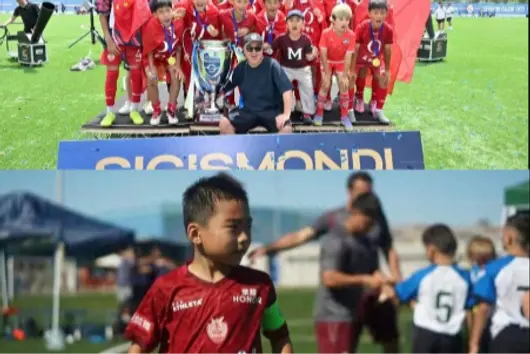
From Thailand, Italy to Spain, BYD accompanied the Chinese Football Juniors 2018 Team all the way, winning championship after championship. In the recently concluded Spanish Brava Cup tournament, top European youth teams such as Barcelona and Atletico Madrid participated, with 67 teams competing in total. The young players endured 9 rounds of matches, winning all 4 group stage games, achieving two turnarounds in the knockout stage, defeating the Espanyol youth team in the semi-finals, and beating Cornella in the final via penalty shootout, claiming the championship with a perfect 9-game record. Han Chengjun (George) in the team stood out, scoring 17 goals in 9 matches and winning the tournament MVP and Golden Boot.


BYD's support for youth football, like the approach to making new energy vehicles, adheres to long-termism. BYD has been deeply engaged in the new energy field for more than 20 years, continuously investing in R&D without pursuing short-term hype. Starting from 2024, BYD has successively organized more than 200 football youths to visit countries such as Germany, Japan, and Brazil, to exchange and compete with top local clubs. Last year this team participated in the Brava Cup and stopped at the quarter-finals. After continuous refinement, they stood on the highest podium this year, and this persistence paid off.


BYD itself is developing steadily in overseas markets, achieving good sales results in many places including Europe and Southeast Asia. At the same time, the brand is also collaborating overseas with football giants such as Manchester City, Inter Milan, and PSG, bringing international football resources back to the domestic market to assist youth training development. Previously, the young players also went to Italy to visit Inter Milan and watch Serie A matches on-site to experience the professional football atmosphere up close.

Chinese football youths shine on the world stage! With BYD's support, already 3 young players have signed with La Liga professional youth teams. There are no shortcuts in football and technological R&D. Continuously rooting in youth football and cultivating talent slowly are the only ways to accumulate new strength for Chinese football. In the future, BYD will also continue to stand shoulder to shoulder with the youths, continuing to challenge around the world and strive for more good results.

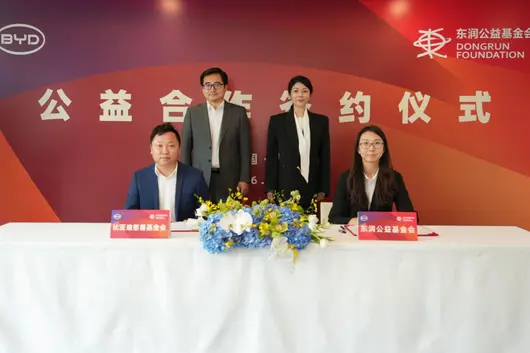
Partnering with Dongrun Public Welfare Foundation, BYD brings youth football support down to grassroots arenas
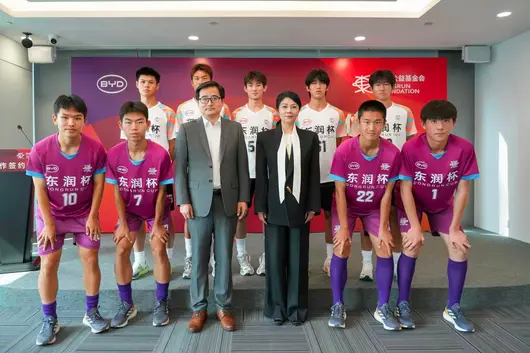
September 17, Beijing. BYD completes cooperation agreement signing with Dongrun Public Welfare Foundation. Li Yunfei, General Manager of BYD Brand and Public Relations, and Kong Dongmei, Founder and Chairman of Dongrun Public Welfare Foundation, attended along with guests and youth football student representatives. Contract signing, plaque awarding, and gift exchange were completed on site, and the two parties formally established a cooperative relationship. According to plans, BYD will support the Dongrun Cup National Youth High School Football Tournament, directing resources towards a broader campus football landscape.

In the automotive industry, sports marketing is far from new. Sponsoring top clubs and appearing at international tournaments are routine moves for many Chinese brands heading global. However, what is most noteworthy about this cooperation between BYD and Dongrun Public Welfare Foundation is not another football label, but the flow of resources: county-level middle schools, regular high school students, grassroots coaches, campus teams. These names rarely appear under the spotlight, yet they are exactly the foundation that Chinese football most needs to be seen.

The Dongrun Cup is not a competition belonging only to a few elites. It covers more than 20 provinces (regions, municipalities) nationwide, benefiting 352 schools, 4864 players and coaches this session, gathering 20 teams from 20 provinces for the finals. As a national 5A-level non-public foundation supervised by the Ministry of Civil Affairs, Dongrun Public Welfare Foundation has long deepened its work in youth education assistance, having won the China Charity Award twice, with projects covering 31 provinces and regions nationwide, 324 counties, benefiting over 100,000 youths. Since the Dongrun Cup was launched in 2022 and officially started in 2023, it has attracted over 1000 campus teams, over 10,000 players and coaches participating, and more than 30 participating players entered the national youth team, middle school national team and U-series elite training camps. The 2nd Finals landing at Beijing Workers' Stadium gave youth competitions influence beyond traditional school matches.
Kong Dongmei expressed a sentiment at the event: Football is a global sport, youth are the future; the Dongrun Cup is not only for selecting football talent, but more about shaping character, nurturing souls, and helping children grow in the long term. In my view, this sentence points out the true value of campus football. While the pinnacle of professional football is undoubtedly dazzling, the thickness of the base determines the upper limit of a country's football ecosystem. Without enough grassroots matches, coach training, and equipment support, talent often cannot leave the mountains, and passion is hard to turn into a path of continuous growth.
The complementarity between BYD and Dongrun lies here. Dongrun has a mature county-level implementation network and public welfare project experience, while BYD can bring corporate resources, brand communication, owner volunteer systems, and overseas football resources. After the cooperation, the implementation of Dongrun Cup provincial leagues and finals will receive more support, and tournament incentive grants will continue to be used for school team construction. Equipment donations, grassroots coach public welfare training and other supporting actions are filling the most realistic shortcomings of grassroots campus football.
This is also not BYD's first move in the football field. In the past few years, BYD's football layout has presented a clear "dual-track logic": Overseas, it cooperates with giants like Manchester City, Inter Milan, PSG, and appeared at international tournaments like the European Cup and Copa America, where the "BYD Derby" once gained global fan attention; Domestically, it directs its attention to youth, especially remote areas and grassroots campuses. Since 2024, BYD has organized over 200 youth football players to go to Germany, Japan, Spain, Thailand, Italy, Brazil, Mexico, etc., to exchange with top overseas clubs, and brought children into top venues like the European Cup and World Cup. Meanwhile, BYD also organized owner volunteers to go to places like Ili, Xinjiang, and Yuanbao, Guizhou, sending equipment, courses, and companionship to children who love football. The Ili youth football team going to Japan for exchange and the Yuanbao women's football team receiving public welfare classes and material support are both extensions of this thinking.
If viewed from the coordinates of corporate public welfare, BYD established its charity foundation as early as 2010, deeply cultivating fields such as education support, poverty alleviation, and disaster relief. On the 30th anniversary, BYD established a 3 billion yuan education charity fund, which has already covered 127 universities nationwide, inspiring over 6,000 students. This partnership with Dongrun can be seen as a systematic downscaling in youth football public welfare: not only supporting a few talented players, not only pursuing brand exposure on international stages, but balancing elite promotion and campus popularization, injecting corporate power into the daily life of grassroots football.
Li Yunfei said on site that enterprises cannot play on behalf of children, but they can help them reach larger stages. This sentence is quite significant when applied to current Chinese car brands. Chinese automakers are accelerating globalization, football is a universal language; but truly substantial brands cannot only be seen on international stages, but must also be remembered in the local society. Partnering with giants overseas is brand height; deeply cultivating campuses domestically is brand warmth and also the thickness of the soil.

Of course, signing is just the beginning. Public welfare fears a one-time storm; campus football needs long-termism more. Whether the Dongrun Cup can continue to be held, whether grassroots coaches can receive stable training, whether equipment and incentives can truly reach school teams, these are more important than the ceremony itself. But at least, BYD did not just keep its eyes on the billboards of top stadiums this time, but chose to walk into county high schools and ordinary campuses. For Chinese youth football, this effort of "bringing them to the scene" might be more valuable than a lively press conference. For Chinese car brands undergoing globalization, this is also a path worth observing: using commercial capabilities to support public welfare, and using public welfare patience to feed back the brand.

From September 12-13, 2026, exciting news was heard again on the green field: In the Spanish Brava Cup where top youth training teams gather, BYD's strongly supported China Football Youngsters 2018 team, with an undefeated record of 9 wins in 9 matches, claimed the championship throne! This event gathered top youth training echelons such as Barcelona, Atletico Madrid, Espanyol, with a total of 67 strong teams participating, rich in value.

Looking back at the championship path, the young players showed maturity and resilience beyond their years. In the group stage, they advanced like a thunder and bamboo, winning 4 consecutive victories. Entering the knockout stage, the young players exploded in adversity, staging two earth-shattering comebacks. In the semi-finals, they defeated the strong rival Espanyol youth team. In the final, they defeated Messi's Cornellà team 5:4 via penalty shootout, perfectly reaching the summit. Among them, core player George (Han Chengjun) showed stunning performance, scoring 17 goals in 9 matches, claiming both the event MVP and the Golden Boot award, showcasing the brilliance of Eastern youth.
From Thailand's "Asian Youth Championship Cup", to Italy's "Little World Cup", to today's Spanish Brava Cup, BYD has accompanied all the way, witnessing the process of Chinese football young players moving from Asia to the center of the world stage. In the silent moments without applause, BYD chose firm support and belief. Now, this group of spirited young people use one championship after another to break external prejudice, making the Five-Star Red Flag wave in the wind on the international stage.

Last year, BYD supported the young players to fight in the Brava Cup, although regretfully stopping at the quarter-finals, but this year they returned and successfully topped the list. This is the best interpretation of "long-termism". BYD's support for football youth training coincides with its philosophy in the field of car manufacturing R&D. Deepening into power batteries and new energy tracks for more than 20 years, cumulative R&D investment exceeds 270 billion yuan, BYD knows well that whether it is car manufacturing or youth training, there is no short cut. As Li Yunfei, General Manager of BYD Brand and PR Department, said: "Short term is just a bustle, long-term persistence is love." Calm down, accumulate strength to achieve a breakthrough, finally welcome the glory that belongs to you.
For this commitment of long-termism, since 2024, BYD has continued to assist Chinese football youth to "go out", organizing over 200 participants to go to Germany, Japan, Spain, Thailand, Italy, Brazil, etc., to exchange and learn with overseas top clubs. Not for short-term traffic, but only to let children temper and grow on a broader stage.
BYD continues to make efforts overseas, establishing cooperation with football giants such as Man City, Inter Milan, PSG, and appearing at international top events such as the European Championship and Copa America. At the same time, BYD does not forget to feed back these high-quality global football resources to domestic youth training. Early this year, BYD organized China Football Youngsters to travel to Italy to visit Inter Milan club, exchange face-to-face with stars, this event MVP Little George also participated. Under BYD's support, currently 3 young players have successfully signed for La Liga professional echelons (Li Haoyan joined Barcelona echelon, Liu Kaiyuan signed Villarreal echelon, Lu Mengyang signed La Liga echelon).

In the international market, with solid product strength, BYD has become the new energy sales champion in many countries and regions such as Europe, Southeast Asia, South America (including Spain, Italy, Thailand). Now, BYD is with its own "Overseas Champion" momentum, fully escorting Chinese Football Youngsters to expedition the globe. In the future, BYD will continue to join hands with the young players, on the green fields in various parts of the world, marking more championship moments belonging to Chinese football! Supporting youth football is supporting the future of Chinese football.
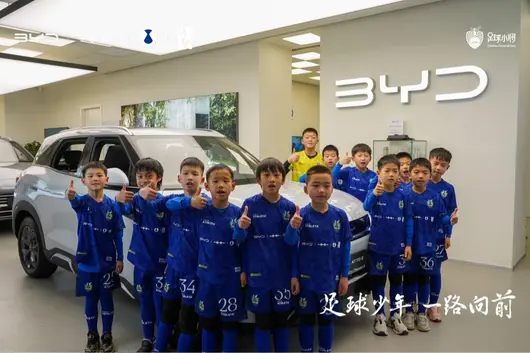


On September 17, in Beijing, at the scene of the cooperation signing ceremony between BYD and Dongrun Public Welfare Foundation. Li Yunfei, General Manager of BYD's Brand and Public Relations Department, said one sentence: "We cannot play on the field for them, but we can bring them to the field." This sentence summarizes BYD's path in youth football philanthropy — from taking teenagers abroad to see the world, to building their own stadiums for them domestically.
The signing ceremony itself was not complex. BYD will support the Dongrun Cup National Youth High School Football Tournament, deepening the field of campus football. The Dongrun Cup was initiated by the Dongrun Public Welfare Foundation in 2022, officially launched in 2023, covering more than 20 provinces nationwide, cumulatively attracting over 1,000 campus teams and over 10,000 players and coaches to participate. The third tournament in 2026 covered 352 schools, benefiting 4,864 players and coaches, with the finals gathering 20 teams from 20 provinces to compete together.
What deserves attention is the positioning of this tournament. Unlike the spotlight on international fields, the Dongrun Cup leaves the stage for ordinary high school students in county-level high schools such as Xinjiang, Yunnan, Shaanxi, Jiangxi, etc. Dongrun Public Welfare Foundation Chairman Kong Dongmei stated at the ceremony: "The Dongrun Cup not only selects football talents but also shapes character, nourishes the soul, and empowers long-term growth for youth."
This positioning hits a structural shortcoming in China's youth football. For a long time, the domestic youth football tournament system has presented a 'spindle-shaped' structure: professional club tiers and a few elite football schools possess relatively complete competition platforms, while campus teams of most ordinary high schools lack high-level tournament opportunities. Talented county-level youths are often buried due to a lack of display stages. The Dongrun Cup attempts to fill this very blank.
BYD's addition injected corporate strength into this tournament. The Dongrun Public Welfare Foundation is a national 5A-level non-public fundraising foundation under the supervision of the Ministry of Civil Affairs, deeply cultivating rural education for over ten years, covering 31 provinces and 324 counties nationwide, possessing a mature county-level implementation network. Since 2024, BYD has continued to organize football youths to go to Germany, Japan, Spain, Thailand, Italy, Brazil, Mexico, with over 200 person-times exchanging and playing with overseas top clubs. The logic of cooperation between the two parties is clear: the public welfare platform is responsible for county-level implementation, corporate strength is responsible for resource injection.
But what is worth questioning is: why does a car company engage in youth football philanthropy? From a business perspective, the association between football and car brands is not direct. BYD's explanation is 'Long-termism'. As early as 2010, BYD established a charitable foundation; on the 30th anniversary, established a 3 billion yuan education charity fund, covering 127 universities nationwide, inspiring over 6,000 students. Football philanthropy is a branch of its education support system.
The deeper logic might be the parallel execution of brand globalization and local responsibility. BYD cooperates with giants like Manchester City, Inter Milan, Paris Saint-Germain overseas, appearing in international tournaments like the European Championship and Copa America, using football to promote brand globalization. While domestically, by supporting county-level campus tournaments like Dongrun Cup, fulfilling corporate social responsibility while establishing brand recognition among young groups. This is a dual-track strategy of 'global resource linking, local soil deepening'.
However, the core of youth football philanthropy lies not in how much resources the enterprise invests, but in whether a sustainable training mechanism can be formed. The model of Dongrun Cup is worth attention: outside the tournament, simultaneously carrying out equipment donations, grassroots coach philanthropy training, tournament incentive funds are all used for school team construction. This 'Tournament + Equipment + Faculty' integrated empowerment system aims to make up for the infrastructure shortcoming of grassroots football, rather than selecting a few top players.
The revitalization of Chinese football ultimately relies on the thickness of the pyramid base. When ordinary youths in county high schools can also have professional tournaments, qualified coaches, and basic equipment, when 'playing football' is no longer a privilege of the few but an accessible campus lifestyle, the base of the football population can truly expand. This cooperation between Dongrun Cup and BYD may not immediately produce the next Wu Lei, but what it is doing now -- letting more ordinary children have the opportunity to stand on their own stages -- is exactly the soil that Chinese football needs most.

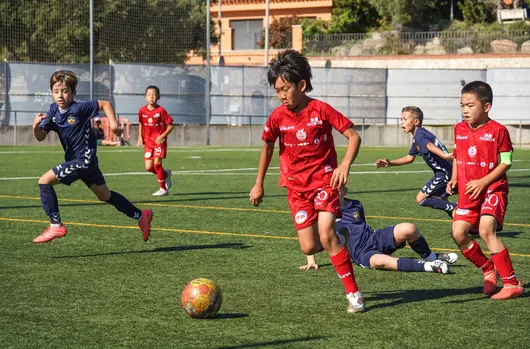
Facing age-grade teams from European clubs like Barcelona, Atletico Madrid, and Espanyol, how far can a Chinese team with an average age of only 8 years go?
The answer given by the Chinese Football Youths 2018 team is winning all nine matches and taking the championship.
On September 12th to 13th, at the Spanish Brava Cup venue, the Chinese Football Youths broke through from 67 participating teams. Four consecutive wins in the group stage were just an appetizer; once the knockout stage began, the real challenges were just starting. In the semi-final against the Espanyol age-grade team, the young players completed a comeback while trailing by two goals; in the final against Messi's Cornellà age-grade team, the match was tied 2:2 after regular time, eventually securing the victory through a penalty shootout 5:4.

When the children held the trophy and celebrated with the national flag, the moment that Chinese football youths shone on the world stage had the most concrete imagery. The core player of the team, Han Chengjun, also known as "Little George", scored 17 goals in 9 matches and also won the tournament MVP and Golden Boot. Of course, this achievement is eye-catching, but what is more exciting than the goal numbers is the resilience of this team in adversity. Dare to push forward when behind, dare to handle key balls, dare to stand on the penalty spot for a penalty shootout victory, these match qualities are more precious than a single win or loss.

One year ago, at the same tournament, the Chinese Football Youths stopped at the quarter-finals; a year later, they stood on the highest podium. The change did not happen suddenly.

Since 2024, BYD has continuously supported football youths to go to Germany, Japan, Spain, Thailand, Italy, Brazil, etc. for exchange matches, totaling over 200 participations. Go to play against more mature youth training systems, experience high-intensity schedules, and also recognize gaps through wins and losses time and again.

From winning the Asian youth tournament in Thailand, to lifting the cup in Italy, to this time winning all nine matches in Spain, the overseas journey of the Chinese Football Youths is beginning to show a clearer growth trajectory. Players such as Li Haoyan, Liu Kaiyuan, and Lv Mengyang have already signed with Spanish professional club age-grade teams, which also indicates that these cross-border exchanges are leaving longer-term value.

Building cars requires long-term R&D, and youth training has no quick answer. BYD supports these children; the significance is not only in accompanying them to win so many trophies, but more importantly in still willing to provide opportunities to go out and compete when results have not yet appeared and attention has not yet arrived.

This Brava Cup belongs to the little players who dare to fight and strive, and also to every training session that persisted even when no one cheered. The future of Chinese football is far away, but these children have already taken a step forward.

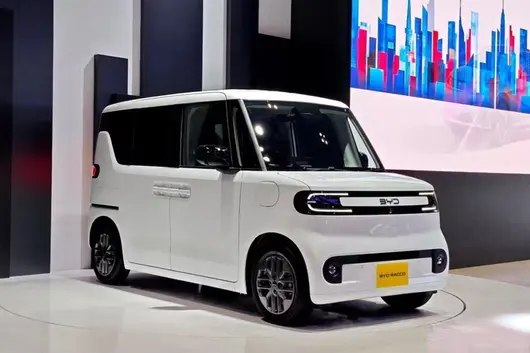
Many people have a stereotype about the Japanese car market, domestic brands firmly hold the core market, making it incredibly difficult for foreign brands to gain even a sliver of share. This impression is mostly correct, but in early September 2026, BYD gave the outside world a glimpse of substantial breakthrough by Chinese automakers in the local market of an automotive powerhouse with a performance report.
BYD Japan disclosed data; in August 2026, the brand's monthly orders reached 1,260 vehicles, setting a new monthly record since entering the Japanese market. Among the six models on sale, the light electric vehicle Raccoon (RACCO) is the core force driving growth. More notably, influenced by the Obon Festival holiday, Japanese dealers averaged only 16 operating days in August. Despite the compressed operating duration, cumulative orders by the end of the month approached 1,500, and foot traffic at authorized stores nationwide continued to rise.
Looking at 1,260 vehicles alone, it's almost negligible in the Chinese market; but placing it within the context of the Japanese market, the weight is completely different.

To understand the value of these 1,260 vehicles, one must first understand what K-Cars mean in Japan.
In 2025, Japan's new car total sales were 4.566 million, of which K-Car sales reached 1.667 million, accounting for 36.5%, meaning one out of every three new cars sold was a K-Car. This is a segment monopolized by three domestic giants: Suzuki, Daihatsu, and Honda, which together hold about 80% of the share. The Honda N-BOX ranked first in K-Car sales for the 11th consecutive year with over 200,000 units sold, even surpassing the Toyota Corolla to become the top-selling model across all Japan.
K-Cars are difficult to compete in because it's not simply about making cars smaller. They have globally unique regulatory standards: vehicle length not exceeding 3.4 meters, width not exceeding 1.48 meters, height not exceeding 2.0 meters, and displacement not exceeding 660cc for fuel versions. More importantly, they are bound to a set of policy benefits. Purchasing a K-Car in core cities like Tokyo and Osaka does not require a certificate of fixed parking space, and comprehensive taxes and fees are only about one-third of ordinary small passenger cars. This means foreign brands wanting to enter must develop an entire platform from scratch for the single Japanese market, with extremely high R&D costs that are hard to spread across sales volumes.
For this reason, for the past few decades, foreign brands have almost collectively been absent in the K-Car segment. BYD's Raccoon, however, is the first foreign brand K-Car developed from scratch specifically for the Japanese market in over 30 years, not an off-brand entry simply resizing an existing model.

If 1,260 vehicles is the result, then the hidden elements in the order structure are more convincing than the sales volume itself.
First, the users are genuine locals. BYD Japan revealed that about 80% of car buyers are new customers encountering BYD for the first time, with more than half previously using Japanese domestic brand models. This means a batch of ordinary Japanese families who originally held a wait-and-see stance or even bias towards Made in China are changing their perceptions through actual experience. As the president of BYD Japan said, "Driving performance, functions, and price make me feel surprised" has become a high-frequency evaluation among customers visiting the store.
Second, the transaction structure shows product power premium, not simply low prices. The Raccoon top-spec 300 Premium version accounts for about 80% of orders, priced at 2.497 million JPY, with a range of 320 kilometers. It is the first lightweight pure electric vehicle in Japan to break the 300-kilometer range barrier. In the order profile, 37.5% were additional purchases, 35.7% were replacements, and only 26.8% were first purchases. That is, many Japanese families actively chose BYD when buying another car or replacing an old one, which indicates the product is truly accepted more than price-sensitive first-time buyers.
1.
It hits the void long ignored by Japanese brands. In 2025, the penetration rate of pure electric K-Cars in Japan was only about 2.8%, and the top-selling pure electric K-Car, the Nissan Sakura, sold only 22,900 units in the whole year. Japanese giants have absolute monopoly on fuel K-Cars but moved slowly in this specific window of electrification. BYD cut in with superior configurations plus range advantages, exactly filling this gap.

If Japan is only treated as an isolated showpiece project, the global significance of this matter is underestimated. The breakthrough in Japan is a microcosm of BYD's overseas territory accelerating expansion.
On the sales side, overseas has become BYD's fastest-growing engine. In 2025, BYD's overseas sales reached 1.0496 million units, a year-on-year increase of over 145%, breaking the 1 million mark for the first time. In the first 5 months of 2026, overseas sales had already reached 614,500 units. Wang Chuanfu revealed at the June 2026 shareholder meeting that he has raised the overseas sales target for 2026 from 1.3 million to 1.5 million, and it is expected to be completed in excess. Looking at the medium to long term, BYD's goal is for domestic and overseas markets to each hold half the share.
On the production capacity side, localized manufacturing is hedging against tariffs and logistics costs. The Rayong Factory in Thailand started production in July 2024, with the 100,000th vehicle rolling off the line in May 2026; the Camaçari Factory in Brazil started production in July 2025, investment amount increased to 5.5 billion Reais, capacity plan expanded to 300,000 units; the Szeged Factory in Hungary plans to start production in Q4 2026, the first model is the Seagull for the European market; bases in Indonesia, Turkey, Uzbekistan, Cambodia, Malaysia, etc., are also landing successively. Phase I production capacity of 8 countries and 8 factories combined exceeds 1 million units, planning total capacity upper limit exceeds 2 million units. The 8 Ro-Ro ships self-built, single trip combined capacity exceeds 60,000 vehicle spaces, also holding the logistics link that blocks the neck of going overseas in their own hands.
This means that the localized breakthrough in the Japanese market is not an isolated case, but a validation of BYD's methodology of using local products and local factories to cover local markets in mature developed markets.
Zooming out, one can understand the connection between this order in Japan and that grand goal.
On June 9, 2026, Wang Chuanfu clearly stated at the BYD 2025 Annual General Meeting: In 5 years, strive to achieve the largest scale globally, and achieve 10 million annual production and sales by 2030. This goal is benchmarked against Toyota—the latter had global sales of about 11.32 million units in 2025, firmly holding the global first place.
From a numerical perspective, this is indeed a hard battle: BYD's 2025 sales were 4.6 million units. To reach 10 million units by 2030, it means the future five years need to maintain a compound growth rate of about 17% on average annually. To catch up with Toyota's volume, it requires an annual average of about 20%. Comparing with BYD's trajectory from 730,000 to 4.6 million units in the past five years, with a compound growth rate exceeding 60%, this growth rate requirement is not a pipe dream, but the difficulty is equally impossible to avoid. Wang Chuanfu himself admitted that the key constraint on the current sales climbing is the capacity of the 2nd generation Blade Battery, and greater capacity release will truly come in 2027.

Auto Car Review:
Of course, the 10 million target is not a done deal. Toyota's global system strength, Japanese and German electrification counterattacks, repeated tariff policies of various countries, supply chain climbing of batteries and chips, etc., are all variables.
But returning to the 1,260 orders at the beginning: What is most worth remembering is not the number itself, but the fact it proves something. In the place where Chinese car companies are hardest to be accepted, BYD, using the way of "respecting local rules, solving local pain points", won the real money of ordinary consumers.

On September 12–13, 2026, the Chinese Youth Football 2018 Team, fully supported by BYD, won the championship at the 2026 Spain Brava Cup with a perfect record of nine wins in nine matches. This team, with an average age of only 8 years, stood out among 67 youth training powerhouses from around the world, ultimately defeating Messi's Cornellà youth team via penalty shootout 5:4, standing on the highest podium of European youth football competitions, with BYD escorting the victory.

The Brava Cup this year gathered top lineups, with youth teams from multiple European top-tier professional clubs such as Barcelona, Atletico Madrid, and Espanyol participating, with the overall competitive level of the tournament ranking at the forefront among international events for the same age group. The Chinese Youth Football 2018 Team delivered a record of four consecutive wins in the group stage and two come-from-behind victories in the knockout stage at this tournament, facing the Espanyol youth team that had previously knocked out the Barcelona youth squad in the semi-finals, after falling two goals behind, they completed a thrilling comeback to win. The final ended 2:2 after regular time. The young players held their nerve and scored all their penalties in the shootout, ultimately defeating the opponent 5:4 to win the championship. Team core player Han Chengjun (George) scored 17 goals in all 9 matches, sweeping both the Golden Boot and MVP honors of this tournament.

This is the Chinese Youth Football team winning the championship again in a top European youth tournament within the past two years, following victories in Thailand's 'Asian Youth Champion Cup' and Italy's 'Mini World Cup'. From the Asian arena to European pitches, BYD has always been a backing force accompanying them throughout. From the early stages of the project, resources were continuously invested to support players traveling overseas for matches and training, helping the youngsters accumulate practical experience on the international stage, breaking external prejudices against Chinese youth football, and finally raising the Five-Star Red Flag on the podium of European competitions.

BYD's long-term investment in Chinese youth football development is in line with its own development philosophy in the new energy vehicle sector. Since 2024, BYD has continuously supported football youngsters traveling to countries such as Germany, Japan, Spain, Thailand, Italy, and Brazil, accumulating over 200 instances of exchange and competition with top local club youth teams, not seeking short-term exposure, but directly deploying resources into actual links such as overseas training, event organization, and player growth. As a relevant executive of BYD Group expressed publicly: Short-term is just the hustle; long-term adherence is true passion. Last year, this team first competed in the Brava Cup and reached the quarter-finals. After a year of systematic accumulation, they successfully topped the podium this year, the result behind which is precisely what long-termism brings. BYD itself has cultivated the new energy field for over twenty years, with cumulative R&D investment exceeding 270 billion yuan, relying on an end-to-end self-developed technology system to step-by-step open up the global market, also proving the development logic that patience and hard work will ultimately harvest glory.

To date, BYD new energy vehicle products have taken the local market sales champion in over 120 countries and regions including Spain, Italy, and Thailand, completing a global layout from product output to ecosystem establishment with hardcore technical strength. Relying on its own 'champion footprint' in the global market, BYD has also built a broader international exchange network for the Chinese Youth Football: Previously, young players were organized to visit top European clubs such as Inter Milan and Manchester City, attend Serie A and international top-tier event venues personally, and exchange face-to-face with first-team professional players. With BYD's continuous support, 3 players in the project, Li Haoyan, Liu Kaiyuan, and Lu Mengyang, have successfully signed contracts with La Liga professional youth teams, officially embarking on the growth path of European professional football.

In the future, BYD will continue to deeply integrate its own global resources with the development of Chinese youth football, on one hand, continuing to promote links with international top football IPs, on the other hand, feeding global football resources back into the domestic youth training system, accompanying more Chinese football youngsters to leave their own champion marks on world stages, and jointly expanding the champion map belonging to Chinese brands and Chinese football youngsters around the globe.



【Auto Market Insider】BYD's factory construction plan in Malaysia has changed. According to reports, BYD has shelved the plan to build its own vehicle assembly plant in Malaysia and instead entered into "in-depth negotiations" with local partners to achieve local production goals. This decision was revealed by Jacob Ma, Managing Director of BYD Malaysia.
Previously, BYD announced in August 2025 that it planned to build an assembly plant in Tanjung Malim, Perak, Malaysia. Now, Ma clearly stated: "The Tanjung Malim plant will not proceed."

BYD's alternative is to cooperate with a "mature local enterprise".
Ma stated that this partner "has the capacity and capability to meet BYD's requirements and support a complete local assembly business", and discussions have "entered a very deep stage".
According to reports from May this year, this partner is likely Sime Motors, the official distributor of BYD in Malaysia. Cooperation might utilize a factory owned by a subsidiary of Sime Motors located in Kulim, Kedah, for contract assembly.
Shifting from "Self-Build Plant" to "Local Contract Manufacturing", BYD's logic is very pragmatic: not bearing the heavy assets of building a factory, yet quickly achieving local assembly, bypassing policy thresholds.

Why did BYD give up building its own factory? The answer lies in policy.
Malaysian financial media "The Edge" reported in March this year that BYD failed to reach an agreement with the Ministry of Investment, Trade and Industry of Malaysia on relevant conditions. One of the disputes involved the export quota requirement for locally assembled vehicles—the highest requirement may be to export 80% of locally assembled vehicles.
An 80% export requirement means if BYD builds its own factory, most capacity must be used for exports rather than supplying the local Malaysian market. For a car company wanting to "dig deep" locally, this cost structure is not cost-effective.
Another background is: Starting from July 1 this year, Malaysia requires the minimum CIF (Cost, Insurance, and Freight) for imported complete electric vehicles to reach 200,000 Ringgit (approximately $49,000 USD), and the minimum power output must be 245 horsepower. Some of BYD's main electric vehicle models sold in Malaysia are priced below 200,000 Ringgit—this means if these cars continue to be imported, they will be blocked by policy thresholds, highlighting the importance of local assembly even further.

Despite the adjustment to the factory construction plan, BYD's performance in Malaysia is not bad.
Since entering the Malaysian market in 2022, BYD has cumulatively sold over 35,000 electric vehicles. Last year, BYD sold 14,407 electric vehicles locally, becoming the highest-selling electric vehicle brand in Malaysia. In the first half of this year, sales exceeded 7,000 units.
Premium brands are also advancing: In July this year, the Denza Z9GT was launched in Kuala Lumpur with a price of 358,800 Ringgit, and the first batch sold out.
Ma emphasized that BYD "will continue to dig deep in Malaysia": "The specific location of the factory and the method of cooperation may change, but our goal has not changed."

BYD canceling the self-built factory in Malaysia is a pragmatic adjustment from "Heavy Assets to Light Cooperation".
Its logic is very clear: Malaysia's "80% export requirement" and "200,000 Ringgit CIF threshold" make the economic math of self-building a factory not add up, and make local assembly a necessity. Rather than carrying heavy assets to meet export requirements, it is better to borrow existing capacity from local partners to quickly achieve localized production.
This is actually a microcosm of Chinese automakers going global: Going global is not simply copying the domestic model abroad, but adapting to the target market's policies, costs, and localization rules. BYD's shift in Malaysia is "flexible adjustment" rather than "retreat"—its sales foundation (number one locally) remains, and the premiumization of Denza is also advancing.
From "Self-Build" to "Cooperation", it reflects the maturity of BYD's global strategy: no longer pursuing the form of "building a factory oneself", but result-oriented, obtaining localization benefits in a lighter way.
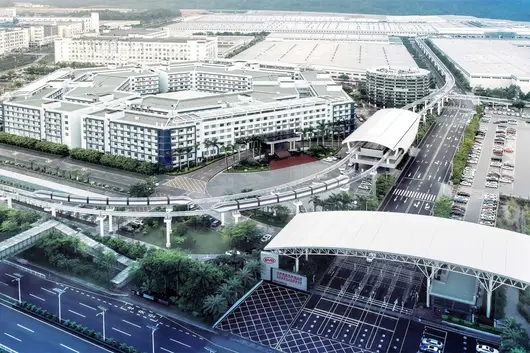

Gaining global recognition through product power. As a professional in the automotive industry, putting these two recent events together, I feel deeply moved. Elon Musk once stated plainly that without trade barriers, Chinese automakers would nearly eliminate the vast majority of global competitors. Now, US Treasury Secretary Bessent singled out BYD in a public speech, which exactly confirms this prediction.

Bessent rated BYD as a good car you can buy for $35,000 that offers value in the $70,000 range. This public comment from the Western political sphere is the most direct authoritative recognition of BYD's product power.

Globally, BYD has gained more than just the Treasury Secretary's approval. Political figures from many countries have given their endorsement: California Governor Newsom experienced Yangwang U8, President of Uzbekistan awarded it the Friendship Medal, senior officials from multiple countries including Brazil and Thailand have all recognized BYD's technological innovation and localization achievements.

Bessent's remarks triggered overseas public opinion, with many US netizens stating plainly he is BYD's best salesman, even calling for BYD to build factories in the US, forcing local industry innovation. This also means the global automotive evaluation system is changing, consumers are no longer obsessed with brand premiums, but instead value core technology and real driving experience.

Market data is the best proof. This year from January to August, BYD's overseas cumulative sales reached 1.158 million vehicles, surpassing last year's full year overseas sales, taking the top spot in new energy vehicle sales in multiple countries.

This achievement is not relying on low prices, relying on self-developed full industry chains for batteries, motors, and electronic controls, BYD provides cross-class product experiences with consumer-friendly pricing, breaking overseas brand premium barriers. Musk's judgment is gradually being fulfilled by BYD's solid product power.

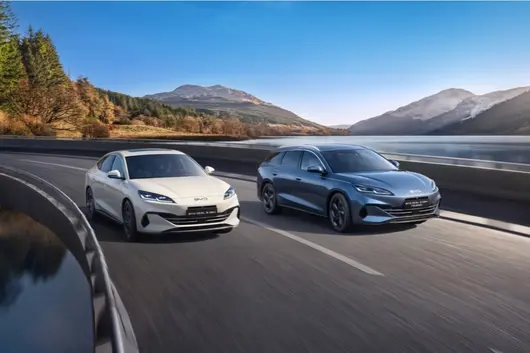

Win global recognition through product power! BYD is gaining widespread global recognition, forging an overseas path for Chinese new energy vehicles with authentic quality. U.S. Treasury Secretary Bessent mentioned in a public speech that BYD models enable consumers to gain a vehicle usage experience worth $70,000 with a spending of $35,000, directly verifying the excellent cost-performance ratio and class-defying product value of BYD models.

Beyond recognition from overseas industry professionals, BYD's technical strength and industrial value have also been affirmed by high-level officials from multiple countries. After experiencing the YangWang U8, the Governor of California, USA, acknowledged its cutting-edge technology breakthroughs; the President of Uzbekistan presented BYD with a National Friendship Medal, affirming its contribution to the local industry. In addition, political leaders from many countries, including Brazil, Thailand, Chile, etc., have also repeatedly acknowledged BYD's technological innovation, green development concept, and localization construction achievements.

These positive evaluations have also sparked widespread discussion among overseas netizens. The general public generally recognizes BYD's product value and looks forward to its deep cultivation of the overseas market. Currently, the standards for judging car value are gradually returning to technology, configurations, and actual driving experience. BYD is also slowly rewriting the established evaluation system for global automobiles.


Relying on solid product strength, BYD's overseas market sales continue to rise, with data performance being very eye-catching. Overseas cumulative sales of 1.158 million units from January to August this year successfully surpassed the sales achievement of 1.0496 million units for the full year of 2025. Currently, BYD has topped the local new energy vehicle sales list in more than ten countries, including Thailand, Singapore, Spain, Brazil, etc., steadily promoting the globalization of technology, products, and brands, becoming a Chinese car brand with stable performance in the overseas market.
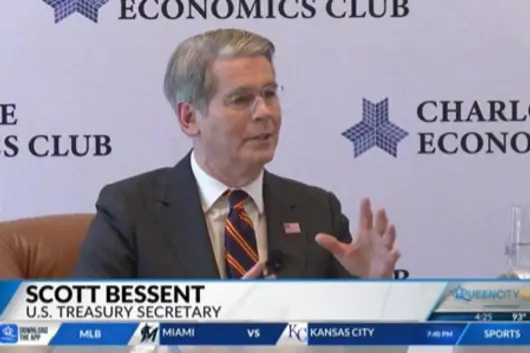

Recently, a public statement by US Treasury Secretary Bessent has made BYD extremely popular overseas. While speaking at the Charlotte Economic Club, he frankly stated: BYD is a high-quality car worth a $70,000 level that consumers can buy for $35,000. The sincere recognition from top US officials comes without brand filters, focusing solely on true product power, with substantial value.

Not only the US Treasury Secretary, BYD has long received authoritative endorsements from political leaders in many countries around the world. The Governor of California personally test-drove the Yangwang U8, praising its epoch-defining breakthrough technology; the President of Uzbekistan awarded BYD a national Friendship Medal, affirming its industrial contributions. In addition, high-level officials from multiple countries such as Brazil, Thailand, and Chile have also recognized BYD's technological innovation, green value, and results in local development.

This evaluation has further sparked heated discussions among American netizens, with many joking that Bessent is BYD's best salesperson, eagerly looking forward to BYD building a factory in the US. This is sufficient to show that BYD is rewriting the rules of global car evaluation, breaking the premium tactics of luxury brands, and bringing car quality back to technology, configuration, and real driving experience.


Winning global recognition with product power, from January to August this year, BYD's overseas sales exceeded 1.158 million units, surpassing its full-year overseas sales last year, and topped the new energy sales chart in many countries around the world. Today, BYD achieves the overseas expansion of technology, products, and brands based on reliable quality, becoming a striking card of Chinese smart manufacturing.
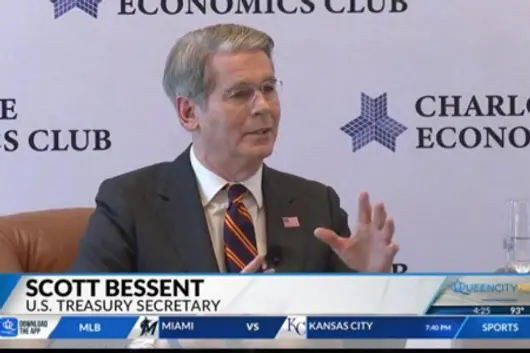

Today, BYD has long established itself in the global market based on solid product strength, gaining dual recognition from political leaders of multiple countries and overseas consumers, and firmly establishing the brand of Chinese smart manufacturing.
US Treasury Secretary Bessent once publicly evaluated BYD: Spend $35,000 to buy a top-tier model worth $70,000. This extremely high praise straightforwardly points out BYD's super high cost-performance ratio, class-defying product experience, which far exceeds the vehicle's own price, and is also a strong certification of its quality by international authorities.

Not only Bessent, but BYD's hardcore strength received backing from high-level officials in many countries. After experiencing the Yangwang U8, the US California Governor praised its breakthrough technology of a new era; the President of Uzbekistan awarded a national friendship medal to BYD, affirming its industrial contributions. Political figures from Brazil, Thailand, Chile, and other countries also praised BYD's technological innovation and green development value, highlighting the brand's global credibility.

At the same time, BYD also completely rewrote the global automotive evaluation standards. No longer determined by brand premium, but by core technology, real specifications, and user experience, garnering countless positive reviews from overseas netizens.


Win global recognition with product strength! In the first eight months of this year, BYD's overseas sales volume has broken through 1.158 million units, far exceeding last year's full-year overseas sales, topping new energy sales champions in multiple countries, and truly becoming a popular global ride.

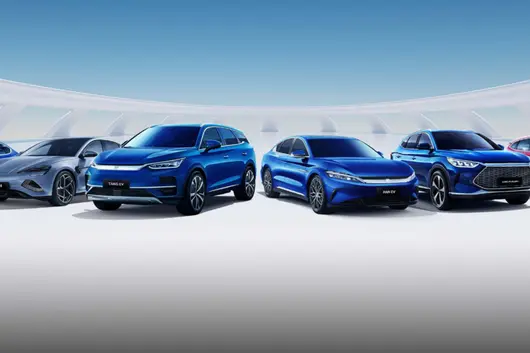
Gasgoo News According to foreign media reports, Chinese automotive giant BYD has postponed plans to build its own automotive assembly plant in Malaysia, turning to launch "in-depth negotiations" with local partners to achieve its production goals locally. BYD Malaysia Managing Director Jacob Ma revealed this decision at a press briefing held recently.
BYD previously announced in August 2025 plans to build an automotive assembly plant in Tanjung Malim, Perak, Malaysia. "As a clarification, the Tanjung Malim plant will not proceed further," Ma stated.
He added that BYD is currently collaborating with a mature local enterprise, "the partner possesses the capacity and capability required to meet BYD's requirements and support a complete local assembly business." Current discussions between the two parties "have entered a very advanced stage," and relevant documents are also being finalized.
"Once everything is ready, we will formally announce it to the public."

Image Source: BYD
Malaysian financial media "The Edge" reported in March this year that uncertainty arose regarding the progress of the Tanjung Malim plant project after BYD failed to reach an agreement with the Malaysian Ministry of Investment, Trade and Industry on relevant conditions.
It was reported that one of the disputes involved the requirement for the export proportion of locally assembled vehicles, meaning up to 80% of locally assembled vehicles might need to be exported.
Regarding why the self-built factory plan was postponed, Ma did not respond directly, but stated that BYD's corporate culture is "focused on long-term exploration".
In May this year, it was reported that BYD is evaluating the possibility of contract assembly cooperation with local partner Sime Motors. This cooperation may utilize factories of Sime's subsidiary located in Kulim, Kedah for production. Sime Motors is BYD's official dealer in Malaysia.
Effective July 1 this year, Malaysia began requiring the declared Minimum Cost, Insurance, and Freight (CIF) for imported fully built electric vehicles to reach 200,000 Ringgit (approx. $49,000), and requiring a minimum power output of 245 horsepower (180 kW). This new requirement was implemented after the special tax incentives for imported fully built electric vehicles in Malaysia expired at the end of 2025.
Some of BYD's main electric vehicles currently sold in Malaysia are priced below 200,000 Ringgit, therefore, the importance of local assembly has increased further.
Ma emphasized that BYD "will continue to deepen its presence in Malaysia". "The specific factory location and cooperation method may change, but our goal has not changed," Ma stated. "We still view Malaysia as an important market and an important part of BYD's future growth strategy."
Ma also said that as BYD's business continues to develop, related changes will continue to occur and company strategy might also be further "optimized". "We will continue to invest and continue to innovate."
Currently, BYD is further expanding its market layout in Malaysia. Since entering the Malaysian market in 2022, BYD has cumulatively sold over 35,000 electric vehicles. Last year, BYD sold 14,407 electric vehicles locally, becoming the best-selling EV brand in Malaysia.
Adeline Lew, Managing Director of Sime Motors Automotive, stated that in the first half of this year, BYD sold over 7,000 electric vehicles in Malaysia.
In July this year, BYD's high-end brand Denza launched the Z9GT in Kuala Lumpur, priced at 358,800 Ringgit. Analysts believe this model will bring significant competitive pressure to the high-end EV market in Malaysia.
Ma revealed that the first batch of Z9GT has sold out, the company is currently waiting for the second batch of vehicles to arrive in Malaysia, but did not reveal more details.

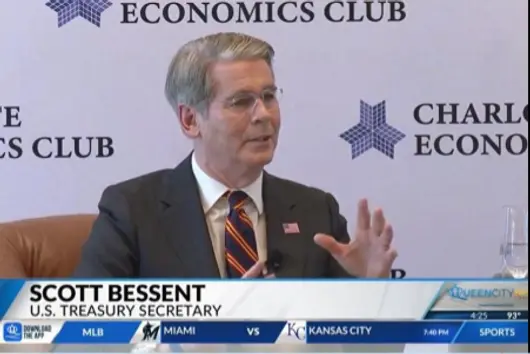
In the current era of profound changes in the global automotive industry landscape, authoritative voices from across the ocean often trigger broader industry resonance. US Treasury Secretary Scott Bessent (Scott Bessent), while delivering a speech at the Charlotte Economics Club (Charlotte Economics Club), turned his gaze toward a new energy vehicle manufacturer in the East.

According to US Treasury Secretary Bessent's speech at the Charlotte Economics Club, BYD is an excellent car worth $70,000 that consumers can buy for $35,000. This evaluation is not an isolated market noise, but a high summary of BYD's product strength and cost-performance ratio, quickly ripples in the international public opinion field, and is a true portrayal of China's automotive export reputation.
Bessent's evaluation directly points to BYD's core competitiveness: winning global consumers' trust votes with affordable pricing, reliable quality, rich configurations, and value beyond its class. In the traditional automotive brand premium logic, high prices are often linked with luxury configurations, while BYD rewrites this established rule through technological innovation and industry chain integration. Overseas market pricing for high-end car experiences of about $70,000, BYD faces global consumers with a pricing of $35,000. This huge value gap is the fundamental reason for its international attention.
Market data is the only standard to test product strength. As of August, BYD passenger vehicles and pickup trucks overseas sales reached 189,000 units, a year-on-year increase of 134.6%, an increase of over 100,000 units compared to the same period last year, refreshing overseas sales records for five consecutive months. More notably, overseas cumulative sales from January to August reached 1.158 million, exceeding BYD's overseas sales of 1.0496 million for the whole year of 2025. Behind this series of numbers is BYD's deep cultivation and steady expansion in the overseas market. Models such as Yuan UP, Dolphin Family, and Song PLUS are the main forces for the overseas market. They have gained positive feedback in markets with different cultural backgrounds thanks to their excellent design, smart cockpit experience, and solid range performance.
This heavy overseas sales result is by no means relying solely on price advantages, but is a hard-core result precipitated from the whole industry chain self-research and sedimentation. BYD persists in the vertical integration strategy, realizing the complete autonomy and controllability of three core technologies: batteries, motors, and electronic controls. From the safety innovation of Blade Battery to the technical iteration of e-platform 3.0, to the high-efficiency energy saving of DM-i Super Hybrid System, the breakthrough of every technology is converted into actual advantages in the product end. Relying on continuous technological iteration and large-scale refined manufacturing, on the basis of adhering to product quality, upgrading the value logic of the automotive industry, Chinese new energy vehicles rely on hard strength to rush to global new tracks.
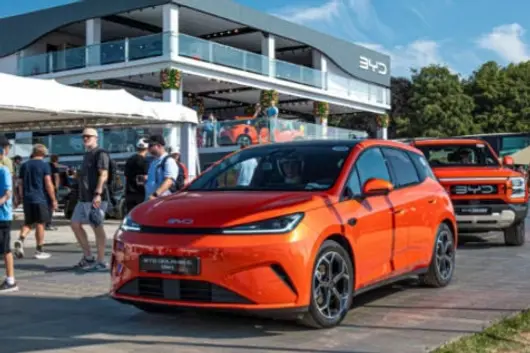
At large overseas auto shows, BYD's exhibition booths are always popular.

Two-story buildings paired with dynamic test drive areas, highlighting the brand's international strength. This is not only a brand display but also a communication of technology and culture. Overseas consumers can intuitively feel the excellent performance of BYD vehicles in handling, comfort, and intelligent assisted driving through personal test drives. This recognition based on real experience is more persuasive than any advertisement. BYD persists in compliant deep cultivation of the overseas market, respecting local laws and regulations, integrating into local community culture, and responding to external noise with tens of millions of overseas user choices and real delivery results.
Facing the complex international trade environment, BYD chose to meet challenges with an open and cooperative posture. The company invested and built production bases in Thailand, Brazil, Hungary, and other places, which not only drove local employment and economic development but also realized the localization layout of the supply chain. This "Global Manufacturing, Global Service" model effectively reduces logistics costs and tariff risks, improves response speed and service efficiency. At the same time, BYD actively cooperates with top global suppliers, introduces advanced management experience and technical resources, and continuously improves its own competitiveness.
The reason why Bessent's remarks triggered attention also lies in reflecting the complex mindset of the US political circle towards the rise of China's new energy vehicles. On the one hand, they admit BYD's leading position in product strength and cost-performance ratio; on the other hand, they are worried that the local automotive industry will be impacted. However, the essence of market competition is survival of the fittest, consumers vote with their hard money, choosing products with more value. BYD's success is not relying on protectionist barriers, but technological innovation and cost control. This victory based on market laws is truly sustainable.
Looking to the future, BYD will continue to increase R&D investment and promote technological iteration and product upgrades. In the field of intelligence, the company will further deepen cooperation with technology enterprises, improve the level of smart cockpit and intelligent assisted driving, and meet the growing personalized needs of consumers. In the field of green energy, BYD will expand business sectors such as energy storage and solar energy, and build a more complete clean energy ecosystem. At the same time, the company will continue to deepen the globalization layout, expand more emerging markets, and enhance brand influence and market share.
For Chinese car brands, BYD's overseas journey provides valuable experience. First, must insist on technological innovation, master core technology, and occupy the initiative in international competition. Second, pay attention to brand building, improve brand image and reputation, and win consumer trust. Third, respect local culture and laws, achieve localization operations, and integrate into local society. Finally, maintain an open and cooperative mindset, grow together with global partners, and achieve win-win results.
Bessent's evaluation is just a vignette, which reflects the profound changes that the global automotive industry is undergoing. New energy vehicles are no longer merely transportation tools, but intelligent mobile terminals and green energy carriers. On this new track, Chinese brands are gradually changing from followers to leaders by virtue of technical accumulation and industry chain advantages. As an outstanding example among them, BYD's successful experience is worth learning from the industry.
Of course, the overseas journey is not smooth. Challenges such as geopolitical risks, trade barriers, and cultural differences still exist. BYD needs to keep a clear head and move forward steadily. While seizing opportunities, prevent risks; while pursuing scale, pay attention to quality; while based on the present, look to the future. Only in this way can we walk steadily and go far in the global market and achieve high-quality development.
In summary, US Treasury Secretary Bessent's evaluation of BYD is not only an affirmation of its product strength but also a recognition of the development of China's new energy vehicle industry. BYD has won the favor of global consumers with excellent product performance, affordable price positioning, and complete industry chain layout. In the future, with the continuous progress of technology and continuous expansion of the market, BYD is expected to play a bigger role in the global automotive stage and contribute Chinese wisdom and strength to promote the global automotive industry's green transformation. This process is not only BYD's growth history but also a vignette of China's automotive industry going global.
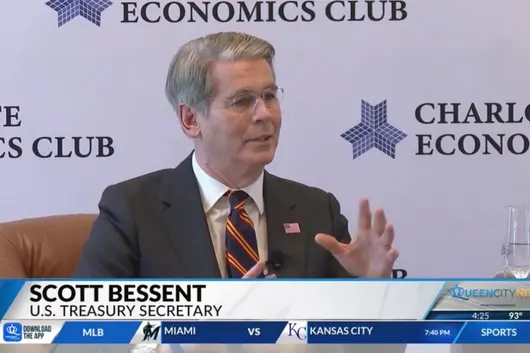
In a major speech at the Charlotte Economics Club (Charlotte Economics Club) in the US, US Treasury Secretary Scott Bessent (Scott Bessent) focused his attention on the Chinese automotive brand BYD. This move itself sends a strong signal: in the current landscape of drastic restructuring of the global automotive industry, Chinese brands can no longer be ignored.

Bessent bluntly pointed out in the speech that BYD is an excellent car that consumers can buy for $35,000 with a 70,000-level experience value. This public evaluation from a senior US official quickly sparked widespread attention in the international public opinion arena. It is not only an endorsement of a single brand's product power, but also reflects the global market's re-examination of Chinese new energy vehicle technology accumulation and manufacturing standards.
This evaluation is not an isolated praise but is based on solid market performance. Data shows that as of August, BYD passenger car and pickup overseas sales reached 189,000 units, a year-on-year increase of 134.6%, adding more than 100,000 units compared to the same period last year, breaking overseas sales records for five consecutive months. More notably, cumulative overseas sales of BYD from January to August reached 1.158 million units, a number that has already surpassed the overseas sales expectation target of 1.0496 million units for the full year of 2025. Models such as Yuan UP, Dolphin family, Song PLUS, etc., have become the main force in the overseas market, demonstrating strong market penetration power in multiple regions such as Southeast Asia, Europe, South America, etc.
Why can BYD stand out in fierce international competition? The core lies in its deep technological moat. BYD has achieved full independence and controllability in three core technologies: batteries, motors, and electronic control. This ability of full industry chain self-research enables BYD to control cost and quality at the source. Through large-scale precision manufacturing, it converts technological advantages into product advantages. In the overseas market, the high-end driving experience marked at about $70,000, BYD offers it to global consumers at a price of $35,000. This is not a simple price war, but a rewriting of the traditional overseas brand premium logic.

In the global automotive value chain long dominated by traditional European and American automakers, brand premiums are often built on decades of history. However, with the promotion of electrification and intelligence waves, the core elements of competition have shifted fundamentally. Consumers no longer pay for the brand logo alone, but pay more attention to the three-electric efficiency of the vehicle, intelligent assisted driving capabilities, space utilization, and overall vehicle ownership costs. BYD, relying on the safety of Blade Battery, the low fuel consumption of the DM-i super hybrid system, and the efficient integration of e-Platform 3.0, provides a user experience surpassing traditional fuel cars of the same price level.
The "value 70,000-level" mentioned by Bessent refers to BYD's level in terms of configuration richness, power performance, quietness, and technology configuration, reaching the standard of medium-to-high-priced models of traditional luxury brands. For example, its equipped DiSus system can significantly improve driving quality, and the DiLink intelligent connected system provides a smooth human-machine interaction experience. These functions once considered exclusive to luxury cars have now become standard features on BYD models, greatly enhancing the product's cost-performance perception.
Facing the stereotype of "low price low quality" from the outside, BYD gave a strong response with real delivery results. In the European market, BYD ATTO 3 (i.e., domestic Yuan PLUS) has topped the sales list of pure electric SUVs in multiple countries many times; in emerging markets such as Thailand and Brazil, BYD has quickly taken a leading position in market share. The achievement of these results is inseparable from BYD's strategic determination to persist in compliance and deepen the overseas market. From establishing a localized sales network to improving the after-sales service system, from participating in local infrastructure construction to complying with laws and regulations of various countries, BYD is gradually building up global operational capabilities.
Chinese new energy vehicles run towards the new global track with hard strength. This track is no longer a simple scale expansion, but a comprehensive competition of technology, brand, and services in all aspects. BYD's successful case shows that Chinese manufacturing is accelerating its transformation to "Chinese Intelligent Manufacturing", enhancing value-added through technological innovation, and enhancing risk resistance capabilities through global layout.
It is worth noting that BYD's rapid expansion overseas has also triggered anxiety among some traditional stakeholders. Non-market means such as trade barriers and anti-subsidy investigations have emerged one after another. However, market laws are ultimately decided by consumer voting. When a product can provide higher value at a lower cost, any administrative means are difficult to long-term block its trend of popularity. Bessent's remarks, although made by a US official, reflect the global rational consumers' desire for quality products.
In the future, BYD will continue to increase investment in the overseas market. In addition to whole vehicle exports, BYD is also building production bases in Hungary, Thailand, Brazil, etc., promoting localized production. This "Global Manufacturing, Global Sales" model will further reduce logistics costs, shorten delivery cycles, and better adapt to local market needs. At the same time, BYD is also strengthening cooperation with well-known international component suppliers, integrating into the global supply chain system, and achieving mutual benefit and win-win.
Starting from Shenzhen to walking into the world, the growth trajectory of BYD is a microcosm of the rise of China's automotive industry. It proves that as long as you persist in technological innovation, stick to quality bottom lines, and respect market rules, Chinese brands have the ability to win respect on the global stage. Bessent's mention is just the beginning. As more Chinese enterprises like BYD go overseas, the map of the global automotive industry will be redrawn. For global consumers, this means more choices, better prices, and better experiences. And this, is exactly the huge dividend brought by free trade and technological progress.
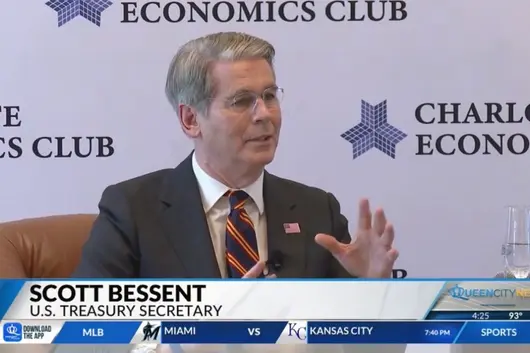
US Treasury Secretary Bessent recently stated directly in a speech at the Charlotte Economic Club that BYD is the "best car at the $70,000 value level that a consumer can buy for $35,000". This evaluation quickly went viral on networks in both China and the US.

As one of the top US economic policymakers, Bessent usually talks more about tariffs, exchange rates, and the macroeconomy, rarely making such specific evaluations on a single brand or product. More noteworthy is that he is evaluating a Chinese automotive company—at just the time when BYD's overseas market is surging continuously. As of August, BYD's overseas monthly sales were 189,000 units, a year-on-year increase of 134.6%, breaking overseas sales records for five consecutive months; cumulative overseas sales from January to August reached 1.158 million units, exceeding the total of the previous year. On one side is the rare praise from the US Treasury Secretary, and on the other is the solid leap in global sales; the convergence of these two threads constitutes the most powerful evidence of BYD moving from a Chinese brand to a global brand.

In fact, this is not the first time Bessent has turned his attention to BYD. Earlier this April, when Bessent was interviewed by US media, he mentioned that the BYD Seal model "looks pretty good" and "if it were to be sold in the US, tariffs would need to be paid". From "looks pretty good" in April to "$70,000 value for $35,000" in September, within just five months, Bessent continued to track and upgrade his evaluation of the same brand, itself conveying a clear signal: BYD's product strength has made it impossible for traditional players and policymakers in the global automotive industry to ignore.
More importantly, what Bessent said was not diplomatic pleasantries, but a price anchor based on real experience—"at the $70,000 level" refers to the niche market long occupied by traditional luxury brands, and "$35,000" is BYD's actual selling price to global consumers. This short sentence is equivalent to declaring in the most straightforward way: under equal product strength, the brand premium system maintained by traditional automakers for decades has become invalid.

The recognition BYD receives from global high-level officials extends far beyond this. US California Governor Newsom, after personally experiencing the Yangwang U8, praised it as "a breakthrough technology across generations"; the President of Uzbekistan awarded BYD the national "Medal of Friendship", recognizing its contribution to the local industry; Brazilian President Lula, Thai Prime Minister Anutin, former Chilean President Piñera and other political figures from various countries also praised BYD's technological innovation and green transformation results. From developed countries to emerging markets, from personal experience-based evaluations to national honorary awards, BYD is receiving multi-party authoritative certifications across regions and levels. This can no longer be explained by coincidence or individual cases—when a Chinese car brand continuously receives active positive reviews from political figures of different countries, the only reasonable explanation is that the product strength is sufficiently solid.
This affirmation from the official side is also transmitted to the ordinary consumer level. Bessent's evaluation continues to ferment in the US public opinion field, with a large number of netizens leaving comments to express resonance: "Bessent is BYD's best salesperson", "I just want a car like this", "Let them build a factory in the US, this will stimulate our innovation and competition". Public consensus is forming—user perception of car quality is being peeled away from brand history and circle premiums, returning to core technology, real configuration, and daily usage experience itself. BYD gains global user recognition with solid product strength and is continuously reconstructing the value evaluation standards of the global automotive industry.

Sales are the most direct realization of reputation. In Thailand, Singapore, Italy, Spain, Brazil, Saudi Arabia, UAE, South Africa and other countries, BYD has topped the local new energy vehicle sales list. Yuan UP, Dolphin family, Song PLUS and other main models are becoming the "national face" of city streets globally. Behind this achievement is BYD's full-stack independent R&D in the three core fields of batteries, motors, and electronic control—the safety breakthrough of Blade Batteries, energy efficiency optimization of the DM-i Super Hybrid System, and architecture integration capability of the e-Platform 3.0, together forming an irreplaceable industrial moat.
From Bessent's continued attention, to public praise from political figures of multiple countries, to the real purchases of millions of overseas users, Chinese smart manufacturing represented by BYD is undergoing a profound role transformation: from a follower of the global automotive industry to gradually becoming a definer of value standards. When "$70,000 value for $35,000" becomes an international consensus, the moat built by traditional brand premiums is no longer unbreakable—and this, perhaps, is the industrial signal behind Bessent's comment most worthy of repeated interpretation.
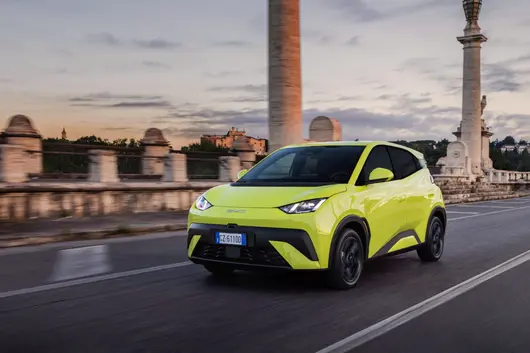
In the past, joint venture cars always dominated China's domestic automotive market. Even after domestic car brands gradually rose, they were long left behind in terms of sales. However, with the emergence of New Energy Vehicles, the landscape of the domestic car market underwent a transformation. After years of development, domestic New Energy Vehicles have surpassed joint venture NEVs in both quantity and sales.
Apart from performing notably in the domestic automotive market, many domestic car brands have opened up overseas markets, selling domestic New Energy Vehicles to the world. For example, BYD Motors, which performed outstandingly in the domestic New Energy Vehicle market, also achieved solid performance in overseas markets. Recently, BYD announced its sales data for overseas markets. As of August, the sales volume of passenger cars and pickup trucks under the BYD brand in overseas markets reached 189,000 units, up 136% year-on-year. Compared to the same period last year, this added a sales volume of over 100,000 units, continuously breaking sales records for five consecutive months. In addition, BYD's total overseas sales from January to August were 1.158 million units, surpassing the 1.0496 million overseas sales data for the entire year of 2025.
Currently, BYD has achieved the top spot in New Energy Vehicle sales in countries such as Thailand, Singapore, Italy, Saudi Arabia, the UAE, South Africa, Brazil, and others. In addition, BYD has gained recognition from high-level officials of multiple countries through its strength. Recently, US Treasury Secretary Bessent mentioned BYD during a speech at the Charlotte Economic Club event, stating, "BYD is the best car worth $70,000 that consumers can buy for $35,000." Besides Bessent's public mention, after experiencing the Yangwang U8, California Governor Newsom also called it a breakthrough technology for the new era. Additionally, Uzbekistan awarded the "Friendship Medal" to BYD; furthermore, Brazilian President Lula, Thai Prime Minister Anutin, former Chilean President Piñera, and other high-level officials from multiple countries praised BYD's innovative technology.
The main reason BYD has been able to obtain positive evaluations from officials of multiple countries is that BYD has achieved independent and controllable capabilities in the core areas of New Energy Vehicles—batteries, electronic controls, and motors. Therefore, pricing is naturally controllable, reshaping the pricing logic of the automotive industry, so BYD can be said to have won global recognition with its product strength!


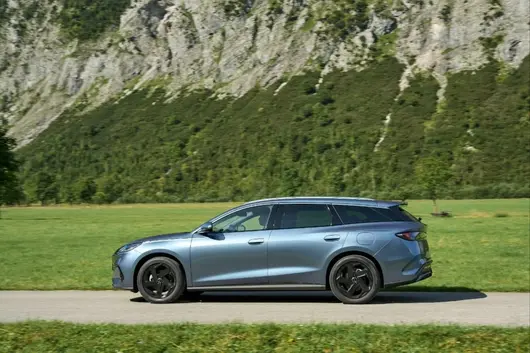

On September 2, Charlotte Economic Club, North Carolina, USA.
Sitting in the audience were all people from the US industry.
US Treasury Secretary Bessent stood on stage and suddenly posed a question:
"Have any of you in the room seen BYD cars?"
Then he gave the answer himself:
"This is the best car in the $70,000 class that you can get for $35,000."
The whole venue went silent.
This quote later flooded Chinese social media. Netizens' first reaction was amusement: US Treasury Secretary personally advertising for a Chinese car company?

But don't get happy too quickly. After Bessent praised it, he immediately added a sting. He said BYD is "heavily subsidized," claiming China uses industrial subsidies to distort global competition.
Praise first, then step on.
This tactic is played very smoothly.
The question is, this step he took was completely exposed with data.
A report from the US Rhodium Group calculated this year: BYD's per-vehicle cost advantage over Tesla is about $4,700.
Out of these $4,700, how much comes from direct government subsidies?
$292.
Less than 5%.
Then where was the rest of the money saved from?
Vertical integration. BYD manufactures its own parts; this alone saves about $2,369. Plus lower operating costs and economies of scale.
That is to say, that "$70,000 experience" is not built by someone dumping money. It relies on manufacturing batteries, motors, and control systems in-house, relying on generations of iteration, and squeezing out cost cent by cent through mass production.
This is truly what makes Bessent uncomfortable.

If BYD was just "cheap," he wouldn't mention it at all. Cheap goods do not constitute a threat.
The real pain point is: spend $35,000, get something worth $70,000.
This is not a price war, it is a value war.
You can block it behind your borders with tariffs, but you can't explain to consumers why, for the same money, others give more.
Data does not lie.
In August, BYD sold 189,000 vehicles overseas, up 134.6% year-on-year, setting a record for the fifth consecutive month. From January to August, cumulative sales reached 1.158 million vehicles, surpassing last year's full year of 1.0496 million vehicles.
Overseas sales account for 43.4% of total deliveries. For every 10 cars sold, more than 4 are handed over to overseas users.
In the first half of this year, BYD's overseas revenue was 181.268 billion yuan, accounting for 52.6% of total revenue.
A Chinese car company, for the first time, earned more than half of its money from abroad.
Moreover, overseas car sales gross margins are nearly 2 percentage points higher than domestic.
It is not low-price volume chasing, but actually making money.
UK sales for the first four months were 26,396 vehicles, an increase of 124%. Latin America growth was 142.8%, and Brazil became the largest overseas market. Thailand, Singapore, Italy, Spain, Saudi Arabia, UAE, South Africa, one after another topping local new energy sales charts.
The factory in Szeged, Hungary, will start production in Q4 of this year.
There is another interesting detail.

Bessent is not the first US official stimulated by BYD.
In April this year, US Commerce Secretary Lutnick was asked if he would allow BYD to build a joint venture factory in the US. He replied with only one word: "No."
Late in April, 74 House Democrats sent a joint letter to the White House, the wording was almost begging: "We must absolutely not hand over the US auto industry to a strategic competitor determined to dominate the world."
In May, another legislator proposed a bill that not only bans Chinese connected car imports, but also plugs loopholes allowing Canadian and Mexican residents to drive temporarily into the country.
From ministers to legislators, from executive orders to legislative proposals, almost every gear of the US political machine is spinning at high speed around "how to block Chinese cars."
The more anxious they are, the more it indicates one thing:
They are scared.
Afraid of what?
It's not that they are afraid of cheap prices. They are afraid that the brand premium game played for decades suddenly stopped working.
In the past, whether a car was worth this price was decided by brand history, by the badge, by circle consensus. A large chunk of the money consumers spent was buying that badge.
What BYD did was to overturn this pricing logic: it doesn't see who you are, it sees what you provide.
Three-electric system independent and controllable, 10,000 fast charging stations built covering 332 cities, charging time only increases by 3 minutes at minus 30 degrees.
These things are hard assets. Whether you like this brand or not, it is right there.
So the dilemma Americans now face is: you can prevent BYD from entering, but you cannot let domestic consumers not know that there is a car outside that spends half the money for double the experience.
Bessent's words were originally meant to say "they rely on subsidies."
As a result, after speaking, everyone remembers only the first half.
$35,000, $70,000 experience.
This is probably the most expensive slip of the tongue.
In the end, the best certification often comes from the person who most wants to deny you.
He is not praising you, he is stating a fact that gives him a headache.
And this fact is a vote cast by tens of millions of overseas users with real money.
Win world recognition with product power—This phrase sounds like a slogan, but in today's context, it is just plain speak:
You are good enough, even your opponent cannot hide it.
What do you think?
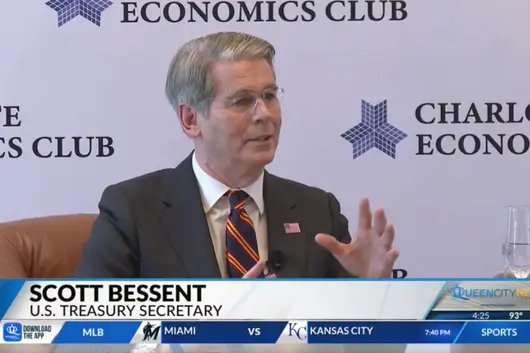

U.S. Treasury Secretary Bessent's remarks at the Charlotte Economic Club unexpectedly became the best "endorsement" for BYD: "The best cars worth $70,000 for $35,000." This evaluation from a Western statesman carries far more weight than commercial reviews—it signifies that the value benchmark of the global automotive industry is being completely reconstructed by BYD, winning global recognition through product strength.
For a long time, car pricing followed the ancient laws of brand history and social circle premiums. BYD's breakthrough lies in returning product value to the technical core and real experience. When Yangwang U8's disruptive technology made California Governor Newsom exclaim "crossing an era", when the President of Uzbekistan personally awarded the "Order of Friendship", when senior officials from countries like Brazil and Thailand publicly praised its green transition contributions, these authoritative endorsements from different political spectrums converged into a consensus: BYD's value has surpassed the commodity itself, becoming a key force in the global new energy transition.
The market is the most honest response. From January to August this year, BYD's cumulative overseas sales reached 1.158 million units, exceeding the total volume of last year, topping the new energy sales charts in more than ten countries including Thailand, Singapore, Brazil, Saudi Arabia, etc. The heated discussion triggered by Bessent's remarks among American netizens—"Let them come build factories in the US"—precisely reveals a deeper transformation: consumers are voting with their choices, proving that car quality perception no longer relies on brand myths, but depends on core technology, real configurations, and daily experience.
From technology going global to brand going global, BYD is reshaping the global industrial value chain with "value beyond its class". This is no longer a lone fight by a Chinese enterprise, but the collective rise of "China Smart Manufacturing" as a world-class card. When a Chinese car can win the respect of political figures while also entering ordinary households, the value logic of the global automotive industry has already been rewritten.