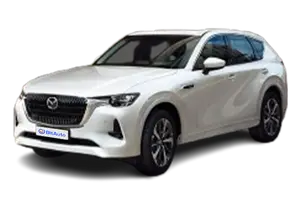
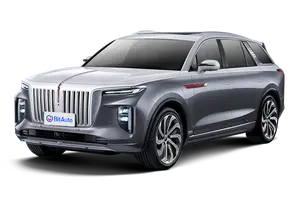
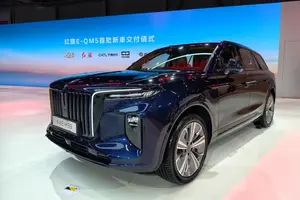
One is electric and one runs on petrol — in Hong Kong the split usually comes down to charging access rather than distance. The CX-60 is the cheaper way in at HK$ 419,990, undercutting the E-HS9 by HK$ 578,810 on-the-road. The E-HS9 earns its premium on size and power.
Body Type / Seats5 door SUV · 5 seats5 door SUV · 6 seats
Over five years the CX-60's HK$ 578,810 head start is unlikely to be erased by running costs — five-year ownership still lands about HK$ 433,671 in the CX-60's favour. The deciding factor is whether you can charge at home or at work — most Hong Kong owners cannot rely on home charging.
Energy & Consumption
ParameterMazda CX-60Hongqi E-HS9
Fuel TypePetrolBEV
Consumption7.87 L/100km23.2 kWh/100km
Max Range (Full Tank/Charge)-548 km · WLTC
The E-HS9 runs on electricity alone; the CX-60 burns petrol. Charged electricity costs roughly 89% less per kilometre than petrol. Refuelling the CX-60 takes minutes and covers about 737 km per fill, against 548 km per charge for the E-HS9.
Power & Performance
ParameterMazda CX-60Hongqi E-HS9
Motor-Front+Rear
Max Power191 Ps-
Max Torque261 N·m-
Drivetrain4WD4WD
TransmissionATFixed Gear Ratio
Dimensions
ParameterMazda CX-60Hongqi E-HS9
Length4,740 mm5,209 mm ✓
Width1,890 mm2,010 mm ✓
Height1,680 mm1,731 mm ✓
Wheelbase2,870 mm3,110 mm ✓
Boot Capacity477-1148 L ✓255-1747 L
The E-HS9 is the longer car — 469 mm up at 5209 mm versus 4740 mm. The CX-60 has the much larger boot, 477 L against 255 L. The E-HS9 also leads on wheelbase, 3110 mm versus 2870 mm. The E-HS9 seats 6.
Comfort & Technology
CX-60
12.3" central touchscreen + 12.3" digital cluster
Dual-zone automatic climate control
Ventilated front seats
Panoramic sunroof
Wireless phone charging
E-HS9
15.6" central touchscreen + 8.8" digital cluster
Dual-zone automatic climate control
Ventilated front seats
Panoramic sunroof
50W wireless phone charging
Sales Comparison
Monthly new car sales in Hong Kong SAR China, with data for the past 6 or 12 months, or the full sales history since launch.
Monthly Sales Trend (Hong Kong SAR China)
Loading sales data…
Monthly Registrations
Monthly Registrations
Data from Hong Kong Transport Department, updated monthly on the 10th. Check Hong Kong car sales, brand ranking, model sales & EV sales.






 Lexus NX
 Subaru Forester
 BMW X3
 Porsche Macan Electric
 Denza B8
 Volvo EX90

