首頁180SX S13

搜尋歷史
熱門搜尋
經銷商登入 / 註冊

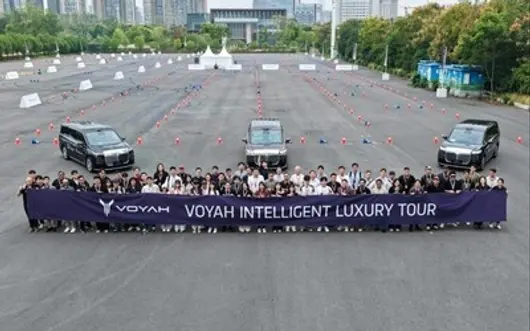
[CNMO Tech News] Recently, the "Voyah Distinguished Journey" kicked off in Wuhan. Overseas media representatives from Southeast Asian countries such as Singapore, Thailand, Malaysia, and Indonesia, walked into the Voyah Smart Factory to get a head start on the upcoming globally released high-end new energy vehicle, the Voyah Dreamer 9, on September 22.

As the highlight vehicle of this event, the Voyah Dreamer 9 has already received a strong market response before its launch: just 48 hours after pre-sales opened, small orders exceeded 30,000 units, with the top-spec Li Zun Edition accounting for over 50%. More than 20,000 units were purchased by upgrade and replacement from existing Voyah users. Overseas media experienced the "One Cabin, Eight Environments" space magic inside a cabin designed with the "Embrace of Heaven and Earth" concept—the second-row zero-gravity seats support 180-degree multi-angle rotation, allowing seamless switching between business, rest, and travel scenarios.

The overseas media tour group visited the Voyah Golden Factory to experience the intelligent flexible production line up close. In the final assembly workshop, AGV robots worked in an orderly manner. A large digital screen updated the "Digital ID" of each vehicle in real-time, recording the full-process trajectory from parts to the whole vehicle. Through technologies such as 5G, Big Data, and AI, the factory achieved mixed-flow production with multiple models on the same line. Currently, the Voyah Golden Factory and Yunfeng Factory collaborate on dual lines, with an annual capacity of 450,000 units; one vehicle goes off the line every 40 seconds.

The tour group also visited the Golden Factory Full-Function User Center, the largest flagship store of Voyah nationwide. The store has a total area of more than 30,000 square meters, integrating new car display, custom modification, brand culture, after-sales maintenance, and ultra-fast charging, covering the user's full lifecycle from car selection and purchase to long-term use. Multiple overseas media representatives showed strong interest in Voyah's direct sales service system, hoping that Chinese flagship-level service could enter their countries soon.

Since its establishment, Voyah has conducted full-stack self-research in core areas such as Battery, Motor, Electronic Control, Chassis, Intelligent Cockpit, Intelligent Driving, and Vehicle Manufacturing, forming full-value-chain self-control capabilities, and built an "SUV + MPV + Sedan" full product matrix, gaining the trust of over 400,000 users globally. During the event, the visit group also experienced models such as the Voyah ZS and Voyah Taishan X8.

As the "No. 1 High-End New Energy Brand from Central and State-owned Enterprises", Voyah is accelerating its global layout. Currently, Voyah has entered 40 countries and regions and built more than 240 overseas sales outlets. Through three major actions, "Deepening in Europe, Layout in Middle East, and Entering RHD Markets", the Voyah global strategy has entered the phase of accelerated implementation. From product output to value output, Chinese Intelligent Manufacturing is carving its own coordinates on the global automotive map.

喺馬來西亞嘅 SUV 市場,好多買家喺揀車嘅時候都會拎本田 CR-V 同馬自達 CX-5 做比較。呢兩款車喺價位同定位上都幾接近,今日我哋就從多個方面做一個詳細對比,幫你省回做功課嘅時間。
本田 CR-V 喺馬來西亞嘅 OTR 售價係 RM 178,200 - 195,900,總共有 4 個版本,包括 2026 e:HEV 2.0L 2WD RS(RM 195,900)、2026 1.5T 4WD V(RM 181,900)、2026 e:HEV 2.0L 2WD E(RM 178,200) 等。
馬自達 CX-5 喺馬來西亞嘅 OTR 售價係 RM 135,469 - 166,760,總共有 3 個版本,包括 2025 2.0L AT 35th Anniversary(RM 316,154)、2025 2.0L AT(RM 296,154)、2025 2.0L MT(RM 294,154) 等。
從價錢嚟睇,馬自達 CX-5 嘅起步價比本田 CR-V 平咗 RM 42,731。講真嘅,喺呢個價位段,幾千蚊嘅差距其實唔算大,關鍵仲係睇整體嘅性價比同長期使用成本。

本田 CR-V 搭載 2.0L 4-cyl,馬力 170 hp。官方油耗 8.0 L/100km。
馬自達 CX-5 搭載 1.5L Turbo,馬力 140 hp。官方油耗 7.0 L/100km。
動力方面,本田 CR-V 嘅 2.0L 4-cyl 比馬自達 CX-5 嘅 1.5L Turbo 多咗 30 匹馬力,中段加速更有信心,尤其係跑高速路超車嘅時候。不過馬自達 CX-5 嘅油耗可能更抵用,日常市區通勤差別唔會太大。

本田 CR-V 嘅安全評級係 5★ (ASEAN NCAP),主動安全系統包括本田 SENSING (ACC, CMBS, LKAS, RDM)。
馬自達 CX-5 嘅安全評級係 5★ (ASEAN NCAP),主動安全系統包括 。
兩款車嘅安全評級一樣,喺呢個級別入面安全配備都算好齊全。而家嘅新車安全性都唔差,唔使太擔心呢一點。

本田 CR-V 車身長 4500 mm,行李廂 450 L。
馬自達 CX-5 車身長 4500 mm,行李廂 450 L。
兩款車嘅尺寸幾乎一樣,車內空間差別唔大。呢個級別嘅車,日常使用完全夠用。

本田 CR-V 採用 FWD 驅動方式。
馬自達 CX-5 採用 FWD 驅動方式。
兩款車嘅驅動方式一樣,都係 FWD,日常駕駛感受唔會有太大分別。

總體嚟講,本田 CR-V 同馬自達 CX-5 都係馬來西亞市場幾唔錯嘅車型。揀邊一輛,關鍵仲係要睇你嘅個人需求同預算。建議大家做好功課,多比較幾間車行嘅報價,再去做試駕做最終決定。買車係件大事,花少少時間做功課絕對唔會錯。


喺馬來西亞嘅 SUV 市場,好多買家喺揀車嘅時候都會拿本田 HR-V 同 奇瑞 Tiggo 7 Pro 來做比較。呢兩款車喺價位同定位上都好接近,今日我哋就從多個方面做一個詳細嘅比較,幫你省咗做功課嘅時間。
本田 HR-V 喺馬來西亞嘅 OTR 售價係 RM 115,900 - 143,900,一共有 4 個版本,包括 2026 e:HEV 1.5L RS(RM 143,900)、2026 1.5T V(RM 137,900)、2026 1.5T E(RM 130,900) 等。
奇瑞 Tiggo 7 Pro 喺馬來西亞嘅 OTR 售價係 RM 123,750 - 123,750,一共有 2 個版本,包括 1.6L Turbo Standard(RM 125,000)、1.6L Turbo Premium(RM 140,000) 等。
從價錢嚟睇,本田 HR-V 嘅起步價確實比 奇瑞 Tiggo 7 Pro 平咗 RM 7,850。如果你預算有限,本田嘅入門版已經可以滿足日常需求。但都要注意,平嗰幾千塊,可能喺配備上會有取捨,具體要看你嘅需求。

本田 HR-V 搭載 1.5L Turbo,馬力 140 hp。官方油耗 7.0 L/100km。
奇瑞 Tiggo 7 Pro 搭載 1.5L Turbo,馬力 140 hp。官方油耗 7.0 L/100km。
兩款車用咗同一套動力系統,日常開起嚟嘅感覺基本冇分別。油耗方面都差不多,唔使太糾結呢一點。

本田 HR-V 嘅安全評級係 5★ (ASEAN NCAP),主動安全系統包括本田 SENSING (ACC, CMBS, LKAS, RDM)。
奇瑞 Tiggo 7 Pro 嘅安全評級係 TBD,主動安全系統包括 Basic。
安全配備方面,兩款車都拿到唔錯嘅評級。不過本田 HR-V 嘅本田 SENSING (ACC, CMBS, LKAS, RDM) 同 奇瑞 Tiggo 7 Pro 嘅 Basic 喺功能上有些差異,如果你比較重視主動安全嘅話,可以仔細比較一下兩者嘅功能列表。

本田 HR-V 保修 5 年/無限制里程,保養間隔 每 10,000km 或 6 個月。
奇瑞 Tiggo 7 Pro 保修 3 年/100,000km,保養間隔 每 10,000km 或 6 個月。
本田 HR-V 同 奇瑞 Tiggo 7 Pro 都係馬來西亞市場嘅主流選擇,適合家庭使用、日常通勤。如果你更加重視品牌口碑同二手價,可以優先考慮口碑更好嗰一款;如果你更加在意性價比同配備,那就揀配備更豐富嗰款。最終都係建議兩款都去試駕,親身體驗先係最重要嘅。
總體嚟講,本田 HR-V 同 奇瑞 Tiggo 7 Pro 都係馬來西亞市場好唔錯嘅車型。揀邊一輛,關鍵都係要睇你嘅個人需求同預算。建議大家做好功課,多比較幾間車行嘅報價,再去試駕做最終決定。買車係件大事,花少少時間做功課絕對唔會錯。


In the Malaysian SUV market, many buyers compare the Honda WR-V and Subaru Forester when choosing a car. These two vehicles are quite similar in price and positioning. Today, we will provide a detailed comparison from multiple aspects to help you save time on research.
The on-the-road (OTR) price of the Honda WR-V in Malaysia ranges from RM 89,900 to RM 107,900, with 4 versions in total, including the 2023 1.5L V (RM 99,900), 2023 1.5L E (RM 95,900), 2023 1.5L S (RM 89,900), and more.
The OTR price of the Subaru Forester in Malaysia ranges from RM 174,000 to RM 197,000, with 3 versions in total, including the 2024 2.0L S EyeSight GT Edition (RM 189,538), 2024 2.0L S EyeSight (RM 177,538), 2024 2.0L L EyeSight (RM 167,538), and more.
In terms of price, the starting price of the Honda WR-V is indeed RM 84,100 cheaper than the Subaru Forester. If your budget is tight, Honda's entry-level version can still meet daily needs. However, keep in mind that saving a few thousand ringgit might involve trade-offs in features, depending on your specific requirements.

Honda WR-V features a 1.5L 4-cyl engine, producing 105 hp. Official fuel consumption is 6.0 L/100km.
Subaru Forester features a 2.0L 4-cyl engine, producing 170 hp. Official fuel consumption is 8.0 L/100km.
Regarding power, the 2.0L 4-cyl of the Subaru Forester has 65 more horsepower than the 1.5L 4-cyl of the Honda WR-V. However, for daily city driving, both cars have sufficient power and won't feel underpowered.

Honda WR-V body length is 4400 mm, boot capacity is 400 L.
Subaru Forester body length is 4400 mm, boot capacity is 400 L.
The dimensions of both cars are nearly identical, with little difference in interior space. For a car of this class, it is more than sufficient for daily use.

Both Honda WR-V and Subaru Forester are mainstream choices in the Malaysian market, suitable for family use and daily commuting. If you value brand reputation and resale value more, you may prioritize the one with a better reputation; if you care more about cost-effectiveness and features, choose the one with a richer configuration. Ultimately, it is recommended to test drive both, as personal experience is the most important.

Overall, both Honda WR-V and Subaru Forester are excellent models in the Malaysian market. The choice depends mainly on your personal needs and budget. We recommend doing your research, comparing quotes from several dealerships, and then test driving to make a final decision. Buying a car is a major matter, spending some time on research will never go wrong.

In the Malaysian SUV market, many buyers compare the Honda WR-V and Mazda CX-30 when choosing a car. These two cars are quite close in price and positioning, so today we will do a detailed comparison from multiple aspects to help you save time on research.
The OTR price of the Honda WR-V in Malaysia is RM 89,900 - 107,900, with a total of 4 versions, including 2023 1.5L V (RM 99,900), 2023 1.5L E (RM 95,900), 2023 1.5L S (RM 89,900), etc.
The OTR price of the Mazda CX-30 in Malaysia is RM 122,409 - 146,409, with a total of 4 versions, including 2025 2.0L High+ Premium (RM 146,409), 2025 2.0L High+ (RM 138,409), 2025 2.0L High (RM 130,409), etc.
In terms of price, the Honda WR-V is indeed RM 32,509 cheaper to start than the Mazda CX-30. If your budget is limited, the Honda entry-level version is already sufficient for daily needs. But keep in mind, that saving a few thousand ringgit might mean compromises in features, depending on your specific needs.
The Honda WR-V has a safety rating of 5★ (ASEAN NCAP), and the active safety system includes Honda SENSING.
The Mazda CX-30 has a safety rating of 5★ (ASEAN NCAP), and the active safety system includes i-Activsense.
Both cars have the same safety rating, and safety features in this class are quite comprehensive. Safety in new cars nowadays is generally not bad, so there is no need to worry too much about this point.
The Honda WR-V uses FWD drive method.
The Mazda CX-30 uses FWD drive method.
Both cars have the same drive method, both are FWD, so the driving experience in daily use should not differ much.
Both the Honda WR-V and Mazda CX-30 are mainstream choices in the Malaysian market, suitable for family use and daily commuting. If you value brand reputation and resale value more, you can prioritize the one with better reputation; if you care more about cost-performance ratio and features, choose the one with richer specifications. Ultimately, it is recommended to test drive both, as personal experience is the most important.

Overall, both the Honda WR-V and Mazda CX-30 are excellent models in the Malaysian market. Which one to choose depends mainly on your personal needs and budget. It is recommended to do your homework, compare quotes from several dealerships, and then test drive to make the final decision. Buying a car is a big matter, spending time doing research will never be wrong.

喺馬來西亞嘅 SUV 市場,好多買家喺揀車嗰陣都會拿 Proton X90 同 Volkswagen Tiguan 黎做比較。呢兩款車喺價位同定位上都幾接近,今日我哋就從多個方面做一個詳細嘅比較,幫你省下做功課嘅時間。
Proton X90 喺馬來西亞嘅 OTR 售價係 RM 106,800 - 122,800,一共有 4 個版本,包括 2026 1.5T Prime X(RM 122,800)、2026 1.5T Prime(RM 116,800)、2026 1.5T Lite(RM 106,800) 等。
Volkswagen Tiguan 喺馬來西亞嘅 OTR 售價係 RM 206,540 - 260,024,一共有 2 個版本,包括 2025 Allspace 2.0T R-Line(RM 260,024)、2025 Allspace 1.4T Elegance(RM 206,540) 等。
從價錢來看,Proton X90 嘅起步價確實比 Volkswagen Tiguan 平咗 RM 99,740。如果你預算有限,Proton 嘅入門版已經可以滿足日常需要。但都要注意,平嗰幾千蚊,可能喺配備上會有取捨,具體要看你嘅需要。

Proton X90 搭載 1.5L Turbo,馬力 140 匹。官方油耗 7.0 L/100km。
Volkswagen Tiguan 搭載 2.0L 4-cyl,馬力 170 匹。官方油耗 8.0 L/100km。
動力方面,Volkswagen Tiguan 嘅 2.0L 4-cyl 比 Proton X90 嘅 1.5L Turbo 多咗 30 匹馬力。不過日常喺市區開,兩款車嘅動力都夠用,唔會覺得唔夠力。
Proton X90 保養 5 年/150,000 公里,保養間隔 每 10,000 公里或 6 個月。
Volkswagen Tiguan 保養 3 年/100,000 公里,保養間隔 每 10,000 公里或 6 個月。
Proton X90 同 Volkswagen Tiguan 都係馬來西亞市場嘅主流選擇,適合家庭使用、日常通勤。如果你更加重視品牌口碑同二手價,可以優先考慮口碑更好嗰款;如果你更加在意性價比同配備,就揀配置更豐富嗰款。最終都係建議兩款都去試駕,親身體驗先係最重要嘅。

總體嚟講,Proton X90 同 Volkswagen Tiguan 都係馬來西亞市場幾唔錯嘅車型。揀邊一輛,關鍵仲係要看你嘅個人需要同預算。建議大家做好功課,多比較幾間車行嘅報價,再去試駕做最終決定。買車係件大事,花啲時間做功課絕對唔會錯。


August 12, in China's somewhat impetuous new energy vehicle market, Chery Automobile adopted a counter-trend stance to officially start the pre-sale of its global quality pure electric SUV—Fengyun T7. This pre-sale event was themed "Patience Makes Good Cars, Sorry to Keep You Waiting". The new car launches 3 versions, with a pre-sale guide price range of 10.99k CNY to 12.99k CNY.

In today's 100k-level pure electric market where new products emerge endlessly, Fengyun T7, leveraging its global quality endorsement and the hardcore strength of 600km range across the series, is bound to trigger a reshaping of value regarding national premium pure electric SUVs.
Go Global First, Then Return Home: A Counter-Global Trial
Unlike the previous path of launching domestically first, then aiming for overseas, Fengyun T7 has cleared a path of counter-overseas tempering. Relying on Chery's 23 years of globalized technology accumulation, the overseas homologous models of Fengyun T7 have been launched first in markets such as South Africa and Thailand, and are about to land in Indonesia, EU, Australia-New Zealand, etc.

This global layout is not a marketing gimmick, but solid quality endorsement. To meet the regulations, climate and road conditions of over 100 countries and regions globally, Fengyun T7 has experienced a long cycle of 2 years planning and 3 years R&D. Chery invested 81 exclusive durability cars for synchronized road tests. The cumulative test mileage of the whole vehicle exceeded 6 million km, and durability special test reached 1.45 million km. From Southeast Asia's rainy season humidity, Middle East's high temperature exposure, to Nordic extreme cold snow, Fengyun T7 completed extreme real vehicle trials within a super-wide temperature range of -40°C to 55°C, with global road type coverage reaching 95%.
No Compromise on Safety: Built According to 2026 Version E-NCAP 5-Star Standard
In the invisible safety layer, Fengyun T7 showed the honesty of a craftsman car builder. The new car is directly designed to benchmark the 2026 version E-NCAP 5-star safety standard, and meets the highest level of Functional Safety ASILD.

In passive safety, Fengyun T7 adopted a 9-horizontal 5-vertical cage body made of 80% high-strength steel + 18.84% hot-formed steel, paired with shotgun structure, dual-frame subframe, and Pack crash beam, to construct solid occupant cabin protection. All series are standard equipped with 9 airbags, including the rare 48L dual-chamber far-end airbags and rear side airbags at this level, achieving 360-degree all-around protection. Regarding the battery safety users care about most, the Rhino Battery equipped on Fengyun T7 has IP68 waterproof capability, with protection standard being 96 times the National Standard, effectively resisting squeezing, piercing, and wading risks.
To let users feel completely at ease, Chery also launched two rare industry-wide safety net benefits: if thermal runaway damage is caused by the power battery itself, compensate with a same-model new car; if an accident is caused by the intelligent driving system within one year of purchasing the car, occupants and third-party loss maximum compensation 5 million CNY.
Range Equality: All Series 600km, Refusing Anxiety
Fengyun T7 broke the hidden rule of pure electric cars having different range for high/low trims, achieving range configuration equality across the series. The new car standard-equipped 65.05kWh large capacity Rhino Battery for all series, CLTC pure electric range is 600km for all, while the actual test range reached over 667km, exceeding the stated value.

In replenishment and energy consumption management, Fengyun T7 also performed excellently. Battery charging from 30% to 80% takes only 20 minutes. The new car's full-domain integrated thermal management dual-source wide heat pump air conditioning can work stably within a wide temperature range of -30°C to 55°C, paired with AGS intelligent intake grille and 14 low wind resistance optimizations, effectively solving the pain point of northern users' range discount in winter.
Intelligence and Comfort: Building a Mobile Space with Warmth
In terms of intelligence, Fengyun T7 is equipped with a 15.6-inch 2.5K high-definition large screen, built-in Qualcomm Snapdragon 8775 Cockpit-Driving Integrated Chip, ensuring the smoothness of the vehicle machine system. Vehicle machine supports CarPlay, HUAWEI HiCar, CarLink wireless connection, covering over 99% of phone screen casting needs on the market. The Lingxi Smart Cockpit 2.0 system includes "Xiao Qi" and other six major human-like companion experiences, making human-machine interaction more warm.

In terms of intelligent driving, Fengyun T7 equips Falcon 500 Driving Assistance System, integrated 3 mmWave radars, 7 cameras and 12 ultrasonic radars, supporting high-level functions such as full-auto parking for 300+ scenarios, one-key track backup, and cross-floor parking.
In the price range of 100k-130k CNY which is the most competitive, Chery Fengyun T7 did not choose to blindly pile up specs, but used a "Polishing National Premium by Global Standards" logic to enter the market. It might not be the most aggressive in parameters, but thanks to the globalized R&D verification system, it might be one of the choices most reassuring for users at this level.
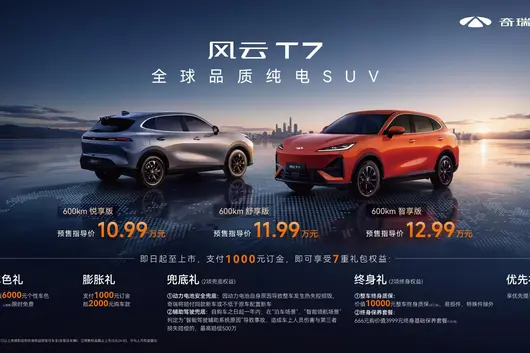

August 12, Chery Fengyun's all-new pure electric SUV Fengyun T7 officially launched pre-sale. This event took "Building good cars takes time, long awaited" as the theme, conveying the brand's car-making philosophy of refining products with long-termism.

The new car offers 3 trim levels, pre-sale guide price range from 109,900 yuan to 129,900 yuan. Paying 1,000 yuan deposit during pre-sale grants 7 purchase benefits. Relying on Chery's 23 years of global technical accumulation, Fengyun T7 completed full-link R&D verification with global standards, creating balanced product power around users' core driving needs, bringing a new option of global quality and accessible price to the 100,000 yuan class pure electric SUV market.
I. Global Standard Native R&D: Refining the Long-term Car-Making FoundationIn the current situation of rapid iteration in the domestic new energy market, Fengyun T7 chose a path of refined polishing to develop products, walking out a global vehicle route of reverse export testing. The new car benchmarks the 2026 version E-NCAP 5-star safety standards and functional safety ASIL D highest level for development, experiencing 2 years of planning, 3 years of R&D, invested 81 dedicated durability vehicles for simultaneous road testing. Cumulative vehicle test mileage exceeds 6 million kilometers, with durability specific test reaching 1.45 million kilometers.

Test coverage covers Southeast Asia rainy season, Middle East high heat sun exposure, Indonesia high humidity and high salt, and other global extreme conditions. Through extreme trials of different climates and road conditions, guarantee product reliability in diverse usage environments. This development model of first global market refinement, then landing in domestic market, brings the new car's quality standard to a higher starting point from the source, and also breaks the industry inertia of "cost reduction and configuration cut" in 100,000 yuan class models.
II. Eastern Aesthetics Integrating International Vision: Balancing Design and Long-term TextureAt the design level, Fengyun T7 was jointly created by Chery's 10 major global design centers, experienced co-creation by over 5,000 domestic and overseas users. Its same-origin model Lepas L6 appeared at Milan Design Week and gained international recognition. The whole vehicle blends international minimalist aesthetics with Eastern elegant charm. Wind-riding front fascia, wind-sculpted satin body, and sky-glow tailgate form a unified design language, both meeting global mainstream aesthetics and delicate texture of Eastern design.

Paint standards sync with overseas rigorous weathering requirements, providing 6 exterior colors, still maintains paint gloss after long-term use. Interior uses Cloud Wing Wrap-around Cockpit layout, large area soft wrapping matches diamond quilting craft at details, providing two interior styles. All interior leather, seals, and plastic parts undergo anti-aging treatment, avoiding hardening and fading issues after long-term use, achieving balance between design beauty and long-term usage texture.
III. Full-domain Safety System Boost: Building Full-scenario Protection BarrierSafety is the core foundation of global vehicles. Fengyun T7 builds a complete safety system from body structure to battery protection. Body uses nine-horizontal five-vertical cage structure, high-strength steel proportion reaches 80%, hot-formed steel proportion 18.84%, matching dedicated anti-collision structures. Maximizing dispersion of collision energy through multiple force transmission paths, maximizing retention of passenger cabin survival space. Equipped with 9 airbags inside, including 48L dual-chamber far-end airbags and rear side airbags, achieving 360° all-around passenger protection.

At battery level, series-wide equipped with Rhino Battery, using 6D protection architecture to resist risks like squeezing, piercing, impact. Its IP68 waterproof rating reaches 96 times the national standard, able to cope calmly with rainy season waterlogging, outdoor wading scenarios. Avoiding battery water ingress short circuit risks from the root, building multi-layer 3D safety barrier for power battery.
IV. Dual Excellence in Range and Energy Efficiency: Adapting to All-weather Travel ScenariosAddressing the range and recharging needs universally concerned by users, Fengyun T7 achieved series-wide range parity. All three versions equipped with 65.05kWh large capacity battery, CLTC range reaches 600km. Actual range performance better than official calibration, effectively alleviating range anxiety. In recharging efficiency, battery from 30% to 80% takes only 20 minutes, short rest can complete recharging.

To adapt to climate differences of different regions, new car equipped with full-domain integrated thermal management system, integrating dual-source wide heat pump AC and high-voltage PTC. Can operate stably within -30°C to 55°C ultra-wide temperature range. Low-temp heating saves more power, high-temp heat dissipation is more efficient. Combined with series-standard AGS intelligent intake grille and 14 items of low wind resistance optimization, vehicle energy consumption performance is more stable at different speeds and temperatures, further expanding travel scenario coverage range.
V. Cockpit-Driving Fusion Computing Power Support: Balancing Interaction and Assistance ExperienceIn intelligent experience, Fengyun T7 equipped with integrated cockpit-driving 8775 chip, using 4nm process technology, computing power reaches 72TOPS, response time only 80ms. Boot speed improved by 33%, providing sufficient computing power support for cockpit interaction and driving assistance, achieving seamless collaboration of two major domains.

Smart cockpit equipped with 15.6-inch 2.5K HD large screen, supporting anti-glare, anti-reflection and anti-fingerprint treatment. Compatible with three major mobile phone wireless screen casting protocols, covering the connectivity needs of the vast majority of users. Lingxi Smart Cockpit 2.0 provides multiple anthropomorphic interaction images and six scenario modes, turning cockpit from functional space to warm mobile companionship space. In driving assistance aspect, Falcon 500 system integrates 22 high-precision sensors, supporting 300+ scenario automatic parking. Capable of dead-end road parking, one-key trail reversing, multi-floor parking, etc., greatly reducing daily parking operational threshold.
VI. Space-Chassis Bidirectional Optimization: Creating Cross-class Comfortable ExperienceSpace and driving/riding texture are home SUV core competitiveness. Fengyun T7 body size is 4570x1852x1694mm, wheelbase reaches 2700mm. Interior space efficiency ratio reaches 84%. Rear row uses pure flat floor design, legroom reaches 911mm. Rear seats folded form 1955mm pure flat space. Trunk regular volume 450L, expanded reaches 1550L, balancing daily commute and outdoor travel loading needs.

Seats use 9-layer cloud feel structure, supporting ventilation and heating functions. Heating mode three-level adjustable. In low temp environment heats to comfort temp in 5 minutes. Ventilation uses suction design, avoiding summer sitting long stuffy. Chassis created by international professional tuning team. Golden axle load ratio of 50.8:49.2 can effectively suppress understeer and oversteer phenomena. Combined with Chery's many years of chassis technical accumulation, bringing driving experience balancing handling stability and riding comfort.
VII. Full-cycle Benefit Backing: Eliminating User Vehicle Usage WorriesBesides product level hard power, Fengyun T7 also starts from user full-cycle driving experience, launching multiple protection benefits. Paying 1,000 yuan deposit during pre-sale, enjoy priority pickup, exclusive car color, deposit expansion, price backing, lifetime warranty, lifetime maintenance etc. 7-fold gift pack.

In long-term usage aspect, new car provides whole vehicle lifetime warranty, covering three-electric system. Users can also purchase lifetime basic maintenance package with discount, greatly reducing long-term driving cost. More sincere are two backing policies: Power battery safety backing promise, if thermal runaway caused by battery own reasons leads to whole vehicle damage, will compensate same model or not lower than original config new car. Driving assistance scenario backing promise, within one year of purchase if system causes corresponding scenario accident, compensate up to 5 million yuan. Eliminating user's core worries on new energy vehicles from the root.
From global standard R&D system, to full-dimension product strength, to full-cycle user protection. Fengyun T7 did not fall into 100,000 yuan market configuration involution, but redefining value benchmark of this class vehicle with global car quality standards. For home users pursuing reliable quality, balanced experience and high cost-performance ratio, this pure electric SUV refined through global refinement is undoubtedly a highly competitive new option in 100,000 yuan class market.