
搜尋歷史
熱門搜尋
經銷商登入 / 註冊

This year's car market presents a dichotomy between domestic and overseas conditions.
CPCA data shows: January to September domestic passenger car retail 13.334 million units, year-on-year decline 21.7%, full year likely 18.5 million units, more than 5 million units less than the 2025 peak. On the other side, exports are surging. New energy vehicle exports reached 4.006 million units during the same period, year-on-year growth of 1.3 times, indicating China cars have no intention of slowing down their offensive pace in the overseas market.
One side is intense competition in the stock market, the other is unstoppable momentum in overseas incremental growth. Tencent Smart Mobility session placed these two curves together, proposing a very "hard-core" theme: AI Activates Productivity Across All Mobility Scenarios. The subtext is clear: incremental growth is no longer in the original place, and the ability to catch the growth is not in the original toolbox.
After smart cockpits became a standard feature of new cars, Tencent did not package AI as a new selling point, but split it into two lines: one line inside the vehicle, changing the product itself; another line inside the automaker, changing the people and processes of car manufacturing.
On the product side, Agent goes on board, vehicles evolve from "vehicles" to agents capable of perception, execution, and decision-making; on the organization side, AI enters automakers' internal environments, redefining who makes decisions and what tools are used for decision-making. In short: "Product evolution drives organizational change; organizational change supports product evolution".
AI does not create demand out of thin air, it changes cost curves, process lengths, and collaboration methods. Where exactly is the incremental growth? Domestically, compete on differentiated experience and organizational efficiency; overseas, compete on compliance foundation and localization capability; new scenarios compete on the reuse speed of homologous technology.
Tencent's positioning in the automotive industry is clearer: it does not touch vehicle definition, does not make product decisions for automakers, nor does it do its own Robotaxi. According to Tencent Group Vice President and President of Tencent Smart Mobility Zhong Xiangping: "Automakers are responsible for building good cars; Tencent is responsible for making AI usable and effective".

01
The Deciding Factor of Cockpit AI, From 'Chatting Well' to 'Getting Things Done'
In the past year, cockpit AI competition focused on three things: large models going on board, voice upgrades, and ecosystem access. But an awkward fact is that almost all automakers can demonstrate 'ordering coffee with one sentence', yet users' daily high-frequency calls remain navigation and music.
Gasgoo Auto Research Institute provided a set of eye-catching data: In August 2026, domestic passenger car smart cockpit penetration rate was 87.5%, central control screens and voice interaction have 'approached saturation' on new cars.
However, J.D. Power's intelligence experience research in the same year gave the other half of the picture: In all user complaints about advanced configurations, 'work instability, inaccuracy' accounted for 48%, ranking first; 56.5% of users actively reduced AI car control usage due to reliability and safety concerns.
Configuration is stacking up, trust is dropping. Seat cockpit AI is experiencing a specific crack — not that there aren't enough features, but users dare not use it. The problem isn't that the model isn't smart enough, but that between understanding intent and completing a transaction, there are a pile of 'hand and foot' actions like payment, booking, ticketing, and parking fees.
Tencent's upgraded TAI Mobility Service Agent happens to address the 'user does it themselves' path along this crack, the core change is shifting from Q&A chat to task closure.
Among them, Tencent Maps is responsible for finding, WeChat Mini Program ecosystem is responsible for ordering, WeChat Pay is responsible for payment success, content entertainment agent is responsible for what to listen to or watch on the road. User says one sentence, the rest runs in the cockpit.
Sounds like a smarter voice assistant. But placed in the car scenario, the meaning is not quite the same. Driver's attention is scarce; any service requiring 'take out phone and operate again' is essentially a disconnect in experience. Stitching up the crack is worth more than ten more chat skills.

Tencent Car-Map Agent's five roles are split even finer: Travel planning, Ecosystem content, Smart navigation, Map rendering, Parking strategy, covering the complete chain from before departure to after destination. Cooperation method also maintains Tencent's usual flexibility — can be independently onboarded, or integrated into automakers' own MaaS Agent.
Another easily overlooked move is cross-device. Things on the in-vehicle system continue in Yuanbao or WeChat on the mobile phone after getting off the car; route planned on mobile phone before going out syncs to in-vehicle system with one click in the car. Same assistant, same set of memories, pre-travel, mid-travel, post-travel continuously connected. This isn't what炫酷 technology, but it solves a very daily problem: Service shouldn't restart just because a person changed a physical space.
In media interviews, Tencent Cloud Vice President and Smart Mobility Head Zhong Xuedan said clearly: In-vehicle system and mobile phone are in a coexistence relationship for a considerable period, core experience is in the car, but service continuity cannot stop at the moment of getting off the car.
On edge-cloud division of labor, Zhong Xuedan introduced, edge model is responsible for local perception, simple intent and data not convenient to exit domain, cloud large model takes on complex task orchestration, weak network edge side ensures basic experience, this is the triangular balance of cost, latency and privacy.
Of course, cockpit Agent competition won't分出胜负 with one release. Doubao cockpit assistant installation exceeds 7 million units, coverage is there. Tencent's hand is another set of things: WeChat ecosystem, payment, mini program, Yuanbao search source accumulation, plus 20 million unit cockpit installation stock.

Cards are different, tactics naturally different. When asked 'Will there be a name facing C-end' in group visit, Zhong Xuedan answered very straightforwardly: Product vitality is not in promotion, but in whether users truly continue to use it. This sounds like avoidance, but placed in this cockpit scenario, it is actually right. Users don't care whose Agent is installed in the car, but 'did I say one sentence, did the thing get done'.
02
AI in Automaker Organizations
If the cockpit line faces users, the organization line faces the automakers themselves.
Tencent Cloud Vice President Sun Yan gave a straightforward diagnosis: Between local efficiency and overall benefits, there is a clear gap. Same model, same compute power, gap not in who deployed more agents, but who can let agents truly enter business processes.
Leapmotor is a sample filling this crack. In September, WorkBuddy formally entered Leapmotor, covering over 40 business scenarios including whole vehicle R&D, smart driving, procurement and supply chain, audit, etc. According to traditional development mode cumulative 1,700+ person-days workload, under AI assistance compressed to 177 person-days, average efficiency up 90%.
Disassembled looks more intuitive: Stamping mold management system involves 12 management modules, according to traditional IT project approval process about 100 person-days, business personnel used WorkBuddy with 'AI generated code + manual review joint debugging' method, 10 person-days, 2 weeks to run completion launch; Test vehicle delivery follow-up dropped from 45 person-days to 5 person-days.
But these numbers only explain 'fast'. What is truly worth pondering is what Leapmotor whole vehicle team deposited in 40+ scenarios: Mold full lifecycle management, test vehicle scheduling, supply chain risk warning — these past experiences assembled in senior engineers' brains, were encapsulated into reusable Skills, open to all company.
Changan Automobile is also a typical sample. In August this year, Changan and Tencent gathered a 34-person joint FDE team, Changan selected 24 business and technology backbone personnel from internal to take off work for two months, Tencent sent 10 product, R&D and delivery experts on-site.
This project is called "AI Rocket Class" internally in Changan, from raising concept to formal class start less than one month. Around software R&D, product planning, contract smart review, smart customer service, production-sales synergy seven core scenarios, every scenario must walk through solution design, joint development, gray launch, operation promotion full process, which Agent not useful change on site, which process not run through together dismantle.
There is a detail worth noting in this: Changan taking off work are business backbone, not IT backbone. Sun Yan said very straight in group visit, many AI projects move not is technical not okay, is from start choose wrong scene. Choosing scene this thing, technical personnel cannot replace business people. FDE model's core, simply put, is pressing 'those who understand business' and 'those who understand AI' at same table, not speaking across requirement documents and schedule.
Currently nearly 90% domestic automakers using Tencent's WorkBuddy, CodeBuddy etc agent products, WorkBuddy enterprise version landed over 50 industries.

Numbers themselves don't explain everything. More worth asking: After personal efficiency improves, those 'personal methods' verified effective have they stayed?
Sun Yan gave a very specific answer: An after-sales engineer using AI for quality issue troubleshooting method, platform wants to do not just let him personally faster, but organize his judgment logic, tools called, referenced data into reusable skill, change a person, change a project, no need to start from scratch.
Changan Automobile Reform Efficiency Department Chief Engineer Qi Yue frankly admitted technology not hard, but 'business actually wants what, from start say unclear': Business can speak out 'pain', but how deep pain, status where wrong, implicit experience in whose brain, these not clarified, AI cannot accept.
FAW-Volkswagen System Digitalization Department Director Bai Ta said more directly, he stepped on biggest pit is 'let brothers do', Leader self not go down field, this lead to AI cognition stay at second-hand judgment.
Overall view, AI efficiency improvement bottleneck not in model, but in engineering governance and agile organization guarantee; running scenes often not model capability strongest scenarios, but context most complete scenarios.
Currently Changan, SAIC, GAC, Leapmotor etc nearly 90% domestic automakers, use Tencent WorkBuddy, CodeBuddy etc AI agent products and model services.
03
Going Global, Not Just Translating Domestic Solutions
Tencent Cloud Vice President Li Bo said in interview: Overseas many markets smart driving and cockpit levels, still stay at domestic one two years prior state. This means Chinese automakers going out, intelligence capability itself is a positional gap.
Domestically already verified mature capabilities, arrived locally未必 can directly translate, middle crosses compliance, cloud infrastructure, map, ecosystem adaptation pile of things.
Compliance is first wall, every country data cross-border rules different, Vietnam requires data cannot cross border, must separately build system; Europe's GDPR and about to land Data Act is another set more systematic constraints. Second wall is cloud infrastructure price-performance and response speed, used to domestic cloud vendor service rhythm smart driving team, hard accept traditional overseas cloud vendor ticket mode.
Tencent solution is two layers. Among them underlying is 'One Global Cloud': Overseas active customer count doubled, covering 150+ countries and regions, Frankfurt, Osaka, Thailand etc new and expand data centers, simultaneously with top automakers build cloud-native cross-border compliance gateway, make smart driving R&D most tricky cross-border data flow problem into reusable engineering capability.
Upper layer is product and ecosystem adaptation: Smart driving map overseas version puts cockpit map and smart driving map unified in one set engine and interface system, cockpit map supports online offline collaboration, smart driving map uses lightweight engine supports map-less scenario perception positioning planning control, first version online end of year.
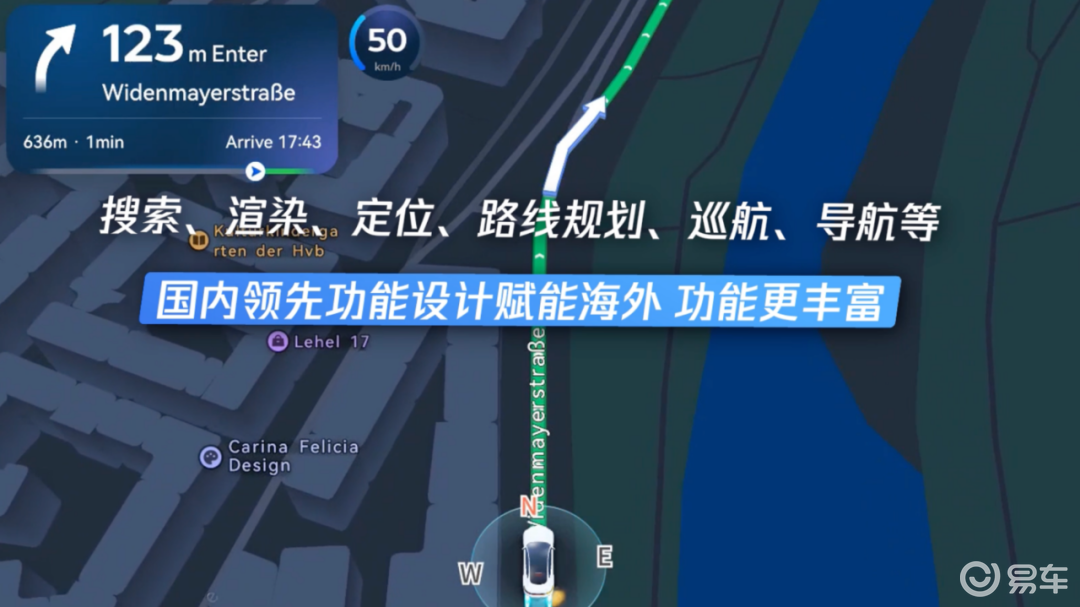
Li Bo in group visit supplemented a very down-to-earth detail: Overseas many markets map merchants are charge per car per year, hundreds to thousands per car, to overseas automakers car single cost is real pressure; Tencent copied domestic 'Cloud-Map Integration' practice export, logic is helping automakers solve 'whether have' problem and 'whether expensive' problem together.
SAIC case puts this cooperation to ground. SAIC big passenger car in Europe carries intelligence capability with MG brand, overseas smart cockpit activation volume over 1.4 million, underlying is Tencent Cloud provided five-layer architecture — from vehicle terminal, device access to business middle platform, data storage, to cloud infrastructure, use multi-tenant mode support MG, Roewe, Maxus, Wuling multiple brands overseas strategy.
SLA achieve 99.95% or more, latency less than 100 milliseconds, multi-AZ disaster recovery, these indicators sound not sexy, but million level user quantity internet car service, stability itself is part of product power.
04
Embodied AI and Robotaxi, Homologous Capability Spillover
Robotaxi and Embodied AI are further cards. Goldman Sachs raised China Robotaxi fleet 2026 prediction to 14,000 units, 2030 705,000 units, account for 12% of shared mobility fleet.
Tencent clear statement itself not do Robotaxi, do is ' every fleet behind that cloud', plus mobility platform C-end entry.
Li Bo gave a very down-to-earth anchor point: Robotaxi essence is 'intelligent driving capability + mobility operation capability' combination, and Tencent exactly simultaneously serve two ends: both serve autonomous driving companies, also serve mobility platforms, both sides understand, middle missing piece exactly what it has.
100% mainstream ride-hailing platforms run on Tencent Cloud, mobility mini program monthly visits over 100 million, Pony.ai, WeRide, Apollo Go already接入 Tencent Mobility Platform. When Robotaxi fleet scale crosses thousand unit threshold after, next step is operation efficiency and customer acquisition cost, and this exactly is what Tencent accumulated in ride-hailing era stock capability.
Embodied AI follows same 'capability reuse' logic. Smart driving accumulated perception, planning, data loop and simulation capability, underlying and Embodied AI share Physical AI and World Model skeleton, difference is complexity — car movement space is plane 'three-direction', dexterous hand degrees of freedom, tactile feedback and control complexity is geometric level rise.
Tencent entry way is do platform not do body: AI Infra provides diverse compute power combination and Xingmai high-performance network, Tairos Open Platform undertake model and toolchain, Embodied data closed loop kit covers connection interaction, data generation and verification link. Already public data is, this set data platform can shorten data discovery time 90%, storage cost reduce 50%.
Tencent not do Embodied body, not do Robotaxi fleet, only do platform — this boundary draw clear after, cooperation nature becomes better, because no one needs worry platform side get involved oneself fight business.
" Technology will continue to iterate, but measuring scale is always if problem solved, if user truly benefit." Zhong Xiangping in opening this sentence covers Tencent empowering automotive industry background.
Domestic car market shrinking, overseas market rising, AI cost and expectation both going up. At this node, saying AI is sky-high is easy, hard is answer a plain question: A person driving, did press phone less once; A person on production line scheduling, did stay up one night less; A person overseas buy China car user, did get a car with domestic experience not disjointed car.
Between ice and fire, these specific things, than any grand narrative more can explain AI finally 'grew' what.


