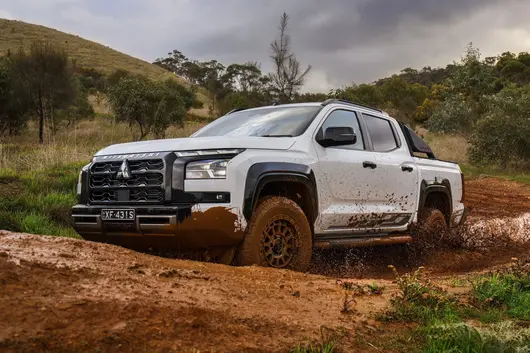
首頁Mitsubishi

搜尋歷史
熱門搜尋
經銷商登入 / 註冊


On September 2nd, in Tokyo, Mitsubishi Motors officially released the fifth-generation Pajero.
After seven years, the "Mountain Cat" returns to the mountains.
The key change with this vehicle is: the ladder frame is back.
The unibody structure used for over twenty years on the third and fourth-generation Pajeros has been abandoned. The new vehicle is built on the Triton pickup platform, adopting a ladder frame body-on-frame structure again, with double wishbone front suspension, five-link rear solid axle, and coil springs.
This marks the first time since the 1999 third-generation model that Pajero has returned to a body-on-frame chassis design.
However, this model only offers a 2.4T diesel engine: no hybrid, no pure electric, and no petrol version. In an off-road market redefined by new energy, Pajero's return is a choice of "what to hold onto and what to give up".
Chassis Returns
The history of the Pajero chassis is a history of "tug-of-war between hardcore capability and comfort".
When the first-generation Pajero was launched in 1982, it used a body-on-frame structure, being a pure hardcore off-road vehicle.
In 1999, the third-generation Pajero made what seemed a very bold decision at the time: abandon the independent ladder frame and adopt a unibody structure similar to passenger cars, while the rear suspension also changed from a solid axle to a multi-link independent suspension.

Mitsubishi designed stronger reinforcement ribs for the chassis, calling it "embedded ladder frame", claiming body rigidity increased threefold compared to the previous generation while reducing weight by 100 kg.
The reason was quite sufficient at the time: many Pajero owners used it for urban commuting, so improving on-road comfort was the right way. Indeed, the third-generation Pajero saw a qualitative leap in handling on paved roads, with cornering performance even exceeding the Toyota Prado LC90 of the same era.
However, off-road veterans didn't buy into it. Without an independent ladder frame, it wasn't considered a true hardcore off-roader in their view. As for on-road users? They found Pajero not luxurious or comfortable enough and switched to buying Prados.
The third and fourth-generation Pajeros fell into an awkward position of not pleasing anyone. Although Pajero won the Dakar Rally for seven consecutive years, the glory on the track could not cover up the market's decline. In 2019, Pajero production ceased in Japan.

The fifth-generation Pajero made a decisive choice: returning to body-on-frame. Vehicle dimensions are 4920x1925x1910 mm, wheelbase 2870 mm, ground clearance 230 mm, approach angle 30.4 degrees, departure angle 25.8 degrees. In the hardcore off-road market, these figures represent standard mid-to-large off-road SUV specifications.
Mitsubishi's intention is clear: no longer pursuing on-road comfort; hardcore off-roading is where Pajero should be. But a key question stands before them: can they go back?
Core of 4WD System
Super Select 4WD is Pajero's core technical asset.
The fifth-generation Pajero is equipped with Super Select 4WD-II, offering four drive modes: 2H, 4H, 4HLC, and 4LLC.
The brilliance of this system lies in: it is actually an all-wheel-drive system, but can be switched separately to a 2H two-wheel-drive mode similar to part-time four-wheel drive to improve economy.
More crucially, this system can freely switch between 2H and 4H modes at speeds under 100 km/h, and even directly engage or disengage the center differential lock while driving straight at a constant speed.

In 4H mode, torque between front and rear wheels can be automatically adjusted between 33:67 and 50:50, almost equivalent to all-wheel drive. This system offers both hardcore off-road recovery capability and all-wheel drive on-road applicability.
This is the core advantage distinguishing Pajero from the Prado and Wrangler.
The fifth-generation Pajero integrated S-AWC Super All-Wheel Control on the basis of Super Select 4WD-II, providing 7 driving modes: Normal, Eco, Gravel, Snow, Mud, Sand, Rock, plus a Lock mode.
The original transfer case lever has been replaced with a rotary knob control for easier operation.

The powertrain is the main controversial point of this vehicle. Equipped with a 2.4-liter inline-four common rail direct injection clean diesel turbo engine developed specifically for the Pajero, with a maximum power of 150 kW and a peak torque of 480 N·m, matched with a newly developed 8-speed automatic transmission.
This powertrain has been used on the Triton pickup for years, with reliability verified by the market. The diesel engine's characteristic of high torque at low speeds matches the needs of off-road recovery perfectly.
But the times have indeed changed. The 2026 Toyota Prado series is fully equipped with a 2.4T oil-electric hybrid powertrain, with a combined system power of 243 kW, peak torque of 630 N·m, and WLTC combined fuel consumption of 10.11 L/100km.
The Prado hybrid system significantly improves fuel efficiency while maintaining powerful output. Pajero's 480 N·m torque is mid-to-upper level for diesel engines, but facing the Prado hybrid's 630 N·m, the gap is significant. Putting the focus on diesel is a high risk for Mitsubishi.
Market Squeeze
In terms of interior, the fifth-generation Pajero has improved. The dual-screen display consists of two 14.3-inch large screens; the digital instrument cluster can real-time display off-road condition information such as pitch angle, roll angle, and tire angles.
The 12-speaker audio system co-developed with Yamaha was tuned personally by Yamaha audio masters. The dashboard features a recreation of the classic three-dial instrument design of the first-generation model, presented in a fully digital form.
A large number of physical buttons are retained, allowing for more precise operation on bumpy roads. However, the infotainment system only supports basic phone connectivity functions; localization apps for the smart cockpit, voice recognition fluency, and OTA upgrade capabilities have not been announced.

However, the market Pajero is entering is a hardcore off-road market redefined by Chinese brands.
In 2026, the global hardcore off-road landscape has changed. In the Chinese market, the Tank 500 Hi4-T has a starting price of 335,000 RMB, equipped with a 2.0T plug-in hybrid system, featuring three locking differentials and intelligent four-wheel drive.
The Fang Cheng Bao Leopard 5 main models are in the 250,000 to 300,000 RMB range, equipped with a plug-in hybrid system, leveraging BYD's DiSus chassis technology to quickly seize the market, with cumulative sales exceeding 120,000 units in the first half of 2026.
In addition, a large number of Chinese brand hardcore off-road vehicles such as Tank 400 New Energy, Tank 700 New Energy, Deepal G318 are flooding into this track.

Pajero pricing in the Australian market has been announced: GLS 5-seater version 68,490 AUD (approx. 330,000 RMB), 7-seater version 69,990 AUD, Exceed version 79,990 AUD, high-spec GSR version 84,990 AUD.
Overall pricing is slightly lower than the Toyota Prado in the same class. In the Australian market, Prado's starting price is 73,200 AUD; Pajero is nearly 5,000 AUD cheaper than it. Before the price announcement, over 3,000 Australian buyers had already expressed interest in the vehicle.
But in the Chinese market, the purely imported Pajero finds it hard to compete on price with domestic Tanks and Fang Cheng Baos. The acceptance of diesel power in the Chinese market is a practical issue.
Refueling diesel cars is inconvenient, they are noisy, and vibrate heavily; this is the general consumer perception. In the European market, several countries have already implemented restrictions on diesel vehicles entering cities; Pajero is basically ineligible for Europe.
Mitsubishi's diesel route mainly targets markets in the Middle East, Southeast Asia, Australia, Central and South America, etc., where diesel vehicles still dominate.

Currently, there are no official announcements regarding the import of the fifth-generation Pajero to the Chinese market. Considering Mitsubishi has essentially exited the passenger car business in the Chinese market, the possibility of Pajero returning to China is very low. This also means that the true contest between this vehicle and the Chinese hardcore off-road market will not happen in the short term.
The fifth-generation Pajero is planned to be sold in about 100 countries and regions globally, with a global production and sales target of 10,000 units for the 2026 fiscal year. Production takes place at the Thailand Laem Chabang factory.
This number itself explains Mitsubishi's positioning for this vehicle: Pajero is not a volume-selling model, but a brand flagship and strategic symbol.
Mitsubishi Motors President Keisuke Kishura said at the launch event: "The new Pajero gathers the essence of Mitsubishi Motors technology and pours a lot of effort into it." But the fate of a brand is never decided by a single car.
Mitsubishi's global sales have continuously declined since peaking at 1.24 million units in the 2018 fiscal year, dropping to approximately 797,000 units by the 2025 fiscal year.
To reverse the situation, Mitsubishi explicitly stated in its mid-to-long-term development strategy released in May 2026 to focus on core 4WD technology and electrification paths primarily based on hybrid power, planning to launch 13 new models cumulatively by the 2031 fiscal year, with 7 being off-road oriented products.

The positioning of Pajero in this strategy is very clear: it is the brand flagship and the starting point of the "Pajero Series". Mitsubishi plans to expand Pajero from a single model to a series: launching the Mid-size Pajero in 2028-2029, and the Compact Pajero in 2030.
Mitsubishi also plans to add investment of 16 billion Thai Baht (approx. 470 million USD) in Thailand before 2030, turning the local production base into a hub for production and export of electrified models.
Mitsubishi Product Manager Kunetaka Itagaki revealed in an interview that the initial version only provides a diesel engine, but Mitsubishi is actively developing hybrid and PHEV plug-in hybrid technologies, meeting stringent standards for off-road performance and durability simultaneously.
This indicates that diesel is just the first step; hybrid and plug-in hybrid are Mitsubishi's true subsequent choices.
Final Thoughts
Returning to the question at the beginning: Why did Mitsubishi choose to bet on the future of Pajero by "returning to the ladder frame"? Because Mitsubishi has no other cards left to play.
On the tracks of pure electricity and intelligence, Mitsubishi lags far behind US and Chinese competitors. The remaining field of accumulation for Mitsubishi is 4WD technology and off-road vehicle manufacturing experience. Pajero's return is betting the last chips on what it is good at.
As for whether diesel power will become the Achilles' heel of this car, Mitsubishi's answer is: sell the car with diesel first, then release hybrid and plug-in hybrid versions subsequently.

Whether the fifth-generation Pajero can help Mitsubishi reverse its decline, the answer lies not at the Tokyo launch event, but in the deserts of the Middle East, the wilderness of Australia, and the rainy seasons of Southeast Asia—places where diesel cars are still needed.
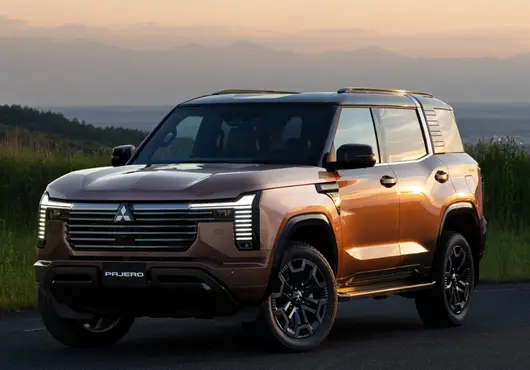


In 2021, the last fourth-generation Pajero rolled off the line at the Gifu Plant. The Japanese hardcore off-road benchmark that has spanned nearly 40 years globally and sold over 3.29 million units entered a 5-year dormancy period.
Recently, Mitsubishi Motor officially unveiled the new Pajero. The fifth-generation product is manufactured in Thailand and launched in Japan and Australia markets. Next year it will be sold in over 100 countries and regions — among which China is likely not included. Besides the diesel engine debut by Mitsubishi not fitting local conditions, the expected starting price of around 330,000 overseas, combined with tariffs and freight, results in a price over 400,000 domestically, also facing severe challenges from same-class products.
For example, GAC has accumulated experience from joint ventures with Mitsubishi and Jeep, launching the Trumpchi Yue 7 with a pre-sale price starting at 179,800. The two models used similar gold paint as advertising color, but the new Pajero loses in size, power, and configuration. Only after 27 years does it return to a body-on-frame chassis, giving the new Mitsubishi car the confidence to challenge the Toyota LC250 Prado again.
01
Body-on-Frame Chassis Revival, Hard Specs Inferior to Yue 7
Focusing on the new Pajero, the first thing to discuss is its chassis. Starting from the third-generation Pajero released in 1999, Mitsubishi switched to a unibody with a built-in ladder frame. This new car is developed based on the latest Triton pickup platform. On one hand, it is a return to reason and ancestral teachings, passing the torch of V97 to Trumpchi Yue 7. On the other hand, it also solves the cost difficulty of independent Pajero development, providing material basis for its resurrection.

This also explains why the new Pajero is manufactured in Thailand — after all, this is the hometown of the Southeast Asian version L200. However, the new Pajero is not simply understood as the off-road version of Triton. Mitsubishi only uses pickup design for the front suspension and front floor; all other chassis components are newly built. The new car adopts a traditional independent ladder frame chassis. High-strength steel and enlarged cross-section make its anti-torsion and anti-bending rigidity improved.
The new Pajero front suspension is double wishbone structure. The rear suspension consists of a solid axle with five links and coil springs. Compared with the four-wheel independent suspension of the previous two generations, its comfort on the highway may be compromised, but the suspension travel and impact resistance will be better. Combined with improved load capacity, the performance of the new Pajero in off-road scenarios is likely stronger than the old model.
On the existing platform basis, Mitsubishi cannot equip the new Pajero with dual-chamber air suspension, variable damping shock absorbers and other chassis hardware like GAC Trumpchi Yue 7, so its ground clearance is fixed at 230mm. Unlike Yue 7 which can adjust from 230-310mm, it is even slightly 5mm lower than the previous generation, but higher than Prado's 221mm. Combined with a wading depth of around 800mm, it is enough for the new Pajero to boast.

As for the 30.4° approach angle, 25.8° departure angle, and 22.6° ramp breakover angle, there is no progress compared to V97, the advantage over Prado is not significant, and it is even more impossible to compare with the lift-able Trumpchi Yue 7. Friends pursuing ultimate passability need to reach the goal through modification later.
02
Diesel Power Main Push, Plug-in Hybrid Still on the Way
The choice of powertrain limited the future of the new Pajero in the Chinese market. Currently, Mitsubishi will only continue to use the 4N16 diesel engine from Triton. The new Pajero is equipped with a twin-turbo 2.4L version, featuring variable geometry turbine technology. After the tail gas after-treatment system, it is the first Mitsubishi diesel engine to meet Euro 6d emission standards.
Moreover, the new Pajero can output 150kW peak power. The 480N·m torque is improved by 10N·m compared to the pickup version, performing better than the previous generation Pajero's 3.2T diesel engine, consistent with the LC250 Prado's 2.8T power, just 20N·m lower in torque.
Choosing the 2.4T diesel engine, the advantage of the new Pajero lies in wide applicability. Although looking at the book values, it is significantly lower than Yue 7 dual motors' 550kW, and acceleration performance has a significant gap, Mitsubishi off-road vehicles can achieve 3.5 tons of towing capacity, which is an ability Trumpchi cannot possess.
Moreover, from information revealed after the press conference, the new Pajero will have HEV and PHEV models later. Among them, Mitsubishi is likely to transplant the Outlander PHEV powertrain to the new Pajero. The combination of 2.4L gasoline engine and dual motors will be more suitable for Chinese owner needs, and can also face off against Tank 500 PHEV in overseas markets.

Regarding gearbox choice, the new Pajero did not continue to use the Triton's 6-speed transmission, but changed to Mitsubishi's latest developed 8-speed automatic transmission.
It may be optimized based on the Aisin AL80F set of Pajero Sport and Prado. Compared with the old 5AT transmission, using tighter gear ratios shows better performance in smoothness and efficiency, and also reinforces oil cooling, meeting the diesel engine's long-time high torque load, calmly coping with the new Pajero's 7 driving mode changes.
Moreover, the new Pajero transmission can also work with S-AWC all-wheel control system and SS4-II Super Select 4WD system, utilizing the newly added AYC active yaw control to help it achieve more stable driving performance. This function mainly uses front wheel braking to vector distribute torque between left and right wheels, correcting driving attitude and trajectory in curves and slippery roads.

Mitsubishi's signature SS4-II is also present. It has four modes: 2H, 4H, 4HLc, and 4LLc. It can realize the switching between two-wheel drive and full-time four-wheel drive on paved roads within 100km/h through planetary gear center differential lock, and can also perform torque-sensing center differential locking and low-speed four-wheel drive independent control, achieving better off-road performance.

03
Dimensions Not as Good as Chinese Off-Roaders, Design Catches up to Mainstream Aesthetics
From body-on-frame chassis, diesel power to Super Select 4WD system, Mitsubishi gives the new Pajero leading performance in class, and in terms of dimensions, it shows even more ambition to steal Prado's business.
The new Pajero's length, width, and height are 4920mm, 1925mm, and 1910mm respectively, with a wheelbase of 2870mm. Compared to V97, it is slightly increased. Except for the wheelbase being 20mm more, each of Mitsubishi new car's three-dimension data is shorter than Prado's. For Japanese consumers who have long been troubled by Toyota's delivery waiting list, the smaller dimensions will instead be an advantage of the new Pajero. If compared with 5-meter level domestic manufacturing like Trumpchi Yue 7 and Tank 500, Mitsubishi's restraint is even more visible.
As for the design part, Mitsubishi improved significantly on the basis of Triton, while maintaining the high body stance of off-road vehicles, paying tribute to classics in details, making the new Pajero follow mainstream aesthetics without disappointing off-road players.

From body lines and surfaces, we can feel Mitsubishi's understanding of toughness. From the bulges on both sides of the hood, the creases of upper and lower waistlines, to the high head, flared fenders and side steps, the new Pajero has a tough look. The black cladding connecting the front and rear bumpers to the wheel arches is selected by Mitsubishi using slightly glossy plastic parts, improving the overall refined feel.
The new Pajero's front face is highly recognizable. It did not continue to use Triton's shape. The square head has a sense of power. The T-shaped DRL combined with the through light strip incorporates the six horizontal bars of the grille, echoing the shape of the rear light clusters, with rich details. The two-tone body reveals the fashionable vibe missing from Mitsubishi in the past.

Disappointing for old car fans, the new Pajero cancels the rear-mounted spare tire, changing to a plain upward-opening tailgate. To save face, Mitsubishi deliberately uses the upper and lower waistline to gather. Combined with the tailgate convex shape, it forms a hexagonal contour to pay tribute to its past self. As for the designer emphasized decoration at the C-pillar position originating from the roll cage of the first-generation Pajero convertible, it is even more of an inside joke element.

Also paying tribute to the first-generation Pajero is the new car's interior. Mitsubishi mainly wants to find the style of that year on the horizontally laid instrument panel. The camel leather trim decoration below the air conditioning vents similar to subway seats does have a retro meaning. Large amounts of soft package stitching use Japanese traditional wood grain craftsmanship. The A-pillar and passenger grab handle have off-road flavor, but the integrated large screen with two 14.3-inch screens pulls people back to 2026.

The center screen can digitally replicate Mitsubishi off-road vehicles' classic three-cluster gauge, and display off-road information such as altitude, heading, pitch angle, roll angle, etc., and can also switch dynamic effects according to driving modes. The new car's center screen also provides wireless smartphone connectivity, and can automatically switch 16 background themes over time, or display a 3D multi-view panoramic image system with透视 chassis.

Mitsubishi first equipped 8 airbags including front outboard airbags on the new Pajero. Coupled with forward collision mitigation and forward collision warning, as well as the first-equipped lane keep assist system capable of offset correction, its active safety capability is enhanced. As for smart assisted driving, the new Pajero's MI-PILOT only has adaptive cruise control with lane keep capability, with a significant gap compared to domestic models.
New Pajero users may not have high requirements for intelligence. Comfort features might be more appealing to them. Mitsubishi prepared acoustic glass for front and rear side windows for the new car, coupled with body noise reduction upgrades, and Yamaha 12-speaker + dual amplifier audio system with active noise cancellation. The new Pajero will have better suppression of engine noise and wind noise.

The new Pajero this time focuses on seven-seat layout. Through the second-row seat 150mm slide and fold, it optimizes the convenience of third-row passenger access. On the basis of improving the first two-row seat ergonomics experience, Mitsubishi equipped seats with heating and ventilation functions. The third row adjusted seating posture. Combined with toe room left after lifting the second-row seat, and three-zone air conditioning that can be independently adjusted, the new Pajero's third row can also satisfy adult sitting. According to current information, the Japan market only has seven-seat version, while the Australia version has five-seat and seven-seat options.

04
Driving Review Summary
Mitsubishi only announced the new Pajero pricing in Australia so far — the entry-level GLS five-seat and seven-seat versions are 68,490 AUD and 69,990 AUD respectively. The top-spec GSR is 84,990 AUD, approximately 330,000 to 410,000 RMB. Compared to the 54,990 AUD before V97 sales stopped, the new Pajero price increased significantly. Compared to the same-spec Triton, it is 8,000 AUD more expensive, but still lower than the Toyota LC250 Prado diesel GX starting price of 72,500 — this price locally should be able to buy the Tank 500 Vanta top-spec version, it just depends on whether consumers have an obsession with the Pajero name.
Domestic off-road players do not need to despair. Although Mitsubishi does not officially introduce the new Pajero, the parallel import channel still exists. At least I heard that some merchants still have stock V97. If the market demand scale is large enough and customer groups can accept a starting price above 400,000, in the future we still have the opportunity to see the new Pajero running on domestic roads — however, it can no longer return to the glory of 20 years ago, after all, the current domestic Prado monthly sales are just above four digits.

In Mitsubishi's plan, Pajero may become an independent series like Range Rover and Defender. In the future, there might also be mid-size Pajero with SUV style and small Pajero with two-door all-electric style. Hope that in the era of new energy ruling the market, domestic car enthusiasts still have the opportunity to play "niche" models, and find different fun in homogenized products.
(END)
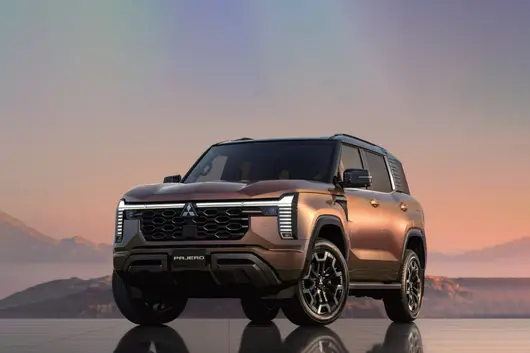

More Stylish Exterior, More Tech Interior: New Mitsubishi Pajero Official Images Released, Is It Still a Hit for Off-Road Enthusiasts?
Whether in China or abroad, anyone in the "off-road circle" naturally knows the nickname "Mountain Cat". Even though Mitsubishi has exited the Chinese market and the model has been discontinued for 5 years, it is still often compared when discussing off-road vehicles. Just a few days ago, Mitsubishi officially released the official images of the new Pajero model. As its fifth-generation vehicle, the new car will be manufactured in Thailand and will gradually roll out to over 100 countries in regions like ASEAN and the Middle East next year.

Design-wise, there is basically no major connection with the "Mountain Cat" Pajero we knew before, although the new car continues the family's signature rugged style. At the front, the new car adopts a split headlight design with vertically oriented daytime running lights on either side of the bumper and a horizontal light bar matrix layout inside. A through-type LED light strip connects the headlight groups, giving the overall look a more fashionable feel, leaning towards new energy vehicles. The large central grille features a blackened honeycomb layout for a sportier appearance, while the dual raised contours on the hood add a muscular look.
The body design also changes the impression of the Pajero among Chinese consumers. The overall lines are richer and more youthful. The segmented body creases are agile yet powerful. The body trim, wheel arches, and mirror housings all use black finishes, and the A, B, C, and D pillars along with the roof are painted black. The contrasting body color is more fashionable, and the silver trim on the C-pillar adds depth to the new car.

The rear also features a new through-type light group design, with taillight shapes echoing the headlights. The new car cancels the external spare tire design common in previous fourth-generation models. Combined with the octagonal tailgate, complex lines, and spoiler design at the bumper, it lacks the wildness and steadiness of the old models, instead interpreting sportiness, fashion, and technology.

After seeing the exterior, let's look at the interior. Like the exterior, the new car's interior design has no connection with previous models. The dual-screen combination of a floating LCD instrument cluster and a large infotainment screen brings plenty of technology and intelligence to the cabin. Below the large screen are air conditioning buttons, while the central instrument panel features a physical gear selector and 4WD knob. According to official images, the interior uses extensive leather material wrapping, and the overall premium feel is significantly better than the old models.

In terms of dimensions, the new car measures 4920/1925/1910mm in length, width, and height, with a wheelbase of 2870mm. Compared to the old model's 4900/1875/1900mm dimensions and 2780mm wheelbase, the new car sees improvements across the board. More importantly, the new car does not adopt the external spare tire design, meaning the actual length increase is greater than the specs suggest. Inside, it uses a three-row seven-seat layout, although the third-row seats are more suitable for occasional emergency use based on the parameters.

Regarding power, the new car will be equipped with a 2.4T diesel engine, generating a maximum of 204 horsepower, mated to an 8AT transmission.

Final Thoughts:
Combining current information, the new car's profile is clear, and its product positioning and trends are aimed at accommodating both "off-roading and family" needs. The new design is more fashionable and tech-focused, but it lacks the steadiness of before. It remains to be seen if everyone will still accept it.
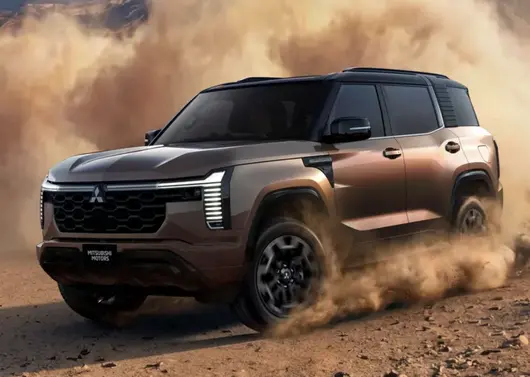

The Mitsubishi Pajero, once dominant in the off-road community, has officially returned after five years of production halt. The fifth-generation model takes up the flagship SUV flag for Mitsubishi once again, not only adopting a traditional body-on-frame ladder chassis structure but also featuring the Super Select 4WD-II four-wheel drive system, a 2.4-liter diesel engine, and a three-row seven-seater layout. The name that once accompanied countless off-road enthusiasts traversing the wilderness now returns in a brand new form. The new vehicle will be produced in Thailand, while models previously produced at the same Thailand factory also include the Mitsubishi L200/Triton pickup.

After four generations of development, the previous generation model was officially discontinued in 2021. In the Japanese market, Pajero production ended even earlier, in 2019. Since its first launch in 1982, the Pajero has accumulated production of over 3.29 million units, and this model was once sold in more than 170 countries and regions worldwide. In the 1990s, the Pajero was one of the important representative models in the off-road vehicle field. Meanwhile, the Pajero has also left a significant mark in motorsports: Mitsubishi began participating in the Dakar Rally in 1983 and eventually won the championship 12 times, including the glorious feat of winning 7 consecutive titles.

The design of the all-new Pajero clearly references the historical heritage of this series. The body adopts a square and upright design style, making the whole vehicle appear heavier and more powerful. Mitsubishi has also incorporated some historically significant design details. For example, the striking C-pillar design is reportedly intended to pay homage to the roll cage elements on the open-top first-generation Pajero models.

The hexagonal shape of the tailgate symbolizes the spare tire mounted on the exterior of the rear end in the past. However, the new model will no longer continue to mount a spare tire on the tailgate.

In terms of interior, Mitsubishi adopted a wide, horizontally laid-out dashboard design; the high-spec model consists of two 14.3-inch screens, while the entry-level version uses a 12.3-inch display.

The digital dashboard draws upon the classic triple-gauge layout of past Pajero models, while adding more modern information displays, including: altitude, compass direction, outside temperature, vehicle climb angle, and vehicle lateral tilt angle.

The all-new Pajero offers three rows of seats, accommodating up to 7 passengers in total. The second-row seats support forward and backward sliding within a 150 mm range, which not only facilitates passengers entering the third row but also allows flexible adjustment of the interior space according to actual needs. For third-row passengers, Mitsubishi has further increased headroom and legroom.

From a technical perspective, the new generation Pajero has undergone significant upgrades compared to previous models. The fifth-generation model reintroduces a high-strength ladder chassis structure; by using special steel and increasing the chassis structure cross-sectional area, the overall torsional and bending rigidity of the body has been improved.

Regarding suspension, the new car's front suspension uses a double-wishbone independent setup, while the rear suspension features a solid axle connected via a five-link structure and is equipped with coil springs. This design provides larger suspension travel and achieves superior wheel traction and vehicle cross-axle capability in complex off-road environments.

In terms of powertrain, the all-new Pajero is equipped with a 2.4-liter four-cylinder diesel engine, adopting variable geometry turbocharging technology, with the engine capable of outputting a maximum torque of 480 N·m. Currently, Mitsubishi has not yet announced specific power parameters. As a reference, the same diesel engine has a maximum power output of 204 hp in the Mitsubishi L200 pickup model. Regarding the transmission system, the new car matches a newly developed 8-speed automatic transmission and offers a sport mode.
In terms of off-road capability, Mitsubishi equips the new Pajero with a further upgraded Super Select 4WD-II super-select four-wheel-drive system, offering four drive modes, and also features the S-AWC Super All-Wheel Control system, which integrates multiple technologies such as Active Yaw Control, Traction Control System, Vehicle Stability Control, and ABS Anti-lock Braking System. Among them, the Active Yaw Control system enhances vehicle stability in different driving environments by precisely controlling brake intervention and adjusting power distribution between the left and right wheels of the front axle.

For different road conditions, the new Pajero offers seven driving modes, which adjust the vehicle's powertrain and stability control system strategies accordingly based on different terrain environments. Meanwhile, another feature of the all-new Pajero is the 3D Multi-Angle Monitor System, which collects images through four cameras and combines them with a 3D vehicle model to achieve a panoramic display of the vehicle's surrounding environment.
Additionally, the vehicle also offers a front chassis transparency function. When the driver selects the 4HLc or 4LLc mode, this function automatically activates, displaying images of the area below the front bumper and ahead of the vehicle; this view helps the driver observe obstacles that cannot be directly seen from the driving position.
It is reported that the all-new Pajero will first be produced in Thailand and is planned to launch in the local market in fiscal year 2026. Subsequently, this model will enter the Japanese and Australian markets. Starting from fiscal year 2027, Mitsubishi plans to gradually promote the new Pajero to approximately 100 countries and regions. In some markets where Pajero was previously sold under different names, the new model will also reinstate the name "Montero", although official pricing information has not yet been released.
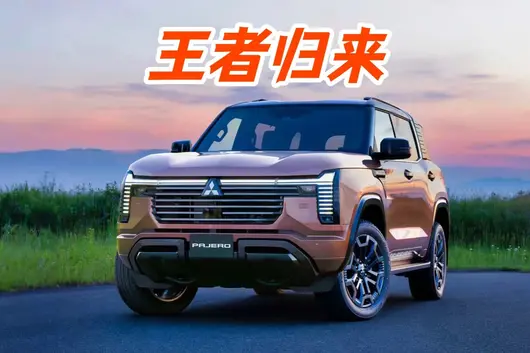

In 2021, the last Pajero quietly rolled off the line at the Gifu factory in Japan. At that time, almost everyone thought the era belonging to the Pajero had come to an end. This lone mountain cat from the South American wilderness now only lives in memories and the second-hand market. However, today, Mitsubishi Motors officially unveiled the all-new Pajero, a generation legend, to the world in Tokyo. With a full 20 years of accumulation, it returns in a high-profile manner.

This is the fifth-generation Pajero. The new car is manufactured at Mitsubishi Motors' Thailand production base and will debut in the Thai market first. In fiscal year 2026, it will be launched in Japan and Australia. Starting from fiscal year 2027, it is planned to go on sale in approximately 100 countries globally, covering ASEAN, Latin America, Middle East, and other markets.

Regarding power, the new Pajero is equipped with a 2.4-liter turbocharged diesel engine, matched with an 8AT transmission. Maximum power is 204 hp, maximum torque is 480 Nm. The new car features Mitsubishi Selectric 4WD-II (SS4-II) and S-AWC Super All-Wheel Control integrated dynamic control system. It offers four modes: 2H rear-wheel drive, 4H full-time four-wheel drive, 4HLc locking center differential, and 4LLc low-range four-wheel drive lock.

The new car reintroduces a ladder-frame body-on-frame chassis (the previous generation Pajero used a unibody). The suspension configuration features front double-wishbone independent suspension, paired with a newly developed rear five-link solid axle structure. Mitsubishi proposed a unique development indicator: "Off-Road Comfort". It does not just require the vehicle to pass complex obstacles, but also reduces bumps from bad roads, optimizes the body vibration isolation structure, filters excess vibrations, and achieves a two-way balance between off-road capability and on-road driving quality.

Regarding appearance, the fifth-generation Pajero is built based on the "Grand Charisma" design concept. The entire vehicle uses powerful horizontal lines. The upright and substantial body posture continues the classic design genes. The flared and raised wheel arches intuitively highlight the performance orientation. The sculptural body surfaces give the whole vehicle a strong visual presence. The full-LED lights at the front adopt a new generation T-shaped design.


The overall length is 4920 mm, width 1925 mm, height 1910 mm, and wheelbase is 2870 mm. The entire side focuses on a box-style shape, with approach angle 30.4°, ramp breakover angle 22.6°, departure angle 25.8°. The rear end cancels the external spare tire, switching to a liftback tailgate, while also selecting a through-light group design.


The interior continues the first-generation iconic horizontal dashboard layout, balancing functionality with luxurious texture. The dual-screen UI design replicates many classic Pajero elements. The former three-dial mechanical instrument cluster has evolved into a modernized multi-functional Multi-Meter display, which can show altitude, heading, body pitch and roll angles, and 4WD system status in real-time. Key information during off-road travel is at a glance. The dashboard and door panels are covered with large-area soft materials. Stitching draws on traditional Japanese craftsmanship, textures are layered, bringing the premium feel that a flagship should have down to every detail touchable by fingertips.


Cabin quietness is the focus of improvement for this generation. Except for the windshield, front and rear doors all use acoustic glass. Noise-reducing materials are arranged at multiple points on the body to suppress wind noise and engine noise. It is equipped with a 12-speaker Yamaha co-developed audio system inside.

In terms of space, the fifth-generation Pajero adopts a three-row seven-seat layout, equipped with a seat ventilation system for natural heat dissipation of the seats as a whole, and also features three-zone automatic air conditioning and independent temperature adjustment.

In terms of safety, the new car is equipped with active safety configurations such as collision warning, emergency lane assist, cross-traffic alert, and adaptive cruise control. Additionally, the new car provides 8 airbags.

In the current market, off-road vehicles are constantly competing on refrigerators, TVs, and spacious sofas. The inclusion of motors further strengthens the performance of off-road models, yet gradually dilutes the most fundamental ability of "conquering roads". Adhering to the pure mechanics of "traditional methods", the all-new Pajero provides the answer for old-school off-road players: A truly excellent flagship off-road SUV should be able to commute safely on city roads and take the family out comfortably; and when needed, rush to unpaved remote destinations.

Regrettably, based on Mitsubishi's current product launch plans, this highly-anticipated hard-core flagship is temporarily unavailable in the domestic market, and domestic consumers currently have no way to experience this new Pajero through official channels. But this does not mean we lack quality hard-core choices. In recent years, local independent brands have risen rapidly in the hard-core off-road track, and a batch of powerful domestic hard-core off-road vehicles has emerged constantly. They also possess body-on-frame chassis, powerful 4WD capabilities, balancing home comfort and cross-country strength. They understand domestic consumers' yearning for outdoor exploration, and fully adapt to local road conditions and usage scenarios, providing a high-standard localized solution for off-road enthusiasts. However, for older generations of domestic consumers and users, the reliability, power, and stability brought by the names "Mountain Cat" or "Pajero" are deeply ingrained.


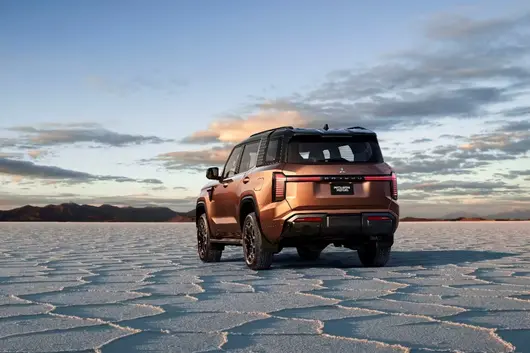

After fading from the market for many years, Mitsubishi has officially launched the all-new Pajero. The new car is positioned as a global flagship off-road SUV, based on a body-on-frame structure, equipped with a 2.4T diesel engine, and will be sold in 100 markets worldwide.

The new Pajero body is 4920mm long with a 2870mm wheelbase, dimensions directly competing with the Toyota Land Cruiser 250 series. The exterior adopts a boxy and rugged design language, the front face is a new family design, retaining the Mitsubishi three-diamond logo. A horizontal through-type LED daytime running light strip spans the entire front, with vertical LED light groups arranged on the left and right, highly recognizable. Large honeycomb-style black grille, paired with a heavy front bumper, with a black protective plate at the bottom. The front lines are straight and rugged, typical of hardcore off-road style.

The boxy and straight body profile features concave lines on the doors and a rugged body line. Doors are equipped with embedded steps for easy entry and exit; door handles are traditional pull-out type. Behind the windows are signature vertical decorative louvers, paying homage to the design of the old Pajero. Paired with large multi-spoke dual-tone off-road wheels, thick-walled tires, flared wheel arches, black fender flares, highlighting off-road attributes.

The rear is square and neat, with a through-type red taillight, vertical light groups on both sides, multi-layer bulb design inside the taillight. "PAJERO" lettering is printed in the middle of the taillight, with the Mitsubishi logo placed above. The rear bumper is thick, with a black bottom protective plate, and red reflectors embedded on both sides. The tailgate is an integrated design, no longer using the old spare tire mount solution.
Body colors available in Armor Copper Metallic and Phantom Blue Metallic (with gold accents).


In terms of interior, the new car adopts a three-row seven-seat layout, with significantly improved materials and craftsmanship, offering Camel leather with black inserts and fine stitching. In terms of tech configuration, high-spec models are equipped with dual 14.3-inch displays (low-spec is 12.3 inches), with 16 built-in theme backgrounds and the "Digital Tri-Gauge" paying homage to the old Pajero, which can display off-road data such as altitude, compass, temperature, pitch/roll angles. The audio system is from Yamaha, equipped with 12 speakers, dual amplifiers, and noise cancellation features.

In terms of sound insulation, measures such as acoustic glass are used, reportedly allowing normal conversation even at high speeds and in high-noise environments. Safety configurations include 8 airbags, MI-PILOT driving assistance kit, and 3D panoramic view (including transparent chassis function).

The chassis is based on the Triton ladder frame, but the suspension system has been exclusively tuned - front double wishbone independent suspension, rear five-link solid axle, tuning referenced Dakar Rally engineering experience. Ground clearance 230mm, approach angle 30.4 degrees, breakover angle 22.6 degrees, departure angle 25.8 degrees.

In terms of power, equipped with a 2.4-liter diesel engine (single variable geometry turbocharger), maximum torque 480 N·m (some specs are 470 N·m), matched with an 8-speed automatic transmission and permanent all-wheel drive system, equipped with Mitsubishi S-AWC Super Select 4WD (including AYC Active Yaw Control and seven terrain modes). Electric power options will be launched in the future.

The new car will be manufactured in Thailand, launching in Thailand, Japan, and Australia before the end of March 2027, then expanding to 100 markets including Southeast Asia, Latin America, and the Middle East. Some markets will use the Montero name. Mitsubishi stated "have not decided whether to introduce to the US", but may enter North America in some form before 2030. In addition, the Pajero will become a sub-brand, and K-Car models and compact SUVs will also be launched in the future.
As for domestic Chinese brands, Hardcore SUVs such as the Fang Cheng Bao Titanium Series, Tank Series, and BYD Yangwang U8 have already secured a share in the Chinese market. If the Pajero has the opportunity to enter the Chinese market in the future, it will face not only the Toyota Land Cruiser and Ford Bronco, but also these Chinese brands with significant advantages in electrification and intelligence. However, the Pajero has deep roots in the global market, especially in the Southeast Asian, Middle Eastern, and Australian markets, its brand appeal remains significant.
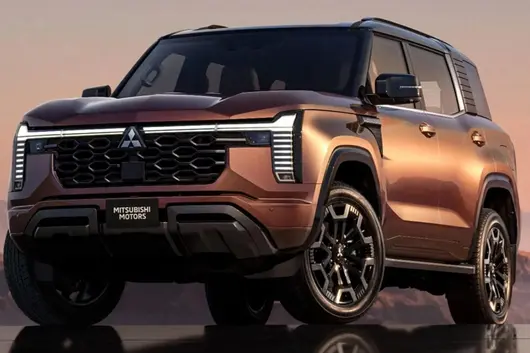

The electrification transformation of mainstream Japanese pickups has finally taken a substantial step. Recently, according to foreign media reports, Mitsubishi Motors has confirmed the launch of a hybrid version of the Triton pickup, this model will go into mass production along with the new Pajero hybrid SUV through the electrification upgrade of its Thailand production base. For this, Mitsubishi plans to add a 16 billion baht investment in the Thailand factory, aiming to build it into a global export hub for electrified pickups and rugged SUVs by 2030.

The first mass-produced version will be the HEV (Hybrid Electric Vehicle) version of the Triton, subsequently, further progress will be made on the R&D of PHEV (Plug-in Hybrid Electric Vehicle) and even fully electric pickups based on battery technology iterations and global market demand. Mitsubishi Global Engineering and Product Strategy Head previously clearly stated, the hybrid solution can be directly compatible with the existing body-on-frame platform, requiring no large-scale modifications to the chassis or underframe structure, resulting in lower short-term implementation costs, and better ensuring the heavy-load capacity and off-road reliability of the pickup models, making it the most pragmatic technical path at present.

Notably, Mitsubishi did not adopt the e-Power extended-range technology from alliance partner Nissan, instead choosing to independently develop a hybrid system exclusive to pickups, the core purpose is to retain the core performance attributes of rugged pickups, avoiding sacrificing load capacity, towing capability, and off-pavement adaptability due to electrification.

Mitsubishi's acceleration of pickup electrification is essentially a market choice forced by the wave of Chinese new energy pickups going overseas. Taking Australia, a global core pickup market, as an example, in 2025 the Mitsubishi Triton sales ranked 17th; while the BYD Shark 6 plug-in hybrid pickup caught up in just one year, ranking 18th. Apart from BYD, the Great Wall Cannon Alpha plug-in version has also landed in the Australian market, combined with the entry of the Ford Ranger plug-in version, the Australian pickup market originally monopolized by diesel power has seen electrification competition fully start.

Unlike Chinese brands that generally prioritize layouts of plug-in hybrids and pure electric routes, Mitsubishi chooses to enter the pickup track from hybrid electric, which fits the core demands of traditional pickup users for reliability and low operating costs, and also avoids the pain points of insufficient charging infrastructure in remote mining areas and off-road scenarios. However, this conservative route also faces challenges: current Chinese brand plug-in hybrid pickups have already achieved technical advantages of all-electric range over 100 km and combined range exceeding 1,000 km, price ranges continue to drop, further squeezing the survival space of traditional diesel pickups.

Conclusion: For Mitsubishi, electrification upgrades are not only a mandatory choice to respond to global emission regulations but also a core layout to resist the overseas expansion of Chinese pickups. With the promotion of the Triton hybrid version, the global mid-size pickup market will welcome a direct confrontation between Japanese hybrids and Chinese plug-in hybrids. The debate on pickup electrification technical routes will also extend from sales competition at the market end to the long-term game of technical paths.