首頁Li Auto L9

搜尋歷史
熱門搜尋
經銷商登入 / 註冊


A toy costing a few yuan triggered a huge storm in late July.
The incident started when a blogger made a bamboo cicada for his daughter, filmed a nostalgic video for the post-80s and 90s generations. Netizens, hearing the "wa wa" sound when shaking the "bamboo cicada", were reminded of Richard Yu's amazed comments on new products at launch events.
Some people made funny videos, paired with captions like "The best toy within 10 million". The videos were mass reported by Huawei Terminal and taken down. Netizens' rebellious emotions were ignited.
"The best toy within 10 million", seemingly a joke, is actually a deconstruction of the AITO M9 promotional slogan. That is, through this joking method, make "The best car within 10 million" completely become a joke.
Huawei's fierce reaction exceeded public expectations, revealing the cruelty of the current car market from the side.
In July, domestic new energy vehicles were still galloping, but under the gallop, another situation was gradually emerging.
Half Joy, Half Concern
The polarization that started in April has greatly deepened by July.
In July, divided by 90,000, car companies were divided into two clear camps. The first tier kept climbing. BYD, SAIC, Geely, Chery, Leapmotor, Changan, six car companies, all achieved year-on-year growth, and month-on-month fluctuation only appeared in SAIC and Geely.
The second tier seemed firmly locked at 40,000 monthly sales. NIO, XPeng, Li Auto, AITO, Hyper, Aion are all like this. These car companies, in July, most did not achieve both year-on-year and month-on-month growth. Especially compared to June, only Hyper Aion saw month-on-month growth.

There is a huge gap between the two tiers. The 6th place Changan is more than twice the 7th place HarmonyOS Intelligent Vehicle, and January-July sales volume reached 3 times. The second tier catching up to the first tier has already become very difficult.
The median and mean further verify this polarization trend. Among the 15 car companies or brands currently announced, the median is 38,027 units, with year-on-year and month-on-year declines of 6% and 15% respectively.
The mean is basically flat with June, with year-on-year growth reaching 28%. Mean growth means overall sales are still increasing. Median decline means car companies in the middle of sales are facing challenges. In other words, the incremental sales were all eaten up by the first tier.
If in the early stage of industry development this is not a problem, but at this stage, for the second tier car companies, days are becoming very difficult.
4 Brands Monthly Sales Break 100,000
Among the 29 brands with announced sales for July, 22 brands achieved monthly sales over 10,000.
Brands that did not exceed 10,000 monthly sales also include BYD Yangwang, Jishi Motors, NIO Firefly, etc. These brands are either special price segment brands, niche models, or new brands, currently in the production capacity climb stage. Excluding these brands, monthly sales over 10,000 is already the basic threshold for sitting at the table, and competition difficulty is increasing.
Among the 22 brands with monthly sales over 10,000, 4 have already broken 100,000 monthly sales. Besides the strong BYD Dynasty and Ocean series, and Geely Galaxy series, Leapmotor became a new member, and Leapmotor is the first new EV maker to break 100,000 monthly sales.
In the below 100,000 yuan price range, there are 11 brands with monthly sales over 100,000. Among them, BYD Fang Cheng Bao sales volume broke 40,000. But it can also be seen that the gap between the two tiers is huge, and brand sales also present extreme polarization. Among numerous brands, breaking through to create a hit is becoming increasingly unlikely.

Under horizontal competition, breaking out becomes more difficult. Vertical achievement of own strategy might bring some comfort, but the reality is, more than half of 2026 has passed, and most car companies' sales target achievement status has not yet broken 50%.
Among car companies that announced annual sales targets, Zeekr's progress is far ahead, completing 71% of the annual target in 7 months. The Galaxy series is also strong, having completed 63%.
Progress on targets for other car companies has not exceeded half, and pressure to sprint for annual targets remains huge. NIO's sales target is relatively small, currently completed 48%. Leapmotor showed bright performance, but the million-unit sales target is large, and the difficulty of completion is high.
Xiaomi's production capacity seems still unable to further improve, maintaining around 30,000 units for 4 consecutive months. To complete the 2026 annual 550,000 unit delivery target, it needs to wait for further production capacity pull-up.

From sales performance, it can be seen that the Matthew effect is very obvious. Whether car companies or sub-brands under car companies, polarization is obvious, and the gap between the two tiers is huge.
Continuation of this situation makes survival status increasingly poor for car companies with weak sales growth.
At the current stage, car company costs are continuously increasing. Seres founder Zhang Xinghai previously gave detailed data. Storage chip price increase rose up to 5 times, lithium carbonate price climbed from 80,000 yuan/ton to 180,000 yuan/ton last August. Dual raw material price increase directly led to AITO single car manufacturing cost increase of 15,000 to 20,000 yuan. Under this situation, profits of most car companies are squeezed significantly.
Data from CPCA shows that January-June auto industry profit margin is 3.8%, downstream industrial enterprise profit margin is 6.5%. Auto industry is obviously still relatively low.
Closing in on Q2 financial report season, many car companies disclosed profit forecasts. The second-tier Seres, GAC, BAIC BluePark all showed losses. Among them, GAC expected loss 4.06-4.57 billion yuan, BAIC BluePark expected loss 1.795-1.995 billion yuan, Seres expected loss 1.5-1.8 billion yuan.
Price reduction means further profit pressure, which might directly threaten operational stability.
Moreover, even with price reduction, it does not equal sales growth. On one hand, the incremental era is heading towards its end.
"Oil-Electricity Equal Rights" curtain opens. Starting from January 1, 2027, energy saving cars half levy car and vessel tax policy, and pure electric commercial vehicles, plug-in (including extended range) hybrid cars, fuel cell commercial vehicles car and vessel tax exemption will be cancelled. This means, the new energy vehicle car and vessel tax preferential policy implemented for 15 years officially enters withdrawal countdown.
Preferential policy cancellation will also cause consumption willingness to slide, and car companies' incremental space will further shrink.
On the other hand, the market is already very internalized, everyone is reducing prices in disguise. Car companies are not conducting price wars on the surface, but secretly all lowering prices and increasing configurations. Data from CPCA shows that January-June, new energy vehicle new car discounted model average price 247,000 yuan discount force arithmetic average reached 30,000 yuan, discount force reached 12%.
Technical innovation is not necessarily a panacea. An innovative product design will quickly become a standard. Relying on one technology or product design to gain excessive market returns has become very difficult.
Under this situation, many car companies' stock prices continue to fall, and car companies have to buy back to maintain stock prices.
SAIC Group announced controlling shareholder promises not to reduce shares held in any way within 6 months. Seres has already bought back 8.9755 million shares, using fund total 587 million yuan. JAC Motors has already bought back 1.5467 million shares, using fund total 34.9948 million yuan.
Under this cruel situation, car companies' survival status is not good, and seeking overseas growth has also become a must-have option.
Going Overseas: New Forces Set Sail
Overseas markets are still led by traditional car companies.
Chery is still the navigator among overseas car companies, and growth momentum is very fierce. According to listed company caliber, Chery July overseas sales 196,300 units, has achieved "walking on two legs". This sales volume is 5th consecutive month breaking historical high.
BYD is closely chasing, July overseas sales 179,800 units, 4th consecutive month breaking historical high, consecutive 9 months sales breakthrough 100,000 units. If only looking at new energy vehicles, BYD might have already led.
In July, BYD Brazil factory 100,000th new energy vehicle officially rolled off production line, factory on-job employee scale reached 5,500 people. Denza's first hypercar listed in UK, Denza Z starting price 1.3 million yuan, global pre-sale orders over 1,000 units. BYD new energy vehicles in Thailand market cumulative delivery volume officially broke 130,000 units.
Currently, BYD is strengthening global influence. The group reached global strategic cooperation relationship with Paris Saint-Germain Football Club (PSG). Both sides will promote cooperation landing through global communication activities, fan interaction forms, etc.
Geely although not rapid growth, also broke 100,000 units for 2 consecutive months, 7th consecutive month breaking historical high. This is a very strong performance. In addition, Great Wall also created new high for 4 consecutive months.
Although SAIC failed to break new high, it has also been stabilizing monthly sales over 100,000 units for consecutive 5 months.

Say, traditional car companies are ushering in a comprehensive explosion in overseas markets. To a certain extent, this can alleviate the tight domestic state.
New forces also saw huge potential in overseas markets. Since this year, car companies such as NIO, XPeng, Li Auto have obviously accelerated overseas layout actions.
XPeng announced its Australia long-term strategy, planning to introduce XPeng high-level intelligent assisted driving locally in 2027. In addition, XPeng Australia New Zealand subsidiary will launch 5 new models within 6 months, and plans to layout 3 flagship tech experience centers and 50 outlets in Australia.
Besides Australia, XPeng also held Mona L03 launch event in Munich, Germany. Planned to land in 65 countries and regions this year, expanding XPeng Group international product lineup.
Li Auto cooperated with Kazakhstan local car group Allur to reach strategic cooperation, will utilize Allur Kostanai factory to start local assembly production. All new Li Auto L9 also listed in Kazakhstan in July, pricing far exceeded domestic.
Leapmotor B10 completed Mexico localization certification, officially landed local market and started delivery, opening North American market expansion process. Currently, Leapmotor B10 has entered Mexico local stores. Leapmotor C10, C16 will also gradually enter market.
Overseas competition has become the only way for car companies. In the stage where domestic market polarization is obvious and market pattern gradually stabilizes, overseas vast markets may become the key to the next stop for car companies.
Xiaomi Overturns Table, Volume Models Released Dense
July is not a big month for product launches. Many car companies put volume models into July launches.
This month's highlight is Xiaomi.
On the night of July 30, Xiaomi Pengcheng held a technical launch event, releasing 2 new cars. Equipped with Xiaomi self-developed Kunlun Extended Range Engine, fuel compatibility performance is broad, can add 92, 95, 98 different grade gasoline. Under WLTC working conditions, Pengcheng N70 lowest fuel consumption is 5.7L/100km, CLTC pure electric range highest can reach 505km, full oil full electricity comprehensive range all break 1,500km.
Lei Jun also focused introduced rear row variable diverse cockpit scene, seats support front row 180° rotation, second row horizontal movement.
The most explosive is price. N90 Max pre-sale price 299,900 yuan, N70 Max pre-sale price 259,900 yuan. Two new cars will be officially launched in September. According to usual laws, new cars might further lower prices. This means, this 9-series full-size SUV has been pressed to within 300,000 yuan by Xiaomi. For AITO M9, Li Auto L9, Zeekr 9x, NIO ES9 and other competitors, it might be a considerable shock.

However, some netizens questioned, new cars put 400V platform on 300,000 class flagship models, no rear wheel steering, no steer-by-wire chassis, battery supplier downgrade, electric drive and intelligent driving hardware intentionally diluted in launch event. But from current market reaction view, Xiaomi Pengcheng will likely give this already very fierce market, add another layer of fire.
Except Xiaomi, other hot car companies also released volume models.
NIO series Firefly announced, Halo Xunguang series first model "Habitat" officially launched, whole vehicle price starting at 133,300 yuan.
XPeng MONA L03 launched 9 models in China market, price 123,800 to 156,800 yuan. L03 positioning compact SUV, providing pure electric and extended range two power.
Leapmotor new B series officially launched. B10 positioning pure electric compact SUV, B01 positioning pure electric compact sedan. Full series standard equip Qualcomm SA8295P chip, all-domain 800V SiC high pressure system + 3C fast charge etc. B10 price starting at 99,800 yuan, B01 price starting at 95,800 yuan.
New generation Li Auto L6 officially launched, only providing Ultra one version, national unified retail price 249,800 yuan.
Traditional car company aspect, Geely series Lynk & Co 07GT officially launched, releasing 4 models. Geely Galaxy TT Ultra officially opened pre-sale, new car positioning pure electric mid-large sedan, Ultra is high config version, later will also supplement price lower models. Zeekr 9X 5-seat version officially launched.
Dongfeng series Voyah Pursuit Light S published quad drive top config model, pre-sale price 309,900 yuan. Later will also supplement long range rear drive version and standard range version. New car positioning pure electric mid-large SUV, product orientation more lean towards young and sports.
BYD Ocean network series Seal 08 officially launched, new car releasing 6 configurations.
Time enters Q3, car companies' second half year sprint is about to open curtain. Considering relevant subsidies start reducing, this half year will be manufacturers' last timing to sprint sales.
Fighting for "Domestic BBA"
"NIO, XPeng, Li Auto" these three new forces sales comparison is becoming meaningless.
On one hand, Leapmotor's sudden appearance, made three car companies become the second game of competitive new forces. On the other hand, XPeng, NIO layout in low price segment, three new forces are no longer mid-high end, luxury car sales direct comparison.
First half year, Li Auto, AITO, NIO, Zeekr, launched fierce battle in full-size SUV, 400,000 yuan above luxury car price segment. These four car companies are currently accelerating grabbing BBA customers.

This trend started with Li Auto L9. Relying on precise grasp of dad and baby family demands, Li Auto car first tested the water. From June 2022 first unit delivery to June 2026, Li Auto L9 completed 300,000 units cumulative delivery in 4 years. Early, Li Auto could rely on one model to hard resist NIO, XPeng. Precise layout on dad market was key.
AITO pushed this market to climax. September 2023, AITO M9 suddenly appeared, 100,000 units sold in a year, consecutive 21 months toping 500,000 yuan above luxury car sales first place.
Before a few years, relying on early layout, intelligent driving and cockpit field leading, AITO and Li Auto enjoyed market dividends. But market pattern will not remain unchanged. AITO M9 and Li Auto L9 lead advantage will soon be caught up.
Zeekr's success comes from 9X and 8X success. Since listing on September 29, 2025, 9X in China 500,000 yuan class high-end SUV market segment, has been toping sales list for 7 consecutive months. This May, Zeekr 8X sales 6,103 units, grabbing transaction average price 300,000-500,000 yuan interval hybrid SUV sales first place.
NIO is following slowly, ES8 and ES9 launched successively. NIO's advantage lies in its battery swap products. Through BaaS rent power mode, NIO pressed ES9 starting price to within 400,000 yuan. July, NIO ES9 also achieved good sales. New ES8 reached 130,000th unit delivery in 305 days. NIO ES9 since May 28 started delivery, 30 days delivery broke 10,000 units, refreshed 500,000 yuan above high-end pure electric vehicle fastest delivery record.
From sales view, in mid-high end and luxury car price segment, July, Zeekr ran to front. Li Auto, AITO, NIO main brands closely chasing. These four car companies' current difference is not big.
Which of these four will be Domestic BBA, or whether these four can all be Domestic BBA, has become more interesting to watch.
Volume Sales, Difficulties All Over
Compared to mid-high end struggle, price reduction seems the simplest option for new forces.
XPeng exiting Mona series, NIO launching Onvo series, Firefly series, are all precise snipers to sales.
But from result side, mass consumer market is not a market where you take what you want. Even positioning mid-high end, does not mean these car companies can use low price to snatch other car companies' shares.
Taking NIO as example, it launched 100,000-200,000 yuan price segment Onvo brand, 100,000 yuan below Firefly brand. But until July, Onvo contribution sales was 10,155 units. Stable above 10,000 units for 3 consecutive months, but recent 2 months month-on-month both showed decline. Firefly similarly struggled to start, until now failed to break monthly sales of 10,000.
XPeng did not announce Mona series contribution sales, but from XPeng's overall sales view, still did not break 40,000 units threshold. Therefore, low price might relieve sales pressure in short term, substantial sales changes still need long process.
This point is also reflected in Hyper Aion traditional car company brand merchants. Once, Aion sales exceeded NIO, XPeng, Li Auto. But in current stage development, gradually lost speed. July sales 34,987 units, still in flat state.
This point Geely and Leapmotor performed better. Leapmotor does not rely on brand, but is truly high price low config. July, Leapmotor sales first time stood on 100,000 units, consecutive 4th month sales creating historical high, throwing other new forces far behind.
Geely Galaxy is also embodiment of product power. Focusing on friendly commute, home rigid demand, focusing on high cost-performance, low usage cost and reliable quality. July sales 107,800 units, consecutive 2nd month breaking 100,000, becoming a strong challenger to BYD.

Mass consumer market, brand is perhaps not the most important factor, higher cost-performance, more reliable product experience.
Xiaomi, HarmonyOS: Internet Car Companies Growth Troubles
Xiaomi and Huawei are both facing their own troubles.
July, Xiaomi sales still stopped around 30,000 units. This of course relates to production capacity. But in December last year, Xiaomi's production capacity was once pulled to 50,000 units, and once consecutive 3 months broke 40,000 units. Now Xiaomi still controls production capacity at 30,000 units, still not well digesting orders. Since this year, Xiaomi's stock price has fallen 30% from peak period, huge pressure.
Same situation HarmonyOS Intelligent Vehicle also encountered. July, HarmonyOS Intelligent Vehicle sales 45,046 units. After May 20,000 in June, it dropped back to 40,000. This is far from the limit of HarmonyOS Intelligent Vehicle. In recent years, HarmonyOS Intelligent Vehicle's "friends circle" continuously expanded. Now there are already "Five Worlds Three Realms", but at current stage, this ecosystem performance is not optimistic.
AITO needs not say. AITO-led Seres car sales only 20,480 units. Sales returned to March water level. Ambitious Luxeed, started delivery in May, until July barely reached 20,000 unit delivery. Stelato cooperating with Chery, finally broke 10,000 this month, reached 10,709 units, but still did not break new high.
Under low sales momentum, cost cooperating with Huawei is becoming prominent. In 2025, Seres paid Huawei over 20 billion yuan procurement fee. These rigid cost expenditures are increasingly eye-catching under current situation.
July, Seres released Q2 loss warning. Among them, AITO car 2026 half-year deduct non-net loss reached 1.7-1.95 billion yuan. HarmonyOS insists on high-end route. Under normal conditions, car companies' profit margin has guarantee. But with supply chain price rise, car company competition intensifies, enterprises on HarmonyOS industry chain face operation pressure.
Facing current situation, Xiaomi gave solution. Launching extended range brand Pengcheng, opening sales again through new products. However, this heat maintained through freshness will eventually return to calm. Xiaomi and Huawei have walked through dividend period. Need stronger product power.
Fierce competition is indeed the current reality of new energy car companies. For many car companies, this is a difficult cycle. But continuously evolving Chinese car companies are comprehensively realizing overtaking on the curve.
Chinese car companies' difficulty is the difficulty of walking uphill. Compared to this, since this year, traditional luxury car three giants BBA (Mercedes-Benz, BMW, Audi) collectively reduced prices. Japanese car companies three strong (Honda, Toyota, Nissan) first half year China sales collectively declined. Among them Honda year-on-year declined 34.7%. Under big trend, Chinese car companies are grabbing territory of old forces, grabbing era opportunity. Need technology and experience more surpassing the era. This is a process. This difficult situation will eventually gradually be overcome.


At the beginning of June, various automakers successively released their sales performance reports for May 2026. According to the forecast data released by the CPCA (China Passenger Car Association) on May 23, domestic new energy passenger car retail volume was expected to reach 950,000 units, penetration rate approximately 62.5%, setting a new historical high. This data further confirms the continued deepening of electrification transformation, as the new energy vehicle market is steadily transitioning from "policy-driven" to "market-driven".
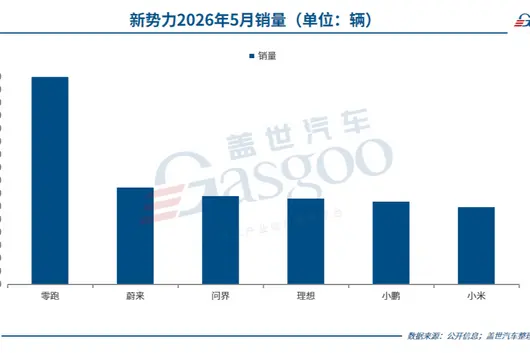
Looking at specific sales data, the top tier pattern of new forces experienced severe differentiation in May - Leapmotor led by a "huge gap" with monthly sales exceeding 80,000 units. At the same time, traditional auto groups represented by BYD, Changan, Geely, etc., saw their self-incubated new energy brands also show a collective surge in volume in May, and the strategic value of multi-brand matrices is accelerating realization.
New Forces Matrix: Leapmotor 80,000+ "Huge Gap Lead", Multiple Brands Gathered in the 30,000 Bracket

The new forces market pattern in May showed distinct tiered characteristics: Leapmotor exceeded 80,000 units in a single month, forming a leading advantage; NIO, relying on three-brand synergy, reached sales volume of 37,700 units; Li Auto, Xpeng, Xiaomi, AITO, and other brands were concentrated in the 30,000-35,000 unit range, forming the most competitive core battlefield.

Image Source: Leapmotor
Leapmotor became the undisputed biggest highlight of May. According to Leapmotor official data, May total delivery volume reached 81,569 units, year-on-year growth 81%, month-on-month growth 14.26%, once again breaking the brand's single-month delivery historical record. Leapmotor also became the first enterprise among Chinese new automakers to exceed 80,000 units in single-month delivery.
Looking at specific models, Leapmotor A10 exceeded 20,000 units in single-month delivery, D19 new orders continued to maintain above 10,000 units, C Series global cumulative sales already exceeded 800,000 units. By the end of May, Leapmotor cumulative delivery in the first five months exceeded 300,000 units.
Leapmotor's 2026 annual sales target is 1.05 million units. Behind this ambition is Leapmotor Chairman Zhu Jiangming's proposed "2026 Sprint to 1 Million Units" strategic goal. With June C Series refresh, D99 pre-sale, and Lafa5 large-scale overseas expansion, Leapmotor is expected to launch a shock at the new milestone of 90,000 units monthly delivery.

Image Source: NIO
NIO Company also showed steady performance in May. Data shows, NIO May delivery of new cars 37,705 units, year-on-year growth 62.3%, month-on-month growth 28.4%.
NIO's growth benefits from the strategic effectiveness of three brands working together - NIO brand delivered 20,013 units, year-on-year growth 50.8%; ONVO brand delivered 12,029 units, year-on-year growth 91.5%, month-on-month increase as high as 124.8%; Firefly brand delivered 5,663 units, year-on-year growth 53.9%.
From the product level, flagship SUV NIO ES8 sold 11,475 units in May, maintaining competitiveness in the high-end market above 400,000 yuan. By the end of May, NIO company cumulative delivery this year reached 150,500 units, year-on-year growth 68.7%, cumulative delivery total has reached 1.148 million units.
Li Auto May delivery 33,350 units, by end of May historical cumulative delivery volume has reached 1.703 million units. Li Auto Chairman and CEO Li Xiang stated, since first quarter this year delivery volume has entered a growth track, among them Li Auto i6 delivered volume exceeded 20,000 units for three consecutive months, stable in top three pure electric SUV sales; May, new Li Auto L9 officially released and started delivery, L Series models entered new upgrade cycle, new L9 Livis order volume exceeded 10,000 units within two weeks of release.

Image Source: Xpeng
Xpeng Group May delivery 32,158 units, month-on-month growth 3.7%, creating a new monthly delivery high since 2026. This growth mainly stems from the continuous effort of existing product matrix - 2026 Model P7+, G6, G9 and G7 Super Range Extender versions etc. models have completed capacity ramp-up, MONA M03 maintains hot sales in 150,000 yuan level pure electric market.
On May 20, new tech flagship Xpeng GX officially launched and started delivery, providing pure electric and super range extender two power, total 8 models, 12 hours after launch firm orders reached 24,863 units, among them Ultra flagship version ratio exceeds 80%.
Xiaomi Auto May delivery volume continued to exceed 30,000 units, holding steady the "30,000+" step for the second consecutive month. Xiaomi has evolved from early SU7 "single product holding the flag" to SU7 Series and YU7 Series dual-line parallel product pattern.
By end of May, Xiaomi Auto first five months cumulative delivery volume approx 140,000 units, completed full year 550,000 units delivery target 25.5%. As a new force entered market only two plus years, Xiaomi maintaining monthly sales 30,000+ level already belongs to difficult, but second half year average monthly delivery needs to reach approx 55,000 units to achieve full year target, challenge still exists.

Image Source: HarmonyOS Intelligent Alliance
May 2026, HarmonyOS Intelligent Alliance single month delivery volume reached 46,122 units, achieving year-on-year and month-on-year dual growth. Among them, AITO Auto full series models May delivery 34,320 units, month-on-month growth 48.2%, 1-5 months cumulative year-on-year growth 28.7%.
New generation AITO M9 launched 24 hours firm orders exceeded 20,000 units, and achieved launch and delivery immediately; AITO M6 launched first month delivery exceeded 20,000 units.
From competitive landscape perspective, besides Leapmotor, remaining several new force brand delivery volumes front and back gap not big, ranking may interchange at any time, pattern highly dynamic. From this "30,000 bracket cluster", it can be seen, new forces from "break 30,000" to "stand firm 40,000" still need to cross growth threshold - this both tests product matrix richness, and puts higher requirements on supply chain management and delivery system.
Domestic New Energy: Multiple Brands Work Together, Enter Fast Lane

In the domestic new energy brand matrix that traditional auto groups are accelerating promoting, May also handed in an outstanding answer sheet. Looking at overall data released by major vehicle groups, the trend of steady improvement in new energy penetration rate is converting into tangible sales volume scale.

Image Source: BYD Auto
BYD May sales 383,000 units, ranking first in industry, among them passenger car sales 377,000 units. Dynasty Network and Ocean Network sales 330,200 units, still BYD sales cornerstone; Fangchengbao sales 30,186 units; Denza sales 16,303 units; Yangwang sales 286 units.
In terms of overseas market, BYD May export new energy vehicles total 160,600 units, year-on-year growth 80.7%, creating new historical high again.
Geely Auto May group total sales volume 238,000 units, realized same month-on-month dual growth for three consecutive months. That month new energy model sales volume 133,000 units, accounted for sales volume ratio 56.1%, exceeded 50% for four consecutive months.
Underlying Zeekr brand May delivery 34,377 units, year-on-year growth 81.8%, creating new historical high again - Zeekr 009, 9X, 8X etc. models ratio nearly 50%, driving brand single car transaction average price year-on-year increase 52.4%, holding steady in luxury brand camp.
Lynk & Co brand May sales 20,732 units, new energy sales 14,688 units, month-on-month growth 17%, new energy sales ratio as high as 71%.

Image Source: Changan Auto
Changan Auto May global delivery 209,000 units, new energy vehicle delivery 92,000 units. Changan electrification transformation shows multi-brand matrix head-to-head competition characteristic: Changan Qiyuan May delivery 34,528 units, among them new Q05 delivery 15,812 units, Thailand launch three days orders exceeded 3,000 units; Deepal Auto May global sales 33,243 units, year-on-year growth 30%, 1-5 months overseas cumulative sales 28,704 units, year-on-year growth 167%; Avatr May delivery 7,336 units, showing continuous upward trend. Sorting out data of each month this year, Avatr from January 2,216 units, February 4,033 units, March 5,143 units, April 5,279 units climbed up to May 7,336 units, visible its growth momentum.
SAIC Motor Group May vehicle sales volume 349,000 units, among them new energy vehicle sales 182,000 units, year-on-year growth 46.49%. Underlying IM Motors May delivery 10,023 units, holding steady 10,000 unit gateway for two consecutive months, 1-5 months cumulative sales year-on-year growth 115%; SAIC Passenger Car new energy 1-5 months cumulative reached 174,000 units, year-on-year surge 195%, MG4 Family 8 months sales broke 10,000.

Image Source: eπ Tech
Dongfeng system domestic new energy brands also performed outstandingly. Dongfeng eπ Tech May delivery 24,830 units, year-on-year growth 42%, 1-5 months cumulative delivery 109,600 units, overseas market year-on-year growth 194%. Voyah Auto May delivery 13,003 units, year-on-year growth 30%, 1-5 months cumulative delivery 62,041 units, year-on-year growth 35%.
Hyper Aion BU May sales 33,140 units, year-on-year growth 23.76%, among them Aion i60 monthly sales continued over 10,000. Arcfox Auto May sales 17,943 units, year-on-year growth 32.82%, overall performance steady, Alpha S5, Koala etc. models are its main force models, May started pre-sale Arcfox Beta S3 and launched Wayfind V9 future will further support its overall sales.
Conclusion:
From overall industry view, May new energy penetration rate approx 62.5%, new high again. Domestic brands have become important market force, traditional big factory late advantage showed - Geely new energy ratio exceeded 56%, Changan new energy approaching 100,000 units, SAIC new energy year-on-year increase over 46%. But there is a problem still cannot ignore, multi-brand matrix at the same time covering segmented markets, also faces resource integration and internal friction control test.
Looking forward subsequently, as multiple new models enter delivery cycle, new energy market expected to continue growth. Can Leapmotor stabilize "One Super" status? Who in 30,000 bracket cluster will break out first? These will be the highlights coming next.