首頁BMW E30 M3

搜尋歷史
熱門搜尋
經銷商登入 / 註冊

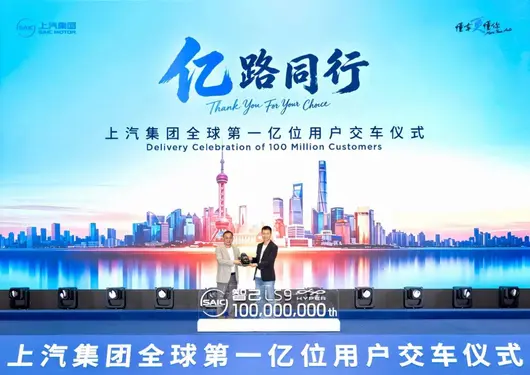
May 28, 2026, SAIC Group held a special vehicle delivery ceremony at Shanghai North Bund World Living Room. What makes it special is not how many leaders came, but because the protagonist changed to users, accurately speaking, it is SAIC's 100 millionth user globally.
100 million vehicles. This is a number never touched by a Chinese automotive group. From 1958 when workers hammered out the first Phoenix sedan with a hammer, to 2026 when over ten brands and nineteen models under its umbrella were delivered synchronously across continents, SAIC took 68 years to write itself into a new coordinate of the Chinese automotive industry.

Behind the 100 Million Vehicles, It's Not Just About Selling More
When many people see "100 million vehicles", their first reaction is: SAIC really sells a lot. This is not wrong, but only half right.
In the first four months of 2026, SAIC sold a cumulative 1.302 million vehicles, taking the crown as the top-selling car enterprise for four consecutive months. Among them, the share of independent brands is close to seven-tenths, new energy vehicles sold 412,000, and the overseas market surged 50.2% year-on-year. These numbers are indeed beautiful, but more worth looking at is the structure: independent brands account for 70%, overseas sales account for more than one-third. This shows SAIC is no longer the enterprise that relied on joint ventures for passive wins back then.

Starting from the localization of Santana, to Roewe creating the Internet car category, to the concentrated launch of high-end smart electric products like IM, Shangjie, and Huajing S, SAIC has taken a road that most traditional car enterprises are walking, but few walk smoothly: while stabilizing the core business in the joint venture sector, let independent brands truly stand up. Today, the outline of this road is quite clear.
Global Relay Delivery Is Not a Show, But Real Skill
The most interesting design of this delivery ceremony is "Global Relay". Outside the Shanghai main venue, delivery scenes in Nanjing, Liuzhou, Taiyuan, as well as the UK, Indonesia, Singapore and other countries and regions were lit up successively. Completing cross-continental, multi-brand, large-batch synchronized delivery on the same day tests not planning ability, but the hard strength of supply chain and channels.
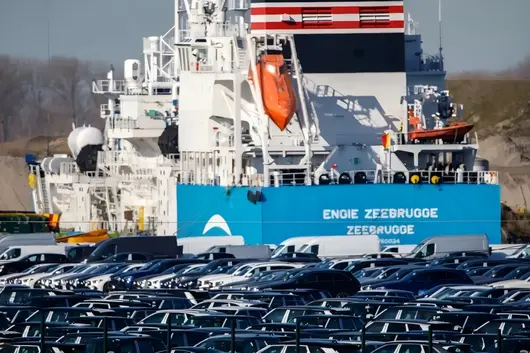
SAIC has over 100 parts production bases overseas, over 3,000 dealer networks. It has built three R&D innovation centers such as London, as well as four production and manufacturing centers in Thailand, Indonesia, India, and Pakistan. Anji Logistics 42 Ro-Ro ships, 8 international routes connected Southeast Asia, Europe, Americas. The facts stacked out by these numbers are: SAIC is one of the few Chinese car groups that truly has global operation capabilities.

MG has been the top-selling Chinese brand in the European market for 11 consecutive years. In 2025, annual sales in Europe broke through 300,000 vehicles, and cumulative sales broke one million in the UK and European markets. This is not a small-scale export, but a head-on confrontation in mature markets. In March this year, the semi-solid-state batteries and Hybrid+ hybrid technology released by MG at the Frankfurt Technology Day, overseas monthly sales have already broken 20,000 vehicles. From "Product Going Global" to "Value Chain Going Global", SAIC's Glocal strategy is being realized.
What Truly Matters Is Whether "Understanding You" Can Be Done Properly
SAIC proposed a slogan called "Know Cars, Know You Better". The first half is basic skills, the second half is the dividing line.
At this delivery ceremony, SAIC did not invite celebrities to endorse, but found real users to tell stories: Luo Zhenyu from Dedao APP, as Huajing S Experience Officer No. 001, talked about Qiankun Intelligent Driving from the New Year's Eve Speech to walking into the factory to witness the launch; former national football player Yang Chen chose ID. ERA 9X, with the reason that Golden Extended Range and Long-termism concepts fit; charity blogger Liu Jia shaved the hair of left-behind children in Guangxi mountainous areas for five consecutive years, Buick not only assisted him, but he himself was also moved by the Zhijing E7 cabin. These stories are not big on their own, but put together, they spell out the signal SAIC wants to convey: Users are not the end point of payment, but the starting point of R&D and service.

Product itself. Volkswagen ID. ERA 9X globally launched Momenta R7 Reinforcement Learning World Model, one month after launch delivery broke 7,000 units; AUDI E7X plans to become Audi's first L3 level landing model globally; Buick Zhijing E7 based on "Xiaoyao" Super Fusion Architecture, one month after launch delivery broke 10,000. The common point of these products is: technology no longer stays on the parameter sheet, but becomes experience perceived by users.
100 Million Vehicles is a Period, Even More a Colon
To be honest, this number of 100 million vehicles is not rare among global automotive giants. Toyota and Volkswagen have long been members of the "100 Million Club". But for the Chinese automotive industry, this is the first time a local enterprise has crossed this line, the meaning is different.
What is more important is not the celebration, but how to go next. SAIC itself is also very clear, positioning this 100 million vehicle delivery as the "starting line of second entrepreneurship". From the establishment of Shanghai Internal Combustion Engine Parts Manufacturing Company in 1955, to the present day where the full brand matrix moves forward together in the global market, SAIC has proved that traditional car enterprises can also complete the "turning the elephant around". But the battle of intelligent electric transformation has only reached the halftime, the next competition will be more cruel, semi-solid-state batteries, AI large model onboard, L3 level autonomous driving landing, every item is a tough fight.
100 million vehicles are the answer sheet SAIC gave to the past, and also the test question given to the future. The tools for answering are already here: full value chain system, global layout, dual engine of independence and joint ventures running in parallel. Whether it can be answered well depends on how deep the sentence "Know Cars, Know You Better" can be implemented.

近日,国务院国资委揭晓2025年度“双百企业”名单,岚图汽车连续第五年入选,并获评最高等级“标杆”,意味着岚图在治理结构、市场化机制、科技创新和经营质效等方面的改革成效获得进一步认可。

“双百企业”,是指入选国企改革“双百行动”的百家规模效益领先企业和百家高成长性企业。“双百企业”评价分为“标杆、优良、合格、不合格”四个等级,“标杆”为最高等级,代表企业在改革成效、治理结构及市场化机制等方面处于行业领先地位。岚图汽车自2022年入选“双百企业”以来,评价逐年上升,在去年“优良”评价的基础上,今年成功摘得“标杆”评价。
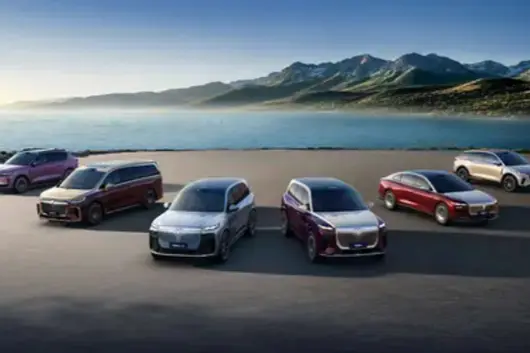
作为东风汽车旗下高端智慧新能源品牌,岚图汽车自成立伊始,便不断探索“成熟车企+造车新势力”创新发展模式,掌握“研-产-供-销-服”全价值链自主掌控能力,以全栈自研核心技术为根基,打造了五大坚实技术底座,以持续扩容的高端产品为支撑,形成了高端智慧新能源“SUV+MPV+轿车”矩阵,持续夯实“央国企高端新能源第一品牌”地位。

岚图汽车持续完善高效灵活的市场化运行机制,坚持以“用户、效率、目标、结果”为准则,打造“以用户为中心”的经营模式,并将实践改革转化为技术创新、绿色发展、资本市场突破和全球化布局的综合能力。今年3月,岚图汽车登陆香港联交所,成为“央国企高端新能源汽车第一股”,进一步打通产业发展与资本市场协同通道。近期,随着资本市场信心高涨,岚图全球化步伐进一步提速,加速推进“深耕欧洲、布局中东、进军右舵市场”三大行动,为中国汽车“国家队”走向世界探索新路径。
此次获评“双百企业”最高等级,既是对岚图过去改革实践的肯定,也为其下一阶段高质量发展提供了更强支撑。面向未来,随着全球战略的推进、产品矩阵的完善和市场化机制的持续释放,岚图汽车有望在民族汽车品牌向上、中国新能源汽车出海和央国企改革深化中,扮演更具示范意义的角色。

[First Commercial Vehicle Network Original]
Since the beginning of this year, Foton Motor's overseas business has continued the strong growth trend of last year, and the "Comprehensive Internationalization" strategy has entered a new phase.
In May 2026, Foton Motor's total sales exceeded 58,000 units, up 17.3% year-on-year; among them, overseas sales broke through again, with a single-month sales volume of 18,000 units, up 64.3% year-on-year. Cumulative sales from January to May reached 89,000 units, up 38% year-on-year, continuing to lead China's commercial vehicle exports. This report card is not only a rise in numbers but also the inevitable result of its years of adhering to strategic stability and deepening localized operations, marking that Foton's globalization process has steadily entered the harvest period of high-quality development.
For details, please refer to the latest report brought by First Commercial Vehicle Network.
Structural Growth Drives May Sales to New Highs
In May, Foton Motor's overseas single-month sales exceeded 18,000 units, up 64.3% year-on-year, continuing to lead the Chinese commercial vehicle overseas export industry. Cumulatively, from January to May 2026, Foton's total overseas exports exceeded 89,000 units, up 38% year-on-year, maintaining strong growth momentum on the basis of last year's high base, showing the resilience and vitality of its global market layout. This series of positive signals has laid a solid foundation for achieving its annual overseas goals.

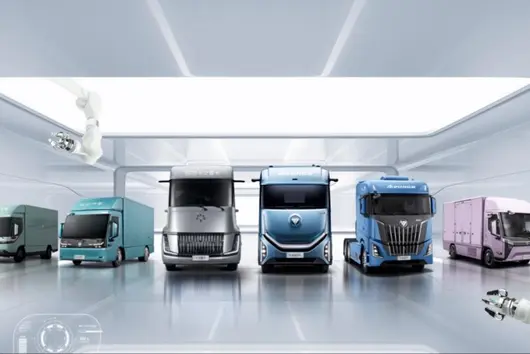
Behind the high growth is the continuous optimization of the export structure and the full-scale effort of high-value-added models. The May data continued the strong momentum of the previous high-end transformation, among which the high-end product line represented by Auman heavy trucks grew particularly outstanding. In May, driven by large order deliveries in strategic markets such as Africa and Central Asia, the Auman heavy truck product line's growth also reached a new high. In addition, Foton Cavan CAVAN C1 recently appeared at the German IFAT Exhibition, receiving high attention from the European market, and also added support for the export of high-end new energy products.
From the perspective of regional markets, Foton's global map presents a gratifying situation of "blooming in multiple points and comprehensive breakthroughs". The high-end strategy in the European market has shown initial results. With the brand effect brought by the TUNLAND V9 pickup winning international awards, as well as the batch delivery of electric light trucks in Spain, European orders continued to maintain high growth from January to May. In Africa, with the successive delivery of the Dangote Group's order of more than a thousand trucks in Nigeria, and the capacity release of the local factory in South Africa, Foton has become a key participant in infrastructure construction and logistics transportation in that region. This full-spectrum breakthrough from points to surfaces, from traditional power to new energy, makes the foundation of Foton's overseas market growth more solid.
Localization Operations Build Competitive Barriers
The secret to sales continuously leading lies in Foton's deep insight into overseas market laws and the solid cultivation of "long-termism". Unlike simple trade models, Foton takes "putting global scenarios into the database" as the origin of product competitiveness. Relying on overseas technology centers spread across the globe, Foton has established a "Global Adaptability Compendium" covering 59 countries and 140 high-frequency markets, transforming 16 typical scenarios such as high temperature, high cold, and dusty into technical standards of 49 key modules and 91 quantitative performance elements, thereby ensuring that every product launched overseas can accurately adapt to local complex working conditions and user habits.

This R&D model based on big data and scenario-driven makes Foton thoroughly say goodbye to "passive fire-fighting" style after-sales rectification. For example, for the heavy load and long downhill operating conditions in the African market, Foton started from selection and verification requirements and provided a complete solution for heavy truck models; and in the high-temperature desert environment in Saudi Arabia, by optimizing the air conditioning system and thermal management scheme, the cooling effect of the bus was significantly improved. It is this extreme pursuit of details that made Foton products win the trust of global top customers such as Dangote Group and Central Asian port operators, continuously winning thousand-level large orders, and converting technical standards into real market share.
More critically, Foton's localization operations have been upgraded from "product adaptability improvement" to "whole industry chain rooting". Whether in manufacturing bases in Brazil and Thailand, or KD factories in South Africa and Saudi Arabia, Foton has not only achieved localized production but also driven the full localization of supply chains, services, and talent. In South Africa, relying on the Port Elizabeth factory, Foton provided customized heavy truck and pickup products for the local area; in Thailand, the launch of the 2000th heavy truck marked that it had deeply integrated into the local logistics system. In March this year, Foton and COSCO SHIPPING Special Carriers established a joint company to build a self-controllable sea transport supply chain system, further consolidating the logistics base for global development. This deeply bound industrial ecosystem effectively avoids trade barriers and builds a "moat" that competitors find difficult to replicate in the short term.

"Comprehensive Internationalization" Strategy Leads to Accelerate towards World-Class Commercial Vehicle Enterprises
From "Product Going Global" to "Brand Going Global", and then to "Ecosystem Going Global", Foton Motor's clear strategic path is the key to its continuous leadership in the industry. Facing global industrial changes, Foton firmly promotes the "Comprehensive Internationalization" strategy, positioning overseas business as the core growth pole and giving resource allocation. Since 2026, Foton has steadily promoted strategic execution, achieving rapid response to global market demands by strengthening the collaborative efficiency of market, product, service, and technology platforms.
Looking to the future, Foton's global layout is still pushing towards depth—in the industrial end, the local factories in key markets such as Indonesia and Saudi Arabia will accelerate production, and the local matching ratio of key components will also be further improved. This not only helps reduce production costs and risks but also deeply integrates into the local industrial chain, transforming from a purely vehicle enterprise to a provider of regional traffic solutions. At the same time, Foton is actively collaborating with excellent domestic supply chain partners to "go out together" and jointly build a more resilient global industrial system.
In terms of technology and products, Foton's "Comprehensive New Energy" and "Comprehensive Intelligentization" strategies are accelerating to extend overseas. Relying on independent three-electric core technologies, Foton is accelerating the promotion of electric, hybrid, and fuel cell commercial vehicle products' overseas coverage, and deeply integrating intelligent technologies with local needs. From the pure electric light truck eMiler listed in Singapore and the new generation medium truck Auman D series, to the TUNLAND V series hybrid pickups landing in Europe, Foton's high-end and new energy product matrix has been implemented in multiple overseas regions. Recently, the Foton brand officially landed in Suriname, further improving its strategic layout in Central America and the Caribbean. It can be foreseen that with the continuous promotion of the strategy, Foton will not only lead in sales volume but also occupy a more core position in the global commercial vehicle value chain.
Concluding Remarks
Looking back from the bright performance in May, Foton Motor's globalization journey has entered the fast lane. It has proved by practice that Chinese commercial vehicle enterprises are fully capable of competing with international giants on the global stage with technological innovation and systemized operations. Time has passed half of 2026, and Foton's overseas business is going towards the annual goal with an irresistible momentum.

Have you ever seen the roads in India?
I've seen them online.
The scene is usually like this: a sedan blocked behind a cow, motorcycles running wild nearby, even milk tea vendors nearby, so "clean and hygienic".

However, in a place where many feel physically uncomfortable after watching, Toyota, Suzuki, Honda and other Japanese car companies decided to bet on India.
According to the Indian "Brand Quality Foundation" website, the three car companies will invest nearly $11 billion to build factories, increase capacity, and develop exports in India.
Some netizens commented: Did the three Japanese car companies have too much money?
In fact, they didn't have endless money to spend, nor were they bewildered by Indian curry. These Japanese car executives are much clearer than us.
Current Japanese car revenue and market share are declining. Raw material costs are soaring. Looking at the world map, finding a market that can accommodate capacity, expand share, and has gentle competition is not easy.
So, it wasn't that Japanese car companies chose India, but because they had no choice.
The Pain of Japanese Car Companies
Past Japanese cars were truly the envy of others.
Ask old drivers who drove Japanese cars over ten years ago, talking about Japanese cars, almost no one doesn't give a thumbs up, cheap price, fuel saving, durable...
Even many Japanese cars needed to be bought at a markup, but who would think this iron fortress would be beaten out of sight in a few short years.
With the wave of new energy vehicles coming, electrification and intelligence became the goal for many domestic car companies to "leapfrog". Relying on China's strong new energy vehicle industry chain advantages and car companies' own persistence on R&D and technology, Chinese independent brands quickly achieved "leapfrogging".
Domestic cars once criticized are now becoming more and more common on the roads, even surpassing joint ventures in share.
According to CPCA data, in April 2026, the share of independent brands reached as high as 62.5%, far exceeding Japan's 13.1%.

You need to know, the Chinese car market is the largest car market in the world. Losing speed in the Chinese market is like losing a huge piece of cake.
Meanwhile, the main theme of the Chinese market in recent years is still price wars. Racing on configuration, price, and service has become a normal state, which also had a huge impact on Japanese cars' profits.
Apart from China, Japanese cars are also not doing well in the US.
On January 20, 2025, Trump swore in as the 47th US President, starting a series of chaotic operations, including imposing additional car tariffs in the name of national security, causing the tariff rate for imported Japanese cars to reach as high as 27.5% at one point. Although it decreased later, it was still far higher than the initial tax rate.
This operation directly led to a tariff loss of over 2 trillion yen for seven Japanese car companies in fiscal year 2025.
Looking at Japan itself, it is actually not easy either.
Middle East geopolitical conflicts blocked shipping in the Strait of Hormuz, transportation costs and raw material costs soared, Japanese car companies also had to suffer in silence.

Executives looking at the reports, their backs went cold, only to find a new growth curve.
So, Japanese car companies didn't fall in love with India, there was nowhere else to go.
Deep Thought on Choosing India
So, what magic does India have, to make Japanese car companies invest heavily?
The first advantage is big. In 2025, the Indian car market achieved 5.517 million new car sales, up 6% year-on-year, breaking the historical record, ranking as the third largest car market in the world, exceeding Japan for four consecutive years, second only to China and the United States.
The value of this doesn't need me to say much. India achieved this result mainly because India has been promoting tax reduction policies to promote consumption, which led to a significant increase in domestic consumption willingness.
The second advantage is close, meaning it is close to places where Japanese cars sell well, such as Africa.
So, India for Japanese car companies is more like a convenience store built in the center of a crossroad. You don't need to ship cars to eight countries separately, just build well at this stop in India, then unload ship by ship, and you can save a lot of costs.

The Nikkei also believes that India is expected to become its global car supply center.
The third advantage is stability. You know, Japanese cars' advantage is fuel cars, after all, the three major components of engines, gearboxes, and chassis, they have played for many years, technology accumulation is number one in the world.
But the Chinese car market has fully promoted electrification and intelligence development, leading to Japanese cars' advantage becoming weaker and weaker, impossible to play out. But India is different, it has the characteristics of few charging piles and slow electrification process. Indian old people buying cars still look for cheap, fuel saving, easy to fix, and these three points are exactly Japanese cars' old trade.
Especially Suzuki, always been India's car market evergreen, almost always sitting on the best-selling model throne, reputation of being worry-free, better than any advertisement.
So, Japanese car companies' vigorous layout of the Indian market is obviously carefully considered.
But, is the Indian market really that easy to mix?
The Hard-to-Bite Indian Market
Of course, India is not perfect like a hot commodity, its disadvantages are as obvious as its advantages, and every one is enough for Japanese car companies to face a hard time.
First talk about electrification. Yes, right now India has few charging piles and electric cars don't sell well, it is indeed a shelter for Japanese fuel cars. But you have to think, how long can this "shelter" avoid?
India previously shouted the slogan of 30% of new cars being electric vehicles by 2030. Although it sounds like bragging, but can't help but they really give subsidies, really build charging stations.
Imagine, what if one day India suddenly wakes up, starts vigorously promoting electrification, doing infrastructure, charging piles popping out like mushrooms after rain, then Japanese cars will be dumbfounded?
Isn't this a version of the Thai market?
Back then Japanese cars in Thailand won easily. The entire Southeast Asian market was called Japanese cars' backyard. Result Thailand took the lead in promoting electrification. Chinese electric vehicles came in, directly became a hot commodity. Look at Japanese cars again, share in Thailand falling down rapidly.

If India accelerates electrification, history will likely repeat, and this time, Japanese cars don't even have a place to flee, how to prevent will become the first problem for Japanese car companies.
Next talk about policy. India's policy is like a pot of curry, you never know if you will eat chicken or potato next time.
This magical country, today low tariff encourages building factories, tomorrow may fine you a huge amount. What's more annoying is mandatory joint venture. Foreign car companies want to sell cars in India, have to find local partners to partner up. When your factory is built, supply chain is done, India directly backstabs you. At that time whether adding money or withdrawing capital, what you get is heartache.
So you see, this market like India is like a mango that looks very sweet, bite the first mouth it's okay, chew two more mouths hit the hard core.
Japanese cars now is calculating, while the core hasn't bit the tooth, hurry up to nibble a few more mouths, but the core will bite sooner or later, just don't know which day.
Epilogue
Japanese cars this trip to India, not go for tourism, is go to make a living.
Chinese and Southeast Asian dining tables are more crowded, production and transportation costs have risen. Looking around the world, only this pot in India is still steaming, even if what is boiling inside is curry-flavored stones, have to bite hard and chew down.
Japanese car companies want to expand market, India wants to pull economy, solve employment, both sides have their own thoughts.
As for the ending is Japanese cars in India regain their glory, or like past competitors shamefully walk away, then is not known.
But no matter how, this play just started, we slowly watch is okay.
Anyway India's story, never bored.