【BitAuto Industry】From 17 to 20 September, the 22nd International Forum (TEDA) on Chinese Automotive Industry Development was held in Binhai New Area, Tianjin. Under the theme of "Intelligent & Green Foundation·Ecological Momentum·Co-creation and Win-Win", this year's forum focused on mid-to-long-term automotive industry policies, cutting-edge technology, and sustainable development.
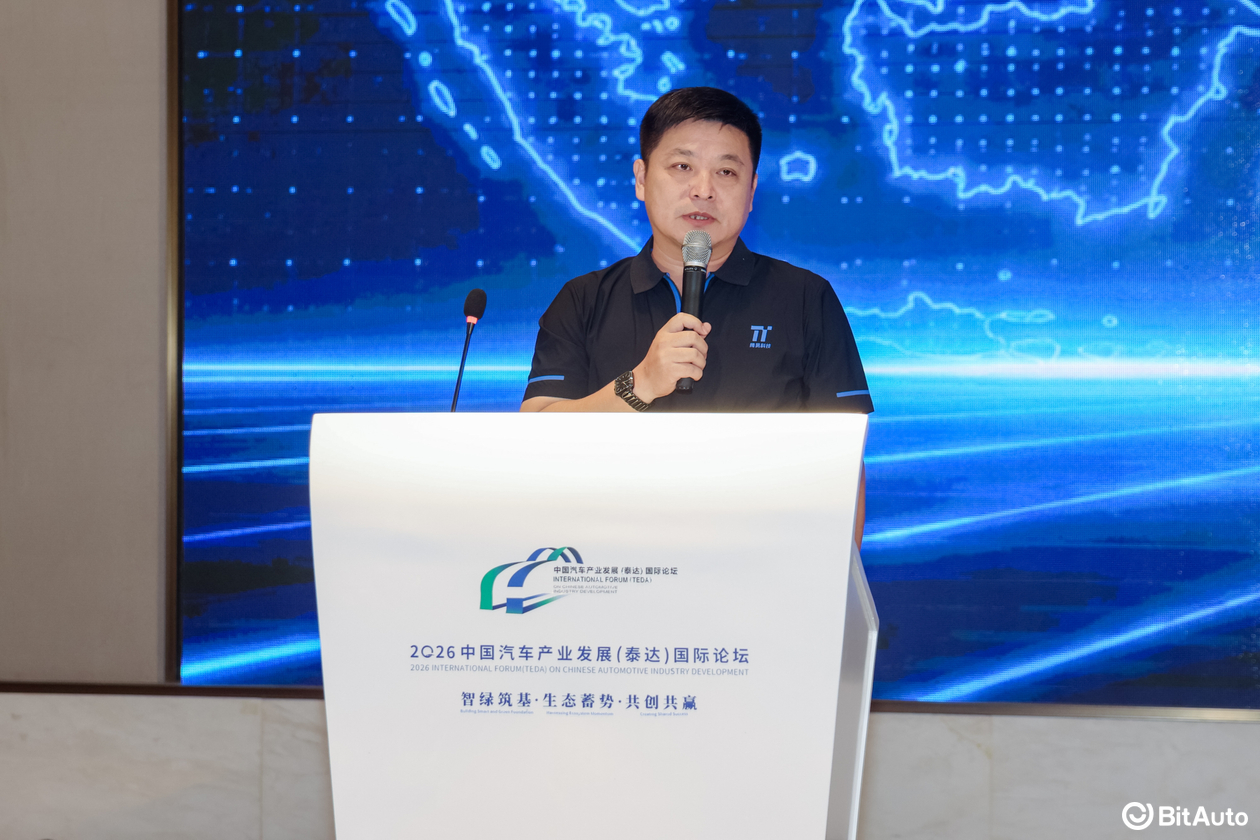
Li Wei, Vice President of Tengyi Technology and Director of BITAUTO TENGYI HK LIMITED , attended the forum and delivered a keynote speech titled "From 'Exporting Products' to 'Putting Down Roots'——Brand Communication Strategies for Chinese Car Brands in Southeast Asia". He shared insights into the global expansion trends of Chinese car marques, opportunities in the Southeast Asian automotive market, and how BitAuto leverages localised content and digital tools to help carmakers and dealerships build long-term operational capabilities.
The global automotive market is entering a new phase defined by "low growth and profound transformation". According to figures shared by Li Wei in his address, global passenger car sales reached 36.17 million units in the first half of 2026, up by 480,000 units year on year—representing a modest growth of just 1.3%. In contrast, China's vehicle exports hit 5.31 million units, surging 53% year on year, with full-year exports poised to surpass the 10-million-unit mark.
Since 2022, Chinese car brands have expanded their cumulative global market share by over 5 percentage points, highlighting their growing worldwide footprint. Li pointed out that the globalisation of Chinese carmakers has shifted from simply "shipping products overseas" to "exporting an entire ecosystem" spanning brand equity, customer service, and operational capabilities. Amid intensifying competition in overseas markets, automotive brands must look beyond pure product competitiveness; they need a deep understanding of local motorists to establish brand communication and operational models tailored to diverse market demands.
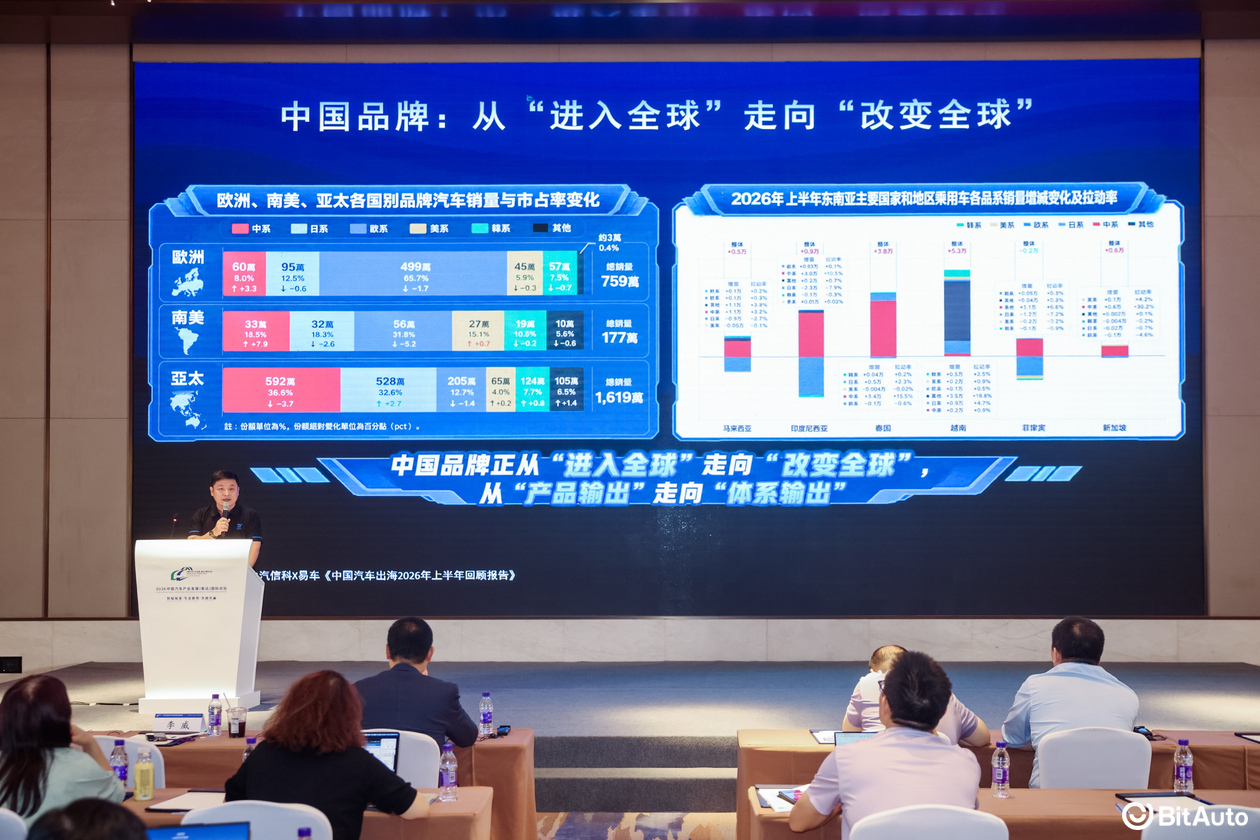
As Chinese carmakers ramp up their overseas footprint, Southeast Asia has emerged as a key strategic battlefield. According to figures shared by Li at the forum, passenger car sales across six Southeast Asian nations grew by 7.7% year on year in the first half of 2026. Among them, Chinese car brands achieved a 63.5% year-on-year surge in sales, lifting their market share by 6.8 percentage points and making them the fastest-growing brand collective in the region.
That said, Southeast Asia is far from a uniform, homogeneous market. Distinct differences exist across individual countries in terms of market scale, industrial infrastructure, consumer behaviour, and the penetration rate of Chinese marques. Li noted that Thailand and Indonesia have established themselves as sizable, core footholds; Singapore serves as an ideal showcase for brand image and new energy vehicle (NEV) tech promotion; while Malaysia and the Philippines present prime opportunities to capture existing market demand shifting from legacy marques. Meanwhile, in Vietnam, Chinese brands hold just a 1.4% market share, indicating a longer cultivation phase will be required.
Beyond volume growth, the Southeast Asian market offers multiple strategic advantages, including untapped upside, industrial capacity absorption, geographical proximity, and high consumer digital adoption. Li believes these factors position Southeast Asia not only as a pivotal strategic hub for Chinese carmakers going global, but also as a vital proving ground for refining localised operational models abroad.
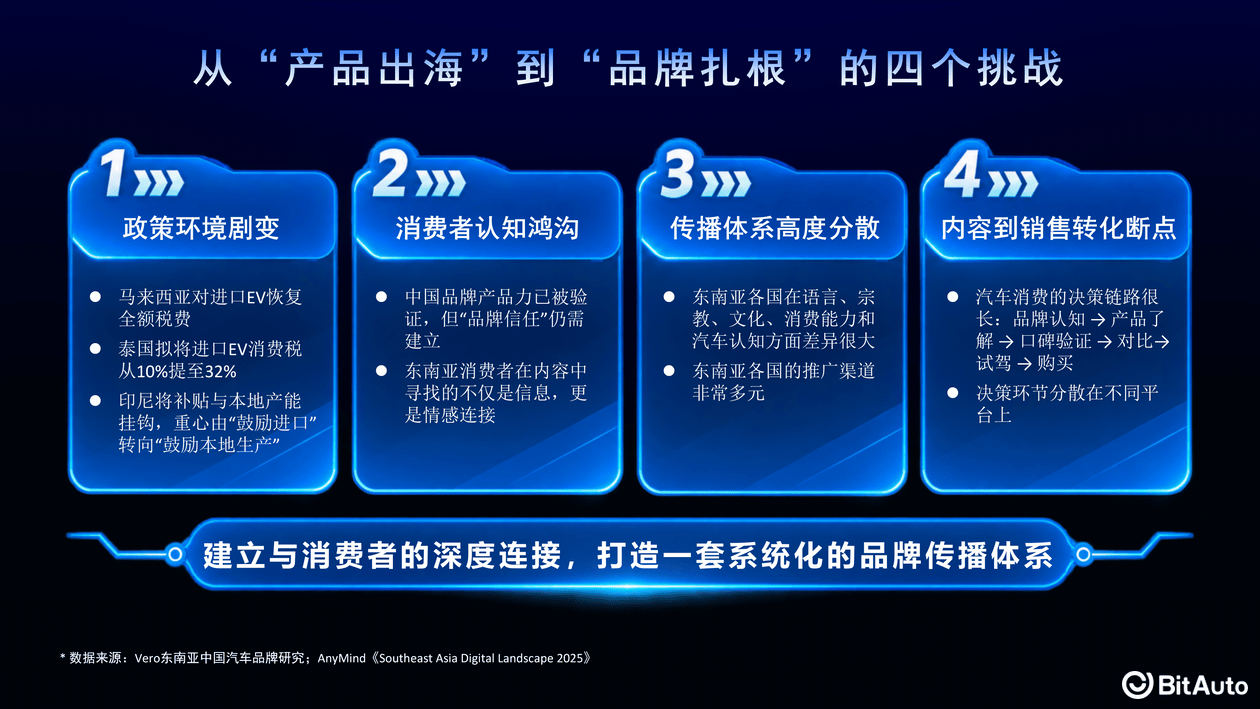
While Chinese car brands continue to gain ground in Southeast Asia, achieving sustainable long-term growth requires overcoming hurdles on multiple fronts. During his keynote, Li outlined four primary challenges facing Chinese carmakers expanding into the region.
First is policy volatility. Citing Malaysia, Thailand, and Indonesia, Li highlighted that shifts in NEV import tariffs, excise duties, and local assembly and production requirements inevitably impact overseas operational strategies.
Second is consumer perception and brand trust. For newcomer marques, compelling specs and competitive pricing do not automatically translate into buying intent. Brands must progressively build market awareness through consistent messaging and hands-on product experiences.
Third is channel fragmentation. With various social media and content platforms serving distinct communication roles, delivering brand messaging effectively to target car buyers has become an ongoing challenge for carmakers in local markets.
Finally, there is the conversion bottleneck between content reach and actual sales. Even when a brand captures consumer attention through compelling content, without robust lead follow-up and management mechanisms, that digital engagement often fails to translate into showroom visits, test drives, and closed deals.
To gain firsthand insight into day-to-day operations in Southeast Asia, BitAuto visited 16 car dealerships across Kuala Lumpur, Malaysia. The field research revealed that social media has become an essential customer acquisition channel for local dealers. All 16 surveyed dealerships actively leverage platforms like Facebook and TikTok to engage prospective buyers, routinely relying on WhatsApp for direct consumer communication.
However, high social media adoption does not equate to a mature digital operations setup. Out of the 16 dealerships surveyed, only 6 had dedicated teams assigned to screen initial customer enquiries, and none had implemented a systematic sales lead qualification or grading mechanism.
The findings indicate that while local dealers can generate interest via social media, substantial room for improvement remains in continuous content creation, customer need identification, and structured sales follow-up.
Li concluded that these issues boil down to two critical phases: "content and trust" on the front end, and "leads and conversion" on the back end. The former hinges on how carmakers build awareness and consumer confidence through content, while the latter depends on whether dealerships can effectively turn buyer interest into solid sales opportunities.
Addressing the marketing and operational demands of overseas auto markets, BitAuto bridges the gap between car buyers and dealerships through localised automotive information platforms, original content, and digital tools. To date, BitAuto has rolled out localised automotive portals in Malaysia and Hong Kong, alongside the debut of its global App in August 2026—enabling consumers across different markets to explore marques, compare models, and connect directly with local dealers.
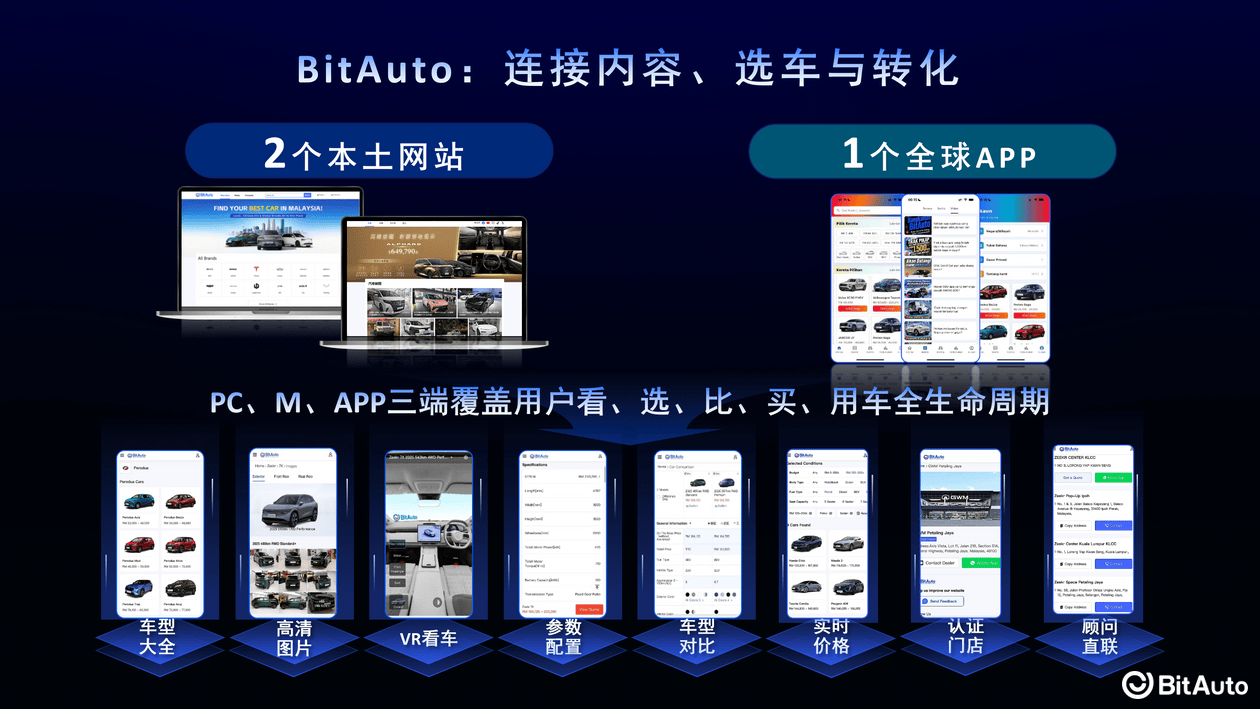
The platform features model specs, equipment lists, high-res galleries, live pricing, side-by-side vehicle comparisons, VR showroom tours, and direct access to verified dealers and sales consultants. This supports car buyers at every stage, from initial brand discovery to spec comparisons and quote enquiries. In his presentation, Li stressed that the platform itself is not the end goal; its real value lies in serving as a unified digital vehicle that links content communication with customer demand capture.
On the editorial front, BitAuto stays committed to serving local markets in their native languages, offering practical buying advice through professional reviews and diverse original features. Flagship editorial IPs, such as "BitAuto Head-to-Head Tests" and the "NEV Real-World Range Challenge", leverage standardised testing protocols and rigorous analysis to showcase genuine vehicle performance, helping carmakers establish professional credibility.
At the same time, BitAuto delivers multi-angle perspectives on brands and models through automotive news, new car test drives, motor show coverage, owner interviews, and AI video content. For car brands taking their first steps abroad, localised content not only boosts brand exposure but also helps prospective buyers grasp key product highlights, gradually fostering brand trust and purchase consideration.
Beyond content dissemination, BitAuto is rolling out dealer membership networks and lead management solutions in overseas markets to help retailers convert consumer interest into tangible sales. Once users finish browsing models, comparing specs, and checking prices on BitAuto, they can directly request price quotes from dealerships or reach out to sales consultants. The platform routes customer enquiries to dealers in real time and integrates with WhatsApp — the communication tool of choice in markets like Malaysia — substantially cutting response times from initial enquiry to sales engagement.
For dealers, the platform supports centralised multi-channel lead tracking, smart allocation, and structured follow-up, while logging showroom visits, test drives, and closed deals. Armed with these insights, carmakers and dealerships can evaluate the real-world return on specific content campaigns and promotions, providing data-backed guidance for subsequent editorial planning and ad spend.
Li highlighted that content communication and sales operations must not function as disconnected silos. Only by building brand trust through content, capturing customer intent via digital tools, and continuously refining marketing strategies with actual sales data can carmakers establish a truly complete overseas operational loop.
"Going global is no longer an optional extra for Chinese car brands; it is an absolute necessity," Li concluded in his closing remarks. The transition from simply exporting cars to putting down deep roots is fundamentally a shift from transactional sales to long-term sustainable business operations. For carmakers aiming to thrive internationally, having competitive products is only half the battle; they must also understand local motorists and cultivate robust brand communication and on-the-ground operational strength.
As Chinese car brands accelerate their global drive, adapting to local buying habits, market dynamics, and dealer requirements to build genuinely localised operating models will be vital. Moving forward, Tengyi Technology will continue leveraging BitAuto's content, data, and digital suite to help Chinese carmakers turn product strengths into brand trust, seamlessly bridging content communication with showroom sales to drive sustainable international growth.
Web: http://www.bitauto.hk/
YouTube: http://www.youtube.com/@bitautohk
Facebook: https://www.facebook.com/bitautohongkong/
Leave your number, an advisor will contact you


香港汽車內容平台 🚗 新車・買車・玩車・用車 用香港視角,睇世界嘅車
+ Follow 【新車速報】紅旗進軍歐洲再出新車!全新純電 SUV EHS4 威尼斯全球首發,續航最高 470 公里,約 20 分鐘即可快速充電!
紅旗 EHS4 專為歐洲市場開發,融合東西方設計元素,配備 7 個安全氣囊及智能駕駛輔助技術,車廂空間利用率達 87.4%。如果呢部純電 SUV 登陸香港,你又會唔會考慮?
#紅旗 #HONGQI #EHS4 #新車速報 #BitAutoHongKong 9小时前
 【新車速報】Lotus 香港換新代理!Eletre、Emeya 即減逾 HK$40 萬,137.8 萬起入手?
Lotus 正式委任盛璟汽車成為香港全新授權代理!旗下 Eletre 600 及 Emeya 600 全新定價 HK$137.8 萬起,原價 HK$178.55 萬,並新增多項標準配置。
灣仔陳列室已投入服務,柴灣售後中心亦正在籌備。品牌未來更計劃引入 V8 超跑,並研究安排純電 Hypercar Evija 來港公開亮相!
你覺得 Lotus 今次重新出發,定價調整會否令更多香港車主考慮入手?
#Lotus #LotusEletre #LotusEmeya #BitAutoHongKong #新車速報 11小时前
 【新車速報】Tesla Cybercab 終於可以私人買入?約 HK$23.4 萬起!
Tesla 無人駕駛車 Cybercab 開始接受部分客戶私人購買,售價為US$29,990,折合約HK$23.4萬,預計 2026 年 12 月交付。不過,車主每月仲要支付約 HK$2,330 自動駕駛訂閱費,首月免費。
Cybercab 最大特色係完全冇軚盤、冇油門及制動踏板,採用雙座設計,主要依靠自動駕駛系統完成行程。目前只限美國指定地區及受支援範圍內使用,亦未能自由上路。
冇軚盤、冇腳踏,如果喺香港見到呢種車,你敢唔敢坐?
#Tesla #Cybercab #無人駕駛 #BitAutoHongKong #新車速報 1天前
Get the latest car news first!
【新車速報】紅旗進軍歐洲再出新車!全新純電 SUV EHS4 威尼斯全球首發,續航最高 470 公里,約 20 分鐘即可快速充電!
紅旗 EHS4 專為歐洲市場開發,融合東西方設計元素,配備 7 個安全氣囊及智能駕駛輔助技術,車廂空間利用率達 87.4%。如果呢部純電 SUV 登陸香港,你又會唔會考慮?
#紅旗 #HONGQI #EHS4 #新車速報 #BitAutoHongKong 9小时前 【新車速報】Lotus 香港換新代理!Eletre、Emeya 即減逾 HK$40 萬,137.8 萬起入手?
Lotus 正式委任盛璟汽車成為香港全新授權代理!旗下 Eletre 600 及 Emeya 600 全新定價 HK$137.8 萬起,原價 HK$178.55 萬,並新增多項標準配置。
灣仔陳列室已投入服務,柴灣售後中心亦正在籌備。品牌未來更計劃引入 V8 超跑,並研究安排純電 Hypercar Evija 來港公開亮相!
你覺得 Lotus 今次重新出發,定價調整會否令更多香港車主考慮入手?
#Lotus #LotusEletre #LotusEmeya #BitAutoHongKong #新車速報 11小时前 【新車速報】Tesla Cybercab 終於可以私人買入?約 HK$23.4 萬起!
Tesla 無人駕駛車 Cybercab 開始接受部分客戶私人購買,售價為US$29,990,折合約HK$23.4萬,預計 2026 年 12 月交付。不過,車主每月仲要支付約 HK$2,330 自動駕駛訂閱費,首月免費。
Cybercab 最大特色係完全冇軚盤、冇油門及制動踏板,採用雙座設計,主要依靠自動駕駛系統完成行程。目前只限美國指定地區及受支援範圍內使用,亦未能自由上路。
冇軚盤、冇腳踏,如果喺香港見到呢種車,你敢唔敢坐?
#Tesla #Cybercab #無人駕駛 #BitAutoHongKong #新車速報 1天前 
© 2024 Bitauto.com. All Rights Reserved.
Bitauto (www.yiche.com and www.bitauto.com) is one of the most visited automotive websites in China. We provide detailed info on Chinese car brands available in your area. Please note that the information provided on this website is based on publicly available data and is for reference only. It may not be fully updated or accurate at all times.

Help us improve our website


