首頁fitness

搜尋歷史
熱門搜尋
經銷商登入 / 註冊

May 28, 2026, Shanghai North Bund World Living Room.
Under the global broadcast cameras of Dragon TV, an unprecedented vehicle delivery ceremony is taking place. Here, there is no traditional press conference podium, leader speeches, PPT presentations, nor deliberately emotional performances.

Instead, there is a "global relay delivery" spanning the Eurasian continent and connecting multiple time zones. The Shanghai main venue connects with multiple domestic cities and overseas delivery points including London, UK; Jakarta, Indonesia; Singapore, etc. 15 brands under SAIC and 18 models are handed over to users baton by baton.

From Roewe to MG, from IM Motors to Shangjie, from Volkswagen and Audi to Buick and Cadillac, from Wuling to Maxus, SUNWIN, Hongyan, Yuejin, and Iveco — passenger cars and commercial vehicles share the stage, domestic and joint ventures stand shoulder to shoulder, and domestic and overseas launch together.
This is not a press conference in the traditional sense. SAIC defines it as a thorough "ritual innovation", a "mobile history open class" with users as the protagonists. It has created a narrative method never before seen in Chinese car brands.
The "Grand Reunion" only SAIC Motor Group can achieve: System Competitiveness
Why can only SAIC Motor Group achieve a ceremony like this?
Let's first look at what "family assets" this global relay mobilized. 15 brands under SAIC Motor Group appeared in full: the independent camp includes Roewe, MG, IM Motors, Shangjie, Wuling, Maxus, etc.; the joint venture camp includes Volkswagen, Audi, Buick, Cadillac, etc.; the commercial vehicle camp includes SUNWIN, Hongyan, Yuejin, Iveco, etc.
This is the most complete "family portrait" of China's automotive industry; no other car company can present the same full brand lineup.

More rare is the breadth of product coverage. From A0-class commuter cars to 500,000-level luxury flagships, from family travel to urban logistics and infrastructure transport. Whether it is Gen Z, multi-child families, urban wealth creators, or infrastructure builders, every user can find the car that belongs to them.

Passenger cars and commercial vehicles appearing together is itself the most vivid footnote to SAIC Motor Group's strategy of "promoting passenger and commercial vehicles together".
Furthermore, the spatial span of this delivery is an unprecedented test for Chinese car brands.
Multiple domestic cities and overseas locations operate simultaneously, spanning the Eurasian continent and crossing multiple time zones. Behind this is a set of mature global operating systems.

41 self-owned Ro-ro ship fleet, routes covering Europe, Mexico, Persian Gulf, Australia & New Zealand, etc.; 3 overseas R&D innovation centers, 4 overseas production and manufacturing centers, more than 3,000 dealership networks, more than 100 overseas parts production bases.
All of this constitutes the "family portrait" capability only SAIC Motor Group possesses.
From comprehensively transforming into new energy in 2014 to welcoming the 100 million vehicle milestone in 2026, a twelve-year zodiac cycle completes. SAIC Motor Group has completed a historic leap from "leading the pack" to "thousands of horses galloping".
Users Take Center Stage: Let Trust Become the Protagonist
The essence of ritual innovation is to invite users from the audience seats to the center of the stage; the protagonist of the delivery ceremony is not the car, but the people.
Most special is the 100 millionth user — Momenta CEO Cao Xudong. A partner turning into a car owner is the most vivid footnote of SAIC's open ecosystem. Cao Xudong announced at the scene that Momenta Level 3 autonomous driving capabilities will be launched first by SAIC.
There are also brand connections across generations.

London Intern Doctor Natalia inherited her grandfather's MG MGB. Two generations, the same brand. From grandfather's classic sports car to granddaughter's fully electric hatchback, MG has completed a half-century legacy in the UK market.
And in Shanghai, an old Roewe 750 owner passed his brand trust to his son-in-law — when Lu Xiaolei took the keys to the Roewe M7 Black Horse Edition, the "Ten-Year Trust Agreement" turned a new page.
Some stories show a deeper connection between cars and people.

Pang Fuqiang, a post-80s village party secretary in Lantian, Shaanxi, delivers meals to 74 left-behind elderly people every day with a tricycle. When he took the keys to the Wuling Rongguang EV Version, "Wuling builds whatever the people need" was no longer just a slogan.
In Dahua, Guangxi, charity blogger Liu Jia has cut hair for left-behind children in the mountains for five consecutive years. His car once broke down on a bumpy mountain road, and Buick extended help immediately. The Zhijing E7 he finally chose is a "perfect cockpit born for guardians".
Of course, the base color of 100 million vehicles comes from more than just individual users. DHL, Jiading Public Transport, DiShangTie, Henan Zhonglian Travel... Behind every commercial vehicle delivery is the story of an enterprise, a team, and an industrial chain striving.
No star endorsements, no influencer sales. Every car owner is the storyteller of their own life. This "decentralized" user narrative lets trust flow naturally and lets brands stop talking to themselves.
Creating a New Paradigm for Chinese Car Brand Narrative
The significance of this ritual innovation extends far beyond a delivery ceremony. It provides a completely new narrative sample for Chinese car brands.
Traditional press conferences are "informing" — the enterprise stands on stage and tells consumers "how good I am". SAIC's ceremony is "resonating" — the brand steps behind the scenes, letting users speak for the brand.
Dragon TV global broadcast, simultaneous delivery in multiple countries and places, user stories of different cultures and languages weaving together in the same space-time, forming a powerful emotional合力.

This is the first time a Chinese car brand has created a truly "global synchronous event". SAIC Motor Group lets users from all over the world speak their own language and tell their own stories with SAIC.
More importantly, SAIC Motor Group turned a corporate milestone into the industry's public memory. 100 million vehicles is not just SAIC Motor Group's sales number, but also the historical footnote of China's automotive industry going from nothing to something, from weak to strong.
From workers using hammers to knock out the first Phoenix Brand sedan in an alley in 1958, to delivering 100 million vehicles on the global stage in 2026 — this journey spanning nearly seventy years makes every delivery moment worth remembering.
This ceremony provides the industry with a completely new narrative sample: the best brand narrative is not what the enterprise says, but what the user feels.
Conclusion
Looking back at this delivery ceremony.
Without leader speeches, people remembered every real face. Without the brainwashing of product parameters, brand concepts went deep into the hearts of the people. Without deliberately emotional performances, the number 100 million gained warmth.

It lets people see SAIC Motor Group's unique system strength, see the true meaning of "Knows cars, understands you better", and also sees a new brand narrative possibility — the best stories are never told by the enterprise itself.
100 million vehicles is a milestone for SAIC Motor Group in making cars.
But harder than making 100 million cars is letting 100 million users become part of the brand story.
And SAIC Motor Group, succeeded.
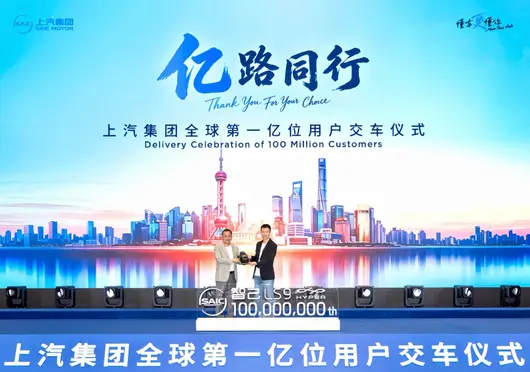

May 28, 2026, SAIC Group held a special vehicle delivery ceremony at Shanghai North Bund World Living Room. What makes it special is not how many leaders came, but because the protagonist changed to users, accurately speaking, it is SAIC's 100 millionth user globally.
100 million vehicles. This is a number never touched by a Chinese automotive group. From 1958 when workers hammered out the first Phoenix sedan with a hammer, to 2026 when over ten brands and nineteen models under its umbrella were delivered synchronously across continents, SAIC took 68 years to write itself into a new coordinate of the Chinese automotive industry.

Behind the 100 Million Vehicles, It's Not Just About Selling More
When many people see "100 million vehicles", their first reaction is: SAIC really sells a lot. This is not wrong, but only half right.
In the first four months of 2026, SAIC sold a cumulative 1.302 million vehicles, taking the crown as the top-selling car enterprise for four consecutive months. Among them, the share of independent brands is close to seven-tenths, new energy vehicles sold 412,000, and the overseas market surged 50.2% year-on-year. These numbers are indeed beautiful, but more worth looking at is the structure: independent brands account for 70%, overseas sales account for more than one-third. This shows SAIC is no longer the enterprise that relied on joint ventures for passive wins back then.

Starting from the localization of Santana, to Roewe creating the Internet car category, to the concentrated launch of high-end smart electric products like IM, Shangjie, and Huajing S, SAIC has taken a road that most traditional car enterprises are walking, but few walk smoothly: while stabilizing the core business in the joint venture sector, let independent brands truly stand up. Today, the outline of this road is quite clear.
Global Relay Delivery Is Not a Show, But Real Skill
The most interesting design of this delivery ceremony is "Global Relay". Outside the Shanghai main venue, delivery scenes in Nanjing, Liuzhou, Taiyuan, as well as the UK, Indonesia, Singapore and other countries and regions were lit up successively. Completing cross-continental, multi-brand, large-batch synchronized delivery on the same day tests not planning ability, but the hard strength of supply chain and channels.
SAIC has over 100 parts production bases overseas, over 3,000 dealer networks. It has built three R&D innovation centers such as London, as well as four production and manufacturing centers in Thailand, Indonesia, India, and Pakistan. Anji Logistics 42 Ro-Ro ships, 8 international routes connected Southeast Asia, Europe, Americas. The facts stacked out by these numbers are: SAIC is one of the few Chinese car groups that truly has global operation capabilities.

MG has been the top-selling Chinese brand in the European market for 11 consecutive years. In 2025, annual sales in Europe broke through 300,000 vehicles, and cumulative sales broke one million in the UK and European markets. This is not a small-scale export, but a head-on confrontation in mature markets. In March this year, the semi-solid-state batteries and Hybrid+ hybrid technology released by MG at the Frankfurt Technology Day, overseas monthly sales have already broken 20,000 vehicles. From "Product Going Global" to "Value Chain Going Global", SAIC's Glocal strategy is being realized.
What Truly Matters Is Whether "Understanding You" Can Be Done Properly
SAIC proposed a slogan called "Know Cars, Know You Better". The first half is basic skills, the second half is the dividing line.
At this delivery ceremony, SAIC did not invite celebrities to endorse, but found real users to tell stories: Luo Zhenyu from Dedao APP, as Huajing S Experience Officer No. 001, talked about Qiankun Intelligent Driving from the New Year's Eve Speech to walking into the factory to witness the launch; former national football player Yang Chen chose ID. ERA 9X, with the reason that Golden Extended Range and Long-termism concepts fit; charity blogger Liu Jia shaved the hair of left-behind children in Guangxi mountainous areas for five consecutive years, Buick not only assisted him, but he himself was also moved by the Zhijing E7 cabin. These stories are not big on their own, but put together, they spell out the signal SAIC wants to convey: Users are not the end point of payment, but the starting point of R&D and service.

Product itself. Volkswagen ID. ERA 9X globally launched Momenta R7 Reinforcement Learning World Model, one month after launch delivery broke 7,000 units; AUDI E7X plans to become Audi's first L3 level landing model globally; Buick Zhijing E7 based on "Xiaoyao" Super Fusion Architecture, one month after launch delivery broke 10,000. The common point of these products is: technology no longer stays on the parameter sheet, but becomes experience perceived by users.
100 Million Vehicles is a Period, Even More a Colon
To be honest, this number of 100 million vehicles is not rare among global automotive giants. Toyota and Volkswagen have long been members of the "100 Million Club". But for the Chinese automotive industry, this is the first time a local enterprise has crossed this line, the meaning is different.
What is more important is not the celebration, but how to go next. SAIC itself is also very clear, positioning this 100 million vehicle delivery as the "starting line of second entrepreneurship". From the establishment of Shanghai Internal Combustion Engine Parts Manufacturing Company in 1955, to the present day where the full brand matrix moves forward together in the global market, SAIC has proved that traditional car enterprises can also complete the "turning the elephant around". But the battle of intelligent electric transformation has only reached the halftime, the next competition will be more cruel, semi-solid-state batteries, AI large model onboard, L3 level autonomous driving landing, every item is a tough fight.
100 million vehicles are the answer sheet SAIC gave to the past, and also the test question given to the future. The tools for answering are already here: full value chain system, global layout, dual engine of independence and joint ventures running in parallel. Whether it can be answered well depends on how deep the sentence "Know Cars, Know You Better" can be implemented.

Folks, today let's talk about big news on going global—not selling cars, but selling "drivers". On June 2, WeRide and Uber jointly announced a plan: to launch the country's first commercial Robotaxi pilot service in Madrid, Spain. In other words: Spanish residents will soon be able to hail a driverless taxi via Uber. This is the first time WeRide and Uber are partnering to enter the European market. Madrid also becomes the 12th city globally where WeRide's Robotaxi arrives.
According to official news, with the support of the Madrid regional government, this service will officially launch within this year. At that time, friends in Madrid can open the Uber App and call WeRide's Robotaxi with one click. It's just like calling an ordinary ride-hailing service, the difference is the arriving car has no driver—at least initially, there is still a difference. In the initial operation phase, a professionally trained safety monitor will be on board, as it's just launched, safety comes first.
This company, WeRide, you might have heard of it, or you might not. A brief introduction: Established in 2017, it has been dedicated to Robotaxi technology R&D and commercialization. Currently, its Robotaxis cover Guangzhou, Beijing, Singapore, Abu Dhabi, Dubai, Riyadh, Zurich... plus Madrid now, totaling 12 cities. Spain is also the 5th European market WeRide has entered—previously entered Switzerland, France, Belgium, Slovakia. According to the plan agreed by WeRide and Uber in May 2025, they plan to deploy Robotaxi services in 15 new international cities within five years, deploying tens of thousands of Robotaxis globally. With the Madrid launch, the deployment in 4 cities has been completed, and 11 more will be covered successively before 2030.
To be honest, it's not the first time Chinese autonomous driving companies are going global, but the combination of Chinese technology + global mobility platform + European market is quite interesting. Madrid is one of the European Robotaxi markets with the most commercial potential, with a large population, high travel demand, and friendly local policies. Being able to take root in this market is a significant milestone for WeRide. For Uber, introducing Robotaxis is also a way to reduce costs—after all, drivers don't need salaries. For Madrid residents, hailing a taxi might be cheaper in the future.