


首頁VinFast VF 3

搜尋歷史
熱門搜尋
經銷商登入 / 註冊


To begin with, calling VinFast the "Vietnamese BYD" is clearly an exaggeration, as there is no comparison between VinFast and BYD in terms of supply chain self-sufficiency or sales volume. However, if focusing on the Vietnamese market, looking solely at VinFast's growth speed after its start and its current dominant position, its achievements in the local market are no less than those of BYD.
This is why we have selected VinFast as the main focus today.
01
What is Vietnam's VinFast?
VinFast is an electric vehicle company under Vietnam's largest private enterprise, Vingroup. Founded in 2017, it is the first independent car brand in Vietnamese history.
Through buying technology and assembling fuel vehicles, it completed its initial three-year start. Later, in 2022, it fully transitioned to pure electric. In 2023, it listed on Nasdaq. Starting from 2024, it surpassed overseas brands like Toyota and Hyundai to become the sales champion in Vietnam's local market. In 2025, it delivered nearly 197,000 vehicles, accounting for approximately 36% of the Vietnamese automotive market.

In the first seven months of this year, VinFast's sales increased by 74% year-on-year again, reaching 138,000 units. Its growth rate was the highest among all local mainstream brands. Its sales volume was greater than the combined total of several overseas brands such as Toyota, Kia, Hyundai, and Mitsubishi. Furthermore, almost all of VinFast's sales were fully electric models. With this single brand, Vietnam's pure electric vehicle penetration rate has leaped into the top tier globally.
However, behind VinFast's dazzling halo lies a huge shadow — within three years of listing, VinFast's cumulative losses exceeded $9 billion, with a net loss of $3.87 billion in 2025. In May this year, VinFast launched its largest restructuring, spinning off its local manufacturing business in Vietnam to the founder's related consortium for about $530 million. The listed company shifted to an asset-light model while setting a goal to achieve profitability by 2027.
In the process of VinFast's rise, Chinese batteries, Chinese components, and Chinese production line equipment played a far more important role than public perception. At the same time, Chinese complete vehicle brands sweeping the Southeast Asian market are the only ones struggling in Vietnam.
02
What kind of market is the Vietnam孕育ing VinFast?
The Vietnamese car market around the birth of VinFast had several distinct characteristics:
First, the market size is small. Annual sales are about 300,000 units, less than one-third of Thailand and one percent of China, almost ignorable on the global map;
Second, all are outsiders. The market is dominated by Toyota, Hyundai, Honda, Kia, and Mitsubishi, exclusively foreign brands, with no local carmakers;
Third, there is no high-end manufacturing. All factories are in CKD/SKD assembly form, importing CKD parts for local assembly. Local supply chains only stay at low-end parts, with no whole-vehicle R&D capability whatsoever;
Fourth, two-wheelers reign supreme. The fleet of motorcycles in Vietnam is about 60 million. For ordinary families, the first motorized vehicle is always a motorcycle, while cars remain luxury goods.

For overseas car companies, the Vietnamese market was once a haven for tax-avoidance assembly. With high整车 import tariffs, foreign brands formed joint ventures with local conglomerates to build assembly plants, assembling imported parts into complete vehicles and selling them to a small group of the wealthy. Vietnam provided labor, land, and market, while core technologies, brand premiums, and major profits all flowed out.
However, the demand shape of Vietnamese consumers is brewing a huge change. With per capita GDP approaching $2,500 and the middle class expanding rapidly, motorcycle-owning families universally have the idea of upgrading to four-wheeled vehicles. An annual increase market with nearly blank stock is thus exposed within the comfort zone of foreign brands.

VinFast founder Pham Nhat Vuong seized this opportunity. This richest man in Vietnam earned his first pot of gold in his early years by selling instant noodles in Ukraine. After returning home, he founded Vingroup, expanding his business to real estate, retail, hotels, hospitals, schools, and other fields, becoming Vietnam's largest private enterprise group.
His business logic is "if Vietnam lacks something, Vingroup will fill it". In 2017, what Vietnam lacked most was its own car brand. At that time, the Vietnamese government was vigorously promoting industrialization upgrades, desiring a national industrial card. Pham Nhat Vuong entering the market at this time stepped on national will, so from day one, VinFast carried the color of a national project.
03
How did the experience-less VinFast start rapidly?
VinFast had no car manufacturing experience. Forward R&D was not a viable option. Its method was simple and rough: spend heavily to purchase mature technology, gather global suppliers, and use capital to compress time.
In terms of production lines, it took over the production line and team of General Motors Vietnam (Hanoi plant), rebranded Chevrolet Spark to launch its first model, Fadil;

In terms of platforms, it purchased chassis and powertrain technology from the previous generation BMW 5 Series (F10) and X5 (F15) to develop sedan LUX A2.0 and SUV LUX SA2.0, with Magna Steyr responsible for engineering development and Italian Pininfarina responsible for exterior design;

In terms of speed, in September 2017, it laid the foundation for the factory on Cat Hai Island, Hai Phong City. It took only 21 months to complete construction and put it into production. This is a modern complete vehicle factory with a welding automation rate of about 90%.
In October 2018, VinFast completed its global premiere at the Paris Motor Show. In 2019, three fuel vehicles were launched, entering the top five in Vietnam sales that year. From establishment to mass production delivery, VinFast took only a little over two years. After seeing the breakthrough difficulties of traditional fuel vehicles and the huge potential of the new energy market, VinFast made a decisive electrification shift in 2022.
04
What kind of cars is VinFast selling?
VinFast's sales explosion truly started after the shift to electrification. Before discussing products specifically, let's first break down VinFast's basic vehicle building philosophy.
First, electrification one step done — skipping hybrids, full series pure electric (BEV), betting that emerging markets like Vietnam can skip the legacy fuel vehicle stock burden and go directly electric.

Second, full price range coverage. From micro cars like VF 3 equivalent to over 50,000 RMB, to the 300,000 RMB tier VF 9, to the ultra-luxury sub-brand Lac Hong (800S/900S) launched in 2026, filling every niche market with a "sea of cars".
Finally, by using battery leasing/subscription, free charging, and long-term warranties, it brought the usage cost of electric vehicles significantly lower than fuel vehicles, dissolving the residual value anxiety of emerging markets for electric vehicles.
Based on the above product philosophy, VinFast's product line was precisely positioned in every niche market.

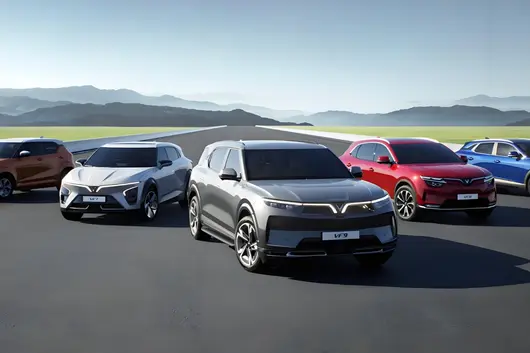
At the entry level, there is an A00 class micro box SUV named VF 3. In 2025, it won Vietnam's annual sales champion with 44,585 units, becoming the first car for young Vietnamese people. Following closely was the VF 5, positioned as an A class subcompact SUV, selling 43,913 units last year, the absolute main force in the entry-level family market.

In the mainstream price range, there is the Limo Green adopting a 7-seat layout targeting the commercial operation market. It became a hit when launched in August 2025, selling 27,000 units that year. The Herio Green, specializing in taxi and ride-hailing scenarios, contributed 12,600 units. Targeting home upgrade needs are the B class SUV VF 6 and C class SUV VF 7, with sales of 23,000 and over 9,600 units respectively last year.
Going up in price, there are the VF 8 and VF 9, positioned as SUVs above C class. They target markets like North America and Europe, bearing the brand's face.
Aside from four-wheel passenger cars, VinFast is also the largest electric two-wheeler brand in Vietnam. This business will not be discussed further.
05
Why can VinFast cars sell well?
Spreading the product line is not difficult, but in a market where overseas brands have deep roots, what exactly did VinFast's products rely on to become hits?

Let's look at the entry-level VF 3 first. This is the "national box" with full emotional value, adopting a rugged cute route. Square outline, unpainted black bumpers and wheel arches, two-door styling. It looks like a scaled-down Suzuki Jimny and resembles the Baojun Yunye in the domestic market. With 9 body colors plus paid custom colors, it is clearly going for "social media sharing".

The interior is minimalist, with a 10-inch screen as the focus. At only 3.11 meters in length, it has an 18.64 kWh LFP battery, with a range of about 210 km (NEDC). Fast charging from 10% to 70% takes 36 minutes. Such product power would be unremarkable in China, but in Vietnam, it precisely hit the largest group of people — young people and small families who commute on motorcycles every day. The price is not much different from high-end motorcycles, yet it provides shelter from wind and rain and shows personality.

The VF 5, bearing the sales pillar, adopts the family's new generation "Flying Bird" V-shaped DRLs. The appearance styling is rounded and friendly, the interior focuses on a refreshing tech feel, with a floating center console, simplified buttons, and a wide field of view.
With a 37.23 kWh battery, 100 kW front motor, and 182 mm ground clearance (tuned for Vietnamese waterlogging and poor roads), 10%–70% fast charging takes about 30 minutes. Space, range, and price achieve a balance that fuel cars in the same price range cannot offer simultaneously, matching the mainstream budget of first-time buying Vietnamese families.

Further up are the VF 6 and VF 7, with styling designed by Italian Torino Design. VF 6 is rounded and vivid, VF 7 has sharp edges. The interior centers on a 12.9-inch center console screen plus HUD. The full series has L2-level driver assistance. The above cabin configurations in Vietnam are basically still empty in joint venture fuel cars at the same price range.

The VF 7 has a motor power of 174 hp, a 59.6 kWh battery pack, and nearly 500 km range. It also has 349 hp dual-motor four-wheel drive with a 75.6 kWh large battery. This model's configuration in power and intelligence allows Vietnamese consumers to personally feel the generational gap between new energy and fuel vehicles in experience.
As for the VF 8 and VF 9 targeting overseas markets, both cars' designs are out of Pininfarina. VF 8 takes a "sporty elegant" route, while VF 9 is a 5.14-meter three-row flagship. Specific product power will not be discussed in detail, but one thing is they took a hit in reputation in the US, with US media even sharply criticizing VF 8 as "the worst car ever reviewed".
The above are the weapons VinFast uses to dominate Vietnam. Placing these products in China, they basically have no competitiveness. But in relatively closed Vietnam, each model basically achieves "unrivaled at the same price" — entry-level market eats up motorcycle upgrading groups; mainstream price level eats up passenger car first-time buying families; going up, uses intelligent configuration to out-flank joint ventures. This layered precise strike allows VinFast to gain an unprecedented sales explosion.
06
Why did Chinese car brands sweeping Southeast Asia fall silent in Vietnam?

Honestly, VinFast's current products cannot get any advantage over any mid-range and above Chinese new energy car company. But ironically, in Vietnam where new energy vehicle penetration rate has exceeded 40%, there is almost no presence of Chinese passenger car brands. Behind this is far from purely market competition.
First, the Vietnamese local champion has the best start. Chinese new energy brands entered the Vietnamese market around 2024, by which time VinFast had already completed the density monopoly of channels, charging networks, and after-sales networks, and locked down the mainstream price range with VF 3/VF 5. This weapon of cost-performance ratio, most good at by Chinese brands, collided exactly with the barrel of VinFast's guns.

Second, in terms of tariffs and policies, non-ASEAN complete vehicle import tariffs are about 15%. The EV exemption registration fee policy treats Chinese and foreign brands equally, but the Vietnamese government's industrial intent is to support VinFast, this local champion, not to make a dress for Chinese brands.
Additionally, there are consumer trust and national sentiment issues. The historical entanglements of China-Vietnam relations make Vietnamese consumers hold extra scrutiny towards Chinese brands. The stereotype of "cheap but unreliable" has not been reversed, while VinFast as a local brand has natural advantages in emotion.

So next, do Chinese car companies still have survival space in Vietnam? Or changing angle, do Chinese car companies need to strive to conquer Vietnam?
For some car companies, this willingness has already converted into practical action: BYD has announced building a factory in Phu Tho Province, Chery has implemented joint venture assembly projects, and Great Wall is planning local assembly plants. The Vietnamese layout of Chinese top players has shifted from complete vehicle exports to localization.
However, Chinese car companies' willingness to develop the Vietnamese market is not strong. Vietnam is the fastest growing and most radical electrification market in Southeast Asia. Absence means giving up a corner of the regional map, but its annual sales volume of 600,000 units is only about 60% of Thailand's, and it is occupied by local champions, so ROI is far lower than other markets like Indonesia, Philippines, etc.
Of course, from another angle, the Chinese industry chain has actually become an indispensable foundation for VinFast. It's just the sales champion title has no Chinese company's name. The absence of complete vehicle brands in Vietnam, in a sense, also symbolizes that China's electric supply chain is already strong enough to support the emergence of a local champion to keep the gate for itself.
07
Third-party observation summary

For over a hundred years, the automotive industry club has only accepted a few types of members: the US and Europe establishing technical barriers in advance, Japan and South Korea counterattacking with lean and systems, and China overtaking by electrification lane change. Historically, almost no country succeeded in squeezing into this table as a latecomer.
And now VinFast has provided a sample for the fourth path: using real estate capital to buy out time, using the Chinese supply chain to complete the trunk, using national will to rewrite policies, using ecosystem loops to secure the market. In eight years, the Vietnamese market known as the global top tier for pure electric penetration, from a blank local industry, to leaving Toyota and Hyundai behind.
Standing at a higher place to look, every step of VinFast's rise cannot be separated from the support of China's new energy industry chain. VinFast found the path suitable for its development, and for enterprises in China's automotive industry chain, hiding behind the scenes and indirectly occupying the local market is also a path to going global.
(END)

首先要說明,把 VinFast 稱為「越南比亞迪」明顯係誇張嘅描述,因為無論產業鏈自給率定係銷量規模,VinFast 同比亞迪都冇咩可比較性,但如果聚焦於越南市場,單看 VinFast 起步後嘅增长速度,定係當前喺越南市場嘅統治地位,佢喺本地市場取得嘅成就毫不遜色比亞迪。
而呢,亦就係我哋今日揀選 VinFast 做主角嘅原因。
01
越南嘅 VinFast 係咩?
VinFast 係越南最大民企 Vingroup 旗下嘅電動車公司,2017 年創立,係越南歷史上第一個自有自主品牌。
透過買技術組裝燃油車,佢完成咗最初三年嘅起步,之後 2022 年全面轉型純電,2023 年登陸納斯達克,2024 年起超越豐田、現代等海外品牌成為越南本地市場嘅銷量冠軍。2025 年交付近 19.7 萬輛、約佔越南汽車市場 36%。
今年頭七個月,VinFast 嘅銷量再次獲得 74% 嘅同比上升,達到 13.8 萬輛,增速係當地所有主流品牌當中最嘅一個,銷量規模比其後豐田、起亞、現代、三菱幾間海外品牌嘅總和仲多。且 VinFast 嘅銷量幾乎全部都係純電車型,憑此一家,越南嘅純電動車滲透率已經躍升至全球第一梯隊。
然而,VinFast 耀眼嘅光環背後,係巨大嘅陰影——上市三年入面,VinFast 累計虧損超 90 億美元,2025 年淨虧 38.7 億美元。今年 5 月份,VinFast 展開最大嘅重組,把越南本土製造業務以約 5.3 億美元剝離俾創辦人關聯財團,上市公司轉向輕資產模式,同時設定咗 2027 年實現盈利嘅目標。
喺 VinFast 崛起嘅過程中,中國電池、中國零部件、中國產線設備扮演咗比公眾認知更重要嘅角色。與此同時,橫掃東南亞市場嘅中國整車品牌,獨有喺越南步履維艱。
02
孕育 VinFast 嘅越南,係一個點樣嘅市場?
VinFast 誕生前後嘅越南车市,有幾個鮮明特徵:
其一,市場細細。年銷量約 30 萬輛,不足泰國嘅三分之一、中國嘅百分之一,放喺全球版圖上幾乎可以忽略;
其二,全部係外來者。市場由豐田、現代、本田、起亞、三菱分佔,清一色外資品牌,無一本地車廠;
其三,冇高端製造,所有工廠都係 CKD/SKD 組裝形態,進口散件、本地拼裝,本地配套僅停留在低端零部件,唔談得上任何整車研發能力;
其四,兩輪為王。摩托車喺越南嘅保有量約 6000 萬輛,普通家庭嘅第一部機動車,永遠係一輛摩托,汽車依舊係奢侈品。
對於海外車廠嚟講,越南市場一度係個避稅組裝樂園,整車進口關稅高企,外資品牌同本地財團合資建組裝廠,把進口嘅散件拼成整車,賣俾先富起來嘅一小撮人。越南出人、出地、出市場,核心技術、品牌溢價同利潤大頭全部外流。
不過越南消費者嘅需求形態,已經喺醞釀巨大變化,人均 GDP 逼近 2500 美元,中產階級快速膨脹,摩托車家庭普遍萌發升四輪嘅念頭。一個年增長可觀、存量近乎空白嘅市場,就咁晾喺外資品牌嘅舒適區入面。
VinFast 創辦人范日旺就捉住咗呢個契機,呢位越南首富早年靠喺烏克蘭賣方便麵賺到第一桶金,返國後創辦 Vingroup,把生意做到房地產、零售、酒店、醫院、學校等領域,成為越南最大嘅私營企業集團。
佢嘅商業邏輯,就係「越南缺咗咩,Vingroup 就補咩」。而 2017 年越南最缺嘅,就係自己嘅汽車品牌。彼時正逢越南政府大力推動工業化升級,渴望一張國家工業名片,范日旺此時入局,算係踩中咗國家意志,所以 VinFast 由第一日開始,就帶住國家工程色彩。
03
零經驗嘅 VinFast,點樣急速起步?
VinFast 冇任何造車經驗,正向自研唔係可行選擇,佢嘅方法簡單粗暴,就係斥巨資購入成熟技術、網羅全球供應商,用資本壓縮時間。
產線方面,接手通用汽車越南(河內工廠)嘅生產線同團隊,換標雪弗蘭 Spark 推出首款車型 Fadil;
平台方面,向寶馬購買上一代 5 系(F10)同 X5(F15)嘅車架同動力總成技術,開發出轎車 LUX A2.0 同 SUV LUX SA2.0,由麥格納斯泰爾負責工程開發、意大利 Pininfarina 負責外觀設計;
速度層面,2017 年 9 月喺海防市吉島奠基工廠,淨用 21 個月建成投產,這係一座焊接自動化率約 90% 嘅現代化整車廠。
2018 年 10 月,VinFast 喺巴黎車展完成全球首秀;2019 年三款燃油車上市,當年即躋身越南銷量前五。從成立到量產車交付,VinFast 只係用咗兩年多。而喺看到傳統燃油車嘅突破難度,以及新能源市場嘅巨大潛力後,VinFast 喺 2022 年又果斷進行咗電動車轉向。
04
VinFast 賣嘅,係咩樣嘅車?
VinFast 嘅銷量爆發,係從電動車轉向之後真正開始嘅,具體傾產品之前,我哋先拆解下 VinFast 嘅基礎造車理念。
首先,電動化一步到位——跳過混動,全系純電(BEV),賭越南咁樣嘅新興市場可以跳過燃油車存量包袱直接電動化。
其次,價格帶全覆蓋。從約合人民幣 5 萬多元嘅微型車 VF 3,到 30 萬元級嘅 VF 9,再到 2026 年推出嘅超豪華子品牌 Lac Hong(800S/900S),用「車海」填滿咗每個細分市場。
最後,透過電池租賃/訂閱、免費充電、超長質保,把電動車嘅使用成本打到明顯低於燃油車,消解新興市場對電動車嘅殘值焦慮。
基於上述產品理念,VinFast 嘅產品線,精準地卡喺每一個細分市場入面。
喺入門級,係一臺名為 VF 3 嘅 A00 級微型方盒子 SUV,2025 年以 44585 輛拿下越南全年銷冠,係越南年輕人嘅第一部車;緊隨其後嘅係定位 A 級小型 SUV 嘅 VF 5,去年銷量 43913 輛,係家庭入門市場嘅絕對主力。
主流價位,係採用 7 座佈局、瞄準營運市場嘅 Limo Green,喺 2025 年 8 月上市即成爆款,當年賣出 2.7 萬輛;專攻嘅士、網約車場景嘅 Herio Green,貢獻咗 1.26 萬輛;瞄準家用升級需求嘅,係定位 B 級 SUV 嘅 VF 6 同 C 級 SUV VF7,去年銷量分別達到 2.3 萬輛同 9600 多輛。
價格再往上,係定位 C 級以上 SUV 嘅 VF8 同 VF9,佢哋瞄準嘅係北美、歐洲等市場,承擔品牌嘅門面。
除咗四輪乘用車之外,VinFast 仲係越南最大嘅電動兩輪車品牌,呢塊業務就唔多提啦。
05
VinFast 嘅車,點解可以賣好?
把產品線鋪開唔難,但係喺海外品牌深耕已久嘅市場上,VinFast 嘅產品具體係靠咩成為爆款呢?
再看入門級嘅 VF 3,呢係情緒價值拉滿嘅「國民方盒子」,外觀走硬派可愛路線:方正輪廓、黑色無漆保險桿同輪眉、雙門造型,像一臺等比縮小嘅鈴木吉姆尼,都神似國內市場嘅寶駿悅也。9 種車身顏色外加付費定制色,明顯係衝住「喺社交媒體晒」去嘅。
內飾極簡,一塊 10 吋螢幕係焦點,車長淨係 3.11 米,18.64kWh 磷酸鋰鐵電池,續航約 210km(NEDC),快充 10%–70% 需 36 分鐘。呢樣嘢產品力放喺中國毫不起眼,但係喺越南,佢精準命中咗最龐大嘅人群——亦就係嗰啲每日騎摩托上班嘅年輕人同細家庭。價格同高端摩托相唔差幾多,卻可以遮風擋雨、彰顯個性。
承擔銷量支柱嘅 VF 5,採用咗家族新一代「飛鳥」V 形日行燈,外觀造型圓潤親和,內飾主打清爽科技感,懸浮式中控、按鍵簡化、視野開闊。
37.23kWh 電池、100kW 前電機、182mm 離地間隙(針對越南積水爛路調校),10%–70% 快充約 30 分鐘。空間、續航同價格做到同價位燃油車唔能夠同時做到嘅均衡,匹配越南首次購車家庭嘅主流預算。
再往上嘅 VF 6 同 VF 7,造型由意大利 Torino Design 操刀,VF 6 圓潤靈動、VF 7 棱角鋒利,內飾以 12.9 吋中控大螢幕 +HUD 抬頭顯示為中心,全系 L2 級輔助駕駛。以上呢啲座艙配備,喺越南同價位合資燃油車入面基本依然係一片空白。
VF 7 嘅電機功率 174 馬力,59.6kWh 電池組、近 500 公里續航,都有 349 馬力雙電機四驅,配 75.6kWh 大電池。呢款車型喺動力、智能化上嘅配備,可以讓越南消費者切實感受到新能源同燃油車喺體驗上嘅時代差距。
至於瞄準海外市場嘅 VF 8 同 VF 9,兩款車設計均出自 Pininfarina 之手,VF 8 走「運動優雅」路線、VF 9 係 5.14 米嘅三排旗艦。具體產品力唔細傾,惟有講佢哋喺美國嘅口碑翻過一次車,美媒甚至犀利咁將 VF 8 批為「史上評價最差嘅車」。
以上就係 VinFast 喺越南本土大殺四方嘅武器,呢啲產品放喺中國,基本都冇咩競爭力,但係喺相對封閉嘅越南,每款車型基本都做到咗「同價位無對手」——入門級市場,食咗摩托升級人群;平級主流價位、食咗乘用車首購家庭;再往上,用智能配備錯位打合資。這種分層精準打擊,令 VinFast 獲得咗前所未見嘅銷量爆發。
06
中國車企橫掃東南亞,點解喺越南啞火?
平心而論,VinFast 目前嘅產品,喺任何一個腰部以上嘅中國新能源車企面前,都討唔到咩宜。但吊詭嘅係,新能源車滲透率已經超過四成嘅越南,卻幾乎冇中國乘用車品牌嘅身影。而呢背後,遠非單純嘅市場競爭所導致。
首先,越南本土冠軍佔盡先機。中國新能源品牌 2024 年前後進入越南市場,VinFast 已經完成咗渠道、補能、售後網絡嘅密度壟斷,並以 VF 3/VF 5 把主流價位焊死,呢種中国品牌最擅長嘅性價比武器,恰好撞喺 VinFast 嘅炮口上。
其次,喺關稅同政策方面,非東盟整車進口關稅約 15%,電動車免註冊費政策雖對中外品牌一視同仁,但越南政府嘅產業意圖,就係要扶持 VinFast 呢個本土冠軍,而唔係替中国品牌作嫁衣。
此外,仲有消費者信任度同民族情緒嘅問題。中越關係嘅歷史糾葛使越南消費者對中国品牌抱負有額外嘅審視,「便宜但有問題」嘅刻板印象尚未扭轉,而 VinFast 作為本土品牌,喺情感方面有天然優勢。
那麼接下來,中國車企喺越南仲有生存空間嗎?或者換個角度,中國車企有必要努力攻堅越南嗎?
對於部分車企嚟講,呢種意願已經轉化咗做實際行動:比亞迪已經宣佈喺富壽省建廠,奇瑞落地合資組裝項目,長城則喺規劃本地組裝廠。中國頭部玩家嘅越南佈局,已從整車出口轉向本地化生產。
不過,中國車企開拓越南市場嘅意願,唔算強烈。越南係東南亞增長最快、電動化最激進嘅市場,缺席意味著讓出區域版圖一角,但其年銷 60 萬輛嘅體量,僅為泰國嘅六成左右,且被本土冠軍盤踞,投入產出比遠不如印尼、菲律賓等其他市場。
當然,從另一個角度嚟講,中國產業鏈其實已經成為 VinFast 不可或缺嘅根基,只係銷冠嘅名頭冇中國企業嘅名,整車品牌喺越南嘅缺席,某種意義上,亦象徵住中國電動供應鏈,已經強大到可以扶出一個本地冠軍來替自己守門。
07
第三方觀察總結
一百多年嚟,汽車工業嘅俱樂部只接納過幾類成員:先發建立技術壁壘嘅歐美,以精益同體系逆襲嘅日韓,以及用電動化換道超車嘅中國。後發國家想要擠進呢張牌桌,歷史上幾乎無人成功。
而而家 VinFast 畀出咗第四條路徑嘅樣本,就係用地產資本買斷時間,用中國供應鏈補齊軀幹,用國家意志改寫政策,用生態閉環圈住市場。八年時間,越南稱為全球純電滲透率第一梯隊嘅市場,從本土產業嘅一片空白,到把豐田、現代甩喺身後。
而喺更高處睇,VinFast 崛起嘅每一步,都離唔開中國新能源產業鏈嘅支撐。VinFast 搵到适合自己發展嘅路,而對於中國汽車產業鏈上嘅企業而言,隱居背後、間接佔據當地市場,亦唔失為一條出海之路。
(完)


