首頁Toyota

搜尋歷史
熱門搜尋
經銷商登入 / 註冊

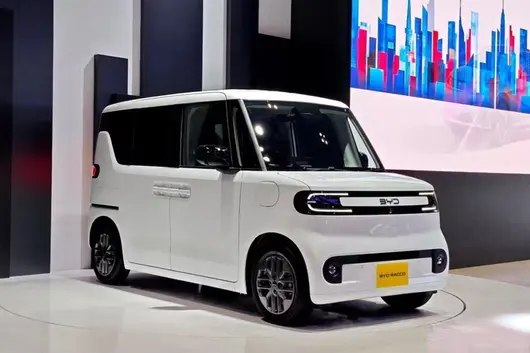
Many people have a stereotype about the Japanese car market, domestic brands firmly hold the core market, making it incredibly difficult for foreign brands to gain even a sliver of share. This impression is mostly correct, but in early September 2026, BYD gave the outside world a glimpse of substantial breakthrough by Chinese automakers in the local market of an automotive powerhouse with a performance report.
BYD Japan disclosed data; in August 2026, the brand's monthly orders reached 1,260 vehicles, setting a new monthly record since entering the Japanese market. Among the six models on sale, the light electric vehicle Raccoon (RACCO) is the core force driving growth. More notably, influenced by the Obon Festival holiday, Japanese dealers averaged only 16 operating days in August. Despite the compressed operating duration, cumulative orders by the end of the month approached 1,500, and foot traffic at authorized stores nationwide continued to rise.
Looking at 1,260 vehicles alone, it's almost negligible in the Chinese market; but placing it within the context of the Japanese market, the weight is completely different.

To understand the value of these 1,260 vehicles, one must first understand what K-Cars mean in Japan.
In 2025, Japan's new car total sales were 4.566 million, of which K-Car sales reached 1.667 million, accounting for 36.5%, meaning one out of every three new cars sold was a K-Car. This is a segment monopolized by three domestic giants: Suzuki, Daihatsu, and Honda, which together hold about 80% of the share. The Honda N-BOX ranked first in K-Car sales for the 11th consecutive year with over 200,000 units sold, even surpassing the Toyota Corolla to become the top-selling model across all Japan.
K-Cars are difficult to compete in because it's not simply about making cars smaller. They have globally unique regulatory standards: vehicle length not exceeding 3.4 meters, width not exceeding 1.48 meters, height not exceeding 2.0 meters, and displacement not exceeding 660cc for fuel versions. More importantly, they are bound to a set of policy benefits. Purchasing a K-Car in core cities like Tokyo and Osaka does not require a certificate of fixed parking space, and comprehensive taxes and fees are only about one-third of ordinary small passenger cars. This means foreign brands wanting to enter must develop an entire platform from scratch for the single Japanese market, with extremely high R&D costs that are hard to spread across sales volumes.
For this reason, for the past few decades, foreign brands have almost collectively been absent in the K-Car segment. BYD's Raccoon, however, is the first foreign brand K-Car developed from scratch specifically for the Japanese market in over 30 years, not an off-brand entry simply resizing an existing model.

If 1,260 vehicles is the result, then the hidden elements in the order structure are more convincing than the sales volume itself.
First, the users are genuine locals. BYD Japan revealed that about 80% of car buyers are new customers encountering BYD for the first time, with more than half previously using Japanese domestic brand models. This means a batch of ordinary Japanese families who originally held a wait-and-see stance or even bias towards Made in China are changing their perceptions through actual experience. As the president of BYD Japan said, "Driving performance, functions, and price make me feel surprised" has become a high-frequency evaluation among customers visiting the store.
Second, the transaction structure shows product power premium, not simply low prices. The Raccoon top-spec 300 Premium version accounts for about 80% of orders, priced at 2.497 million JPY, with a range of 320 kilometers. It is the first lightweight pure electric vehicle in Japan to break the 300-kilometer range barrier. In the order profile, 37.5% were additional purchases, 35.7% were replacements, and only 26.8% were first purchases. That is, many Japanese families actively chose BYD when buying another car or replacing an old one, which indicates the product is truly accepted more than price-sensitive first-time buyers.
1.
It hits the void long ignored by Japanese brands. In 2025, the penetration rate of pure electric K-Cars in Japan was only about 2.8%, and the top-selling pure electric K-Car, the Nissan Sakura, sold only 22,900 units in the whole year. Japanese giants have absolute monopoly on fuel K-Cars but moved slowly in this specific window of electrification. BYD cut in with superior configurations plus range advantages, exactly filling this gap.

If Japan is only treated as an isolated showpiece project, the global significance of this matter is underestimated. The breakthrough in Japan is a microcosm of BYD's overseas territory accelerating expansion.
On the sales side, overseas has become BYD's fastest-growing engine. In 2025, BYD's overseas sales reached 1.0496 million units, a year-on-year increase of over 145%, breaking the 1 million mark for the first time. In the first 5 months of 2026, overseas sales had already reached 614,500 units. Wang Chuanfu revealed at the June 2026 shareholder meeting that he has raised the overseas sales target for 2026 from 1.3 million to 1.5 million, and it is expected to be completed in excess. Looking at the medium to long term, BYD's goal is for domestic and overseas markets to each hold half the share.
On the production capacity side, localized manufacturing is hedging against tariffs and logistics costs. The Rayong Factory in Thailand started production in July 2024, with the 100,000th vehicle rolling off the line in May 2026; the Camaçari Factory in Brazil started production in July 2025, investment amount increased to 5.5 billion Reais, capacity plan expanded to 300,000 units; the Szeged Factory in Hungary plans to start production in Q4 2026, the first model is the Seagull for the European market; bases in Indonesia, Turkey, Uzbekistan, Cambodia, Malaysia, etc., are also landing successively. Phase I production capacity of 8 countries and 8 factories combined exceeds 1 million units, planning total capacity upper limit exceeds 2 million units. The 8 Ro-Ro ships self-built, single trip combined capacity exceeds 60,000 vehicle spaces, also holding the logistics link that blocks the neck of going overseas in their own hands.
This means that the localized breakthrough in the Japanese market is not an isolated case, but a validation of BYD's methodology of using local products and local factories to cover local markets in mature developed markets.
Zooming out, one can understand the connection between this order in Japan and that grand goal.
On June 9, 2026, Wang Chuanfu clearly stated at the BYD 2025 Annual General Meeting: In 5 years, strive to achieve the largest scale globally, and achieve 10 million annual production and sales by 2030. This goal is benchmarked against Toyota—the latter had global sales of about 11.32 million units in 2025, firmly holding the global first place.
From a numerical perspective, this is indeed a hard battle: BYD's 2025 sales were 4.6 million units. To reach 10 million units by 2030, it means the future five years need to maintain a compound growth rate of about 17% on average annually. To catch up with Toyota's volume, it requires an annual average of about 20%. Comparing with BYD's trajectory from 730,000 to 4.6 million units in the past five years, with a compound growth rate exceeding 60%, this growth rate requirement is not a pipe dream, but the difficulty is equally impossible to avoid. Wang Chuanfu himself admitted that the key constraint on the current sales climbing is the capacity of the 2nd generation Blade Battery, and greater capacity release will truly come in 2027.

Auto Car Review:
Of course, the 10 million target is not a done deal. Toyota's global system strength, Japanese and German electrification counterattacks, repeated tariff policies of various countries, supply chain climbing of batteries and chips, etc., are all variables.
But returning to the 1,260 orders at the beginning: What is most worth remembering is not the number itself, but the fact it proves something. In the place where Chinese car companies are hardest to be accepted, BYD, using the way of "respecting local rules, solving local pain points", won the real money of ordinary consumers.

The narrative of "cool domestically and hot internationally" has become the main theme of China's automotive market.
According to the latest data from CPCA, July domestic passenger car retail sales reached 1.461 million units, a 20.9% year-over-year decline. Year-to-date cumulative retail sales stand at 10.173 million units, down 20.3% from last year.
Meanwhile, July passenger car exports hit 918,000 units, surging 87.8% year-over-year, with the proportion of export volume to total manufacturer sales climbing to 41% (37% last month, 21% in the same period of 2025).

Regarding the "cool domestic market," CPCA analysis suggests this is due to the resonance of multiple factors, including oil price rebounds, weakening macroeconomics, seasonal slumps, prior demand exhaustion, and policy shifts.
Conversely, the contraction of domestic demand has accelerated the pace of Chinese car companies "going global"—since the domestic market is overcrowded, they go overseas to find blue oceans.
On this rising export curve, BYD's performance has been the most striking.
Data released by BYD shows that overseas sales reached 179,800 units in July, a 124.3% year-over-year increase. Even according to CPCA's statistical standards, BYD's 174,000 unit NEV export sales in July exceeded the combined total of the second-ranked (Chery, 83,000 units) and third-ranked (Tesla, 66,000 units) exporters, establishing a fractured leading advantage.

More importantly, BYD's export proportion of total sales in July rose to 43.1%. It is worth noting that just two years ago in 2024, this proportion was only a little over 10%.
This means BYD is no longer a Chinese brand simply relying on the domestic market, but a truly global car company. This has prompted the outside world to re-examine the strategic vision previously proposed by Wang Chuanfu of "achieving the largest scale globally in five years."
If BYD wants to "achieve the #1 global scale," it will face Toyota, this "giant."
Toyota's strength lies in its global production and sales network and extreme cost control in the fuel vehicle era. What BYD currently demonstrates is the ability to reconstruct the global market on the new energy track.
CPCA data shows that July NEV passenger car exports reached 540,000 units, up 147.8% year-over-year, accounting for 58.8% of total exports, an increase of 14 percentage points compared to the same period last year.
According to CPCA Secretary-General Cui Dongshu's statistics, from January to June 2026, China's NEV passenger car world share reached 62%, and the share in the plug-in hybrid field was as high as 71%.

The share of Chinese NEVs worldwide is rising rapidly. As the global NEV sales champion, BYD is actually standing at the forefront of the global output of China's supply chain.
Data shows that in the first half of 2026, Toyota's global sales were 5.0089 million units, ranking first globally for seven consecutive years; BYD's first-half global sales were 1.8085 million units, ranking sixth. The difference between the two was 3.62 million units, but the speed of narrowing the gap is accelerating—the gap was 13.4 times in 2021, narrowed to 2.7 times in 2023, and by the first half of 2026, the gap between the two is less than 1.7 times.
It took BYD less than two years to increase the export proportion from 10% to 40%. If the overseas market can maintain this growth rate, and Toyota continues to struggle in the quagmire of electrification transformation, then "surpassing" will no longer be a "whether possible" question, but a "when it happens" question.
But sales figures are just the most superficial things. What is truly worth thinking about is, what does BYD rely on to fill this gap of over 3 million units?
Toyota's foundation is a global fuel vehicle system that has been operating for decades; from supply chain to channels to brand perception, it is all stacked up by time.
BYD's opportunity lies in the fact that the technical logic and cost structure of NEVs are completely different from fuel vehicles. It does not need to fight position warfare in Toyota's home field, but uses a new product logic to find its entry point in every regional market.
BYD's overseas strategy can be summarized as "precise entry" and "deep localization." This strategy shows highly flexible adaptability in different regional markets. A highly representative case is the launch of BYD's K-Car in the Japanese market.

On July 28, BYD's pure electric K-Car "Sea Otter Racco," built specifically for the Japanese market, was launched. As of August 9, in less than two weeks, orders broke 1,000 units, with 80% coming from the top-spec version. For any car company wanting to penetrate the Japanese market, this is a capital worth "boasting" about.
It is worth noting that the Japanese market has long been a solid fortress of the global auto industry, with local brands holding absolute dominance. Even "giants" like Volkswagen and Hyundai find it difficult to open the Japanese market. Especially the K-Car market, which has an annual retail volume exceeding 1.6 million units and is known as the totem of Japanese auto culture, has been monopolized for over thirty years by three local giants: Suzuki, Daihatsu, and Honda.
More importantly, due to the adoption of Chinese self-developed parts, the Sea Otter can only receive a subsidy of 150,000 yen in Japan, while local competitors like Nissan Sakura can receive 580,000 yen. Under the subsidy disadvantage of three times that of competitors, orders still exceeded expectations. This directly shows that BYD has already possessed the strength to directly confront Japanese car companies in manufacturing processes and cost control.

An earlier example is BYD's Shark Pickup launched for the Americas, Australia, and other markets. It accurately hit the pain point of combining commercial and home use in the local market, becoming one of the best-selling Chinese brand models. CPCA data shows that BYD Shark Pickup overseas market monthly average sales are about 3,000 units, with sales in some months even exceeding 4,500 units.
Data released by BYD shows that under the boost of the Shark Pickup and subsequent imported Seagull and other NEV models, Brazil has become BYD's largest overseas market, with cumulative export volume reaching 194,700 units in the first half. Meanwhile, just on July 16, the 100,000th car of BYD Brazil factory officially rolled off the production line.
From Japan's exquisite K-Car to America's tough Pickup, BYD is no longer exporting "global products," but providing "regional customization." This transformation allows it to quickly fill the market void left by traditional brands.
Orient Securities forecasts that BYD's 2026 full-year sales will exceed 5 million units, with overseas sales between 1.8 million and 1.9 million units, a year-over-year growth of 75%.
Morgan Stanley predicts that BYD overseas sales will reach 1.6 million to 1.8 million units, with a year-over-year growth of 68% to 89%. It estimates that the company's passenger car share in markets like Brazil, Thailand, and Australia has exceeded 5%, and NEV sales share in multiple regions exceeds 20%.
Under the dual drive of "involution" and "going overseas," Chinese car companies represented by BYD are gradually transforming "surpassing Toyota" from a vision into reality through differentiated product strategies and deep localization layout. Whether it is the K-Car in the Japanese market or the Shark Pickup in the Americas, it proves that China's automotive industry has the ability to compete in the global diverse market.
In the future, with more companies like BYD digging deep in the overseas market, China's automotive industry's global share is expected to further increase, and the industry trend of "East Rising, West Declining" will be irreversible.
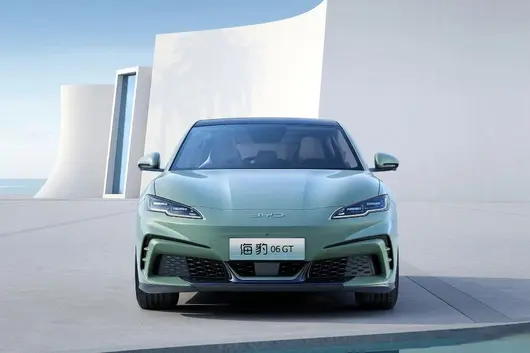

The global automotive market in the first half of 2026 delivered its results amidst multiple shifts: escalating geopolitical conflicts, repeated supply chain disruptions, and the electrification transition entering a critical phase. Looking at internationally mainstream automakers with announced data, the sales landscape shows significant differentiation: Japanese, German, and American traditional giants generally face pressure and decline, while some Chinese independent brands and automakers focusing on emerging markets achieve resilient growth. This structural reshuffle reflects the profound reshaping of the global automotive industry landscape.
Toyota Retains Sales Crown, Multiple Chinese Brands Reach the Top Tier
According to the official H1 2026 global sales data announced by each automaker, Toyota Motor remained the sales champion for the first half of the year, with global sales of approximately 5.39 million units, a year-over-year decrease of 2.8%. This marks the first time Toyota has seen a year-over-year decline in global H1 sales in two years. The Volkswagen Group ranked second globally with approximately 4.126 million sales, with the year-over-year decline widening to 6.3%, a gap of 1.26 million units from Toyota. The Hyundai Motor Group (combined Hyundai and Kia) had a total H1 sales of approximately 3.579 million units, overall performance relatively stable, holding the third place globally.

(Note: Some automakers have not yet announced H1 sales data)
The Stellantis Group ranked fourth with H1 sales of 2.958 million units, the only traditional giant achieving double-digit positive growth, with a year-over-year increase of 11%, demonstrating surprising resilience and elasticity. Stellantis Group H1 global sales were approximately 1.36 million units in the first quarter, a year-over-year increase of 12%; 1.597 million units in the second quarter, a year-over-year increase of 10%, mainly driven by the North American and European markets.
General Motors delivered approximately 2.721 million units in the first half of the year, a year-over-year decrease of 8.9%. However, benefiting from the high premium of North American pickups and SUVs, its sales revenue instead grew counter-trend slightly to $91.7 billion, showing the rare characteristic of "volume down, profit stable".
Notably, Chinese brands occupy three spots on the top 10 list. BYD's cumulative sales reached 1.809 million units in the first half of the year, a year-over-year decrease of 15.7%. Geely's total sales for the first half of the year were approximately 1.423 million units, including brands such as Geely, Lynk & Co, and Zeekr, a slight year-over-year increase of 1%, with new energy product penetration reaching 56%. During the same period, Chery Group's total sales for the first half of the year reached 1.358 million units, a year-over-year increase of 7.7%, setting a new historical high. Among them, June single-month sales were 256,612 units, a year-over-year increase of 9.8%.
Japanese automaker Suzuki's total sales for the first half of the year were 1.8 million units, a significant year-over-year increase of 110.3%. The company saw sales growth in markets such as India, Indonesia, Pakistan, and Africa, driving its overseas H1 sales to a new record. Nissan's sales for the first half of the year were 1.506 million units, a year-over-year decrease of 6.7%, continuing the sluggish trend of recent years.
Traditional Giants Lose Speed: Loss of China Market Resonates with Middle East Geopolitical Impact
In traditional automakers where performance declined, the sluggish sales in the China market, the spillover effects of Middle East geopolitical conflicts, US tariffs, and the retreat of electric vehicle policies, together formed the "headwinds" suppressing their global performance.
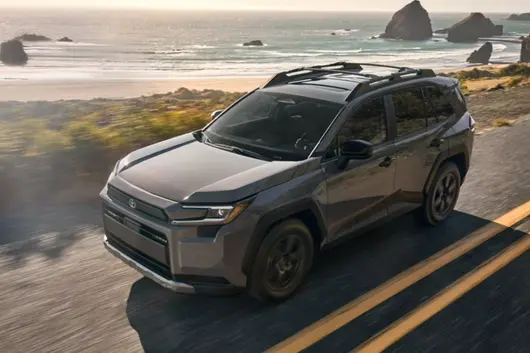
An announcement issued by Toyota Motor at the end of July stated that due to weakening demand in the Chinese market and the drag from model replacement adjustments of the popular model RAV4, the company's global production and sales in the first half of the year saw a decline. From January to June this year, Toyota's sales in the Chinese market plummeted by 17.1%, offsetting demand growth in the North American and Japanese markets. In the announcement, the Toyota Group stated: "North American and Japanese market demand is stable, demand for hybrid models and other models in the North American market remains strong, but was offset by the decline in sales in the Chinese market."

Image Source: Toyota Motor
Geopolitical conflict combined with fierce competition in the Chinese market has begun to impact the profit records set by Toyota in the previous fiscal year. In June this year, sales of Toyota and Lexus brands in the Middle East region decreased by 24% year-over-year, while sales in the Chinese market decreased by 27% year-over-year. At the performance conference in May this year, Toyota stated that the automaker exports approximately 500,000 to 600,000 vehicles to the Middle East annually, and the company estimates that nearly half of the export volume could be impacted by the situation in the Middle East.
However, Toyota also adjusted the combined sales forecast for automobiles upwards by 100,000 units from the previous forecast, to 9.7 million units, a figure higher than the previous fiscal year's total sales of 9.595 million units. Toyota stated that the upward adjustment originated from strong demand in North American and European markets, while alternative logistics channels to the Middle East were completed, driving a recovery in local sales.
Volkswagen Group's performance pressure in the first half of the year was also highly concentrated in the Asia-Pacific market, where the decline in the Chinese market was particularly obvious. Volkswagen delivered 24% less in the Asia-Pacific market in the first half of the year, and deliveries in the Chinese market decreased by 25.9% year-over-year. From the perspective of sub-sectors, the downward trend of pure electric models is particularly significant: from January to June this year, Volkswagen Group's deliveries of pure electric models in China plummeted by 47.9%. Volkswagen also had a difficult situation in the North American market in the first half of the year, with pure electric business performance particularly pronounced. In the first half of the year, the group's sales of pure electric models in North America fell sharply by 68.8%, plummeting from 31,300 units in the same period last year to only 9,800 units in the first half of the year.
General Motors' global deliveries for the first half of the year decreased by 8.9%, but supported by stable prices and strong demand for pickups and SUVs, global sales revenue still climbed slightly, demonstrating the profit moat of the North American market. However, General Motors' performance in the Chinese market was also not optimistic, as its joint venture brands face all-round siege from Chinese local brands.
Chinese Brands: From Domestic Fierce Competition to Global Offense
Represented by automakers such as BYD, Geely, and Chery, Chinese automakers ranked high on the global sales list in the first half of the year, showing an unprecedented scale presence for Chinese brands. These three automakers supported overall sales with explosive growth in overseas markets. The core engine of these brands' growth has shifted from domestic to overseas, and the globalization of Chinese automakers is changing from slogans to reality.

Image Source: BYD
Although BYD's total sales declined in the first half of the year, its structural highlight lies in the continuous breakthrough in overseas markets — cumulative overseas sales of passenger cars and pickups reached 789,000 units, a year-over-year increase of 68%, and the proportion of overseas sales to total sales has exceeded 43%. This means BYD has transformed from a "Chinese new energy giant" into a true "global new energy automaker".
BYD's export destinations in the first half of the year showed a layout characteristic of "Latin America leading, Europe breaking out at multiple points, Oceania, Southeast Asia, and Middle East differentiated expansion". Brazil continues to firmly occupy the position of this automaker's largest overseas market, and the top five countries in Europe also rank in the top ten of BYD's export destinations.
Geely's total sales for the first half of the year were approximately 1.423 million units, with outstanding overseas export performance, cumulative exports of 474,228 units, a year-over-year increase of 158%, a figure that has already exceeded the total export volume for the full year of 2025. June single-month exports were 102,874 units, a year-over-year increase of 157%, a month-on-month increase of 21%, achieving year-over-year and month-on-month double growth for six consecutive months, marking that Geely's export business has entered the stage of scale release. Geely's new energy product export sales in the first half of the year were 277,189 units, a surge of 585% year-over-year, with new energy proportion reaching 59%.
As a leader of Chinese brands going global, Chery Automobile accumulated 943,817 exports in the first half of the year, a year-over-year increase of 71.5%, with export proportion approaching 70%, making it a Chinese brand with high degree of internationalization. In July, Chery's exports of automobiles were 202,533 units, a year-over-year increase of 70.1%, breaking the record for Chinese car single-month exports for five consecutive months, becoming the first Chinese automaker to break through 200,000 exports in a single month.
Summary:
In the second half of the year, the global automotive industry will still move forward heavily burdened: weak demand, continuous heating of trade protection, cost increases brought by Middle East turmoil, and logistics and supply chain disruptions, transnational automakers will continue to promote cost reduction, production capacity contraction, and adjustment of electrification pace. These factors will also lead to the global car market still being full of high uncertainty. But a clear trend has been established: with the rise of Chinese automakers, the global automotive industry is accelerating from "Triopoly of Japan, Germany, and America" to "Multipolar Competition".


Written by | Liu Ying
Edited by| Huang Dalu
Designed by | Zhen Youmei
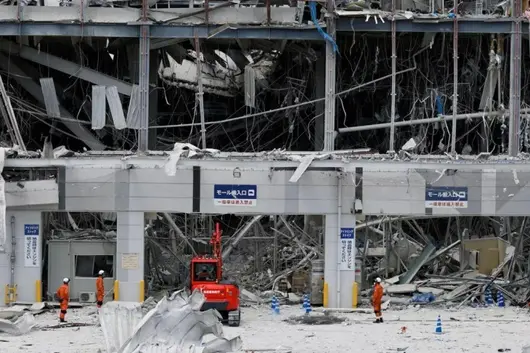
On the evening of July 28, 2026, the ground in Kyushu began to shake without warning.
On the assembly line at the Miyata Plant in Fukuoka Prefecture, robotic arms hung in mid-air and suddenly stopped. Workers put down their tools and quickly evacuated the workshop along the safety aisle. Minutes later, the production lines at the Kanda and Kokura plants also came to a standstill.
This was a magnitude 7.1 earthquake.
Toyota initially thought it could resume operations quickly, but several hours later, it had to shut down three plants again. Production was scheduled to resume on July 31, but the deadline was subsequently pushed back to August 5.
The shadow of the halt quickly spread from Kyushu to Honshu. Nissan HQ initially announced "production as usual" externally, but only two days later, due to parts not arriving at the factory in time, some production lines had to stop as well. A Toyota plant in Aichi Prefecture, over 600 kilometers away, was also affected.
As of August 4, 2026, four Toyota plants in Kyushu were still scheduled to shut down until August 5, and another plant in central Japan was scheduled to halt until August 7. Two of these four plants are vehicle assembly bases.

Such scenes are not unfamiliar to the Japanese automotive industry.
In 1995, factories in Kobe were filled with cracks after the earthquake; in 2004, the shutdown of a small factory in Niigata forced all four Honda production bases to stall simultaneously; in 2007, an inconspicuous piston ring held back half of the Japanese automotive companies; in 2011, a tsunami swept away factories along the coastline, and Toyota buyers traced layer by layer along supply relationship maps, finally marking 659 damaged supply points in the ruins.
For thirty years, Japanese car companies have continuously reinforced their supply chains, but this earthquake proved again that a factory withstanding impact does not mean the production line can be restarted immediately.
The Factory Withstood the Earthquake
The aftershocks had not yet subsided, but engineers were already wearing hard hats and walking back into the workshop with inspection checklists. The light beam from flashlights swept across weld seams, and precision equipment had to be checked one by one.
Toyota did not find large-scale structural damage in the three plants, yet they did not resume work.
Just because the factory looks undamaged does not mean production conditions have been restored. After violent shaking, the processing accuracy inside precision equipment may have quietly shifted. Engineers must remeasure and calibrate parameters, then confirm quality using prototype products. Only when equipment, pipelines, energy supply, and product accuracy all meet requirements can the production line restart.
The company's statement reflected a kind of caution: "Including aftershocks and recovery work, the situation changes every day."

During this period, Mitsubishi reduced production at its Mizushima Plant in Okayama Prefecture, and Honda extended the shutdown time at its Kumamoto Plant to repair damaged facilities.
The situation encountered by semiconductor factories was even more tricky.
In Renesas Electronics' two plants in Kumamoto, ceiling blocks fell off, walls cracked with fine patterns, and accumulated water seeped from damaged pipes. Sony and TSMC also suspended operations. Engineers crawled into clean rooms to check gas lines and precision equipment for shifts one by one.
TSMC began restoring partial operations several hours after the earthquake; Renesas planned to restart the Kumamoto Plant in phases from August 5; Sony, however, would not be able to restore production lines to pre-quake levels until mid-August.
Nobuhiko Kiuchi, Chief Economist at Nomura Research Institute, gave a relatively optimistic judgment: "The negative impact on production activities and supply chains may be relatively short-term."
The damage from this earthquake to housing and infrastructure was relatively limited, and the shutdown of many factories included a component of preventive inspection. However, for the automotive industry which calculates beats by the minute, "short-term shutdown" still means the loss of output from multiple shifts.
As long as one key supplier has not recovered, assembly lines hundreds of kilometers away may continue to wait.
For thirty years, the change in the Japanese automotive industry has not been to eliminate this waiting entirely, but to strive to make it happen less frequently and end faster.
Small Parts Stop Big Factories
Early morning on January 17, 1995, the Great Hanshin Earthquake tore through Kobe and surrounding industrial areas. Port crane arms twisted and deformed, roads split with deep gullies, and factories and warehouses revealed collapsed corners in the morning light.
Daihatsu's two assembly plants stopped production. Mazda, due to parts shortages, was forced to suspend Hiroshima and Hofu plants, with estimated losses of about 3,000 vehicle units.
Toyota's vehicle plants themselves were not heavily damaged, but the supply of brake calipers and audio components was cut off. The company could only close all assembly facilities in Japan, with an estimated reduction of about 20,000 vehicles.
Post-event statistics showed this earthquake damaged 13 supplier production points, a number not particularly large. But some of these parts had no inventory buffer, and no alternative factories could be found to immediately step in.
Nine years later, the story repeated itself.
In October 2004, the Chuetsu earthquake in Niigata Prefecture collapsed part of the Nippon Precision Machine Nagano Factory's facilities, stopping the instrument cluster production line abruptly. Honda's Saitama and Suzuka vehicle plants, Yachiyo Industrial's Yokkaichi micro-car plant, and the Kumamoto engine plant fell into silence in succession.
Honda later disclosed that the manufacturing precision required for analog instrument pointers was extremely high, and at that time most similar products globally were produced in Niigata. The company's risk management at the time mainly targeted parts "mass-produced in only one place," relying on increased inventory to leave some buffer for supply interruptions.
In July 2007, the Chuetsu-Oki earthquake in Niigata Prefecture struck again. The walls of Riken Kashiwazaki Factory cracked, and the supply of piston rings and other parts was interrupted.

Major Japanese car companies such as Toyota, Honda, Nissan, Mazda, Mitsubishi, and Suzuki successively halted or reduced production. Honda's work stoppage area expanded from Suzuka all the way to Saitama, Yokkaichi, Hamamatsu, and Kumamoto. Whether subsequent work could resume depended entirely on when Riken could restart its machines.
Multiple car companies sent engineers, equipment maintenance personnel, and even R&D personnel to Kashiwazaki to clean the factory area, repair water and electricity with Riken employees, and check machines one by one. Honda wrote in its official history that at that time almost the entire company was mobilized, including the R&D department.
Brake calipers, instrument pointers, and piston rings are not the most expensive components on a car, but they have similar supply characteristics: concentrated production locations, limited inventory, and specialized processes that are difficult to replicate quickly.
Even if another company has the capability to produce similar parts, it must go through matching, testing, and quality confirmation. Qualified parts cannot be directly installed on another car company's production line the day after the original factory halts production.
At that time, the recovery capability of the Japanese automotive industry relied more on the tacit understanding between companies to assist each other. When the original supplier restarted determined when assembly lines hundreds of kilometers away would resume rotation.
The bigger problem was that car companies did not even fully know where their parts actually came from.
First Time Seeing the Complete Supply Network
On March 11, 2011, the ground churned violently in Japan's Tohoku region, tsunamis followed closely, and the shadow of the Fukushima nuclear accident subsequently overshadowed the whole situation.
Ports were paralyzed, roads were broken, and power and communications were interrupted on a large scale. Toyota's own production facilities were relatively limited in damage, but parts and material shortages still caused the company to suspend all vehicle production in Japan starting from March 14.
On March 15, Toyota's procurement and production teams sent out investigation teams, braving aftershocks to visit the sites of about 200 suppliers, and then tracing layer by layer along procurement relationships to continue pursuing second-tier and third-tier suppliers.
Ultimately, the company confirmed 659 supply points were damaged, procurement interruptions involved 1,260 types of parts and materials, and in the worst case might affect about 80% of global models. About 500 types of materials needed immediate repair, production transfer, or alternative development from scratch.
Honda later found during a review that many Tier 1 suppliers used products from the same damaged material factory. The company previously knew nothing about this relationship and could only temporarily unite procurement and R&D departments to use alternative materials to re-develop parts.
Renesas Electronics' Naka Plant was one of the most serious breakpoints.

The main factory building withstood the earthquake, but internal equipment, ceilings, cables, and ventilation systems suffered severe damage, and the supply of automotive microcontrollers stopped abruptly. Engineers initially estimated it would take a full six months for the factory to recover.
Dan Mahoney, then President and CEO of Renesas Electronics Americas, later recalled: "These buildings withstood the earthquake, performing quite excellently."
While the walls were saved, the facilities inside the factory, which were intertwined and precise like watch gears, still needed to be repaired and adjusted bit by bit.
At its peak, about 2,500 employees and external contractors crowded into the Naka Plant to repair day and night. Multiple car companies and suppliers sent manpower and equipment, and competitors also voluntarily postponed their orders to make space for automotive chip production.
Renesas transferred about 60% of the affected output to other factories. The Naka Plant eventually recovered partial production in three months, three months earlier than initially expected.

Toyota originally expected that all global models and production lines would not fully recover until November or December 2011. As the materials needing key processing shrunk from about 500 types at the end of March to about 30 types in May, domestic Japanese plants returned to normal first in early July, while overseas production dragged on until September to approach full recovery.
Relevant studies later found that the disruptions caused by the Great East Japan Earthquake affected not only the disaster-hit enterprises but also transmitted to their direct and indirect suppliers and customers along the trading network. This earthquake and its supply chain chain reaction caused the growth rate of Japan's actual GDP in the following year to decline by about 0.47 percentage points.
After 2011, Japanese car companies finally realized that supply chain risks do not only come from visible Tier 1 suppliers. A material or chip factory hidden deep in the network can also bring global production to a halt.
To make the supply chain more resilient, the first step is not to prepare more rescue personnel, but to first see clearly where the breakpoints are.
From Calling One by One to Finding Breakpoints According to Maps
After the Great East Japan Earthquake, Toyota established the supply chain database RESCUE, entering the production locations and upstream and downstream relationships of about 6,800 types of materials into the system, and conducting disaster drills regularly with suppliers.
From then on, procurement personnel could filter suppliers by disaster-affected areas and quickly determine which parts, models, and plants might be affected.
Honda also entered parts and actual production locations into the SCRKeeper system. In 2011, Honda still needed to call one by one to confirm supply status; later, suppliers needed to pre-register manufacturing locations and distribution routes, allowing the procurement department to see where risks were concentrated earlier.
Nissan, on the other hand, focused its efforts on the first few minutes after the earthquake occurred.
On March 11, 2011, the company established the Global Disaster Control HQ at its Yokohama HQ in just 15 minutes, immediately starting to confirm the status of employees, plants, dealers, and suppliers. Three weeks before the earthquake occurred, Nissan had just completed a related drill.
These improvements were put to the test in the 2016 Kumamoto earthquake.

On April 14 and 16, two consecutive strong earthquakes struck. Aisin Kyushu and Aisin Kyushu Casting were forced to stop production, and continuous aftershocks made inspectors hesitate to enter the building interior. Wiring, pipes, and transformer facilities inside the factory were damaged, and power was cut.
As soon as the supply of doors and engine parts produced by Aisin was cut, Toyota suspended most vehicle assembly lines in Japan starting from April 18.
This time, damaged suppliers and relevant parts could be identified relatively quickly. But knowing where the breakpoint is does not mean molds, equipment, and manufacturing processes there can be immediately replicated.
Starting from April 19, huge cranes lifted equipment and molds out of damaged factories piece by piece and slowly loaded them onto trucks.
Aisin sent 339 employees to the disaster area to shift production to affiliated enterprises in the Kyushu region and Aichi plants, with some products even urgently imported from overseas. After molds and equipment arrived at alternative bases, they still had to go through installation, debugging, trial production, and quality confirmation; every step could not be omitted.
Supply chain databases solve the "where to find" problem, but they cannot omit the physical processes required to restore manufacturing capabilities.
Progress in supply chain management is not about making these processes disappear, but about discovering problems earlier, initiating transfers earlier, and shortening shutdown times as much as possible.
Toyota Leaves Months of Inventory for Semiconductors
After the Great East Japan Earthquake, Toyota also re-examined the relationship between Just-in-Time production and inventory.
The cycle from ordering to delivery for automotive chips is long, and production is highly concentrated. According to Reuters, Toyota subsequently required suppliers in its business continuity plan to reserve two to six months of semiconductor inventory for them according to their respective delivery cycles.
This arrangement did not extend to all automotive parts. Just-in-Time and low inventory are still the basic rules for most procurement links, only microcontrollers with long production cycles, highly concentrated supply, and difficult to find temporary alternative sources, were separately included in inventory buffers.
Toyota's spokesperson spoke frankly: "For us, this is a classic lean solution."
Toyota also requires companies to master core technologies of chips used in automobiles internally and cannot hand over semiconductor capabilities completely to suppliers. Long before the launch of the Prius, Toyota began accumulating design and manufacturing capabilities for microcontrollers.
Long-accumulated technical capabilities, combined with targeted inventory reserves, meant that Toyota's impact during the initial phase of the global chip shortage in 2021 was relatively small. However, when the duration of the shortage exceeded the scope that inventory could cover, Toyota still had to adjust production.

Inventory can buy time, but cannot indefinitely offset supply interruptions.
On January 1, 2024, the Noto Peninsula earthquake struck, affecting multiple Toyota suppliers and affiliated enterprises. Before the holiday had ended, Toyota's inventory checks and damaged plant investigations had already been launched.
On January 8, the company decided to maintain the operation of Japanese vehicle plants and stated externally: "We will use parts stored outside the disaster area."
Toyota first determined the production arrangement after January 8, then step by step decided how to produce in the next stage based on aftershocks and supplier recovery progress. By January 10, the company announced that production would continue according to plan after January 15, based precisely on inventory reserves outside the disaster area and the gradual recovery of some damaged suppliers.
Off-site inventory did not replace damaged factories, but bought them a few days of breathing time.
For automotive assembly lines that calculate part inventory by the hour, these few days often determine whether the factory needs to stop immediately.
From Factory to Power, Molten Aluminum, and Data
In September 2018, the Iburi East Earthquake in Hokkaido caused widespread power outages, with darkness covering the entire industrial area.
Powertrain parts such as gearboxes produced by Toyota Motor Hokkaido Co. were subsequently cut off. Multiple Toyota vehicle plants in Japan were affected by both power restrictions and parts shortages. Motomachi, Takada, Tsutsumi, Tahara, and group company production lines could only recover in stages from September 11 to 13.
Aisin later disclosed a thrilling detail.
The Hokkaido power outage lasted for more than two days, and the company urgently gathered temporary power generation equipment from all over Japan, just to prevent the molten aluminum in the holding furnace from solidifying during the power failure.
Once high-temperature metal hardens inside the furnace, the loss is no longer just a few production shifts, but will expand to the cleaning and long-term repair of the entire set of equipment.
After this, Aisin increased its own power generation equipment and regularly conducted simulated power outage tests, determining the power supply priority order for furnace bodies, information systems, and key production facilities during power outages one by one.
The scope of disaster prevention thus expanded from walls, equipment, and pipelines to energy, work-in-progress, and even production data itself.

The way of shutdown is also becoming more refined.
On February 13, 2021, a sudden strong earthquake hit off the coast of Fukushima Prefecture. Toyota suspended 14 production lines at 9 plants in Japan. RAV4, Harrier, Land Cruiser, and multiple Lexus models were affected.
In March 2022, a strong earthquake hit off the coast of Fukushima Prefecture again. Toyota's 18 production lines at 11 plants in Japan were suspended. Crown, Mirai, RAV4, Harrier, Land Cruiser, and multiple Lexus models were affected again.
Unlike shutting down all Japanese assembly facilities together in the past, companies at this time were already able to subdivide the shutdown arrangement to specific plants, production lines, models, dates, and even shifts based on parts supply conditions.
Production lines where parts arrived normally continued to operate, and lines short of materials quietly waited for suppliers to recover. Each factory no longer had to be forced to stop and restart together at the same rhythm.
Japanese car companies will still shut down, but the probability of one supply cutoff dragging down the entire production system is decreasing.
Saving Equipment Ten Years Ago, Verifying Quality Ten Years Later
In July 2026, Aisin Kumamoto Plant once again neared the epicenter. The shaking on site was even more violent than in 2016, some water pipes burst on sound, but the factory building and major equipment did not suffer serious damage.
Aisin CFO Daisuke Kondo stated that seismic measures implemented after 2016 reduced the losses caused by this earthquake. Nearly 200 Aisin employees, customers, and partner enterprise personnel then entered the site and invested in recovery work.
Ten years ago, the starting point of recovery work was completely different.
In 2016, Aisin had to rescue molds and large equipment from damaged factories first; in 2026, major equipment was preserved, and the focus of recovery work had shifted to quality verification, logistics recovery, and supplier coordination.

The factory was still shut down, but the work content had changed. Ten years ago, the company first had to re-establish manufacturing capabilities; ten years later, major manufacturing capabilities were preserved, and on-site personnel could enter earlier for inspection, debugging, and trial production.
The reinforcement measures after 2016 did not eliminate shutdowns, but reduced direct damage and shortened the distance from the earthquake occurrence to starting production recovery.
Over the past thirty years, the first layer of change in the Japanese automotive supply chain was formed here: supply networks became more transparent, factories and equipment became more robust, key materials had more targeted inventory, and companies could also control shutdown scopes by production line rather than the entire company.
The second layer of change occurred outside Japan.
Overseas Plants Provide a Second Layer of Buffer
Domestic disaster prevention infrastructure eventually has physical limits. Faced with Japan's frequent geological disasters, in terms of macro strategy, the globalization of production capacity (such as the rise of India and Thailand bases) passively or actively became the highest level of "risk hedging".
Data from the Japan Automobile Manufacturers Association shows that Japan's domestic motor vehicle production was 8.23 million units in 2024, down 8.5% year-on-year; in the same year, Japanese car companies' overseas vehicle production reached 16.48 million units, about twice the domestic production.
Overseas plants have long undertaken most of the car production for Japanese brands. In the past, these plants mainly served local markets; now, production bases in India and Thailand began to supply more models to the Japanese market, and the number of automotive reverse imports increased accordingly.

Suzuki Motor President Toshihiro Suzuki stated in January 2025 that India will become the global production base for Suzuki EVs, and the first EV, e Vitara, will be exported to Japan, Europe, and other markets.
Toshihiro Suzuki described this game as follows: "India's scale advantage is Suzuki's strength. We will fully utilize this advantage to provide high-quality and attractive products to markets such as Europe, Japan, the Middle East, Africa, and South and Central America."
Honda plans to use India as the production and export base for a new EV starting from 2027. Toyota, Honda, and Suzuki are also continuing to expand local investment. Lower labor costs, increasingly mature parts systems, and a huge local market jointly support this round of expansion.
The importance of Indian plants is not just about lower costs. When overseas bases can produce models for Japan and multiple countries, Japanese car companies gain greater space for production allocation.
But overseas plants are not mirror backups of Japanese factories that can be activated at any time.
Models produced in different factories, parts systems, dedicated equipment, and market specifications are not exactly the same. Shifting a car from Japan to be produced in India or Thailand still requires going through equipment preparation, supplier adjustment, quality confirmation, market certification, and logistics organization.
Therefore, global layout is difficult to solve the shutdown within days after an earthquake. It provides risk dispersion over a longer cycle: reducing enterprise dependence on a single production area, and allowing for the possibility of supplementing supply from other regions when some models are restricted from production in Japan.

Japanese domestic plants will not disappear for this reason.
Toyota announced in August 2025 that it will build a new vehicle plant in Toyota City, Aichi Prefecture, planned to start production in the early 2030s. This is the first time the company has built a new vehicle assembly plant in Japan proper since 2012.
At the same time, Toyota still maintains a long-term policy of annual production of about 3 million units in Japan, with about half used for export.
Nissan moves in the opposite direction. The company plans to stop vehicle production at the Tsu Plant before March 2028, transfer related output to Nissan Automotive Kyushu, and compress global annual capacity from 3.5 million units to 2.5 million units, reducing manufacturing bases from 17 to 10.
Tsu Plant started production in 1961 and has long been known as Nissan's "Mother Plant," cumulatively producing over 17.8 million cars. Before closing, it had about 3,900 employees. Nissan Japan plants have an average capacity utilization of only about 60%. After Tsu output is transferred to Kyushu, the company expects Kyushu plant's capacity utilization will rise to 100%.

A factory carrying memories of more than half a century is about to end vehicle production, while capacity concentrates on more efficient bases.
Toyota building new plants and Nissan closing plants look in opposite directions, but the logic behind them is interconnected: Japanese automotive manufacturing will not simply move entirely overseas, but will reallocate resources between local technical capabilities, production efficiency, and global capacity.
Overseas plants will undertake more mass-market models facing the Japanese and global markets; Japan proper will retain a large amount of vehicle production capacity, continuing to undertake export, high-end models, complex powertrains, and new process introduction.
Domestic and overseas are no longer just a choice of cost high or low, but gradually constitute two layers of supply chain resilience.
Thirty Years Have Passed
Over the past thirty years, the Japanese automotive supply chain has not become a network that will not break, but Japanese car companies have successively filled in several obvious gaps.
Dedicated equipment and molds still cannot be instantly replicated, precision production lines still need recalibration, and power, logistics, parts, and personnel still must be restored simultaneously. As long as automotive production continues to rely on highly specialized equipment and suppliers, earthquakes may still bring factories to a halt.
What truly changed is the way enterprises withstand interruptions.
The actual production location of suppliers has been entered into the database, so after an earthquake, it is not necessary to inquire layer by layer starting from Tier 1 suppliers; key chips have longer inventory, which can buy recovery time for damaged factories; factory buildings, equipment, and power systems have been reinforced so as not to start with rescuing molds and machines every time; shutdown arrangements can also be subdivided into specific plants, production lines, and shifts.
By 2026, Japanese car companies are already able to quickly locate affected suppliers, keep shutdowns within specific plants and production lines, and shift the focus of recovery to quality, logistics, and coordination under the condition that equipment is basically preserved.

Domestic plants rely on seismic reinforcement, supply chain databases, key inventory, and refined production management to shorten short-term shocks; overseas plants provide more long-term capacity dispersion for enterprises by undertaking more models.
The former allows car companies to stand up faster after earthquakes, while the latter reduces the production system's long-term dependence on a single region.
After thirty years, earthquakes will still force Toyota to stop and will also make Nissan assembly lines hundreds of kilometers away fall silent for not waiting for a part. But the Japanese automotive industry is clearer than before about where to start recovery and how to recover.
"Automotive Business Review" believes that in the era of intelligent electrification, when the dependence of cars on chips and precision electronics rises exponentially, the value of this "transparent supply chain" defense system exchanged by Japanese car companies for thirty years of earthquakes will be far greater than before.


Written by | Ying Liu
Edited by Dalu Huang
Designed by | Youmei Zhen
On June 5, 1950, Kiichiro Toyoda resigned as president. This founder, who brought the family loom business into the automotive industry, could not hand over the company directly to his children.
A labor-management standoff lasting two months ended with large-scale layoffs and executive resignations; 2,146 employees left, and the vice president and executive directors resigned alongside Kiichiro Toyoda on the same day. Over a month later, Juzo Ishida, president of Toyota Automatic Loom Works, concurrently took over as president of Toyota Motor Corporation, while Fumio Nakagawa and others from the banking background entered the new management team.
The turning point occurred on the twentieth day after Kiichiro Toyoda's resignation.
The outbreak of the Korean War brought truck orders from the US military, giving the bankrupt Toyota a reprieve. By March 1951, cumulative orders reached 4,679 units, totaling 3.66 billion yen. Factories resumed operations, and the books once again showed cash flow. By early 1952, the company was preparing to ask the founder to return and resume the presidency. However, just before the official comeback, Kiichiro Toyoda suddenly passed away at the age of 57.
Succession moments for Toyota have frequently undergone changes.
In 1967, President Fumio Nakagawa suffered a sudden heart attack after returning from a business trip to Tokyo; the presidential position remained vacant until after his funeral. In 1995, Shoichiro Toyoda was hospitalized for six months due to illness, interrupting the period of family control once again. In 2009, Akio Toyoda took charge amidst the company's predicted first annual operating loss since inception, later became involved in one of Toyota's most severe recall crises, and testified before the US Congress alongside Yoshimi Inaba, head of Toyota North America, in 2010.

Toyota also once had a secret succession.
In late 2022, at the Buriram Circuit in Thailand, Akio Toyoda asked Koji Sato, an engineer beside him, if he was willing to assume the presidency. Sato officially took office in April 2023. In April 2026, he transferred to the position of Vice Chairman and Chief Industry Officer, with Kenji Kondo succeeding him as President and CEO.
In 2026, another personnel change sparked external attention to the fifth generation of the family, but Toyota did not define it as a succession plan.
On August 1, 2026, Daisuke Toyoda, 38-year-old son of Akio Toyoda, will leave Woven by Toyota, the software company he co-created, and the first phase of Woven City, which has already been launched, as well as the second phase still under construction, to return to Toyota Motor Corporation. He will not join the board of directors, nor will he receive an executive title; instead, he will enter a department close to the vehicle development "frontline" (genba) as a project manager. Toyota has not disclosed the specific department or model.
Toyota has not publicly announced any successor. The company's history of nearly ninety years repeatedly proves that a name can provide credit during a crisis but may also raise doubts during a power transition.
The Fifth Generation Returns to the Vehicle Development Frontline
Woven City is built on the site of the old Toyota East Fuji factory, testing autonomous vehicles, robots, and logistics equipment in a real urban environment. In September 2025, Phase 1 officially launched, and the first residents began moving in, with multiple partner enterprises entering the co-creation phase; Phase 2 is currently still under construction.
As a founding member of Woven by Toyota, Senior Vice President, and core head of Woven City, Daisuke Toyoda once turned his gaze beyond automobiles. In a 2025 interview, he compared this city to his great-grandfather Kiichiro Toyoda entering the automotive industry and posed a question: "When we truly become a mobility company, will Toyota Motor still be the group's core? We don't know."
Less than a year later, he began to move back.

On June 1, 2026, Woven announced that Daisuke Toyoda would transfer to Toyota Motor Corporation on August 1. The company announcement did not disclose the new position. A Toyota spokesperson subsequently confirmed to Reuters that he would serve as a project manager, entering a department close to the vehicle development "frontline" (genba), but refused to specify the specific business division and model.
This means his work focus will shift from a city-level testing platform to vehicle development. However, since Toyota has not yet explained specific duties, it is currently impossible to judge whether he will independently be responsible for a specific model, nor can this confirm it is a succession training arrangement.
This is not his first time entering Toyota Motor Corporation. In 2016, he worked in the Electronic Control Engineering Department; in 2018, he transferred to Toyota's Advanced R&D subsidiary. Since then, his work has mainly focused on software, autonomous driving, and future mobility.
Counting from Sakichi Toyoda, he is the fifth generation of the family. Counting from Kiichiro Toyoda, the founder of Toyota Motor, he is the fourth generation of the automotive business.
However, Toyota's succession history has never followed a bloodline straight line since the first president.
1937: The First President Was Not a Blood Relative of Sakichi Toyoda
At the founding conference in August 1937, the person appointed as the first president was not Kiichiro Toyoda, who opened the automotive business, but Riichiro Toyoda. Kiichiro served as vice president and only assumed the presidency in 1941.
Riichiro was originally Riichiro Kodama. After marrying Aiko Toyoda, the eldest daughter of Sakichi Toyoda, in 1915, he was adopted by the family and changed his surname to Toyota. He came from the cotton textile industry, managed the family business for years, and naturally took the presidential seat upon the company's establishment.
In other words, the first president of Toyota Motor was both a family member and not a blood relative of Sakichi Toyoda. Marriage, adoption, management ability, and family trust, several forces together decided where this position would fall.
The early family boundaries of Toyota were inherently wider than a straight-line genealogy.
In 1936, the automotive business intentionally distanced itself from the family name. The logo solicitation received about 27,000 submissions, and finally, the brand name was changed from the Katakana writing of the family surname "トヨダ" (Toyoda) to "トヨタ" (Toyota), and the Roman alphabet spelling was also changed to "Toyota".
Toyota's official reasons included: the new name uses unvoiced sounds, sounding clearer than the voiced sound of "Toyoda"; the Katakana writing of "トヨタ" is exactly eight strokes, and eight strokes are considered related to wealth and good fortune. This name change also symbolized the enterprise moving from a small independent company to a larger-scale company.

In Chinese, both "Toyoda" and "Toyota" are written as "Toyota", a subtle distinction that is easily overlooked. But this rewrite of the Japanese and English names drew a clear line: the enterprise comes from the Toyota family but does not belong solely to the Toyota family.
Even so, the Toyota surname remains deeply embedded in the company's DNA. Sakichi Toyoda left the automatic loom and the concept of "Stop at anomaly," while Kiichiro Toyoda turned family technical accumulation toward automobiles and bred the prototype of just-in-time production. Later, Eiji Toyoda, Shoichiro Toyoda, and Akio Toyoda passed the torch to mature the production system, expand globally, and drive product transformation.
This family has never provided a stable majority shareholding, but rather an industrial narrative spanning generations. Whenever the company intrudes into unfamiliar fields or hits major crises, the Toyota surname is always pushed back to the forefront. However, after experiencing the first true life-and-death test, it proved the company could actually invite the founding family off the driver's seat.
1950: The Founder Was Forced to Leave the Management Frontline
In the spring of 1950, Toyota's cash flow had reached the breaking point. Post-war economic tightening crushed automotive demand, and steel and non-ferrous metal prices soared; bank negotiation representatives sat across the conference table, demanding business restructuring, downsizing layoffs, and spinning off the sales department separately.
In April 1950, Toyota Motor Sales Co., Ltd. was established, separating manufacturing and sales, a split that lasted 32 years.
The split failed to put out the crisis immediately.
Starting from April 11, labor and management clashed over wages, layoffs, and reconstruction plans. People at both ends of the negotiation table almost met every day, negotiating for two months straight. The company eventually closed its Shibaura and Kameido factories in Tokyo; 2,146 people left, and the total number of employees plummeted from 8,140 to 5,994. The vacant workstations in the factory area were temporarily unfilled, and those who stayed had to accept pay cuts.

On June 5, Kiichiro Toyoda, Vice President Kazuo Kumabe, and Executive Director Takahachi Nishimura resigned on the same day. After the extraordinary general meeting on July 18, Juzo Ishida, president of Toyota Automatic Loom Works, concurrently assumed the presidency of Toyota Motor Corporation, while Fumio Nakagawa from the Imperial Bank entered management.
Toyota Motor had been established for only 13 years when the founder already lost control of operations.
20 days after Kiichiro Toyoda's resignation, the Korean War broke out. The US military quickly procured trucks from Toyota, issuing a first batch of 1,000 units on July 31, followed by additions of 2,329 and 1,350 units, totaling 4,679 units and 3.66 billion yen. War orders stabilized Toyota's operations after layoffs, split, and management changes.
Kiichiro Toyoda did not return immediately.
After leaving office, he continued to privately follow passenger car development, with sketches and parts lists on his desk. By early 1952, with the company's operations improving, Juzo Ishida began arranging for his comeback. Facing the invitation, he only said: "A company that doesn't build passenger cars is not a car manufacturer."
This statement sounded tough, but Eiji Toyoda later recalled that he was actually very happy inside.

The company originally planned to officially announce his comeback at the July 1952 shareholder meeting, and the new passenger car project had already launched in January of that year. However, on March 27, Kiichiro Toyoda suddenly passed away, abruptly ending the comeback plan, and the planned welcome ceremony was never held. The development of the Crown, which later became Toyota's representative model, also launched during this period.
The founder created the automotive business himself but was forced to leave during the company's most difficult moment. Orders flooded in after he left, and when the company was ready to welcome him back, he suddenly passed away.
Toyota's first succession was not completed. The company continued to be managed by professional managers, while the founding family retreated to the edge of power for a long time, waiting for the next turning point.
1967 to 1995: Sudden Succession
On October 13, 1967, Toyota President Fumio Nakagawa attended all-day meetings in Tokyo and was driving back to Nagoya. In the dead of night, he suffered a sudden heart attack and did not wait until dawn.
The company did not announce a successor on the second day. Since other representative directors were still maintaining operations, the president position remained temporarily vacant. It was not until October 30, after the funeral ended, that Vice President Eiji Toyoda officially assumed the role.
Eiji Toyoda was the cousin of Kiichiro Toyoda. He had long been rooted in the factory and technical system, promoting the Toyota Production System to maturity together with Taiichi Ohno and others. Before being pushed to the highest position, he had worked in the company for decades.
He later recalled that the position itself did not make him feel strange, "what surprised me was the change in the attitude of people around me."

This sudden succession reflected a typical way of Toyota family influence: Family members would never sit in the highest position solely based on bloodline. However, when the company suddenly lost a leader, someone with deep internal experience who could represent the company's tradition was easier for management to accept.
Eiji Toyoda served as president for 15 years until 1982, when the manufacturing and sales companies were recombined.
At that time, Japan-US automotive trade friction intensified, and Toyota began considering overseas production. Communication costs resulting from the separation of manufacturing and sales rose higher and higher. The company urgently needed to unify products, funds, personnel, and international decision-making. In January 1982, the two signed a merger memorandum, then immediately handled merger ratios, board seats, and organizational structure.
At 9:30 AM on July 1, 53 executives attended the establishment ceremony of the new company at headquarters. Eiji Toyoda and Shoichiro Toyoda unveiled the company sign for "Toyota Motor Corporation," recombining the manufacturing and sales system separated for 32 years into one.

At the subsequent board meeting, Eiji Toyoda served as chairman, and Shoichiro Toyoda, son of Kiichiro Toyoda, became president. Eiji Toyoda wrote in a letter to employees: "Toyota's post-war era has ended."
This was a true return of the family, but still not a direct baton handover between father and son. After Kiichiro Toyoda left in 1950, three presidents passed: Juzo Ishida, Fumio Nakagawa, and Eiji Toyoda. 32 years passed before his son sat in the presidency of the merged Toyota.
Shoichiro Toyoda subsequently promoted North American localization production. In 1983, Toyota and General Motors established the New United Motor Manufacturing, Inc. (NUMMI). His younger brother, Daigo Toyoda, deeply participated in the North American production system and succeeded to the presidency in 1992.
Family continuous control lasted only three years.

Daigo Toyoda had long suffered from health issues. He resigned after being hospitalized for about six months in 1995 and transferred to Vice Chairman. Toyota did not look for another family member to fill the position but appointed Minoru Oda, who had worked in the company for about 40 years, as president.
After that, Minoru Oda, Fujio Cho, and Takeo Hashimoto successively led Toyota, and professional managers held power for 14 years.
The family did not truly leave. Shoichiro Toyoda continued to serve as chairman and honorary chairman, retaining a voice in group relations and major directions, while daily operations were handed to internal professional managers.
Toyota thus formed a structure that repeatedly appeared: the family was responsible for preserving history, sense of direction, and symbolic meaning during crises, while professional managers were responsible for maintaining operational continuity in a huge organization. The boundaries between the two were not clear, but they checked and balanced each other for a long time.
2009: The Family Returns in a Crisis
In late 2008, the global financial market was full of alarm bells, and Akio Toyoda's name began to appear frequently in succession rumors.
At that time, the global financial crisis rapidly suppressed automotive demand. Toyota had just surpassed General Motors to become the global sales champion but was expected to face its first annual operating loss since inception. Whether to have the founding family retake the helm at this moment, there were different opinions within the company.
According to Reuters reports at the time, key figures such as Fujio Cho, Minoru Oda, and Shoichiro Toyoda weighed whether to arrange a transitional manager first to let Akio Toyoda accumulate a few more years of experience. Ultimately, Toyota chose to have 52-year-old Akio Toyoda assume the role directly.
His surname was both a talisman and a shackle.

When Akio Toyoda joined the company in 1984, his father Shoichiro Toyoda warned him that no one wanted to become "the president's son's subordinate." Many employees kept their distance from him for a long time. He rotated through production, sales, North American joint ventures, and Asian and Chinese businesses, moved his desk time and time again, only entering the board of directors in 2000 and officially assuming the presidency in 2009.
Soon after taking office, a large-scale recall crisis came head-on. Between 2009 and 2011, over 10 million Toyota vehicles were recalled due to issues such as accelerator pedals and floor mats. In 2010, Akio Toyoda testified before the US Congress alongside Yoshimi Inaba, head of Toyota North America.
At that hearing, he linked his family identity with personal responsibility: "I am the grandson of the founder, and all Toyota cars carry my name. When the car gets hurt, I feel hurt too."

After this, Akio Toyoda served as president for 14 years but did not hand the position to his son. In late 2022, at the Buriram Circuit in Thailand, he asked Koji Sato, head of Lexus and GR: "Would you be willing to assume the presidency?"
Koji Sato officially took office in April 2023, and Akio Toyoda transferred to Chairman. According to his own words, an important reason for selecting Sato was that he was young, loved cars, and demonstrated Toyota's philosophy and way of doing things on the vehicle development frontline.
2026: Kenji Kondo Assumes Presidency
In February 2026, Toyota announced that Sato would transfer to Vice Chairman and Chief Industry Officer in April, with Kenji Kondo succeeding him as President and CEO.
This adjustment occurred amidst Toyota facing multiple pressures. The certification violation incident of 2024 is still testing the group's governance. At the same time, uncertainty in trade policy, costs, and industry competition is rising. Toyota listed improving profitability and reducing break-even sales volume as urgent tasks in official explanations and stated that Sato still needs to devote more energy to the Japan Automobile Manufacturers Association and industry collaboration.
Therefore, the change of command should not be simply understood as a negation of Sato's three-year term but more like a reorganization of responsibilities for operations and industry affairs.
Kenji Kondo's most important resume is serving as Executive Officer and Chief Financial Officer of Toyota Motor Corporation. He has long engaged in finance and operation management, having served as Akio Toyoda's secretary early on, and later concurrently served as a Woven director and CFO.

These experiences concentratedly reflect his trust relationship with Akio Toyoda, financial expertise, and cross-departmental experience. According to Toyota's published division of labor, Sato will mainly be responsible for industry cooperation and external affairs, while Kenji Kondo will be responsible for corporate operations, profitability improvement, and reducing break-even sales volume.
From Akio Toyoda stepping down to Koji Sato and Kenji Kondo succeeding one after another, the presidential position was handed to non-family members twice. Akio Toyoda still serves as Chairman and Representative Director, continuing to exert influence in products, culture, group relations, and manager training.
This influence cannot be explained solely from shareholding ratios.
Akio Toyoda's personal shareholding is less than 0.2%, and the total family shareholding is also lower than 2%, making it impossible to influence the board of directors with majority shareholding. Toyota's current major shareholders are mainly trust banks, financial institutions, and group enterprises; family members don't even squeeze into the top ten shareholder seats.

Scholars researching Japanese family enterprises call names, reputation, internal relations, social networks, and long-term accumulated management knowledge "soft family assets." At Toyota, it is precisely these assets that allow the family to influence corporate culture and strategy even after shareholding is constantly diluted.
This influence is also constrained by shareholders. In 2024, dragged down by certification violations and corporate governance controversies, Akio Toyoda's shareholder support rate once fell to about 72%. In 2025, the support rate rose back to 96.72%. A surname can bring authority within the company but cannot exchange for unconditional support in the capital market.
Beyond the Surname, There Is Also a System
In Toyota's current company documents, there are no clauses like "Family Priority," "Primogeniture," or "Founding Family Reserved Seat."
According to Japanese company law and Toyota's governance structure, shareholder meetings are responsible for electing directors, and the board of directors selects representative directors from them and appoints positions such as Chairman and President. Akio Toyoda personally does not possess legal "power of transmission," and Daisuke Toyoda cannot directly inherit the presidency by a surname.
Toyota did not start disclosing president training and selection mechanisms only in 2026. As late as 2023, its comprehensive report and shareholder meeting notices had already listed links such as talent training, evaluation feedback, candidate determination, and external director participation. The 2026 shareholder meeting notice, combined with the appointment of Kenji Kondo, once again and more centrally explained how this mechanism works.

Potential candidates will be sent to serve as internal company presidents, regional CEOs, and functional heads, taking on management responsibilities in product, regional, and professional posts. Candidates will also demonstrate judgment, skills, and working style through regular operational discussions and frontline work. Independent external directors observe their execution through listening to internal heads and regional executive reports and visiting business sites.
Toyota also conducts interviews with over 40 management executives and senior management talents each year to understand their personal characteristics. Candidates receive comprehensive evaluations and 360-degree feedback from multiple superiors and relevant personnel annually, with evaluation results continuously accumulated for several years. Finally, candidates must also undergo individual interviews.
Final choices are deliberated by the executive appointment meeting.

This meeting currently has three members, including two independent external directors and one internal director, with external directors holding the majority. The meeting is responsible for discussing executive and director candidates, forming appointment plans, and then submitting them to the board of directors for a vote; director candidates must finally be handed to the shareholder meeting for formal election.
Toyota told The Financial Times that the company will not be subjected to "inappropriate influence" from the Toyota family, and family members joining the company must go through the same procedures as other employees.
Beyond the system, personal trust still truly exists.
The fact that Koji Sato received the inquiry by the race track indicates that the formal nomination procedure cannot completely present the entire process of succession brewing. Long-term observation and personal trust still affect when candidates enter the formal procedure.

Akio Toyoda's arrangement for his son is constrained by company systems but also carries the consideration of family heritage.
When asked in 2025 whether Daisuke Toyoda would continue the family business, Akio Toyoda said: "He is my son, but also a completely different person." He does not want his son to replicate the path he walked but still hopes something can be passed down.
"The driver decides the flavor of the brand."
Daisuke Toyoda has participated in endurance races and also participated in the vehicle evaluation of the Toyota GR GT flagship sports car from the concept stage. Official materials list him as one of the drivers involved in development evaluation. He has provided feedback to the engineering team on vehicle performance alongside Akio Toyoda, professional drivers, and internal evaluation drivers.
These experiences can prove he understands driving and products but cannot replace a complete management resume. In public materials, he has not yet independently been responsible for a global mass-produced model, nor has he managed a large factory, a major regional market, or a business requiring profit responsibility.
The position of Project Manager is therefore worth attention. Woven and Woven City gave him experience in software, partners, and future mobility. After returning to Toyota Motor, whether he can supplement the vehicle development and operation management resume depends on specific duties and actual results.

In 1936, Toyota proactively distanced itself from the family surname in brand spelling, hoping the automotive business would grow into a socially broader enterprise. Nearly ninety years later, the Toyota family has never truly exited this company, but they also did not guard a stable hereditary channel.
The founder was once forced to resign, professional managers held power for consecutive years, and family members also left the scene in disgrace due to illness. The presidential seat can be temporarily filled after a funeral or decided with a question by the side of a track, but finally, everything must go through corporate governance procedures and the test of operational results.
The Toyota surname offers an earlier opportunity to be seen and brings a more difficult responsibility to shoulder.
On August 1, 2026, Daisuke Toyoda will enter a department close to the vehicle development frontline as a project manager. For him, this is a position transition. Whether it is also a path to higher management positions, there is no answer yet.

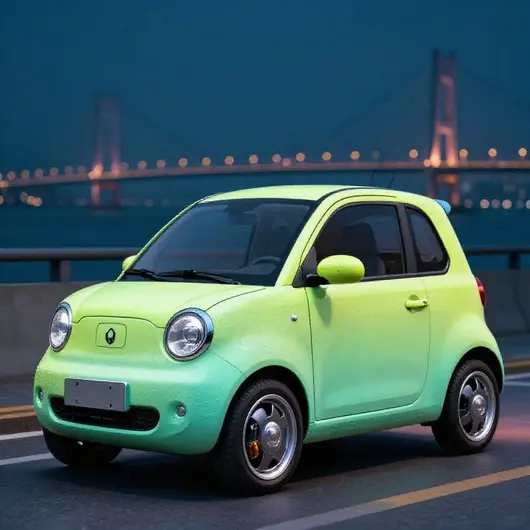
82 days. From 16 million to 17 million, BYD only took 82 days.
This speed, placed in the history of the global automotive new energy industry, is not "rare", it has never happened before.

On July 8, Xi'an, a Seal 08 drove down the production line of the BYD Xi'an Factory.
It marks the official birth of BYD's 17 millionth new energy vehicle, making BYD the first automaker globally to reach 17 million new energy vehicle deliveries.
From 16 million to 17 million, BYD only took 82 days. Sales in the first half of this year reached 1.8085 million, with overseas cumulative sales nearing 790,000, a year-on-year increase of 68%.
In 2003, BYD's first car was delivered here. In 2008, the world's first plug-in hybrid vehicle F3DM was born here.
Today, the 17 millionth new energy vehicle once again drives out of here to the world. From 1 to 17 million, the Xi'an factory witnessed BYD's process from moving China to the world.


Behind 17 Million
In the first half of this year, BYD's cumulative sales reached 1,808,511 vehicles, among which June single-month sales broke through the 400,000 mark for the first time, reaching 403,400 vehicles.
Especially worth noting is the overseas market. Passenger cars and pickups overseas cumulative sales in the first half reached 789,367, up 68% year-on-year, with overseas sales accounting for over 40% of total sales.
In May and June, BYD's market share in Germany exceeded that of Toyota.

This is not a specific model, it is overall market share. Germany is the heart of the European automotive industry, and Toyota is a giant that has cultivated here for 50 years. BYD completed the overtaking here in less than 5 years.
This would have been a joke to German car executives 10 years ago.
Additionally, the BYD Shark PHEV went on sale in the UK, with a WLTP pure electric range of 90km, comprehensive 674km, priced at £47,290, approximately 430,000 RMB.
And in Thailand, BYD has already dominated the feeds.
On July 12, BYD is about to announce its first brand spokesperson, with many Thai fan accounts intensively reposting to heat up the buzz, with the hot candidate pointing to Thai-Chinese star Lingling Kwong.

Chinese automakers in Southeast Asia have permeated from the product level to the cultural level. When Thai young people start screaming for BYD spokespersons, the forty-year emotional monopoly of Japanese cars in Southeast Asia is beginning to crack.

Technical Barriers
This year, BYD has continuously dropped heavy bombs on two main lines: electrification and intelligence.
In March, the second generation Blade Battery and Supercharge technology were launched, which can charge from 10% to 70% in 5 minutes at room temperature, and to 97% in 9 minutes; even in extreme cold environments of -30℃, charging time is only 3 minutes longer than room temperature.

This is mass production technology. No automaker in the world can achieve this charging speed while guaranteeing low-temperature performance.
As of June 30, a total of 7018 Supercharge stations have been built nationwide, covering 325 cities; BYD also announced that by the end of the year, 20,000 Supercharge stations will be built nationwide, leading new energy vehicles into the comprehensive Supercharge era, injecting momentum into the zero-carbon dream.
In May, BYD once again took the lead in promising a 1-year safety backing for City Pilot, and announced that all models can be equipped with God's Eye B Assist Driving LiDAR Version, creating an era of universal City Pilot.


The "Flagship Answer" of 17 Million Vehicles
Seal 08
Seal 08 went on sale officially on July 2, priced from 196,900 to 239,900 RMB. At this price, when you look at the configuration of Seal 08, it is enough to make competitors at the same price point silent.

Pure electric version CLTC max range 905 km; all models equipped with Native Supercharge Platform and second generation Blade Battery, 5 minutes to charge well, 9 minutes to charge full. Plug-in hybrid version full tank full battery comprehensive range reaches 1,660 km.
All models standard equipped with front double wishbone and rear five-link independent suspension, equipped with DiSus-A Closed Dual-chamber Air Suspension and Road Preview System, equipped with Rear Wheel Active Steering, turning radius of only 4.62 meters. This is a chassis configuration previously only seen on million-level luxury cars.
All models standard equipped with God's Eye B Assist Driving LiDAR Version; official provides dual safety backing for City Pilot and Intelligent Parking. No industry common sickness of "high specs exclusive, entry reduced specs".
Body dimensions 5150mm×1999mm×1505mm, wheelbase 3030mm; front dual zero gravity seats feature ventilation, heating and massage functions, equipped with 20-speaker Devialet sound system; over 90% soft padding uses Mother and Baby Grade Eco-Friendly Nappa Leather.
Seal 08 integrates 37 global firsts, with unique product strengths such as Supercharge technology, dual safety backing for parking intelligent driving, 905 km pure electric range, DiSus-A plus rear wheel steering, pulling the threshold of million-level flagship experience down to the 200,000 level.

Summary
In 2003, BYD delivered its first car in Xi'an.
At that time, no one believed that this private enterprise starting with batteries could build a decent car, let alone believed it could truly conquer Germany.
But BYD did it.
Ten years ago, Chinese automakers were learning from Toyota. Now, Toyota is learning from BYD.
From the first 1 million vehicles taking 13 years to the latest 1 million vehicles taking only 82 days.
In the future, BYD will continue to adhere to technological innovation, perfect global industrial layout, with higher quality and higher value products, leading the global new energy vehicle industry towards a new height, injecting momentum into the zero-carbon dream.
In May this year, data from the European Automobile Manufacturers Association (ACEA) shows that Chinese car brands in Europe's 31 countries saw overall sales for the first time exceed Japanese brands. Chinese automakers (BYD, SAIC, Geely, Chery, Leapmotor) sold a total of 138,400 vehicles, while Japanese automakers (Toyota, Honda, Nissan, etc.) sold a total of 130,400 vehicles.
The story of Chinese new energy vehicles has just entered the climax.
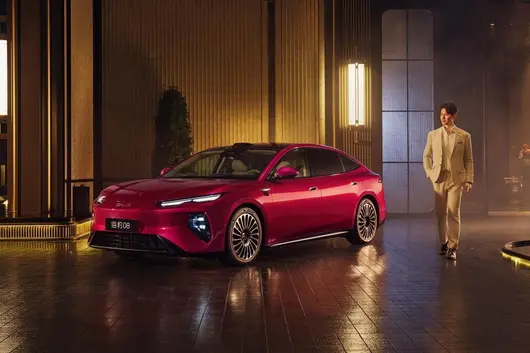

 Auto-First | Li Dezhe
Toyota Motor recently announced plans to further increase the scale of its overseas production cuts, raising the total overseas production reduction volume from June to November of this year from the previously planned 38,000 units significantly to 83,000 units, doubling the production cut magnitude. Combined with the preliminary production cut of 40,000 units by Japanese domestic factories for the Middle East market in the first quarter of this year, Toyota's total vehicle capacity reduction plan within half a year exceeds 120,000 units.
Toyota's capacity adjustment this time is highly targeted, mainly aiming at sluggish markets and slow-selling models, including overseas factories in Thailand, India, Malaysia, etc., and overseas production lines dedicated to the Middle East market. Main models with production cuts are concentrated on fuel version RAV4, Camry, Fortuner, Innova and other traditional fuel SUVs and family sedans. Hybrid models and pure electric models capacity remains basically unchanged.
On the surface, short-term geopolitical crisis and supply-demand imbalance might be the main reasons for Toyota's current production cuts, but actually, this also reflects that holding firm to the internal combustion engine base in the global new energy wave has already fallen into a strategic disadvantage.
For a long time, Toyota insisted on hybrid technology route, pure electric model R&D and launch pace was slow, relying on durability and resale value advantages to deep-plow global fuel car blue ocean market. Especially in emerging markets like Middle East, Southeast Asia long-term occupied absolute leading position. However, in recent years, global auto industry landscape completely reconstructed, core markets like China, Europe comprehensively accelerated electrification substitution, Southeast Asia, Middle East and other traditional fuel car "safe havens" also began to gradually introduce new energy supportive policies, local new energy models rose rapidly, diverting fuel car market share.

Toyota continuously shrinking overseas capacity also reflects the new logic of current multinational automakers' global layout. In the past, automakers pursued global layout, capacity full coverage, to reduce production costs with economies of scale; Nowadays global geopolitical conflicts frequent, regional trade barriers rising, car market regional division intensifying, blind expansion of global capacity risk surged. Multinational automakers began to shift from "global expansion" to "precision layout", shut down inefficient, slow-selling fuel car capacity, concentrate funds and capacity into high-growth electrification tracks, becoming common industry practice.
It can be said, this global capacity shrinkage wave initiated by Toyota, also sounded a warning bell for current Chinese independent brands expanding overseas.
In recent years domestic car market fierce competition intensified, top automakers increased investment in overseas factories, complete vehicle exports, Middle East, Southeast Asia are exactly the core growth markets for Chinese automakers going overseas, in 2025 China's car export volume to the Middle East exceeded 1.4 million units, coinciding with Toyota passively yielded market share due to logistics disruption, geopolitical turmoil, many domestic automakers followed suit to increase regional capacity deployment and inventory stocking. But Toyota's dilemma directly exposed the common risks of global car building: single region geopolitical turmoil, sea shipping routes blocked, regional demand changes, can instantly severely damage heavy-asset overseas capacity layout.

At the same time, Chinese automakers going overseas also currently hide two hidden risks: One is some automakers blindly copying Japanese past heavy-asset factory building models, rapidly launching complete vehicle factories in emerging markets, capacity expansion pace far exceeds local new energy penetration rate, very easy to follow Toyota's fuel car capacity excess trap; Two is some overseas products structure single, over-rely on fuel cars or low-price entry-level new energy cars, lack diverse product matrix adapted to different regional policies, road conditions, insufficient ability to resist market volatility.
In addition, geopolitical supply chain risks Toyota is currently facing also reminding Chinese automakers, going overseas cannot only pursue sales volume scale, must simultaneously build diversified shipping routes, disperse regional market layout, accelerate overseas supply chain localization support, reduce impact brought by external sudden risks.
Looking at the overall situation, Toyota's overseas production cut is another heavy signal of the end of the global fuel car era. Auto industry stock competition arrives, geopolitical risk, energy change, electrification wave triple variables are reshaping global auto industry new rules. For all multinational automakers, relying on fuel cars to lie back and win era has completely ended, only by accelerating capacity structure reform, can adapt to the brand new global auto market layout.
 Auto-First | Li Dezhe
Toyota Motor recently announced plans to further increase the scale of its overseas production cuts, raising the total overseas production reduction volume from June to November of this year from the previously planned 38,000 units significantly to 83,000 units, doubling the production cut magnitude. Combined with the preliminary production cut of 40,000 units by Japanese domestic factories for the Middle East market in the first quarter of this year, Toyota's total vehicle capacity reduction plan within half a year exceeds 120,000 units.
Toyota's capacity adjustment this time is highly targeted, mainly aiming at sluggish markets and slow-selling models, including overseas factories in Thailand, India, Malaysia, etc., and overseas production lines dedicated to the Middle East market. Main models with production cuts are concentrated on fuel version RAV4, Camry, Fortuner, Innova and other traditional fuel SUVs and family sedans. Hybrid models and pure electric models capacity remains basically unchanged.
On the surface, short-term geopolitical crisis and supply-demand imbalance might be the main reasons for Toyota's current production cuts, but actually, this also reflects that holding firm to the internal combustion engine base in the global new energy wave has already fallen into a strategic disadvantage.
For a long time, Toyota insisted on hybrid technology route, pure electric model R&D and launch pace was slow, relying on durability and resale value advantages to deep-plow global fuel car blue ocean market. Especially in emerging markets like Middle East, Southeast Asia long-term occupied absolute leading position. However, in recent years, global auto industry landscape completely reconstructed, core markets like China, Europe comprehensively accelerated electrification substitution, Southeast Asia, Middle East and other traditional fuel car "safe havens" also began to gradually introduce new energy supportive policies, local new energy models rose rapidly, diverting fuel car market share.
Toyota continuously shrinking overseas capacity also reflects the new logic of current multinational automakers' global layout. In the past, automakers pursued global layout, capacity full coverage, to reduce production costs with economies of scale; Nowadays global geopolitical conflicts frequent, regional trade barriers rising, car market regional division intensifying, blind expansion of global capacity risk surged. Multinational automakers began to shift from "global expansion" to "precision layout", shut down inefficient, slow-selling fuel car capacity, concentrate funds and capacity into high-growth electrification tracks, becoming common industry practice.
It can be said, this global capacity shrinkage wave initiated by Toyota, also sounded a warning bell for current Chinese independent brands expanding overseas.
In recent years domestic car market fierce competition intensified, top automakers increased investment in overseas factories, complete vehicle exports, Middle East, Southeast Asia are exactly the core growth markets for Chinese automakers going overseas, in 2025 China's car export volume to the Middle East exceeded 1.4 million units, coinciding with Toyota passively yielded market share due to logistics disruption, geopolitical turmoil, many domestic automakers followed suit to increase regional capacity deployment and inventory stocking. But Toyota's dilemma directly exposed the common risks of global car building: single region geopolitical turmoil, sea shipping routes blocked, regional demand changes, can instantly severely damage heavy-asset overseas capacity layout.
At the same time, Chinese automakers going overseas also currently hide two hidden risks: One is some automakers blindly copying Japanese past heavy-asset factory building models, rapidly launching complete vehicle factories in emerging markets, capacity expansion pace far exceeds local new energy penetration rate, very easy to follow Toyota's fuel car capacity excess trap; Two is some overseas products structure single, over-rely on fuel cars or low-price entry-level new energy cars, lack diverse product matrix adapted to different regional policies, road conditions, insufficient ability to resist market volatility.
In addition, geopolitical supply chain risks Toyota is currently facing also reminding Chinese automakers, going overseas cannot only pursue sales volume scale, must simultaneously build diversified shipping routes, disperse regional market layout, accelerate overseas supply chain localization support, reduce impact brought by external sudden risks.
Looking at the overall situation, Toyota's overseas production cut is another heavy signal of the end of the global fuel car era. Auto industry stock competition arrives, geopolitical risk, energy change, electrification wave triple variables are reshaping global auto industry new rules. For all multinational automakers, relying on fuel cars to lie back and win era has completely ended, only by accelerating capacity structure reform, can adapt to the brand new global auto market layout.


Snatching Toyota.
Writer|Hu Chengxu Editor|Mao Shiyang
Auto Pixel (ID:autopix)Original
June 9, like in previous years, BYD held its 2025 Annual Shareholders' Meeting at its headquarters in Pingshan, Shenzhen.
More people came than in previous years, so the company temporarily moved the venue from a meeting room to the hall usually used for press conferences. Wang Chuanfu said on stage that nearly 1,000 people attended today, the most in history.
During the Q&A session, a long-term shareholder with heavy stakes stood up. He wanted to know where the company would head next.
In Wang Chuanfu's answer, a word appeared for the first time: "Global No. 1". He said that in the next three to five years, BYD will continue to grow. After five years, in terms of scale, it will achieve "true Global No. 1".
Not No. 1 in New Energy, not No. 1 in China, but No. 1 in total vehicle scale including Toyota, Volkswagen, Hyundai Kia, etc.
When saying this, BYD was experiencing the biggest deceleration since the New Energy era. In the first five months of 2026, BYD sold 788,000 vehicles domestically, down 43.3% year-on-year. The Chinese market is becoming increasingly difficult to provide the incremental growth it enjoyed in the past.
So Wang Chuanfu's goal truly points to overseas.
Take a closer look at what BYD has done in the past two to three years, this goal is not strange. Its playbook no longer resembles that of a company only wanting a seat at the table overseas.
01
What BYD Wants to Grab,
is the Base of Toyota, Hyundai, et al.
To understand how far BYD is from its goal, one must first look at the gap.
Today, the global No. 1 in auto sales is Toyota, selling a bit over 10 million a year; BYD sold 4.6 million vehicles in 2025, ranking sixth globally. There is a gap of more than 5 million vehicles in between, roughly equivalent to creating another BYD of today's scale on top of its existing volume.
As for this extra 5 million-plus vehicles, what is certain is that most of it will not come from the domestic market.
In 2025, China's New Energy penetration rate reached 53.9%, approaching the ceiling; BYD's domestic sales that year fell instead of rose, down by over 300,000 vehicles compared to 2024.
Geely, Chery, and Changan are all chasing, and this local board is nearly at its peak, with limited incremental growth left to extract. The growth gap is thus pushed overseas as a whole. Outside China, the global New Energy penetration rate is still just over 11%.
But "overseas" is never a single block; its biggest chunks happen to be where BYD cannot enter. The US uses tariff and regulatory barriers to seal off the world's largest and most profitable market; Japan and South Korea are fortresses of local brands, hard for outsiders to pry open; India blocks Chinese cars out with high tariffs and entry barriers.
What remains available are South America, Southeast Asia, Central Asia, Australia, the UK, Gulf States, as well as parts of Europe and Mexico. The market set is smaller, and the share burden for each location to reach is heavier.
And these open markets are none of them empty fields.

Southeast Asia is Toyota's home court, where it holds nearly 40% share; BYD has only just squeezed into the top 3 in Thailand. Australia is even more extreme, with Toyota holding sales No. 1 for 23 consecutive years, sales at two and a half times the second place; Gulf States are the common dominion of Toyota and Hyundai Kia, where Toyota's market share is champion in countries like Saudi Arabia, UAE, and Oman.
Only in Brazil is the stock held by Stellantis, Volkswagen, Hyundai Kia, and Renault.
List the owners of these markets one by one, names will repeat constantly; the most frequent is Toyota, followed by Hyundai Kia, then Volkswagen, Stellantis, and other European automakers.
So the overseas granary BYD wants to grab is a very specific existing stock, the base built up over decades of fuel cars by Japanese and Korean automakers.
What it truly wants to replace is RAV4, Corolla, Elantra, Creta and similar economy, durable, high-volume cars sold for decades, using its own DM-i PHEV and Blade Battery EV to replace them one by one within the highest-volume price bands in each market.
Straighten out the chain, and the slogan "Global No. 1" landing on the ground is actually a simpler sentence: BYD must take the home base they've sold for decades within the Toyota and Hyundai Kia base.
This is a ruthless fight; how many opportunities does it have?
02
Wang Chuanfu Writes Growth into a Production Schedule
Faced with questions like "how to go from sixth to first", Wang Chuanfu's habit is to rewrite it as a supply-side arithmetic problem.
On June 9, what he talked about most was not the market, but production capacity. He said how many cars can be sold this year depends on how many batteries can be built; the capacity of the 2nd Gen Blade Battery is climbing month by month, adding 20,000 to 30,000 sets each month; production capacity will be released on a large scale by 2027, and both domestic and overseas markets will see volume increases.
An issue that should be about market and product was interpreted by him as "how much I can make". In his narrative, demand seems assumed sufficient, and the bottleneck lies on his production lines.
Wang Chuanfu seems to believe that if the technology curve of domestic New Energy in the past three years reenacts overseas, the remaining problems can be left to the production schedule.
This logic can explain BYD's overseas layout over the past two years.

It has at least six factories under construction or planned overseas: the Brazil Camaçari plant is a renovation of an old factory exited by Ford, secured in 2023, with the first car rolling off the line in July 2025, targeting 300,000 capacity by end of 2026; the Thailand plant started production in 2024, with an annual capacity of 150,000; the Hungary Szeged plant serves as Europe HQ; Turkey plans to invest 1 billion USD (potentially delayed); Uzbekistan and Indonesia each have points set up.
BYD's playbook's starting point is a bet on speed.
Looking back at BYD's rise domestically, it relied on technology first. In 2021, the 4th Gen DM-i made PHEV the same price as same-level fuel cars with lower fuel consumption; the Blade Battery simultaneously solved safety and cost, with PHEV annual sales jumping from 270,000 to over 2 million vehicles in two or three years.
During those years, China's New Energy market was almost empty; whoever put electric cars that were easy to use and cheap on shelves first could capture whole chunks of incremental growth.
This playbook continues to now. At this year's shareholders' meeting, Wang Chuanfu said "I spend about half my time every week swimming in the ocean of technology", believing he is "one of the 120,000 engineers inside BYD".
But now this playbook's process of converting to sales is not so smooth. Geely, Chery, Leapmotor have caught up one by one; DM-i is no longer a secret technique; not just BYD makes Flash Charge.
Technology is becoming more homogeneous, approaching the physical ceiling further; taking half a step forward brings less and less sales.
Overseas is another matter. Outside China, New Energy is still at the starting point BYD faced years ago: low penetration, few good cars, high prices, most markets still dominated by fuel cars.
The technology curve that once lifted BYD to sixth globally has barely started climbing overseas. What BYD wants to do is take the most advantageous position before this curve rises, copying the success already verified domestically exactly onto a larger plate.
This explains why the overseas game is played heavily and urgently. BYD judges the window period is limited; once overseas New Energy also ramps up, pursuers will flood in as they did domestically, and the time left for first movers might not be longer.
It is unwilling to spend time waiting for the market to mature, and even less willing to hand over initiative.
This June, foreign media claimed BYD is considering acquiring an old European factory, having looked at "many factories" in Europe and is talking with automakers including Stellantis.
BYD prefers independently operated factories; it wants to take over brownfield factories that can be quickly renovated and operated independently with clear ownership and operational boundaries, rather than getting stuck again in existing European auto JV, leasing, or multi-party interest structures.

Key factories and supply chain self-led; distribution and brand also controlled by self as much as possible, serving efficiency and speed. It would rather not have risk-sharing partners first, and have a decision chain that can drive the fastest.
The Brazil old factory renovation took only 16 months from groundbreaking to first car off the line. Export modules are the same; a 6 to 8-ship fleet brings overseas logistics into its own hands. On the channel end, BYD took an equity stake in a Thai local dealer, bound a dealer group with over 100 stores in Latin America; UK authorized stores increased from 52 to 125 in one year, and signed a 100,000 unit deal with Uber.
Following this logic, overseas moves connect into a line. The strategy Wang Chuanfu launched is a replicable template; this is why when asked about sales, he answers with "production schedule" logic.
Whether it holds ultimately rests on that most fundamental judgment: the technology-pulled market curve, how steep it was domestically in recent years, will be equally steep in many overseas markets in coming years.
As long as this judgment holds, simplifying the problem into a production schedule is the fastest solution.
03
BYD VS Geely
Same Overseas Expansion, Different Betting Methods
A easily occurring misunderstanding is summarizing BYD's overseas expansion as "more valued" than Chery or Geely.
In terms of aggressiveness, all three are actually neck and neck. In terms of overseas volume, Chery sold 1.34 million vehicles overseas in 2025, nearly 300,000 more than BYD, sitting on the Chinese passenger vehicle export champion spot for over 20 consecutive years; in terms of capital courage, Geely has bought all the way from Volvo, Lotus, Polestar to a powertrain JV with Renault.
The real difference is not in the degree of aggressiveness, but in the strategic judgment behind the aggressiveness.
Chery bets on export breadth: complete vehicle export plus semi-knocked-down assembly, spreading cars to corners others can't reach, essentially an asset-light playbook.
Geely bets on capital and alliances; Li Shufu is more like an allocator. He grabs core capabilities on one side, polishing smart and New Energy tech to optimal; on the other side, he takes shares and makes allies, seeking leverage at the factory and channel levels.

▍Li Shufu
This year, Geely's Qianli Haohan G-ASD obtained EU UN R171 certification, becoming the first Chinese ADAS system to pass this regulatory certification; equipped models can be sold in the EU without country-by-country re-certification.
At the same time, Geely integrated Gothenburg and Frankfurt R&D teams, established Geely Technology Europe, planning to compress the launch time gap between China and overseas models from over a year to within 6 months.
Also this year, Lynk & Co's Europe sales reuse Volvo resources; Geely in South Korea and South America reuses Renault resources. Gan Jiayue of Geely Automobile has said, Chinese brands going overseas is not to "conquer", but to "walk in", local JVs, reusing local resources to make win-wins, this is the natural expression of this logic.
Behind the three choices are three strategic judgments, and also three judgments on where the moat should be built.
Geely's judgment on tech replacement is not so anxious. In March this year, at the Geely Holding FY2025 performance press conference, CEO Gui Shengyue said the future economy passenger car market will likely be replaced by robotaxis. Shortly after, Geely became one of Nvidia's automotive partners.
This judgment shows Geely does not see today's New Energy competition as the final outcome. It believes there will be longer tech rearrangements after the auto industry, so it is more willing to keep elasticity using cooperation and capital allocation.
Because of this difference, Geely is not anxious to raise "No. 1", nor will it compress the time to first to five years. It is more like betting on the future rather than pressing all chips on this current New Energy replacement round. So Geely's choices overseas are almost the opposite of BYD's: willing to accept slower, more dispersed, more complex.
BYD wants to maximize scale with batteries, factories, fleets, and channels; Geely is more willing to take more positions in tech routes, regional markets, and partnership relationships.
04
The Other Side of the Production Schedule
Reaching No. 1 in scale is a goal setting, a strategic judgment, and will eventually become a structure.
In 2026, Geely, Chery, Changan, Great Wall almost all offered oil-electric hybrids, to grab Toyota THS share in markets with inconvenient charging,唯独 BYD absent.
Technically it is not incapable. This round of HEV by Chinese automakers is not replicating Toyota THS. It bypasses engines, planetary gears, and long-term calibration that old auto giants are good at, pulling the battlefield back to electric drive systems more familiar to Chinese automakers, downsizing batteries, removing external charging, keeping the PHEV low fuel logic, becoming a hybrid that doesn't need charging.
But BYD chose not to do it, turning to laying charging facilities overseas.

In March this year, BYD booked a stadium with 18,000 seats to launch the 2nd Gen Blade Battery, simultaneously launching the plan "Flash Charge China, Change the World". Wang Chuanfu spoke alone for an hour and a half; the press conference dragged from two hours to three hours; it set a year-end goal to build 20,000 flash charge stations domestically, with capital expenditure in the billions, and changed flash charge stations to integrated storage and charging solutions with built-in storage cabinets, bypassing the trouble of applying to the grid for capacity expansion, deploying on three parking spots.
From year-end, these piles will start spreading overseas; the MW-level network in Europe has already been demonstrated at the Munich Auto Show.
Building charging piles in target markets is the latest chapter in BYD's overseas line, possibly the most money-burning chapter. BYD bets that once the charging network is laid out, the transitional form matters less. Others keep hybrids; BYD chooses not to bet on multiple fields, pressing all chips on this New Energy transition round.
Put these together, it is a consistent logic: growth is punched out section by section from factories, technology, and charging piles.
BYD is almost the only domestic automaker highly controlling everything from supply chain vertical integration to overseas assets. This heavy asset model makes scale a must-do; in this dimension, sales "No. 1" is just a byproduct.
Vertical integration is only worth it when spread to world-class scale; maintaining a fleet requires enough exports to fill it; building cell capacity at that level requires enough whole vehicles to digest it; investing billions to lay 20,000 charging piles requires enough installed base to feed it.
Chery can stop at export champion; Geely can be a large enough multi-brand group; if BYD's scale is not larger than them, the efficiency of this setup cannot be guaranteed.
This gives BYD the possibility to challenge for Global No. 1, and makes it very hard to accept a "not big enough" result.

This article is original content of Auto Pixel (autopix)
Unauthorized reproduction is prohibited
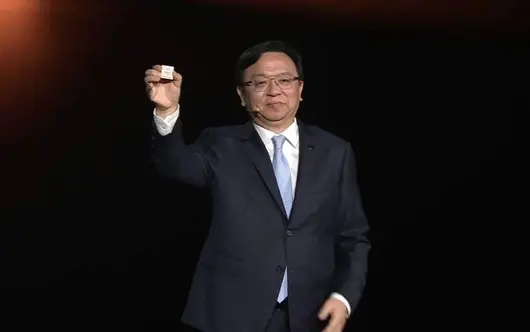

In April 2026, the Thailand automotive market presented an extreme polarization pattern: total new car sales 48,394 units, year-on-year growth 2.54%, pure electric vehicle sales surged 90.61%, SUV year-on-year growth 23.91%, but one-ton pickup sales were only 9,950 units, plummeting 29.7% from March, down 5.84% year-on-year, becoming the only core sub-segment with negative growth. Thus, January-April 2026 Thailand pickup cumulative sales 48,802 units, the decline compared to the same period last year widened further, the annual target of 171,000 units (2024 new low) predicted by ttb analytics was precarious, actual sales are highly likely to drop below 165,000 units.

Although the duopoly structure has not shaken, the 'precipitous' drop of top models is no longer in doubt. Toyota Hilux Travo/Revo April sales 5,104 units, down 27.1% from previous month, January-April cumulative 23,098 units, market share slightly rose to 51.3%; Isuzu D-MAX followed closely, April sales 3,469 units, plummeted 25.2% from previous month, cumulative 17,760 units, market share 34.9%. The two Japanese brands combined still accounted for 86.2% of the share, but the significant shrinkage in absolute sales indicates that even top products with the most complete dealer networks and highest residual values cannot withstand systemic risks.

The rest of the traditional fuel brands suffered a complete defeat: Ford Ranger nearly halved month-on-month, Mitsubishi Triton plummeted 63.7%, Nissan Navara has basically withdrawn from mainstream competition.

Chinese brand performance showed significant divergence. Pure electric pickup leader Geely Radar RD6 April sales 85 units, down 24.8% month-on-month, but the drop was far smaller than most fuel models, January-April cumulative 327 units, continued to hold the top spot among Chinese brands and the first place in the pure electric pickup sub-market. Great Wall Cannon Sahar became one of the few models growing against the trend, April sales 34 units, surged 142.9% month-on-month, but the base was extremely low and scale has not yet formed. Other Chinese brands continued to face pressure: Foton e-Tunland down 61.5% month-on-month, MG Extender plummeted 71.4%.

This divergence between pickups and the overall Thailand car market is essentially the conflict between production tool attributes and consumption upgrade trends, compounded by multiple policy and economic shocks:


Final Thoughts: Looking forward, the turning point for the Thailand pickup market has yet to appear, the golden age of traditional diesel pickups has ended. Low-carbon transformation has become the only way out for the industry, and Chinese new energy pickups represented by Radar RD6, with differentiated product positioning and technical advantages, are expected to seize the initiative during the market restructuring process, becoming a key force to break the long-term Japanese monopoly structure.