首頁Hyundai

搜尋歷史
熱門搜尋
經銷商登入 / 註冊

On October 30, 2026, an insider at Beijing Hyundai confirmed a matter: General Manager Li Fenggang left office due to "personal reasons", falling nine days short of completing the one-year term since his formal appointment on November 10, 2025.
Li Fenggang's employment contract was for three years, but he served only one. A few days before his departure, Yonhap News Agency released a set of figures: In September, combined retail sales of Hyundai and Kia in China totaled approximately 9,000 units, with monthly sales falling below the 10,000-unit mark and market share at 0.6%. Among them, Hyundai sold about 4,000 units, a year-on-year decline of 47%; Kia sold about 5,000 units, a year-on-year decline of 31%.
Unexpectedly, it was these two events that brought Korean cars back into the industry spotlight. Recently, Beijing Hyundai and Yueda Kia had just made a good impression on social media platforms for issuing generous holiday bonuses and gift packages to employees during the Mid-Autumn Festival and National Day.
Forgotten Glory
Korean cars had experienced glory in the Chinese market.
In 2016, Beijing Hyundai sold 1.142 million units, Yueda Kia sold 650,000 units, totaling nearly 1.8 million units for both. Their market share approached 10%, securing a stable position as the third pillar of the joint venture camp, second only to Volkswagen and GM.
Even earlier, in 2013, Beijing Hyundai's annual sales exceeded 1 million units, making it the third domestic manufacturer to achieve single-brand production and sales of over 1 million, following FAW-VW and Shanghai-VW. The feat Toyota, Honda, and Nissan had not yet achieved, Hyundai accomplished earlier.
Those years marked the true "street car era" for Korean cars in China. Elantras and K5s were parked downstairs at countless homes, with a constant flow of customers in dealerships. At auto shows, due to the presence of Korean celebrities, the Beijing Hyundai exhibition booth was surrounded tightly, tickets were scalped to double the price, and the glass doors of the exhibition hall were even damaged by the crush.
Beijing Hyundai, the star automaker of the time, was established in October 2002, with BAIC and Hyundai each holding a 50% stake. In August of the same year, Dongfeng Yueda Kia was established earlier in Yancheng, Jiangsu, with Dongfeng, Yueda, and Kia each holding 25%, 25%, and 50% respectively.

Both Korean brand joint venture companies used a similar strategy: high configuration, low price, and fast introduction. Three months after the establishment of Dongfeng Yueda Kia, the first car, the Spectra, rolled off the assembly line, quickly entering the compact family sedan market. Beijing Hyundai also launched its first Sonata at the end of the same year, subsequently entering the official and business vehicle market.
Afterwards, Cerato, Forte, Sportage, K3, Sportage, K5, Elantra, Accent, Tucson, ix35 were deployed one after another with tacit understanding between the two brands. Hyundai focused on bringing down the price of joint venture cars, while Kia focused on making joint venture cars better looking. Together, they pinned the image of Korean cars to "cheap, good looking, high configuration".
Both companies were busy expanding capacity in those years. Beijing Hyundai located factories in Cangzhou and Chongqing outside of Shunyi, Beijing, once arranging five factories; Yueda Kia owns three factories in Yancheng. As capacity expanded, everyone assumed growth would continue, no one thought about what would happen if these factories became empty in the future.
Turning Point and Divergence
The turning point came suddenly. In early 2017, the THAAD incident escalated, and the status of Korean goods in the minds of Chinese consumers declined rapidly. This matter was beyond the control of enterprises, yet it happened to hit the vital point of Korean cars.
Both Beijing Hyundai and Dongfeng Yueda Kia faced declines in 2017. Beijing Hyundai's sales dropped to 785,000 units that year, a year-on-year decline of 31.3%; Dongfeng Yueda Kia dropped to about 360,000 units, a year-on-year decrease of 45%, nearly halved.
The turning point of Korean car sales in China was of course not decided by the THAAD incident. THAAD was the trigger, but not the root cause. There was a consensus on this within both companies at the time and among outsiders. The Korean side summarized that "they lacked excellent SUV products on the hottest track", while Kia frankly admitted "they were too optimistic, there were mistakes in product promotion and pricing".
Both enterprises subsequently launched price reduction promotions. Beijing Hyundai even launched a new Verna starting at 49,900 yuan. In 2018, Beijing Hyundai's sales briefly stabilized, and Dongfeng Yueda Kia saw a slight increase.
But this was more like a fleeting recovery, followed by a more terrifying decline channel. The sales of both companies continued to drop, with rumors of selling factories and contracting channels. It was from here that both sides moved in different directions.
For Beijing Hyundai, the demands and propositions of the Chinese and Korean shareholders diverged. The Chinese side hoped to support channels and market share with higher sales targets; the Korean side hoped to reduce losses with more conservative targets. The Chinese side advocated for drastic cost reduction and introducing the local supply chain; the Korean side tended to protect the existing Korean supplier system, with nearly 80% of Beijing Hyundai's suppliers belonging to the Korean system.
A 50:50 shareholding ratio, placed on a pair of equally strong and unwilling shareholders, became a stalemate that was difficult to reconcile when facing difficulties and challenges. Falling upon Beijing Hyundai, this joint venture, it resulted in fatal management infighting and long-term strategic ambiguity. The company did not know where to drift amid intense competition and disorder.
In 2024, Beijing Hyundai's annual sales reached 154,200 units. This is the eighth year of continuous decline from 1.142 million units.
On the other side in the same year, Yueda Kia's annual sales rebounded to 248,000 units, a year-on-year growth of 49.2%. This figure was mainly driven by exports.

In July 2018, Chun Byung-jin, the newly appointed deputy president of Kia, assumed the role of General Manager of Dongfeng Yueda Kia. The following month, Dongfeng Yueda Kia received its first overseas export order: 400 Vistos dispatched to Egypt. From receiving the order to shipping, it totaled just under four months.
From this speed, it can be seen that the Korean side almost immediately determined the export strategy for Dongfeng Yueda Kia after Chun Byung-jin took office, attempting to transfer the problem of insufficient capacity utilization at Chinese factories through Kia's global network.
After the 400 Vistos were dispatched to Egypt, the second batch of 856 Vistos immediately loaded at Shanghai Port, of which 200 continued to Egypt, and 656 were sent to the Philippines. A few days later, the first batch of 288 engines also loaded for export to Slovakia. Afterwards came more intensive exports of complete vehicles and engines.
In December 2021, Dongfeng Yueda Kia welcomed a more important turning point. Dongfeng listed its 25% equity in the hands for transfer at 297 million yuan. Jiangsu Yueda, as the sole bidder, took over. "Dongfeng Yueda Kia" was renamed "Yueda Kia".
After Dongfeng withdrew, Yueda Kia's shareholders became two parties. Although the shareholding ratio was also 50:50, Yueda Kia's internal structure was obviously simpler. The voice of the Korean side remained dominant. After the equity change, the decision-making chain became shorter, and the Korean side's voice was heavier.
Yueda Kia also established a management system consistent with Kia's global standards. Only one person was appointed as the head of each department, and the dual-signature system was abolished. A departing executive of a joint venture company once evaluated the dual-signature system: "The essence is to ensure the shareholders' own interests through dispatched managers, rather than the interests of the joint venture company".
Without the management infighting of the dual-signature system, Yueda Kia, which was completely under Korean control, when facing a more intense price war in the Chinese market, its strategy leaned more towards exports. The Yancheng factory was explicitly designated as an export hub in Kia's global network. Although the company still shouted "In China, for China", the weight of exports became heavier year by year.
Who is Right and Who is Wrong?
In 2025, signs of improvement began to appear at Beijing Hyundai. First, the two shareholders seemed to reach a consensus on strategy.
In March of that year, BAIC and Hyundai jointly increased capital by 8 billion yuan. In October, the "Smart Start 2030 Plan" was released, setting the goal: to launch 20 new products in the next 4 to 5 years, achieve annual sales of 500,000 units in 5 years (300,000 domestically, 200,000 exports), and strengthen the strategy of "In China, for China, towards the world".
In Yantai and Shanghai, Beijing Hyundai established R&D branches led by Chinese engineers, with a scale exceeding 1,300 people, focusing on new energy development, intelligent driving, and intelligent cockpits, aiming to enhance product definition and technical route dominance in the Chinese market.
In November of the same year, Li Fenggang, the first Chinese general manager since the establishment of Beijing Hyundai, was appointed. This appointment was interpreted as a move by Hyundai Motor Global CEO Scott Oh to push for management localization. Scott Oh took office in January 2025. He is the first non-Korean Global CEO in Hyundai Motor's history, advocating operating local markets with people who better understand the local market.
Beijing Hyundai also achieved sales of 210,000 units in 2025, welcoming rare growth after 8 years of decline, and exports also began to accelerate.
Li Fenggang naturally wanted to do something radical. After taking office, he proposed "Integration Direct Sales", wanting customers to order online with unified national prices. At the Beijing Auto Show in April 2026, the "Star Sprint Plan" was released, with the goal to expand the dealer network from more than 200 to 484 by 2030.
But news of his departure came even faster. According to informed sources, the resource allocation power and decision-making initiative Li Fenggang actually obtained did not match his title. In the management sequence dispatched by the Korean side, the progress of supplementing Chinese personnel was limited, and key positions remained dominated by Korean nationals. There were rumors that management wanted the Yantai Technology Center to support Beijing Hyundai's work, and part of their energy had to be spent on "dining with the Korean R&D team".

The goals of the two shareholders still remain difficult to align. The divergence still centers on the core issue of maintaining sales versus reducing losses. The Chinese side hopes to set higher sales targets and reduce costs to a greater extent. But cost reduction, in the view of the Korean side, is not just a financial issue, but a matter involving vested interests of the Hyundai Korea headquarters.
Until September 2026, the Chinese and Korean shareholders barely reached a consensus, giving up higher sales targets. Annual sales were set at about 160,000 units, and losses were controlled at around 1.9 billion yuan.
Shortly after this consensus was confirmed, news of Li Fenggang's departure was leaked, stating he left for "personal reasons". An internal representative of Hyundai China stated, "We recognize the measures taken during his tenure very much internally".
At this time, Yueda Kia was in a completely different situation. In 2025, Yueda Kia's annual sales reached 254,000 units, showing positive growth for two consecutive years. But among these, exports were 173,000 units (accounting for 68%), and domestic sales were 81,000 units (accounting for 32%).
By September 2026, Yueda Kia had cumulatively exported over 666,400 complete vehicles, with export sales breaking through 7.44 billion USD, covering 92 countries and regions; engines cumulatively exported exceeded 550,000 units, sold to South Korea, Russia, Vietnam, Malaysia, and other places.
Exports also supported the company's profits. In 2025, Yueda Kia's net profit reached 843 million yuan, finally turning losses into profits. After the company made money, Yueda Kia also timely shared the wealth with employees.
In 2025, Yueda Kia adjusted wages generally. Production posts had a performance-based wage increase of 100 yuan per month; management posts had a combined salary grade and performance wage increase of 225 yuan per month; annual bonuses were issued for 3 months, 0.5 months more than the previous year.
In June 2026, Yueda Kia adjusted wages generally again. Regarding this salary increase, internal notices stated: "The 2026 global automotive market faces heavy challenges, including rising raw material costs due to Middle East geopolitical conflicts, exchange rate fluctuations, and intensified internal competition in the domestic passenger car market. However, on the management level, we persist in 'people-oriented', recognizing employee dedication, therefore implementing a salary increase for all employees".
During the Mid-Autumn Festival and National Day in 2026, Yueda Kia issued 1,400 yuan in cash holiday bonuses (1,000 yuan from the company + 400 yuan from the union) plus snack gift packs and mooncakes. After Yueda Kia employees posted this on social media, it sparked much discussion among netizens.
Some netizens praised the employee protection and humanistic care of Korean car companies. This point is indeed unquestionable. Even for Beijing Hyundai, where the situation is not easy, non-poor double holiday welfare was also sent to employees: 500-1,000 yuan in cash holiday bonuses plus physical gifts. This welfare, placed in the entire automotive industry in 2026, can be considered decent.
Of course, some suspected departing employees complained about large-scale layoffs in recent years due to the marginalization of Korean cars in China. Compared to ensuring the welfare of current employees, departing employees hope for long-term job security. Even if everyone drinks porridge, it is better than some eating and others drinking water.
Who is right and who is wrong? There are no standard answers to many things in the world. Just as Borges wrote in "The Garden of Forking Paths": Time forever forks, leading to countless futures. We walk different paths, no one knows whether flowers bloom on the other path.
Ten years have passed. Although Korean cars have been marginalized, both companies are still here. Like all other automakers, they strive to set off towards the future. As for how the future will unfold, no one can answer at this time.

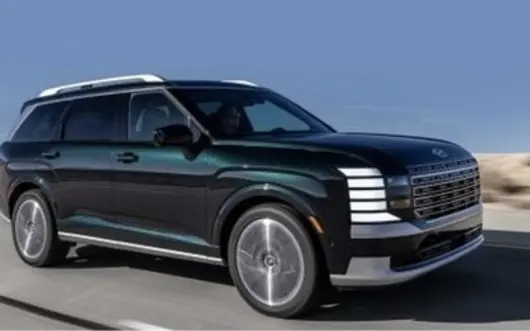
[CNMO Tech News] Indonesia's hybrid car market continues to expand this year. Data shows, from January to August 2024, Indonesia's hybrid car wholesale sales reached 58,040 units, a year-on-year increase of 43.3%. Against this backdrop, Hyundai Palisade Hybrid sold 774 units ranking 9th on the local hybrid car sales list, and Santa Fe Hybrid ranked 14th with 538 units.

Source: Internet
According to data released by the Indonesia Automotive Industry Association, in the first 8 months of this year, Indonesia's total car sales were 859,256 units, with hybrids accounting for about 6.75%. From a market structure perspective, local hybrid car sales growth was mainly driven by large MPVs and SUVs suitable for family use, with significant demand for relevant models.
Looking at specific models, Toyota Innova Zenix Hybrid led with 17,845 units, Veloz Hybrid sales were 15,554 units, ranking second. Followed by Suzuki XL7 Hybrid with 5,572 units; Fronx Hybrid sales 3,294 units; Honda HR-V Hybrid sales 3,225 units. These models constitute the main sales volume of Indonesia's hybrid car market.
Regarding Hyundai Motor, Palisade Hybrid and Santa Fe Hybrid both entered the top tier of local hybrid car sales. Among them, Palisade Hybrid is Hyundai's best-selling hybrid model in the Indonesian market. Based on existing data, the combined sales of these two models amount to 1,312 units, occupying a certain share in the local hybrid car market.


Written by | Zhang Linyu
Edited by | Huang Dalu
Designed by | Zhen Youmei
Many global automakers have different realities in China and the rest of the world.
For example, Renault, a brand that has lost its presence in China, is thriving in Europe, much like Geely is in China.
Similarly, Hyundai and Kia have struggled in China for years, but in the US, Europe, and other markets, they have long been one of the major choices for local consumers when buying cars.
Hyundai Motor Group is undervalued in China, but this is also related to its own strategy and the broader environment. Today, as Chinese automakers go global, Hyundai and Kia could be a sample worth studying.
Hyundai, Kia, and Genesis target different consumers, retaining their own product and brand expressions while sharing the group's platforms, R&D, procurement, and manufacturing resources.
According to the sales announcements released by the two companies on July 1, 2026, in the first half of the year, Hyundai Motor Company including Genesis had a global sales volume of approximately 1.966 million vehicles; Kia had approximately 1.631 million vehicles, with a combined total of approximately 3.597 million vehicles. Among them, Hyundai Motor Company's sales decreased by 4.9% year-on-year, while Kia increased by 2.7%, setting a record for its first-half sales.

During the same period, Hyundai Motor Company's sales in South Korea were approximately 317,000 vehicles, and Kia's were approximately 296,000 vehicles. The Korean local market provides a stable business foundation for the group, but the larger sales volume comes from overseas.
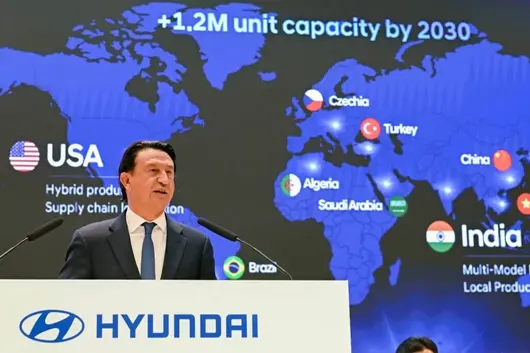
Hyundai and Kia operate products and channels separately in the US, supply through manufacturing bases in the Czech Republic, Turkey, and Slovakia in Europe, and have established local production systems in India. The two brands share the group's technology and procurement resources while competing against different users.
The Hyundai and Kia we see in China obviously do not represent the whole picture of this group. However, global scale has not allowed the two companies to escape profit pressure.
In the second quarter of 2026, Hyundai Motor Company's revenue was 49.22 trillion Korean won, up 1.9% year-on-year; operating profit was 2.85 trillion Korean won, down 20.8% year-on-year, with an operating profit margin of 5.8%. Kia's revenue for the same period was 33.03 trillion Korean won, up 12.6% year-on-year; operating profit was 2.62 trillion Korean won, down 4.9% year-on-year, resulting in an operating profit margin of approximately 7.9%.

Kia's revenue growth and operating profit margin were higher than Hyundai Motor Company, but both companies faced declining operating profit despite revenue growth. Different brands and product combinations presented different operating results within the same group.
Global layout gave Hyundai and Kia multiple market pivots but did not eliminate the pressure brought by costs, products, and competition.

Their lack of development in China does not hinder the study of how they established global business and how they succeeded globally. But at the same time, this system also faces challenges in the new automotive era.

Hyundai and Kia Going Global

The reason for Hyundai going global was first that the South Korean market is too small.
Chinese car companies that do well in their local market may reach millions of vehicles in scale and complete iterations of technology relying on China's supply chain. Hyundai does not have such conditions.
Established in 1967, it began producing the Ford Cortina in 1968, exported the Pony to Ecuador in 1976, and entered the US with Excel in 1986. While learning to build cars, it had to find overseas buyers.
For latecomers to the automotive industry, platforms, molds, R&D, and factories are investments that need to be spread across a scale. Local demand in South Korea determines that if Hyundai wants to become a large automobile enterprise, it cannot wait until all capabilities are mature before considering overseas expansion.
The global market has been a constraint it has had to face since early on in establishing its industrial capabilities.
This makes the growth conditions for Chinese and Korean car companies different.
Chinese enterprises can rely on the huge domestic market to perfect products and accumulate scale before expanding overseas business. Hyundai needed to learn how to enter other people's markets much earlier, understanding price tolerance, aesthetics, roads, and consumption habits. This difference does not determine who is more advanced but influences how enterprises later allocate resources and power.
Hyundai initially also relied on low prices. But the US market quickly made it understand that low prices can bring the first purchase, but quality and service bring the second.
In 1998, Hyundai Motor America introduced a coverage plan for 1999 model new cars, including a limited 10-year or 100,000-mile powertrain warranty. This was a concrete action to establish credit.
Within the scope covered by warranty terms, it transferred the reliability risks consumers worried about back to the manufacturer and required manufacturing, repair, and quality management to catch up. Whether a strange brand can stand, it needs to make consumers believe that someone is still responsible for problems that occur after buying the car.
The 1998 acquisition of Kia was another important node for Hyundai to establish today's global system. The two brands gradually expanded the sharing of platforms and procurement while retaining their own design and market expressions.
In 2005, the Hyundai Alabama plant went into production, and Kia subsequently established a production base in Georgia. Hyundai and Kia gradually changed from import brands to become local employers, purchasers, and investors, establishing long-term relationships with suppliers, dealers, and local governments.
Hyundai's Palisade and Kia's Telluride等大型 SUVs respond to family travel needs, hybrid models respond to usage costs, and Genesis bears the task of brand upward mobility. Two mass-market brands plus a luxury brand allow the group to compete between different prices and needs.
Hyundai and Kia in the US are not just Korean models with a few more configurations added. Local needs entered product definition, and car buying finance, leasing, and services entered the daily lives of consumers.
India took another path.
Hyundai established business in India in 1996, launched the Santro in 1998, and began local production, gradually expanding from small cars to compact SUVs. Price, space, fuel consumption, and maintenance convenience constitute the more realistic car buying judgment for local families.

Kia later entered India, establishing business through local production and products such as SUVs and MPVs. The two brands forming different product combinations in the same market also further increased India's weight in the group's global layout.
Hyundai India disclosed in its performance exchange in February 2026 that the localization level has reached 84%. As local procurement and manufacturing capabilities continue to deepen, India concurrently takes on the role of sales market, manufacturing base, and regional export center, supplying to the Middle East, Africa, Latin America, and other Asia-Pacific markets.
Europe had different requirements.
Hyundai established local R&D capabilities and supplied through Czech and Turkish factories, while Kia formed a manufacturing pivot in Slovakia. Body forms, driving feel, safety, and emission requirements need to be solved in the development stage. Channels, repair, and parts supply familiar to consumers determine whether products can be operated continuously after launch.
Localization in Brazil even went directly into the power system.
The Hyundai Brazil plant put into production in 2012 and the HB20 developed for the local market need to adapt to the ethanol fuel system, purchasing power, and usage environment. The Middle East and Africa rely more on distribution partners to establish coverage, then deepen assembly and procurement according to demand and policy. The Asia-Pacific market's demand for multi-person travel provided product space for MPVs and SUVs different from Europe.
These markets were not treated by Hyundai and Kia as different sales addresses for the same set of models.
South Korean local provides R&D, platform, and manufacturing foundations, with each region forming its own product combinations, supply chains, and business relationships. The group shares resources, brands face consumers separately, and regional business handles local needs.
The change Hyundai and Kia completed is that different markets gradually entered the enterprise, participating in deciding what this group produces, how it is produced, and how it serves users.

Undervalued Design

The role of design is often obscured by the impression of cost-performance ratio.
In the past, when people talked about Korean cars, the first thing that came to mind was value for money.
Today, Hyundai's IONIQ 5 pixel lights and Kia's EV9 geometric contours are all turning brands into recognizable product languages. Hyundai and Kia absorb global design talent and gradually form their own expressions. The experience of South Korean consumer electronics, home furnishings, retail, and cultural industries facing global consumers also provides a background for understanding such aesthetic expressions.
For automobiles, culture can be reflected in proportions, materials, colors, spaces, and interfaces, and does not need to become a prominent traditional symbol every time. The place Hyundai and Kia are worth studying is how to make people from different cultural backgrounds understand their designs while willing to pay for them.
After sharing platforms and technologies, the two brands still need to retain their respective appearances. Technical synergies can spread costs, but design and product positioning need to give consumers different reasons to choose.
When batteries, motors, chips, and screens are increasingly easy to obtain, product differences will not naturally disappear, but relying solely on configuration tables to build advantages will become more and more difficult. Design, usability, and overall experience will affect whether a brand can escape price competition.
Of course, Hyundai and Kia did not invent globalization. Toyota completed much of the work on this path earlier.
In 1984, Toyota and General Motors established NUMMI, i.e., New United Motor Manufacturing Inc., accumulated experience in organizing production and handling labor relations in the US, and then expanded its own manufacturing system. The IMV, i.e., Innovative International Multi-purpose Vehicle project, launched in 2004, incorporated bases such as Thailand, Indonesia, South Africa, and Argentina into common platforms and transnational division of labor, allowing a country's factory to serve multiple markets.
The advantage Toyota established was reliability, production management, repair networks, and long-term usage costs. As a later entrant, Hyundai and Kia needed to make up for quality while closing the brand gap through design, configuration, and price combinations.
They both value local operations, but Hyundai and Kia's experience is closer to the situation Chinese car companies are facing today: products already have competitiveness, why do consumers still unwilling to switch brands?
This is also where this sample is most valuable when comparing Chery, Geely, and BYD.
Chery entered emerging markets earlier, relying on high cost-performance products, local dealers, and co-assembly to expand coverage, then deepening manufacturing and brand investment. This path has similarities with Hyundai and Kia.
The next test is to convert the expansion speed brought by different partners into stable quality, spare parts, and service standards. The more countries, brands, and models, the higher the difficulty of channel management.
Geely relies more on capital shareholding or acquisition and technical cooperation.
Volvo and the cooperation with Renault in Brazil brought different forms of brand, R&D, factory, and regional relationships, and also brought Chinese technology into the existing global network. It needs to solve how brand autonomy and platform sharing get along, and whether complex equity and cooperation relationships can truly improve efficiency.
BYD relies on synergies between batteries, electric drive, entire vehicles, and plug-in hybrid technologies to push the scale and cost advantages formed in the Chinese market overseas.
The Thailand factory places local sales and regional exports together, reflecting the idea of a production network. The next test is, after increasing investment in overseas factory construction, local procurement, and channel services, how much cost advantage BYD can still maintain, and whether it can convert product competitiveness into dealer profits and users' long-term trust. Repair efficiency, spare parts supply, and used car residual value all need to be accumulated through continuous operation.
The experience Hyundai and Kia provide is that the assessment of going global must ultimately fall on local operations. Whether cars sold after entering channels are sold to users, whether dealers can make money, how long spare parts take to arrive, and whether financing costs are acceptable explain business quality more than announcing entering how many countries.
Localization also requires power to follow responsibility.
If a region is to be responsible for sales and profits, it must be able to influence product definition, configuration, launch rhythm, and partner selection. The headquarters retains platforms, quality, and safety standards, and local teams need the ability to respond to the market.

New Automotive Era

China is changing the value structure of automobiles. New energy platforms, batteries, smart cockpits, assisted driving, and rapid updates have formed a high-intensity innovation environment.
New functions and product concepts can quickly enter a large number of models, being verified, improved, or eliminated in real competition.
Chinese car companies have thus obtained a high upper limit for product experience. But a smart car that is highly mature in China may not be able to completely retain this experience in other markets.
Maps, accounts, music, payments, cloud services, and AI applications need to be reconnected; data permissions, privacy settings, and proactive recommendations need to be redesigned. A service that can be completed by voice in the country, overseas, may not have corresponding service providers, or may need to re-obtain user authorization. Whether local users need it also cannot be presumed in advance.
Past localization mainly revolved around regulations, chassis, power, and language. Today, it is increasingly deepening into the automobile's software structure and business relationships. The deeper China's digital ecosystem is integrated, the more parts may need to be re-developed and coordinated when migrating overseas.
China's intelligent advantage needs to be realized overseas through another set of organizational capabilities. How many functions are added should be determined by local needs; to what extent users hope the system is proactive also needs research. Cannot directly equate the high configuration density of the Chinese market with high satisfaction in all markets.
Hyundai and Kia have long faced multiple markets and accumulated experience in handling regional differences. This experience may help them adapt to different digital ecosystems.
But whether they already possess a good enough software architecture, development efficiency, and application experience is another problem still to be tested.
Assisted driving will further increase the difficulty.
Non-motor vehicles in Shanghai, roundabouts in Paris, and parking yield in US suburbs involve different road environments and driving habits formed over the long term. Completing a large number of verifications in China does not mean overseas local verification can be skipped.
Whether data can be collected, where it is stored, and how it is used for training are also affected by rules in different regions. Automobile platforms can be as unified as possible, but the data closed loop needs to possess regional capabilities. For Chinese car companies, this increases the cost of globalization; for Hyundai and Kia, sales scattered around the world will not automatically convert to usable assisted driving data.
Hyundai and Kia's failure in China serves as a reminder that global capabilities accumulated in the past also have boundaries.
Beijing Hyundai once broke through an annual sales volume of one million vehicles in 2013, and Kia also once had a much higher market presence in China than today. Local factories, joint venture partners, and channels were once complete, but when Chinese brands continued to advance in quality, design, SUVs, and new energy, the original reasons for purchasing for Korean brands gradually weakened. External shocks around 2017 exacerbated the decline, but were not enough to explain the long-term slump thereafter.
Manufacturing has been localized, but technology choices and product deployment still need to keep up with changes in the Chinese market. When consumers start evaluating cars with cockpits, assisted driving, and update speeds, past fuel vehicle credit cannot automatically become the attraction of new products.
Therefore, China's significance to Hyundai Motor Group cannot be just restoring sales volume. It also needs to re-enter the innovation system here.
Hyundai has begun introducing the technical capabilities of Chinese partners. In the China strategy announced in 2026, it includes collaborating with Momenta to develop assisted driving systems and introducing the Doubao Large Language Model in the smart cockpit. Whether these cooperations can improve product experience still needs to be verified by mass production performance and continuous updates. Source: Hyundai Motor China Strategy Explanation
Toyota adopting Momenta technology on China models, Nissan and Mazda also promoting new energy products through Chinese teams or partners, all show that China's significance to global automakers is extending from sales markets to the input end of technical and product capabilities.
Hyundai and Kia's Chinese joint venture companies also have new roles.
Yueda Kia's Yancheng factory has become part of the global export network, but manufacturing export is just one layer. China's supply chain and R&D speed can also support product development, then enter other markets through the group's regulations, quality, and brand systems.
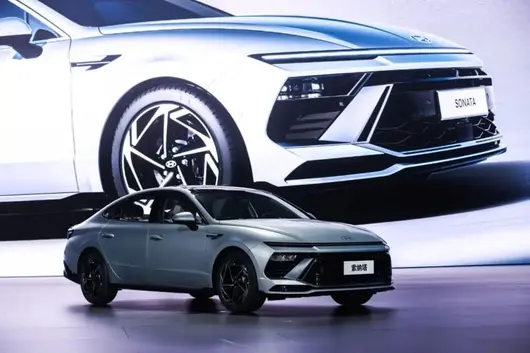
Beijing Hyundai ELEXIO has begun moving overseas along this path. This electric SUV was produced by Beijing Hyundai, launched first in the Chinese market in October 2025, and then entered the Australian market, a product under Hyundai's "Made in China, For China, Going Global" strategy.
But after ELEXIO's launch in China, sales were low, and the situation has not yet opened up. China development and manufacturing, using group channels to enter overseas, show the product has connected to the global network; whether it has enough competitiveness still needs to be answered by the market.
ELEXIO's test therefore has two layers: In China, it needs to re-establish consumers' reasons to choose Hyundai electric vehicles; overseas, it needs to prove that after local adaptation, this set of products can obtain continuous sales and reasonable profits. The slump in the Chinese market cannot directly predict overseas results, but equally cannot be covered up by overseas deployment news.
This requires global companies to have the ability to judge which Chinese innovations can be migrated, which need adjustment, and which are only suitable for China. Discovering and verifying innovation in China, then making it adapt to users in different countries is the capability Hyundai Motor Group needs to further establish.
Whether it can complete this step will directly affect how Hyundai and Kia respond to the overseas challenges of Chinese car companies.

New Competition in Global Markets

Competition in Europe has fallen on pure electric, plug-in hybrid, price, and software experience simultaneously.
Hyundai and Kia's respective electric vehicle products expanded the group's market coverage and allowed the two brands to compete for users with different designs and models. But owning electric vehicle products does not mean the market is already held. Chinese brands are still making up for production and channels, while Hyundai and Kia need to face competition on costs and experience.
Competition in South America and Southeast Asia is more direct.
Chinese car companies bring battery and plug-in hybrid advantages to the local area, also building factories, channels, and service systems. Plug-in hybrids especially may change some markets where public charging facilities are insufficient: for consumers with daily charging conditions, they do not need to wait for public charging networks to be fully mature to obtain daily electric driving experiences. How much usage costs can be reduced depends on local gasoline and electricity prices and actual charging and driving situations.
Hyundai and Kia need to judge how long fuel vehicles and regular hybrids can support, and at what speed pure electric, plug-in hybrid, and extended range should enter. Investing too slowly will lose users, while too quickly may bear idle capacity. The Middle East and Africa cannot be processed generally; purchasing power, energy prices, and infrastructure differences vary greatly between the Gulf and other markets.
The US and India provide different degrees of buffer.
US access restrictions, India's investment environment and local industry relationships all increase the difficulty for Chinese car companies to enter directly. But Hyundai and Kia still have to face Toyota, US local enterprises, and India's Maruti Suzuki, Tata, and Mahindra. Policies can influence the time competition occurs but cannot solve cost, product, and demand problems for enterprises.
Both companies' product and investment choices have already reflected this judgment.
Hyundai Motor Company continues to expand capacity in North America and India, strengthen hybrids, and plans to launch its first batch of extended range models starting from the first half of 2027. Kia, in addition to expanding pure electric and hybrid products, takes PBV dedicated vehicle business as a new growth direction. The group's common technical foundation is being used for product arrangements of different brands and markets. Source: Hyundai Motor 2026 Investor Day Announcement, Kia 2026 Investor Day Announcement
What is truly difficult is that multiple technology routes require money and also require organizations to undertake.
Fuel, hybrid, pure electric, and extended range are all invested in simultaneously, old and new factories need coordination, and software, autonomous driving, and robots are vying for R&D resources. The group is promoting Pleos cockpits and software-defined cars. With related systems entering mass production, development, verification, and continuous update efficiency will accept the test of actual use.
Processes that helped it establish global scale in the past may also increase time and costs in new competitions. The more regional businesses there are, the more important unified architecture is; the greater market differences, the more important local autonomy is. How to divide work between the two is something global automotive companies must repeatedly adjust in the future.
Hyundai Motor Company set a sales target of 5.55 million vehicles and an operating profit margin target of over 9% for 2030; Kia set a sales target of 4.13 million vehicles and a 10% operating profit margin target. The combined sales volume targets of the two companies are approximately 9.68 million vehicles. Achieving these targets requires improving product structure, costs, and capacity utilization simultaneously. Source: Hyundai Motor Target, Kia Target
If Chinese competitors continuously improve cost-performance ratios, and Hyundai and Kia can only increase discounts, scale targets and profit targets will constrain each other. Sharing technology and procurement can spread investment but cannot replace each brand establishing a purchase reason in the local market.
Hyundai and Kia have previously proven they are good at absorbing external capabilities and putting these capabilities into their own global systems. The next step, they still need to prove whether they can create new product experiences faster. The task for Chinese car companies is to make the already formed innovative capabilities continue to hold in different regulations, cultures, and digital ecosystems.
Therefore, what Hyundai Motor Group is most worth Chinese car companies learning is how to let an enterprise growing from a local base continue to operate in many countries, letting local users be willing to buy, use for a long time, and choose it again. This capability needs to be implemented in products, factories, suppliers, channels, and every after-sales service.
And the new exam question China gives is, when the technical and experience standards of automobiles are increasingly formed in China, can it bring these changes into the global system in time.
Hyundai and Kia have already proven how to become a global car company, next they still need to prove how to continue to do well as this group after cars are redefined.