


首頁HILUX

搜尋歷史
熱門搜尋
經銷商登入 / 註冊

August 2026, Australia new car market deliveries reached 108,760 units, up 4.9% year-on-year. Behind the stable figures lies a historic shift in powertrains: 27,078 Battery Electric Vehicles (BEVs) were delivered, surging 169.4% year-on-year. With a market share of 24.9%, BEVs surpassed petrol, diesel, and hybrid for the first time, becoming the top powertrain type in Australia; Plug-in Hybrid Electric Vehicles (PHEVs) also grew 171.1% to 10,591 units. The Tesla Model Y topped the overall model sales list, while BYD secured second place among brands with 8,231 units (+68.8%), making New Energy brands the biggest winners of the month.

As pickups bear heavy-load tasks such as hauling, towing, and off-roading, their requirements for range and power are far higher than ordinary passenger cars; consequently, their electrification lags significantly behind the overall market — but August data shows they can no longer stay isolated.

Toyota Hilux retained the pickup title with 4,833 units, but saw only a slight increase of 0.2% year-on-year, essentially standing still. Ford Ranger suffered a cliff-like drop, delivering only 2,440 units, plummeting 50.6% year-on-year — primarily due to a temporary delivery halt caused by safety concerns with side air curtains, resulting in a monthly loss of about 2,500 units, which is a supply-side shock rather than a demand collapse.

Isuzu D-Max delivered 1,708 units (-26.2%), Mitsubishi Triton 1,161 units (-23.8%), and Mazda BT-50 recorded 804 units (-29.4%); all three Japanese diesel pickups declined by double digits. Volkswagen Amarok 306 units (-27.7%), Nissan Navara 277 units (-53.2%), and Kia Tasman performed the worst with only 312 units, down 61.1% year-on-year.

Pickups manufactured in China continued to expand their presence. BYD Shark 6 led Chinese brand pickups with 1,385 units, followed closely by Great Wall Cannon with 827 units. Adding Maxus LDV pickups (T60 + Terron 9 totaling 423 units), Foton Tunland V7 (124 units), MG U9 (115 units), JAC T9 (77 units), and others, total Chinese pickups reached approximately 2,951 units, accounting for about 18.5% of the Australian pickup market. In contrast, vehicles manufactured in Thailand delivered 15,658 units in August, down 24.7% year-on-year, driven almost entirely by the contraction of the pickup segment — Thailand is the main production base for Japanese pickups.

Amidst the general decline, BYD Shark 6 grew 9.8% year-on-year, reaching a year-to-date total of 12,094 units, becoming one of the few mainstream pickups with positive growth. Its PHEV positioning balances electric driving experience with pickup utility needs, coupled with BYD's strong brand power and more competitive pricing, opening up new volume outside of traditional diesel pickups. Notably, New Energy itself is not a guarantee of growth; brand momentum, pricing, and supply rhythm are key.

The full-size pickup market showed clear divergence. Ford F-150 delivered 152 units (surged from a low base), Chevrolet Silverado 1500 delivered 148 units (-6.9%), and RAM 1500 fell 32.6% to 149 units. Premium pickups above A$100,000 overall grew 18.1% to 764 units, forming a contrast with mainstream market weakness.

Final thoughts: August data clearly shows that even in the pickup segment where electrification is inevitably lagging, traditional fuel powertrains are also feeling a clear chill. Ranger's delivery halt amplified the decline. BYD Shark 6's growth against the trend validated the viability of PHEVs in the pickup market. Chinese brands like Great Wall Cannon, Maxus LDV, and others became an undeniable force in the Australian pickup market through stable sales volumes and forward-looking new energy layouts. With Ranger resuming deliveries in September and more hybrids and EV pickups entering the market, how the Australian pickup landscape will change again remains to be seen.

In July 2026, the Thailand pickup market totaled only 11,134 units for the month, continuing a weak trend. Toyota Hilux TRAVO/REVO secured the top spot with 5,358 units, holding a 48.1% share, accounting for nearly half the market; Isuzu D-Max sold 3,803 units, with a 34.2% share. The two Japanese brands combined accounted for over 82% share, and the dual oligopoly structure remains stable.

Internally, the Toyota Hilux series shows "concurrent operation of commercial and passenger lines": Travo commercial version sold 3,242 units, Revo passenger version sold 2,116 units; the former has a base advantage, while the latter's continued sales volume reflects that demand for high-end passenger pickups has not completely disappeared. Hilux Champ ranked fourth with 479 units, a 4.3% share, complementing Travo as a product.

Isuzu D-Max remains firmly in second place, locking the top 2 positions with Toyota. Ford Ranger sold 568 units ranking third, with a 5.1% share, securing its place among American pickups; Mitsubishi Triton sold 403 units ranking sixth, with a 3.6% share.

What is worth noting is the performance of new energy pickups. Geely Radar (GEELY Radar) ranked fifth with 409 units, a 3.7% share, surpassing Mitsubishi Triton to become the largest pure electric pickup in July sales. King Long Dracon sold 16 units, Foton e-Tunland sold 10 units, Deepal Hunter K50 sold 3 units. Chinese brands have formed a cluster effect in the pure electric pickup track. Although the overall share of pure electric pickups is still less than 4%, in the context of the continuous decline of traditional fuel pickups, electrification may be a key variable to break the Japanese monopoly.

July's slump was not accidental. Suwat, Vice Chairman of the Federation of Thai Industries and Chairman of the Automotive Industry Group (AIC), had previously warned: In 2025, the proportion of Thailand's pickup sales to the overall market dropped to 23%, a historic low. Between 2010 and 2022, this proportion remained at around 45% for a long time. In 2023, it dropped to 34% (about 265,000 units), in 2024 it fell to 23% (about 163,000 units), and in 2025 it remained at 23% but the absolute volume dropped to about 144,000 units.

High household debt, rising non-performing loans, and weak domestic purchasing power are the core reasons for the continuous pressure on the pickup market. AIC urged the government to introduce stimulus policies as soon as possible, because the localisation rate of the pickup industry is as high as 90%, covering more than 2,500 parts suppliers. Market contraction will have a chain impact on the entire supply chain.

Exports are also under pressure. Affected by the Middle East situation, Thailand's car exports declined by more than 20% in the past two months. From January to May 2026, Thailand exported 49,961 cars to the Middle East, a year-on-year drop of 30.4%. The Middle East is Thailand's third-largest export market, accounting for 20% of total exports in 2025. Four-door pickups and PPVs (pickup-derived SUVs) are their main demand products. Combined with weak domestic demand, Thailand's pickup industry is facing a dual squeeze.

Final Thoughts: July data once again confirms that the downward trend of the Thailand pickup market has not bottomed out. The dual oligopoly structure of Toyota and Isuzu is difficult to shake in the short term, but Chinese pure electric pickups represented by Geely Radar are quietly accumulating momentum. How to find a balance between domestic demand stimulus, export diversification, and electrification transformation will be the key to determining whether the Thailand pickup market can emerge from the valley.
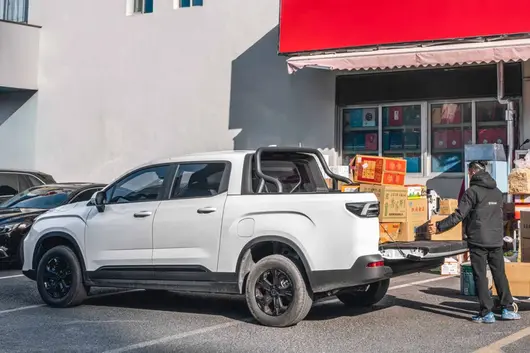

2026 年 7 月,泰國皮卡市場全月合計僅 11,134 輛,延續低迷態勢。豐田 Hilux TRAVO/REVO 以 5,358 輛穩居榜首,份額 48.1%,幾乎佔據半壁江山;五十鈴 D-Max 售出 3,803 輛,份額 34.2%。兩大日系品牌合計份額超 82%,雙寡頭格局依然穩固。
豐田 Hilux 系列內部呈"商用乘用雙線並進":Travo 商用版售出 3,242 輛,Revo 乘用版售出 2,116 輛,前者基數佔優,後者持續走量反映出高端乘用皮卡需求並未完全消失。Hilux Champ 以 479 輛排名第四,份額 4.3%,與 Travo 形成產品互補。
五十鈴 D-Max 穩居第二,與豐田牢牢鎖定前 2 名位置。福特 Ranger 售出 568 輛排名第三,份額 5.1%,守住美系皮卡一席之地;三菱 Triton 售出 403 輛排名第六,份額 3.6%。
值得關注的是新能源皮卡表現。吉利雷達(GEELY Riddara)以 409 輛排名第五,份額 3.7%,力壓三菱 Triton,成為 7 月銷量最大的純電皮卡。金龍 Dracon 售出 16 輛,福田 e-Tunland 售出 10 輛,深藍 Hunter K50 售出 3 輛,中國品牌在純電皮卡賽道已形成集群效應。雖然純電皮卡整體份額仍不足 4%,但在傳統燃油皮卡持續萎縮的背景下,電動化或許是打破日系壟斷的關鍵變數。
7 月低迷並非偶然。泰國工業聯合會副主席、汽車產業集團(AIC)主席 Suwat 此前已警告:2025 年泰國皮卡銷量佔整體市場比例已降至 23%,創歷史新低。而 2010 至 2022 年間,這一比例長期維持在 45% 左右。2023 年降至 34%(約 26.5 萬輛),2024 年跌至 23%(約 16.3 萬輛),2025 年維持 23% 但絕對量已降至約 14.4 萬輛。
家庭債務高企、不良貸款攀升、國內購買力疲軟是皮卡市場持續承壓的核心原因。AIC 呼籲政府盡快出台刺激政策,因為皮卡產業本地化率高達 90%,覆蓋超 2,500 家零部件供應商,市場萎縮將對整個供應鏈產生連鎖衝擊。
出口端同樣承壓。受中東局勢影響,近兩個月泰國汽車出口下滑超 20%。2026 年 1 至 5 月,泰國對中東出口汽車 49,961 輛,同比大跌 30.4%。中東是泰國第三大出口市場,2025 年佔出口總量 20%,四門皮卡和 PPV(皮卡衍生 SUV)正是其主力需求產品。出口受阻疊加內需疲軟,泰國皮卡產業正面臨雙重擠壓。
最後寫: 7 月數據再次印證泰國皮卡市場下行趨勢尚未見底。豐田與五十鈴的雙寡頭格局短期難以撼動,但以吉利雷達為代表的中國純電皮卡正在悄然積累勢能。如何在內需刺激、出口多元化和電動化轉型之間找到平衡,將是決定泰國皮卡市場能否走出低谷的關鍵。


