首頁Going Global

搜尋歷史
熱門搜尋
經銷商登入 / 註冊

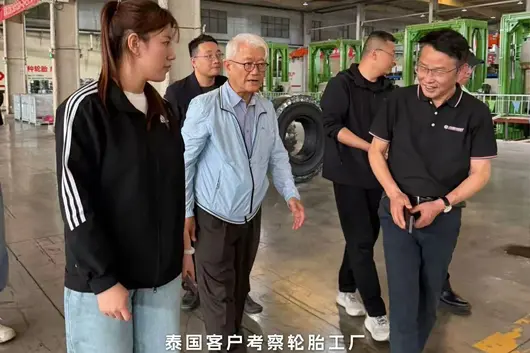
Recently, the team from YaoQian International Trade (Henan) Co., Ltd., a subsidiary of the Malaysia YaoQian Group, accompanied Thai clients to inspect its strategic solid tire production base. Behind the high acclaim given to the automated production lines and rigorous quality control by the visitors lies the company's unique strategic path: bypassing the saturated local market, leveraging Central Plains manufacturing, and targeting the global special tire market.

New Factory Welcomes Guests: Thai Clients Praise "Made in China"
As a new force that just opened its doors in Jiaozuo this July, YaoQian International welcomed a successful start. In the production workshop, Thai clients closely observed the entire process from raw material inspection to finished product output, gaining a direct understanding of core performance of solid tires such as high load-bearing capacity, wear resistance, and maintenance-free operation. This inspection deepened mutual trust between both parties and laid the foundation for long-term cooperation. YaoQian International stated it would continue to leverage its professional advantages to help high-quality "Made in China" products go global.

Foreign Investment Move: 37-Year Industry Giant Enters, Focusing on Special Tires
The confidence to welcome guests stems from the YaoQian Group's deep industry accumulation. On July 17, YaoQian International with a registered capital of 10 million US dollars officially opened in Shanyang District, Jiaozuo, becoming a key foreign investment project attracted by the district in 2025. The parent company, Malaysia YaoQian Group, has been deeply engaged in tire manufacturing for 37 years, with business covering more than 110 countries, having cooperated with engineering machinery giants such as XCMG, Sany, and Caterpillar for a long time. Industry speculation suggests that YaoQian's tire factory in Jiaozuo will most likely focus on its advantageous areas - mining and special tire production. Although Jiaozuo already has special tire giants such as Aeolus Tires, YaoQian's entry will bring new competition and cooperation, but its true ambition does not lie here.

Breaking the Pattern with Differentiation: No Red Ocean Battle, Building an Export "Trade Hub"
Facing fierce price wars domestically, YaoQian (Henan) has a clear differentiation positioning: to be a "production capacity pivot" and a "trade hub". The company clearly stated it will rely on the advantages of China's manufacturing cluster, integrate heavy equipment manufacturing resources in Jiaozuo and surrounding areas, and establish an international supply chain system. Its strategic focus is to radiate globally centered on the Central Plains, focusing on developing emerging markets such as Russia, Central Asia, and Africa, and building a trade network covering the "Belt and Road Initiative".
Under this logic, YaoQian (Henan) focuses on the cost and efficiency advantages of Made in China, dedicated to becoming a multinational trade platform connecting Chinese intelligent manufacturing with global resource development, rather than focusing mainly on the domestic market. In the future, the group will also introduce patented technologies, integrate global marketing networks, and continuously expand the high-end markets in Europe and America.
Industry analysis believes that through the new path of "Overseas Demand + Chinese Production Capacity + Global Trade Network", YaoQian Group not only injected foreign trade resources into Jiaozuo but also provided a highly valuable sample for observing new strategies of foreign investment in China.


Written by | Wu Jing
Edited by | Huang Dalu
Designed by | Zhen Youmei
"In the current international market, the essence of 'going global' has fundamentally changed. Previously, it was called 'export', selling a car to different countries and different overseas markets. Now, with changes in the geopolitical landscape and economic and trade situation, this way is slowly becoming unfeasible."
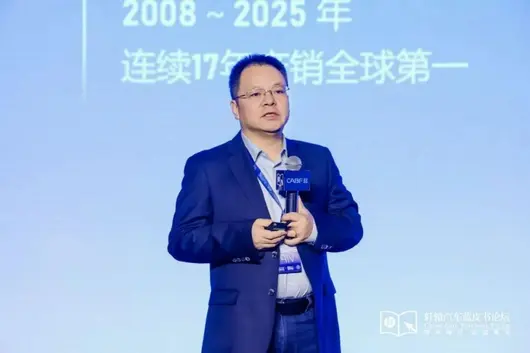
On May 15, 2026, at the 18th Xuan Yuan Auto Blue Book Forum, Chen Jiadang, Deputy General Manager of Geely International, pointed out the turning point facing Chinese car exports.
In the past 17 years, China's automobile production and sales have maintained the top spot globally. In 2025, China's automobile exports exceeded 7 million units, ranking first globally for 3 consecutive years. Chen Jiadang pointed out that China's automobile going global has entered a new development stage. The traditional 'one-size-fits-all' product export model is unsustainable. The core of globalization has shifted to regionalization, fragmentation, and localization.
He summarized car company going global into four major stages:
The first is the trade export stage. Selling complete vehicles overseas to achieve growth from 0 to 1. However, this stage lacks sufficient brand accumulation. Channel and service networks in the region are incomplete, and the risk resistance capability is weak.
The second stage is brand going global. Car companies build marketing companies overseas, spreading and building their own brands in overseas markets through a combination of general agency and direct distribution.

The third stage is capacity and industry going global. Layoutting KD factories overseas, breaking through trade barriers in supply chains. Relying on regional R&D centers to develop exclusive overseas version models and synchronizing the localization of full value chain services.
The fourth stage is ecosystem going global. Promoting the going global of ecosystem services such as finance, insurance, and used cars. Simultaneously participating in the formulation of industry standards in core areas of local safety, intelligence, and energy, creating local national brands.
Based on the new era landscape, Geely has set a goal of 6.5 million group sales by 2030, with overseas sales accounting for 1/3, new energy accounting for 75%, and entering the top five global automakers. In 2026, it strives to achieve 750,000 overseas sales.
Finally, Chen Jiadang also summarized the five major shifts in Geely's internationalization and globalization: the shift in market layout, the shift in product structure, the shift in business model, the shift in business philosophy, and the shift in strategic goals.
The essence of globalization is regionalization. The goal of regionalization is to make localized operations deep and thorough, taking root downwards. Chen Jiadang stated that on this strategic cognition, Geely is experiencing a transition from past technology output to value co-creation.
"In the past, we quickly made up for shortcomings in competitiveness through core technology investment and R&D. Currently, we need to enter a higher-order stage of value co-creation, sharing our core technology, outputting mature management systems and corporate values with global partners," he said.

The following is the transcript of Chen Jiadang's speech, organized by "Automotive Business Review," with minor deletions here:
Hello everyone! I am Chen Jiadang from Geely International.
Today's forum theme is 'shift', which I feel is very meaningful and aptly reflects the current stage of Chinese car brands 'going global'. I will mainly combine Geely International's practice and thinking in going global in recent years, as 2026 is also the first year of the entire Geely Internationalization future five-year strategic plan.
The essence of 'going global' has fundamentally changed
In the past 17 years, China's automobile production and sales have maintained the top spot globally without doubt. China is the world's largest automobile market. In 2025, China's automobile exports exceeded 7 million units, also ranking first globally for 3 consecutive years.
Relying on a complete industrial system and strong technological innovation capabilities, Chinese automobiles have not only achieved leapfrog development themselves but also promoted the global automotive industry towards a new era in the fields of new energy, including intelligent driving and intelligent cockpits.
On the eve of the just-concluded 2026 Beijing Auto Show, we convened overseas dealers to attend the Geely Dealers Conference and visited the Beijing Auto Show. Based on the feedback from all foreign dealer partners, the eyes of the whole world are focusing on the Chinese market as never before.

Geely Automobile is one of the most technology-innovative and intelligently leading car brands in China. We just invited dealer partners from more than 100 countries and more than 1,000 partners to Hangzhou at the end of April, holding a dealer partners conference with the theme 'Jointly Embarking on the Era of Smart Vehicles'.
Overseas dealers came to China. We showed them our full range of products, technology, and R&D strength. This exhibition was very important for Geely. Our overseas partners also saw the strength of Chinese automobiles in the field of smart technology.
High attention from the global market makes us clearly see that the international influence of Chinese automobiles is rapidly rising. In the past, Chinese brands only participated in the competition of the global market. Now it has gradually shifted to leading the transformation of the automotive industry.
Chinese automobile going global has entered a new stage. In the current international market, the essence of 'going global' has fundamentally changed. Previously, it was called 'export', selling a product to different countries and different overseas markets. Now, with changes in the geopolitical landscape and economic and trade situation, this way is slowly becoming unfeasible.
New globalization, we define it as regionalization, trending towards fragmentation and localization.
Every region, when we go to every country, the differences in policies, regulations, user needs, and industrial support changes are very obvious. In the current environment, no brand can achieve the goal of globalization with the past 'one-size-fits-all' way. So, the essence of 'globalization' has changed.
The competitive logic of the global automotive industry is迎来 a shift. This means Chinese car companies' going global is no longer simple trade expansion. It is a journey from simply going out, to going in with quality, to going up; from past product output to future technology and system output; from past 'following' to future 'leading'. I think this is a challenge for Chinese automobiles.
But this also creates an opportunity for us, an opportunity for Chinese automobile brands to stand in the mid-to-high-end positions of the global value chain.
Four stages of Chinese car companies going global
Facing such a major industry trend, we combined past car company going global and summarized it into several stages:
The first stage, we define it as trade export. In the past, we sold complete vehicles overseas, found general agents overseas, set targets, confirmed FOB price, basically selling cars to achieve growth from 0 to 1. This method actually lacked brand accumulation. Channel and service networks in the region were incomplete, and risk resistance capability was weak.
The second stage we define as brand going global. Car companies build overseas marketing companies overseas. Through a combination of general agency and direct distribution, spreading and building their own brands in overseas markets.

The third stage is actually the current stage, capacity and industry going global. Layoutting KD factories overseas, doing manufacturing overseas, layoutting supply chains to break through trade barriers. Relying on regional R&D centers, developing overseas exclusive versions, developing overseas exclusive models, defining user needs for each country according to local conditions, and developing competitive products, synchronizing the localization of full value chain services.
The fourth stage we define as ecosystem going global. This is also the stage Chinese brands are currently and will experience in the future. Promoting the going global of the entire finance, insurance, used cars, and other ecosystem services. You can also participate in the formulation of industry standards in core fields such as local safety, intelligence, and energy. We output technology, output standards, output solutions to help local countries build so-called national brands. This might be the future stage of ecosystem going global.
The above four stages are summarized through practice exploration by top global car companies, and are also a compass for Chinese car companies' going global path.
Conforming to the general trend, Geely Automobile also layoutted future five-year internationalization goals starting from 2026. The entire Big Geely proposed the strategic goal 'One Geely, Comprehensive Leadership'. By 2030, it aims to achieve 6.5 million units for the entire automobile group.
In this goal, overseas sales are to account for 1/3, and the brand should occupy the top five strategic position globally. According to such strategic planning, we also sorted out global and internationalization goals. This year we strive to achieve 750,000 units. Next year we sprint for higher targets.
Five major shifts in Geely going global
Against this background, based on Geely going global practice, I will share the following with everyone. I summarize it into Geely's internationalization, globalization going global five major shifts:
First, the shift in market layout. 80 million capacity global market, for example, USA, Canada, India, Japan & Korea might be temporarily unreachable. Other regions I think might be the main battlefield for Chinese brands overseas. Market layout shifted from past 'going out' to 'going in'. We need to deepen core regions, operate with quality. Under the new globalization background, only focusing is possible to achieve high-quality growth.
We established 'Two Alliances, Two Regions', i.e., European Union, ASEAN, North America, South America are our main battlefield. Europe is the world's most mature automobile market and also a highland for car brands. The entire market capacity is about 15 million unit volume.

We started entering Europe layoutting a few subsidiaries last year. France, Germany, UK, Spain, Netherlands, Hungary. These subsidiaries all realized opening and operation listing in the first quarter of this year. First quarter sales also performed well. The entire growth rate was as high as 400%, also becoming one of the fastest-growing brands among Chinese brands in the European market.
In ASEAN, we cooperated with Proton, deepening the market of Malaysia. Simultaneously, Indonesia KD factory landing. Simultaneously, we continue to deeply cultivate key markets such as Philippines, Thailand, Vietnam, comprehensively consolidate the ASEAN market.
North America and South America. North America is Mexico. The current market sales are also not bad. Because we layoutted a subsidiary in Mexico, and also set a relatively challenging goal. In South America, we did strategic cooperation with Renault, established a joint venture subsidiary with Renault, promoting localized production. Simultaneously relying on Renault channels, we also challenge the goal of monthly sales breakthrough 10,000 units.
From 'going out' to 'going in' then to 'going up', we realized steady overseas business growth. This year past 4 months, the entire Geely achieved 286,000 units target internationally, year-on-year growth exceeded 150%. This is the first shift, regarding the shift in market layout.
Second, the shift in product structure. In the past, Chinese automobile brands going out, most sold were fuel vehicles. We need to move from fuel-dominated to fuel and electricity together. In the fuel vehicle field, we need energy efficiency and also intelligence.
This year January-April, we new energy field export contributed 174,000 units target. The entire growth is very rapid, performance is also quite bright. But more importantly, we need to adhere to brand premiumization. Because we have the entire international, have Geely, fuel vehicles, electric vehicles, Lynk & Co, Zeekr. Zeekr brand positioning is brand upward breakthrough. With technology strength to reshape the global value of Chinese brands.
Third, the shift in business model. From past 'product output' to 'full value chain localized output'. Facing global trade barriers and regional market demands, past simple complete vehicle export has become unsustainable. Geely firmly promotes the entire business model shift. From past product output to R&D, production, sales system output. Realizing full value chain localization.

R&D end, we have R&D resources in Germany, Sweden. Integrate them into Geely's European Technology Center. Truly research and develop in the region, develop products needed in the region.
Production end, we layoutted many manufacturing bases overseas. In Malaysia, mainly taking Proton as the core, established Automotive High-tech Silicon Valley. We internally call it AHEV. Building a regional hub with 500,000 capacity.
Additionally, in sales end, we layoutted subsidiaries in many places. Building brand marketing, channel development, and after-sales service localized operating capabilities. So, globalization is not simply copying the Chinese model overseas. But landing in overseas, suitable local models. Only this way can it take root downwards in regional markets.
Fourth, the shift in business philosophy. From 'single globalization mindset' to 'depth of localized operations'. The going global of automobiles is actually also very key.
The essence of globalization is regionalization. Actually, the goal of regionalization is how to do localized operations deep and thorough, take root downwards. So, we need to co-build value ecosystem with the local. On strategic cognition, we are experiencing a transition from past technology output to value co-creation stage. In the past, we made up for competitiveness shortcomings quickly through core technology investment and R&D. Currently, we need to enter a higher-order value co-creation stage. Sharing our core technology, outputting mature management systems and corporate values with global partners.
In brand operation, we define it as the 'T' Plan for going global. 'T' is equivalent to a unified global tag for a brand. 'T' vertical can be compared to doing brand marketing in every market. Local operation takes root downwards, promoting localized brand construction, localized marketing, localized user operation. Simultaneously need to build good partner relationships with localized dealers. We pursue beauty shared by all, realizing landing and deep cultivation in the region, taking root and growing.
Actually, the root of localized operation is talent. Including regional regulations, local culture, local user preferences, product definition differentiation, even compliance, risk control, etc. Only by using local talent well can we effectively break cultural barriers, bridge the communication between brand and users.
Talent culture integration, recruiting local talent, training local talent is the true criterion for taking root overseas markets and operations.

Fifth, the shift in strategic goals. From past calling 'scale priority', going out to see how many markets, sell how many cars, to 'high-quality globalization'. Doing such strategic goal changes.
Internationalization business is the top priority for Geely's future development. So overseas business must adhere to high-quality development. We rely on brand construction, technology accumulation, product quality, and after-sales service system construction to build sustainable long-term competitiveness.
But on the development road, do not blindly pursue expansion speed. Strictly abide by the bottom line of compliance. Walk a steady and sustainable development road. Always adhere to user-centered, with globally unified strict standards for global users to provide consistent high-quality travel experience. This is about the entire strategic goal shift.
Ladies and gentlemen, we stand at the critical juncture of the era of global industry landscape reshaping. We should not only be grateful for the development advantages endowed by the era but also actively grasp the major opportunities within it. Let us use long-termism as the spear, technology innovation as the square, walk a path from following to leading, from products to brand upgrading. Geely Automobile is willing to walk towards newness together with all Chinese car companies, letting the world see the power of Chinese automobiles!
Let's let the world be full of Geely together. Thank you all!
Thank the following partners for strong support. Let us face 'shift' together and win the future together.

Recently, the team from YaoQian International Trade (Henan) Co., Ltd., a subsidiary of the Malaysia YaoQian Group, accompanied Thai clients to inspect its strategic solid tire production base. Behind the high acclaim given to the automated production lines and rigorous quality control by the visitors lies the company's unique strategic path: bypassing the saturated local market, leveraging Central Plains manufacturing, and targeting the global special tire market.
New Factory Welcomes Guests: Thai Clients Praise "Made in China"
As a new force that just opened its doors in Jiaozuo this July, YaoQian International welcomed a successful start. In the production workshop, Thai clients closely observed the entire process from raw material inspection to finished product output, gaining a direct understanding of core performance of solid tires such as high load-bearing capacity, wear resistance, and maintenance-free operation. This inspection deepened mutual trust between both parties and laid the foundation for long-term cooperation. YaoQian International stated it would continue to leverage its professional advantages to help high-quality "Made in China" products go global.
Foreign Investment Move: 37-Year Industry Giant Enters, Focusing on Special Tires
The confidence to welcome guests stems from the YaoQian Group's deep industry accumulation. On July 17, YaoQian International with a registered capital of 10 million US dollars officially opened in Shanyang District, Jiaozuo, becoming a key foreign investment project attracted by the district in 2025. The parent company, Malaysia YaoQian Group, has been deeply engaged in tire manufacturing for 37 years, with business covering more than 110 countries, having cooperated with engineering machinery giants such as XCMG, Sany, and Caterpillar for a long time. Industry speculation suggests that YaoQian's tire factory in Jiaozuo will most likely focus on its advantageous areas - mining and special tire production. Although Jiaozuo already has special tire giants such as Aeolus Tires, YaoQian's entry will bring new competition and cooperation, but its true ambition does not lie here.
Breaking the Pattern with Differentiation: No Red Ocean Battle, Building an Export "Trade Hub"
Facing fierce price wars domestically, YaoQian (Henan) has a clear differentiation positioning: to be a "production capacity pivot" and a "trade hub". The company clearly stated it will rely on the advantages of China's manufacturing cluster, integrate heavy equipment manufacturing resources in Jiaozuo and surrounding areas, and establish an international supply chain system. Its strategic focus is to radiate globally centered on the Central Plains, focusing on developing emerging markets such as Russia, Central Asia, and Africa, and building a trade network covering the "Belt and Road Initiative".
Under this logic, YaoQian (Henan) focuses on the cost and efficiency advantages of Made in China, dedicated to becoming a multinational trade platform connecting Chinese intelligent manufacturing with global resource development, rather than focusing mainly on the domestic market. In the future, the group will also introduce patented technologies, integrate global marketing networks, and continuously expand the high-end markets in Europe and America.
Industry analysis believes that through the new path of "Overseas Demand + Chinese Production Capacity + Global Trade Network", YaoQian Group not only injected foreign trade resources into Jiaozuo but also provided a highly valuable sample for observing new strategies of foreign investment in China.

Article | Auto Expert Compilation
Welcome Submissions | Please add WeChat auto188
May 21, the opening ceremony of the 12th Chengdu International Auto Parts and Aftermarket Service Exhibition and the China Auto Ecosystem Partners Conference was held at Century City New International Conference and Exhibition Center in Chengdu. This event, themed "Leading the Trend 2026: A Must-Do, Taking a Step Ahead", focused on two current hot topics "Automotive Modification Industry Supply Chain" and "Automotive Complete Vehicle & Parts Industry Going Global", gathering industry elites to discuss the industry's future, injecting strong momentum into the high-quality development of the Southwest automotive industry.

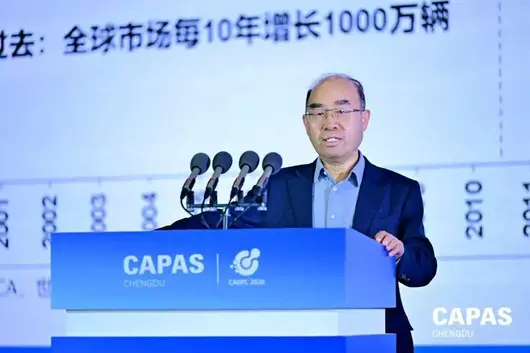
During the keynote speech session, Xu Changming, former Deputy Director of the National Information Center and Senior Economist (Positive Level), believed that China's auto exports are at a historical leap stage, and the underlying logic for future growth is solid - release of demand in emerging global markets, qualitative change in competitiveness of Chinese brands, and active going global of the whole industry chain. Despite volatile factors such as trade friction and local protection, the trend of internationalization is irreversible. Enterprises should focus on quality and service, avoid vicious competition, promote the upgrade from "Complete Vehicle Export" to "Ecosystem Going Global", and achieve sustainable, upward global development amidst fluctuations.
The following is the speech transcript (compared based on recording by Auto Expert):
Respected guests, good morning! I am very happy to share my views on auto export and internationalization trends with you today.
This chart shows that during the "14th Five-Year Plan" period, China's auto exports achieved leapfrog development. Before 2020, for about ten-plus years, auto exports were stable at around 1 million vehicles. In 2021 it reached 2 million vehicles, and last year it reached 7.1 million vehicles. In five years, it increased by 6 million vehicles, which is a major trend. In the first four months of this year, exports reached 3.18 million vehicles, up 62% year-on-year, another year of rapid growth. China has large export volumes in major global regions and countries. Among them, exports to Asia are the highest, reaching 3 million vehicles last year, followed by Europe. At the country level, exports to three countries exceed 500,000 vehicles, exports to five countries are at the 300,000 vehicle level, and exports to more than ten countries are between 100,000 and 200,000 vehicles. Overall, China's export distribution globally is relatively balanced.
Everyone is concerned about the export trend in the next five years. We judge that in the next few years, China's auto internationalization will still maintain a relatively good development trend. There are three reasons:
Reason One: The potential of international markets is huge, providing potential opportunities for China's auto exports.
This chart shows the change in global auto market sales over the past twenty-plus years. Actually, going back forty years, from 1960, global total auto sales increased by 10 million vehicles every ten years. The fastest recent growth was from 2011 to 2017, increasing by 20.2 million vehicles in seven years. Why so fast? Because China and India, two major population countries, saw synchronous market growth in these seven years - China doubled, and India's market also rose. During the "14th Five-Year Plan" period, the past five years saw recovery growth from the pandemic, with the global market increasing by 13 million vehicles, of which China accounted for over 6 million vehicles, and we shared a larger portion of the increase. More critically, the growth of the global market mainly comes from emerging market countries. The two curves in the chart, blue represents mature markets, red represents emerging markets. Mature markets are stable at 40 million vehicles, no growth in twenty years, and even slightly declining in recent years; while emerging markets grew from over 9 million vehicles to over 40 million vehicles. Starting from 2021, consumption in emerging market countries surpassed mature markets. The characteristic is: purchasing power is not strong enough, but they want to buy cars. Therefore, Chinese cars have a market in models with moderate prices and higher performance/quality, and this market will grow relatively fast in the future.
Research on the basic law curve of auto demand: The horizontal axis is GDP per capita, the vertical axis is vehicle ownership per 1,000 people. The basic law is: when GDP per capita is between 1,000 and 3,000 USD, as long as the economy grows, ownership per 1,000 people rises, generating a large amount of new demand every year; after exceeding this range, ownership per 1,000 people no longer grows, mainly shifting to replacement demand. There are still many countries in the world at the bottom left - low GDP per capita, low ownership per 1,000 people. As long as these countries' economy grows in the future, demand will grow.
Looking at specific regions: Latin America, 660 million people, total sales last year 4.25 million vehicles. China has 1.4 billion people, Latin America is about half of China, according to China's per capita purchasing level, its sales should reach 12 million vehicles, but now it is only over 4 million vehicles, huge potential. Middle East region, 380 million people, sales last year 3.43 million vehicles, according to China level should reach around 7 million vehicles. ASEAN region, nearly 700 million people, sales last year only 2.8 million vehicles, sales corresponding to half of China's population should be 12 million vehicles, therefore huge growth space. Africa 1.5 billion people, more than China, sales last year only 1 million vehicles, not even a fraction of China's, potential is even greater. Of course, the prerequisite is economic growth. So, as long as the global economy, especially emerging market countries' economy grows, auto demand has great space, and these markets are exactly where Chinese cars have competitiveness.
Reason Two: The competitiveness of Chinese brand cars globally has improved rapidly, reflected in data performance and reputation.
First look at data: In 2020, for every 100 cars sold in overseas markets, Chinese brands only accounted for 0.8 cars. By last year, this number rose to 6.5 cars, growth was very fast. The share in emerging markets is higher, slightly worse in mature markets. The line below is our share per 100 cars in developed country markets, although also rising, overall share is low, less than 3 cars. But in emerging markets, for every 100 cars sold, we account for 13.6 cars, basically reaching Japan's level. Look at EVs, competitiveness is stronger: for every 100 EVs sold in overseas markets, we account for 18.7 cars; for every 100 fuel cars sold, we only account for 4 cars. EVs also account for nearly 10% in mature markets, and still growing. In emerging markets, for every 100 EVs sold, we account for over 50 cars, more than half are Chinese brands. Thirty years ago, the EV market was dominated by Germany, Japan, South Korea, and the USA, now in emerging markets more than half are Chinese brands.
Just having data is not enough. If the reputation is poor, it will repeat the fate of motorcycles - in 2002, 2003 we quickly became first in the Vietnam motorcycle market, but surpassed by Japan after three or four years because quality was not good. Now our reputation is very good. For example in Thailand, for every 100 EVs sold, Chinese brands account for 86 cars; in Indonesia, account for 92 cars. User evaluation is very high: Great Wall Motor customer feedback, Chinese EV safety systems are done very well, automatic follow, braking, anti-collision technologies are almost all present.
Fuel car reputation is also very good: 23.6% share in Malaysia fuel car market, 38.5% in Egypt. A multi-brand dealer in Malaysia evaluated, Chinese car prices are close to local brands, but configurations are far superior, especially in smart cockpits, sunroofs, electric seats, LED lights, etc., extremely attractive to young consumers. Egypt users say, initially felt owning Chinese cars was risky because Chinese cars often had faults before, but this view changed over the past five years, Chinese auto quality has significantly and unexpectedly improved.
These are conclusions obtained by the National Information Center through in-depth research. Good quality, good reputation, next step if spare parts supply and after-sales service system can be significantly improved, China's auto going global will be unstoppable - this is the extension of domestic competitiveness. Five years ago exports stayed at 1 million vehicles, because domestic competitiveness was not enough. Last year, independent brand domestic market share already reached 64%, while in 2020 it was only 33%.
Reason Three: Industry chain entities represented by complete vehicles are all actively promoting internationalization.
In terms of complete vehicles, three enterprises with million-unit exports: Chery 1.33 million vehicles, BYD 1 million vehicles, SAIC Passenger Vehicle plus Commercial Vehicle close to 1 million vehicles. Half million level: Geely, Great Wall, Changan. 100,000 level: JAC, Dongfeng, GAC, FAW. Enterprise distribution is also relatively balanced, will not affect overall exports due to individual enterprise issues. Chery has ranked first among Chinese brands in exports for 23 consecutive years, overseas sales revenue exceeded 100 billion yuan last year, overseas dealers reached 3,000. During Beijing Auto Show, Chery set up a separate hall, inviting overseas dealers to China to visit Wuhu factory. BYD chased very fast in the recent two years: 400,000 vehicles exports in 2024, reached 1 million vehicles in 2025, relying on EVs to open international market, brand reputation has formed. Others like SAIC, Changan, Great Wall also have unique advantages.
In addition, parts enterprises, logistics, dealers, automotive financial institutions, service agencies, etc. are all actively going global - as experts said "Ecosystem Going Global", although slightly weaker compared to complete vehicles, overall trend is good. Joint venture brands are also doing exports, last year reached 830,000 vehicles, Tesla, Kia, Volvo, Hyundai, Ford leading the way. Many joint venture enterprises see sales decline in China market, only relying on domestic market difficult to sustain, therefore all make export a strategy. Kia is most typical: domestic sales 100,000+ vehicles, exports 170,000 vehicles, maintain 300,000 vehicle scale, realized profit last year, became "Small but Refined" case. Volkswagen, Toyota, etc. are also researching how to utilize China production capacity and manufacturing capability for export, especially new energy vehicles.
As overall export volume rises, professional niche markets will also follow. For example, off-road vehicles, started two years late, accelerated starting 2023, reached 500,000+ vehicles last year, increased more than double for consecutive years. This March off-road vehicle exports 80,000 vehicles, at this scale annual is expected to reach 1 million vehicles. Next step, modified cars will also have good development. Used car exports will also increase. Therefore, future export forms will be diversified, both complete vehicles, also industry chains and ecosystem chains, can build factories themselves, also can utilize local production capacity, etc.
Of course, I also agree with the views of the two experts: exports will not rise in a straight line, but develop amidst fluctuations. Because auto is very important to any country, only exporting complete vehicles opponents will definitely not be willing, and cannot crush local industry. So, my confidence in exports is firm - it will definitely develop gradually forward amidst fluctuations.
Thank you all!

At the beginning of June, all car companies announced their May sales data. Since entering the second quarter of 2026, sales for each brand have generally been steadily increasing.
It is still the familiar two giants, BYD and Geely. May sales figures were respectively383,453 units and237,637 units.But in my personal opinion, their export data is even more worth our attention.

First, looking at BYD's part, in May their passenger cars and pickupsold 160,177 units overseas, an increase of 80.7% year-on-year; cumulative sales from January to May reached 614,470 units.
Geely similarly performed excellently,May overseas export sales volume was 85,144 units, a year-on-year growth of 184%.

Actually, many readers should know, BYD's 'ATTO 3' which is the overseas version of the Yuan PLUS, and their pickup model 'BYD SHARK' sold quite well overseas.
But in fact, BYD sells more than just these products overseas, and BYD's big weapon 'Flash Charging Technology' is also still in the initial layout stage overseas.
They plan to scale up about 6,000 megawatt flash charging stations overseas by the end of 2026, simultaneously exporting flash charging models equipped with second-generation Blade Batteries.

As for Geely, their premium brand Zeekr has recently been shining overseas, not only is Zeekr 9X very popular in the Middle East market, but the video of 'Zeekr 8X Beating Ferrari' is also widely circulated on the foreign internet.
Including in some lower-tier markets, models like Emgrand, Xing Yuan are also opening up recognition, Chinese car exports can be said to be welcoming a new stage.

According to data released by CPCA,in 2025 China's car exports reached 8.32 million units, a year-on-year growth of 30%; new energy vehicle exports in 2025 totaled 3.43 million units, a year-on-year growth of 70%.
Time has come to 2026, January to March China's car exports reached 2.34 million units, year-on-year growth of 53% compared to the same period in 2025. Combining this data and the current situation, see,I think China's car export volume in 2026 is expected to break through 10 million units.

Everyone says the economy is bad now and no money to buy cars, so why are car companies constantly launching new cars? Yes, one important reason is that Chinese car export business is growing rapidly.
Although the domestic car market has already tended towards saturation, the overseas market is still very vast, and Chinese cars are very competitive.
From CPCA's Cui Dongshu's article we can see, Chinese cars are exported in large quantities to countries such as Russia, Brazil and Mexico, and like the UK, Belgium and Italy in Europe, are also important export regions for Chinese cars.

Besides new cars, exporting used cars is also a big trend.
Domestically, the penetration rate of new energy vehicles long exceeded 50%, but it is not so overseas. In recent one or two years, while domestic consumers use replacement subsidies to buy new cars, a large number of fuel cars flowed into the used car market.
But the market cannot timely digest this part of inventory, therefore many used car merchants chose to export some 'Global Models' with relatively good condition to overseas, especially Asian, African, and Latin American countries, they have a huge demand for such products.

It is not hard to see, in the long term in the future, Chinese car exports will be a very big trend. If friends are interested, they might try to enter this industry, maybe there will be good development prospects.
So how are the major car companies laying out? If friends pay attention to this side should know, new force car companies actually attach great importance to export business.
Take the familiar 'NIO, XPeng, and Li Auto' as an example, NIO had already laid out the overseas market as early as 2021, and also built charging swap stations in parts of Europe and the Middle East.

But NIO's current main focus is still on consolidating the domestic market. Indeed NIO just recently 'got better', there is not enough financial strength and energy to cope with overseas challenges, so NIO's going global speed slowed down in 2026.
But with the help of ES8 and ES9, NIO basically passed the most difficult moment. I think it is time for them to work harder on new car going overseas.A car like Firefly is very suitable for the European market, at the same time, it is already being sold overseas, I think more can be done with it.

And XPeng Motor, for example, 2025 delivered over 45,000 new cars overseas, business covering 60 countries and regions globally.
At the same time, they have also set up 3 production bases overseas, to cope with challenges in tariffs and manufacturing costs. As early as July 2025, the Indonesia base was completed and started production; September Graz, Austria factory started European localization production; December Malaysia base was also completed.
Even they set such a grand goal as 'achieving half of sales from overseas by 2033', believe XPeng has the opportunity and ability to complete it.

But among new force brands, the one with the biggest potential I think is still Leapmotor.
Nowadays Leapmotor in the domestic market can be said to be on a strong trend, continuously gaining the title of sales champion among new force car companies,and in the overseas market it relies on Stellantis Group's sales network, at extremely cost-effective prices achieved good results in the European market.
2025 Leapmotor export volume reached 67,052 units, and in 2026 I think this data is expected to improve further, after all, if they want to achieve the goal of 'millions of annual sales', overseas market naturally cannot be ignored.

Of course, there are also some new force car companies whose export business started relatively slowly.
For example, Li Auto officially started export business only in 2025, but their products were sold overseas via 'parallel export' very early, and also received good reviews.
For example, Xiaomi Motor which sold very well domestically, plans to start export business only in 2027, but according to Xiaomi Tech's layout and influence overseas, I think Xiaomi Motor also has the opportunity to sell hotly.

However, the continuous increase of Chinese car export volume is not entirely the credit of 'Chinese brands', many joint venture brands' models produced in China exported overseas also counts as Chinese car export.
This includes products produced by Tesla China factory, and models from brands under SAIC like MG, Chevrolet, etc.Some joint venture brands' products may not be welcome domestically, but placed in the overseas market that is a 'blockbuster'.
This also explains why some brands' presence domestically is not quite high, but when statistics sales data is not considered bad.

Overall, the increase in Chinese car export volume is very beneficial for promoting economic circulation, can promote the inflow of foreign exchange, provide support for reviving the economy.
And independent brand car companies should also attach more importance to export business, only then can they open up a larger market.So which car company is the biggest winner now? I think some readers should be able to guess, it is Chery Motor.

May 2026, Chery Group sold 247,823 cars, year-on-year increase of 20.5%. Among them, group new car exports were 181,871 units, year-on-year growth of 80.5%, and broke Chinese car single-month export record for three consecutive months.
In the full year of 2025, Chery Motor exported new cars totaling 1,344,020 units, a year-on-year growth of 17.4%; cumulative car exports 5.85 million units, ranked first in Chinese brand passenger car exports for 23 consecutive years.
Although I often criticize Chery's product sequence is chaotic, it is precisely the sufficiently rich product sequence that allows Chery to do well in different countries, plus early layout, let Chery Group become the unquestionable 'Chinese Brand Car Company Export No. 1'.

Nowadays the iteration speed of new cars has become incredibly fast, many friends might think 'Why are there so many people wanting to buy cars'? But after understanding this car export matter, everyone should have a new understanding.
Car companies releasing new cars is not just for the domestic market, it is also a layout for overseas business.
The domestic new car market indeed has already tended towards saturation, but if we look further and wider, from a global perspective, isn't the market very vast?

Everyone can perceive that now is no longer the period of economic upward trend, in the situation where the real estate industry has cooled down, we need a new pillar industry.
For the domestic market, the automotive consumption industry is the choice made by the 'Invisible Hand'. So in your opinion, will car export business be a new trend?
((The above content represents only personal opinion))

On June 3, 2026, a certification from the Indonesian Civil Aviation Authority ignited the Chinese low-altitude economy circle.
AutoFlight V2000CG Kayou – this 2-ton unmanned cargo eVTOL, has secured the world's first overseas type certification (VTC) for an eVTOL. In plain terms, this is the first time a Chinese-ton-plus eVTOL has obtained an "export pass".
The news itself is not complex, but the signal behind it is worth savoring.

Why Indonesia?
Choosing Indonesia as the first stop was no accident.
The title "Land of Ten Thousand Islands" is not given for nothing – more than 17,000 islands, logistics is a major hurdle. Sea shipping is too slow, airplanes too expensive, and building runways is unrealistic. This geographical dilemma is exactly the natural habitat for eVTOL. Vertical takeoff and landing, no runway needed, a 200 km range, like an air courier tailor-made for the archipelago.
But the more crucial layer of logic is that Indonesia itself has an aviation industry foundation and airworthiness certification capability. In other words, its approval is not merely a "formality", but genuine technical endorsement with real value. Getting the nod from a knowledgeable country is more persuasive than obtaining certifications from ten loose markets.
The True Weight of This Certificate
Many people might not fully understand the significance of VTC. Simply put: The CAAC issued a TC (Type Certificate), representing that this plane can fly in China. But to fly in Indonesia, the Indonesian Civil Aviation Authority must issue another VTC, confirming "we recognize your Chinese certification standards, this plane is safe in Indonesia as well".
The difficulty lies in that the standards of both parties do not necessarily align. Passing this time indicates that China CAAC's airworthiness standards have achieved effective alignment with the Indonesian Civil Aviation Authority's – behind this is mutual trust between the two nations' civil aviation management systems and deep technical alignment.
In other words, what AutoFlight obtained is not just a certificate, but also empirical evidence that China's low-altitude airworthiness standards are recognized internationally.

A Signal Easily Overlooked
Reviewing the timeline: March 2024 obtained China TC, July 2025 submitted Indonesia application, June 2026 obtained VTC – the entire cycle is less than one year. For a brand new aircraft category, this speed is quite astonishing.
What does this indicate? It indicates that China's eVTOL airworthiness certification system has become relatively mature, providing clear path references for going global. And the Indonesian side also demonstrated efficient coordination capabilities. Both sides are racing against time – because in the low-altitude economy sector, the person who runs first has an absolute advantage.
This is completely different from the protracted struggles of traditional large aircraft airworthiness certification that often take years.

Calmly Speaking, Challenges Lie Ahead
Obtaining certification is a major breakthrough, but the hard battle of commercialization has just begun.
The V2000CG is currently the cargo version, which itself is a pragmatic choice – although cargo requires high safety redundancy, at least it does not have to face the public opinion pressure of passenger carrying where "anything happening is a big deal". First running through logistics scenarios, accumulating operational data and safety records, then aiming for passenger carrying, is a more stable path.
But Indonesia's operating environment is not simple. The archipelago climate is changeable, infrastructure varies, how to build a maintenance support system – these are all practical tests. Certification is a permit to fly, but whether it can fly well, fly safely, fly efficiently is another matter.

Greater Imagination
The most noteworthy aspect of this event might not be AutoFlight's breakthrough alone, but that it opens up a possibility: China has the opportunity to become a "standard exporter" in the low-altitude economy sector.
In the past in the civil aviation large aircraft field, airworthiness standards were long dominated by Europe and America. But on this new track of eVTOL, countries are still in the exploration stage. If China can leverage a complete industrial chain, rapid iteration capabilities, and accumulation of early application scenarios to form a set of standards recognized internationally first, that will be a leap from "selling products" to "selling rules".
This is far more meaningful than selling hundreds of aircraft.
This AutoFlight plane flying to Indonesia brings not only cargo, but also a low-altitude economy solution defined by China. And the true value of this world's first VTC might only be clearer when looking back in five years.


Article | Auto Expert Compilation
Welcome Submissions | Please add WeChat auto188
May 21, the opening ceremony of the 12th Chengdu International Auto Parts and Aftermarket Service Exhibition and the China Auto Ecosystem Partners Conference was held at Century City New International Conference and Exhibition Center in Chengdu. This event, themed "Leading the Trend 2026: A Must-Do, Taking a Step Ahead", focused on two current hot topics "Automotive Modification Industry Supply Chain" and "Automotive Complete Vehicle & Parts Industry Going Global", gathering industry elites to discuss the industry's future, injecting strong momentum into the high-quality development of the Southwest automotive industry.
During the keynote speech session, Xu Changming, former Deputy Director of the National Information Center and Senior Economist (Positive Level), believed that China's auto exports are at a historical leap stage, and the underlying logic for future growth is solid - release of demand in emerging global markets, qualitative change in competitiveness of Chinese brands, and active going global of the whole industry chain. Despite volatile factors such as trade friction and local protection, the trend of internationalization is irreversible. Enterprises should focus on quality and service, avoid vicious competition, promote the upgrade from "Complete Vehicle Export" to "Ecosystem Going Global", and achieve sustainable, upward global development amidst fluctuations.
The following is the speech transcript (compared based on recording by Auto Expert):
Respected guests, good morning! I am very happy to share my views on auto export and internationalization trends with you today.
This chart shows that during the "14th Five-Year Plan" period, China's auto exports achieved leapfrog development. Before 2020, for about ten-plus years, auto exports were stable at around 1 million vehicles. In 2021 it reached 2 million vehicles, and last year it reached 7.1 million vehicles. In five years, it increased by 6 million vehicles, which is a major trend. In the first four months of this year, exports reached 3.18 million vehicles, up 62% year-on-year, another year of rapid growth. China has large export volumes in major global regions and countries. Among them, exports to Asia are the highest, reaching 3 million vehicles last year, followed by Europe. At the country level, exports to three countries exceed 500,000 vehicles, exports to five countries are at the 300,000 vehicle level, and exports to more than ten countries are between 100,000 and 200,000 vehicles. Overall, China's export distribution globally is relatively balanced.
Everyone is concerned about the export trend in the next five years. We judge that in the next few years, China's auto internationalization will still maintain a relatively good development trend. There are three reasons:
Reason One: The potential of international markets is huge, providing potential opportunities for China's auto exports.
This chart shows the change in global auto market sales over the past twenty-plus years. Actually, going back forty years, from 1960, global total auto sales increased by 10 million vehicles every ten years. The fastest recent growth was from 2011 to 2017, increasing by 20.2 million vehicles in seven years. Why so fast? Because China and India, two major population countries, saw synchronous market growth in these seven years - China doubled, and India's market also rose. During the "14th Five-Year Plan" period, the past five years saw recovery growth from the pandemic, with the global market increasing by 13 million vehicles, of which China accounted for over 6 million vehicles, and we shared a larger portion of the increase. More critically, the growth of the global market mainly comes from emerging market countries. The two curves in the chart, blue represents mature markets, red represents emerging markets. Mature markets are stable at 40 million vehicles, no growth in twenty years, and even slightly declining in recent years; while emerging markets grew from over 9 million vehicles to over 40 million vehicles. Starting from 2021, consumption in emerging market countries surpassed mature markets. The characteristic is: purchasing power is not strong enough, but they want to buy cars. Therefore, Chinese cars have a market in models with moderate prices and higher performance/quality, and this market will grow relatively fast in the future.
Research on the basic law curve of auto demand: The horizontal axis is GDP per capita, the vertical axis is vehicle ownership per 1,000 people. The basic law is: when GDP per capita is between 1,000 and 3,000 USD, as long as the economy grows, ownership per 1,000 people rises, generating a large amount of new demand every year; after exceeding this range, ownership per 1,000 people no longer grows, mainly shifting to replacement demand. There are still many countries in the world at the bottom left - low GDP per capita, low ownership per 1,000 people. As long as these countries' economy grows in the future, demand will grow.
Looking at specific regions: Latin America, 660 million people, total sales last year 4.25 million vehicles. China has 1.4 billion people, Latin America is about half of China, according to China's per capita purchasing level, its sales should reach 12 million vehicles, but now it is only over 4 million vehicles, huge potential. Middle East region, 380 million people, sales last year 3.43 million vehicles, according to China level should reach around 7 million vehicles. ASEAN region, nearly 700 million people, sales last year only 2.8 million vehicles, sales corresponding to half of China's population should be 12 million vehicles, therefore huge growth space. Africa 1.5 billion people, more than China, sales last year only 1 million vehicles, not even a fraction of China's, potential is even greater. Of course, the prerequisite is economic growth. So, as long as the global economy, especially emerging market countries' economy grows, auto demand has great space, and these markets are exactly where Chinese cars have competitiveness.
Reason Two: The competitiveness of Chinese brand cars globally has improved rapidly, reflected in data performance and reputation.
First look at data: In 2020, for every 100 cars sold in overseas markets, Chinese brands only accounted for 0.8 cars. By last year, this number rose to 6.5 cars, growth was very fast. The share in emerging markets is higher, slightly worse in mature markets. The line below is our share per 100 cars in developed country markets, although also rising, overall share is low, less than 3 cars. But in emerging markets, for every 100 cars sold, we account for 13.6 cars, basically reaching Japan's level. Look at EVs, competitiveness is stronger: for every 100 EVs sold in overseas markets, we account for 18.7 cars; for every 100 fuel cars sold, we only account for 4 cars. EVs also account for nearly 10% in mature markets, and still growing. In emerging markets, for every 100 EVs sold, we account for over 50 cars, more than half are Chinese brands. Thirty years ago, the EV market was dominated by Germany, Japan, South Korea, and the USA, now in emerging markets more than half are Chinese brands.
Just having data is not enough. If the reputation is poor, it will repeat the fate of motorcycles - in 2002, 2003 we quickly became first in the Vietnam motorcycle market, but surpassed by Japan after three or four years because quality was not good. Now our reputation is very good. For example in Thailand, for every 100 EVs sold, Chinese brands account for 86 cars; in Indonesia, account for 92 cars. User evaluation is very high: Great Wall Motor customer feedback, Chinese EV safety systems are done very well, automatic follow, braking, anti-collision technologies are almost all present.
Fuel car reputation is also very good: 23.6% share in Malaysia fuel car market, 38.5% in Egypt. A multi-brand dealer in Malaysia evaluated, Chinese car prices are close to local brands, but configurations are far superior, especially in smart cockpits, sunroofs, electric seats, LED lights, etc., extremely attractive to young consumers. Egypt users say, initially felt owning Chinese cars was risky because Chinese cars often had faults before, but this view changed over the past five years, Chinese auto quality has significantly and unexpectedly improved.
These are conclusions obtained by the National Information Center through in-depth research. Good quality, good reputation, next step if spare parts supply and after-sales service system can be significantly improved, China's auto going global will be unstoppable - this is the extension of domestic competitiveness. Five years ago exports stayed at 1 million vehicles, because domestic competitiveness was not enough. Last year, independent brand domestic market share already reached 64%, while in 2020 it was only 33%.
Reason Three: Industry chain entities represented by complete vehicles are all actively promoting internationalization.
In terms of complete vehicles, three enterprises with million-unit exports: Chery 1.33 million vehicles, BYD 1 million vehicles, SAIC Passenger Vehicle plus Commercial Vehicle close to 1 million vehicles. Half million level: Geely, Great Wall, Changan. 100,000 level: JAC, Dongfeng, GAC, FAW. Enterprise distribution is also relatively balanced, will not affect overall exports due to individual enterprise issues. Chery has ranked first among Chinese brands in exports for 23 consecutive years, overseas sales revenue exceeded 100 billion yuan last year, overseas dealers reached 3,000. During Beijing Auto Show, Chery set up a separate hall, inviting overseas dealers to China to visit Wuhu factory. BYD chased very fast in the recent two years: 400,000 vehicles exports in 2024, reached 1 million vehicles in 2025, relying on EVs to open international market, brand reputation has formed. Others like SAIC, Changan, Great Wall also have unique advantages.
In addition, parts enterprises, logistics, dealers, automotive financial institutions, service agencies, etc. are all actively going global - as experts said "Ecosystem Going Global", although slightly weaker compared to complete vehicles, overall trend is good. Joint venture brands are also doing exports, last year reached 830,000 vehicles, Tesla, Kia, Volvo, Hyundai, Ford leading the way. Many joint venture enterprises see sales decline in China market, only relying on domestic market difficult to sustain, therefore all make export a strategy. Kia is most typical: domestic sales 100,000+ vehicles, exports 170,000 vehicles, maintain 300,000 vehicle scale, realized profit last year, became "Small but Refined" case. Volkswagen, Toyota, etc. are also researching how to utilize China production capacity and manufacturing capability for export, especially new energy vehicles.
As overall export volume rises, professional niche markets will also follow. For example, off-road vehicles, started two years late, accelerated starting 2023, reached 500,000+ vehicles last year, increased more than double for consecutive years. This March off-road vehicle exports 80,000 vehicles, at this scale annual is expected to reach 1 million vehicles. Next step, modified cars will also have good development. Used car exports will also increase. Therefore, future export forms will be diversified, both complete vehicles, also industry chains and ecosystem chains, can build factories themselves, also can utilize local production capacity, etc.
Of course, I also agree with the views of the two experts: exports will not rise in a straight line, but develop amidst fluctuations. Because auto is very important to any country, only exporting complete vehicles opponents will definitely not be willing, and cannot crush local industry. So, my confidence in exports is firm - it will definitely develop gradually forward amidst fluctuations.
Thank you all!

Recently, the team from YaoQian International Trade (Henan) Co., Ltd., a subsidiary of the Malaysia YaoQian Group, accompanied Thai clients to inspect its strategic solid tire production base. Behind the high acclaim given to the automated production lines and rigorous quality control by the visitors lies the company's unique strategic path: bypassing the saturated local market, leveraging Central Plains manufacturing, and targeting the global special tire market.
New Factory Welcomes Guests: Thai Clients Praise "Made in China"
As a new force that just opened its doors in Jiaozuo this July, YaoQian International welcomed a successful start. In the production workshop, Thai clients closely observed the entire process from raw material inspection to finished product output, gaining a direct understanding of core performance of solid tires such as high load-bearing capacity, wear resistance, and maintenance-free operation. This inspection deepened mutual trust between both parties and laid the foundation for long-term cooperation. YaoQian International stated it would continue to leverage its professional advantages to help high-quality "Made in China" products go global.
Foreign Investment Move: 37-Year Industry Giant Enters, Focusing on Special Tires
The confidence to welcome guests stems from the YaoQian Group's deep industry accumulation. On July 17, YaoQian International with a registered capital of 10 million US dollars officially opened in Shanyang District, Jiaozuo, becoming a key foreign investment project attracted by the district in 2025. The parent company, Malaysia YaoQian Group, has been deeply engaged in tire manufacturing for 37 years, with business covering more than 110 countries, having cooperated with engineering machinery giants such as XCMG, Sany, and Caterpillar for a long time. Industry speculation suggests that YaoQian's tire factory in Jiaozuo will most likely focus on its advantageous areas - mining and special tire production. Although Jiaozuo already has special tire giants such as Aeolus Tires, YaoQian's entry will bring new competition and cooperation, but its true ambition does not lie here.
Breaking the Pattern with Differentiation: No Red Ocean Battle, Building an Export "Trade Hub"
Facing fierce price wars domestically, YaoQian (Henan) has a clear differentiation positioning: to be a "production capacity pivot" and a "trade hub". The company clearly stated it will rely on the advantages of China's manufacturing cluster, integrate heavy equipment manufacturing resources in Jiaozuo and surrounding areas, and establish an international supply chain system. Its strategic focus is to radiate globally centered on the Central Plains, focusing on developing emerging markets such as Russia, Central Asia, and Africa, and building a trade network covering the "Belt and Road Initiative".
Under this logic, YaoQian (Henan) focuses on the cost and efficiency advantages of Made in China, dedicated to becoming a multinational trade platform connecting Chinese intelligent manufacturing with global resource development, rather than focusing mainly on the domestic market. In the future, the group will also introduce patented technologies, integrate global marketing networks, and continuously expand the high-end markets in Europe and America.
Industry analysis believes that through the new path of "Overseas Demand + Chinese Production Capacity + Global Trade Network", YaoQian Group not only injected foreign trade resources into Jiaozuo but also provided a highly valuable sample for observing new strategies of foreign investment in China.

At the beginning of June, all car companies announced their May sales data. Since entering the second quarter of 2026, sales for each brand have generally been steadily increasing.
It is still the familiar two giants, BYD and Geely. May sales figures were respectively383,453 units and237,637 units.But in my personal opinion, their export data is even more worth our attention.
First, looking at BYD's part, in May their passenger cars and pickupsold 160,177 units overseas, an increase of 80.7% year-on-year; cumulative sales from January to May reached 614,470 units.
Geely similarly performed excellently,May overseas export sales volume was 85,144 units, a year-on-year growth of 184%.
Actually, many readers should know, BYD's 'ATTO 3' which is the overseas version of the Yuan PLUS, and their pickup model 'BYD SHARK' sold quite well overseas.
But in fact, BYD sells more than just these products overseas, and BYD's big weapon 'Flash Charging Technology' is also still in the initial layout stage overseas.
They plan to scale up about 6,000 megawatt flash charging stations overseas by the end of 2026, simultaneously exporting flash charging models equipped with second-generation Blade Batteries.
As for Geely, their premium brand Zeekr has recently been shining overseas, not only is Zeekr 9X very popular in the Middle East market, but the video of 'Zeekr 8X Beating Ferrari' is also widely circulated on the foreign internet.
Including in some lower-tier markets, models like Emgrand, Xing Yuan are also opening up recognition, Chinese car exports can be said to be welcoming a new stage.
According to data released by CPCA,in 2025 China's car exports reached 8.32 million units, a year-on-year growth of 30%; new energy vehicle exports in 2025 totaled 3.43 million units, a year-on-year growth of 70%.
Time has come to 2026, January to March China's car exports reached 2.34 million units, year-on-year growth of 53% compared to the same period in 2025. Combining this data and the current situation, see,I think China's car export volume in 2026 is expected to break through 10 million units.
Everyone says the economy is bad now and no money to buy cars, so why are car companies constantly launching new cars? Yes, one important reason is that Chinese car export business is growing rapidly.
Although the domestic car market has already tended towards saturation, the overseas market is still very vast, and Chinese cars are very competitive.
From CPCA's Cui Dongshu's article we can see, Chinese cars are exported in large quantities to countries such as Russia, Brazil and Mexico, and like the UK, Belgium and Italy in Europe, are also important export regions for Chinese cars.
Besides new cars, exporting used cars is also a big trend.
Domestically, the penetration rate of new energy vehicles long exceeded 50%, but it is not so overseas. In recent one or two years, while domestic consumers use replacement subsidies to buy new cars, a large number of fuel cars flowed into the used car market.
But the market cannot timely digest this part of inventory, therefore many used car merchants chose to export some 'Global Models' with relatively good condition to overseas, especially Asian, African, and Latin American countries, they have a huge demand for such products.
It is not hard to see, in the long term in the future, Chinese car exports will be a very big trend. If friends are interested, they might try to enter this industry, maybe there will be good development prospects.
So how are the major car companies laying out? If friends pay attention to this side should know, new force car companies actually attach great importance to export business.
Take the familiar 'NIO, XPeng, and Li Auto' as an example, NIO had already laid out the overseas market as early as 2021, and also built charging swap stations in parts of Europe and the Middle East.
But NIO's current main focus is still on consolidating the domestic market. Indeed NIO just recently 'got better', there is not enough financial strength and energy to cope with overseas challenges, so NIO's going global speed slowed down in 2026.
But with the help of ES8 and ES9, NIO basically passed the most difficult moment. I think it is time for them to work harder on new car going overseas.A car like Firefly is very suitable for the European market, at the same time, it is already being sold overseas, I think more can be done with it.
And XPeng Motor, for example, 2025 delivered over 45,000 new cars overseas, business covering 60 countries and regions globally.
At the same time, they have also set up 3 production bases overseas, to cope with challenges in tariffs and manufacturing costs. As early as July 2025, the Indonesia base was completed and started production; September Graz, Austria factory started European localization production; December Malaysia base was also completed.
Even they set such a grand goal as 'achieving half of sales from overseas by 2033', believe XPeng has the opportunity and ability to complete it.
But among new force brands, the one with the biggest potential I think is still Leapmotor.
Nowadays Leapmotor in the domestic market can be said to be on a strong trend, continuously gaining the title of sales champion among new force car companies,and in the overseas market it relies on Stellantis Group's sales network, at extremely cost-effective prices achieved good results in the European market.
2025 Leapmotor export volume reached 67,052 units, and in 2026 I think this data is expected to improve further, after all, if they want to achieve the goal of 'millions of annual sales', overseas market naturally cannot be ignored.
Of course, there are also some new force car companies whose export business started relatively slowly.
For example, Li Auto officially started export business only in 2025, but their products were sold overseas via 'parallel export' very early, and also received good reviews.
For example, Xiaomi Motor which sold very well domestically, plans to start export business only in 2027, but according to Xiaomi Tech's layout and influence overseas, I think Xiaomi Motor also has the opportunity to sell hotly.
However, the continuous increase of Chinese car export volume is not entirely the credit of 'Chinese brands', many joint venture brands' models produced in China exported overseas also counts as Chinese car export.
This includes products produced by Tesla China factory, and models from brands under SAIC like MG, Chevrolet, etc.Some joint venture brands' products may not be welcome domestically, but placed in the overseas market that is a 'blockbuster'.
This also explains why some brands' presence domestically is not quite high, but when statistics sales data is not considered bad.
Overall, the increase in Chinese car export volume is very beneficial for promoting economic circulation, can promote the inflow of foreign exchange, provide support for reviving the economy.
And independent brand car companies should also attach more importance to export business, only then can they open up a larger market.So which car company is the biggest winner now? I think some readers should be able to guess, it is Chery Motor.
May 2026, Chery Group sold 247,823 cars, year-on-year increase of 20.5%. Among them, group new car exports were 181,871 units, year-on-year growth of 80.5%, and broke Chinese car single-month export record for three consecutive months.
In the full year of 2025, Chery Motor exported new cars totaling 1,344,020 units, a year-on-year growth of 17.4%; cumulative car exports 5.85 million units, ranked first in Chinese brand passenger car exports for 23 consecutive years.
Although I often criticize Chery's product sequence is chaotic, it is precisely the sufficiently rich product sequence that allows Chery to do well in different countries, plus early layout, let Chery Group become the unquestionable 'Chinese Brand Car Company Export No. 1'.
Nowadays the iteration speed of new cars has become incredibly fast, many friends might think 'Why are there so many people wanting to buy cars'? But after understanding this car export matter, everyone should have a new understanding.
Car companies releasing new cars is not just for the domestic market, it is also a layout for overseas business.
The domestic new car market indeed has already tended towards saturation, but if we look further and wider, from a global perspective, isn't the market very vast?
Everyone can perceive that now is no longer the period of economic upward trend, in the situation where the real estate industry has cooled down, we need a new pillar industry.
For the domestic market, the automotive consumption industry is the choice made by the 'Invisible Hand'. So in your opinion, will car export business be a new trend?
((The above content represents only personal opinion))

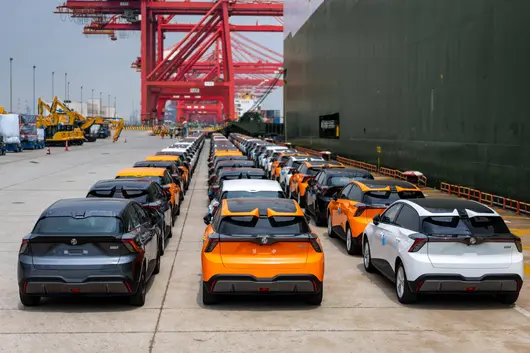
Chery's globalisation strategy has delivered another outstanding result. Data shows that in May, Chery Group exported 181,871 vehicles, a year-on-year increase of 80.5%, marking the third consecutive month setting a new record for monthly vehicle exports by Chinese automakers. Among them, new energy vehicle exports grew by 138.8% year-on-year, becoming the main engine for Chery's "going global" strategy.
Looking at the overall performance, from January to May this year, Chery Group cumulatively exported 752,755 vehicles, a year-on-year increase of 69.5%, creating a new record for Chinese automakers "exceeding 700,000 vehicles exported within five months", and continuously surpassing the milestones of 140,000, 170,000, and 180,000 vehicles, consistently leading the "going global" of Chinese cars.

The core driving force behind the continuous surge in export volume is Chery's long-established "Green Going Global" strategy. Relying on continuously iterated green technologies, a complete product matrix, and global layout, Chery has successfully converted green competitiveness into global market growth, bringing Chinese cars' "Green Solutions" to the world.
First Sino-European Carbon Footprint Mutual Recognition Certificate: Securing the European "Green Passport"
Green and low-carbon technology is the "passport" for Chinese automakers to enter high-regulation markets. Chery focuses on greening the entire industry chain, from raw materials to recycling throughout the full lifecycle, dedicated to making greenery permeate the entire process of a car from birth to rebirth.
Taking the European best-selling model JAECOO 7 SHS as an example, its full lifecycle carbon footprint is only 120.40 g CO₂e/km, at the leading level of its class. This stems from the model's systematic green technology layout: using approximately 75% low-carbon aluminum to reduce carbon emissions at the material stage, and production factories now use 100% green electricity to reduce carbon emissions at the manufacturing stage.
This all-chain, systematic low-carbon solution allowed Chery to obtain the first Sino-European mutual recognition full lifecycle carbon footprint report among Chinese automakers, and JAECOO 7 SHS received China's first Sino-European carbon footprint mutual recognition certificate.

Figure: JAECOO 7 SHS receiving China's first Sino-European carbon footprint mutual recognition certificate
Recognition in High-End Markets: New Energy Vehicle Sales in Europe Grow by 5.7 Times
With the support of the "Green Pass", Chery's sales have continued to climb in high-regulation markets such as Europe. From January to April, Chery cumulatively sold 107,000 vehicles in 24 European markets where it has already entered, including 53,600 new energy vehicles, a year-on-year surge of 570%. Today, for every 2 cars Chery sells in Europe, 1 is a new energy vehicle.
In the UK, a core European market, Chery has ranked in the top two of new car sales for two consecutive months, among which JAECOO 7 became the best-selling model in the entire UK market across all brands in March, earning recognition in Europe's high-end market.

In Australia, Chery continues to achieve new breakthroughs. Chery has maintained positive sales growth in Australia for 22 consecutive months. In May, OMODA&JAECOO sales increased by 729% year-on-year, ranking at the forefront of the industry; JAECOO J5 ranked second in the pure electric vehicle sales chart, second only to Tesla Model Y.
Multifaceted Efforts to Deepen Global Markets: New Energy Layout Accelerates
While consolidating high-end markets such as Europe, Chery is accelerating the global rollout of new energy products, focusing efforts on key regions such as the Middle East, Southeast Asia, Africa, and Latin America, comprehensively accelerating the global new energy layout.
In May, iCAR (the overseas brand name) landed in Oman, Indonesia, and South Africa, further expanding the layout of high-end new energy markets in the Middle East, Southeast Asia, and Africa; Vantec G700 launched in Mexico, accelerating the deepening of the high-end off-road market in Latin America. Meanwhile, Jetour landed in markets such as Poland, Malaysia, Brazil, and South Africa, continuously deepening the global new energy layout. By the end of May, OMODA&JAECOO had entered 70 markets globally. The accelerating new energy global map is bringing Chery's "Green Mobility" solutions to more users worldwide.

Figure: iCAR V27 landed in Oman in May to deepen the high-end new energy market in the Middle East

Figure: iCAR V23 landed in South Africa in May, further perfecting the African regional network

Figure: Vantec G700 carrying out off-road test drive activities locally in Mexico
Continuous product iteration, technology upgrades, and globalisation have enabled Chery's global user base to rise steadily. By the end of May, Chery Group's cumulative global users surpassed 19.62 million, of which overseas cumulative users exceeded 6.59 million. Looking to the future, Chery will persist in green development and green going global, providing greener, safer, and smarter travel products and experiences for users worldwide.