首頁Geely

搜尋歷史
熱門搜尋
經銷商登入 / 註冊

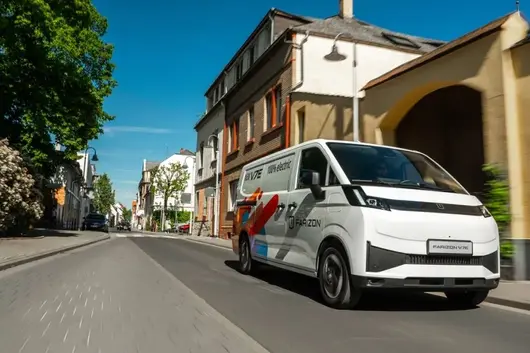
September 14-20, the biennial global top commercial vehicle event – Hannover International Transport Show (IAA Transportation 2026) will be held at the Hannover Exhibition Center in Germany. Geely Farizon New Energy Commercial Vehicles will land at the Hannover Auto Show for the first time, showcasing three flagship products: Farizon Star Han H, Super VAN, and Farizon Star V7E at Booth P55.

Deepening Global Layout
Accelerating European Localization Capabilities
As the first new energy commercial vehicle brand globally to achieve sales of 600,000 units, Geely Farizon's global expansion journey has upgraded from "product export" to "ecosystem rooting". Behind this process lies the collaborative advantage of "One Geely" - Farizon shares Geely's global technical accumulation and over 20 years of European localization operational resources, successfully importing mature new energy and intelligent technologies from passenger cars into the commercial vehicle sector, bringing "passenger car-level" intelligent driving experience and reliable quality to the European market.

As of now, Geely Farizon's business covers 70 countries, building more than 150 sales outlets and over 200 overseas service centers. In the first half of 2026, Geely Farizon's overseas cumulative exports ranked first in the industry, a year-on-year increase of 123%, topping the export list in 28 countries and regions including the UK, Australia, and the UAE. In August, international shipment volume continued to grow, surging 99.1% year-on-year, with overseas market potential exploding.
In Europe, Geely Farizon's strategic layout is particularly solid. Following the operational launch of the European headquarters Farizon Mobility Europe B.V., and the subsequent landing of German and French subsidiaries, this year has officially landed in the two core markets of Germany and France, with the globalization layout moving from broad coverage to deep rooting. Meanwhile, the German Gaggenau Europe spare parts warehouse has been put into operation, linking with the Ningbo International Spare Parts Distribution Center to build a "Domestic‑Europe" dual warehouse system, significantly shortening the European spare parts delivery cycle. The Indonesia KD plant achieved full vehicle production, the first overseas assembly plant has entered scaled operation, achieving the upgrade from full vehicle export to local manufacturing.
"We are not just here to sell vehicles, but to bring a complete European operational system to serve customers." This full ecosystem solution covers the user's entire lifecycle from purchasing, usage, maintenance, to replacement, truly responding to the deep needs of European logistics companies for a "reliable partner".
Three Products Debut
Dialogue with the World Through International Certification Strength
All models participating in this exhibition are positively developed based on the pure electric digital intelligence architecture, following UNECE regulations, obtaining EU market access certification, covering mainstream commercial scenarios such as trunk logistics and urban distribution.
Farizon Star Han H: As the technical foundation of Geely Farizon, the European version pure electric heavy truck is equipped with a 600kWh battery, range over 500 km, B10 design life 1.5 million km, meeting Europe's strict operational standards.

Super VAN: Max space 13m³, can accommodate 5 Euro standard pallets; Won the runner-up of IVOTY2026 International Van of the Year Award and What Van 2026 Annual Zero-Emission Van Award, safety rated 5 stars by EuroNCAP.

Farizon Star V7E: Loading space 6.95m³, range 328 km, payload 1373kg, standard equipped with over 14 ADAS features; Shortlisted for the top 3 in IVOTY2027 finals, final results will be revealed on the night of September 14.

Ten years of persisting in long-termism and positive development, Geely Farizon has completed the role upgrade from domestic leader to deeply integrating into the global industrial chain. At this Hannover Auto Show, Geely Farizon will uphold the brand's original intention of "Creating Smart Interconnection, Leading Green Commercialization", practice the development concept of "Born Global", build a green logistics ecosystem with global partners, and head towards a sustainable future.

Recently, Geely Automobile officially released its August sales data. The data shows that Geely's total monthly sales in August reached 270,194 units, achieving year-on-year and month-on-month growth for six consecutive months, with the new energy vehicle sales share soaring to 65%. More worthy of industry attention is the overseas market, where export volume reached 110,094 units, standing firm at the 100,000-unit threshold for three consecutive months, with overseas new energy vehicle exports surging 446% year-on-year.

In my opinion, given the current context of intensifying involution in the car market and resurgent price wars, such results are not merely a simple rise in sales volume, but the outcome of simultaneous efforts in technology, products, and globalization.
Many people looking at car company financial reports focus on total sales first, but what stood out most for Geely in August was the structure. Among the 270,000 total sales, new energy vehicle sales including Geely, Lynk & Co, and Zeekr reached 175,877 units. For every 10 cars sold, more than 6 were new energy models. This proportion indicates that Geely has broken away from the old model where fuel cars support the basic base and new energy vehicles make up the numbers, and new energy vehicles truly became the core engine driving overall market growth.
Looking at the breakdown of the three major brands, each has found its own position without one point exploding in popularity while other sectors drag behind.

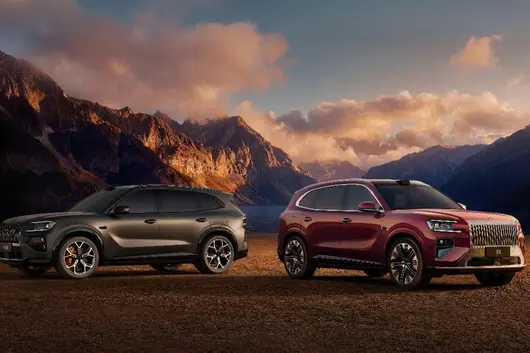
Zeekr, positioned as a global luxury technology brand, delivered 36,981 units in August, doubling year-on-year. Zeekr 7X continued to break 10,000 monthly sales, with global orders surpassing 200,000; Shooting brake models exceeded 10,000 sales for three consecutive months, with Zeekr 9X, Zeekr 8X, and Zeekr 009 taking the top spot in sales and reputation in their respective high-price segments respectively. It can be seen that Zeekr has firmly established itself in the 300,000-500,000 yuan or even higher luxury market, no longer relying solely on a single blockbuster model, but forming a multi-model matrix, completely opening up the high-end market.
Lynk & Co is following the route of expanding breadth. In August, overall sales reached 17,027 units, with a very high proportion of new energy vehicles. The new Lynk & Co 20 debuted at the Chengdu Auto Show, balancing urban trends and sport versions. At the same time, Lynk & Co also participated in the CRC Rally Championship, winning the category championship. On one hand, catering to the home consumer market, on the other hand, using motorsport to hone hybrid technology, this approach continues to reinforce Lynk & Co's sporty and high-end label.

Regarding the Geely brand which bears the sales basic block, August sales reached 216,186 units. Among them, Geely Galaxy made a huge contribution, selling 119,115 units in a single month. Geely Star Wish has broken monthly sales of 50,000 for three consecutive months, accumulating close to 900,000 units, equivalent to a delivery speed of more than 1,000 units per day, becoming a national-level new energy blockbuster. Galaxy E5 maintained stable output, Galaxy TT started pre-sales, Galaxy Battleship 700 debuted at the Chengdu Auto Show, with new cars constantly taking over the relay, ensuring continuous fresh blood in the mainstream new energy market.

The fuel sector is also not lying flat. The China Star series continued to exert effort. The fourth-generation Boyue L i-HEV and the brand new Xingyue L PLUS appeared in succession, completing product upgrades relying on fuel-hybrid technology and high-level intelligent driving. Current Geely fuel cars are not passively waiting to be replaced by new energy, but are renovating through HEV hybrid technology, holding onto the basic block of fuel users, achieving multiple legs walking for fuel, hybrid, and pure electric.

In fact, Geely's sales explosion naturally relies on continuous technology output. Taking August as an example, Geely released a full set of AI new energy off-road technologies, including the GTA native new energy off-road architecture, Thunder EM-T electric hybrid, and AI all-terrain digital chassis. This technology suite will be equipped on the Galaxy Battleship 700 first.
In the past, hard-core off-road was basically dominated by traditional fuel ladder frame cars. Now Geely tries to use AI + new energy to rewrite off-road track rules again. At the same time, full-domain AI has run through the entire process from R&D, manufacturing to after-sales, no longer just a voice assistant on the car infotainment screen, but infiltrating the underlying logic of whole vehicle development. This is also an important reason why Geely product iteration speed is getting faster and faster.

If the domestic market reflects Geely's product power, then the overseas market represents another pole of its future growth. August exports reached 110,094 units, increasing both year-on-year and month-on-month for 8 consecutive months. Among exports, 64% are new energy models. You should know that just a short while ago, domestic car company exports were mainly cost-performance fuel cars. Now, most cars sold by Geely overseas are new energy products.

And its market layout also blooms everywhere: Zeekr wins the luxury pure electric sales champion in Australia and Malaysia; Lynk & Co stands firm in the high-end new energy market in Tunisia and Egypt; Geely Star Wish wins the electric vehicle sales champion in Thailand. Europe, Latin America, Southeast Asia, Middle East, one by one markets are broken through one by one. New markets such as Austria, Argentina, Jordan, Vietnam are continuously opening channels. Based on the market's improvement, Geely directly raised its full-year overseas target, from 640,000 to 920,000, sprinting hard for 1 million exports.
Final Thoughts:
Looking at the current domestic car market, many car company growth relies either on domestic involution lowering prices to exchange for sales, or going overseas with low prices to move volume. Geely is relatively special. Domestic high-end, home-use, fuel, new energy bloom at multiple points; overseas high-end models can also gain good market share, achieving simultaneous increase in volume, price, and profit. Mid-term performance total revenue 173.6 billion yuan, net profit attributable to parent company 9.68 billion, achieving simultaneous rise in volume, price, and profit.
Therefore, looking at this, Geely's 270,000 units sales in August is not a temporary accidental surge, but a comprehensive result of full-domain AI technology landing, multi-brand matrix formation, and globalization layout entering the harvest period. Domestic involution will continue, overseas competition will also become increasingly fierce. Geely's model of stabilizing the basic block domestically and opening a second growth curve overseas also provides a worthwhile reference sample for Chinese car companies.
(This article is originally produced by the New Media Editorial Department of [Car World], relevant content only combines network public information to carry out personal objective analysis. All vehicle model configurations, prices, range data, and sales volumes are subject to brand official announcements in the end; views in the text represent personal reference only and do not constitute any advice.)

On August 1, Geely Automobile Holdings Limited (0175.HK) announced the latest sales data: July sales reached 250,161 vehicles, showing month-on-month and year-on-year double growth for 5 consecutive months, with a 5% increase year-on-year and a 4% increase month-on-month. Among them, overseas exports reached 106,663 vehicles, a 202% increase year-on-year and a 4% increase month-on-month, achieving month-on-month and year-on-year double growth for 7 consecutive months, and exports exceeding 100,000 vehicles for two consecutive months. In the first half of the year, Geely Automobile's overseas sales cumulatively reached 470,000 vehicles. Behind this impressive performance is the result of Geely Automobile relying on a global product matrix and industrial layout, accelerating the promotion of high-value overseas expansion, gradually improving local channels and production systems, and accelerating the implementation of the globalization strategy.

Double Breakthrough in Sales and Structure, Moving Towards High-Value Overseas Expansion
From a data perspective, Geely's overseas growth is substantial. In July, new energy vehicle exports reached 62,604 units, surging 616% year-on-year, accounting for 59% of total exports, achieving simultaneous upgrades in export scale and product structure.
Meanwhile, multiple brands are blooming in multiple locations in the global market. In June, Geely Star Wish (Geely EX2) ranked first in Thailand EV sales, second in Brazil EV sales, and second in Mexico all-category pure electric sales; Starship 7 EM-i (Geely EX5 EM-i) secured first place in Poland's C-segment PHEV market single model sales and second place in Mexico's June PHEV sub-market sales.
Since its launch, Lynk & Co 08 has achieved nearly 190,000 cumulative global deliveries, ranking in the top three for Mexico's high-end PHEV SUV and Morocco's mid-size PHEV SUV sales in the first half of the year. Zeekr has anchored its global luxury technology brand positioning, with its influence continuously advancing, securing the top spot for Australia and Malaysia's luxury pure electric brand sales in the first half of the year. From the mainstream mass market to the luxury technology track, Geely Automobile's product matrix has taken root globally.

Systematic Collaboration Construction Establishes New Paradigm for Overseas Expansion
The continuous improvement of overseas exports is rooted in Geely's globalization strategy coordination, as well as long-term technical accumulation and systematic innovation capabilities.
Relying on the "One Geely" strategy, Geely has built a brand matrix with clear positioning and distinct personality, forming a development pattern of collaborative combat and potential complementarity among Geely, Lynk & Co, and Zeekr. Among them, the Geely brand is positioned as a global mainstream automobile brand, focusing on safety, quality, and intelligence; the Lynk & Co brand is positioned as a global new energy high-end brand, focusing on fashion, sports, and personality; the Zeekr brand is positioned as a global luxury technology brand, focusing on luxury, extreme, and technology.
Geely has always regarded technological innovation as the core driving force for globalization development, building a globalization technology system of "Five Design Centers, Five Engineering R&D Centers, Five Testing Areas, Five Energy Technology Forms, and Five AI Smart Ecosystems" around global R&D, global synergy, and global innovation, providing solid support for globalization development.
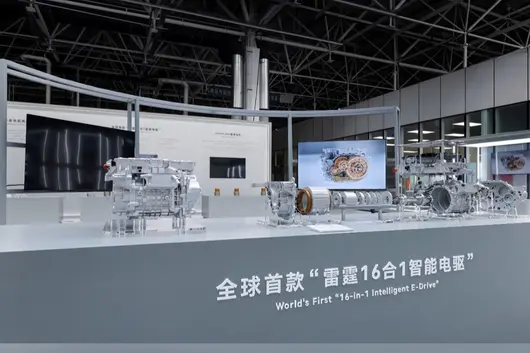
In the past decade, Geely's cumulative R&D investment has exceeded 250 billion yuan. In the fuel vehicle field, Geely has created globally leading BMA and CMA vehicle architectures and independently developed the Thunder God power system; in the new energy field, it has created new energy exclusive architectures such as SEA and GEA, successively launched core technologies such as the Thunder God AI Electric Mix 2.0 system, Divine Shield Gold Brick Battery, and "11-in-1" electric drive, continuously improving product competitiveness.

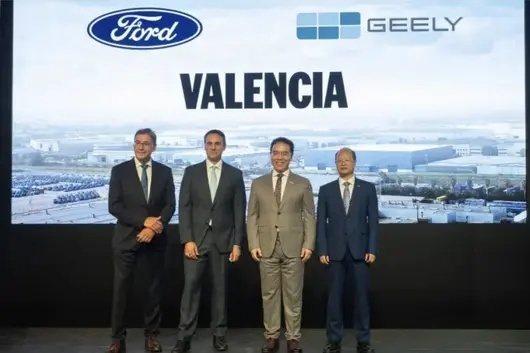
In addition, Geely continues to promote the construction of local operational capabilities, further opening up overseas market growth space through win-win cooperation with localization enterprises. In July, Geely Automobile reached an agreement with Ford Motor Company, and both parties will establish a joint venture company at Ford's Valencia plant in Spain, creating new energy vehicle products for the Geely and Ford brands for the European market through capacity sharing, accelerating the implementation of Geely's European localization strategy.

Under the top-level coordination of the "One Geely" strategy, with five globalization technology systems as the growth base, multi-brand differentiated matrices as market touchpoints, and local operations as the grip, continuously strengthening service and channel systems, Geely has walked a new path of driving high-quality growth with systematic capabilities.
Looking to the future, we will continue to adhere to open collaboration, persist in continuous product technology innovation, adhere to user supremacy, and insist on compliant operation, creating higher value for global users, and contributing greater strength to promoting the high-quality "going global" of China's automotive industry.

In the Brazilian car market, BYD leaving everyone else in the dust is a well-worn topic, but what truly deserves close examination is Geely's skyrocketing speed.
July just delivered a sales report of 7,458 units, stubbornly competing with Chery until there was only a 105-unit gap, maximally heightening the suspense of who is the third Chinese brand; the single EX2 model sold nearly 4,000 units, firmly ranking in the top 10 for EV sales in Brazil, with the full month brand sales likely to stay steadily above 7,000 units.

It is worth noting that Geely's official announcement of entering Brazil was just one year ago. In one year, going from zero to selling over 7,000 units a month and breaking into the top 11 of the brand rankings, this speed counts as first-tier level across the entire history of Chinese automakers going global.
Many people only focus on that exaggerated 26,535.7% year-on-year growth, joke about it being a "low base number game", and move on from this. But few dig deep into why it was precisely Geely that was able to solidify sales in such a short time? The answer, bluntly put, is not complex – this "asset-light joint venture global expansion" strategy of theirs is too mature and too practical.
Don't be deceived by the percentage, over 7,000 units is a solid foothold
The 26,535.7% year-on-year growth rate is essentially because in July 2025, Geely had not officially started sales, there were only dozens of exhibition cars and test drive cars registered that month, the denominator was extremely small, so the calculated percentage naturally exploded. But setting aside this statistical number, looking at absolute sales: July 7,458 units, exceeding old-brand joint venture players like Jeep and Nissan, and only 105 units away from Chery which has cultivated the Brazilian market for years, this is no longer a number game.

As of early August 2026, Geely has just completed one year in Brazil, cumulative sales have already broken through 25,000 units. For a brand new brand, this achievement is highly valuable. It is worth knowing that for many Chinese brands entering emerging markets, stable monthly sales of 3,000 units in the first two years is considered passing. Geely directly touched the threshold of 7,000 units in just one year, and is still climbing upwards.
The core supporting this sales volume is the EX2 car, which is the Xingyuan in China. Compact pure electric, rear-drive layout, sufficient range and space, plus precise pricing, just hit the market gap for entry-level EVs in Brazil. But product strength is just the foundation, what truly allowed it to quickly stock and deliver was the path Geely chose that was completely different from BYD and Great Wall.
Core Password: Don't forcefully invest in heavy assets, enter directly by borrowing Renault's express lane
BYD bought Ford's old factory to renovate it themselves, Great Wall took over Mercedes' old factory and then expanded capacity, both walking the heavy asset route of "building factories themselves, building channels themselves" – the benefit is having full control, the downside is high costs and long cycles, volume doesn't start without three to five years.
Geely chose the completely opposite path: in 2025 established a joint venture with Renault, acquired 26.4% of shares of Renault Brazil, directly letting Renault serve as their General Distributor in Brazil.

How ruthless is this move? It is equivalent to directly grabbing all of Renault's assets accumulated over decades of operation in Brazil:
Ready-made distribution system: Renault Brazil originally had 263 dealership outlets, covering major cities nationwide, familiar with local dealer rules and consumer habits. Geely didn't need to recruit from scratch, directly relied on this system to expand authorized stores, opening 43 standard 4S stores and 13 mall experience points in one year, covering 24 states and over 50 cities. If another brand did it themselves, this coverage would take at least 3 years.
Ready-made after-sales and parts system: Brazil has vast territory, parts warehousing and after-sales repair are the fatal weaknesses of new brands. Renault has mature nationwide parts warehouses and after-sales standards, Geely directly accessed them, consumers buying cars don't worry about not being able to repair or waiting for parts for half a year, naturally adding a layer of trust.
Ready-made factory capacity: No need to buy land and build factories, directly started production of EX2 at Renault's Ayrton Senna Industrial Park, achieved local mass production in June 2026, just avoided Brazil's gradually rising import tariffs, costs directly dropped a notch, supply volume no longer restricted by sea transport.
Put simply, others going global is "starting from scratch", Geely directly brought product technology, "moving in ready-furnished" to others' mature industrial systems. Less money spent, fewer pitfalls stepped into, volume growth speed naturally became faster.
This is not a last-minute rush, it is Geely's mature strategy played over nearly 10 years
Many people think this is the first time Geely is doing this, actually quite the opposite, this "equity investment in local automakers, outputting technology products, reusing partner channel capacity" model, Geely had already worked it out in Malaysia long ago.
In 2017, Geely acquired 49.9% shares of the Malaysian national brand Proton. At that time Proton had been losing money for consecutive years, annual sales dropped from a peak of over 200,000 units to 70,000 units, market share left only 15%, even Volkswagen and Peugeot were unwilling to take over. Geely didn't grab controlling equity, only took operation management rights, exported their car models, technology, management system into it, the first car was the Proton X70 built based on Boyue.

How was the result? Proton sales volume increased by 50% year-on-year in the second year, directly turned from loss to profit in 2019, by 2024 annual sales had rushed to 152,000 units, sitting second in the Malaysian market steadily for 6 consecutive years, market share close to 19%. Geely not only revitalized a local brand, but also by using Proton's identity, smoothly obtained the entry ticket to the entire ASEAN market, avoiding high regional trade barriers.
The Brazil model is essentially an upgraded version of the Proton model. The subsequent Korean Renault cooperation, Spanish Ford joint venture, all follow the same train of thought: do not pursue wholly-owned control, do not directly confront the local market, but find a partner with capacity, channels, and understanding of local rules, I provide technology and products, you provide sites and networks, we share the money together, make the market bigger together.
Why say this model is worth most Chinese automakers learning
Now talking about Chinese automakers going global, many people open with "build factories themselves, cultivate locally", as if without spending billions to build a factory, it's not considered truly going global. But the reality is, not all automakers have the volume and cash flow of BYD, capable of withstanding the pressure of investment without output in the first few years.

The value of Geely's asset-light model lies in that it offers another feasibility:
First, fast results, low trial and error costs. No need to wait two or three years for factory construction and channel expansion, cooperation landing can stock goods, if selling well add more, if selling poorly won't cause major damage.
Second, low local resistance, easier to land. Compared to the impression of "Chinese automakers coming to snatch the market", this "cooperating with local enterprises, revitalizing idle capacity, creating jobs" model, whether government or consumers, acceptance is much higher, and not easy to become a target of local industry associations.
Third, extremely high replicability. From Southeast Asia to South America, then to Europe, as long as a local partner with capacity and channels can be found, this model can be quickly reused, no need to explore from zero for every market.
Conclusion: Of course it doesn't mean the heavy asset model is bad. BYD and Great Wall's route, although can firmly hold the brand and profit in their own hands, but the initial investment is undoubtedly higher. For more Chinese brands wanting to go global and also quickly open the market, Geely's "taking advantage of the trend" strategy is clearly more pragmatic and more universal.

The Brazilian market is just a microcosm. In the next few years, Chinese automakers going global will shift from "swarming in" to "competing in refined operations", by that time, whoever can find a landing method more suitable for themselves will truly survive and thrive. And the asset-light joint venture idea Geely has verified over nearly 10 years and multiple markets is obviously an assignment worth serious reference.
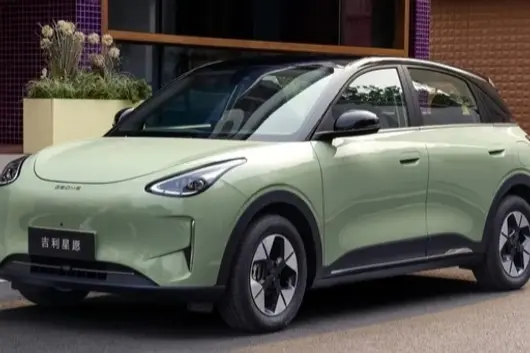
He leaned back against the seat, not because he was tired, but to see the entire chessboard clearly. On August 17, Li Shufu resigned as Chairman of the Geely Auto Board of Directors, and An Conghui took over. With no performance explosion, no shareholder pressure, at a juncture of 173.6 billion in semi-annual revenue and a 46% surge in profit, this car-making visionary voluntarily handed over the steering wheel. Some said Geely was changing its regime, quite the opposite; Li Shufu used this exit to secure Geely's entry ticket for the next thirty years.

I. Founder Yields Place, Harder Than Starting a Business
Li Shufu is not a defeated general, but a monarch who voluntarily stepped down from the throne. In the past thirty years, every risky move Geely made bore Li Shufu's name—daring to make cars, daring to buy Volvo, daring to bet on new energy. But as the company grew to Geely's scale, with seven or eight brands globally and business spanning Europe, Asia, and South America, relying on one person to make decisions is like letting an aircraft carrier chase a speedboat. He saw through it: a founder's intuition is the company's ceiling and its limit. An Conghui is a professional manager grown from Geely itself, working from the grassroots to the core. Li Shufu's words "Professional talent is rare" were handing the baton to someone who had truly run on the track. This baton pass is not a shift in power, but a victory of organizational life over individual lifespan.

II. What's Missing is Not Technology, but the Explosive Power of Hit Products
The new chairman didn't read a welcome report upon taking office, but first admitted shortcomings: "Lack of hit products, lack of mid-tier strength." In the first half, Zeekr sold 178,000 units crazily, Xingyuan stormed the entry-level market list, but in the middle golden belt of 150,000 to 300,000, Geely was surrounded like an iron barrel by BYD, Li Auto, and AITO. Chassis, intelligent driving, batteries, Geely lacks none of these, but what is missing is the chemical reaction to turn technology into hit products. So "One Geely" is no longer a slogan—cutting overlapping models, R&D expenses decreased, procurement tightened into one rope, the goal is one: make every penny strike a sound-producing product. In the first half of electrification, it was about lone heroes; in the second half, it is about the speed of system punches.

III. The Next Chapter of Globalization, Relying on Leverage Instead of Building Factories
Sold 474,000 units overseas in the first half, more than doubled year-on-year, but Geely played smarter this time. Li Shufu made things clear: not building new factories everywhere, sharing capacity with Ford in Spain, borrowing Volvo's European foundation, landing in Malaysia relying on Proton, side by side with Renault in South America. Investments made over these years finally assembled into a global manufacturing network. The early routine of Chinese car companies going overseas was shipping and selling cars, what Geely wants to do is package technology, supply chain, and localization together, quietly taking root in other people's markets. At this time, the founder's personal will cannot cover time zones and national borders, must let the organization grow thousands of feet, to run for Geely on the Earth.

Li Shufu stepped back, Geely took a big step forward. After Steve Jobs, Apple was still making money, but products changing the world were fewer; what Geely wants to prove is not whether changing the person still allows making money, but whether the gene of daring to bet and venture will break without the strongman. On An Conghui's desk lay the semi-annual report, and also three new car model blueprints. The real exam has just begun—not testing who sits on that chair, but testing whether that chair can shine on its own. The founder's value has never been standing on the stage forever, but letting the stage be empty, and the show can still be more wonderful.


That August 1st sales quick report, I read it over and over again. Geely's total July sales reached 250,161 units, nothing unexpected; what really made me pause in front of my computer was the overseas data: exports of 106,663 units, up 202% year-on-year, rising month-on-month and year-on-month for 7 consecutive months, and reaching the 100,000 unit mark for two consecutive months.

Working in this industry for so long, you develop a feel for numbers. Previously when we talked about exports, it was assumed we just pull domestic surplus inventory to the Middle East or Africa to get blood back. But of Geely's 106,000 units this month, new energy vehicles accounted for 62,604 units, a proportion as high as 59%. What does this show? It shows what Geely sends overseas is no longer "surplus stock", but the "elite forces" currently fighting the main battle domestically.
The logic behind this deserves to be broken down and discussed thoroughly.
Model Matrix: No longer single-point explosions, but carpet-style deploymentI see many peers focusing on total sales volume. Actually, break it down by model dimension, you will find Geely's approach has changed. Previously relying on one car to rule the world, now it is rising simultaneously in various sub-segments.

Taking Star Wish (EX2) as an example, it took first place in Thailand's pure electric market in June, pushing BYD Atto 3 aside. This car looks unremarkable domestically, but in Southeast Asia's congested, high-temperature, cost-performance-focused markets, it is simply a dimensional strike. Even more incredibly, this car entered the top two in Brazil and Mexico. An A0-level small car can gain volume simultaneously in Southeast Asia and Latin America with completely different usage scenarios. This is definitely not luck, but right product definition.
Look at Starship 7 EM-i (EX5 EM-i), this car took C-level PHEV first place in Poland. Europeans are shrewd, high fuel prices, inconvenient charging, PHEV is indeed the optimal solution at this stage. Geely taking the domestic Thor Electric Hybrid technology over there, just cut right into the pain points.
Lynk & Co 08 and Zeekr need not be mentioned. Lynk & Co 08 entering the top three in premium plug-in hybrids in a place like Mexico, which is the "heartland of American cars", Zeekr pressing BBA down in right-hand drive markets like Australia, Malaysia. This is no longer explainable by "cost-performance", this is substantive breakthrough in brand elevation. Previously we said Chinese cars going overseas is "encircle the cities from the countryside", now it looks like Geely wants to directly enter "the city" to open stores.
Valencia: This Move Carries More Weight Than 100,000 UnitsTo tell the truth, July sales volume is just the result, that big move Geely and Ford pulled off in Spain at the end of July is the key to deciding the pattern of the next three years.

Geely spent 221 million euros to buy 34% stake of Ford's Spanish Valencia factory. This money looks a lot, but in the background of building factories in Europe costing billions of euros, this is simply "rock-bottom price".
Why is this move so clever? We who work in industry all understand, the European market has always had a "glass door", that is that anti-subsidy tariff. Previously we made cars and sent them over, tariffs were so high it was shocking, price advantage instantly disappeared. Now Geely directly builds a joint venture factory in Spain, using Ford's idle capacity to make Geely cars. This trick of "borrowing a boat to go out", directly bypasses the tariff barriers.
More importantly, this factory was built in 1976, Ford has run it there for decades, supply chain, workers, union relations are all sorted out. Geely spending small money to do big things, not only gained capacity, but also gained the "ticket" to enter the EU market and "compliance credentials". Afterward, Europeans buying Geely cars, packaging might print "Made in Spain". This is not only a business victory, but survival wisdom under geopolitical games.
System Capability: From "Selling Cars" to "Outputting Systems"Having done auto reporting for so many years, I have seen too many companies fail miserably when going overseas. Previously many car manufacturers going overseas, just find an agent, send cars over, whether they sell well depends entirely on heaven. But Geely's current gameplay is "system overseas".
What is a system? It is "One Geely" strategic coordination. Geely, Lynk & Co, Zeekr three brands, positioning clearly divided, fighting each other not at all. Geely focuses on volume, Lynk & Co on quality, Zeekr on high-end. This multi-brand synergy is even more important overseas than domestically, because overseas dealers fear OEM left-right mutual fighting.

Looking deeper, it is technical foundation sharing. CMA, SEA these architectures, plus Thor Electric Hybrid, Shield Battery, all globally universal. This is like building blocks, base is universal, above can according to different country regulations, road conditions, consumer habits change shells. This development efficiency is what those still "one car one car redesign" competitors cannot compare with.
Past decade smashed in 250 billion R&D fees, now look, time for harvest has arrived.
Written at last: Don't just look at the spectacle, look at the essenceOf course, we also must be calm. Although Geely's momentum is fierce, challenges are still ahead. Before Valencia factory first car rolls out in 2028, union negotiations, production line renovation, EU certification, every gate is not easy. Moreover, Lynk & Co and Zeekr really entering Western Europe, facing Mercedes, BMW, Tesla these "local heavyweights", hard battles are still ahead.
But for us spectators, Geely's July 106,000 units, signal meaning already very clear. Chinese cars going overseas, already passed that "selling cars out is enough" untamed era, entered "manufacture locally, sell locally, service locally" system competition stage.
Later you see Zeekr on Sydney streets, or Starship 7 in Warsaw, likely not from Ningbo Port crossing ocean transported over, but European local factory roll-out products. This is true globalization, also Geely this wave operation most makes me feel "sophisticated" place.
This game of chess, Geely has only just started placing stones.
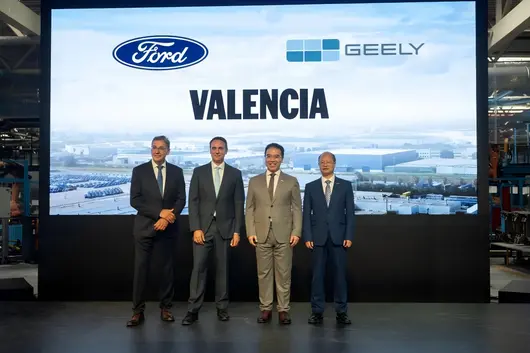

“Selling cars doesn't make money" — this industry joke ultimately came true as a prophecy.
The price war has lasted three years, and industry profit margins have fallen from 7.8% ten years ago to 1.5%. "Quantity and profit cannot be had together" changed from a phenomenon into industry consensus.

But Geely overturned this consensus with a set of data — in the first half of this year, automotive sales reached 1.42 million units, a slight year-on-year increase of 1%; revenue was 173.6 billion yuan, a surge of 15% year-on-year; core net profit attributable to the parent company reached 9.68 billion yuan, a surge of 46% year-on-year; core net profit attributable to the parent company per vehicle was 6,806 yuan, an increase of 45% year-on-year.

Sales up 1%, profit up 46%.This isn't piled up by "selling more cars, thin margins on high volume", but every car is earning more money. If you look at it over a longer time, this is Geely's sixth consecutive year of positive revenue growth. In a cycle turning from "incremental competition" to "stock elimination", these five words "Volume, Price, and Profit All Rising" are the most hardcore footnote of this semi-annual report.
One Geely, Clenched Fist
The data is there, anyone can calculate the accounts. But what is more worth asking is — Geely, on what basis?
The answer is hidden in a strategy launched two years ago. In September 2024, Geely released the "Taizhou Declaration", proposing five major measures of "Strategic Focus, Strategic Integration", declaring a move from the expansion era of "raising many children to fight well" to the focus era of "returning to one Geely".

At that time, Geely answered the two questions most focused by the market: Why and How?
The answer to the former is very direct: change the past situation of scattered brands fighting separately, concentrating resources into a fist; the path for the latter is also very clear: Zeekr, Lynk & Co., Galaxy, and China Star, the four major brands, are under one corporate structure, with the Central Research Institute, supply chain, and manufacturing system all connected. In August this year, a General Sales Company was established, with four brand sales companies under it, further coordinating marketing resources. From R&D, manufacturing, procurement, to sales, "One Geely" completed the last piece of the puzzle.
The effect of integration was also directly written into the income statement — administrative expense ratio dropped to 1.7% in the first half of the year, R&D expense ratio dropped to 5.2%, money was spent less, efficiency was higher.

The four brands also have their respective duties. Zeekr carries the profit, selling 178,000 units in the first half of this year, accounting for only 12.5% of total sales, but contributing 31.7% of revenue — this is the power of premiumization; average transaction price 350,000, already exceeding BBA.
Galaxy pursues volume, selling nearly 520,000 units in the first half of the year, breaking into the top three globally in new energy. Running volume in the mainstream market, spreading costs, is Geely's basic foundation.
China Star defends internal combustion, selling over 580,000 units in the first half of the year, securing the first place in Chinese brand internal combustion car sales for the 10th consecutive year. Industry internal combustion cars dropped 31.9%, China Star only dropped 8.8%, holding the internal combustion camp with product power.
Lynk & Co. focuses on differentiation, over 144,000 units in the first half of the year, new energy penetration rate reached 65%, labels of "trendy, sports, individual" are stuck tighter, doing what they are good at in niche markets. "No fighting, no internal friction" — this is not one brand fighting, but four pillars holding up Geely's profit chassis simultaneously.
Second Curve, Expedition Overseas
After stabilizing the domestic market, Geely turned its eyes to further places.

While the domestic auto market is still fighting in price wars, Geely cars are already loaded onto ocean freighters. In the first half of the year, Geely's overseas export sales reached 474,200 units, a 158% year-on-year increase, exceeding the total export volume of the entire year of 2025. In June and July, overseas monthly sales exceeded 100,000 units consecutively.
Horizontal comparison is more intuitive — Geely has the highest export growth rate among mainstream Chinese automakers, total export volume and new energy export volume both ranked in the top three among Chinese automakers. The proportion of exports to total sales was pulled from about 13% last year's same period to 33%.

But more valuable than sales volume is the structure of exports — in the first half of this year, Geely's new energy vehicle exports reached 277,200 units, a surge of 585% year-on-year, accounting for 58.5% of total exports. That is to say, in the cars Geely sells overseas, over half are new energy — not moving domestic fuel cars that can't be sold overseas to clear inventory, but pushing the most advanced products to the global market.
At the same time, Geely's approach is also upgrading: from "whole vehicle export" to "system overseas". In the first half of the year, overseas manufacturing plants put into operation reached 12, overseas capacity exceeded 650,000 units, expected to exceed 840,000 units by year-end. Geely Auto Board Chairman An Conghui disclosed longer-term layouts at the performance meeting: Volvo Europe factory will undertake Geely system's luxury car production; Proton Malaysia factory is undergoing technical transformation, planned for upgrade to 500,000 unit-level Southeast Asia manufacturing base; Ford joint venture Spain factory capacity is also 500,000 units. From "selling cars out" to "building factories out", Geely is completing the leap from product overseas to industrial overseas.

And based on the first half-year growth rate, Geely has raised the full-year overseas sales target from 640,000 units to 920,000 units, and shouted the slogan of sprinting to 1 million units, long-term goal is overseas contributing two-thirds of total sales.
From 13% to 33%, then to two-thirds, a clear upward curve outlines Geely's overseas market growth trajectory, and also marks a key node of a Chinese automaker leaping to a global company.
Smart Track, Heavy Bet on AI
One seeks efficiency inwards, one seeks increment outwards —
Integration is tightening resources, going overseas is opening the market. But this merely solves the problem of getting to the table, wanting to win the game, you still need to place a bigger bet.

Open Geely's R&D ledger: R&D investment 9.06 billion yuan in the first half of the year, year-on-year growth 8%, R&D expense ratio actually dropped 0.3 percentage points. Money was spent more efficiently, but R&D investment absolute value is still rising — this money, most of it thrown to one direction: AI.
In January 2026, Geely announced on US CES that full-domain AI technology system evolved to 2.0 era. Core breakthrough is based on self-developed WAM World Behavior Model, achieving cross-domain fusion of AI technology in various domains of the whole vehicle, allowing automotive intelligence to first possess a continuous evolving "worldview" and "judgment capability".

Based on WAM model, Geely built a so-called "1+2+N" multi-agent collaboration framework, core logic is not complex: one brain unified scheduling, Super Eva and Qianli Haohan G-ASD respectively responsible for "thinking" and "moving", then extended to all vehicle function modules. Simply put, you say a sentence casually, behind there might be several intelligent modules working together — understand intent, plan path, control vehicle, adjust cockpit, all in one go.
On the ground, Qianli Haohan G-ASD already covers Zeekr, Lynk & Co. brand 16 car models, equipped vehicles over 300,000 units. In 2026, Geely plans to push highway L3 and urban L4 functions under legal permission, and realize Robotaxi commercial operation.

Different from the industry's common "Product Intelligence" — adding a pile of functions to the car, Geely embedded AI into the full chain from design, R&D, manufacturing to after-sales. i-HEV Intelligent Engine Hybrid, AI Digital Chassis, 16-in-1 Intelligent Electric Drive launched in the first half, behind them all have shadows of AI large models. At the same time, further chess game has been played: Geely has deepened cooperation with NVIDIA, also plans to establish 2030 Laboratory, layout power semiconductors, embodied intelligence, large models and other frontier fields.
If "One Geely" is the chassis, going overseas is the accelerator, then full-domain AI is the steering wheel — it determines where this company will finally drive to. And Geely official stance on this matter is: Accelerating towards "Full-domain AI Intelligent Vehicle Leader".
Ending:

"This is an eye-catching financial report, but not yet at the level of dazzling." At the performance press conference, Geely Auto Board Vice Chairman and Executive Director Gui Shengyue gave four judgments: Above Expectations, Eye-catching, Not Dazzling, Can Sustain Long Term with Huge Room for Improvement.
And behind this exactly corresponds to the three-fold logic of Geely's semi-annual report: Above Expectations, it is efficiency release brought by integration; Eye-catching, it is growth space opened by going overseas; And Not Dazzling but Huge Room for Improvement, it is sober cognition of this AI marathon — trump card has been shown, but the final outcome is far from coming.
For the industry, the greatest value of Geely's semi-annual report is not providing another "case of making money", but providing a "sample of how to live well in a stock elimination cycle" — not relying on price wars, not relying on stacking configurations, relying on strategic determination, system capability and forward-looking layout. This is Geely's answer, and also its deepest moat.

2026First half of the year, China's vehicle manufacturing profit margin fell to 1.5%, reaching a new low in nearly a decade.
In this context, Geely's performance is very prominent.
Total sales volume in the first half reached 1.423 million units, a year-on-year increase of only 1%. However, revenue was 173.6 billion yuan, a year-on-year increase of 15%; core net profit attributable to shareholders was 9.68 billion yuan, a year-on-year increase of 46%. Gross margin increased from 16.2% in the same period last year to 17.9%.
Management summarized it in one sentence: "Revenue growth is faster than sales volume growth, and profit growth is faster than revenue growth."

Growth drivers come from two aspects.
Premiumization — Zeekr's sales volume in the first half reached 178,000 units, a year-on-year increase of 97%, accounting for 12.5% of total sales and contributing 31.7% of revenue. Zeekr's gross margin is approximately 20%, occupying about one-third of the domestic sub-market above 500,000 yuan.
Internationalization — It is the structural change in the financial report worth analyzing most closely. To understand Geely's profit explosion, one must first see the structural explosion of its overseas business.
No New Factories, Overseas Capacity Doubled Plus
In the first half, Geely's overseas export sales reached 474,200 units, a year-on-year increase of 158%, exceeding the full-year export volume of 2025. Among them, new energy vehicle exports reached 277,200 units, a year-on-year increase of 585%.
The proportion of overseas sales to total sales jumped from about 13% in the same period last year to about 33%. In June and July, overseas monthly sales broke through 100,000 units. The growth rate ranks first among mainstream automakers.
Regional markets are showing comprehensive blossoming. Latin America and Africa increased by 298% year-on-year, Europe increased by over 280%, ASEAN over 120%, Eastern Europe and Central/West Asia approached 100%.
Geely announced that it raised the full-year export target from 640,000 units to 920,000 units, and proposed challenging 1 million units.
With going global becoming a clear card and cure-all for Chinese automakers, more worth paying attention to than numbers is Geely's unique strategy for going global.

Zhejiang Geely Holding Group Chairman Li Shufu clearly stated: "In the new process of global transformation, we will not build new capacity. We insist on win-win cooperation with global peers and share capacity."
Behind this sentence, there are three specific details.
"1": One overseas Geely system. Back-end and middle-back-end are fully unified, not acting independently. The three brands Zeekr, Lynk & Co, and Geely maintain clear positioning — Zeekr focuses on tech luxury, Lynk & Co focuses on sports trends, and Geely plans the mainstream household market.
"23456": Five regional markets, totaling 2 million units. Europe 600,000, ASEAN 500,000, Latin America & Africa 400,000, Eastern Europe 300,000, Central Asia & Middle East 200,000.
The timeline is the next 2 to 3 years. Geely Automobile Holdings Ltd. Board Chairman An Conghui reiterated the long-term strategic goal: overseas markets will contribute two-thirds of sales.
The implementation of the strategy relies on three factories.
Volvo Europe Factory — Put into production in 2028, producing Geely's high-end cars.
An Conghui revealed at the earnings call that the Volvo Europe Factory will undertake the production of high-end luxury cars within the Geely Automobile Group, expected to start production in 2028. It specifically involves the Trollhättan factory in Gothenburg, Sweden, the Ghent factory in Belgium, and the newly built EV factory in Košice, Slovakia.
Previously, Volvo signed an agreement with Lynk & Co to be responsible for the exclusive import and operation of the Lynk & Co brand in the European market. Now, the production side is also included in the Volvo Europe system, forming a complete localized layout from manufacturing and import to sales and after-sales service.

Ford Spain Factory — 500,000 units capacity, Roll-off line in 2028.
On July 23, 2026, Geely and Ford signed an agreement to acquire 34% equity of Ford's Valencia plant in Spain for 221 million euros. This factory, put into production in 1976, has an annual capacity of about 500,000 units and is one of the largest manufacturing bases in Europe.
After the joint venture company is established, the Valencia factory will undertake the production tasks for 5 car models of Geely and Ford simultaneously. Geely will put into production two new energy vehicle models including EX2 (Domestic Xingyuan), with the first car rolling off the line in 2028.
It was clarified at this earnings call that the Spain factory will produce Geely Galaxy and Lynk & Co products.
Proton Malaysia Factory — From 200,000 to 500,000 units
The Proton Malaysia factory acquired by Geely is undergoing technical transformation. Capacity is increased from 200,000 units to 500,000 units, positioned as a Southeast Asia manufacturing base. In addition, the Brazil factory cooperated by Geely and Renault has an annual capacity of about 300,000 units, and the Korean factory is also continuing to increase capacity.
As of the first half, Geely's operational overseas manufacturing factories have reached 12, overseas capacity exceeds 650,000 units, and it is planned to be increased to over 840,000 units by the end of the year.
Three factories, three cooperation forms: Volvo is capacity synergy within the system, Ford is external joint venture sharing, Proton is acquisition renovation upgrade. In terms of overseas capacity layout, Geely appears to have almost no repetitive moves, possessing the flexibility of "One Place, One Policy", which exactly reflects the unified investment concept of integrating existing resources.
How the Brand Matrix Supports Overseas Expansion
"123456" Strategy, the core meaning of "1" is an overseas system, three brands with different divisions of labor. So to what extent have Geely's three brands achieved in the overseas market?

Zeekr is the highest-end brand for going global, with an average transaction price of 350,000 yuan, with a clear goal: to occupy one-third of the market in China priced above 500,000 yuan, and to also take one-third of the global high-end market.
In the first half of this year, Zeekr has entered markets such as Malaysia and the Middle East. Zeekr 7X and 007 are the current export mainstays. In the second half of the year, Zeekr 9X, 8X, and 009 will expand to more markets: Zeekr 9X lands in Central Asia in Q3 and enters Europe in Q4; Zeekr 8X enters Latin America and Europe in Q4; Zeekr 009 and 009 Glory launch European versions in the second half of the year.
According to reports, some overseas markets have already seen situations where dealers add markups to car purchases, indicating sufficient demand.
Lynk & Co is positioned as "Sports Trends + Volvo Entry-Level Supplement", has signed 10 dealers in Belgium, and the pace of entering Europe is accelerating. Europe focuses on plug-in hybrids as the main product direction, forming differentiation with Zeekr's pure electric positioning.
Galaxy and China Star are responsible for the mainstream mass market. Geely Automobile Holdings Ltd. CEO Gan Jiayue announced at the earnings call that Geely will no longer develop traditional fuel vehicles in the future; all fuel vehicle models will turn to i-HEV Smart Hybrid, and next year all i-HEV models will be launched to the overseas market.
The i-HEV engine thermal efficiency is 48.41%, breaking the global mass production record. This is Geely's trump card to compete head-on with Japanese hybrids overseas. In the first half of the year, China Star sales volume dropped 5.7% year-on-year, but market share increased from 8.7% last year to 10.4%, winning against the industry against the background of a 31.9% decline in the fuel vehicle market.
Conclusion
Geely is also bearing the pressure of shrinking overall volume in the domestic market.
At the earnings call, An Conghui openly shared: The brand power of Geely's system in the mainstream price range is still insufficient, lacking strong mid-range products.
In the downturn cycle of the industry, the core reason why Geely was able to submit a scorecard with 46% profit growth is that it completed two leaps in the strategic dimension: using Zeekr's premiumization to break through the profit ceiling, and using deep overseas localization cooperation to broaden survival space.
The domestic elimination race is far from over; globalization is a required course for survival. But in this interim report, Geely proved one thing to the industry: car companies that plant roots deeply into the global system early can better undertake the challenges of the times.
In addition, how to coordinate brand positioning and manufacturing standards when Volvo factories OEM Geely brand models? Can the joint venture model of Ford Spain factory be replicated to other markets? How to cope with the high uncertainty of geopolitical politics? It still needs time to test.

In the past, when evaluating the success of a Chinese private enterprise, we especially liked to tell the founder's story.
Ren Zhengfei, Jack Ma, Ma Huateng, Cao Dewang, Li Shufu… In the critical years of growth for many enterprises, the founder was almost synonymous with the company. Where the company should go next, what is worth betting on, and when to take risks often depended on this person's judgment.
Even for the outside world, the founder themselves was the company's biggest certainty.
But if a company really wants to last for decades, sooner or later it must face a harder question: If one day this person is no longer in that position, will the company continue to move forward?
Now, the batch of Chinese private enterprises that grew up earliest has successively reached the time when they must handle this matter.
On August 17, Geely Automobile announced an important personnel adjustment.

Starting from August 18, Li Shufu resigned as Chairman and Executive Director of Geely Automobile Holdings Limited, and was appointed Lifetime Honorary Chairman; An Conghui succeeded as Chairman, and Gan Jiayue took over as CEO. Li Shufu of course has not left Geely, he is still Geely Automobile's major and controlling shareholder, and also continues to serve as Chairman of Geely Holding Group.
But the changes are now very clear. The person who has been tied to the word "Geely" for the past few decades is starting to hand over the governance and operation of this listed company, Geely Automobile, more completely to a professional management team.
This baton pass did not happen during Geely's most difficult times. Quite the opposite.
In the first half of 2026, Geely Automobile's revenue was 173.6 billion yuan, up 15% year-on-year; core net profit attributable to parents was 9.684 billion yuan, up 46% year-on-year, and gross margin rose to 17.9%.

The boss was not forced into a corner by performance, and the company was not waiting for someone to put out fires; instead, behind a rather good semi-annual report, Li Shufu himself moved his chair back.
This is worth discussing. Because changing people when the company is in trouble is actually easy to understand. When sales are not good, profits drop, or strategy goes astray, someone has to come out to change the approach.
The difficulty lies in whether the company can actively do less when it is clearly still moving up, and the founder themselves is still capable of making decisions.
In Geely's story over the past more than 30 years, Li Shufu's personal color was too strong.

Early car manufacturing, then acquiring Volvo later, followed by Lynk & Co, Zeekr, and today Geely's net spread globally, many decisions that looked quite bold or even a bit risky back then,were behind with a strong Li Shufu style.
When a company is small, this style is very useful.
When everyone hesitates, the boss dares to make the decision; when everyone thinks the risk is too big, the boss dares to bet; when the industry hasn't figured it out yet, the boss has already led the company forward. Many of the first generation of Chinese private enterprises were rushed out this way.
But once the company becomes large, this set of games will also encounter its own ceiling.
How complex is Geely today?
Just in the listed company system, there are multiple brands including Geely, Lynk & Co, Zeekr, etc.; if you further expand the vision to the entire Geely Holding system, outside there are also global resources like Volvo, Proton, etc. Behind it, it also triggers R&D, procurement, supply chain, and manufacturing, business spread all the way to Europe, Southeast Asia, the Middle East, and South America.

Different markets have different regulations, different users, different industrial partners, and even energy routes are not entirely the same.
So large a pile of things, if in the end it still has to wait for one person to make the decision,then even if this person has 48 hours a day it won't be enough.
So at this performance meeting, I think Gui Shengyue's sentence is more important than many sales targets: "In the future, Geely will rely less on personal charm and authority, and instead rely on organizational systems and talent echelons".

It sounds like a bit of an enterprise management class, but put it in Geely, it's really not an empty word.
Because what Geely needs to prove now is not whether Li Shufu still has the ability to lead the company forward, but after Li Shufu gradually retreats from the daily governance and operation of the listed company, can this system still run as usual, and is there someone to push it forward.
So An Conghui sitting in this position is very key.He has no halo of being an external hire, nor is he a sudden star manager brought in from outside for a high price, but someone who grew up in the Geely system.
Li Shufu evaluated him at the performance meeting like this: "An Conghui is a very excellent professional talent cultivated within the Geely system. Professional talents are rare."

Thinking about this sentence carefully, it is actually more interesting than praising his resume as beautiful.
Because if a company talks about talent echelons every day, but when the top management team is handed over, they find no one inside can take over, and in the end still have to seek a 'master' with 'heavy money' from the whole country or even the world, then this talent echelon is somewhat remained in the PPT.
This point, An Conghui at least has caught.
Of course, once people are in place, the matter has just begun.The trouble in front of Geely, he also has not hidden.
Making his public appearance for the first time as Chairman of Geely Automobile's Board of Directors, An Conghui spoke quite directly: "We still lack blockbuster products, the core problem lies here." Then he added a sentence:"We lack mid-range strength."
I think this sentence is quite rare.
After all, semi-annual revenue over 170 billion yuan, core profit up 46%, first appearance of the new chairman, changed for many companies, the press conference would likely start playing "Historic Best", "Comprehensive Leadership", "Enter New Stage" in a loop.
An Conghui first picked out a fault for himself, and this fault picked was quite accurate.
Today's Geely, one head has Zeekr to support high-end.First half of year Zeekr sales volume increased 97% year-on-year to 178,000 units, revenue increased 103% to 55 billion yuan. The other end still has Star Wish, this car everyone is more familiar with, entry market now basically monthly charging ahead in sales ranking.

Trouble lies exactly in the middle.
150,000, 200,000, 250,000, 300,000 yuan this big section, is also the region with the most intensive competition in China's auto market now. BYD, Chery, Changan, Li Auto, AITO, Xpeng, all piled up here products, piled up technology, fighting for users.
You have platform, I have; you have smart driving, I have; you have big battery, I can even stuff a few more degrees than you.
So when An Conghui says "mid-range strength is not enough", actually he has explained the problem very practically, Geely now does not lack technology and resources, lacks is the efficiency of continuously transforming these abilities into more blockbusters.
This is also where "One Geely" needs to reflect value most in the next.

In the past few years Geely has been doing integration, cross products reduced, overall product quantity down over 20%; first half management expense rate down from 1.9% to 1.7%, R&D expense rate down from 5.5% to 5.2%, past R&D, procurement, supply chain resources scattered in different brands, different business systems, also constantly twisting together.
These numbers look quite good in the financial report.
But when consumers buy cars, obviously they won't sit in the dealership asking sales: "May I ask your company management expense rate how much did it drop this year?"
For consumers, "One Geely" at the end should behave very concretely.
After R&D stops burning money repeatedly, can product development be faster; same underlying ability can be reused by more models, same budget can exchange for stronger product power; brand boundaries more clear, don't trample each other's feet again, one car from project start more clearly knows who it sells to.

In the end, these internal efficiencies all have to fall on products.
Develop faster, cost lower, brand boundaries clearer, finally can continuously produce a batch of sellable cars, "One Geely" can count as from internal integration, walked to the consumer front.
As for why exactly now push this organization forward, I think there is another very realistic reason.
Geely's next stage, already impossible to only stare at China market.
First half of this year, Geely overseas sales 474,000 units, up 158% year-on-year, already exceeded 2025 full year export volume. Full year overseas target also adjusted up from 640,000 units to 920,000 units, and began to challenge 1 million units.

However, beyond numbers, Geely's round of global game strategy is actually more worth watching.
Li Shufu said clearly this time, in future globalization process, Geely does not plan every go one place to oneself build large construction re-create a factory,but more share existing capacity with global peers.
Europe has cooperation with Ford around Valencia Spain factory, Volvo itself has mature Europe manufacturing system; Malaysia has Proton, South America also has cooperation with Renault.

Put these things together to look, will discover Geely past 10+ years those at the time looked mutually scattered investments, acquisitions and cooperation,now slowly pieced together into a net that can be used for global business.
Back then many people looked at Geely buying Volvo, first reaction still felt, Chinese company bought this big one Europe brand, digest can manage?
Now looking again,Volvo brought to Geely, obviously not just a luxury brand.
It also has Europe industrial experience, supply chain relations, R&D capability, and hardest thing for money to directly buy, is dealing with global auto industry credit.

So Geely's next stage obviously also not just "export more China cars".That is more like Chinese auto globalization early stage thoughts.
A truly global auto company, has to be able to produce in Europe, produce in Southeast Asia, produce in South America, do business with local enterprises, use local supply chain, at the same time bring out China these years in new energy, intelligence and product development efficiency advantages.
At this time, a company if still wants to rely on founder's one will cover so many markets, basically already not realistic.
Arrived at this step,organizational capability also not just inside company how to manage people question, it will directly affect Geely next stage can put this global network spread how big, run how fast.
Also because of this, I think Li Shufu this time retreat one step, to challenge things actually bigger than "Geely future can still make money" a lot.

Look out to global, whether enterprise can transcend founder, from beginning always very hard.
Founder can leave company, brand, technology, money and system, but hard to pack leave next generation their judgment, ambition even that sometimes looks not too rational creativity.
Even strong like Apple, also cannot bypass this question.
After Jobs, professional manager born Cook can run Apple continue to make money, market value higher and higher, this of course is a remarkable ability. But like iPhone that redefines one industry product, later indeed less and less seen.
Enterprise can hand out operation right, founder creativity also cannot handle "job handover".
This might also be Geely next stage needs to face.
Li Shufu already does not need to prove again whether can do success auto company. From back then one private auto company all the way to today half year revenue 170 billion yuan, this matter already does not need prove.
Next stage to look, is An Conghui and Gan Jiayue led a set more professionalized system forward, Geely can still retain back then dare to bet, dare to experiment, dare to go other people didn't go place take a look head.
If can, then this time baton pass significance, just far more than changed one chairman.
After all, create one great company, was originally rare thing.
More hard, is always great down.
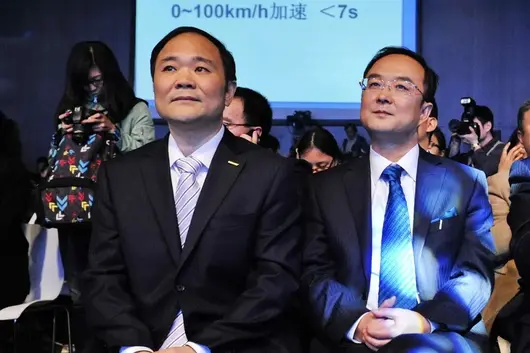

Over the past two days, we attended Geely's interim performance briefing, which mainly highlighted the "123456" strategy and the 5th Generation Energy Replenishment Technology.
Well, understanding this from an outsider's perspective, it simply means Geely wants to accelerate its own globalization.
If you observe closely, you will find that the so-called "product globalization" of most domestic automakers nowadays is a form of pseudo-globalization. Either they manufacture products domestically and ship them out to sell, or they build factories locally for local production.

But Geely's globalization is not this model; it uses others' factories to build its own cars. So you see why Geely spent 221 million euros to acquire a stake in the Ford factory in Spain, and why it upgrades the capacity of the Proton factory in Malaysia from 200,000 units to 500,000 units. Actually, these are both Version 2.0 of "local car manufacturing".

Although many might think that if a car's assembly, supply chain, and sales channels are all handled by foreigners, it is no longer considered a "Chinese car", foreign consumers seeing production sources outside China theoretically makes it easier to boost sales volume, after all, their stereotype is that "Made in China is cheap but dare not buy".
Actually, the 5th Generation Energy Replenishment Technology also addresses the same issue, which is solving deeper-level user fears, because only if users dare to buy, can the cars be sold.

Therefore, the true essence of Geely's globalization is to strip "Chinese car" labels from the products, finally transforming itself into a global brand without national attributes.
Consumers can reject "Made in China", but it is hard to reject a car produced in Spain, assembled by Europeans, with transparent technical standards.


On August 17, Geely Automobile announced its mid-year 2026 performance. Almost at the same time, a more symbolic handover was also taking place.
Li Shufu resigned as Chairman and Executive Director of Geely Automobile Holdings Limited, with An Conghui taking over as Chairman. For Geely, amidst simple personnel adjustments, the enterprise achieved a governance upgrade after a new phase of development.
After all, today Geely Automobile has set its 2030 goal at sales volume over 6.5 million units and revenue exceeding 1 trillion yuan. Having reached the current scale, how to establish a systemic, professional, and young management system, to let Geely transform from being driven by "one person" to truly becoming the cause of "a group of people", has become key to supporting the next round of growth.
Right at this node, Geely presented a semi-annual report with considerable weight. In the first half of the year, Geely's total sales volume exceeded 1.42 million units, total revenue reached 173.6 billion yuan, up 15% year-on-year, maintaining growth for six consecutive years; core net profit attributable to shareholders reached 9.68 billion yuan, up 46% year-on-year, profit growth significantly outpaced revenue growth; gross margin reached 17.9%, core net profit margin increased to 5.6%, revenue per vehicle increased 16% year-on-year to 112,000 yuan. By the end of June, cash reserves further reached a historic high of 69.56 billion yuan.

If the management handover solves the question of "who will lead Geely forward in the future", then the semi-annual report this year answers what kind of Geely the new management team is taking over. At least based on the current portfolio, An Conghui is taking over an automotive group with a stable financial foundation, a gradually clear brand matrix, rapid expansion in overseas markets, while still possessing ample technology and cash reserves.
Of course, a good hand does not mean the game will be easy. Geely's full-year sales target for this year reached 3.45 million, completed 1.423 million in the first half, still needs to complete over 2 million in the second half; after rapid growth in new energy vehicle sales, the mainstream market of 120,000 to 250,000 yuan still needs to strengthen "mid-range products"; after overseas sales exceeded 470,000, how to move from exports to truly local operations has become a new exam question; meanwhile, "One Geely" still needs to continue to solve the efficiency problems behind multiple brands, multiple platforms, and a huge organizational system...
At this time, what is truly worth discussing in this semi-annual report is no longer how much money Geely earned. After the important management handover, they are jointly answering: When Geely goes from a 3 million unit-level automaker to a 6.5 million unit-level global automotive group, what does it rely on to achieve the next round of growth?
Aiming for One Million Units, Geely's Globalization Reached the Moment to "Change Track"
One of the most notable changes Geely witnessed in the first half of the year was overseas markets. Data shows that in the first half of the year, Geely Automobile overseas sales exceeded 474,000 units, up 158% year-on-year. Among them, new energy vehicle overseas sales reached 277,000 units, up 585% year-on-year, new energy vehicles accounted for 58.5% of overseas sales proportion. By the first half of the year, Geely has covered 114 core overseas markets, global channels exceeded 2,000.
Such growth directly changed Geely's goals set at the beginning of the year.
At the mid-year performance conference, An Conghui, Chairman of Geely Automobile Holdings Limited, announced raising the 2026 overseas sales target from 640,000 units to 920,000 units, and further proposed challenging 1 million units. The more long-term goal is even more aggressive; in the future, Geely hopes two-thirds of sales come from overseas.
The importance of this sentence may be even greater than "exporting one million units" itself. Because if calculated based on Geely's 2030 sales target of over 6.5 million units, two-thirds means in the future Geely may need to support a sales scale of millions of units overseas. At that time, overseas markets will not be a supplement to Chinese sales but must truly become core business on par with the Chinese market.
Therefore, what Geely is doing now is no longer just "selling more cars abroad".

Gan Jiayue, CEO of Geely Automobile Holdings Limited, stated that Geely is building an overseas system of "One Geely". Zeekr, Lynk & Co, Geely, and other brands share middle and back-office resources, and establish different scale goals around Pan-European, ASEAN, Latin America & Africa, Eastern Europe, Central Asia, and Middle East regions. Among them, Pan-European market target reaches 600,000 units, ASEAN 500,000 units, Latin America & Africa 400,000 units, Eastern Europe 300,000 units, Central Asia & Middle East 200,000 units, together forming a 2 million unit overseas foundation. This is also what Geely internationalization calls the "123456" strategy.
Overseas goals have changed, and the methods to achieve these numbers are all different.
In the past, the most typical path for Chinese cars going overseas was producing domestically and exporting via trade; one step further, independently building factories locally. Now, Geely is trying to utilize industrial resources accumulated from years of global mergers and acquisitions and cooperation to turn overseas partners' existing capacity into its own global manufacturing network.
An Conghui revealed that Geely's overseas manufacturing system has already begun to take shape. Malaysia Proton factory is upgrading to a 500,000 unit Southeast Asian production base; Spain Ford factory has about 500,000 units capacity, will produce multiple Geely brand models in the future; Volvo Europe factory can take on Geely's high-end products; Renault合作的 Brazil project planned capacity about 300,000 units. Geely summarizes this as "industrial symbiotic" going overseas, that is, using existing resources of partners like Volvo, Proton, Renault, Ford, etc., to accelerate localization with a relatively lighter asset model.

The value of this system will be more obvious in the environment where global trade barriers are increasing. For an enterprise planning for most future sales to come from overseas, true globalization is having R&D, production, supply chain, channels, and after-sales service capabilities in different markets. To this, Gan Jiayue specifically emphasized at the press conference "whether after-sales service can be done well is one of the important marks of whether Chinese automakers can successfully go global", which actually explains that Geely's understanding of globalization is changing.
From selling products to managing markets, then to managing local industrial systems, this is a layer of change behind Geely's export numbers that deserves more attention. Moreover, overseas growth is turning back to improve Geely's profit structure. Taking Galaxy Xingyuan as an example, it undertakes the task of sales volume domestically, but overseas markets, due to higher selling prices and profit space, can contribute better revenue per vehicle. In the first half of the year, Xingyuan exported 87,000 units, accounting for over 40% of Galaxy brand exports, some overseas market selling prices significantly higher than domestic.

In other words, past exports solved "selling more cars", in the future Geely hopes to solve "where to sell cars for more profit".
Strengthen Both Ends, Next Step is to Strengthen the "Waist"
However, the beautiful numbers in the semi-annual report do not mean Geely has no problems. At the performance meeting, An Conghui directly pointed out the most realistic shortcoming in the current product structure: Geely new energy still lacks a strong enough "mid-range product".
Today Geely's product matrix two ends are already quite clear.
High-end market, Zeekr has gradually built price and brand support. In the first half of the year, Zeekr sales reached 178,400 units, up 97% year-on-year, sales accounted for 12.5% of Geely total sales, but contributed 31.7% of revenue, average transaction price around 350,000 yuan, meaning Zeekr is undertaking the important task of Geely improving revenue per vehicle and profit structure. The other end, Galaxy has established scale advantages. In the first half of the year, Galaxy sales close to 520,000 units, Xingyuan and other products became important volume-driving models.

What truly needs strengthening is the middle.
120,000 to 250,000 yuan is exactly one of the most cruel and largest mainstream battlefields for China's new energy vehicles today. This market faces not a single brand, but a product group formed by many domestic new energy brands densely layout. Consumers are extremely sensitive to range, space, intelligent driving, cockpit, hybrid efficiency, and even price.
Of course, Geely is not without products. Galaxy E5, Starship 7, and Lynk & Co some models have already entered this market, but from the whole new energy matrix perspective, there is still a need for more "mid-range forces" that can continuously stand at the top of niche markets and form stable monthly sales volumes. This is why the second half of the year is so important for Geely.

Gan Jiayue stated that Galaxy TT, Galaxy Warship 700, and Lynk & Co 07 GT, New Lynk & Co Z20, and other products are entering the market one after another, essentially bearing the same task: to let Geely new energy's sales structure further transform from "few star models + high-end brands" to a product matrix with multiple stable pivot points. According to Geely announced plans, Galaxy will also expand mainstream market coverage through featured new products, main model upgrades, etc., while Lynk & Co 07 GT aims for the 150,000 to 200,000 yuan B-class plug-in hybrid wagon market.
An automotive group that reached 3 million units, 4 million units, and future 6.5 million units scale cannot always rely on one or two hit products to support growth. In the second half of the year, what Geely truly needs to prove is whether it can establish a whole row of "mid-range forces". This is the first product system exam that "One Geely" must accept after completing brand sorting.
"One Geely" Starts Subtraction, Profit Sheet Starts Addition
In the past decade or so, Geely built a huge brand and technology system through acquisitions, incubation, and internal innovation. It helped Geely complete the leap from a Chinese independent automaker to a global automotive group, but following this came multiple brands, multiple platforms, multiple R&D teams, multiple sales systems, and even product cross-over in similar price ranges.
During the industry's high-growth period, this model could cover efficiency problems through incremental growth; when the industry enters stock competition, repeated R&D, repeated procurement, repeated channels, and internal product competition will directly reflect on the profit sheet. Therefore, the most important significance of "One Geely" is to do a "subtraction" to the complex system left behind by past rapid expansion.
Gan Jiayue revealed that after "One Geely" integration, Geely has adjusted product planning with cross-over, reducing product quantity by about 20%. At the same time, R&D starts sharing vehicle architecture, electronic-electrical architecture, three-electric, assisted driving, and smart cockpit technology resources; procurement promotes joint procurement; manufacturing coordinates production; channels and after-sales gradually co-build, middle and back-office human resources, finance, legal, and other resources also begin coordination.

These changes have finally entered the financial statements. In the first half of the year, Geely's administrative expense ratio decreased 0.2 percentage points year-on-year to 1.7%, R&D investment ratio decreased 0.3 percentage points to 5.2%; in the case of rapid overseas business expansion, sales expense ratio still remains basically flat compared to the same period last year. At the same time, Geely's total R&D investment still reached 9.061 billion yuan, up 8% year-on-year.

Even more noteworthy is that in the first half of this year, Geely continued to actively compress supplier payment terms, currently supplier payment terms have been unified to within 60 days, small and medium suppliers further shortened to within 30 days; listed company accounts payable turnover days decreased from 115 days last year to 103 days, second quarter further dropped to 96 days.
For automakers, extending payment terms can improve short-term cash flow, shortening payment terms means true money flows out earlier. Geely chose the latter, essentially using its own cash reserves to exchange for supply chain stability. By the end of June, Geely cash reserves still reached a historic high of 69.56 billion yuan.
So, the value of 69.56 billion yuan besides "Geely has a lot of money on the ledger", it also gave Geely the qualification to make long-term choices in the industry's low-profit cycle.
Gasoline Vehicles Are Another Card in Geely's Globalization
There is another number in the semi-annual report that is easily overlooked.
In the first half of the year, Geely gasoline and gasoline hybrid model sales reached 623,500 units, down 8.8% year-on-year. Surface appearance seems not very eye-catching. But Gan Jiayue responded that the same period China gasoline and gasoline hybrid market overall decreased about 17%, Geely decline significantly smaller than market, thus instead achieving market share increase.
In past few years, some automakers equated "comprehensive new energy transformation" with quickly exiting gasoline vehicles, but for an ultra-large automotive group like Geely, the answer is obviously more complex. So what Geely did to gasoline vehicles was redefinition, laying out from harmless and intelligentization two directions.

Gan Jiayue pointed out that in the future Geely will no longer continue to develop traditional pure gasoline products, but gradually transition to i-HEV Smart Engine hybrid, reducing fuel consumption through electrification, while moving intelligent cockpit, assisted driving, and other capabilities formed in new energy era to gasoline foundation.
Currently i-HEV has covered Emgrand, Xingyue L, Xingrui and other main products, within the year will also add 3 model types, year-end i-HEV plan to hit monthly sales over 30,000 units, and enter European, Asia-Pacific, UK, Australia New Zealand and other overseas markets in 2027. In this way, China Star's role will also change. In the first half of the year, China Star sales exceeded 580,000 units, continuing to contribute stable sales and profits to Geely. For today's Geely, cash flow created by gasoline vehicles can continue to support large-scale investment in new energy, AI, globalization, etc.; after i-HEV transformation, China Star can again become an important product tool for Geely entering some overseas markets.
This strategy is actually a very realistic technical route selection, letting different energy forms serve different markets. Pure electric suits mature infrastructure markets, plug-in hybrid, extended-range cover more new energy scenarios, i-HEV adapts to areas with insufficient charging facilities, methanol can enter more special energy markets. Geely ultimately hopes to establish a system where five technical routes parallel: pure electric, plug-in hybrid, extended-range, gasoline hybrid, alcohol-hydrogen.
From this perspective, gasoline vehicles are not Geely new energy transformation's "historical burden", but are being re-constructed as a tool in the globalization era.
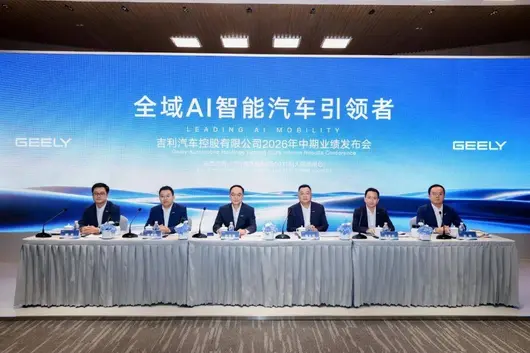

Recently, Geely's series of moves were quite aggressive. Besides the adjustments in executive management, the layout and specific operations of the overseas market also have clearer plans. First, regarding sales targets, Geely's 2026 exports were raised from 640,000 vehicles to 920,000 vehicles, challenging an annual sales volume of one million.

In the first half of the year, Geely's overseas sales were approximately 480,000 vehicles, a year-on-year increase of 158%. With the traditional peak season of the second half of the year, Geely's standard for raising the sales target is very pragmatic, and there is a high probability of successfully challenging an annual sales volume of one million vehicles.

Meanwhile, Geely Holding Group CEO An Conghui stated: Volvo's factories in Europe will become an important base for Geely's European strategy, undertaking the production of high-end luxury cars within the Geely Automobile Group, expected to start production in 2028. Looking at the data, Volvo's year-on-year decline in the European market in 2025 was 10%, dropping to approximately 332,700 vehicles.

Entering the first quarter of 2026, Volvo's sales in Europe and other regions worldwide were 95,335 vehicles, a further year-on-year decline of 2%. Global sales from March to May were 179,000 vehicles, a year-on-year drop of 5.5%. The surge in Geely's sales in the overseas market can just utilize Volvo factories' idle capacity, which is quite reasonable.
Meanwhile, regarding layout in other overseas markets, Geely previously acquired Proton's factory in Malaysia. After upgrading, it has an annual production capacity of 500,000 vehicles to meet the needs of the Southeast Asian market. In South America, it relies on Renault Brazil's industrial collaboration, sharing manufacturing resources and market channels between the two parties, significantly reducing the investment cost of building its own factories.

Additionally, in July this year, Geely and Ford also reached an agreement. Both parties will establish a joint venture company in Valencia, Spain. Through capacity sharing, they will create various new energy vehicle models for the Ford and Geely brands for the European market. From this perspective, Geely's layout in the overseas market is mainly to revitalize the group's various brand resources, or establish joint venture companies with other brands, trying to avoid the high investment of building factories alone, and also serving a role in risk avoidance.
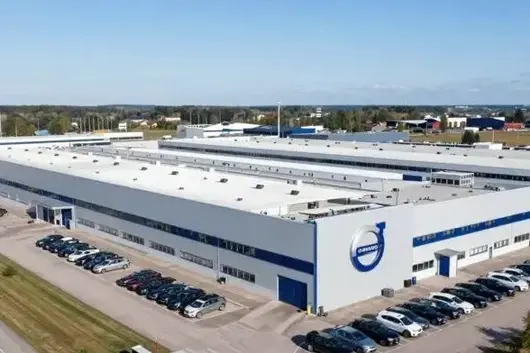

During the first half of this year, China exported 5.096 million vehicles, a 65.3% increase year-on-year, with June seeing single-month exports surpass 100,000 vehicles for the first time. Among these, the proportion of new energy vehicles has exceeded 46%.
More importantly, this wave of overseas expansion is no longer just about loading cars onto ships for shipment. Chery, BYD, SAIC, and Great Wall Motor have all built factories abroad, moving entire factories, supply chains, and channels over. Even with the EU raising tariffs to 45.3%, China's car exports to Europe increased by 84.7% in the first quarter, with market share rising from 0.5% three years ago to 11%.
The opportunity has truly arrived. At this critical moment, Geely did something at its mid-year performance briefing: raising the full-year overseas sales target from 640,000 vehicles to 920,000 vehicles in one go, and also stated an ambition to aim for an annual sales volume of one million.
A single increase of 44% in targets is rare among domestic automakers. The first reaction of outsiders is "It's just bragging." However, after reviewing Geely's mid-year report and its overseas strategy, you will find it isn't gambling, but holding a clear play it has held for a long time.

These 920,000 vehicles are not made on a whim
We have seen too many companies喊 targets at the beginning of the year and quietly adjust them by mid-year. But this time, Geely's reasons are so simple you cannot refute them: the original 640,000 target was already completed in the first half.
Let's look at the data directly, all from the mid-year performance announcement: overseas sales reached 474,000 vehicles in the first half, a 158% increase year-on-year, exceeding last year's full-year volume. Last year's entire workload was finished in this year's first half.
Overseas monthly sales broke 100,000 vehicles for two consecutive months in June and July, with July alone reaching 106,700 vehicles, a massive 202% increase year-on-year. This is no longer luck, but a new normal. Cumulative sales for the first seven months were 580,900 vehicles, a 164.8% increase year-on-year. So, adjusting from 640,000 to 920,000 simply means writing the obvious trend into official numbers ahead of time.
Moreover, the quality of these 920,000 vehicles is even more worth discussing than the numbers themselves. New Energy Vehicles are the absolute main force: new energy exports reached 277,200 vehicles in the first half, skyrocketing 585% year-on-year, accounting for nearly 60% of total exports; in July alone, new energy exports were 62,600 vehicles, directly more than six times the previous year.
In other words, what Geely is selling overseas is no longer the old story of exchanging foreign exchange via low-price fuel vehicles, but new energy vehicles equipped with intelligent cockpits and three-electric technology. More impressively, as volume increases, prices do not drop — average vehicle revenue is 112,000 yuan, up 15,000 yuan year-on-year, with a gross margin of 17.9%, and core net profit per vehicle of 6,806 yuan, up 45% year-on-year.
Selling more and selling for more value. With this momentum, raising the target to 920,000 might even be considered conservative by Geely itself.

Where is the confidence? Three words — Systematic Capability
Geely's overseas expansion has long passed the stage of just shipping cars to ports; now it is moving factories, technology, and brands outward. This is the fundamental reason why it dares to shout 920,000 vehicles without feeling insecure.
The first layer of confidence is that capacity has truly landed. Overseas, 12 factories are already running, with capacity exceeding 650,000 units, aiming for 840,000 by year-end. This is not a PPT pitch, but actual production lines. Southeast Asia is the root. The Proton AHTV industrial park in Malaysia is upgrading capacity from 200,000 to 500,000 units, and was included in the Malaysian government's national development plan, handling R&D, manufacturing, and exports all at once.
Europe has two legs. On July 23, Geely spent 221 million euros to acquire 34% equity in Ford's Valencia, Spain factory, an old plant with 500,000 units annual capacity, where Galaxy and Lynk & Co will start production in 2028; the Volvo Europe factory will take over the luxury car role within the system, also aiming for 2028. For South America, it will leverage Renault's local bases and channels.
The most refined point of this asset-light, industry symbiosis strategy is: it bypasses the "Made in China, Sold Globally" tariff wall, using joint ventures, equity, and shared capacity to plant Chinese brands directly into local industrial chains. While others are still figuring out how to export, Geely is already answering how to take root.
The second layer of confidence is that channels and markets are spread out systematically. 114 core overseas markets, 17 emerging markets, and over 2,000 offline channels. Regional layout is also clear: ASEAN one 300,000-unit tier, Europe, Eastern Europe, and Latin America/Non-ASEAN three 200,000-unit tiers, Middle East & Asia one 100,000-unit tier. The benefit of this multi-polar pattern is that even if one market fluctuates, it won't cause severe damage — this is exactly the strategy only mature multinational automakers have.
The third layer of confidence is a thick war chest. R&D expenditure in the first half was 9.06 billion yuan, up 8% year-on-year; cash reserves on hand were 69.56 billion yuan. With nearly 70 billion yuan backing, daring to continue increasing R&D spending speaks of long-termism. Going overseas is a marathon, not a sprint; the money bag is the stamina for the second half.

Why偏偏 is it now?
Some might say, anyone can shout targets, why believe Geely can deliver? My view is that this window right now is almost tailor-made for Chinese automakers going global.
Sky time (Timing). In the export map of the first half of this year, Russia, Brazil, and the UK ranked top three, with emerging markets contributing over 4.14 million vehicles in one breath, and the acceptance of Chinese brands visibly warming up. Despite tariffs, market share in Europe continues to rise, proving that the product power of Chinese new energy vehicles is already hard to stop. Geely is stepping right on this biggest trend.
Earth location (Geography). Domestic new energy penetration rates hit 60%, and the world's top-tier industrial scale has given Chinese automakers cost and efficiency advantages in batteries, intelligent driving, and supply chains that others cannot catch up with in a short time. Once these advantages start flowing outward, it is the starting point for Chinese automobiles rewriting the global landscape.
People (Team/Strategy). Geely's strategy in the past two years has been doing subtraction — Geometry merging with Galaxy, Lynk & Co merging with Zeekr, brands shifting from fighting independently to collaborative warfare. The effect is real: administrative expense ratio dropped from 1.9% to 1.7% in the first half. With strength twisted into one rope, the momentum for going overseas naturally increases.
There is also a rather interesting detail. On the day the mid-year report was released, Geely announced management adjustments simultaneously: Li Shufu stepped down as Chairman of the Board and became Honorary Chairman, An Conghui took over, Gui Shengyue served as Vice Chairman, and Gan Jiayue became President. Completing this generational transition while handing in these results is itself a sense of calm — Geely's globalization no longer relies on the bravery of a single person, but on a whole set of running systems and teams.

920,000 vehicles, what does it actually mean?
To be honest, 920,000 vehicles is a hard threshold in the global automotive landscape. It means Geely is moving from "First Tier of Overseas Expansion" to "True Global Automaker". When a Chinese automaker's overseas sales approach one million units, its identity is no longer just an exporter of Made-in-China products, but someone qualified to sit at the table to discuss rules.
Geely's own words are more direct: the long-term goal is to have two-thirds of sales come from overseas. Once that day comes, Geely will change from "Chinese Geely" to "Global Geely" — this is what generations of Chinese automotive people want to do, and the outline is becoming clearer now.
Of course, I won't put too many words to fill the air. The overseas market has never been a smooth path; tariffs, geopolitics, localization, cultural differences — every hurdle requires real skill, the battle for 920,000 vehicles has just begun.
But there is one thing I dare to judge: a car company that dares to raise export targets from 640,000 to 920,000 at mid-year in front of the whole industry, with nearly 70 billion yuan in cash on hand and 12 overseas factories running — it is not gambling, it is using strength to force you to reconsider it.

Auto Review:
In the wave of exports surpassing 5 million units this half, which Chinese automaker will dare to shout for one million in overseas sales next? When Chinese car overseas sales collectively stand on one million units, how will the global automotive chessboard be played again?
This matter is worth our focus on the long view, watching slowly.
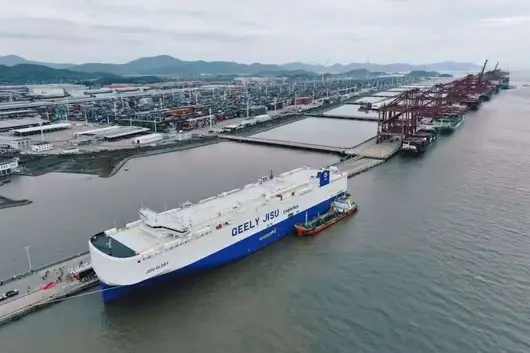

On August 17, Geely Automobile (0175.HK) released its 2026 interim results.

In the first half of the year, the company achieved total revenue of 173.6 billion yuan, a year-on-year increase of 15%, setting a new historic high; after deducting the impact of exchange gains and losses and impairment of non-financial assets, core net profit attributable to the parent company reached 9.68 billion yuan, a year-on-year increase of 46%; total sales volume was 1.423 million vehicles, setting a new historic high for the same period.
The industry backdrop for these results is not easy. Data from the National Bureau of Statistics shows that in January to May 2026, profits in the automotive manufacturing industry fell 19.8% year-on-year; the China Passenger Car Association estimated that the automotive industry sales profit margin for the first half of the year was about 3.8%, still at a historic low. Volume competition, rising raw materials, and investment in transformation simultaneously squeezing profits has become a common industry challenge.
Therefore, observing this interim report, what is most worth focusing on is not how many new highs revenue and profits have set, but the relationship formed between the numbers: sales volume remained basically flat, revenue grew by 15%, core profit grew by 46%, revenue growth speed was faster than sales volume, and profit growth speed was faster than revenue. At the same time, gross margin rose to 17.9%, an increase of about 1.6 percentage points year-on-year; core net profit margin was 5.6%, an increase of about 1.2 percentage points; revenue per vehicle was 112,000 yuan, a year-on-year increase of 16%; core net profit attributable to parent company per vehicle was 6,806 yuan, a year-on-year increase of 45%. These indicators all point to one thing: Geely's growth is shifting from scale expansion to structural improvement and efficiency enhancement.
Integrating "Synergy" Into the Interim Report
Behind the improvement in profitability, high-end products and overseas business are two direct drivers, while system synergy constitutes a deeper reason.

In the first half of the year, Geely's administrative expense ratio further dropped to 1.7%; the proportion of R&D investment to revenue fell from 5.5% to 5.2%, but the absolute value of R&D investment grew 8% year-on-year, reaching 9.06 billion yuan. The simultaneous occurrence of expense ratio decline and R&D investment increase means the company is reducing duplicate construction and inefficient expenditure, without contracting technical investment intensity.
The cash position also provides verification. In the first half of the year, net cash flow from operating activities approached 20 billion yuan; as of the end of June, capital reserves were about 69.6 billion yuan, at a historic high. Expense efficiency, R&D intensity, profit growth, and cash creation improved synchronously. This interim report presents not short-term elasticity brought by a certain vehicle model, but a comprehensive result after a management system gradually matures.
This also provides an entry point to re-understand "One Geely".
In September 2024, Geely Holding Group released the "Taizhou Declaration", proposing five initiatives: Strategic Focus, Strategic Integration, Strategic Synergy, Strategic Prudence, and Strategic Talent. At the beginning of 2026, "One Geely, Leading in All Aspects" was further clarified as a strategic goal for 2030, core to which is strengthening top-level planning and global synergy, forming a global "One Chessboard" of co-created technology, co-explored markets, and shared supply chains. The purpose is to recombine Geely's accumulated brands, platforms, technology, supply chains, and global resources into a unified system capable of efficient operation.
Over the past two years, Geely has successively promoted the strategic integration of Zeekr and Lynk & Co, completing Zeekr's privatization; it established large-scale procurement, R&D, and platform-based sales systems internally, and adjusted vehicle planning with overlapping models between brands. Management revealed at the results conference that after reorganization, the number of overlapping products between brands has decreased by more than 20%, and the administrative expense ratio and R&D investment ratio have also declined.
This adjustment has gradually formed a clear structure: the front office maintains brand differentiation, while the back office promotes the unification of technology, R&D, procurement, supply chain, and global resources.
Four Major Brands Form a Complete Value Ladder
"One Geely" does not mean all brands grow into the same face. After system integration, the division of labor among the four major brand sectors is rather clearer.

Geely China Star bears the scale basic board of the fuel and oil-mixed markets, with sales of 581,000 vehicles in the first half of the year, and plans to comprehensively promote i-HEV and intelligence; Geely Galaxy focuses on high-value mainstream new energy markets, with sales of 520,000 vehicles in the first half of the year, breaking through 2.5 million vehicles cumulatively after three years; Lynk & Co strengthens its positioning of sporty, trendy personalized high-end, with sales of 144,000 vehicles in the first half of the year, with the new energy proportion rising to 65%; Zeekr bears the task of technology luxury and brand upward movement, with sales of 178,000 vehicles in the first half of the year, a year-on-year increase of 97%. Thus, Geely has formed a complete product gradient from mainstream fuel, mainstream new energy, to personalized high-end, technology luxury.
The positioning of the four brands differs, while simultaneously sharing vehicle architecture, electronic and electrical architecture, intelligent driving, intelligent cockpit, battery, electric drive, and electric hybrid technical resources — reducing duplication between brands, underlying capabilities are reused, and the same technology can form scale effects across different price bands.
Zeekr is the part that best reflects the structural change. In the first half of the year, Zeekr contributed revenue of about 5.5 billion yuan, a year-on-year increase of 103%; vehicle sales above 300,000 yuan grew 578% year-on-year; accounting for about 12.5% of sales, it contributed about 31.7% of the group's revenue. Zeekr 9X delivered more than 46,000 vehicles in the first half of the year, ranking first in sales of vehicles above 500,000 yuan in the country. High-endization for Geely is no longer just a brand image project, but an operating variable that can enter revenue, gross margin, and per-vehicle profit.
Globalization Begins to Move from Sales Volume Increment to Profit Increment
Along with high-endization, overseas business is changing the revenue structure.

In the first half of the year, Geely's overseas sales were 474,000 vehicles, a 158% year-on-year increase, surpassing the full year of 2025 in half a year; among them, overseas new energy vehicle sales were 277,000 vehicles, a 585% year-on-year increase, accounting for about 59%; June single-month overseas sales broke 100,000 vehicles for the first time. The company subsequently raised the full-year overseas target from 640,000 vehicles to 920,000 vehicles, and proposed a challenge of 1 million vehicles.
The importance of this set of data is not just in growth speed. Management disclosed at the results conference that the export business comprehensive gross margin is significantly higher than domestic: domestic about 15%, overseas about 22% to 25%; the increase in the proportion of overseas high-end and new energy vehicles was an important driver for the gross margin in the second quarter rising from 17.5% to 18.4%. The overseas market has shifted from supplementing sales volume to lifting the profit center.
The outbound method is also changing synchronously. Geely proposed establishing "One Geely Overseas System", with Zeekr, Lynk & Co, and Geely brands maintaining clear positioning, and middle and back office resources unified synergy. In July this year, Geely and Ford announced the establishment of a joint venture in Spain, utilizing Ford's Valencia factory to produce models for both brands, with the factory's potential annual capacity about 500,000 vehicles; expansion of the Malaysia Proton base and cooperation with Renault in Brazil and Korea are also being promoted.
Acquiring Volvo, investing in Proton, partnering with Renault, in the past was more understood as the expansion of a global asset map. Entering the "One Geely" stage, these resources are being reorganized into local manufacturing, supply chain, channels, and brand operation capabilities. Management's summary is: products "Go Out", supply chains "Go In", brands and technology "Go Up".
AI Establishes the "One Geely" Common Foundation
Beyond the four brands and global markets, AI is another main thread to understand "One Geely".

In 2026, Geely released Full-domain AI 2.0, with the technical logic of connecting vehicle computing power, data, and models, forming a unified vehicle intelligent center, allowing intelligent cockpit, assisted driving, chassis, safety, and power systems to operate synergistically. This unified foundation is spreading on a large scale to the four brands: Qianli Haohan G-ASD will cover Zeekr, Lynk & Co, and Galaxy products, Super EVA 2.0 promotes cabin-vehicle integration, Robotaxi customized models and large-scale operations are also on the way.
The application scope of AI extends from cockpits and assisted driving to traditional automotive engineering. In the first half of the year, Geely released i-HEV Intelligent Hybrid, AI Digital Chassis, and 16-in-1 Intelligent Electric Drive; the next stage will apply large model capabilities to 900V high-voltage charging, battery thermal control, and lifecycle management.
This is exactly the value of "One Geely" at the technical level: underlying capabilities are unified for development, front-end products are differentiated for application according to brand positioning. One set of technology covers a larger sales volume and more price bands, the marginal efficiency of R&D investment continues to improve — this also explains why R&D investment is still increasing in the first half of the year, while the R&D investment ratio is falling.
"Leading in All Aspects", Entering the Quantifiable Verification Stage
Looking back from this semi-annual report, "One Geely" has a more concrete meaning than a strategic slogan.
It is a brand system: China Star, Galaxy, Lynk & Co, and Zeekr each bear clear tasks, covering from scale basic board to high-end value breakthrough.
It is a management system: R&D, procurement, sales, supply chain, and product planning reduce duplicate investment, system synergy begins to enter expense ratio, gross margin, and per-vehicle profit.
It is a global system: domestic and overseas synergy, vehicle export and localized operation proceed in parallel, global resources form a One Chessboard. Full-domain AI constitutes a common technical foundation, transforming intelligence from single-point configuration into a system capability across brands, energy forms, and markets.
And on August 17, it added the last piece: governance system. A few hours after the interim report release, Geely Automobile announced management adjustments — Li Shufu resigned as Chairman of the Board and Executive Director, and was appointed Lifetime Honorary Chairman; An Conghui succeeded as Chairman, Gan Jiayue became President, and Li Shufu continued to command Geely Holding Group. His statement at the results conference can serve as a footnote: "The automotive industry is a marathon without an end; corporate inheritance and value orientation determine a company's sustainable development capabilities." Thus, the "One Geely" integration has progressed from brand, organization, and technology to corporate governance itself — the continuity of strategy is formally handed to systems and teams.
Therefore, the value of this interim report is not just in 173.6 billion yuan revenue and 9.68 billion yuan core net profit attributable to the parent company. More worth focusing on is that capabilities previously scattered across different brands, technology platforms, and global markets are being organized into the same set of management logic, and are starting to act together on revenue structure, profit levels, and cash creation.
After the automotive industry entered a deep competition stage of electrification, intelligence, and globalization, the competition between companies is no longer about a certain hit model. Whether profitability can break dependence on price cuts, whether growth can cross a single market, whether technology can be reused on a large scale, whether brands can have clear division of labor, whether organizations can operate without relying on a single person — these factors collectively determine whether a vehicle enterprise can weather the cycle. In this sense, "Leading in All Aspects" is closer to a set of system indicators that need continuous verification, rather than a sales ranking for a certain stage.
What does "One Geely" intend to do?
The answer is walking from strategic text into financial statements, and also into governance structures: improving efficiency through system synergy, creating value through brand division of labor, opening growth space through global operations, and building long-term competitiveness through full-domain AI — and this time's management handover adds the last piece of the map to "Leading in All Aspects". After this map is fully pieced together, Geely's goal for 2030 truly has a way to run continuously.
This is perhaps also the most worth rereading part of this semi-annual report.
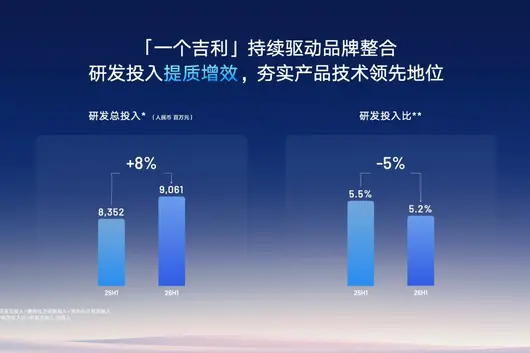

On July 15, Geely Star Wish cumulative sales broke through the 800,000 unit mark. From 0 to 800,000, it took only 21 months, averaging 1 vehicle sold per minute and over 1,200 vehicles sold per day. This A0-class compact car, once viewed as merely "for grocery runs and commuting", has forcefully turned itself into a phenomenon-level blockbuster in the Chinese automotive market. On August 10, Star Wish released another big move — exclusive fan appreciation rights for 800,000 users were officially launched. This wave directly maximized expectations in the car community.

I. One Vehicle Delivered Every 60 Seconds
21 months, 800,000 units, what is the concept? Equivalent to on average every 60 seconds, one Star Wish finds an owner. In 2025, Star Wish directly topped the Chinese automotive market all-category sales champion, leaving a crowd of sedans and SUVs behind; in the first half of 2026, cumulative sales rushed to 249,000 units, year-on-year growth of 21%; July single month sold 55,105 units, breaking the 50,000 unit mark for two consecutive months. In the A0-class pure electric market, its market share has already exceeded 30%. Some people always say the ceiling of A0-class compact cars is low, Star Wish counters and proves: compact cars can also dominate the whole field.
This image appears to be AI-generated

II. From China's Sales Champion to Global Top Trend
Even more impressive is that Star Wish's ambition is not limited to domestic. In Q1 2026, it directly joined the global new energy vehicle sales top three, it is the only Chinese brand model to appear on the list. Currently, Star Wish has landed in global 30+ countries, taking China new energy two-door models export TOP2; Brazil launched 5 months sales exceeded 10,000, June topped Thailand new energy sales champion, August 5 again officially launched in Australia, third quarter still to enter EU and UK. From emerging markets all the way to developed countries, galloping on foreign streets Star Wish, has already become a moving Chinese business card.


III. The Ace Card Behind the Galaxy Speed
Star Wish's surge also propelled the entire Geely Galaxy brand. From January to July 2026, Geely Galaxy cumulative sales reached 627,000 units, holding the number one spot for emerging EV brand sales, and also ranking in the top three global new energy brands; as of now, cumulative sales have exceeded 2.44 million units, becoming the fastest new energy brand globally to reach this scale. Behind this dazzling "Galaxy Speed", Star Wish is the most powerful engine. Without Star Wish's sprint, there is no Galaxy takeoff. An A0-class compact car supporting the entire brand's prestige — if said two years ago, no one would have believed it.

800,000 units is a milestone, and also a brand new starting line. From "a hit upon launch" to "being a champion is the norm", Star Wish uses a series of hardcore data to vividly display the big impact of a compact model. Next, it will take the trust of 800,000 users to sprint towards the Million Club. This acceleration legend staged by Chinese compact cars has just begun.


800,000 people buying cars, what answer would they choose? The sales list writes it clearly: Geely Xingyuan. 21 months on the market, 800,000 users voted with their hard-earned money, bringing this A0-class small car to the sales champion throne. Someone asks, why is it them? Peel away the marketing filter, take it apart to see the hard-core assets of this small car, and you will find: Hit products never rely on luck, but rather on solid, cross-class product strength.

1. Good Battery, No Blind Box Gaming
What are small cars most afraid of? False range claims, unreliable batteries. Xingyuan directly gives you peace of mind: Equipped with CATL cells across the board, regardless of version or batch, users never have to play the blind box. Coupled with an all-domain liquid cooling temperature control system, CLTC range up to 480km, real-world tested range redemption rate exceeds 100%; 30% to 80% fast charging takes only 19 minutes, recharging efficiency leads in class. Plus Shenhu battery safety system and 11-in-1 intelligent e-drive, full-link protection from cell protection to BMS smart management. Regarding the battery, Xingyuan welded 'peace of mind' to the car.

2. Good Chassis, Even Beginners Dare to Let Loose
Having a good battery isn't enough, driving well is the real skill. Xingyuan's chassis is honed with real skill: Joint tuning by China and Germany, rear-wheel drive + multi-link independent suspension standard across the board, 4.95m turning radius, U-turn in narrow alleys in one go. This January, the team also partnered with Lotus Engineering to travel to Sweden, repeatedly honed ESC and anti-slip systems in minus 30°C ice and snow, sediment track experience into daily stability. 130km/h Fishhook Test, 80.7km/h Moose Test, unique in its class. Wenzhou owner avoided danger twice with emergency evasions on a foggy day, this is the best live ad for this chassis.

3. Good Safety, Stand Tough Without Fear
Driving control is face, safety is the lining. Xingyuan partnered with CCTV to challenge frontal 50km/h + lateral 55km/h continuous collision, high voltage system powers down in seconds, battery pack does not smoke or catch fire, passenger cabin structure intact; AEB stop at 120km/h, AES active avoidance at 130km/h, active and passive safety maxed out directly. A Chengdu owner's car was rear-ended by a box truck, crashed into 'total loss level' but unscathed, bought another Xingyuan afterward; Thailand owner rear-ended and crushed by 18-wheeler heavy truck, similarly escaped safely. Regarding safety matters, Xingyuan never plays games.


Small cars shouldn't just be cheap, they must be reliable. Xingyuan achieved cross-class quality in battery, chassis, safety three major matters, only then earned the confidence of 800,000 users. How to choose an A0-class small car? Remember one sentence: Like Xingyuan, willing to pile up materials, daring to weld safety bottom line, just buy it without hesitation.
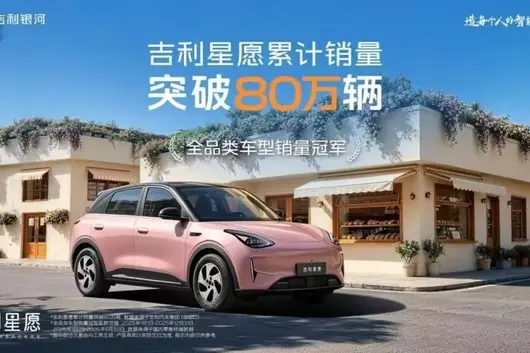
August has just begun, Geely has made two moves.
First, July sales report reached 250,161 units, with same-period and month-on-month growth for 5 consecutive months, new energy vehicles accounting for 64%.
Following closely, on August 2, Geely Automobile Group Sales Headquarters was officially launched.
To be honest, restructuring when sales are at a high point is harder than radical treatment when sales are low.
Geely's step of "retracting the fist to strike harder" reveals a rare composure and puts the industry's chronic issue of multi-brand management on the table.
 250,000+ Units: Refusing Imbalanced Growth for Balanced Development
Zeekr delivered 35,837 units, a 111% increase year-on-year.
The 9X secured the 500,000+ RMB range, the 7X delivery exceeded 10,000.
This proves that Zeekr's foothold in the high-end market is not a fleeting phenomenon.
Galaxy withstood the fire of the mainstream market, Star Wish sold 55,105 units individually, cumulative sales broke 800,000.
A7 EM's Guinness Record of 2,608 kilometers negated range anxiety at its source.
Lynk & Co 07GT had over 10,000 major orders within 27 minutes of launch, and immediately plans to compete in rally racing. This contrast of half-home, half-racing is exactly the scarcity Lynk & Co found in the red ocean.
 More worth mentioning is the overseas market.
Exports reached 106,663 units, breaking 100,000 for two consecutive months, with new energy vehicles accounting for 59%.
Star Wish topped charts in Thailand and Brazil, Zeekr 7X led in Australia and Malaysia.
This shows Geely is no longer solely dependent on domestic involution, but has built a multi-tiered brand echelon in the global market.
This pattern of internal and external cultivation is more valuable than sales numbers alone.
 Sales Headquarters: From Warlord Division to Legion Warfare"
This establishment of the Sales Headquarters is by no means a simple departmental merger, but a closure of a Geely strategy in the "Taizhou Declaration."
Lin Jie leads, also managing Zeekr; Fan Junyi serves as Executive Vice President, managing Lynk & Co on one hand and Galaxy on the other, preserving Zeekr's independence and premium tone, while enabling Lynk & Co and Galaxy, two brands with similar tones and slightly overlapping price bands, to achieve synergy in the middle and back office.
Wang Bo manages China Star, Guan Jiuyang serves as Executive Vice President of Galaxy.
 In this era of micro-profits with vehicle gross margins falling to 1.5%, the enemy of multi-brands is often themselves.
In the same city and on the same street, Galaxy and Lynk & Co compete for customers. Repeated channel construction devours profits. This is a common disease of many car companies.
Geely's move to retract its fist is essentially treating front-office brands as special forces to maintain flexibility, while managing channel, data, budget, and other middle and back-office resources as a unified logistics army.
This "split front office, unified middle and back office" model can effectively solve internal friction and improve marginal efficiency.
 Zhang Guan Commentary: Geely's "Entropy Reduction" Experiment
In my opinion, this step by Geely is an "entropy reduction" experiment on automotive industry involution.
Previously, when discussing multi-brands, the talk was about differentiation; now discussing multi-brands, efficiency must be discussed.
Referring to the previous experience of integrating Zeekr and Lynk & Co, the sales expense ratio dropped to 5.9%, which is actual profit.
With the operation of the Sales Headquarters, Geely's channel reuse rate overseas will increase significantly. Selling multi-brand models at a single set of outlets can greatly dilute overseas costs.
 Of course, organizational change inevitably accompanies pain.
Six originally independent sales systems need to divide budgets and set strategies at one table; an adaptation period is inevitable.
But Geely chooses to act when winning, rather than passively putting out fires. This strategic resolve deserves praise.
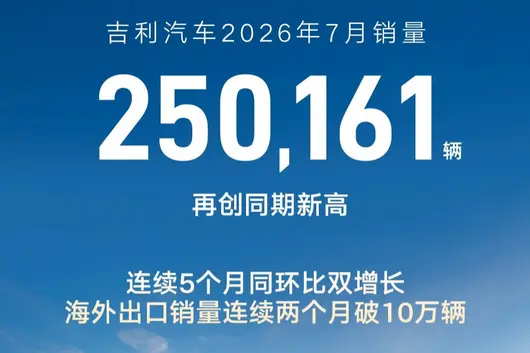

On July 23, 2026, Valencia, Spain. On this day, Geely Automobile and Ford Motor—two "old friends" shaking hands again after 16 years—signed a significant agreement in a factory with nearly 50 years of history.
Geely Automobile announced the acquisition of a 34% equity stake in Ford's Valencia, Spain factory for 221 million euros. Both parties established a joint venture, sharing one of Europe's largest automobile factories with an annual capacity of about 500,000 units. Geely will launch two new energy models here, with the first vehicle rolling off the line in 2028; Ford will continue producing three multi-energy models such as Kuga.

This is not only capacity sharing between the two automakers but also a key strategic move in Geely's globalization strategy—from "going out" to "integrating in," from complete vehicle exports to local manufacturing. Geely is exploring its own path amidst the changes in the global automotive industry.
The "Trust Vote" from 16 Years Ago
To understand the origins of this cooperation, we must turn the clock back to March 28, 2010.
On that day, Geely Holding Group acquired Volvo Cars entirely from Ford for 1.8 billion USD. At that time, Geely was an unknown Chinese private car company, while Volvo was a well-known luxury brand. This "small swallowing big" deal shocked the global automotive industry.
But what kept this story going until now was not the deal itself, but what happened after the deal.
After taking over Volvo, Geely did not rush to integrate but chose to "let the tiger return to the mountains"—keeping Volvo's Swedish headquarters and Belgian factories, respecting its independent development system, and fulfilling all commitments to the brand, employees, and unions made during the acquisition. Ford, as the former parent company, witnessed throughout how Geely protected and revived a classic brand with pragmatic actions.

This commercial integrity of "doing what you say" won Ford's respect and trust for Geely. 16 years later, when Ford faced challenges in capacity efficiency and the market in Europe—the Valencia factory has an annual capacity of 500,000 units, but actual production in 2025 was less than 100,000 units—it chose to extend an olive branch to Geely again. Through capacity sharing, it aims to create new energy vehicle products for Geely and Ford brands for the European market, improve capacity utilization, and jointly expand the regional market. Behind this lies trust accumulation across time cycles.
As Geely Holding Group Chairman Li Shufu often said internally: The fun of business lies in making friends and doing deals at the same time, achieving win-win results in every cooperation, and leaving pleasant memories. This philosophy was concretely embodied in this cooperation.

"Light Asset" Going Overseas: Building a "Network of Friends" Instead of Factories
Unlike most Chinese automakers choosing to "build their own factories" for going overseas, Geely took a differentiated path.
In April this year, Geely Holding Group clarified a new strategy for overseas expansion: instead of building new production factories, it proceeds to advance business layout through cooperation, integration, and reviving existing capacity. For Geely, in the context of tense geopolitical situations and changing global patterns, prioritizing the use of existing factories by partners is a more pragmatic choice.
This "light asset" logic has been repeatedly verified in Geely's previous global layout:
Volvo's European factories provide a manufacturing pivot for Geely to enter high-end markets;
Proton's Southeast Asian network allowed Geely to build a High-Tech Automotive Valley in Tanjong Malim, Malaysia;
Renault's Brazilian factories and channels support new energy cooperation between both parties in the Latin America and Africa market;
The establishment of HORSE Powertrain with Renault achieves deep technical synergy for the global market.

Geely and partners use these ready resources together. This Geely-style localization method improves overseas and market expansion efficiency while reducing regional barrier risks. Wanlian Securities Investment Consultant Qu Fang evaluated: "This belongs to a light asset, high efficiency 'going overseas' layout mode. Compared with building factories, the investment is lower, the implementation cycle is shorter, and the pace of capacity expansion can be adjusted flexibly."
The Spanish joint venture is the European debut of this model. Geely secured a 34% equity stake and stable subcontracting capacity with only 221 million euros, quickly obtaining a production base compliant with EU standards. Relying on Ford's accumulated European supply chain and local operation experience over many years, it greatly reduced the cost and risk of overseas layout.
From "Product Export" to "System Going Overseas"
In the first half of 2026, Geely Automobile's overseas sales reached 474,000 units, up 158% year-on-year, exceeding the total export volume of the full year of 2025. Among them, new energy exports were 277,000 units, surging 585% year-on-year, accounting for 58%.
Behind these numbers is a net Geely wove globally over the past decade-plus—acquiring Volvo, investing in Proton, holding Lotus, and cooperating with Renault to build factories in Korea and Brazil. Now, this net has added a key node: Spain.
Geely Automobile Group CEO Gan Jiayue once emphasized that Geely promotes international development by adhering to the strategies of "global synergy" and "regional deep plowing." Geely has built a global strategic system composed of "five major design centers, five major research and development centers, five major test areas, five major energy technology forms, and five major AI intelligent ecosystems."
In January 2026, Geely Holding released the "One Geely, Leading Comprehensively" 2030 strategic goal: achieving a breakthrough in global total sales of 6.5 million, revenue exceeding 1 trillion yuan, and ranking among the top five global automakers by sales by 2030. The core of the new strategy is integration—unified scheduling in R&D, manufacturing, supply chain, and global market levels, reducing internal duplicate investment, and improving efficiency through scaled synergy.
In terms of overseas layout, Geely focuses on the "3+2" five major markets: Europe, Eastern Europe, ASEAN, Latin America and Africa, and Middle East Asia Pacific. Plan to increase overseas outlets to 2,200 by the end of 2026. Based on the strong performance in the first half of the year, Geely has adjusted the full-year export target to 900,000 units.
Why Europe? Why Now?
Europe is the highland of the global automotive industry and a key market for Geely's global strategy. But the threshold of the European market is rising.
Currently, the EU has set high additional tariffs on imported electric vehicles from China, and direct export would greatly compress price competitiveness. Geely's choice to localize production in Spain is essentially using "local manufacturing" to bypass tariff barriers. A Citigroup research report points out that local production bases help the company avoid import tariffs that the EU might impose on Chinese electric vehicles and greatly improve price competitiveness.
This strategy was also used by foreign automakers entering China thirty years ago—in the 1990s, international giants like Volkswagen and General Motors established joint ventures with Chinese automakers to enter the Chinese market, bypassing high import tariffs through local production. The logic at the time was "trading technology for market." Now the roles are reversing—under the premise of acting in accordance with laws and regulations, Chinese automakers take technology and products to Europe to "trade capacity for market."

A few words by Ford Europe President Jim Baumback at the signing scene were particularly meaningful. He evaluated Geely as "one of the fastest-growing automotive forces globally," possessing world-class electrification capabilities, speed, and vast global scale; while Ford has over a century of engineering wisdom, an unbreakable bond with European users, and the best workforce. He believes the combination of the two will form unparalleled competitive advantages. This statement is both recognition of Geely and reflects Ford's practical considerations for this cooperation.
From "Going Out" to "Integrating In"
Geely Automobile Group Vice President Nan Shengliang defined this cooperation as a "milestone event in global development." He stated that this will further solidify Geely's localization layout in Europe, enabling Geely to truly establish roots in and deeply cultivate Europe with safe and low-carbon products and leading new energy technologies.
From the European media title at the 2006 Frankfurt Motor Show "The Chinese are coming, but can their cars run?" to sharing a factory with Ford in the European heartland in 2026—in 20 years, Geely has walked the complete cycle from being questioned to being recognized.
Behind this is a deep evolution of Geely's globalization strategy: from simple product export to "going out" to establish overseas sales networks; from early capital acquisition learning advanced brands and technologies to "integrating in" through local manufacturing to deeply integrate into regional markets. Geely is exploring not simply product output, but a new paradigm of "using global resources to serve regional markets, using local capabilities to win global competition."
Ending Words
This factory in Valencia, Spain, was once an important asset of Ford in Europe, and now is becoming a key piece on the board of Geely's new globalization game. From the "small swallowing big" of acquiring Volvo to the "light asset" of regional expansion—Geely has written a progressive history of Chinese automaker globalization in 16 years. And this history is still being written.
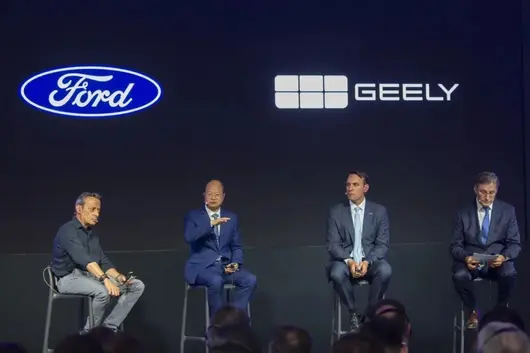

Written by Han Zihan Edited | Qingzhu
A Prime Minister, plus three cabinet ministers, standing behind an investment by a Chinese automaker. Amid the EU adding layer upon layer of measures to Chinese electric vehicles, it itself conveys a signal.
On July 23, at the Geely Valencia factory, in the presence of Prime Minister Pedro Sánchez, Geely Automobile and Ford signed a joint venture agreement to create new energy vehicles for Geely and Ford brands for the European market through capacity sharing.

Not buying a factory, but a joint venture; not defeating others, but win-win cooperation.
Whether bringing in or going out, Geely's internationalization has always implemented Chairman Li Shufu's words: "Business is beautiful, doing business and making friends at the same time".
Time rewind to 16 years ago. On March 28, 2010, Geely Holding Group signed the final 100% equity acquisition agreement for Volvo Cars Group with Ford Motor Company. Geely became the first multinational corporation in the Chinese automotive industry. Ford witnessed and supported this cooperation case with global automotive industry influence, forging commercial friendship with Geely.
Today, 16 years later, Geely and Ford shake hands again. For the current explosive growth of Chinese cars going overseas, this has strong implications.
2026, the overseas expansion of China's automotive industry is undergoing a key leap from quantitative change to qualitative change.
In the first half of the year, China's vehicle export volume reached 5.096 million, up 65.3% year-on-year. June's single-month exports broke the 1 million vehicle threshold for the first time. For every 10 vehicles produced domestically, nearly 4 head to overseas docks.
Consulting firm AlixPartners predicts that China's annual vehicle export volume is expected to reach 10 million, becoming the first country globally to break this number.
Behind the numbers, deeper changes are occurring.
In June, the market share of major Chinese brands in Europe was 13%, surpassing Japanese brands for two consecutive months. When we occupy a larger share of the EU market, we cannot just sell cars simply, we must achieve harmonious win-win with the local industrial ecosystem, laws and regulations, and social well-being.
The joint venture between Geely Automobile and Ford to establish a company in Spain happens to stand at this node of qualitative change. It is also another practice of Li Shufu from "going out" to "integrating in".
A Prime Minister's Endorsement, and Two Handshakes Spanning 16 Years
On July 23, the day of the signing ceremony. Spanish Prime Minister Pedro Sánchez appeared at the Almussafes factory in Valencia, followed by three ministers from the Ministry of Labor and Economy, Ministry of Industry and Tourism, and Ministry of Science, as well as the President of the Valencian Community.

The Almussafes factory was built in 1976, and was once Ford's largest production base outside the United States, with cumulative production of over 11 million vehicles to date. For nearly 50 years, this factory has been the livelihood for tens of thousands of families in the Valencia region of Spain.
But the industrial era never stops for sentiment. Starting from 2024, with the promotion of EU industry and electrification, Ford gradually ceased production of multiple fuel models such as Mondeo, S-MAX, Galaxy, leaving only one production line producing the Kuga in the huge factory.
Last year, the factory with an annual capacity of 500,000 vehicles actually produced less than 100,000 vehicles, with utilization rate less than one-quarter. The factory that once fed thousands of Spanish families is facing a crossroads of fate.
Geely's arrival could not have been more timely. Through capacity sharing, it not only brings jobs, capacity, and tax revenue to the locality, but also allows Ford to activate remaining assets in a more efficient way, continuing to generate value.
According to the plan, the joint venture company will officially commence operations in the first half of 2027.
In the new factory, Geely will launch two new energy vehicle models, and Ford will also produce three multi-energy vehicle models, including continuing to produce the Kuga, and launching an all-new rugged compact SUV of the Bronco family in 2028.
The five models will share capacity and coordinate production scheduling. Both sides stated in the announcement that the joint venture will "promote more model choices and value enhancement", and through "integrating output to reduce per-vehicle costs". For the local economy, jobs are preserved, and an industrial lifeline of a region is reactivated, which can be called a win-win on multiple fronts.
Currently, Spain is becoming a strategic pivot for Chinese automakers landing in Europe. Labor costs are about one-third of Germany's, energy costs are lower than Germany and France, possessing world-class port clusters, and Barcelona is the core gateway for Chinese cars entering Europe.
In Q1 2026, Chinese brands sold approximately 38,700 vehicles in Spain, up 67% year-on-year.
Jian Jiayue, CEO of Geely Automobile Group, said a passage: Automakers going overseas will face many issues, from the overseas perspective, Chinese brands are there to "conquer" other people's markets, so the "going out" of Chinese automotive brands is actually to "walk in". Walking into the local market. Building factories in joint venture locally, mobilizing local resources, is a path of multi-win.

For Geely, although it seems like taking a small loss, cannot enjoy profits exclusively. But it actually avoided many hidden costs and efficiency frictions.
The EU has always been a high threshold market, with high compliance costs, high environmental protection requirements, long approval processes, influence of local voter opinions and political factions, which will make business behavior complicated. Specific cases can refer to the drama-like twists and turns of Tesla's German factory.
Actually, now there are already domestic automakers who suffered the same loss. Fighting alone, one-sidedly emphasizing ambition and sales targets, instead resulted in much hostility and obstruction, even becoming a chip in local political party games.
But the other path Geely took, preserving jobs in overseas markets, activating assets for old car companies, taking root for Chinese brands locally, letting technology flow become a constructive force, by "win-win cooperation, beauty shared" making oneself a welcomed partner.
Seeking Strategic Depth, Prioritizing Synergy
Citi estimates that if Geely obtains the 150,000 vehicle annual production quota in the Valencia factory, the cost is only equivalent to 10%-20% of building a new greenfield factory.
Beyond cost advantage, the more critical value lies in time. From signing to production, the joint venture model requires only 18 months, while self-built factories usually take three to five years. In the rapidly changing European electric vehicle market, an 18-month time difference is enough to determine whether a brand can lock in position.

Geely has already validated this strategy in many markets globally.
In Malaysia, in 2017, Geely acquired 49.9% stake in Proton and fully dominated operations. Let Proton walk out of the quagmire of losses, achieving brand revitalization.
In January 2026, Proton's exclusive EV factory at Tanjung Malim Automotive High-Tech Valley officially started production, and the first pure electric model eMas7 started CKD local assembly. The eMas7 is built on the Geely Galaxy E5 platform, ranking champion in Malaysia EV sales for consecutive months.
Until today, from Malaysia's political circles to the public, they still regard Proton as "their own brand". What Geely does is not replacing, but making it better.
In Korea, Geely cooperated with Renault to launch intelligent hybrid models. In Brazil, Geely acquired 26.4% stake in Renault Brazil, sharing factory capacity and market network.
In Europe, Volvo Cars is fully responsible for Lynk & Co's commercial and brand operations in the European region, assisting Lynk & Co brand's regional expansion in Europe.
This is exactly Geely's unique logic of global layout — not advancing alone, but weaving an ecological synergy network. Every cooperation node is both a strategic pivot to enter local markets, and proof of long-term trust from partners. Making globalization a value network of multi-win cooperation and continuous deepening.

So, although "from product exports to system exports" has become industry consensus, what exactly is the system? Moving your own system forcefully there, or building a system from scratch, or integrating into the local system? These operational details reflect a company's business values and development outlook.
Geely's Spain joint venture and the logic behind this system provide a good sample and idea for the Chinese automotive industry, and reflect as substantial growth data.
In the first half of 2026, Geely's overseas sales reached 474,000, up 158% year-on-year, already exceeding the total export volume of the full year 2025. Based on the first half performance, Geely has upped the full year export target to 900,000 vehicles.
Conclusion: From "Student" to "Partner", the Metamorphosis and Responsibility of Chinese Automakers
In early 2010, Geely and Ford signed an agreement in Gothenburg, Sweden, to acquire the globally renowned Swedish luxury brand Volvo for 1.8 billion US dollars, and the media used "snake swallowing an elephant" to describe this transaction.
Geely fulfilled all commitments with action, did not intervene in Volvo's independent operations, protected and respected its existing development systems, letting Volvo achieve brand revitalization in the following decade plus.
More importantly, Geely also learned Volvo's systematic R&D capabilities, safety-first manufacturing standards and quality control. This transaction allowed Geely to complete an "advanced study", laying the capability foundation for active performance on the global stage later.
Traditional automakers hold existing capacity, channels, and sales teams, while Chinese automakers hold the advantages and cost efficiency of the fastest growing new energy system, both sides found what both parties need in this stage.

As Ford Europe President Jim Baumback said: "Geely's world-class electrification capabilities, speed, and massive global scale, combined with Ford, are unparalleled competitive advantages."
From the humble "student" in 2010 to the equal "partner" in 2026, Geely exchanged pragmatism for trust, won respect with capability, and integrated into global industry development in the best way.
Geely's globalization has never been a simple capital game, but constantly exploring open and win-win global industry cooperation models under the premise of legality and compliance, it is respect for brands and technology, layout and deep construction of synergy systems.
From Volvo to Proton, Lotus, then Mercedes-Benz, Renault, and Ford, Geely's built global system synergy not only activated new momentum for Geely's global development, but also formed a solid guarantee to help brand going overseas. This also confirms what Li Shufu said, "Business is the most equal and beautiful manifestation of human civilization."
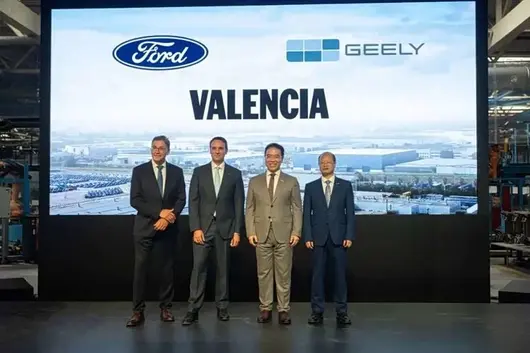

16 years ago, Geely bought Volvo from Ford.
At that time, many people's first reaction was not admiration, but worry: a Chinese private car company suddenly taking over a European luxury brand, was this an overseas acquisition, or simply spending money to buy a master to worship?

16 years later, the story circled back to Ford.This time, however, the positions of the people sitting at both sides of the negotiation table were slightly different.
On July 23, Ford and Geely announced they will establish a joint venture company targeting the European market around the Valencia, Spain factory.Ford holds about 66%, Geely holds about 34%, both parties will produce multi-energy models of Ford and Geely brands here. According to the plan, two Geely new energy SUVs will be rolled off the line in 2028, and both parties will jointly develop a new car that offers pure electric, plug-in hybrid, and extended-range versions.

So strictly speaking,Geely did not buy the Ford factory with people and land as a package deal.
But what is most worth looking at is not who has a few more percentage points on the equity table, but who needs whom more.
The Valencia factory has an annual capacity of about 500,000 vehicles and was once one of Ford's most important manufacturing bases in Europe, producing a long list of models familiar to European consumers such as Fiesta, Mondeo, Galaxy. However, now the factory mainly relies on Kuga to maintain production, capacity utilization is only about 30%, and production volume has dropped by more than 70% compared to 2019.

A factory capable of producing 500,000 cars is now waiting for orders most of the time. Machines are still there, workers are still there, supply chains are still there,but there aren't enough cars to sell.
It is like an old restaurant that once had people queuing for two hours to eat; the kitchen, tables and chairs, waiters, nothing was missing, but finally discovered there were only three tables of guests in the hall.
At this time, Geely pushed the door and walked in.Not here to eat, but bringing menus, chefs, and a group of new customers, asking Ford: Your kitchen is empty anyway, why don't we partner up?
This is the really interesting part of this news. In the past, Chinese car companies going to Europe were usually there to learn. Learn how Europeans do design, learn how Germans tune chassis, learn how century-old car companies manage supply chains. If really can't learn, directly hire a few designers, chassis engineers, and sales executives back.

Chinese cars at that time were like students who suddenly made money, searching the world for famous teachers. European car companies sat on the podium, collecting tuition fees while being somewhat condescending.
In 2010, Geely acquired Volvo, which was the most representative transaction under this historical background. Why did Ford sell Volvo back then? Because after the financial crisis, they lacked money and needed to contract their frontline. Why did Geely buy? Because it needed brands, technology, and a mature global system.
That was a standard exchange of Chinese capital for European technology.
But the logic of today's Valencia cooperation has been reversed. What Ford needs from Geely is not just money,but new energy products, vehicle platforms, development speed, and orders that can fill the factory again.
In other words, 16 years ago Geely bought a European luxury brand from Ford; 16 years later, Ford is starting to invite Geely back to help solve what cars the European factory should actually build.

This is not simply "feng shui goes in cycles", but a rearrangement of power relations in the automotive industry. Because for an automotive company, what is truly dangerous has never been selling fewer cars, but gradually losing the ability to define the next car.
Factory idleness is just the appearance.Behind the appearance is Ford's awkwardness in Europe's new energy transformation.
In the past few years, Ford has done a lot of things in Europe. It cooperated with Volkswagen, launching Explorer EV and Capri EV based on Volkswagen's MEB platform; also cooperated with Renault, hoping to jointly develop cheaper small electric vehicles; now inviting Geely into Valencia.

Cooperation is certainly not wrong. The automotive industry is inherently a highly collaborative industry, no car company can manufacture everything from chips to tires by itself.
But when a century-old car company's new products rely more and more on others to provide platforms, technology, or capacity solutions, things are not as easy as "open cooperation".It shows that Ford is using partners to make up for its speed and cost shortcomings in European new energy products.

Past Ford, others came to borrow platforms, factories, brands. Present Ford, started looking for partners everywhere. Volkswagen handles part of the pure electric platform, Renault helps solve small electric vehicles, now Geely brings new energy SUVs and new platforms into the Spanish factory.
Those who don't know might think Ford pulled a group chat in the auto industry, the group name being "European Business Self-Help Mutual Aid Society".
And Geely choosing to enter Valencia at this time is absolutely not doing charity in Europe.
Chinese car companies going overseas, the simplest stage, is to load cars onto ships from domestic and ship them to Europe to sell. But with tariffs, local manufacturing rules, and political reviews increasing, pure exports are becoming a business with higher costs and lower certainty.
The EU currently still implements countervailing measures on pure electric vehicles produced in China, and is also discussing more clear "Made in Europe" requirements.

So now what Chinese car companies are thinking is no longer "how to sell cars to Europe",but "how to make themselves part of the local European industry". That is exactly the purpose behind BYD poaching a former Hungarian foreign minister; Geely's cooperation with Ford in the Spanish Valencia factory today is the same.
After all, building a factory from scratch is like registering a new account again. But entering a factory that Ford has operated for many years is like taking over an old account with real-name certification, credit records, and lists of local government and union friends.

What is truly valuable is not those stamping machines in the factory building, but the workers behind them, suppliers, certification experience, and interest relationships formed with the local government and community.
In the past, what Europe feared most was whether Chinese cars would take away Europeans' jobs. Now a slightly awkward picture has emerged,if Chinese car companies don't come, some European workers' jobs will be even harder to keep.
Europe is adding tariffs on Chinese EVs on one side, worrying that Chinese brands will impact the local industry; on the other side, welcoming Chinese models into local factories, because factories need orders, local areas need tax revenue, workers need jobs.
What they say on their mouths is "prevent industrial hollowing out", but their bodies honestly ask: When can those two models of SUVs go on the production line?
However, seeing this, don't rush to open champagne yet.
Chinese car companies walking into European factories does not mean they have obtained permanent property rights from then on.On the contrary, the troubles Chinese enterprises have encountered overseas in the past year and a half are already so many that they could almost shoot an international business war serial drama alone.

The UK government forcibly nationalized British Steel under China's Jingye Group; The Netherlands government implemented rare operational intervention on Nexperia under Wingtech Technology; Panama Supreme Court ruled contracts invalid for companies under Hutchison Whampoa operating two canal ports; Australian government clearly promoted Darwin Port to return to national control, Landbridge Group holding 99-year lease has launched legal action.
The resource countries are not idle either.Niger expelled three Chinese oil company executives, wanting to avoid debt; Indonesia, after relying on Chinese capital and technology to become a global nickel industry center, started tightening ore quotas, raising taxes and fees, adjusting pricing methods, hoping to keep more profit and resource control rights in its own hands.

The most uncomfortable is India, planning to maintain strict review for Chinese enterprises for a long time, BYD was recently investigated due to import parts tariff issues. The Indian government also issued a 650 million tax bill to BYD.
Looking at these things together, it is indeed easy to feel a sense of an approaching storm.
It seems as soon as Chinese enterprises prepare to go out on a large scale, the whole world starts closing doors and changing locks, then tells you, sorry, recently the four words "National Security" are a bit busy, ports are managed by it, chips are managed by it, steel is managed by it, mines are also managed by it.
But this is exactly the proof that Chinese enterprises have truly started globalization.
In the past, Chinese companies had less presence overseas, of course not so much friction. You just sell some goods, others treat you as a supplier; when you start buying factories, getting ports, controlling resources, building supply chains, even affecting a country's employment and industrial security, the way others look at you naturally changes.

A person who never goes to sea certainly will not encounter storms at sea. But this cannot prove the shore is safer, it can only prove he can never reach the other shore.
So the question has never been whether Chinese enterprises should go overseas or not,the way of going overseas must be upgraded.
In the past, Chinese enterprises were best at calculating production costs, how much a battery costs, how long it takes for a car to roll off the line, how much efficiency can be improved.
In the future, we also have to learn to calculate political costs, whether the government will change, whether industrial policy will turn, whether the boundary of "National Security" will suddenly expand, after contract disputes, whether local laws and arbitration mechanisms are reliable.
From this angle, looking at the joint venture between Geely and Ford, it is even more interesting.
Ford holds 66%, Geely holds 34%, on the surface Geely has no control, not enough "to feel proud". But this may exactly be a design where courage and wisdom coexist.

Geely did not buy a European factory alone, then hang a sign at the door announcing flag planting success, but kept Ford on the ship, kept Spanish workers on the production line, tied local suppliers, government tax revenue and employment into the project.
If someone really wants to overturn the table in the future, those whose feet will be hit first are not just Geely, but also Ford, local unions, parts enterprises, and families relying on this factory to eat.
This is mature globalization.It is not walking to a country, declaring this belongs to me from now on; but making more and more locals discover that if this project is gone, they will also feel the pain.
So these recent overseas frictions are certainly worth being vigilant, but not worth concluding "Chinese enterprises should not go overseas".

The larger the contact surface, the more friction points there are naturally. The heavier the assets Chinese enterprises take out, the more critical the industries entered, the more resistance encountered will not just be commercial competition, but become a mixed question of law, politics, public opinion, and national security.
This is very troublesome, but it is also an unavoidable path.
16 years ago, Geely bought Volvo from Ford, buying a ticket to enter the global automotive industry.
16 years later, Geely walked into Ford's European factory, bringing not just money, but products, technology, efficiency, and orders.
In the past, Chinese cars going overseas, they sold cars. In the future, what truly needs to be exported is a complete car-making method, and the ability to survive in unfamiliar rules.
The thing European cars worried most about has indeed happened. Chinese car companies not only drove cars into the European market, but also started to embed themselves into the production lines of the European automotive industry.
But for Chinese enterprises, the real test has just begun.
Selling cars is just the first step. True globalization is walking outwards while getting beaten, while learning how not to get beaten for nothing.