首頁Denza D9

搜尋歷史
熱門搜尋
經銷商登入 / 註冊









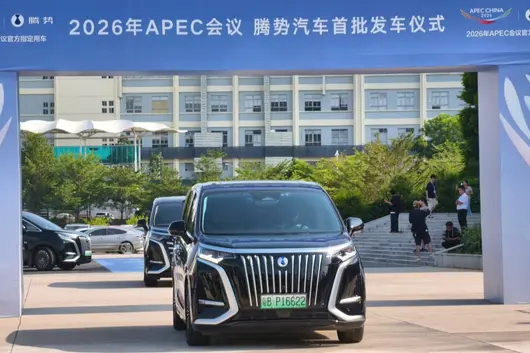
On October 22, outside the lobby building of the Denza Headquarters in Shenzhen, the official departure ceremony for the first batch of APEC official designated vehicles, themed 'Shenzhen Takes Off, China Denza', was officially held. Nearly 700 Denza vehicles were ready for departure, with over 600 units being the second-generation Denza D9, which will provide high-spec travel support in November 2026 for high-ranking officials, delegations, and overseas and domestic media of the 21 economies at the APEC meeting.

At the departure ceremony scene, Denza Auto General Manager Li Hui: "Denza involvement in global major events is never just a slogan, but hard power tested by numerous international grand events. Today, cars made in Shenzhen welcome an international grand event organized in Shenzhen, this is not only Shenzhen's green answer sheet to the world, but also a contemporary footnote to the upward development of China's automotive industry — Shenzhen Takes Off, China Denza!"
Shenzhen Hosts the World, China Denza Bears Heavy Responsibilities
This year marks China's third time hosting the APEC meeting, and Shenzhen's first time hosting this top-level international grand event. In past international large-scale conferences, high-end reception vehicles were long occupied by overseas luxury brands, in the market's default evaluation system, 'Foreign Luxury' was almost equivalent to 'Diplomatic Reception Standards'. This time, BYD, as the 2026 APEC meeting official partner, with the Denza brand undertaking core travel service guarantees, means this industry convention lasting for many years is being completely rewritten.

The screening for official designated vehicles for world-class conferences has never been a single-product competition, but a systematic verification of the brand's full-chain capabilities. From vehicle safety, stability, supply scale, to service team dispatch response, cross-scenario adaptation capabilities, every link must undergo multiple rounds of strict verification.

That Denza could secure a service order of nearly 700 units, behind it is the industry-unprecedented large-scale delivery and synchronous guarantee capability — this not only requires the brand to complete the centralized delivery of hundreds of high-quality vehicles in a short time, but also build an operation, dispatch, and emergency response system covering the entire conference cycle, this level of comprehensive service capability belongs to the first tier in the global high-end MPV market.
Top Grand Event 'Regular Guest': Denza D9 Product Power and Service Dual Verification
Before this APEC departure ceremony, Denza D9 had already completed the service landing of multiple top-level international grand events in 2026: from guest reception at the Boao Forum for Asia, to full-scenario business commuting at the China-ASEAN Expo, and to travel support at the Summer Davos Forum, Denza D9 has become a 'regular guest' in top-level political and business activities. This high-frequency top-level scenario landing is not a coincidental marketing cooperation, but a natural result after product strength and service capabilities were repeatedly verified.

As a high-end new energy brand under BYD, the Denza D9 is equipped with the DiSus-C Intelligent Damping Body Control System, relying on the Road Preview 2.0 technology, can adjust suspension stiffness at the millisecond level, achieving a driving experience of 'no head lift when starting, no nodding when braking, no motion sickness when riding', perfectly adapting to the extreme requirements for stability in diplomatic reception. Its second-row zero-gravity aviation seats are equipped with 16-point massage, ventilation and heating functions, combined with 'Privacy Sound Shield' acoustic isolation technology, creating an independent private negotiation space inside the vehicle, meeting the needs of prestige and business privacy simultaneously during mobile travel. While the low fuel consumption and long range characteristics brought by DM-i Super Hybrid Technology, and the supercharging capability of the pure electric version's 800V high-voltage platform, also allow the centralized dispatch of hundreds of vehicles and long-distance cross-regional travel to be freed from energy replenishment anxiety.

At the market end, Denza D9 also turned in a phenomenological industry report: Since its launch in 2022, cumulative sales have broken through 350,000 units, winning the Chinese all-category MPV annual sales championship for three consecutive years, becoming the world's first new energy MPV to reach this milestone, while topping the list of '2026 Hurun China New Energy MPV Brand TOP10'. From the user structure perspective, 90% of Denza D9 users come from additional purchases or trade-ins, among whom 50% come from converting from traditional luxury brands, even including many Rolls-Royce and Bentley owners, this cross-layer user recognition allows Denza D9 to break out of the traditional positioning of 'New Energy Substitute', truly establishing a luxury value system belonging to Chinese brands.
Denza's APEC Moment is a New Starting Point for Chinese Automotive Globalization
Nearly 700 Denza units serving APEC, the industry impact of this matter, far exceeds a single brand exposure. It is equivalent to handing over a 'China Card' to the global luxury MPV market: In the past, when global users mentioned high-end MPVs, the first thought was overseas brands, now, Denza uses actual service performance at world-class grand events, to redefine the standards of 'Luxury New Energy MPV'.

Before this, Denza had already secured the first place in luxury MPV sales in multiple Southeast Asian countries, even in mature automotive markets like Singapore, Denza D9's sales price exceeded traditional imported luxury MPVs, and still gained recognition from a large number of high-end users. And this global communication of this APEC, is equivalent to giving Denza's globalization path a most weighty 'credit endorsement' — in the future, political and business activities in more countries globally, high-end users, will all, because of the travel experience of this world-class grand event, re-understand the strength of Chinese luxury new energy vehicles.
When over 600 second-generation Denza D9s slowly drove out from the Shenzhen headquarters, what this departure ceremony carried, was long not just travel support for a meeting. It is a green smart manufacturing card handed by Shenzhen to the world, but also a contemporary footnote to China's automotive industry moving from 'Chasers' to 'Leaders'. On the track of the global new energy vehicle industry, Chinese brands represented by Denza, are redefining the standards of luxury MPVs, also showing the world, the upward breakthrough of China's automotive industry, has already moved from the product market, truly to the center of the world stage. (Written by Chen)
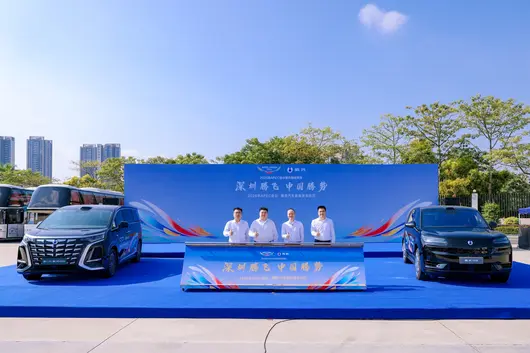

Shenzhen hosted APEC for the first time, and the first batch of "face" (ambassadors) sent out were Denza.
On October 22, at BYD Headquarters, dozens of D9 and N9 vehicles covered with APEC car wraps lined up, no slogans, no pretense, directly driving to the November venue. Nearly 700 vehicles, with over 600 being D9s, serving guests, delegations, and overseas media from 21 economies.
This looks like event support, but looking deeper, it means Chinese premium new energy vehicles have truly taken their seat at the world's diplomatic front row.
Shenzhen's showcase relies not on over-specification
APEC is not a regular expo. 21 economies, dense schedule, route changes anytime, round-the-clock reception rhythm. Requirements for cars are strict: no breakdowns, no VIP waiting, no embarrassing moments captured by cameras.
In the past, hosts usually sought established luxury brands to back the occasion. Behind that "prudence" lay the default answer formed by decades of diplomatic protocol.

But this time is different. Shenzhen hosted APEC for the first time, choosing Denza. Not just a few display cars for decoration, but nearly 700 units entering on a large scale, giving the main role to a Chinese brand new energy MPV.
Behind this lies a simple logic: Shenzhen itself is the face of China's new energy industry. Cars leaving here should best represent the city's true level in batteries, electronic control, smart cockpits, and whole vehicle manufacturing. Asking others to take over feels less like Shenzhen.
So the theme "Shenzhen Soars, China Denza" is not marketing jargon. It clearly states one thing: The city's level has reached the mark, and local brands can handle it.
D9 can handle the job, relying on more than just the three words "luxury feel"
What are foreign affairs vehicles most afraid of? Not that configurations aren't flashy enough, but failing under high-pressure scenarios.
An international conference, a fleet might cover more than a dozen points in a day, driver shifts, random road conditions, VIPs getting in/out cannot be slow, luggage cannot miss a single item. For this job, sitting comfortably is just the passing line.

For Denza D9 to be selected as the main force, look at a few real skills first.
Charging must be fast. The 2nd Gen D9 uses 2nd Gen Blade Battery and Flash Charge, rated at refueling a segment in about 5 minutes, nearly full in 9 minutes, just 3 minutes more in low temp. Fleets fear charging queues; shorter refueling windows mean more calm dispatching.
Space must be truly usable. MPVs fear "looks big, can't load". D9 re-arranged the chassis via Yuan Super Integrated Power Platform, 7 seats full still leaves 882L trunk. For foreign affairs travel with large luggage and office equipment, no need to choose between "people or cargo".
Safety must be a guarantee. 75% high-strength steel, 9 airbags, plus AEB, AES, ESA this 3A active protection, crosswinds, blowouts have stable control. The first principle of diplomatic vehicles is: nothing happens. Quietly delivering people is the highest level of safety.
Comfort must be understated. Semi-aniline leather, cloud velvet seats, 16-point massage, Cloud Suspension-C preview, not to let guests say "this car is so soft", but to let guests remain relaxed after the long transfer.

These capabilities individually are not mystical, stacking them is where value lies: it means a car can run continuously in high-intensity meetings, stay in character, cause no trouble.
Plus AI cockpit "DidiXia" details, voiceprint recognition, memory, chat capability, foreign guests don't need to study buttons, speak and use. The level of Chinese smart cockpits now doesn't need translation to the world, the car speaks for itself.
Sales have actually pre-verified the quality. D9 launched from 2022 to now breaking 350,000 units, 2023 to 2025 won Chinese MPV sales champion for three consecutive years, Hurun New Energy MPV list also first. The meaning of 350,000 units is not good numbers, it's supply chain, quality control, after-sales were repeatedly tested by the real market. State affairs activities have zero tolerance, exactly trusting cars "massively used".
World protocol, Chinese cars caught it
Denza actually hasn't been idle this year. Boao Asian Forum, China-ASEAN Expo, Summer Davos, APEC Forestry Ministers' Meeting, D9 missed none.

The value added up from these scenarios is more real than any ad spend: it practices not "how to drive the car there", but driver training, route plans, emergency mechanisms, multilingual services, cross-timezone dispatch, the whole set of hard work.
Waiting for Shenzhen APEC this grand performance, nearly 700 cars entering together, is the real big exam.
More crucially, perception has changed.
A few years ago, Chinese luxury cars going global were often assumed to be "value-for-money players". D9 in SE Asia, Singapore, some European markets, price already hits traditional imported luxury MPV range, still people buy, shows users are not chasing cheap, but recognizing the product.

APEC pushes this one step further: When political/business guests, media reporters, and accompanying staff from various countries get in and out of Denza daily, after returning their imagination of "Chinese Luxury" will change from "Pretty good" to "So it's already like this".
This isn't just Denza's matter. It's credit endorsement for the whole Chinese new energy high-end camp: We not only make cheap easy-to-drive family cars, but also can make world-class protocol standards.
In the past saying "World's big matters involve Denza" sounds like a brand claim. Now, it is a fact happening right now.
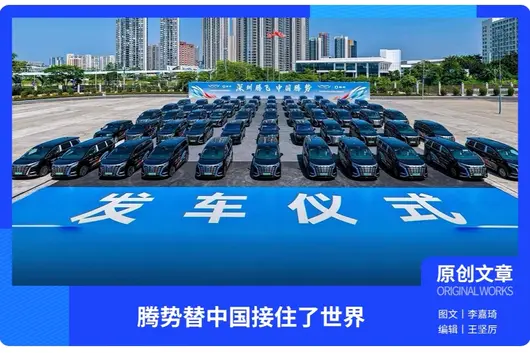

On October 22, Denza Automobile held the launch ceremony for the first batch of officially designated vehicles for the 2026 APEC meeting at the BYD headquarters in Shenzhen. Dozens of second-generation Denza D9s and Denza N9s bearing official meeting logos were delivered on-site and will subsequently be deployed for meeting traffic support. According to the plan, the 2026 APEC meeting will be held in Shenzhen in November. This is the third time China has hosted the APEC and the first time Shenzhen is hosting this international conference. As an official partner of this meeting, Denza provided nearly 700 vehicles to transport representatives from each economy, delegation members, and registered media, with the Denza D9 accounting for more than 600 units.


Regarding the reason for Denza's selection, Li Hui, General Manager of Denza, stated in an interview after the ceremony that the conference organizers had specific requirements for safety, technical level, and ride experience when screening reception vehicles, and Denza was ultimately selected after multiple rounds of communication.

He also mentioned that in recent years, domestic new energy vehicles have frequently appeared at various international conferences, the root cause being the development of the industry itself. China's monthly penetration rate for new energy vehicles has exceeded 60%, and the acceptance of products and technology in overseas markets continues to improve. The selection of Chinese models for international conferences objectively reflects changes in the competitiveness of China's automotive industry.

Safety is the most frequently mentioned topic in the interview. Li Hui explained that active and passive safety run through Denza's product development: regarding passive safety, it uses a five-star safety architecture and cage-form high-strength steel body; regarding active safety, the e-Platform 3.0 supports millisecond-level response. Official test indicators cover scenarios such as crosswind stability, high-speed avoidance, slippery road handling, and stability during tire blowouts, with relevant performance leading the industry. Meanwhile, the BYD Blade Battery has passed tests such as nail penetration and high-intensity impact, and the Denza N9 also achieved the highest score among more than 200 models tested in the C-IASI collision safety evaluation.

On the other hand, behind the selection of vehicles for international conference reception there are also considerations regarding brand internationalization. Li Hui recalled that in earlier years when the APEC meeting was held in China, Mercedes-Benz was rented as the vehicle for VIPs, while this time a Chinese brand undertook the reception task, reflecting the development of Chinese high-end automotive brands to a certain extent. According to his introduction, the Denza D9 has currently entered markets such as Thailand, Singapore, Malaysia, the UK, France, and Brazil, and the Denza N9 is also on the market in multiple major European countries. In terms of pricing, the D9 and Z9GT in overseas markets are equivalent to nearly 1 million RMB, higher than domestic prices.

Li Hui also revealed subsequent product arrangements: the five-seater SUV Denza N8 will begin reservations on October 26 and officially launch in November; the urban super sports car Denza Z is planned to launch domestically by the end of the year. Regarding overseas markets, models such as N8 and N9 will be launched in batches by country and region, and Denza will also release several new models next year.

In terms of market performance, since the Denza D9 launched in 2022, cumulative sales have exceeded 350,000 units, ranking first in domestic MPV annual sales for three consecutive years from 2023 to 2025. In the meeting vehicle field, apart from this APEC meeting, Denza also participated in traffic support for events such as the Boao Forum for Asia, the China-ASEAN Expo, and the Summer Davos Forum this year.

【AutoDao Industry】Let's review the major events that occurred in the automotive circle on October 16, 2026.
Automotive Event 1: JAC Motors Hits Limit Up
On October 16, the automotive sector saw volatile rebounds, with JAC Motors hitting the limit up, quoted at 22.37 CNY/share, a rise of 9.98%, with the latest total market value exceeding 50 billion CNY.


On October 15, Zunjie Automotive issued a statement, stating that Zunjie Automotive actively responded, fully obeyed, and would fully cooperate with the work of the joint investigation team, resolutely safeguard the legitimate rights and interests of consumers, and resolutely safeguard the overall situation of the development of the new energy vehicle industry. That evening, the Ministry of Industry and Information Technology and two other departments released a joint investigation report on the relevant vehicle brake pedal bracket fracture problem.
Subsequently, on the evening of October 15, Huawei Executive Director, Chairman of the Product Investment Review Committee, and Chairman of the Terminal BG, Richard Yu, responded on his personal WeChat Moments, "Justice may be late, but it will never be absent!"
Automotive Event 2: September 2026 Domestic Power Battery Capacity Installed 87.2GWh, Month-on-Month Increase of 10.4%


On October 15, the China Automobile Power Battery Industry Innovation Alliance released the September 2026 Power Battery Monthly Information. Regarding September production, the combined output of power and energy storage batteries in China was 237.8GWh, a month-on-month increase of 0.3%, and a year-on-year increase of 57.3%. From January to September, the cumulative output of power and energy storage batteries in China was 1833.1GWh, a cumulative year-on-year increase of 63.4%.
Automotive Event 3: Denza Dual Flagship Models Debut in Indonesia
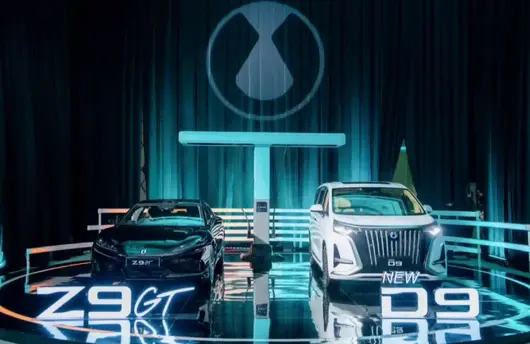
Recently, Denza Automotive officially released the second-generation Blade Battery and Flash Charge Technology in Indonesia, and announced that Denza Z9GT and Denza D9 have officially landed. Relying on two disruptive technological innovations, it has achieved a globally leading ultra-fast charging speed, truly achieving "Charge fully in 5 minutes, charge completely in 9 minutes", making charging as convenient and efficient as refueling.

Liu Xueliang, Vice President of BYD Company Limited and General Manager of the Asia-Pacific Auto Sales Division, stated: "True technical passion is believing in a future and firmly turning it into reality. Up to now, BYD's thinking on technological innovation has long transcended the simple category of 'making cars, selling cars'. We have always believed that a company's value lies not only in how strong it is itself, but more in whether it can create greater value for society through technological innovation, so that advanced technology truly benefits more people. It is this belief that drives BYD to constantly break through technical boundaries and gradually turn what once seemed like a distant technical vision into reality. Taking the second-generation Blade Battery and Flash Charge Technology to Indonesia this time is the specific realization of this concept. We hope to let more Indonesian consumers truly feel the changes brought by technological progress, and let advanced technology truly enter people's daily life."
Automotive Event 4: Changan Automobile Senior Personnel Adjustment

Recently, AutoDao reported, On October 16, Chongqing Changan Automobile Co., Ltd. (hereinafter referred to as "Changan Automobile") latest announcement disclosed, Zhu Furong continues to serve as the Party Secretary and Chairman of China National Chang'an Automotive Group Co., Ltd. (hereinafter referred to as "China National Chang'an Automotive"), coordinating the overall planning and long-term development of the automotive business under the group from a group level, no longer holding any position in the company and its holding subsidiaries. Original Changan Automobile President Zhao Fei promoted to Chairman, Original Executive Vice President Ye Pei promoted to President.

(Zhao Fei)
In addition, Ye Pe no longer serves as Changan Automobile Executive Vice President, will serve as Director, President, Deputy Party Secretary. Yang Dayong no longer serves as Changan Automobile Executive Vice President, will serve as Executive Vice President. Deng Chenghao no longer serves as Changan Automobile Vice President, will serve as Executive Vice President.
Changan Automobile stated that this adjustment aims to give full play to the role of China National Chang'an Automotive Group as a professional automotive industry group in "strategy setting, resource allocation, synergy promotion, risk control, and incentive strengthening", which is conducive to the company's further optimization of market-oriented mechanisms, focusing on global operations, and promoting high-quality development of listed companies.
"Daily Car News", here are the latest car news of the day, please continue to follow "AutoDao".
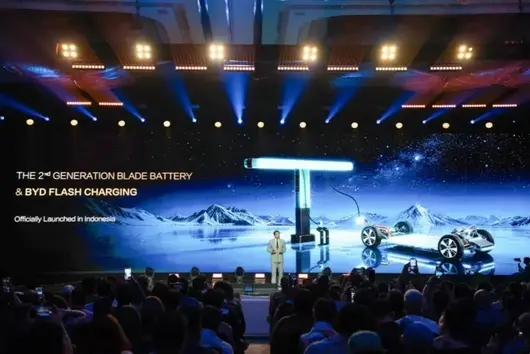

Recently, BYD Denza officially launched the second-generation Blade Battery and Super Charger technology in Indonesia. Denza Z9GT and Denza D9 went on sale simultaneously, and the first overseas fast-charging operation network was announced as completed. Charge fully in 5 minutes, charge to saturation in 9 minutes — this technical promise traveling from China to Jakarta signifies far more than two new cars entering a Southeast Asian market. It marks the first overseas landing of a complete strategic logic, and the first brand carrying this logic is Denza.

Fast Charging Exports, Delivering a Complete System
The core parameters of the second-generation Blade Battery are already well-known in the industry: charging from 10% to 70% takes only 5 minutes, and up to 97% takes only 9 minutes, with a single-gun power of 1500kW for fast-charging piles. But what is more worth paying attention to than charging speed is the overseas expansion method BYD has paired with this technology.
In Indonesia, the first step of the fast-charging network was not to spread to public charging stations, but to deploy fast-charging piles in 10 Denza dealer stores first, open them for public experience to the whole society, and gradually expand to the public network by the end of the year. This order is crucial. It means BYD did not wait for third-party charging operators to complete infrastructure, but built the piles into the car-selling scenarios themselves. When users walk into the Denza showroom, the charging experience and car purchasing decisions happen within the same physical space.
A deeper layout lies in the technical architecture of the fast-charging piles. BYD fast-charging stations equip each pile with an energy storage system, converting instantaneous high-power demand into a stable low-power load on the grid via a charge-storage-discharge mechanism. This design significantly reduces the fast-charging stations' reliance on local grid renovation — in a market like Indonesia with uneven grid infrastructure, this point is more replicable than the charging speed itself. Meanwhile, BYD is already cooperating with international energy companies such as Shell to explore the model of adding fast-charging piles within existing gas stations.
In other words, the Indonesian fast-charging network is not just a infrastructure statement accompanied by a product launch, but the first complete overseas output of a system verified in the Chinese domestic market — technology, energy storage, channels, cooperation models — . As of October 2026, BYD has built more than 12,000 fast-charging stations in China, covering 341 cities, and the construction plan for 6,000 overseas fast-charging stations has also been launched. Indonesia is the first test field for this system to go out of China.

Why is the first step Denza?
There is no shortage of brands under BYD. The Dynasty Network and Ocean Network have a massive sales base in the Chinese market, and Fang Cheng Bao is quickly gaining volume in the personalized market. But the launch rights of the first overseas fast-charging network have been handed to Denza.
This is directly related to Denza's positioning within the BYD system. Denza is the starting point of BYD's high-end strategy — in 2010, BYD and Daimler jointly founded Denza, positioning it for the high-end new energy market. Internally within BYD, Denza's brand proposition is Tech Safety New Luxury, undertaking the mainstream luxury market scale and forming a clear differentiated segmentation from other brands.
Fast charging is an experiential technology. Its value does not lie in the 9 minutes on the spec sheet, but in the moment when users see with their own eyes and operate with their own hands in the showroom, re-evaluating the brand's technical strength. Placing the fast-charging launch on Denza is equivalent to telling the market and consumers: this technology first serves high-end experiences, rather than cost-sensitive products for the mass market. The allocation of this technology launch right is itself part of BYD's high-end narrative.
The Indonesian market provides an explanation from another dimension. Denza D9 has already accumulated a sales base of over 10,000 units in Indonesia. For a high-end MPV, this number means Denza has already established preliminary brand awareness among the high-end consumer group in Indonesia. After the new D9 is equipped with the second-generation Blade Battery, the maximum power increases from 230kW to 340kW, and the range increases from 600km to 730km, which is a technical leap on the existing user base. Meanwhile, Z9GT enters the market with a pricing of 225 million Indonesian Rupiah, directly benchmarking the high-end GT sub-segment, needing fast-charging technology as a technical anchor for flagship identity.

Indonesia is More Than Just Indonesia
Taking a wider view, Indonesia's position in BYD's global map explains why the first stop for fast-charging overseas was chosen here.
In September 2026, BYD's intelligent industrial park factory located in Subang, West Java Province, officially commenced production, covering 126 hectares, with a planned annual capacity of 150,000 units, and all four major processes of stamping, welding, painting, and final assembly are complete. The positioning of this factory goes far beyond local manufacturing in Indonesia — it is an export hub for BYD facing the global right-hand drive market, and products will be shipped to Malaysia, Singapore, Australia, and African right-hand drive countries.
This means the value of the Indonesian fast-charging network has duality. Locally in Indonesia, it serves the sales and user experience of the Denza brand; on a more macro level, it is the first stop for BYD to verify the feasibility of the fast-charging plus energy storage plus channel model in the right-hand drive market. If this system runs smoothly in Indonesia, the logic of replicating it to Malaysia, Singapore, and Australia is clear — the same right-hand drive models, the same fast-charging pile specifications, the same priority deployment strategy for stores.
BYD's market share in the Indonesian electric vehicle market has already broken through 37%, firmly holding the first place in the industry. Launching the fast-charging network first in a market where a market-dominant position has been established has controllable risks and clear sample significance. This is a path that first converts home-field advantage into system advantage, and then replicates the system advantage outward.

Auto Network Commentary: What is the significance of BYD doing this? On the surface, this is a combination of a technology launch plus a new car listing plus the completion of the charging network. But looking at the three actions together, what BYD is doing is: redefining the standard of electric vehicle energy replenishment experience in the overseas market. When the "charge fully in 5 minutes, charge to saturation in 9 minutes" technical tag from the Chinese market becomes a reality that Indonesian consumers can walk into Denza stores to experience personally, BYD is outputting not just a battery or a car, but a complete proposition about how electric vehicles should be used.
Handing the first step to Denza is affixing a high-end launch label to this proposition. Technology permeating downwards from a high-end brand is much easier than climbing upwards from a mass brand. The existing user base and brand awareness of Denza in Indonesia provided a suitable stage for the first appearance of fast-charging technology.
The right-hand drive export hub positioning of the Indonesian factory gives this stage a dual function of both a model room and a launch pad. The model that the fast-charging network runs smoothly in Indonesia is the standard answer for BYD facing the global right-hand drive market. The first page of this answer writes the name of Denza.

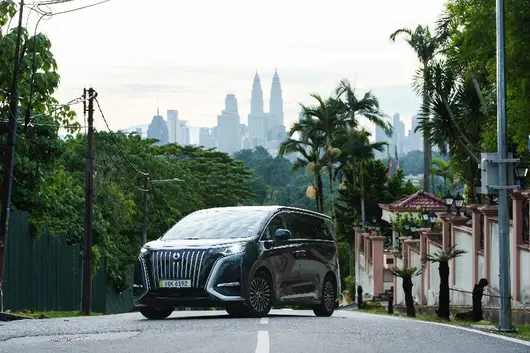
When they drive Denza D9 to pick up the porcelain that best represents Chinese culture from Jingdezhen, select exquisitely designed silk from Hangzhou silk workshops, choose Wuyi Rock Tea from the first spring from Wuyi Mountain, and drive off the ferry onto Singaporean soil, you can hardly help but feel a sense of disorientation as if traveling through time and space.

Following BYD's arrival in the UK and Europe at the July 2026 Goodwood Festival of Speed with a multi-brand matrix including Denza, Yangwang, Sealion 07, etc., launching a loud shot for Chinese new energy vehicles to enter the Western European market with the largest exhibition booth in global brand history, on August 25, the grand closing ceremony of the "2026 Silk Road 10,000 Li · Enlightening Road" Maritime Silk Road was held grandly in Singapore. BYD, as the full-transportation partner for this event, provided the entire event support fleet, completing a land and sea silk road expedition lasting 33 days and covering over 10,000 kilometers.

BYD Brand Booth at the Goodwood Festival of Speed
This 10,000-kilometer convoy set off from Xi'an, Shaanxi, the starting point of the overland Silk Road, on July 24, passing through cultural landmarks such as Jingdezhen, Jiangxi, Hangzhou, Zhejiang, and Wuyi Mountain, Fujian, following the millennium-old Silk Road cultural vein, crossing mountains and rivers, visiting the civilizational roots of silk, porcelain, and tea; the convoy crossed national borders, traversing Thailand and Malaysia in turn, finally arriving at the hub node of the maritime Silk Road, Singapore, completing this land-sea linked cultural and technological exploration journey.

Thousands of years ago, when merchant ships sailing across the sea along this channel delivered China's top-tier silk, porcelain, and tea into the hands of people from foreign lands, they saw an aesthetic and craftsmanship that a civilization had settled for hundreds of years. But today, this convoy starting from under the Xi'an Ancient City Wall, crossing the Indochina Peninsula and crossing the Strait of Malacca, hands over a more complete modern civilization solution: 5G data streams flowing in the vehicle infotainment system, battery cells lying on the chassis, every kilometer passing by outside the car window is the pulse of the ancient Silk Road beating in the contemporary era.

In the financial report released just recently for the first half of 2026, the confidence of this expedition was already backed by data: BYD's cumulative sales in the first half reached 1.8085 million units, of which the total volume of exports and local delivery in the overseas market reached 792,000 units, a strong increase of 67.8% year-on-year. Performance broken down by core markets is more substantial: In the first half, in Australia, BYD's cumulative sales of all powertrain models reached 52,300 units, a year-on-year increase of 124%, rising to second place among all car brands in Australia, second only to Toyota. BYD, which has been in the UK for a full 18 months, sold a cumulative 38,000 new cars locally in the first half of the year.
And Singapore happens to be the most substantial sample market for this era's dialogue.
You should know that in this harshest automotive arena for global entry barriers, the cost of one Certificate of Entitlement (COE) equals half a luxury car domestically; the car purchase list swept by consumers' fingertips is stacked with all the names that the global automotive industry is most proud of over the past century. It is on this tiny plot of land that BYD forcibly turned itself into part of the streetscape.

As of July 2026, BYD has consecutively held the Singapore passenger car brand sales champion title for 19 months; from January to July this year, the overall market share reached 24.7%, and all categories of Chinese car brands combined occupy nearly half of the local new car market. Singapore's total passenger car registration volume for the year is less than 60,000 units, with BYD stably delivering 1,100-1,400 units per month; almost every four new cars sold, one is from BYD. Walking on the streets of Singapore, around city landmarks such as Orchard Road, Sentosa, Merlion Park, and Botanical Gardens, BYD Sealion 07 (Sealion 7), Yuan PLUS Overseas Version ATTO 3, and Denza D9 can be seen everywhere; Chinese new energy vehicles have deeply integrated into Singapore's daily commuting landscape.

During this journey, a vivid detail was impressive: the local driver responsible for the overseas airport pickup and drop-off service for this event drives a Toyota Alphard MPV daily. During the conversation, he admitted that the Certificate of Entitlement he holds has only two years of validity left, and when exchanging the certificate, he plans to directly swap for a Denza D9. The high fuel costs are forcing local practitioners in Singapore to collectively shift to new energy.

We specifically visited BYD's exclusive general agent in Singapore, Vantage Automotive. In the land-scarce Lion City, the operator built a BYD + Denza dual-brand flagship showroom covering about 4,500 square meters, integrating product display, customer experience, and after-sales maintenance; it has four authorized dealer outlets under its portfolio, building a service network of 27 sales stores covering the whole island, the scale being rare in the local luxury brand channel system.

Singapore BYD General Agent New Car Showroom
Affected by the high Certificate of Entitlement cost and import tariffs, BYD's high-end sequence models sell at a significantly higher price locally than domestically: Denza D9 market price is worth more than 1.6 million RMB, Denza B5 and Denza B8 prices are both higher than the domestic versions. Even with high prices, local public opinion forms an interesting folk evaluation: Many Singaporean users believe that BYD system brands' current market status and user goodwill have already surpassed traditional BMW and Mercedes-Benz. Local circles even spread a playful verbal expression, calling the BBA legacy luxury brands "The Old Guard", while BYD, Denza and other Chinese new energy brands are the market's new favorites "The New Guard".

Behind this jest lies an answer that the Chinese automotive industry has been pursuing for more than half a century: We finally no longer trade low prices for market share, nor do we trade subsidies for growth increments.
Never has an industrial product been able to send China's technological confidence and cultural warmth packaged to the whole world like today's new energy vehicles. The Silk Road merchant teams from a thousand years ago transported out a civilization grown from the land; the convoy expediting along the same road today transports out strength grown from the workshop.

In the past, when we talked about "Globalization", we subconsciously felt we had to cater to others' rules, having to squat down to get the entry ticket. But the footprints BYD has walked along tell everyone: The true globalization that stands and takes the market is walking out with one's own 5,000-year cultural roots—from the Big Wild Goose Pagoda in Xi'an to the Merlion in Singapore, from the kiln fires in Jingdezhen to the track fireworks at Goodwood, the winds of old and new Silk Roads met head-on at the Strait of Malacca.
The era of silk and porcelain is the past, the era of smart EVs and photovoltaic energy storage is the present, and that channel that has been flowing for a thousand years has never broken; it's just that this time, carrying Chinese manufacturing forward are no longer camel caravans and sails, but rolling wheels and flashing lightning. Technology has power, culture has warmth, when the two merge into one, it is the Chinese overseas narrative that can most boost the confidence of the people.

Twenty thousand li of roads with clouds and moon, Chinese automobiles no longer need to try all means to prove "we are not inferior to others". Because in this new energy era deeply participated and even led by Chinese automakers, what we deliver is a future lifestyle that the world is willing to share and pay for.
When hardcore technology flows with the warmth of civilization, every wheel print of Chinese brands rushing to the globe will be walked with immense certainty and dignity.

Walking along Singapore streets, you'll notice an interesting phenomenon — whether on city main roads, core business districts, or shopping malls, BYD models are everywhere. In one of the markets with the highest car ownership costs and strictest entry standards globally, this Chinese brand is being fiercely pursued by local consumers.


The numbers speak for themselves. As of July 2026, BYD has topped the passenger car sales champion across all brands in Singapore for 19 consecutive months. From January to July 2026, BYD captured 24.7% of the overall local car market and 40.3% of the pure electric vehicle market — on average, 1 out of every 4 new cars is a BYD, and over 4 out of every 10 pure electric cars come from BYD.
As is well known, Singapore's car purchase threshold is extremely high, and BYD models are priced quite high, yet they are regarded as a premium brand locally and remain hot-selling despite the "high price". This is absolutely not accidental, but a double victory of product technology and localized operational capabilities. On the channel front, BYD has deployed 16 retail touchpoints, with some stores directly entering core shopping malls to reach high-end audiences through innovative models, and dealer confidence continues to strengthen.

Hard power is the confidence. On July 24, 2026 Silk Road 10,000 Mile Journey · Enlightenment Road ASEAN Line departed from Xi'an, lasting 33 days traversing Thailand and Malaysia, concluding upon landing in Singapore, with the Dynasty, Ocean, Denza, Fang Cheng Bao, and Yang Wang five major matrices providing escort throughout. The Silk Road journey accompanied by green energy, supporting the expedition are precisely the two technologies: Flash Charging and God's Eye.


Flash Charging makes "charging like refueling" a reality: 5 minutes to charge from 10%-70% at normal temperature, 9 minutes to charge to 97%; from 20%-97% in extreme cold at -30° only takes 3 more minutes. On August 28, BYD Flash Charging stations officially surpassed 10,000, with 20,000 stations to be built by the end of the year, within 5 kilometers in 90% of urban areas for charging. God's Eye B equipped with LiDAR covers highways, city pilot, and smart parking, and pioneered the "Double Safety Net" — Smart Parking lifetime guarantee, City Pilot 1-year guarantee. The 19-time Champion is just the beginning.

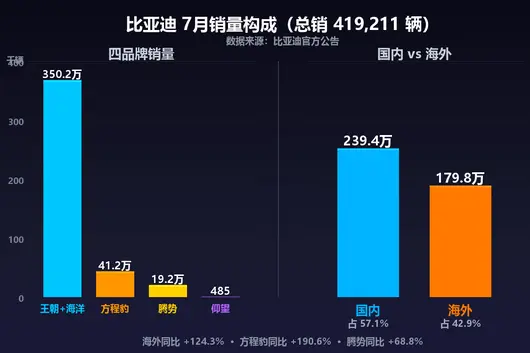
【Auto Market Expert】BYD sold 419,211 units in July, a year-on-year increase of 21.76%. Cumulative sales from January to July reached 2,227,722 units.
Total volume hit a new high again. Structural changes are more noteworthy than total volume: Overseas markets are becoming the largest growth engine, while the domestic market is shifting from rapid expansion to refined cultivation.

Dynasty + Ocean: 350,178 units. Absolute mainstay, accounting for over 80%. Qin, Song, Dolphin, Seagull have secured a solid share in the 100,000-200,000 RMB range. With a massive base, the growth rate naturally slowed—this is a stage any major product goes through after maturation. More importantly, the foundation remains solid, and competitive barriers stay firm.
Fang Cheng Bao: 41,213 units, a year-on-year increase of 190.6%, and a month-on-month increase of 15.7%. Fastest growth rate within BYD. Leopard 5 and Leopard 8 Super Fast Charging versions established themselves in the 300,000-500,000 RMB range, indicating that premiumization is not about stacking specs to compete on price, but about product strength. What does monthly sales of 40,000+ mean in the market above 300,000? NIO's main brand monthly sales are about 10,000, Li Auto about 30,000—Fang Cheng Bao achieved the combined volume of both with just one brand.
Denza: 19,196 units, a year-on-year increase of 68.8%. D9 firmly holds the top spot in MPV sales, Z9GT contributes steadily in the coupe market. Z9S started pre-sales today; after adding the sedan line, the product matrix is more complete.
Yangwang: 485 units. Nearly 500 units sold monthly at the million-level price point, comparable to Mercedes-Benz S-Class, BMW 7 Series. Yangwang is not about volume; it is a technology flagship, endorsing brand upward movement.
Overseas: 180,000 units, growth rate 124%Overseas sales in July reached 179,841 units, a year-on-year increase of 124.3%. Cumulative overseas sales from January to July were 969,208 units; the full year is likely to exceed 1.5 million units.
It's not just numbers rising; the model is upgrading too. The Thailand factory with an annual capacity of 150,000 units is already in production, the Brazil factory is under construction, and the Uzbekistan factory is operational—from exporting complete vehicles to local manufacturing, this step determines whether overseas growth can continue. In overseas markets, BYD is not just selling cars; it is building factories, channels, and brand awareness.
Global car sales in July were about 7 million units, with BYD accounting for around 6%. There is huge room for improvement overseas—not a one or two-year matter, but a ten to twenty-year growth track.

July domestic sales were about 240,000 units. Behind this number is the new normal for the domestic new energy vehicle market—penetration rate has exceeded 60%, the high-growth dividend period is transitioning to a stock competition period.
For BYD, this is not a challenge, but an industry rule. The market share in the 100,000-200,000 RMB range is already high, and marginal expansion space naturally narrows. The domestic strategy is also adjusting: not pursuing further significant share increases, but securing the foundation through new products (Qin MAX, Seal 08) and new technologies (Second-generation Blade Battery, Super Fast Charging), while allocating more resources to overseas markets and premiumization.
Simply put: domestically shifting from grabbing territory to holding ground, overseas shifting from testing waters to aggressive offense.

Three stages are becoming clearer.
Stage 1 "Domestic Competition King" (2021-2023): Blade Battery and DM-i swept the 100,000-200,000 RMB market. Stage 2 "Brand Upward" (2024-2025): Denza, Fang Cheng Bao, Yangwang targeting the premium sector, basically completed. Stage 3 "Global Expansion" (2026-Present): Overseas share rises rapidly, moving from "Chinese BYD" to "World BYD".
Fang Cheng Bao monthly sales broke 40,000, overseas monthly sales approached 180,000—these numbers were unthinkable a year ago. Stage 2 is concluding, Stage 3 is accelerating.
Next highlight: When will overseas monthly sales exceed domestic? With the current growth rate difference, this might be seen in the fourth quarter of this year.

The 2026 Fortune Global 500 list was officially released on July 28, with BYD appearing on the list for the 5th consecutive year. Ranked 91st this year, it has firmly joined the top 100 global companies, undoubtedly becoming a benchmark enterprise for global new energy vehicles, while also highlighting the strong development momentum of Made in China. 
In 2025, BYD achieved an annual revenue of 804 billion yuan and a net profit of 32.6 billion yuan; new energy vehicle sales for the year reached 4.6 million units, retaining the titles of global new energy vehicle sales champion and China market car sales champion. As of June, BYD's cumulative sales in 2026 have exceeded 1.8 million units. Just last July, BYD's 17 millionth new energy vehicle rolled off the assembly line, becoming the first automaker to reach this milestone.
 Some people may be puzzled: BYD's annual revenue in 2025 was as high as 804 billion yuan, so why was the net profit only 32.6 billion? This inevitably leads to the massive investment BYD Group has made in technical research and development. BYD has always regarded deep technical expertise and long-term development as core concepts, investing heavily in technical R&D for many years. In 2025, BYD's investment in technical R&D reached 63.4 billion yuan, almost twice the net profit.
The result of such high capital investment is BYD continuously solving industry pain points with profound technology and digging deep into the technical moat. Examples include the 2nd Generation Blade Battery + Flash Charging Technology, e3, DiSus-A Closed Dual-Cavity Air Suspension, DiSus Sky Eye 5.0 ADAS system, and more. Recently, BYD's 20,000th flash charging station is about to be completed, and BYD plans to build 6,000 overseas flash charging stations worldwide. BYD's R&D investment has ranked first among A-share listed companies for two consecutive years.
 In 2025, BYD's overseas sales broke through 1 million units for the first time, a year-on-year increase of 145%. Overseas sales in the first half of 2026 exceeded 780,000 units, maintaining a strong growth momentum. The overseas market has become an important engine for BYD's growth. More notably, the depth and breadth of the overseas layout are expanding simultaneously. This year, BYD's first overseas SkyRail officially opened in Sao Paulo, Brazil. The Brazilian factory welcomed its 100,000th new energy vehicle off the line, and the Latin American market entered a stage of integrated operation for production, sales, and service; the Denza brand entered Europe with three models: Z, Z9GT, and D9, developing the high-end market with a positioning of tech luxury; the first overseas specialized model, Sea Otter (BYD RACCO), landed in Japan, fully catering to local market demand; the Thailand factory celebrated its second anniversary of production, further consolidating the foundation of the Southeast Asian market.
In terms of sustainable development, as of June 30, 2025, compared to traditional fuel vehicles, BYD new energy vehicles have achieved a cumulative carbon emission reduction of approximately 149 million tons in energy production and usage, equivalent to planting 2.48 billion trees. This data intuitively presents the tangible contribution of new energy vehicles to global carbon reduction. In terms of giving back to society, BYD launched a 3 billion yuan education charity fund, reached donation agreements with 127 universities nationwide, and has inspired over 6,000 students. Long-term investment in education and public welfare is in line with the company's concept of adhering to technological innovation and focusing on long-term development.
 In conclusion, the 91st ranking on the Fortune Global 500 is not just a business achievement for BYD, but more of a perfect proof. It proves that the development concept of always "sticking to technology supremacy and keeping the original intention" can not only achieve success but also lead Chinese automakers globally. BYD lives up to being a benchmark enterprise for global new energy vehicles. And its beautiful vision of "cooling the Earth by 1℃" will eventually be realized step by step.
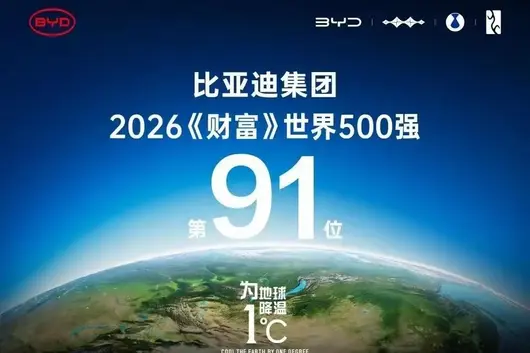

Chinese automakers are going absolutely crazy! On July 28, the 2026 Fortune Global 500 Ranking was just released, with BYD directly reaching 91st globally!

Listed for 5 consecutive years, firmly ranking among the global top 100. Do you know what this means? Among all automakers worldwide, BYD is the highest-ranked Chinese automaker, and also the only Chinese automotive brand to break into the top 100!
Some might say, what's there to brag about being ranked 91st? Come, let me run the numbers for you.
In 2025, BYD's full-year revenue was 804 billion, net profit 32.6 billion. Sold 4.6 million new energy vehicles all year, consecutively winning the title of global new energy vehicle sales champion, China market automaker sales champion, etc., and is a benchmark enterprise for global new energy vehicles. In the first half of this year, it sold another 1.8 million+, the 17 millionth new car rolled off the production line in July, making BYD the first automaker globally to achieve this number!
Do you think that's it? The most fierce part is R&D investment.
BYD has always adhered to the development concept of "Technology is King, Innovation is the Foundation". Invested 63.4 billion in R&D in 2025! A year-on-year increase of 17%, ranked 1st among all A-share listed companies for two consecutive years. Invested another 11.3 billion in Q1 this year. Until now, cumulative R&D investment has surpassed 250 billion! What concept? For many automakers, one year's revenue isn't even this much.
Where was the money spent? The 2nd Gen Blade Battery + Super Flash Charge technology released in March this year. By the end of the year, nationwide to build 20,000 Super Flash Charge stations, another 6,000 overseas. Even fiercer in May, all vehicle series can be equipped with Sky-Eye B Assisted Driving Laser Version, and also promises City Navigation Safety Guarantee for 1 year, full guarantee for smart parking, ushering in the era of public city navigation.
The overseas market is also expanding wildly. In 2025, overseas sales surpassed 1 million for the first time, surging 145%. Sold another 780,000 in the first half of this year. BYD's overseas expansion strategy has formed a pattern of "Latin America leading, Europe breaking through, Asia blooming at multiple points". This year, BYD's first overseas Cloud Rail was opened in Brazil, the Brazil factory reached the 100,000th new energy vehicle rolled off the line; Denza Z, Z9GT and D9 jointly opened a new chapter of European tech luxury; BYD's first overseas specialized model Sea Otter (BYD RACCO) landed in Japan; the Thailand factory welcomed its 2nd anniversary of production. BYD is accelerating into a deep-rooted local, high-quality development globalization new stage. As of now, BYD's business has spread to 121 countries and regions worldwide.
There is another detail: As of June 30, BYD new energy vehicles cumulative carbon emission reduction was 149 million tons, equivalent to planting 2.48 billion trees. In terms of social responsibility implementation, BYD launched a 3 billion yuan education charity fund, and reached donation agreements with 127 universities nationwide, incentivizing over 6,000 students.
From a small battery factory to a global top 100 automaker, BYD took 20 years. Some say Chinese brands are no good. Some say Chinese automakers can only compete fiercely domestically. What's the result? BYD's presence can be seen in hundreds of countries worldwide, Europeans are queuing to buy Denza, developing new models specifically for the Japanese market. What expressions are those who looked down on Chinese cars back now making?
804 billion revenue, 4.6 million sales, 63.4 billion R&D, 17 million cars rolled off, the story behind these numbers boils down to one sentence: Chinese automobiles, have truly stood up!
As the global leader in new energy vehicles, BYD firmly ranks in the world's top 100 camp, which is the result of its persistence in technological innovation and global breakthroughs. Looking forward, BYD will continue to unswervingly uphold sustainable development concepts, with more cutting-edge technology and a more perfect global layout, to cool down the Earth by 1°C.
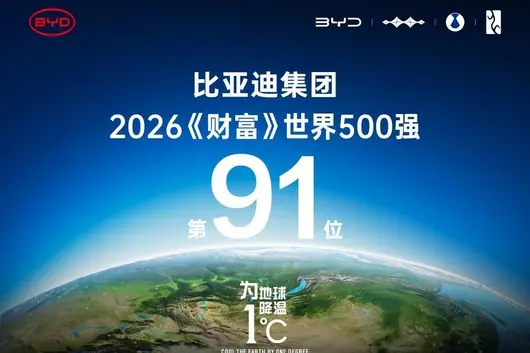

Recently, the 2026 Fortune Global 500 list was officially released. Among them, our new energy industry leader BYD has been on the list again, and this is the 5th consecutive year BYD has been on the list, and this time ranking 91st, firmly staying in the global top 100.

As a leader in the new energy industry, BYD can be said to be "blossoming everywhere". From the brand strategy perspective, there is not only the BYD Dynasty Network and Ocean Network series focusing on the mainstream market, but also the Fang Cheng Bao brand focusing on the personalized market, as well as Denza and the million-level luxury brand Yangwang, focusing on the high-end market. Moreover, products under these sub-brands have received considerable attention from consumers. Not only that, BYD continues to uphold the development philosophy of "Technology is King, Innovation is Foundation". Therefore, we can not only see many cutting-edge technologies in the Yangwang brand, but also see BYD applying Flash Charging technology, second-generation Blade Battery, and the Sky's Eye B auxiliary driving system with LiDAR to 100,000 yuan-level mainstream products.
From the level of hard technology investment, it is clear that BYD has always maintained leading R&D intensity in the industry. In 2025, brand R&D investment reached as high as 63.4 billion yuan, a year-on-year increase of 17%. Relying on continuous high-intensity technology deepening, it secured the top position for R&D investment among A-share listed enterprises for two consecutive years. At the same time, in the first quarter of 2026, the company's R&D investment reached 11.3 billion yuan, far exceeding domestic mainstream automakers and top new EV forces. Throughout the journey, BYD's cumulative R&D investment has exceeded 250 billion yuan. Relying on long-term uninterrupted high-intensity technology deepening, a large number of disruptive innovation achievements have been brought from the laboratory to mass production.

For example, in March 2026, BYD released the second-generation Blade Battery and Flash Charging technology, and plans to build 20,000 Flash Charging stations nationwide by the end of the year, so that BYD car owners in all regions can enjoy the convenience brought by Flash Charging. In addition, BYD will also layout 6,000 overseas Flash Charging stations globally. This will be of great help to overseas BYD car owners and BYD's export strategy. And in May this year, BYD was the first to promise a 1-year safety guarantee for Urban Pilot Navigation, and announced that all series models can be equipped with the Sky's Eye B auxiliary driving system with LiDAR.

Speaking of overseas exports, we cannot help but brag about BYD's brilliant achievements. In 2025, BYD's overseas annual sales first broke through 1 million units, a year-on-year increase of 145%. Moreover, the growth momentum continued into the first half of 2026, with the brand's overseas sales exceeding 780,000 units. Nowadays, the company's overseas strategy has formed a pattern of "leading in Latin America, breakthrough in Europe, and blossoming at multiple points in Asia-Pacific". And this year, BYD also opened its first overseas Cloud Rail in Brazil, while the Brazil factory also achieved the 100,000th new energy vehicle off the assembly line. Not only that, Denza Z, Z9GT, and D9 jointly opened a new chapter of technology-based luxury in Europe; BYD's first overseas dedicated model Sea Otter (BYD RACCO) landed in Japan; the Thailand factory welcomed its second anniversary of production start. These are all things worth celebrating and being proud of, because our Chinese automobiles have gone to the whole world. As of now, BYD's business has covered 121 countries and regions globally.

Additionally, it is worth mentioning that BYD achieved an annual revenue of 804 billion yuan in 2025, with a net profit of 32.6 billion yuan. Not only that, BYD's new energy vehicle annual sales reached as high as 4.6 million units, retaining the titles of global new energy vehicle sales champion and China market automotive sales champion, etc. This once again proved with strength and data that it is indeed a top player in the new energy vehicle industry. In addition, from January to June this year, BYD's cumulative sales exceeded 1.8 million units. At the same time, BYD's 17 millionth new energy vehicle was officially rolled off the line in July, which also made it the first automaker to reach this milestone.
Finally, looking at the direction of sustainable development, as of June 30, BYD new energy vehicles have cumulatively achieved carbon emission reduction of 149 million tons compared to traditional fuel vehicles in the energy production and usage links. This data is equivalent to planting 2.48 billion trees. In addition, in terms of practicing social responsibility, BYD established a 3 billion yuan education charity fund, and has reached donation cooperation with 127 universities nationwide, benefiting more than 6,000 young students. Special funding has built a study guarantee for students from financially disadvantaged backgrounds, helping them bravely chase their ideals.
Editor's Summary
In short, as a benchmark enterprise for global new energy vehicles, BYD is indeed an enterprise worthy of respect and learning. From initially focusing on battery production, to crossing over into car manufacturing and being questioned by everyone, to technological explosion and comprehensive transformation, until today's multi-brand matrix and globalization, these 30 years of BYD have perfectly demonstrated what the idiom "Thirty years in the East, Thirty years in the West" means. And from beginning to end, BYD has focused on technology downscaling and cost-effectiveness, allowing more and more users to feel the convenience brought by technology. In the future, BYD will continue to unswervingly uphold the concept of sustainable development, with more cutting-edge technology and a more perfect global layout, to cool the Earth by 1°C.