


首頁Beetle 1960s

搜尋歷史
熱門搜尋
經銷商登入 / 註冊

In 2026, the Chinese car market, on the surface, is still moving forward, but the underlying tone is not easy. On one hand, NEV penetration continues to rise, with new cars arriving one after another; on the other hand, promotions, price cuts, and benefit increases have basically become the norm.
It is worth noting that selling cars does not mean profit remains. You should know that the most uncomfortable part of this industry is not the lack of sales, but that many enterprises are exchanging profit for market share and cash flow for voice.
Entering July, the market pressure did not suddenly disappear. According to data released by the China Passenger Car Association, from July 1st to 26th, national passenger car retail was 1.123 million units, down 18% year-on-year and 13% month-on-month. From here, it is clear that consumers are more cautious about buying cars, and enterprises can no longer solely rely on a round of marketing hype to push up sales.

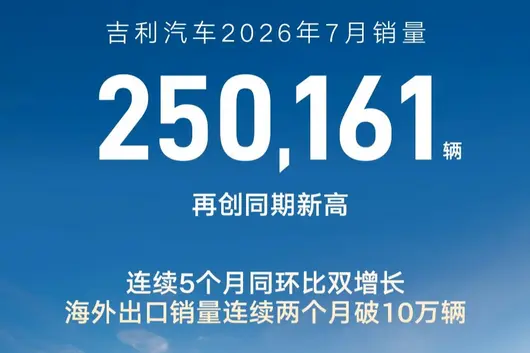
However, precisely against this backdrop, Geely Automobile delivered a July «report card» with quite a sense of contrast. Its single-month sales reached 250,161 units, making Geely Automobile the only company in the industry to achieve month-on-month and year-on-month double growth in sales for five consecutive months. Among them, NEV sales (including Geely Automobile, Lynk & Co, ZEEKR) were 160,165 units, up 23% year-on-year, accounting for 64% of total sales. More worth pondering is that Geely Automobile's overseas exports also reached 106,663 units, up 202% year-on-year and 4% month-on-month, achieving double growth year-on-year and month-on-month for seven consecutive months.
You should know that these are not numbers easily exchanged by «lowering the price a bit more» and «pumping volume more fiercely». Because the market today no longer lacks a car that becomes popular in the short term; it lacks a system that can continuously meet demand: mainstream markets need scale, high-end markets need brand momentum, fuel users cannot be abandoned, and NEV users must be persuaded; the domestic market needs stability, and the overseas market must have new growth.
Therefore, what is truly worth looking at in Geely Automobile's July report card is not the result of 250,000 units itself, but where these 250,000 units come from, what supports them, and whether they can continue. When the industry is generally under pressure, why can Geely Automobile still run its own rhythm? Let's explore it together!
Not just «one best-selling model», but a product matrix that can fight
If you break down Geely Automobile's July sales by company, you will find that its growth logic is not single-line.
Geely Brand sales for the month were 197,942 units, up 2% year-on-year, still constituting the most solid basic base of this automaker. Looking down, Geely Galaxy sold 107,797 units, up 13% year-on-year; China Star Series sales were 90,145 units, up 15% month-on-month; ZEEKR deliveries were 35,837 units, a big jump of 111% year-on-year; Lynk & Co sales were 16,382 units, among which NEV products reached 14,069 units. The meaning of these numbers lies not in every brand having to become «Number One», but in different price bands, energy routes, and usage scenarios having relatively clear successors.

Let's look at Geely Galaxy first. It bears the scale task of the mainstream NEV market. Star Wish July sales were 55,105 units, up 24% year-on-year and 8% month-on-month, cumulative sales breaking 800,000 units. For a volume-selling car, the true test has never been whether it can create hype at launch, but whether it can still retain users after rapid product iteration and frequent price cuts by competitors. Continuous sales performance shows that Galaxy is not just hitting the rhythm in a certain window period; it has begun to possess the ability to output stably.

Next is ZEEKR. 35,837 units of monthly delivery and a 111% year-on-year increase are not just a number change in the high-end NEV market. It exactly shows that in the process of Geely Automobile moving upwards, it did not understand high-endization as «more expensive configuration sheets», but is strengthening the combined force of brand, technology, and product experience. Products such as ZEEKR 9X, Refreshed ZEEKR 009, and 7X have successively progressed for delivery, targeting different battlefields such as high-end SUVs, luxury MPVs, and global pure electric markets. Users of high-end cars are not insensitive to prices, but they care more about whether a car is complete enough—design, performance, intelligence, safety, and service cannot focus on just one item.

Compared to ZEEKR, Lynk & Co undertakes the group's «broader» task. It did not crowd into the same comfortable home-use track with all brands, but continues to strengthen sports and travel attributes. In July, Lynk & Co 07 GT went on sale and 10,000 large orders were broken in 27 minutes, although this data comes from the enterprise disclosure standpoint. But it at least reflects a trend: when NEV products gradually look more and more alike, products that can provide clear driving personality and scene value are actually easier to be remembered.

And besides NEV cars, don't ignore fuel cars. When many people talk about NEV transformation, they habitually view fuel businesses as «old burdens» that need to be discarded as soon as possible. But for an automaker pursuing operating quality, fuel cars are still important cash flow and user foundations. In this regard, Geely China Star continues to consolidate fuel car market competitiveness. China Star July sales reached 90,145 units, up 15% month-on-month; the Double Bin Family sales were 31,152 units, up 68% year-on-year. This means Geely Automobile did not use NEV to hard confront and replace all demand, but retained different user choice rights during the transformation process.
From here, it is not difficult to see that this is where the synergy of Geely's four brands is most valuable: Galaxy is responsible for deepening and expanding the mainstream NEV market, ZEEKR is responsible for breakthroughs in high-end value zones, Lynk & Co defends youthful, sporty, and personalized expressions, and China Star stabilizes the basic base of fuel car users. They are not four teams fighting independently, but jointly undertaking growth tasks in different segmented markets.

More importantly, the value of the matrix is not just «many cars». From the appearance of Galaxy TT and Galaxy Warship 700, to the successive deliveries of new ZEEKR and Lynk & Co products, to the product renewal of China Star, Geely is expanding product boundaries to more scenarios such as sedans, SUVs, MPVs, wagons, and NEV off-roading. If the new product rhythm of some automakers can ultimately be converted into continuous delivery and reputation, this matrix will be upgraded from «coverage» to «moat».

Thus, the answer to the question is already becoming clear. Geely Automobile's counter-trend is not relying on a single car suddenly exploding, but relying on a product system that relays to each other. When market demand becomes more fragmented and pickier, try not to let users flow elsewhere. What needs to be seen next is why this system can not only sell cars domestically but also extend growth overseas.

Exports Break 100,000 in Two Consecutive Months, From «Product Going Overseas» to «Value Going Overseas»
In the past, Chinese car exports were often understood as a business of «sending products overseas»: finding importers, laying out channels, grabbing market share. This road can be run fast, but not necessarily far. Because the competition for NEVs is not just battery capacity and screen size on the configuration sheet; it also has to face charging conditions, after-sales response, financial solutions, regulatory standards, and even user trust in the brand in different countries.

The difference in this round of Geely Automobile's overseas growth lies in it starting to do three things at once: using NEV products to open the mainstream market, using high-end brands to raise the value ceiling, and using local partnerships to turn one-time sales into long-term operations. The three lines are not fighting independently, but are jointly answering the same question: how to enter the core price band of the global car market without relying on low prices.
From the data perspective alone, Geely Automobile's overseas exports in July were 106,663 units, achieving month-on-month and year-on-month double growth for seven consecutive months, breaking the 100,000 unit threshold for two consecutive months. The export volume has accounted for 42% of total sales, supporting nearly half of the business. More含金量 (worthiness) is the export structure. Its NEV product exports in July were 62,604 units, surging 616% year-on-year, accounting for 59% of total export volume. In August, Star Wish will enter the broad A0-class Australian market, with a price of 124,000-146,000 RMB, and gross profit margin significantly higher than domestic.
From specific market performance, Geely Automobile's products have already established a foothold in multiple global markets. Geely Star Wish (Geely EX2) ranked first in Thailand EV sales, second in Brazil EV, and second in Mexico pure electric models; Star Ship 7 EM-i (Geely EX5 EM-i) ranked first in Poland C-class PHEV market single model sales, second in Mexico June PHEV segmented market sales, also topping the plug-in hybrid list in Slovenia, Bulgaria and other markets, and ranking second in Mexico plug-in hybrid segmented market.

The overseas expansion of high-end brands is also noteworthy. Since the launch of Lynk & Co 08, global cumulative deliveries have reached nearly 190,000 units, ranking in the top three of Mexico high-end plug-in hybrid SUV and Morocco mid-size plug-in hybrid SUV sales in the first half of the year; ZEEKR ranked first in Australian and Malaysian luxury pure electric brand sales in the first half of the year. ZEEKR 7X ranked first in multiple segmented markets including Australia mid-size SUV over 65,000 AUD, Malaysia luxury EV, Morocco luxury electric SUV, Egypt mid-size luxury electric SUV, and ZEEKR 009 firmly stays at the top of Thailand and Malaysia luxury pure electric MPV sales.
At the same time, ZEEKR's global territory is still expanding rapidly. Among them, ZEEKR 007GT officially landed in 16 European countries; ZEEKR 7X exceeded 1,000 pre-sale orders in South Korea, with high-middle and high-spec ratio as high as 94%; ZEEKR also became the first Chinese high-end automobile brand to land in East Malaysia, and channel networks continue to sink. Geely Automobile's overseas expansion has never been simply «selling cars abroad», but walking the route of localized operations, reducing risks and improving efficiency through win-win cooperation.

Besides product overseas expansion, Geely Automobile continues to promote localized operation capability construction. In July, Geely Automobile reached an agreement with Ford. The two parties will establish a joint venture company at Ford's Valencia, Spain factory to produce NEV models for the European market through capacity sharing. This light asset cooperation model can quickly cut into core European markets without building factories from scratch, and can effectively counter tariffs and geopolitical policy risks. Both domestic and overseas brokerages have consistently expressed看好 (look favorably). Additionally, on the channel end, Geely Automobile is also promoting simultaneously. Geely Automobile has formally signed with Pakistan comprehensive enterprise group Bestway Group, authorizing it as Geely Galaxy's official importer in Pakistan. It will officially enter the Pakistan market in Q3 this year, initially introducing two pure electric SUVs Galaxy E5 and Star Wish, continuously developing emerging markets.

As of July, Geely Automobile has completed 58% of its annual million-export goal, with pace far exceeding industry expectations. With ZEEKR 9X landing in the Middle East and i-HEV hybrid technology going overseas in the second half of the year, this second growth curve of globalization will continue to release profit potential and become an important support for Geely Automobile to traverse the domestic cycle.
Technical Moat
Why can Geely Automobile maintain profitability in an «bleeding» industry environment? Besides brand and market success, the fundamental reason lies in its deep technical moat. When price wars are fought fiercely, Geely Automobile chose a harder but more correct path: using technology premium to counter price involution.

In core NEV technology, Geely Galaxy released the world's first «Thunder 16-in-1 Smart Electric Drive», completing breakthrough iteration of NEV electric drive underlying technology. This system will be equipped on Geely Galaxy TT first, not only successfully winning «Lowest energy consumption record for mass-produced pure electric cars circling Qinghai Lake» and «Longest continuous dual-car drift on wet roads (electric vehicle)» Guinness World Records, but also controlling 100km/h electric consumption at a surprising level of 8.20kWh. This generational advantage in technology gives Geely Automobile absolute pricing power in the 100,000-200,000 mainstream market.

In the manufacturing field, two core technologies of Geely Automobile won the Second Prize of the 2025 National Science and Technology Progress Award. Whether «Heat-treated Quenching and Tempering Aluminum/Magnesium Alloy and Its Application Technology for Integrated Die Casting» or «Key Technologies and Industrialization of High Safety, High Fault Tolerance, High Efficiency Intelligent Electric Electric Chassis», they all broke the long-term monopoly of overseas enterprises in high-performance materials and high-end chassis fields. This means Geely Automobile can not only make good cars, but also make good cars at lower costs and higher efficiency. This manufacturing cost advantage is the confidence for it to dare to «not lose money» in price wars.

In intelligence, Geely Automobile always insists on safety as the bottom line. On July 21, Geely Automobile obtained the industry's first «Automobile Production Organization Combined Driving Assistance Safety Management System Certification Certificate». In today's era of intelligence driving systems flooding, Geely Automobile did not blindly pursue «futures» functions, but established an industry-leading safety standardization system through «Qianli Haohan» intelligence driving system. In the second half of the year, Geely Automobile will also set up a «2030 Lab» to tackle frontier fields such as acoustics, optics, digital chassis, embodied intelligence, etc. This «develop one generation, reserve one generation, apply one generation» technical rhythm ensures Geely Automobile products always lead by half a position.
Final Thoughts:
July 250,000 units, five consecutive months of double growth, overseas breaking 100,000 consecutive months, NEV penetration rate 64%. Geely Automobile's report card placed against the backdrop of the industry's overall decline speaks for itself.
But what is worth thinking about more than numbers is the way of growth. Geely Automobile did not participate in bottomless price wars or rely on pressing inventory to pump volume, but covered layered markets through multi-brand synergy, opened up incremental space through high-value overseas expansion, and built competitive barriers through underlying technology. This is a path of «high-quality growth». It is not about who loses less, but who has stronger blood-making ability. From multi-brand synergy to global layout, from technological innovation to product value improvement, Geely Automobile is building a systemic capability to traverse the cycle. As the industry elimination window approaches, this capability may be the hardest hand to stay at the table. Let us look forward to Geely Automobile bringing us greater surprises in the future!

喺馬來西亞嘅 SUV 市場,好多買家喺揀車嘅時候,都會拿寶騰 X70 同長城 哈弗 H6 嚟比較。呢兩款車喺價位同定位上都好接近,今日我哋就從多個方面嚟做一個詳細嘅比較,幫你省咗做功課嘅時間。
寶騰 X70 喺馬來西亞嘅 OTR 售價係 RM 106,800 - 122,300,一共有 3 個版本,包括 1.5L Standard 2WD(RM 106,800)、1.5L Executive 2WD(RM 115,800)、1.5L Premium 2WD(RM 122,300) 等。
長城 哈弗 H6 喺馬來西亞嘅 OTR 售價係 RM 139,750 - 139,750,一共有 2 個版本,包括 1.5L Turbo Standard(RM 140,000)、1.5L Turbo Premium(RM 155,000) 等。
從價錢嚟睇,寶騰 X70 嘅起步價的確比長城 哈弗 H6 平咗 RM 32,950。如果你預算有限,寶騰嘅入門版已經可以滿足日常需求。但都要注意,平嗰幾千蚊,可能喺配備上會有取舍,具體要看你嘅需求。
寶騰 X70 嘅安全評級係 5 星 (ASEAN NCAP),主動安全系統包括 ADAS (ACC, AEB, LKA, LDA, BSM, RCTA)。
長城 哈弗 H6 嘅安全評級係 TBD,主動安全系統包括 Basic。
安全配備方面,兩款車都拿到唔錯嘅評級。不過寶騰 X70 嘅 ADAS (ACC, AEB, LKA, LDA, BSM, RCTA) 同長城 哈弗 H6 嘅 Basic 喺功能上有些差異,如果你比較看重主動安全嘅話,可以仔細比較下兩者嘅功能列表。
寶騰 X70 採用 FWD 驅動方式。
長城 哈弗 H6 採用 FWD 驅動方式。
兩款車嘅驅動方式一樣,都係 FWD,日常駕駛感受唔會有太大區別。
寶騰 X70 保修 5 年/150,000 公里,保養間隔 每 10,000 公里或 6 個月。
長城 哈弗 H6 保修 7 年/150,000 公里,保養間隔 每 10,000 公里或 6 個月。
寶騰 X70 同長城 哈弗 H6 都係馬來西亞市場嘅主流選擇,適合家庭使用、日常通勤。如果你更看重品牌口碑同二手價,可以優先考慮口碑更好嗰一款;如果你更在意性價比同配備,那就選配置更豐富嗰款。最後都係建議兩款都去試駕,親身體驗先係最重要嘅。
總嘅嚟講,寶騰 X70 同長城 哈弗 H6 都係馬來西亞市場好唔錯嘅車款。揀邊一輛,關鍵仲係要看你嘅個人需求同預算。建議大家做好功課,多比較幾間車行嘅報價,再去試駕做最終決定。買車係件大事,花少少時間做功課絕對唔會錯。

喺馬來西亞嘅 SUV 市場,好多買家喺揀車嗰陣都會拎 Proton X70 同 MG MG HS 嚟做比較。呢兩部車喺價錢同定位上都好接近,今日我哋就從多個方面做一個詳細嘅對比,幫你節省咗做功課嘅時間。
Proton X70 喺馬來西亞嘅 OTR 售價係 RM 106,800 - 122,300,一共有 3 個版本,包括 1.5L Standard 2WD(RM 106,800)、1.5L Executive 2WD(RM 115,800)、1.5L Premium 2WD(RM 122,300)等。
MG MG HS 喺馬來西亞嘅 OTR 售價係 RM 130,450 - 146,450,一共有 2 個版本,包括 1.5L Standard(RM 105,000)、1.5L Executive(RM 115,000)等。
從價錢嚟睇,Proton X70 嘅起點價確實比 MG MG HS 平咗 RM 23,650。如果你預算有限,Proton 嘅入門版已經可以滿足日常需求。但都要留意,平嗰啲幾千蚊,可能會喺配備上有取捨,具體要睇你嘅需求。
Proton X70 搭載 1.5L Turbo,馬力 140 hp。官方油耗 7.0 L/100km。
MG MG HS 搭載 1.5L Turbo,馬力 140 hp。官方油耗 7.0 L/100km。
兩部車用咗同一套動力系統,日常開落嚟嘅感覺基本冇咩分別。油耗方面都幾接近,唔使太糾結呢一點。
Proton X70 嘅安全評級係 5★ (ASEAN NCAP),主動安全系統包括 ADAS (ACC, AEB, LKA, LDA, BSM, RCTA)。
MG MG HS 嘅安全評級係 TBD,主動安全系統包括 Basic。
安全配備方面,兩部車都拿到唔錯嘅評級。不過 Proton X70 嘅 ADAS (ACC, AEB, LKA, LDA, BSM, RCTA) 同 MG MG HS 嘅 Basic 喺功能上有啲差異,如果你比較看重主動安全嘅話,可以仔細對比吓兩者嘅功能列表。
Proton X70 保修 5 年/150,000km,保養間隔 每 10,000km 或 6 個月。
MG MG HS 保修 7 年/150,000km,保養間隔 每 10,000km 或 6 個月。
Proton X70 同 MG MG HS 都係馬來西亞市場嘅主流選擇,適合家庭使用、日常通勤。如果你更看重品牌口碑同二手價,可以優先考慮口碑更好嗰一款;如果你更在意性價比同配備,那就揀配備更豐富嗰款。最終都建議兩者都去試駕,親身體驗先係最重要嘅。
總體嚟講,Proton X70 同 MG MG HS 都係馬來西亞市場幾唔錯嘅車型。揀邊一部,關鍵都要睇你嘅個人需求同預算。建議大家做好功課,多比較幾間車行嘅報價,再去試駕做最終決定。買車係件大事,花少少時間做功課絕對唔會錯。

In the SUV market in Malaysia, many buyers compare the Proton X70 and Chery Tiggo 8 Pro when choosing a car.
The OTR price for the Proton X70 in Malaysia is RM 106,800 - 122,300, with a total of 3 variants, including 1.5L Standard 2WD (RM 106,800), 1.5L Executive 2WD (RM 115,800), 1.5L Premium 2WD (RM 122,300), etc.
The OTR price for Chery Tiggo 8 Pro in Malaysia is RM 159,750 - 159,750, with a total of 2 variants, including 1.6L Turbo Standard (RM 130,000), 1.6L Turbo Premium (RM 145,000), etc.
From a price perspective, the Proton X70's starting price is indeed RM 52,950 cheaper than the Chery Tiggo 8 Pro. If your budget is limited, Proton's entry-level version can already meet daily needs. However, note that the few thousand difference may involve trade-offs in equipment, depending on your specific needs.
The Proton X70 features a 1.5L Turbo, with 140 hp. Official fuel consumption is 7.0 L/100km.
The Chery Tiggo 8 Pro features a 2.0L 4-cyl, with 170 hp. Official fuel consumption is 8.0 L/100km.
Regarding power, the Chery Tiggo 8 Pro's 2.0L 4-cyl has 30 more hp than the Proton X70's 1.5L Turbo. However, for daily city driving, both cars have sufficient power, and you won't feel underpowered.
The Proton X70 body length is 4400 mm, trunk 400 L.
The Chery Tiggo 8 Pro body length is 4400 mm, trunk 400 L.
The dimensions of both cars are almost the same, with little difference in interior space. For cars of this class, it is more than sufficient for daily use.
The Proton X70 uses FWD drivetrain.
The Chery Tiggo 8 Pro uses FWD drivetrain.
The drivetrain of both cars is the same, both are FWD, and the daily driving experience will not differ much.
The Proton X70 has a 5-year/150,000km warranty, service interval every 10,000km or 6 months.
The Chery Tiggo 8 Pro has a 3-year/100,000km warranty, service interval every 10,000km or 6 months.
In summary, both the Proton X70 and Chery Tiggo 8 Pro are very good models in the Malaysian market. Which one to choose mainly depends on your personal needs and budget. We suggest doing your research, comparing quotes from several car dealers, and then test driving to make the final decision. Buying a car is a big matter, and taking time to research will never be wrong.

In Malaysia's SUV market, many buyers compare Proton X70 and Chery Tiggo 8 Pro when choosing a car. These two cars are quite close in price and positioning. Today we will do a detailed comparison from multiple aspects to help you save time on research.
The OTR price of Proton X70 in Malaysia is RM 106,800 - 122,300, with a total of 3 versions, including 1.5L Standard 2WD (RM 106,800), 1.5L Executive 2WD (RM 115,800), 1.5L Premium 2WD (RM 122,300) etc.
The OTR price of Chery Tiggo 8 Pro in Malaysia is RM 159,750 - 159,750, with a total of 2 versions, including 1.6L Turbo Standard (RM 130,000), 1.6L Turbo Premium (RM 145,000) etc.
In terms of price, the starting price of Proton X70 is indeed RM 52,950 cheaper than Chery Tiggo 8 Pro. If your budget is limited, Proton's entry-level version can already meet daily needs. However, note that the cheaper few thousand may have compromises in features, depending on your needs.
Proton X70 is equipped with 1.5L Turbo, 140 hp. Official fuel consumption 7.0 L/100km.
Chery Tiggo 8 Pro is equipped with 2.0L 4-cyl, 170 hp. Official fuel consumption 8.0 L/100km.
In terms of performance, Chery Tiggo 8 Pro's 2.0L 4-cyl has 30 more horsepower than Proton X70's 1.5L Turbo. However, for daily city driving, the power of both cars is sufficient, you won't feel underpowered.
Proton X70 adopts FWD drivetrain.
Chery Tiggo 8 Pro adopts FWD drivetrain.
Both cars have the same drivetrain, both FWD, there won't be much difference in daily driving experience.
Proton X70 warranty 5 years/150,000km, maintenance interval every 10,000km or 6 months.
Chery Tiggo 8 Pro warranty 3 years/100,000km, maintenance interval every 10,000km or 6 months.
Proton X70 and Chery Tiggo 8 Pro are both mainstream choices in the Malaysian market, suitable for family use and daily commuting. If you value brand reputation and resale value more, you can prioritize the one with better reputation; if you care more about cost-performance ratio and features, then choose the one with richer configuration. Ultimately, it is recommended to test drive both, personal experience is the most important.
Overall, Proton X70 and Chery Tiggo 8 Pro are both very good models in the Malaysian market. Which one to choose depends on your personal needs and budget. It is recommended to do research, compare quotes from several car dealerships, then test drive to make the final decision. Buying a car is a big matter, spending time doing research will never be wrong.

In Malaysia's SUV market, many buyers compare Proton X70 and Chery Tiggo 7 Pro when choosing a car. These two cars have quite similar prices and positioning. Today we will make a detailed comparison from multiple aspects to help you save time on research.
Proton X70's OTR price in Malaysia is RM 106,800 - 122,300, with a total of 3 versions, including 1.5L Standard 2WD (RM 106,800), 1.5L Executive 2WD (RM 115,800), 1.5L Premium 2WD (RM 122,300), etc.
Chery Tiggo 7 Pro's OTR price in Malaysia is RM 123,750 - 123,750, with a total of 2 versions, including 1.6L Turbo Standard (RM 125,000), 1.6L Turbo Premium (RM 140,000), etc.
From a price perspective, Proton X70's starting price is indeed RM 16,950 cheaper than Chery Tiggo 7 Pro. If your budget is limited, Proton's entry-level version can already meet daily needs. But also note, the few thousand cheaper, there might be trade-offs on equipment, specifically depending on your needs.
Proton X70 is equipped with a 1.5L Turbo, 140 hp horsepower. Official fuel consumption 7.0 L/100km.
Chery Tiggo 7 Pro is equipped with a 1.5L Turbo, 140 hp horsepower. Official fuel consumption 7.0 L/100km.
Both cars use the same power system, the driving feeling in daily use is basically no difference. Fuel consumption is also about the same, no need to worry too much about this point.
Proton X70 body length 4400 mm, trunk 400 L.
Chery Tiggo 7 Pro body length 4400 mm, trunk 400 L.
Both cars' dimensions are almost the same, interior space difference is not large. For this level of cars, daily use is completely sufficient.
Proton X70 adopts FWD drive method.
Chery Tiggo 7 Pro adopts FWD drive method.
Both cars' drive methods are the same, all FWD, daily driving feeling will not have too big a difference.
Proton X70 and Chery Tiggo 7 Pro are both mainstream choices in the Malaysian market, suitable for family use, daily commuting. If you value brand reputation and resale value more, you can prioritize the one with better reputation; if you care more about cost-performance and equipment, then choose the one with richer configuration. In the end, it is still suggested to test drive both models, personal experience is the most important.
Overall, Proton X70 and Chery Tiggo 7 Pro are both quite good car models in the Malaysian market. Which one to choose, the key is still to see your personal needs and budget. Everyone is advised to do homework well, compare quotes from several car dealers, then go test drive to make the final decision. Buying a car is a big matter, spending some time doing homework absolutely will not be wrong.

喺馬來西亞嘅 SUV 市場,好多買家喺揀車嘅時候都會拿寶騰 X70 同馬自達 CX-3 嚟做比較。呢兩款車喺價位同定位上都幾接近,今日我哋就由多個方面做一個詳細嘅對比,幫你省咗做功課嘅時間。
寶騰 X70 喺馬來西亞嘅 OTR 售價係 RM 106,800 - 122,300,一共有 3 個版本,包括 1.5L Standard 2WD(RM 106,800)、1.5L Executive 2WD(RM 115,800)、1.5L Premium 2WD(RM 122,300)等。
馬自達 CX-3 喺馬來西亞嘅 OTR 售價係 RM 126,159 - 139,159,一共有 2 個版本,包括 2023 2.0L High(RM 139,159)、2023 2.0L Plus(RM 126,159)等。
由價錢睇落,寶騰 X70 嘅起步價真係比馬自達 CX-3 平咗 RM 19,359。如果你預算有限,寶騰嘅入門版已經可以滿足日常需求。但要注意,平嗰幾千蚊,可能喺配備上面會有取舍,具體要看你嘅需求。

寶騰 X70 搭載 1.5L Turbo,馬力 140 hp。官方油耗 7.0 L/100km。
馬自達 CX-3 搭載 1.5L Turbo,馬力 140 hp。官方油耗 7.0 L/100km。
兩款車用住同一套動力系統,日常開嘅感覺基本冇乜分別。油耗方面都差不多,唔使太糾結這一點。

寶騰 X70 車身長 4400 mm,後備箱 400 L。
馬自達 CX-3 車身長 4500 mm,後備箱 450 L。
空間方面,馬自達 CX-3 嘅車身比寶騰 X70 長咗 100 mm,乘坐空間更有優勢。不過寶騰 X70 喺城市入面泊車會靈活啲,各有取舍。

寶騰 X70 採用 FWD 驅動方式。
馬自達 CX-3 採用 FWD 驅動方式。
兩款車嘅驅動方式一樣,都係 FWD,日常駕駛感受唔會有太大區別。
寶騰 X70 保修 5 年/150,000km,保養間隔 每 10,000km 或 6 個月。
馬自達 CX-3 保修 5 年/150,000km,保養間隔 每 10,000km 或 6 個月。
兩款車嘅保修條件一樣,呢方面唔使糾結。實際保養成本仲要睇品牌嘅服務網絡同零件價格,建議去車友群問吓真實車主嘅經驗。
總嚟講,寶騰 X70 同馬自達 CX-3 都係馬來西亞市場好唔錯嘅車型。揀邊部,關鍵仲係要睇你嘅個人需求同預算。建議大家做足功課,多比較幾間車行嘅報價,再去做試駕先做最終決定。買車係件大事,花啲時間做功課絕對唔會錯。


In the SUV market in Malaysia, many buyers compare the Proton X70 and Toyota Yaris Cross when choosing a car. These two cars are quite close in terms of price and positioning. Today, we will do a detailed comparison from multiple aspects to help you save time on research.
The OTR price for the Proton X70 in Malaysia is RM 106,800 - 122,300, with a total of 3 versions, including 1.5L Standard 2WD (RM 106,800), 1.5L Executive 2WD (RM 115,800), 1.5L Premium 2WD (RM 122,300), etc.
The OTR price for the Toyota Yaris Cross in Malaysia is RM 99,900 - 109,900, with a total of 2 versions, including 2026 1.5L Standard (RM 99,900), 2026 HEV 1.5L Standard (RM 109,900), etc.
From a price perspective, the starting price of the Toyota Yaris Cross is RM 6,900 cheaper than the Proton X70. Honestly, at this price range, the difference of a few thousand is not actually significant; the key is to look at the overall value for money and long-term usage costs.

The Proton X70 uses FWD drive configuration.
The Toyota Yaris Cross uses FWD drive configuration.
The drive configuration for both cars is the same, both are FWD, so there shouldn't be a huge difference in daily driving experience.

Proton X70 warranty 5 years/150,000km, maintenance interval every 10,000km or 6 months.
Toyota Yaris Cross warranty 5 years/unlimited mileage, maintenance interval every 10,000km or 6 months.

Both the Proton X70 and Toyota Yaris Cross are mainstream choices in the Malaysian market, suitable for family use and daily commuting. If you value brand reputation and resale value more, you can prioritize the one with better reputation; if you care more about value for money and features, choose the one with richer configurations. Finally, it is recommended to test drive both, as hands-on experience is the most important.
Overall, both the Proton X70 and Toyota Yaris Cross are quite good models in the Malaysian market. Which one to choose depends mainly on your personal needs and budget. It is recommended to do your research, compare quotes from several car dealerships, and then test drive to make the final decision. Buying a car is a big matter, spending some time doing research will definitely not be wrong.


喺马来西亚嘅 SUV 市場,好多買家喺揀車嘅時候都會拿 Proton X50 同 Kia Sportage 嚟做比較。這兩款車喺价位同定位上都幾接近,今日我就從多個方面做一個詳細嘅比較,幫你省下做功課嘅時間。
Proton X50 喺马来西亚嘅 OTR 售價係 RM 89,800 - 113,300,一共有 4 個版本,包括 1.5T Executive(RM 89,800)、1.5T Premium(RM 101,800)、1.5T Flagship(RM 113,300) 等。
Kia Sportage 喺马来西亚嘅 OTR 售價係 RM 129,639 - 179,320,一共有 4 個版本,包括 2025 1.6T DCT 4WD High(RM 179,320)、2025 1.6T DCT 2WD High(RM 159,320)、2025 2.0L AT 2WD High(RM 139,639) 等。
從價錢來看,Proton X50 嘅起步價確實比 Kia Sportage 便宜咗 RM 39,839。如果你預算有限,Proton 嘅入門版已經可以滿足日常需求。但都要注意,便宜嗰幾千蚊,可能喺配備上面會有取捨,具體要看你嘅需求。

Proton X50 搭載 1.5L 4-cyl,馬力 105 hp。官方油耗 6.0 L/100km。
Kia Sportage 搭載 1.5L Turbo,馬力 140 hp。官方油耗 7.0 L/100km。
動力方面,Kia Sportage 嘅 1.5L Turbo 比 Proton X50 嘅 1.5L 4-cyl 多咗 35 匹馬力。不過日常喺市區開,兩款車嘅動力都夠用,唔會覺得唔夠力。

Proton X50 嘅安全評級係 5★ (ASEAN NCAP),主動安全系統包括 ADAS (ACC, AEB, LKA, LDA, BSM, RCTA)。
Kia Sportage 嘅安全評級係 5★ (ASEAN NCAP),主動安全系統包括 Drive Wise。
兩款車嘅安全評級一樣,喺呢個級別裡面安全配備都算俾得好齊全。而家嘅新車安全性都唔差,唔使太擔心這一點。

Proton X50 保修 5 年/150,000km,保養間隔 每 10,000km 或 6 個月。
Kia Sportage 保修 5 年/300,000km,保養間隔 每 10,000km 或 6 個月。

總體嚟講,Proton X50 同 Kia Sportage 都係马来西亚市場好唔錯嘅車型。揀邊一輛,關鍵都要睇你嘅個人需求同預算。建议大家做好功课,多比較幾間車行嘅報價,再去試駕做最終決定。買車係件大事,花啲時間做好功課絕對唔會錯。


喺馬來西亞嘅 SUV 市場,好多買家喺揀車嘅時候都會拿 Proton X50 同 Chery Tiggo 9 做比較。這兩款車喺價位同定位上都好接近,今日我哋就從多個方面做一個詳細嘅比較,幫你省返做功課嘅時間。
Proton X50 喺馬來西亞嘅 OTR 售價係 RM 89,800 - 113,300,一共有 4 個版本,包括 1.5T Executive(RM 89,800)、1.5T Premium(RM 101,800)、1.5T Flagship(RM 113,300) 等。
Chery Tiggo 9 喺馬來西亞嘅 OTR 售價係 RM 166,800 - 179,800,一共有 1 個版本,包括 2026 2.0T Standard(RM 179,750) 等。
從價錢嚟睇,Proton X50 嘅起步價真係比 Chery Tiggo 9 平咗 RM 77,000。如果你預算有限,Proton 嘅入門版已經可以滿足日常需要。但都要留意,平嗰幾千蚊,可能喺配備上會有取舍,具體就要睇你嘅需求。
Proton X50 搭載 1.5L 4-cyl,馬力 105 hp。官方油耗 6.0 L/100km。
Chery Tiggo 9 搭載 2.0L 4-cyl,馬力 170 hp。官方油耗 8.0 L/100km。
動力方面,Chery Tiggo 9 嘅 2.0L 4-cyl 比 Proton X50 嘅 1.5L 4-cyl 多咗 65 匹馬力。不過日常喺市區開,兩款車嘅動力都夠用,唔會覺得唔夠勁。
Proton X50 車身長 4400 mm,後備箱 400 L。
Chery Tiggo 9 車身長 4400 mm,後備箱 400 L。
兩款車嘅尺寸幾乎一樣,車內空間分別唔大。呢個級別嘅車,日常使用完全足夠。
Proton X50 採用 4WD 驅動方式。
Chery Tiggo 9 採用 FWD 驅動方式。
Proton 嘅 4WD 同 Chery 嘅 FWD 喺操控上會有唔同感受,建議試駕比較。

Proton X50 保修 5 年/150,000km,保養間隔 每 10,000km 或 6 個月。
Chery Tiggo 9 保修 3 年/100,000km,保養間隔 每 10,000km 或 6 個月。

總括嚟講,Proton X50 同 Chery Tiggo 9 都係馬來西亞市場好唔錯嘅車型。揀邊架,關鍵仲要睇你嘅個人需要同預算。建議大家做好功課,多比較幾間車行嘅報價,再去試駕先至做最後決定。買車係件大事,花啲時間做功課絕對唔會錯。

喺馬來西亞嘅 SUV 市場,好多買家喺揀車嘅時候都會拿 Proton X50 同 Mazda CX-5 嚟做比較。
Proton X50 喺馬來西亞嘅 OTR 售價係 RM 89,800 - 113,300,一共有 4 個版本,包括 1.5T Executive(RM 89,800)、1.5T Premium(RM 101,800)、1.5T Flagship(RM 113,300) 等。
Mazda CX-5 喺馬來西亞嘅 OTR 售價係 RM 135,469 - 166,760,一共有 3 個版本,包括 2025 2.0L AT 35th Anniversary(RM 316,154)、2025 2.0L AT(RM 296,154)、2025 2.0L MT(RM 294,154) 等。
由價錢睇落,Proton X50 嘅起步價確實比 Mazda CX-5 平咗 RM 45,669。如果你預算有限,Proton 嘅入門版已經可以滿足日常需求。但都要注意,平嗰幾千塊,喺配備上可能會會有取捨,具體就要睇你嘅需求。
Proton X50 嘅安全評級係 5★ (ASEAN NCAP),主動安全系統包括 ADAS (ACC, AEB, LKA, LDA, BSM, RCTA)。
Mazda CX-5 嘅安全評級係 5★ (ASEAN NCAP),主動安全系統包括 。
兩款車嘅安全評級一樣,喺呢個級別入面安全配備都算給得好齊全。而家嘅新車安全性都唔差,唔使太擔心這一點。
Proton X50 保修 5 年/150,000km,保養間隔 每 10,000km 或 6 個月。
Mazda CX-5 保修 5 年/150,000km,保養間隔 每 10,000km 或 6 個月。
兩款車嘅保修條件一樣,呢方面唔使糾結。實際保養成本仲要睇品牌嘅服務網絡同零件價格,建議去車友群問吓真實車主嘅經驗。
Proton X50 同 Mazda CX-5 都係馬來西亞市場嘅主流選擇,適合家庭使用、日常通勤。如果你更睇重品牌口碑同二手價,可以優先考慮口碑更好嗰款;如果你更在意性價比同配備,就揀配置更豐富嗰款。最終都係建議兩款都去試駕,親身體驗先係最重要嘅。

總嘅嚟講,Proton X50 同 Mazda CX-5 都係馬來西亞市場好唔錯嘅車型。揀邊輛,關鍵都係要睇你嘅個人需求同預算。建議大家做足功課,多比較幾間車行嘅報價,再落去試駕先做最終決定。買車係件大事,花少少時間做功課絕對唔會錯。

喺馬來西亞嘅 SUV 市場,好多買家喺揀車嗰陣都會拿 Proton X50 同 Honda HR-V 嚟做比較。呢兩款車喺價位同定位上都差唔多,我地而家就從多個方面做一次詳細嘅對比,幫你省返做功課嘅時間。
Proton X50 喺馬來西亞嘅 OTR 售價係 RM 89,800 - 113,300,一共有 4 個版本,包括 1.5T Executive(RM 89,800)、1.5T Premium(RM 101,800)、1.5T Flagship(RM 113,300) 等。
Honda HR-V 喺馬來西亞嘅 OTR 售價係 RM 115,900 - 143,900,一共有 4 個版本,包括 2026 e:HEV 1.5L RS(RM 143,900)、2026 1.5T V(RM 137,900)、2026 1.5T E(RM 130,900) 等。
從價錢睇,Proton X50 嘅起步價確實比 Honda HR-V 平咗 RM 26,100。如果你預算有限,Proton 嘅入門版已經可以滿足日常需求。但都係要留意,平嗰幾千蚊,可能喺配備上面會有取舍,具體要看你嘅需求。
Proton X50 裝載 1.5L 4-cyl,馬力 105 hp。官方油耗 6.0 L/100km。
Honda HR-V 裝載 1.5L Turbo,馬力 140 hp。官方油耗 7.0 L/100km。
動力方面,Honda HR-V 嘅 1.5L Turbo 比 Proton X50 嘅 1.5L 4-cyl 多咗 35 匹馬力。不過日常喺市區開,兩款車嘅動力都夠用,唔會覺得唔夠力。
Proton X50 嘅安全評級係 5★ (ASEAN NCAP),主動安全系統包括 ADAS (ACC, AEB, LKA, LDA, BSM, RCTA)。
Honda HR-V 嘅安全評級係 5★ (ASEAN NCAP),主動安全系統包括 Honda SENSING (ACC, CMBS, LKAS, RDM)。
兩款車嘅安全評級一樣,喺呢個級別入面安全配備都算給得好齊全。而家嘅新車安全性都唔差,唔使太驚呢一點。
Proton X50 採用 4WD 驅動方式。
Honda HR-V 採用 FWD 驅動方式。
Proton 嘅 4WD 同 Honda 嘅 FWD 喺操控上面會有唔同感受,建議試駕比較。

Proton X50 同 Honda HR-V 都係馬來西亞市場嘅主流選擇,適合家庭使用、日常通勤。如果你更睇重品牌口碑同二手價,可以優先考慮口碑更好嗰款;如果你更在意性價比同配備,那就揀配置更豐富嗰款。最終都係建議兩款都去試駕,親身體驗先係最重要嘅。
總嘅嚟講,Proton X50 同 Honda HR-V 都係馬來西亞市場好唔錯嘅車型。揀邊一輛,關鍵都要睇你嘅個人需求同預算。建議大家做好功課,多比較幾間車行嘅報價,再去試駕做最終決定。買車係件大事,花少少時間做功課絕對唔會錯。


Exports are surging, but the domestic market is leaking.
Sales of 1.8085 million in half a year! This would be enough for any Chinese automaker to stand head and shoulders above the rest.
However, for BYD today, behind this report card is not a victory lap, but a touch of anxiety.
Just like all Chinese listed automakers, overseas performance is soaring, while the domestic market faces harsh conditions; technology keeps breaking through, but profits are bleeding non-stop.
With the "single dominance" pattern broken, how can this technology-focused new energy vehicle giant turn the tide?
01
From an absolute sales figure perspective, BYD's single-month sales of 403,500 in June make it the only automaker to break the 400,000-vehicle mark that month. Within the Chinese independent brand camp, it still firmly holds the top spot.
In the first half of this year, with sales of 1.8085 million, BYD continued to secure the champion title among independent brands; however, the luster of this "champion" has slightly faded. With a significant gap of 236,800 vehicles, BYD lost to SAIC Group and failed to retain the sales crown among Chinese listed automakers.

More critically, the signal of being overtaken by SAIC Group is far more alarming than the numbers themselves. It means BYD no longer possesses a "crushing" competitive barrier; some rivals have already found ways to crack it.
Not only that, but the footsteps of followers are constantly drawing closer. Geely and Chery achieved sales of 1.423 million and 1.2751 million respectively in the first half of the year, both maintaining positive growth. Rivals that BYD once left so far behind they couldn't even see the taillights are now appearing in its rearview mirror, closer than ever.
It cannot be ignored that while others are chasing, BYD is merely slowing the rate of decline.
Among the 18 Chinese automakers registered in "AutosKline" statistics, BYD's 15.72% year-on-year decline was only better than FAW Group, Changan Automobile, and XPeng Group.
02
Starting this year, the pattern of BYD's single dominance has been broken, replaced by the new normal of "fierce competition among rivals".
More worrying is the domestic market. In the first half of this year, BYD's domestic sales were 1.0191 million, a 39% decrease year-on-year.

Wang Chuanfu stated at the shareholder meeting in December last year, "Declining technology leadership and industry homogeneity." These few words summed up BYD's passive situation in the domestic market.
As Wang Chuanfu said, such rivals as Geely, Chery, and even SAIC Group continue to launch competitor products against BYD at the product level, whether pure electric or plug-in hybrid, almost completely erasing BYD's first-mover advantage.
However, it needs to be clarified that this 39% decline is not entirely "blood loss". The same period of 2025 saw an explosive growth in new energy vehicle penetration rates, which set a huge base. BYD is also actively undergoing structural adjustments, compressing low-profit ride-hailing and low-price orders, and tilting capacity towards high-end models and overseas markets.
Therefore, BYD's passive situation in the domestic market also has components of active contraction.
However, this passivity is now transmitting from "sales" to "profits".
03
On April 28, BYD disclosed its 2026 Q1 report: Operating revenue was 150.225 billion yuan, a 11.82% year-on-year decline; Net profit attributable to the parent company was 4.085 billion yuan, plummeting 55.38% year-on-year; Deducted non-recurring net profit was 4.148 billion yuan, a 49.24% year-on-year decline.

Behind the profit being cut in half, foreign exchange losses were also a fatal "black swan". First-quarter financial expenses reached 2.1 billion yuan, while the same period last year saw 1.908 billion yuan in foreign exchange gains. One step forward, one step back, the exchange factor alone swallowed a scissors difference of about 4 billion yuan.
In its globalization process, BYD holds a large USD exposure. A weakening dollar caused this technology-focused automaker to pay a heavy price on the financial battlefield.
What is the concept of 4 billion yuan? BYD's full-year net profit in 2025 was about 30 billion yuan; one quarter evaporated profits equivalent to over 13% of the whole year.
Of course, a weakening dollar also reduced the import costs of some raw materials (such as lithium mines, chips), but this dividend is far from enough to offset the direct impact of foreign exchange on the income statement.
At the same time, the decline in revenue and profits is also directly related to the domestic price war and falling sales.
So, where does its growth momentum come from?
04
The answer, like almost all Chinese listed automakers, still points overseas.

In the first half of this year, BYD's cumulative overseas sales reached 789,400, a year-on-year surge of 67.92%; single-month exports in June were 174,900, a year-on-year explosion of 95%, setting a new historical high.
Meanwhile, the proportion of overseas sales in total sales has broken 43%, and the completion rate of the 1.5 million overseas target for the year has reached 52.62%.
"AutosKline" believes that against the background of overall sales decline, the strong growth in the overseas market is almost the only support for listed automakers' confidence in the capital market.
From the start of production in Thailand and Uzbekistan factories, to the first car rolling off the line in Brazil, to the confirmation that the Hungary factory will start assembly in the fourth quarter, BYD is completing the qualitative change from product export to industry export.
Bank of Communications International even stated directly that "the overseas market remains one of the most certain sources of growth for BYD".
However, there is an inescapable problem. BYD's 789,400 overseas incremental volume in half a year, minus the approximately 670,000 domestic decline year-on-year, results in a net increase of only about 120,000 vehicles.

The overseas market is indeed galloping, but more so to fill the gap left by falling domestic sales. This is BYD's current most realistic situation.
Furthermore, behind the high growth overseas lie hidden worries. New regulations in Malaysia have stalled local factories, European tariff barriers remain, and the huge foreign exchange losses in the first quarter exactly exposed BYD's financial risk management shortcomings in its global layout.
These issues remind us: is the overseas market the cure or the new lesion? The answer depends on whether BYD can win on both battlefields simultaneously.
However, even if there are many uncertainties overseas, BYD still has another card in its hand—technology.
05
In March, BYD officially launched the second-generation Blade Battery and Flash Charging technology. Under normal temperature, charging from 10% to 70% takes only 5 minutes, and from 10% to 97% takes only 9 minutes. This is undoubtedly one of the most impactful technology breakthroughs in the new energy vehicle field in 2026.
With the release of the new batteries and flash charging technology, BYD's orders also exploded in growth. On the launch day of Datang EV, cumulative orders broke 150,000.

Problems emerged as well: capacity cannot keep up.
Wang Chuanfu admitted at the shareholder meeting: "This year, BYD's sales will depend on battery production volume."
Currently, the production capacity of the second-generation Blade Battery is climbing by 20,000 to 30,000 units per month, but distant water cannot solve near fire. Deliveries of popular models need to wait several months, and a large number of orders face the risk of being lost while waiting.
Technology leadership but losing to capacity ramp-up, this is a happy dilemma. Even for BYD, it is inevitable to fall into a temporary stalemate in supply chain management and mass production rhythm control. The time gap between technology launch and capacity release has discounted the first-mover advantage.
Facing triple pressure from sales, profits, and capacity, BYD's choice is, rather than passively taking a beating, to actively transform.
06
Since mid-June, BYD has launched the largest-scale whole-vehicle business organizational transformation since its inception.
The four brands—Dynasty, Ocean, Denza, and Fang Cheng Bao—are fully implementing independent operations, implementing market-based mechanisms for independent accounting and self-responsibility. Each brand calling upon group production lines, batteries, core technologies and other shared resources will be settled separately according to internal pricing mechanisms.

At the same time, the Group Engineering Research Institute has been split into five, establishing five brand-specific research institutes. This is completely different from the current industry consolidation and reorganization for mutual aid.
The core logic of this combination punch is only one—breaking the "big pot" mentality. In the past, the group's unified backup mode made each brand lack profit awareness, product homogeneity was serious, and internal resource competition was intense; now, profits go to the team, losses are borne by themselves.
However, carrying out internal partitioning on the eve of sales decline and profit cut is inevitable to experience pain. Independent accounting for each brand means a temporary decline in collaboration efficiency. If internal collaboration costs rise significantly in the short term, BYD may face the pain period of big enterprise disease.
Splitting the research institute into five, if coordination is not handled well, common platforms such as chassis and intelligent driving may face the risk of reinventing the wheel.
The effect of this transformation will not be immediate, but the direction is clear: farewell to extensive growth, return to the essence of operations.
07
After the disclosure of BYD sales data, multiple institutions released research reports. The overall view is optimistic, generally acknowledging that overseas sales exceeding expectations is the biggest highlight, and看好 flash charging technology + second-generation Blade Battery building differentiated barriers; at the same time, it is believed that the company is gradually coming out of the bottom of the fundamental situation, and domestic sales are being repaired month by month.
Among them, Oriental Securities maintained a "Buy" rating, believing that overall sales improved year-on-year and month-on-month, and overseas sales hit a new high; Huachuang Securities gave a "Strong Push" rating and raised the annual export expectation to over 1.8 million.

However, there are also different voices. CLSA lowered the full-year sales forecast from 4.9 million to 4.6 million, and the target price from 130 HKD to 120 HKD, to reflect sales lower than expected and domestic recovery slowing. However, CLSA still gave BYD a "High Confidence Outperform" rating.
This divergence essentially reflects the difference in the market's judgment on "whether BYD can stop bleeding domestically". No matter how strong the overseas market is, if the domestic market continues to lose blood, the overall growth ceiling remains clear.
Views of AutosKline:
From barbaric growth to stock competition, BYD has found incremental volume overseas, built barriers in technology, and turned the knife inward in organization. These actions show that Wang Chuanfu's team is fully aware of the problems.
But strategic clarity does not equal tactical smoothness. Shortcomings in exchange rate risk management led to 4 billion profits vanishing; ramp-up rhythm out of control, orders in hand but cars cannot be delivered; trapped in a price war quagmire, brand premium ability is being continuously diluted...
Wang Chuanfu said, "The worst time is over", but this does not mean "the good times are coming".
From hitting bottom to rebounding, there is a long road of capacity ramp-up, continuous consumption of domestic price wars, and periodic threats of foreign exchange risks in between.
SAIC, Geely, Chery... will not give BYD time to catch its breath. The competition in the second half of the year will be even more cruel.
Content is original from [AutosKline], content reference material originates from listed company announcements and industry public information (relevant companies and institutions should have the obligation to be truthful and responsible); some pictures are from the internet, copyright belongs to the original author.
This account articles, without authorization, cannot be reprinted, and will be prosecuted. At the same time, the article content does not constitute investment advice for anyone! Stock market risk is high, investment must be cautious!


喺馬來西亞嘅 SUV 市場,好多買家喺揀車嗰陣都會拿 Perodua Aruz 同 Chery Tiggo 7 PHEV 嚟比較。呢兩部車喺價位同定位上都幾相近,今日我哋就由多個方面做一個詳細比較,幫你省返做功課嘅時間。
Perodua Aruz 喺馬來西亞嘅 OTR 售價係 RM 72,900 - 77,900,一共有 2 個版本,包括 1.5L X(RM 72,900)、1.5L AV(RM 77,900)等。
Chery Tiggo 7 PHEV 喺馬來西亞嘅 OTR 售價係 RM 129,750 - 129,750,一共有 2 個版本,包括 2025 1.5T 90km CSH(RM 129,750)、支持咩充電方法?可唔可以用家用插座充電?(RM 117,478)等。
從價錢睇落,Perodua Aruz 嘅起步價確實比 Chery Tiggo 7 PHEV 平咗 RM 56,850。如果你預算有限,Perodua 嘅入門版已經可以滿足日常需要。但都需要注意,平嗰幾千蚊,可能喺配備上要有取舍,具體睇你嘅需要。

Perodua Aruz 裝載 1.5L 4-cyl,馬力 105 hp。官方油耗 6.0 L/100km。
Chery Tiggo 7 PHEV 裝載 Hybrid,馬力 170 hp。官方油耗 4.5 L/100km。
動力方面,Chery Tiggo 7 PHEV 嘅 Hybrid 比 Perodua Aruz 嘅 1.5L 4-cyl 多咗 65 匹馬力。不過日常喺市區開,兩款車嘅動力都夠用,唔會覺得唔夠力。
Perodua Aruz 車身長 4400 mm,車尾箱 400 L。
Chery Tiggo 7 PHEV 車身長 4400 mm,車尾箱 400 L。
兩款車嘅尺寸幾乎一樣,車內空間差別唔大。呢個級別嘅車,日常使用完全夠用。
Perodua Aruz 採用 FWD 驅動方式。
Chery Tiggo 7 PHEV 採用 FWD 驅動方式。
兩款車嘅驅動方式一樣,都係 FWD,日常駕駛感受唔會有大分別。

Perodua Aruz 同 Chery Tiggo 7 PHEV 都係馬來西亞市場嘅主流選擇,適合家庭使用、日常通勤。如果你更睇重品牌口碑同二手價,可以優先考慮口碑好嗰款;如果你更在意性價比同配備,就揀配置更豐富嗰款。最終都建議兩款都去試駕,親身體驗先係最重要。

總體嚟講,Perodua Aruz 同 Chery Tiggo 7 PHEV 都係馬來西亞市場好唔錯嘅車型。揀邊部,關鍵都要睇你個人需求同預算。建議大家做足功課,多比較幾間車行嘅報價,再去試駕先做最終決定。買車係件大事,花少少時間做功課絕對唔會錯。


In the Malaysian SUV market, many buyers compare the Perodua Aruz and Honda WR-V when choosing a car. These two models are quite close in price and positioning. Today, we will make a detailed comparison from multiple aspects to help you save time on research.
The Perodua Aruz OTR price in Malaysia is RM 72,900 - 77,900, with a total of 2 versions, including 1.5L X (RM 72,900), 1.5L AV (RM 77,900), etc.
The Honda WR-V OTR price in Malaysia is RM 89,900 - 107,900, with a total of 4 versions, including 2023 1.5L V (RM 99,900), 2023 1.5L E (RM 95,900), 2023 1.5L S (RM 89,900), etc.
From a price perspective, the Perodua Aruz starting price is indeed RM 17,000 cheaper than the Honda WR-V. If your budget is limited, Perodua's entry-level version can already meet daily needs. But also note, the few thousand cheaper difference might involve trade-offs in features, depending on your specific needs.
The Perodua Aruz safety rating is 5★ (ASEAN NCAP), active safety systems include .
The Honda WR-V safety rating is 5★ (ASEAN NCAP), active safety systems include Honda SENSING.
Both cars have the same safety rating, and safety features are quite complete within this class. New cars nowadays generally have good safety, no need to worry too much about this point.
Perodua Aruz body length is 4400 mm, trunk 400 L.
Honda WR-V body length is 4400 mm, trunk 400 L.
The dimensions of both cars are almost the same, and the interior space difference is not significant. For cars in this class, daily use is fully sufficient.
Both Perodua Aruz and Honda WR-V are mainstream choices in the Malaysian market, suitable for family use and daily commuting. If you value brand reputation and resale value more, you can prioritize the one with better reputation; if you care more about cost-performance and features, choose the one with richer configurations. Finally, it is recommended to test drive both, experiencing them personally is the most important.

Overall, both Perodua Aruz and Honda WR-V are quite good models in the Malaysian market. Which one to choose depends mainly on your personal needs and budget. We suggest doing your research, comparing quotes from several car dealerships, and then test driving to make the final decision. Buying a car is a big matter, spending some time doing research will never be wrong.

Countless business histories prove that the moment everyone recognizes the landscape is unbreakable, the true breaker-out will grow in the cracks.
When a mature market truly undergoes qualitative change, it is often not because a new product appeared, but because the name of the number one changed. Tesla in the automotive industry, Apple in smartphones, DJI in drones, all are like this.
Against the backdrop of countless box-style products emerging and the light off-road track becoming increasingly crowded, such moments of symbolic significance are also arriving successively.
In June 2026, the BJ30 Traveller achieved a monthly sales volume of 8,609 units, topping the sales list of the 100,000-level light off-road box-style market under the same caliber statistics; in the same month, the 150,000th vehicle officially came off the line, becoming the model in China's light off-road SUV that reached 150,000 sales fastest.

The BJ30 Traveller accumulated 150,000 units of sales in less than two years, such a growth speed is not common even in the entire box-style track. But if understanding these merely as an overtake, it undoubtedly underestimates its significance.
Just as BJ40 firmly stays first in the hardcore off-road market, and BJ40 EREV also dominates the EREV box-style market similarly, on a track where competition continues to heat up, true overtaking has never been about chasing opponents, but redefining the endpoint of competition.

BJ40 precisely cracked the 'scenario fragmentation' pain point long existing in the hardcore off-road market, while BJ30 Traveller redefines, not the ceiling of a single parameter, but what kind of user a 100,000-level light off-road SUV should be for, what kind of problems to solve, and what kind of value to create. Along with this, it also redefines the relationship between off-roading and family—they have never been an either-or choice, but a lifestyle that can achieve each other and empower each other.
Therefore, the peak of the BJ30 Traveller is an even clearer signal that under the iteration of competition logic, the light off-road box-style market has entered a new competition cycle.
A New Interpretation of Energy Conservation in Light Off-roading
In the light off-road track of the past few years, it seems to adhere to an iron rule: the stronger the off-road parameters, the higher the product value.
But under the iteration of consumer groups, the track logic has welcomed a fundamental shift. For the vast majority of users, off-roading is just going wild occasionally, not climbing mountains every week. The value standard deciding light off-road is not simply how high the limit of off-road capability is, but whether it can achieve balance among various scenarios like off-roading, urban commuting, and family travel.
On June 12, at the BAIC Zhuzhou Super Factory, the BJ30 Traveller used an all-network public teardown to hand in a set of brand new problem-solving ideas.

Under the live streaming lens, the key component status of this car was laid bare before the audience one by one: engine turbo carbon deposits are extremely few, transmission casing has no oil leakage, internal gears have no wear pits, battery pack has no bulging, liquid leakage, or degradation, sub-frame and suspension arms have no rust or oil seepage.
What the teardown truly validates is not just the mechanical status after 150,000 kilometers, but the balance of a HEV light off-road model in long-term, multi-scenario usage.
Currently, the light off-road market has multiple technical routes. Pure electric power is quiet, smooth, and responds directly, but energy replenishment highly relies on charging facilities; for plug-in hybrid vehicles, after the battery runs out, fuel consumption performance and driving texture will both show obvious slumps.
In comparison, HEV is actually a more balanced choice. No charging piles needed, no range anxiety, fuel up and go; at low speed the motor startup is light and quick with direct response, during cruising the engine runs efficiently, balancing fuel economy.
This balance, in essence, is a response to users' real life scenarios. Not performing outstanding only in one scenario, but able to switch freely between daily life and distance—no awkwardness on workdays, no nervousness on holidays.

Of course, we must also avoid a 'concept trap'.
The 'Light' in 'Light Off-roading', many mistakenly think means reducing off-road performance. In fact, the 'Light' here lowers the experience threshold, not product capability. Although consumers may not challenge extreme road conditions every day, they still hope the vehicle has reliable passability in complex scenarios like muddy ground, gravel roads, wet slippery tracks.
Just as BJ30 chose 'Triple Power', instead of the more common 'Double Power' on the market, it also lies in the understanding of off-road capability.

Double power hybrid systems represented by Toyota THS, Honda i-MMD are already mature enough in urban commuting scenarios, but for a light off-road positioned SUV, the double power architecture with only front drive motors, when facing low adhesion road conditions like cross-axles, mud, gravel roads, still has certain limitations in power response and four-wheel drive distribution.
The Triple Power Four-Wheel Drive Six-Mode HEV Hybrid System equipped on BJ30 Traveller, the whole system consists of a hybrid dedicated engine with thermal efficiency reaching 41%, front drive motor and rear axle drive motor. The three power sources each have their own duties: engine responsible for high-speed cruising and continuous output, front motor bears daily driving like startup, acceleration, rear motor is when vehicle needs recovery, climbing, or driving on unpaved roads, provides stronger low-speed torque and rear-wheel drive power.
Matching the only 'Three Major Components for Travelling Off-roading' in the same class: Electric 4WD, Energy Center Lock, ATS All-Terrain Control System, equivalent to equipping the vehicle with a 'Smart Brain', can automatically identify slipping wheels and transfer power instantly to wheels with adhesion, achieving easy recovery, making the journey worry-free.
Off-roading is capability, Life is the Purpose
Regardless of which route, the power form is never the goal, but the means.
In the auto circle of these few years, it always gives people a feeling of 'over-hyped', more and more technologies, configurations and concepts are stacked endlessly, but may not truly solve users' actual needs. But humans are the measure of all things, truly top-tier technology never obsesses over so-called 'Disruption', but without needing users to bow down to accommodate, whether power form, space configuration, like electric power, they are quietly and deeply supporting, proactively holding up our lives.
Especially for family users, an excellent light off-road, besides answering which technical route is more balanced, also needs to answer three more realistic questions: whether it saves more when driving, whether it's more comfortable when sitting, whether it carries more.
Solving these is the most powerful annotation of 'Disruption'.
Previously, BJ30 Traveller conducted real-world fuel consumption tests in multiple countries overseas, participated by auto bloggers from five countries: South Africa, Indonesia, UAE, Poland, Mexico. Test scenarios included urban congestion, highway cruising, unpaved roads, long-distance self-driving and complex weather, far more close to light off-road users' daily life than standard conditions. Finally, BJ30 Traveller's measured 100km fuel consumption in every country was all below 5L.

Converting this measured data into usage costs, calculated based on driving 15,000 kilometers a year, BJ30 Traveller compared to same-level fuel SUV, can save about 4,000 yuan in fuel costs annually—even compared with many A0-class small cars, its usage cost is still more advantageous.
If low usage cost lowers the ownership threshold, then space determines whether a car can truly integrate into family life.
Family users' demand for space, is not 'big enough', but 'flexible enough'. This also redefines what truly valuable space means: not just dimensional advantages, more in letting families, when facing various 'planned' and 'unplanned', have stronger calm response ability.
The BJ30 Traveller's thinking style is very direct: rather than making space a book advantage, better to turn it into an experience advantage. 2820mm wheelbase, 3-row 7-seat layout and 66% usable space ratio, ensures that every family member can have reasonable seating space when fully loaded; 978mm rear legroom combined with more spacious third row, as much as eliminate the compromise feeling of traditional 7-seat SUV 'Third row is only for emergency'.

Scenarios most commonly encountered by family cars, often are sudden large item moving, temporarily increased travel numbers, or spontaneous short-term camping.
After BJ30 Traveller second row seats folded down, can form 1496L flat loading space. Whether large furniture, appliances during moving, or camping gear, skiing equipment, can easily accommodate; return trip parents stuffed local specialties, Sam's Club etc. warehouse store purchased large items also no need to worry about loading space. Whole car 38 storage spaces, let water cups, umbrellas, documents, computers etc. daily items each have their place.

The recently launched BJ30 Traveller Highlight Edition, is another extension of product value boundaries.
The Highlight Edition adds exclusive paint, fashion modification kit, Star ring hubcaps and orange interior, further emphasizing youthfulness and personalized expression; seat heating and ventilation, steering wheel heating, rain sensing auto window close, 64-color ambient lights, HiFi audio etc. comfort config additions, further improved daily usage quality feeling.

And when a car truly integrates into life scenarios, in every high-frequency usage moment making people feel 'chose right', recognition will naturally precipitate into word of mouth, word of mouth further converts into recommendation. Looking further out, it changes not only a product's market value, but also upgrading consumers' value cognition on light off-roading, a new life travel mode.
The Endgame of Products is Always User Value
Everyone says in this impetuous era, mindshare is the last battle. What is mindshare? Traffic recedes, noise dissipates, the precipitated value is probably mindshare.
Currently, total traffic peaks, per capita attention continues to be scarce, user perception of marketing information also becomes increasingly fatigued. Truly able to cross cycles, continuously growing brands, often are not brands most good at chasing traffic, but those able to continuously occupy user mindshare.
In the final analysis, it is standing with users.
Many people think a car's word of mouth starts after listing. But for BJ30 Traveller, its word of mouth, actually started brewing before the product was born.
Several years ago, box-style started becoming market hot spot, at that time each car enterprise almost put attention on larger sizes, stronger 4WD, higher passability on, industry competition constantly upgrading to 'Harder'.

However, in auto forums, social platform comment sections, users discussed another matter.
'If only box-style cars could save fuel like hybrid cars.' 'Why can't there be a box-style that doesn't need charging, has 4WD, and low fuel consumption?'
These voices seem scattered, but reflect a newly forming new demand: what consumers want is not a more extreme off-road vehicle, but a light off-road SUV that can truly integrate into daily life.
BJ30 Traveller choosing the HEV route, launching domestic first HEV hybrid box-style, is precisely a response to this demand—in other words, it is not defining demand, but discovering demand.
Beijing Off-road did not treat product launch as the end point, but regarded it as the beginning of continuous iteration.

There is user feedback, hope to further improve battery durability during long-term vehicle use. Less than a product cycle, this suggestion was reflected on BJ30 Traveller Highlight Edition—new car upgraded mounting long-life dedicated AGM battery, cycle life reaches 3 times of ordinary battery.
Such changes seem like just a component upgrade, behind which reflects the change of product development ideas: not enterprise defining what users need, but letting users participate in product growth.
This continuous 'listen to advice' ability, also gradually precipitated into BJ30 Traveller's word of mouth asset. According to data released by China Automobile Dealers Association, BJ30 Traveller with 69.5% retention rate ranks first among 100,000-150,000 yuan independent compact SUV retention rate.
BJ30 Traveller is also continuously extending user experience. At the purchasing link, Beijing Off-road launched '30,000 Super Trade-in Policy', trade-in users and new purchase users can both enjoy. BJ30 Traveller whole series super trade-in price as low as starting at 69,900 yuan, pulling hardcore box-style SUV entry threshold to 70,000-level price range.

Looking back, BJ30 Traveller's growth trajectory, actually formed a clear development logic: insight real demand, quickly respond demand, continuously iterate product, then through user word of mouth complete value precipitation. Sales, retention rate and user recognition, seem to be three independent results, essentially are answers after the same set of product logic constantly verified by market.
This path, might become the whole industry's reference template, therefore worth deconstructing, continue to focus.
After all, number one will eventually constantly replace, but truly able to change industry, has always been that set of new value standards behind the list. And this, might be BJ30 Traveller ascending 100,000-level light off-road box-style market, most weighty era significance.

喺馬來西亞嘅轎車市場,好多買家在揀車嗰陣都會拿本田思域同馬自達 3 來做比較。呢兩款車喺價位同定位上都好接近,今日我哋就從多個方面做一個詳細嘅比較,幫你節省做功課嘅時間。
本田思域喺馬來西亞嘅 OTR 售價係 RM 133,900 - 167,900,一共有 5 個版本,包括 2025 e:HEV 2.0L RS(RM 167,900)、2025 1.5T RS(RM 149,900)、2025 1.5T V(RM 144,900)等。
馬自達 3 喺馬來西亞嘅 OTR 售價係 RM 119,620 - 175,059,一共有 2 個版本,包括 1.5L SkyActiv-G(RM 135,000)、2.0L SkyActiv-G(RM 155,000)等。
由價錢睇,馬自達 3 嘅起步價比本田思域平咗 RM 14,280。講句老實話,喺呢個價位段,幾千蚊嘅差距其實唔算大,關鍵仲係睇整體嘅性價比同長期使用成本。

本田思域搭載 1.5L Turbo,馬力 140 hp。官方油耗 7.0 L/100km。
馬自達 3 搭載 1.5L Turbo,馬力 140 hp。官方油耗 7.0 L/100km。
兩款車用緊同一套動力系統,日常開嘅感受基本冇分別。油耗方面都差唔多,唔使太糾結呢一點。

本田思域車身長 4450 mm,車尾箱 470 L。
馬自達 3 車身長 4400 mm,車尾箱 400 L。
空間方面,本田思域嘅車身比馬自達 3 長咗 50 mm,車內乘坐空間會稍微闊少少,尤其係後座腳部空間。如果你經常載家人或者需要放嬰兒車,大少少嘅車身確實更實用。

本田思域同馬自達 3 都係馬來西亞市場嘅主流選擇,適合家庭使用、日常通勤。如果你更看重品牌口碑同二手價,可以優先考慮口碑好少嗰一款;如果你更在意性價比同配備,就揀配備更豐富嗰款。最後仲係建議兩款都去試駕,親自體驗先係最重要嘅。
總嚟講,本田思域同馬自達 3 都係馬來西亞市場好唔錯嘅車型。揀邊一輛,關鍵仲係睇你嘅個人需求同預算。建議大家做好功課,多比較幾間車行嘅報價,再去試駕做最終決定。買車係件大事,花少少時間做功課絕對唔會錯。


喺馬來西亞嘅汽車市場,好多買家喺揀車嘅時候都會將 Mazda CX-80 同 Volvo XC40 做比較。今日我哋從多個方面做一個詳細嘅比較,幫你節省做功課嘅時間。


Mazda CX-80 喺馬來西亞嘅 OTR 售價係 RM 296,610 - 296,610,合共有 1 個版本,包括 2025 2.5L 65km High Plus(RM 296,610)等。
Volvo XC40 喺馬來西亞嘅 OTR 售價係 RM 278,888 - 278,888,合共有 1 個版本,包括 2025 2.0T Plus(RM 278,888)等。
由價錢睇落去,Volvo XC40 嘅起步價比 Mazda CX-80 平咗 RM 17,722。老實講,喺呢個價位段,幾千蚊嘅差距其實唔算大,關鍵仲係睇整體嘅性價比同長期使用成本。

Mazda CX-80 嘅安全評級係 5★ (ASEAN NCAP),主動安全系統包括 Brand ADAS。
Volvo XC40 嘅安全評級係 5★ (Euro NCAP),主動安全系統包括 Pilot Assist, City Safety (標準)。
安全配備方面,兩款車都拿到唔錯嘅評級。不過 Mazda CX-80 嘅 Brand ADAS 同 Volvo XC40 嘅 Pilot Assist, City Safety (標準) 喺功能上有些分別,如果你比較看重主動安全嘅話,可以仔細對比下兩者嘅功能清單。

Mazda CX-80 車身長 4500 mm,行李箱 450 L。
Volvo XC40 車身長 4400 mm,行李箱 400 L。
空間方面,Mazda CX-80 嘅車身比 Volvo XC40 長咗 100 mm,車內乘坐空間會稍微寬鬆啲,尤其係後座腳部空間。如果你經常載家人或者需要放嬰兒車,大少少嘅車身確實更加實用。

Mazda CX-80 採用 FWD 驅動方式。
Volvo XC40 採用 FWD 驅動方式。
兩款車嘅驅動方式一樣,都係 FWD,日常駕駛感受唔會有太大分別。
總體嚟講,Mazda CX-80 同 Volvo XC40 都係馬來西亞市場幾唔錯嘅車型。揀邊一輛,關鍵仲係睇你嘅個人需求同預算。建議大家做好功課,多比較幾間車行嘅報價,再去試駕先至做最終決定。買車係一件大事,花少少時間做功課絕對唔會錯。


喺馬來西亞嘅汽車市場,好多買家喺揀車嗰陣都會拿 Hyundai Tucson 同 Mercedes-Benz GLA 做比較。今日我哋由多個方面做一個詳細嘅對比,幫你省返做功課嘅時間。


Hyundai Tucson 喺馬來西亞嘅 OTR 售價係 RM 143,888 - 197,888,一共有 5 個版本,包括 2025 HEV 1.6T AT 2WD Prestige(RM 197,888)、2025 1.6T DCT 4WD Prestige(RM 186,888)、2025 1.6T DCT 2WD Prime(RM 164,888) 等。
Mercedes-Benz GLA 喺馬來西亞嘅 OTR 售價係 RM 258,888 - 295,888,一共有 1 個版本,包括 Standard(RM 258,888) 等。
從價錢嚟睇,Hyundai Tucson 嘅起步價的確比 Mercedes-Benz GLA 平咗 RM 115,000。如果你預算有限,Hyundai 嘅入門版已經可以滿足日常需要。但都要注意,平嗰幾千蚊,可能喺配備上會有取捨,具體要睇你嘅需要。

Hyundai Tucson 車身長 4400 mm,尾箱 400 L。
Mercedes-Benz GLA 車身長 4400 mm,尾箱 400 L。
兩款車嘅尺寸幾乎一樣,車內空間差別唔大。呢個級別嘅車,日常使用完全夠用。

Hyundai Tucson 保養 5 年/300,000km,保養間隔 每 10,000km 或 6 個月。
Mercedes-Benz GLA 保養 3 年/100,000km,保養間隔 每 10,000km 或 6 個月。

Hyundai Tucson 同 Mercedes-Benz GLA 都係馬來西亞市場嘅主流選擇,適合家庭使用、日常通勤。如果你更重視品牌口碑同二手價,可以優先考慮口碑更好嗰一款;如果你更在意性價比同配備,就揀配置更豐富嗰款。最終仲係建議兩款都去試駕,親自體驗先係最重要嘅。

總括嚟講,Hyundai Tucson 同 Mercedes-Benz GLA 都係馬來西亞市場幾唔錯嘅車型。揀邊一部,關鍵仲係睇你嘅個人需要同預算。我哋建議大家做好功課,多比較幾間車行嘅報價,再去試駕做最終決定。買車係件大事,花少少時間做功課絕對唔會錯。


喺馬來西亞嘅汽車市場,好多買家喺揀車嗰陣都會拿 Hyundai Palisade 同 Porsche Macan 嚟比較。今日我哋從多個角度做詳細比較,幫你慳返做功課嘅時間。


Hyundai Palisade 喺馬來西亞嘅 OTR 售價係 RM 368,838 至 399,838,合共 4 個版本,包括 2023 3.8L 2WD Luxe 7 Seats Petrol(RM 399,838)、2023 2.2T 4WD Executive 7 Seats Diesel(RM 389,838)、2023 3.8L 2WD Luxe 8 Seats Petrol(RM 378,838)等等。
Porsche Macan 喺馬來西亞嘅 OTR 售價係 RM 469,000 至 469,000,合共 4 個版本,包括 2025 55 quattro S line(RM 467,285)、2025 50 quattro Advanced(RM 361,135)、PMT 1874, Lorong IKS BukitTengah 14000 Bukit Mertajam(RM 296,610)等等。
由價錢睇,Hyundai Palisade 嘅起步價確實比 Porsche Macan 平咗 RM 100,162。如果你預算有限,Hyundai 嘅入門版已經可以滿足日常需求。但都要注意,平嗰幾千蚊,可能喺配備上有取捨,具體要睇你嘅需求。

Hyundai Palisade 車身長 4400 mm,行李箱 400 L。
Porsche Macan 車身長 4400 mm,行李箱 400 L。
兩款車嘅尺寸幾乎一樣,車內空間分別唔大。呢個級別嘅車,日常使用完全足夠。

Hyundai Palisade 保養保修 5 年/300,000km,保養間隔 每 10,000km 或 6 個月。
Porsche Macan 保養保修 3 年/100,000km,保養間隔 每 10,000km 或 6 個月。

Hyundai Palisade 同 Porsche Macan 都係馬來西亞市場嘅主流選擇,適合家庭使用、日常通勤。如果你更睇重品牌口碑同二手價,可以優先考慮口碑更好嗰款;如果你更在意性價比同配備,就揀配置更豐富嗰款。最後始終建議兩款都去試駕,親身體驗先係最重要。
總體而言,Hyundai Palisade 同 Porsche Macan 都係馬來西亞市場幾不錯嘅車型。揀邊輛,關鍵始終要睇你嘅個人需求同預算。建議大家做好功課,多比較幾間車行嘅報價,再去試駕做最終決定。買車係件大事,花少少時間做功課絕對唔會錯。


