喺馬來西亞嘅 SUV 市場,好多買家喺揀車嘅時候都會拎 Proton X90 同 Hyundai Tucson 嚟做比較。呢兩款車喺價錢同定位上都幾近,今日我哋就從多個方面做一個詳細比較,幫手節省你做功課嘅時間。
寶騰 X90 喺馬來西亞嘅 OTR 售價係 RM 106,800 - 122,800,一共有 4 個版本,包括 2026 1.5T Prime X(RM 122,800)、2026 1.5T Prime(RM 116,800)、2026 1.5T Lite(RM 106,800) 等。
現代 Tucson 喺馬來西亞嘅 OTR 售價係 RM 143,888 - 197,888,一共有 5 個版本,包括 2025 HEV 1.6T AT 2WD Prestige(RM 197,888)、2025 1.6T DCT 4WD Prestige(RM 186,888)、2025 1.6T DCT 2WD Prime(RM 164,888) 等。
由價錢嚟睇,寶騰 X90 嘅起步價確實比 Hyundai Tucson 平咗 RM 37,088。如果你預算有限,寶騰嘅入門版已經可以滿足日常需要。但都係要留神,平嗰幾千蚊,可能喺配備上會有取捨,具體要睇你嘅需要。

寶騰 X90 搭載 1.5L Turbo,馬力 140 hp。官方油耗 7.0 L/100km。
現代 Tucson 搭載 1.5L Turbo,馬力 140 hp。官方油耗 7.0 L/100km。
兩款車用嘅係同一套動力系統,日常開嚟嘅感受基本無分別。油耗方面都係差唔多,唔使太糾結呢一點。

寶騰 X90 車身長 4400 mm,行李箱 400 L。
現代 Tucson 車身長 4400 mm,行李箱 400 L。
兩款車嘅尺寸幾乎一樣,車內空間分別唔大。呢個級別嘅車,日常使用完全足夠用。

寶騰 X90 同 Hyundai Tucson 都係馬來西亞市場嘅主流選擇,適合家庭用途、日常通勤。如果你更睇重品牌口碑同二手價,可以優先考慮口碑更好嗰一款;如果你更在意性價比同配備,就揀配置更豐富嗰款。最後都係建議兩款都去試駕,親身體驗先係最重要。

總括嚟講,寶騰 X90 同 Hyundai Tucson 都係馬來西亞市場幾唔錯嘅車型。揀邊輛,關鍵都係要睇你嘅個人需要同預算。建议大家做好功課,多比較幾間車行嘅報價,再去做試駕做最終決定。買車係件大事,花少少時間做功課絕對無錯。

8 月 12 日,風雲 T7 正式啟動預售。三款車型,價錢由 10.99 萬蚊至 12.99 萬蚊,同步推出七重購車權益。

呢場發佈會嘅主題係「慢工出好車,久等了」。六個字,兩層意思:一係承認畀用戶等咗好耐,二係說明呢台車確實花咗時間去打磨。
喺新能源車恨不得半年一換代嘅節奏入面,講「慢」係要勇氣嘅。但風雲 T7 嘅慢,有佢嘅邏輯——佢行咗一條反向路線:先去咗海外市場轉一圈,再返嚟面對中國用戶。
倚靠奇瑞二十幾年嘅全球化技術積累,風雲 T7 將全球標準當作底線嚟打。品質生活六個維度嘅剛需——靚相、安全、出行、智能、舒適、安心——佢唔係一項項滿足,而係一齊全部裝入。通勤代步、長途穿越、戶外露營、全家出動,呢啲場景佢都要頂得住。

先講靚相。奇瑞喺全球有十個設計中心,呢台車嘅外觀係中外五千多名用戶一齊投票投出嚟嘅。同源車型仲喺米蘭設計周亮相過。御風前臉、風塑絲綢車身、天際霞光尾門,行嘅唔係激進路線,係嗰種耐看嘅東方味道。六種車身顏色,漆面標準同海外市場一樣嚴格。

內飾兩種風格可選,雲翼環抱座艙,軟包覆面積唔細,揚聲器、縫線呢啲細節夠細睇。重點係所有內飾材料都做咗抗老化處理,用幾年唔會明顯褪色變形——呢件事好多車主介意,但好少車廠明講。

安全方面,風雲 T7 對標嘅係 2026 版 E-NCAP 五星標準,功能安全做到 ASILD 最高等級。數字可能枯燥,但背後嘅功夫係:2 年策劃、3 年研發、81 台耐用車同步路試,整車累計測試超 600 萬公里,專門針對東南亞雨季、中東高溫、印尼高濕呢啲極端環境做實測。
車身結構上,80% 高強度鋼,18.84% 熱成型鋼,九橫五縱籠式車身。正面 9 條碰撞傳力路徑,側面 6 條,撞擊時可以把力分散開,俾乘客留出生存空間。9 個安全氣囊,包括 48L 雙腔遠端氣囊同後排側氣囊。
電池安全係另一道防線。犀牛電池嘅 6D 防護能頂得住擠壓、穿刺、衝擊,IP68 防水等級係國標嘅 96 倍。雨季積水、戶外涉水,唔使驚電池短路。

出行剛需,核心係續航。全系標配 65.05kWh 電池,CLTC 續航 600 公里,實測跑出過 667 公里以上。呢件事好有意思——反向虛標,說明車廠保守咗。30% 到 80% 嘅快充需要 20 分鐘,剛剛好一杯咖啡嘅工夫。
針對北方用戶,熱管理系統用咗雙源寬熱泵空調加高壓 PTC,-30°C 到 55°C 都能穩定運作。AGS 智能進氣格柵同 14 項低風阻優化,令高低速能耗都更穩定。
智能座艙用嘅係座駕一體 8775 芯片,4nm 製程,72TOPS 算力,響應 80 毫秒。15.6 吋 2.5K 大螢幕,防眩光防指紋,CarPlay、HiCar、CarLink 三種手機互聯全覆蓋。靈犀智艙 2.0 入面有一套好有意思嘅語音角色——東北阿姨、語文老師、故事大王,車內氣氛可以隨時切換。

輔助駕駛方面,22 顆傳感器(3 毫米波雷達 +7 鏡頭 +12 超聲波雷達),能覆蓋 300 多種泊車場景。死胡同泊車、一鍵循跡倒車、跨樓層泊車,呢啲有難度嘅操作佢都能自己完成。
空間係風雲 T7 嘅一個亮點。4570mm 車長,2700mm 軸距,車內實用率 84%。後排純平地台,腳部空間 911mm,同級裡算寬敞。後排放倒能變成 1955mm 嘅純平大牀,尾箱由 450L 擴展到 1550L。38 處儲物格,4 個承重 300kg 嘅鉚環,2 個承重 3kg 嘅掛鉤——露營裝備、大件貨物都能固定住。

座椅 9 層結構,通風加熱都有。加熱三級可調,-20°C 環境下 5 分鐘能到 30°C。通風係抽風設計,夏日後背唔出汗。

底盤由瑪莎拉蒂前底盤調校專家領銜嘅團隊打磨,50.8:49.2 嘅黃金軸荷比,過彎同直路行駛嘅穩定性都有唔錯嘅表現。
最後講權益。奇瑞推出咗兩個兜底保障:一係電池自身原因導致熱失控損毀,賠新車;二係購車一年內,因智能駕駛系統原因喺泊車或領航場景出意外,最高賠償 500 萬。另外仲有整車終身質保同每年一次嘅終身基本保養。
由全球研發、全球設計、全球製造,到全球路試驗證,風雲 T7 呢條先出海再返國嘅路線,喺當下中國汽車市場入面顯得好另類。但佢用一整套紮實嘅產品邏輯,回應咗品質家庭六個維度嘅核心需求。
呢部車唔急。但等佢嘅人,大概唔會失望。#風雲 T7

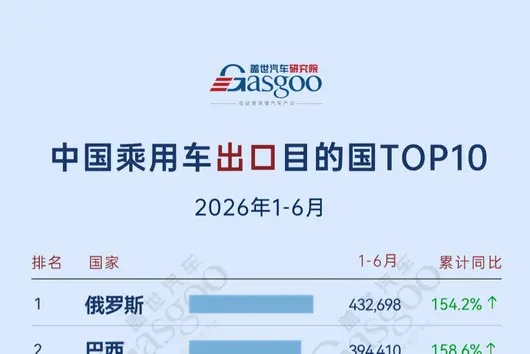
According to Gasgoo Automotive Research Institute data, in the first half of 2026, China's passenger car and new energy passenger car exports continued to maintain a growth trend, and the global market layout was further optimized. Traditional passenger car exports showed regional differentiation characteristics, with Russia and Brazil maintaining the lead, and the European market consolidating its core status; new energy passenger car exports continued the high momentum, with Brazil leading the way, while European and Asia-Pacific markets became the main growth engines. With the evolution of global market demand and the deepening of localization layout by Chinese automakers, overseas exports are moving from scale expansion to a more diversified and refined development stage.
Top 10 Destination Countries for China's Passenger Car Exports (January-June 2026)
NO.1 Russia, January-June 2026, exports of passenger cars to Russia were 432,698 vehicles, cumulative year-on-year growth of 154.2%.
NO.2 Brazil, January-June 2026, exports of passenger cars to Brazil were 394,410 vehicles, cumulative year-on-year growth of 158.6%.
NO.3 United Kingdom, January-June 2026, exports of passenger cars to the United Kingdom were 251,290 vehicles, cumulative year-on-year growth of 91.4%.
NO.4 Belgium, January-June 2026, exports of passenger cars to Belgium were 215,184 vehicles, cumulative year-on-year growth of 46.2%.
NO.5 Australia, January-June 2026, exports of passenger cars to Australia were 211,965 vehicles, cumulative year-on-year growth of 84.2%.
NO.6 Mexico, January-June 2026, exports of passenger cars to Mexico were 148,154 vehicles, cumulative year-on-year decline of 33.7%.
NO.7 Italy, January-June 2026, exports of passenger cars to Italy were 146,769 vehicles, cumulative year-on-year growth of 141.9%.
NO.8 United Arab Emirates, January-June 2026, exports of passenger cars to the United Arab Emirates were 135,713 vehicles, cumulative year-on-year decline of 36.4%.
NO.9 Spain, January-June 2026, exports of passenger cars to Spain were 115,264 vehicles, cumulative year-on-year growth of 55.0%.
NO.10 Malaysia, January-June 2026, exports of passenger cars to Malaysia were 103,745 vehicles, cumulative year-on-year growth of 38.7%.

According to Gasgoo Automotive Research Institute data, in the first half of 2026, the landscape of destination countries for China's passenger car exports adjusted further. Russia returned to the top export market with 432,698 vehicles, a year-on-year growth of 154.2%, surpassing Brazil to take the top spot, showing that the strong demand for Chinese cars in the local market is being continuously released. Brazil ranked second with 394,410 vehicles, a year-on-year growth of 158.6%. Driven by inventory buildup prior to the increase in complete vehicle import tariffs in July, it maintained high-speed growth in the first half, but with the implementation of policy adjustments, the subsequent export model may gradually transform towards KD (knock-down assembly) and local production.
From a regional distribution perspective, Europe remains the core growth pole for China's passenger car exports. The United Kingdom ranked third with 251,290 vehicles firmly, Belgium (215,184 vehicles), Italy (146,769 vehicles) and Spain (115,264 vehicles) all entered the top ten, of which Italy grew by 141.9% year-on-year, continuing the high-speed growth trend. However, the European market still faces challenges such as trade policies, anti-subsidy investigations, and intensified local competition. Future growth will rely more on brand power and local operation capabilities.
Latin American market differentiation intensified further. Brazil continued to maintain strong growth, while Mexico's export volume was 148,154 vehicles, a year-on-year decline of 33.7%, affected by tariff policy adjustments and tightening North American trade environment factors, market demand continues to be under pressure. The Middle East market also entered an adjustment phase, with United Arab Emirates exports of 135,713 vehicles, a year-on-year decline of 36.4%, high-speed growth momentum slowed down somewhat. In contrast, Asia-Pacific market maintained steady expansion, with Australia ranking fifth with 211,965 vehicles, a year-on-year growth of 84.2%, and Malaysia with 103,745 vehicles, a year-on-year growth of 38.7% first broke through 100,000 vehicles, showing Southeast Asia and Oceania markets still have considerable growth potential.
Overall, in the first half of 2026, China's passenger car exports continued to maintain high growth, but growth momentum is shifting from single market driven to multi-regional coordinated development. With changes in global trade environment and continuous promotion of local policies in various countries, Chinese automakers' overseas competition is also gradually shifting from export scale competition to comprehensive competition in brand building, channel operations and local system capabilities.
Top 10 Destination Countries for China's "New Energy" Passenger Car Exports (January-June 2026)
NO.1 Brazil, January-June 2026, exports of new energy passenger cars to Brazil were 293,032 vehicles, cumulative year-on-year growth of 158.8%.
NO.2 Belgium, January-June 2026, exports of new energy passenger cars to Belgium were 207,174 vehicles, cumulative year-on-year growth of 45.3%.
NO.3 United Kingdom, January-June 2026, exports of new energy passenger cars to the United Kingdom were 181,880 vehicles, cumulative year-on-year growth of 101.8%.
NO.4 Australia, January-June 2026, exports of new energy passenger cars to Australia were 154,305 vehicles, cumulative year-on-year growth of 199.7%.
NO.5 Germany, January-June 2026, exports of new energy passenger cars to Germany were 83,085 vehicles, cumulative year-on-year growth of 219.5%.
NO.6 Thailand, January-June 2026, exports of new energy passenger cars to Thailand were 80,914 vehicles, cumulative year-on-year growth of 84.0%.
NO.7 Italy, January-June 2026, exports of new energy passenger cars to Italy were 77,773 vehicles, cumulative year-on-year growth of 298.8%.
NO.8 South Korea, January-June 2026, exports of new energy passenger cars to South Korea were 73,940 vehicles, cumulative year-on-year growth of 161.5%.
NO.9 Spain, January-June 2026, exports of new energy passenger cars to Spain were 71,872 vehicles, cumulative year-on-year growth of 69.3%.
NO.10 United Arab Emirates, January-June 2026, exports of new energy passenger cars to the United Arab Emirates were 59,739 vehicles, cumulative year-on-year growth of 34.7%.

According to Gasgoo Automotive Research Institute data, in the first half of 2026, China's new energy passenger car exports continued to maintain high growth, and the landscape of destination countries further concentrated on European and Asia-Pacific markets. Brazil ranked first with 293,032 vehicles, a year-on-year growth of 158.8%, new energy models have become the absolute main force for Chinese car exports to the Brazilian market. Belgium and the United Kingdom ranked second and third with 207,174 vehicles and 181,880 vehicles respectively, exports to the United Kingdom exceeded 180,000 vehicles for the first time, year-on-year growth of 101.8%, while Belgium continued to play an important role as a European logistics and transshipment hub.
From a regional distribution perspective, the European market remains the core growth engine for China's new energy passenger car exports. Belgium, the United Kingdom, Germany, Italy and Spain entered the top ten, of which Germany grew by 219.5% year-on-year, Italy grew by 298.8%, and the United Kingdom also achieved double-digit growth, reflecting that Chinese new energy vehicles are continuously improving competitiveness in mainstream European markets. At the same time, European market competition will gradually shift from product introduction stage to comprehensive competition in brand, channel and local operation capabilities.
Asia-Pacific market continued rapid expansion. Australia ranked fourth with 154,305 vehicles, a year-on-year growth of 199.7%, becoming the largest new energy export market outside Europe; Thailand and South Korea exported 80,914 vehicles and 73,940 vehicles respectively, year-on-year growth of 84.0% and 161.5%, showing that Chinese new energy vehicles' penetration rate in Southeast Asian and Northeast Asian markets continues to improve. In the Middle East market, United Arab Emirates exported 59,739 vehicles, year-on-year growth of 34.7%, maintaining steady growth, but growth rate slowed somewhat compared to before.
Overall, in the first half of 2026, China's new energy passenger car exports continued to maintain high momentum, and market coverage extended from emerging economies to traditional automotive powerhouses. With continuous improvement of product competitiveness and global channels, local systems continuously improving, Chinese new energy vehicles are accelerating from scale expansion to high-quality globalization development.

On July 25, 2026, Chengdu Science Fiction Hall. Chery Group's global cumulative total vehicle sales broke through 20 million units, and this 20 millionth unit delivered was exactly Chery's "First-generation IP" — Fengyun. From the first "Fengyun" coming off the line in Wuhu in December 1999 to the delivery of the Fengyun A9 as the 20 millionth unit in 2026, Chery completed a highly symbolic loop over 29 years.

"After 20 million units, we will no longer participate in involution." The weight of this statement by Chery Automobile Chairman Yin Tongyue can only be truly understood when placed within Chery's 29-year entrepreneurial coordinate system.
· From "Grass Hut" to 20 Million: A Turnaround Curve of Independent R&D

In March 1997, Chery's "Engine Plant No. 1" broke ground on a barren beach north of Wuhu City, driving the first stake. At that time, two sentences circulated in the Chinese auto industry: "Without joint ventures, there is no way out; without a scale of over a million units, do not talk about independent R&D."
Chery simply refused to believe this. In May 1999, the first independently developed engine fired successfully on the first attempt, breaking the prejudice that "Chinese people cannot make independent engines"; in December 1999, the No. 000001 "Fengyun" sedan rolled off the line, starting the "from 0 to 1" of independent car making; in October 2001, the first batch of 10 Fengyuns were exported to Syria via Tianjin Port, starting the precedent of mass export of Chinese sedans; in August 2007, the 1 millionth vehicle came off the line, becoming the first independent brand to cross the "million-unit threshold"; in December 2015, the 5 millionth vehicle came off the line; in 2025, Chery listed on the HKEX; on July 25, 2026, global cumulative sales exceeded 20 million units.

From taking 16 years for the first 5 million units to less than 3 years for the third 5 million units—the steepening of the sales curve reflects a trajectory of the technical system leaping from following to leading. Nowadays, Chery's technical reserves extend to multiple cutting-edge fields such as cells, chips, intelligent driving, solid-state batteries, flying cars, and humanoid robots; the "joint venture fate theory" and "scale threshold theory" crumble before tangible development results.
· Whole Vehicles and Parts: A Global Competitiveness Sample of Wuhu's "Auto City"

In 2001, the first batch of 10 Fengyun sedans from Chery were exported to the Middle East. 25 years later today, Chery's cumulative exports have approached 7 million units, ranking first in China for 23 consecutive years in passenger car brand exports, with overseas users exceeding 6.23 million.
But Chery's "whole vehicle" story has never been fighting alone. In Wuhu, Anhui, Chery has driven nearly 4,000 parts supporting enterprises to form an automotive industry cluster with global competitiveness. From the ACTECO series engines to Continuously Variable Transmissions (CVT), from the "Kunpeng Power CHERY POWER" full-domain power architecture to the full-function hybrid configuration DHT, Chery possesses production capabilities for powertrains with fully independent intellectual property rights.
More worthy of mention is that Chery is also at the forefront of parts exports — in March 2006, the first batch of Chery engines were exported to the United States, pioneering the reverse entry of China's core auto parts into the European and American markets. This dual-line export path of "whole vehicles + parts" is the key background distinguishing Chery from other independent brands.
· Finance and Capital: "Ammunition Restructuring" After HKEX Listing

In 2025, Chery listed on the HKEX, a key leap in Chery's development history. From independent entrepreneurship to an industrial financial group ringing the bell at the HKEX, Chery's capital operation capabilities themselves are a sample of the maturity of China's automotive industry.
Yin Tongyue clearly stated that the funds raised from the HKEX listing are mainly used for R&D, overseas business, and investment layouts targeting future mobility, focusing on four major sectors: electrification, intelligence, AI, and lightweighting. This marks Chery's shift from "self-sustaining" to a new stage of dual-wheel drive of "industrial capital + financial capital".
· Intelligent Technology and Humanoid Robots: Chery's "Second Stake"

On March 18, 2025, at the Chery Intelligent Strategy Conference, Yin Tongyue made a statement repeatedly quoted in the industry: "28 years ago we drove the first stake for building the factory; today we must drive the second stake — the stake for AI intelligence."
Eagle Intelligent Driving achieved full brand and model coverage in 2025; the first mass-produced end-to-end L4 intelligent driving system "Eagle Robocar" has been unveiled; Mo-Jia Humanoid Robots, Chery layouts in the humanoid robot field, extending from making cars to making robots; during the 2026 Beijing Auto Show, deep strategic cooperation was reached with NVIDIA (Intelligent Driving Computing Power), Bosch (Electrical Architecture), Qualcomm (Cockpit Chips), Volcengine (Cloud Large Model), CATL (Energy Supplement Network), shifting from "Client-Contractor" to "Joint Definition".
· Ecosystem Export: From "Selling Cars" to "Becoming a Local Member"

In the first half of 2026, Chery Group exported 943,800 units, a year-on-year surge of 71.5%, breaking China's car company monthly export records for four consecutive months, with one Chery vehicle shipping overseas every 17 seconds on average. But behind the numbers, what deserves to be written is the iteration of Chery's export philosophy — "In somewhere, For somewhere, Be somewhere" (Wherever, For wherever, Be a local member).
First is R&D localization. Building a global "1+7+N" collaborative innovation network, 8 major global R&D centers; in April 2026, the first overseas regional operation center in Barcelona, Spain was launched, with the Spanish Research Institute started simultaneously. Second is manufacturing localization. Cooperation with Spanish EV MOTORS to revive the EBRO brand; South Africa localization production project expected to launch the first model in 2027. Then is talent localization. International talent employees exceed 20,000, localization staff ratio reaches 85%. Finally is market premiumization. Chery has entered 18 European national markets, Q1 2026 European export volume 90,579 units, year-on-year growth 170%; Jaecoo brand became the fastest-growing car brand in the UK in 2025 over the past ten years.
True globalization is by no means simply product export, but the full ecosystem integration of "R&D, Manufacturing, Brand, Culture". Chery is moving from "Trade Export" to "Ecosystem Rooting" — this is the latest footnote Yin Tongyue wrote for globalization.
· Social Responsibility: Treating ESG as a "Required Course" for Globalization

In the "Chery Automobile 2025 ESG Report", Chery clearly proposed the goal of achieving carbon neutrality in its own operations by 2037 and carbon neutrality in the entire value chain by 2047. Currently, the proportion of green electricity in Chery's vehicle base exceeds 52%, and independently developed recycled low-carbon aluminum alloy technology can significantly reduce carbon emissions over the full life cycle.
Even warmer is Chery's "Business for Good". Renewed global cooperation with UNICEF, pledging to continue investing $6 million to promote global education progress; previous cooperation has helped nearly 40 million teenagers worldwide access quality education; Cooperated with IUCN to carry out Spain Marine Ecological Restoration and Malaysia Mangrove Protection projects; In 2024, partnered with 10 core suppliers to release the "Chery Automobile Sustainable Supply Chain Initiative", included in "Fortune" "China ESG Impact List" for two consecutive years, and became the only automotive enterprise selected in the "2024-2025 Forbes China Sustainable Development Industrial Enterprise" selection.
As Yin Tongyue said, Chery's globalization insight is — "Go to places others cannot go, dare not go, and are unwilling to go". And this long-termism has also earned the two-way rush of "Going wherever, creating value for the locals".
In 2027, Chery will welcome its "30th Anniversary". From the first Fengyun coming off the line in 1999 to the delivery of the Fengyun A9 as the 20 millionth unit in 2026 — this "Long-range smart and beautiful pure electric coupe" carries Chery's first-generation global model iteration upgrade results, and is also the new starting point for Chery's "Setting off towards beauty". It completely completes the Fengyun New Energy Series Plug-in Hybrid, Extended Range, Pure Electric three major power routes, marking the full implementation of Chery Electrification 2.0.
29 years, Chery stepped precisely on the two major historical turning points of China's automotive industry from "Market for Technology" to "Technology Export", from "Product Export" to "Ecosystem Export". 20 million units is not the end, but a brand new starting line for Chery to move from "China's Automobiles" to "Global Automobiles".

喺馬來西亞嘅 SUV 市場,好多買家喺揀車嘅時候都會拿 Proton X50 同 Chery Tiggo 7 Pro 嚟比較。呢兩款車喺價位同定位上都幾接近,而家我哋就由多個方面做一個詳細嘅比較,幫大家省返做功課嘅時間。
Proton X50 喺馬來西亞嘅 OTR 售價係 RM 89,800 - 113,300,一共有 4 個版本,包括 1.5T Executive(RM 89,800)、1.5T Premium(RM 101,800)、1.5T Flagship(RM 113,300) 等。
Chery Tiggo 7 Pro 喺馬來西亞嘅 OTR 售價係 RM 123,750 - 123,750,一共有 2 個版本,包括 1.6L Turbo Standard(RM 125,000)、1.6L Turbo Premium(RM 140,000) 等。
由價錢嚟睇,Proton X50 嘅起步價確實比 Chery Tiggo 7 Pro 平咗 RM 33,950。如果你預算有限,Proton 嘅入門版已經可以滿足日常需要。但都要留意,平嗰幾千蚊,可能喺配備上面會有取舍,具體睇返你嘅需要。

Proton X50 嘅安全評級係 5★ (ASEAN NCAP),主動安全系統包括 ADAS (ACC, AEB, LKA, LDA, BSM, RCTA)。
Chery Tiggo 7 Pro 嘅安全評級係 TBD,主動安全系統包括 Basic。
安全配備方面,兩款車都拿到唔錯嘅評級。不過 Proton X50 嘅 ADAS (ACC, AEB, LKA, LDA, BSM, RCTA) 同 Chery Tiggo 7 Pro 嘅 Basic 喺功能上面有些差異,如果你比較重視主動安全嘅話,可以仔細對比一下兩者嘅功能列表。

Proton X50 車身長 4400 mm,後車廂 400 L。
Chery Tiggo 7 Pro 車身長 4400 mm,後車廂 400 L。
兩款車嘅尺寸幾乎一樣,車內空間分別唔大。呢個級別嘅車,日常使用完全夠用。

Proton X50 保養 5 年/150,000km,保養間隔 每 10,000km 或 6 個月。
Chery Tiggo 7 Pro 保養 3 年/100,000km,保養間隔 每 10,000km 或 6 個月。
Proton X50 同 Chery Tiggo 7 Pro 都係馬來西亞市場嘅主流選擇,適合家庭使用、日常通勤。如果你更加重視品牌口碑同二手價,可以優先考慮口碑更好嗰一款;如果你更加在意性價比同配備,就揀配置更豐富嗰款。最後都建議兩款都去試駕,親身體驗先至最重要。
總體嚟講,Proton X50 同 Chery Tiggo 7 Pro 都係馬來西亞市場唔錯嘅車型。揀邊部,關鍵都係睇返你嘅個人需求同預算。建議大家做好功課,多比較幾間車行嘅報價,再去試駕先做最終決定。買車係件大事,花少少時間做功課絕對唔會錯。

This year is a milestone year for Chinese automakers going global. According to new car sales statistics from the European Automobile Manufacturers Association, in May, sales of Chinese brand cars in Europe surpassed Japanese brands for the first time.
Following this, SAIC Group also sparked a wave of enthusiasm in the UK. On July 8, SAIC MG held a technology conference in London, bringing the most cutting-edge intelligent and electric technology back to the brand's birthplace; On July 9, SAIC MG appeared at the Goodwood Festival of Speed, where two concept cars, the two-door electric compact MG Go! and the coupe SUV Cyber Concept, shone brightly. The heritage of a century-old brand and the strength of a technological ace sparked sparks, as Chinese automakers ignite the global automotive market with intelligent and electric innovation technologies.

Scene of MG UK Technology Conference
At the same time, SAIC's overseas market also submitted an excellent half-year exam report: Sales overseas in June reached 146,000 vehicles, a year-on-year surge of 61.2%, setting a historical high. In the first half of this year, SAIC's overseas market cumulative sales reached 735,000 vehicles, a strong increase of 48.7% year-on-year, ranking among the leaders in the industry. Driven by the "Glocal Strategy", SAIC is transforming from selling cars to full-chain global expansion, continuously deepening overseas value chain construction.
Comprehensive Technological Advancement, Polishing the Product Name Card
At the technical brand level, SAIC is systematically building global intelligent labels for "Hybrid+ Hybrid Technology", "SolidCore Solid/Semi-Solid Battery Technology", and "i-Smart Intelligent Driving Technology". At the UK technology conference, the MG brand showcased MG Plug-in Hybrid+ Hybrid, SolidCore Semi-Solid Battery, and MG Parking Smart Cockpit and Assistive Driving. In addition, MG became the first automotive brand globally to achieve mass production of semi-solid batteries; The IM AD intelligent driving system of IM Motors has covered five continents globally; The global activation volume of the overseas travel i-Smart system has exceeded one million.

Scene of MG UK Technology Conference
At the Goodwood Festival of Speed, the MG brand unveiled globally two concept models: the two-door electric compact MG Go! and the coupe SUV Cyber Concept, stunning the entire audience. The design inspiration for the two models comes from MGB GT, MG 6 R4 Group B Rally Cars, MG EX181 Streamlined Racing Cars, and other classic brand models, showcasing brand heritage and future vision.

MG GO! Concept Car

MG Cyber Concept Concept Car
At the product implementation level, SAIC will achieve massive product global deployment in the next three years: Full powertrains cover ICE, HEV, PHEV, EV four forms, adapting to energy policies and consumption habits of various countries; At the same time, SAIC is creating over ten new overseas models including SUV, sedan, MPV, pickup, comprehensively covering household, commuting, high-end driving, long-distance travel, outdoor and other full scenario needs, connecting global mainstream market segments.
From Frankfurt to London, from technology exhibitions to runways, SAIC MG advances in leaps and bounds, showcasing a new name card of Chinese intelligent manufacturing to the world with more cutting-edge technology and newer models.
Deepening Regional Markets, Serving Global Users
While technology sails overseas, the pace of SAIC deepening the global market is also accelerating. Currently, SAIC's products and services cover over 170 countries and regions worldwide, forming 1 "300,000-class" market (Europe) and 5 "50,000-class" markets (Americas, Middle East, Australia & New Zealand, ASEAN, South Asia), with overseas cumulative sales exceeding 7 million vehicles.
Europe is SAIC's largest overseas market. The MG brand has won the "Chinese Brand European Sales Champion" for 11 consecutive years and has become the first Chinese automotive brand to exceed 1 million cumulative sales in Europe. In the first half of this year, MG brand sales in Europe exceeded 190,000 vehicles, a year-on-year growth of over 20%. On July 1, MG brand established a direct sales company in Belgium and Luxembourg, which is also an important step for SAIC to implement the "Glocal Strategy" and take root in local Europe. From leading Chinese automotive brands in sales scale to deepening the European market and building long-term user relationships, MG is realizing a transformation from "selling cars" to "managing", thereby better improving service capabilities, listening to customer needs, achieving agile responses to market dynamics, and precise control of customer experiences.

MG Brand Appears at Goodwood Festival of Speed
Not only in Europe, SAIC is blooming in multiple points globally by continuously deepening local markets. In Thailand, the MG brand launched the new service strategy "MG SMILE" in May, solving local user concerns such as price transparency, dealer commitment fulfillment, and consumer rights protection with a full-process service standard system, and providing lifetime warranty for three-electric systems for pure electric models. With the support of new service standards and lifetime warranty policies, the new MG URBAN went on sale in Thailand on June 24, bringing high-quality products and services of Chinese intelligent manufacturing to more Thai users.

MG URBAN
In Central Asia, in June this year, multiple models such as SAIC Volkswagen Tiguan L Pro, Passat Pro, Teramont X, Teramont Pro, T-Roc New, Lavida New entered the Uzbekistan market, achieving the "zero breakthrough" for SAIC Volkswagen in the Central Asian market. Previously, the SAIC Group Almaty MG Flagship Store officially opened in April this year, SAIC joined hands with Allur, Kazakhstan's largest automotive production and assembly enterprise to achieve localized production and model adaptation for customer needs. The two brands join hands to explore the Central Asian map, providing more intelligent models and higher-level services for local consumers.
Good news also came from the commercial vehicle sector. Recently, SAIC Hongyan formally reached a strategic cooperation agreement with a top port major customer in Thailand for 1,000 new energy heavy trucks. The first batch of complete vehicles has completed packing and boarded ships in batches, setting off from domestic production bases to Thailand. This also marks that SAIC Hongyan, relying on independent core three-electric technologies, full-scenario customization capabilities, and a comprehensive overseas local service system, breaks the monopoly of foreign brands in the Thai heavy truck market, showcasing the complete industrial chain of Chinese commercial vehicles and the hard power of green intelligent manufacturing to the world.
From monthly sales breaking the best historical record to technology label formation and localization deepening landing, behind SAIC's overseas market report card is the systemic effectiveness of the Glocal Strategy "Global Automotive Brand + Localized System Ecosystem". Facing the future, SAIC will continuously accelerate the transformation from complete vehicle overseas to value chain overseas, writing a new chapter of Chinese intelligent manufacturing in the global automotive industry landscape.

In the Malaysian SUV market, many buyers compare the Perodua Aruz and Proton X50 when choosing a car. These two cars are quite close in price and positioning. Today, we will make a detailed comparison from multiple aspects to save you the time of doing research.
The OTR price of Perodua Aruz in Malaysia is RM 72,900 - 77,900, with a total of 2 versions, including 1.5L X (RM 72,900), 1.5L AV (RM 77,900), etc.
The OTR price of Proton X50 in Malaysia is RM 89,800 - 113,300, with a total of 4 versions, including 1.5T Executive (RM 89,800), 1.5T Premium (RM 101,800), 1.5T Flagship (RM 113,300), etc.
From a price perspective, the starting price of Perodua Aruz is indeed RM 16,900 cheaper than Proton X50. If your budget is limited, Perodua's entry-level version is already sufficient for daily needs. However, be aware that the few thousand ringgit difference might involve trade-offs in equipment, depending on your specific requirements.

Perodua Aruz safety rating is 5★ (ASEAN NCAP), active safety systems include .
Proton X50 safety rating is 5★ (ASEAN NCAP), active safety systems include ADAS (ACC, AEB, LKA, LDA, BSM, RCTA).
The safety ratings for both cars are the same, and safety features in this segment are quite comprehensive. New cars nowadays generally have good safety, so there is no need to worry too much about this point.

Perodua Aruz uses FWD drive type.
Proton X50 uses 4WD drive type.
Perodua's FWD and Proton's 4WD will have different handling experiences, test drive comparison is recommended.

Perodua Aruz warranty is 5 years/150,000km, maintenance interval every 10,000km or 6 months.
Proton X50 warranty is 5 years/150,000km, maintenance interval every 10,000km or 6 months.
The warranty conditions for both cars are the same, no need to worry about this aspect. Actual maintenance costs also depend on the brand's service network and parts prices, it is recommended to ask real owners in car enthusiast groups for experience.

Overall, both Perodua Aruz and Proton X50 are very good models in the Malaysian market. Which one to choose ultimately depends on your personal needs and budget. It is recommended to do your homework, compare quotes from multiple car dealers, and then go for a test drive to make a final decision. Buying a car is a big matter, spending some time doing research will never be wrong.

喺馬來西亞嘅 SUV 市場,好多買家揀車嗰陣都會拿寶迪亞 Ativa 同豐田 Yaris Cross 嚟比較。呢兩款車喺售價同定位上都幾接近,今日我就從多個方面做個詳細嘅比較,幫你省返做功課嘅時間。
寶迪亞 Ativa 喺馬來西亞嘅 OTR 售價係 RM 62,500 - 73,400,一共有 3 個版本,包括 1.0L Turbo X(RM 62,500)、1.0L Turbo H(RM 67,300)、1.0L Turbo AV(RM 73,400) 等。
豐田 Yaris Cross 喺馬來西亞嘅 OTR 售價係 RM 99,900 - 109,900,一共有 2 個版本,包括 2026 1.5L Standard(RM 99,900)、2026 HEV 1.5L Standard(RM 109,900) 等。
由價錢睇,寶迪亞 Ativa 嘅起步價真係比豐田 Yaris Cross 平咗 RM 37,400。如果你預算有限,寶迪亞嘅入門版已經可以滿足日常需要。但要留意,平嗰幾千蚊,可能喺配備方面有取捨,具體就要睇你嘅需求。

寶迪亞 Ativa 嘅安全評級係 5★ (東協 NCAP),主動安全系統包括 ASA 3.0 + ACC + LDA + LKA + BSM + RCTA。
豐田 Yaris Cross 嘅安全評級係 5★ (東協 NCAP),主動安全系統包括 TSS。
兩款車嘅安全評級一樣,喺呢個級別入面安全配備都算好齊全。依家新車嘅安全性都唔差,唔使太擔心呢一點。

寶迪亞 Ativa 採用 FWD 驅動方式。
豐田 Yaris Cross 採用 FWD 驅動方式。
兩款車嘅驅動方式一樣,都係 FWD,日常駕駛感受唔會有太大分別。

寶迪亞 Ativa 同豐田 Yaris Cross 都係馬來西亞市場嘅主流選擇,適合家庭使用、日常通勤。如果你更睇重品牌口碑同二手價,可以優先考慮口碑更好嗰款;如果你更在意性價比同配備,就揀配備更豐富嗰款。最終都建議兩款都去試駕,親身體驗先至最重要。

總體嚟講,寶迪亞 Ativa 同豐田 Yaris Cross 都係馬來西亞市場好唔錯嘅車款。揀邊一輛,關鍵都要睇你嘅個人需求同預算。建議大家做好功課,多比較幾間車行嘅報價,再去試駕做最終決定。買車係件大件事,花少少時間做功課肯定無錯。

In the SUV market in Malaysia, many buyers compare Perodua Ativa and Proton X90 when choosing a car. These two cars are quite close in price and positioning. Today we will do a detailed comparison from multiple aspects to help you save time on research.
Perodua Ativa OTR price in Malaysia is RM 62,500 - 73,400, there are 3 versions in total, including 1.0L Turbo X (RM 62,500), 1.0L Turbo H (RM 67,300), 1.0L Turbo AV (RM 73,400) etc.
Proton X90 OTR price in Malaysia is RM 106,800 - 122,800, there are 4 versions in total, including 2026 1.5T Prime X (RM 122,800), 2026 1.5T Prime (RM 116,800), 2026 1.5T Lite (RM 106,800) etc.
From a pricing perspective, the starting price of Perodua Ativa is indeed RM 44,300 cheaper than Proton X90. If your budget is tight, Perodua's entry-level model can already meet daily needs. However, keep in mind that the Ringgit savings of a few thousand might involve compromises on features, which depends on your specific requirements.

Perodua Ativa is equipped with 1.5L 4-cyl, horsepower 105 hp. Official fuel consumption 6.0 L/100km.
Proton X90 is equipped with 1.5L Turbo, horsepower 140 hp. Official fuel consumption 7.0 L/100km.
Regarding power, Proton X90's 1.5L Turbo has 35 more horsepower than Perodua Ativa's 1.5L 4-cyl. However, for daily driving in the city, the power of both cars is sufficient and you won't feel underpowered.

Perodua Ativa safety rating is 5★ (ASEAN NCAP), active safety systems include ASA 3.0 + ACC + LDA + LKA + BSM + RCTA.
Proton X90 safety rating is 5★ (ASEAN NCAP), active safety systems include ADAS (ACC, AEB, LKA, LDA, BSM, RCTA).
Both cars have the same safety rating, safety features are quite complete within this class. New cars nowadays don't lack in safety, no need to worry too much about this.

Perodua Ativa body length 4400 mm, trunk 400 L.
Proton X90 body length 4400 mm, trunk 400 L.
Both cars' dimensions are almost the same, interior space difference is not significant. For this class of cars, it is fully sufficient for daily use.

Perodua Ativa adopts FWD drive mode.
Proton X90 adopts FWD drive mode.
Both cars have the same drive mode, both are FWD, daily driving experience will not differ significantly.

Overall, Perodua Ativa and Proton X90 are both very good models in the Malaysian market. Choosing which one depends mainly on your personal needs and budget. It is recommended to do your research, compare quotes from multiple dealerships, and then test drive to make a final decision. Buying a car is a big matter, spending time doing research will definitely not be wrong.

喺馬來西亞嘅轎車市場,好多買家喺揀車嘅時候都會拿 Lexus LS 同 Porsche Panamera 嚟做比較。呢兩款車喺價位同定位上都幾接近嘅,今日我哋就從多個方面做一個詳細比較,幫你省返做功課嘅時間。
Lexus LS 喺馬來西亞嘅 OTR 售價係 RM 1,250,000 - 1,531,000,合共有 2 個版本,包括 2021 500 Executive Kiriko(RM 1,531,000)、2021 500 Luxury(RM 1,250,000) 等等。
Porsche Panamera 喺馬來西亞嘅 OTR 售價係 RM 1,340,000 - 1,340,000,合共有 2 個版本,包括 2026 Panamera 2.9T(RM 1,340,000)、DCT(RM 1,200,800) 等等。
從價錢嚟睇,Lexus LS 嘅起步價的確比 Porsche Panamera 平咗 RM 90,000。如果你預算有限,Lexus 嘅入門版已經可以滿足日常需要。但都要注意,平嗰幾千塊,可能喺配備上會有取舍,具體要看你嘅需要。

Lexus LS 採用 FWD 驅動方式。
Porsche Panamera 採用 FWD 驅動方式。
兩款車嘅驅動方式一樣,都係 FWD,日常駕駛感受唔會有太大分別。

Lexus LS 保修 3 年/100,000km,保養間隔 每 10,000km 或 6 個月。
Porsche Panamera 保修 3 年/100,000km,保養間隔 每 10,000km 或 6 個月。
兩款車嘅保養條件一樣,呢方面唔使糾結。實際保養成本仲要睇品牌嘅服務網絡同零件價格,建議去車友群問吓真實車主嘅經驗。

Lexus LS 同 Porsche Panamera 都係馬來西亞市場嘅主流選擇,適合家庭使用、日常通勤。如果你更睇重品牌口碑同二手價,可以優先考慮口碑更好嗰一款;如果你更在意性價比同配備,那就揀配置更豐富嗰款。最終都建議兩款都去試駕,親身體驗先係最重要嘅。

總體嚟講,Lexus LS 同 Porsche Panamera 都係馬來西亞市場幾唔錯嘅車型。揀邊一輛,關鍵仲係要睇你嘅個人需要同預算。建議大家做好功課,多比較幾間車行嘅報價,再而去試駕做最終決定。買車係件大事,花啲時間做功課絕對唔會錯。