首頁智能

搜尋歷史
熱門搜尋
經銷商登入 / 註冊





喺馬來西亞嘅 SUV 市場,好多買家喺揀車嗰陣都會拿 Proton X50 同 GWM Haval H6 做比較。呢兩部車喺價位同定位上都幾接近,今日我哋就由多個方面做一個詳細比較,幫你省返做功課嘅時間。
Proton X50 喺馬來西亞嘅 OTR 售價係 RM 89,800 - 113,300,一共 4 個版本,包括 1.5T Executive(RM 89,800)、1.5T Premium(RM 101,800)、1.5T Flagship(RM 113,300) 等。
GWM Haval H6 喺馬來西亞嘅 OTR 售價係 RM 139,750 - 139,750,一共 2 個版本,包括 1.5L Turbo Standard(RM 140,000)、1.5L Turbo Premium(RM 155,000) 等。
由價錢睇落,Proton X50 嘅起步價確實比 GWM Haval H6 平咗 RM 49,950。如果你預算有限,Proton 嘅入門版已經滿足日常需要。但亦都要留意,平嗰幾千蚊,喺配備上可能會有取舍,具體就要睇你嘅需求。

Proton X50 搭載 1.5L 4-cyl,馬力 105 hp。官方油耗 6.0 L/100km。
GWM Haval H6 搭載 Hybrid,馬力 170 hp。官方油耗 4.5 L/100km。
動力方面,GWM Haval H6 嘅 Hybrid 比 Proton X50 嘅 1.5L 4-cyl 多咗 65 匹馬力。不過日常喺市區開,兩部車嘅動力都夠用,唔會覺得唔夠力。

Proton X50 嘅安全評級係 5★ (ASEAN NCAP),主動安全系統包括 ADAS (ACC, AEB, LKA, LDA, BSM, RCTA)。
GWM Haval H6 嘅安全評級係 TBD,主動安全系統包括 Basic。
安全配備方面,兩部車都拿到唔錯嘅評級。不過 Proton X50 嘅 ADAS (ACC, AEB, LKA, LDA, BSM, RCTA) 同 GWM Haval H6 嘅 Basic 喺功能上有少少分別,如果你比較重視主動安全嘅話,可以仔細比一下兩者嘅功能列表。

Proton X50 車身長 4400 mm,尾箱 400 L。
GWM Haval H6 車身長 4400 mm,尾箱 400 L。
兩部車嘅尺寸幾乎一樣,車廂空間差別唔大。呢個級別嘅車,日常使用完全夠用。
Proton X50 同 GWM Haval H6 都係馬來西亞市場嘅主流選擇,適合家庭使用、日常通勤。如果你更加重視品牌口碑同二手價,可以優先考慮口碑更好嗰部;如果你更加在意性價比同配備,那就揀配備更豐富嗰部。最後始終建議兩部都去試駕,親身體驗先至係最重要。
總括嚟講,Proton X50 同 GWM Haval H6 都係馬來西亞市場幾唔錯嘅車型。揀邊一部,關鍵都要睇你嘅個人需要同預算。建議大家做好功課,多比較幾間車行嘅報價,再去試駕做最後決定。買車係件大事,花少少時間做功課絕對唔會錯。




According to Thai media reports, the Federation of Thai Industries (FTI) and the Thailand Automotive Industry Association (TAIA) recently jointly urged the government to formulate more complete local parts policies in the future, encouraging or even requiring electric vehicle manufacturers to prioritize components produced by local suppliers when manufacturing in Thailand, rather than relying heavily on imports.

Currently, including Chinese brands such as BYD, Great Wall, MG, AION, and Changan, have already set up production bases in Thailand, and some models have even started CKD assembly locally. However, industry observers point out that many key parts are still imported from China, making it difficult for traditional Thai auto parts suppliers to truly benefit.
FTI Chairman Suwat Supakandechakul stated that Thailand already has the capability to produce many auto parts, including car seats, wiring harnesses (Wiring Harness), windshields, and other products, and local suppliers are fully capable of meeting factory needs. If these parts can be prioritized for Thailand manufacturing, it not only reduces overall production costs but also allows the local parts industry to gain greater development space.

In addition, he also suggested that the government could provide tax incentives (Tax Deduction) and other reward measures for factories with a higher proportion of local parts used, further encouraging factories to increase their localization rate, and even hoped that in the future, even high-value parts like chassis (Chassis) could be gradually realized for local production.
Besides supporting the local supply chain, Thailand's automotive industry also worries about the continuous changes in the international trade environment. Industry observers point out that the US has continued to strengthen inspections on "transshipment (Transshipment)" in recent years. If products exported to the US have most parts still from China and only assembled in Thailand, they may face stricter tariff inspections in the future, even affecting export competitiveness.
Therefore, increasing the proportion of local parts usage can not only strengthen Thailand's automotive industry competitiveness but also help reduce future international trade risks. On the other hand, the Thailand Automotive Industry Association (TAIA) also submitted several suggestions to the government, including adjusting the consumption tax policy for imported electric vehicles (CBU) to protect the local manufacturing industry.

At the same time, the association also suggested that the government could provide individual income tax incentives for consumers who purchase Thai-assembled cars, encouraging more consumers to choose locally produced models. In addition, government departments should also prioritize Thai-assembled electric vehicles when procuring official vehicles in the future to further drive market demand.
In fact, Chinese brands have invested heavily in Thailand in recent years, not only driving the location to become one of the most important EV production bases in Southeast Asia but also attracting a large number of related industries to move in. However, for the Thai government and local industries, the true goal is not merely to attract factory setup, but to hope these investments can further drive local supply chain growth, benefiting more Thai parts factories, component suppliers, and related employment opportunities.

If the government formally promotes stricter localization policies in the future, Chinese brands will inevitably need to further expand cooperation with local Thai suppliers and increase the proportion of parts procurement, which may become an important direction for Thailand's EV industry development in the future.
It is worth noting that this policy currently still belongs to suggestions proposed by industry groups to the government, not formal regulations. However, with Thailand continuing to promote automotive industry upgrades, whether more clear localization standards will be formulated in the future will become the focus of major factory owners.

In May, China's automotive market overall presented a gentle recovery trend, with domestic brands still being the sales backbone of the market. Recently, BYD, Geely, Chery, Changan, and Great Wall, the top 5 domestic automakers, successively released their monthly performance reports. From the data, these five companies show a general characteristic of "stable total growth, divergence between domestic and international markets, and accelerated new energy penetration". Overseas exports and new energy vehicles have become the most core growth engines; export business has evolved from a "bonus item" to the "core foundation" for some companies. BYD's "dominant leader" status is further consolidated, Chery achieved high growth via exports, Geely's new energy penetration rate broke 56%, Changan focused steadily on balanced development, while Great Wall appeared slightly under pressure during structural transformation.
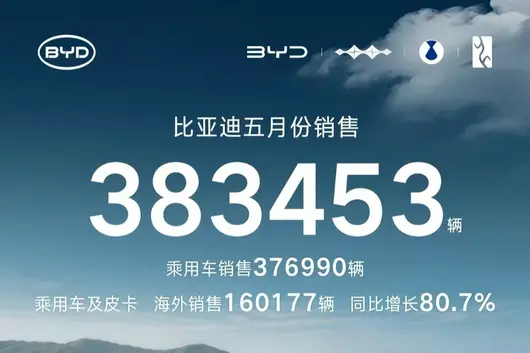
BYD: Export Hits New High Becomes Biggest HighlightIn May, BYD stood firmly at the top of domestic brands with a monthly sales volume of 383,500 vehicles, maintaining positive growth both year-on-year and month-over-month under a large base. Its two main brands, Dynasty and Ocean, sold a combined 330,200 vehicles, contributing 86.1% of total sales; Fangchengbao's monthly sales broke 30,000 units to reach 30,200, a year-on-year increase of 139.7%, setting a new high for the year; Denza sold 16,300 vehicles, and Yangwang delivered 286 vehicles. From a model perspective, BYD had eight models in May with monthly sales exceeding 20,000 vehicles. The Song Family and Yuan Family both broke 50,000 units, selling 51,370 and 56,691 vehicles respectively. The Sea Lion Family followed closely with 42,615 vehicles, and Seagull sales were also close to 40,000 vehicles.

BYD's biggest highlight in May was exports. Overseas new energy vehicle sales reached 160,600 units, an 80.4% year-on-year increase, accounting for about 42%. The sharp expansion of export scale effectively countered the phased weakness in domestic demand. Cumulative exports from January to May exceeded 620,000 vehicles. High export growth mainly benefited from continued ramping up of overseas factory capacity, improved ocean shipping capacity, and accelerated channel network expansion. In the domestic market, BYD promoted Megawatt Super Charging and intelligent strategies simultaneously—Megawatt charging achieved about 90% charge in 9 minutes; 20,000 super charging stations are planned to be built by 2026; all series models are available with Sky Eye B intelligent driving solutions and city navigation safety fallback plans, accelerating the popularization of high-level intelligent driving. As Gen 2 Blade Battery capacity gradually releases, the company's orders are expected to continue rising.
Chery: Sales Growth Leads the Top 5Chery Group's total sales volume in May was 247,800 vehicles, a significant year-on-year increase of 20.5%, ranking first in growth speed among the top 5. Exports remained its most core growth engine—May exports reached 181,900 vehicles, an 80.5% year-on-year increase, accounting for 73.4% of total sales that month, continuously breaking the single-month export record for Chinese brands for three months. In terms of new energy, Chery New Energy sold 100,300 vehicles, a 58.8% year-on-year increase. April and May consecutively saw monthly new energy sales breaking 100,000 vehicles.

The strong performance in exports benefited from Chery's long-term deep cultivation of overseas channel advantages and localized operation capabilities. While overseas orders continued to rise, high export growth formed a sharp contrast with domestic sales—Chery's domestic sales in May were only 60,000 vehicles, accounting for one-quarter of total sales. From cumulative data, Chery Group accumulated 1.101 million sales from January to May, but against the annual goal of 3.2 million vehicles, monthly averages need to reach about 420,000 vehicles later, and pressure remains significant.
Geely: New Energy Penetration Rate Breaks 56%Geely Auto's total sales volume in May was 237,600 vehicles, a 1% year-on-year increase, achieving month-over-month double growth for three consecutive months. In terms of structure, Geely's "New Four Transformations" transformation showed significant results: new energy vehicle sales reached 133,400 units, accounting for 56% of total sales, with new energy share exceeding 50% for four consecutive months.

From sub-brands, performance was significantly divergent. Zeekr brand sales in May reached 34,400 vehicles, a 82% year-on-year increase; Zeekr 9 Series and 8 Series models combined sales approached 50% of total sales, showing bright performance in the high-end market; Galaxy brand sales were 81,700 vehicles; Geely brand sales were 182,500 vehicles, among which China Star Series sales reached 100,800 vehicles; Lynk & Co brand sales were 20,700 vehicles, with new energy vehicle sales share rising to 71%.
In terms of exports, Geely's overseas vehicle exports in May reached 85,100 vehicles, a explosive 184% year-on-year increase, setting a brand single-month export record high. Among exported products, new energy vehicles reached 40,800 units, accounting for nearly half; hybrid and pure electric products have successively landed in Southeast Asia, Middle East, Latin America, and other markets, highlighting the results of global strategy implementation.
Changan: Multi-brand Matrix Balanced EffortChangan Auto's delivery volume in May was 209,100 vehicles, among which new energy deliveries were 92,400 vehicles, a 5.8% year-on-year increase, with new energy share about 44%. In terms of exports, overseas deliveries reached 70,700 vehicles, a 38% year-on-year increase, becoming another major growth highlight for Changan in May.
In the sub-brand matrix, Changan Qiyuan delivered 34,500 vehicles in May; All-New Q05 delivered 15,800 units, with orders breaking 3,000 units within three days of listing in Thailand; Deepal sales in May were 33,200 vehicles, a 30% year-on-year increase; January to May overseas cumulative sales were 28,700 vehicles, a significant 167% year-on-year increase; Avatr delivered 7,336 vehicles in May; Changan Auto (Gravity) delivered nearly 49,000 vehicles in May.

Changan Auto's balanced layout was fully reflected in May: the fuel car base remained stable, new energy brands Deepal and Qiyuan accelerated volume growth, high-end brand Avatr continued to break through in technical cooperation, and overseas markets simultaneously achieved breakthrough growth. The pattern of five brands working together, driven by both new energy and exports, is initially taking shape.
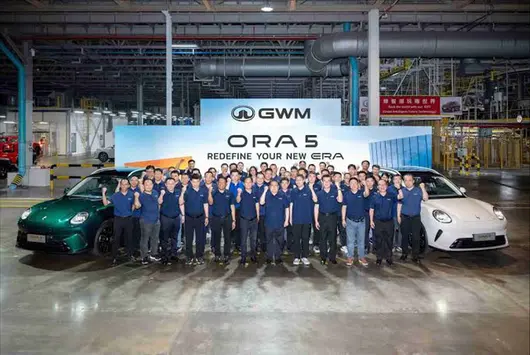
Great Wall: Overseas Sales Growth Year-on-Year 46.75%Great Wall Motor's sales in May were 100,400 vehicles, slightly down compared to last May's 102,200 vehicles, making it the only company among the top 5 to show a year-on-year negative growth. From sub-brands, Haval brand sales in May were 55,500 vehicles, remaining Great Wall's most important sales pillar; Tank brand sales were 17,100 vehicles; both Haval and Tank brand sales showed year-on-year declines; Wey brand sold 8,119 vehicles, a 31.78% year-on-year increase, achieving growth against the trend; Ora brand performance was most stunning, with sales of 6,018 vehicles, a significant 206.88% year-on-year increase. In terms of new energy, Great Wall sold 30,400 new energy vehicles in May, with new energy vehicle transformation gradually accelerating.

The overseas market became Great Wall's biggest highlight in May, with overseas sales growing 46.75% year-on-year. Against the background of pressure on the domestic market, strong growth in overseas business effectively made up for the decline in the domestic market. Great Wall Motor's current core contradiction lies in: Haval and Tank, the two traditional main-selling brands, face weak growth, while Wey and Ora brands, although growing notably, have relatively small volume and are not yet enough to support overall growth. How to complete the "relay" between old and new brands is the key issue Great Wall must solve subsequently.
Final ThoughtsFrom May data, the growth pattern of the top 5 domestic brands has clearly diverged, but there are three common trends worth noting: First, exports have become a key engine for domestic brands to seek stability and growth. Second, new energy transformation is still accelerating, but paths differ among enterprises. Third, technological innovation continues to deepen brand moats. Looking ahead to the second half of the year, competition in the automotive industry will continue to upgrade around these three trends. Although everyone has a common direction, these three trends are all competing for the entire enterprise's industrial chain strength, and the strong will remain strong, which has almost become an inevitable outcome.