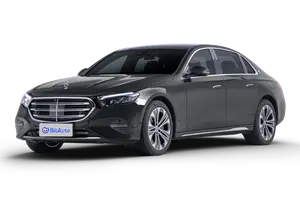
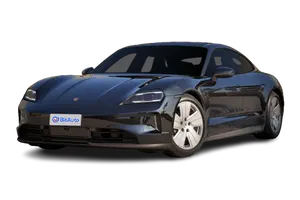
One is a plug-in hybrid, the other a pure electric — both need charging to make sense, but only the hybrid can fall back on petrol. The E-Class PHEV is the cheaper way in at HK$ 829,000, undercutting the Taycan by HK$ 649,000 on-the-road. The Taycan earns its premium on power and battery capacity.
Body Type / Seats4 door Sedan · 5 seats4 door Sedan · 4 seats
Energy & Consumption
ParameterMercedes-Benz E-Class PHEVPorsche Taycan
Fuel TypePHEV · 95BEV
Consumption0.8 L/100km · WLTP-
Max Range (Full Tank/Charge)116 km · WLTP-
The Taycan is pure electric; the E-Class PHEV adds a petrol engine for longer runs. That engine is a 2-litre turbocharged engine. Battery capacity is 25.4 kWh versus 89 kWh.
Power & Performance
ParameterMercedes-Benz E-Class PHEVPorsche Taycan
MotorFrontRear
Max Power204 Ps-
DrivetrainRWDRWD
TransmissionATAT
Dimensions
ParameterMercedes-Benz E-Class PHEVPorsche Taycan
Length4,949 mm4,963 mm ✓
Width2,065 mm ✓1,966 mm
Height1,480 mm ✓1,379 mm
Wheelbase-2,900 mm
Boot Capacity370 L407 L ✓
The Taycan is the longer car — 14 mm up at 4963 mm versus 4949 mm. The Taycan has the slightly larger boot, 407 L against 370 L. The E-Class PHEV seats 5.
Comfort & Technology
E-Class PHEV
Dual-zone automatic climate control
Ventilated front seats
Sunroof
Wireless phone charging
17-speaker Burmester system
Taycan
Dual-zone automatic climate control
Heated front seats
Panoramic sunroof
15W wireless phone charging
10-speaker sound system
Sales Comparison
Monthly new car sales in Hong Kong SAR China, with data for the past 6 or 12 months, or the full sales history since launch.
Monthly Sales Trend (Hong Kong SAR China)
Loading sales data…
Monthly Registrations
Monthly Registrations
Data from Hong Kong Transport Department, updated monthly on the 10th. Check Hong Kong car sales, brand ranking, model sales & EV sales.
Key Specs Compared
ParameterMercedes-Benz E-Class PHEVPorsche Taycan
Overview
PriceHK$ 829,000 ✓HK$ 1,478,000
Body Type4 door Sedan4 door Sedan
Seats5 seats ✓4 seats
Performance
MotorFrontRear
Max Power204 Ps-
Max Power150 kW-
0–100 km/h6.4 s4.8 s ✓
Top Speed236 km/h ✓230 km/h
DrivetrainRWDRWD
TransmissionATAT
Battery & Charging
Battery Capacity25.4 kWh89 kWh ✓
Electric Range116 km · WLTP-
DC Charging Time-18 min
Dimensions
Length4,949 mm4,963 mm ✓
Width2,065 mm ✓1,966 mm
Height1,480 mm ✓1,379 mm
Wheelbase-2,900 mm
Kerb Weight2,190 kg-
Boot Capacity370 L407 L ✓
FAQs
Is the E-Class PHEV or Taycan better?
The E-Class PHEV is the cheaper of the two at HK$ 829,000, but the Taycan answers back with more equipment for the money.
What is the price difference between the E-Class PHEV and Taycan?
The E-Class PHEV starts at HK$ 829,000, the Taycan at HK$ 1,478,000 — about HK$ 649,000 in favour of the E-Class PHEV.
Which one is more powerful?
The Taycan is more powerful — 402 hp against 204 hp.
Which is quicker from 0 to 100 km/h?
The Taycan hits 100 km/h in 4.8 s versus 6.4 s.
Which has more boot space?
The Taycan has the larger boot at 407 L against 370 L.
Do both cars come with advanced driver assistance?
Both list autonomous emergency braking and adaptive cruise control; the E-Class PHEV adds lane-keeping assist and blind-spot monitoring.




 Lexus ES BEV
 BMW i5
 Mercedes-Benz CLA BEV
 BMW i7
 Polestar 5
 Lotus Emeya

