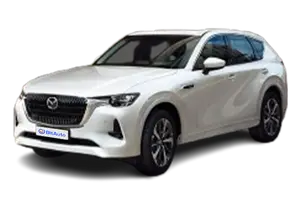
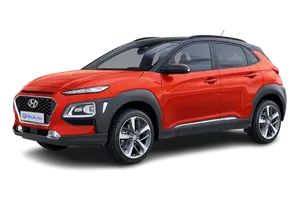
Both run on petrol, so fuel bills and running costs stay in the same ballpark. The Kona is the cheaper way in at HK$ 218,800, undercutting the CX-60 by HK$ 201,190 on-the-road. The CX-60 earns its premium on boot space and size.
Key Differences
Price (on-the-road, incl. first-registration tax):CX-60 HK$ 419,990; Kona HK$ 218,800
a compact body that's easy to thread through Hong Kong traffic and car parks
6.9 L/100km fuel economy
Which car suits your lifestyle best?
Family buyers: CX-60 — a larger 477 L boot suits family duty better
Daily commuters: Kona — the lower list price and compact dimensions that are easy to park make it a cheap city runabout
Budget-conscious buyers: Kona — saves HK$ 201,190 upfront
Price & Ownership Costs
ParameterMazda CX-60Hyundai Kona
PriceHK$ 419,990HK$ 218,800 ✓
Body Type / Seats5 door SUV · 5 seats5 door SUV · 5 seats
Over five years the Kona's HK$ 201,190 head start is unlikely to be erased by running costs — five-year ownership still lands about HK$ 221,362 in the Kona's favour. The deciding factor is how much space and equipment you actually need.
Engine, Fuel Economy & Refuelling
ParameterMazda CX-60Hyundai Kona
Engine Capacity2,488 cc ✓1,591 cc
Rated Economy7.87 L/100km6.9 L/100km
Fuel Tank58 L ✓50 L
Both run conventional petrol engines. The Kona uses a 1.6-litre turbocharged engine; the CX-60 a 2.5-litre naturally-aspirated engine. The Kona is more frugal at 6.9 L/100km versus 7.9 L/100km. A full tank gives both cars roughly the same range.
Power & Performance
ParameterMazda CX-60Hyundai Kona
Max Power191 Ps ✓177 Ps
Max Torque261 N·m265 N·m ✓
Drivetrain4WD4WD
TransmissionATDCT
Dimensions
ParameterMazda CX-60Hyundai Kona
Length4,740 mm ✓4,165 mm
Width1,890 mm ✓1,800 mm
Height1,680 mm ✓1,550 mm
Wheelbase2,870 mm ✓2,600 mm
Boot Capacity477-1148 L ✓361 L
The CX-60 is the longer car — 575 mm up at 4740 mm versus 4165 mm. The CX-60 has the noticeably larger boot, 477 L against 361 L. The CX-60 also leads on wheelbase, 2870 mm versus 2600 mm.
Comfort & Technology
CX-60
12.3" central touchscreen + 12.3" digital cluster
Dual-zone automatic climate control
Ventilated front seats
Panoramic sunroof
Wireless phone charging
Kona
Automatic climate control
Ventilated front seats
Sunroof
Wireless phone charging
Heated and power-folding door mirrors
Sales Comparison
Monthly new car sales in Hong Kong SAR China, with data for the past 6 or 12 months, or the full sales history since launch.
Monthly Sales Trend (Hong Kong SAR China)
Loading sales data…
Monthly Registrations
Monthly Registrations
Data from Hong Kong Transport Department, updated monthly on the 10th. Check Hong Kong car sales, brand ranking, model sales & EV sales.
Key Specs Compared
ParameterMazda CX-60Hyundai Kona
Overview
PriceHK$ 419,990HK$ 218,800 ✓
Body Type5 door SUV5 door SUV
Seats5 seats5 seats
Performance
Max Power191 Ps ✓177 Ps
Max Power140.4 kW-
Max Torque261 N·m265 N·m ✓
0–100 km/h-7.9 s
Top Speed-205 km/h
Drivetrain4WD4WD
TransmissionATDCT
Dimensions
Length4,740 mm ✓4,165 mm
Width1,890 mm ✓1,800 mm
Height1,680 mm ✓1,550 mm
Wheelbase2,870 mm ✓2,600 mm
Kerb Weight-1,477 kg
Boot Capacity477-1148 L ✓361 L
FAQs
Is the Kona or CX-60 better?
The Kona is the cheaper pick at HK$ 218,800 and also adds fuel economy. The CX-60 has to justify its premium elsewhere.
What is the price difference between the Kona and CX-60?
The Kona starts at HK$ 218,800, the CX-60 at HK$ 419,990 — about HK$ 201,190 in favour of the Kona.
Which one is more powerful?
The two are closely matched on power, at about 177 hp apiece.
Which has better fuel economy?
The Kona is more frugal at 6.9 L/100km against 7.9 L/100km.
Which has more boot space?
The CX-60 has the larger boot at 477 L against 361 L.
Which is bigger?
The CX-60 is longer, at 4740 mm against 4165 mm.
Do both cars come with advanced driver assistance?
Both list adaptive cruise control; the CX-60 adds autonomous emergency braking and lane-keeping assist.




 Lexus NX
 Subaru Forester
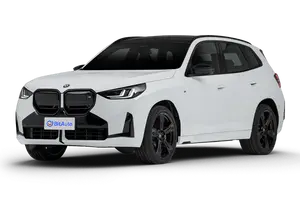 BMW X3
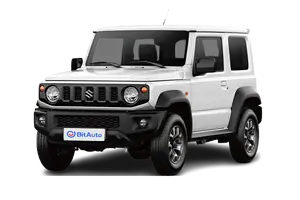 Suzuki Jimny
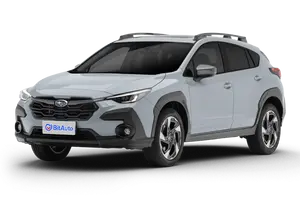 Subaru Crosstrek
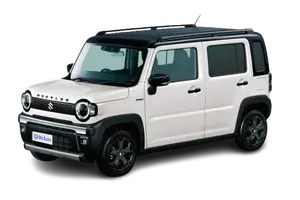 Suzuki Hustler

