首頁walk

搜尋歷史
熱門搜尋
經銷商登入 / 註冊

In Malaysia's SUV market, many buyers compare Proton X90 and Mazda CX-60 when choosing a car.
Proton X90's OTR price in Malaysia is RM 106,800 - 122,800, with a total of 4 versions, including 2026 1.5T Prime X (RM 122,800), 2026 1.5T Prime (RM 116,800), 2026 1.5T Lite (RM 106,800), etc.
Mazda CX-60's OTR price in Malaysia is RM 200,510 - 252,873, with a total of 2 versions, including 2026 3.3T 4WD High Plus (RM 252,873), 2025 2.5L 2WD High (RM 200,510), etc.
From a price perspective, the starting price of Proton X90 is indeed RM 93,710 cheaper than Mazda CX-60. If your budget is limited, Proton's entry-level version can already meet daily needs. However, keep in mind, the fewer thousand cheaper, might involve compromises in equipment, it depends on your specific needs.

Proton X90 is equipped with 1.5L Turbo, horsepower 140 hp. Official fuel consumption 7.0 L/100km.
Mazda CX-60 is equipped with 2.0L 4-cyl, horsepower 170 hp. Official fuel consumption 8.0 L/100km.
In terms of power, the Mazda CX-60's 2.0L 4-cyl has 30 more horsepower than the Proton X90's 1.5L Turbo. However, for daily city driving, the power of both cars is sufficient and does not feel underpowered.

Proton X90's safety rating is 5★ (ASEAN NCAP), active safety systems include ADAS (ACC, AEB, LKA, LDA, BSM, RCTA).
Mazda CX-60's safety rating is 5★ (Euro NCAP), active safety systems include i-Activsense Pro.
Regarding safety equipment, both cars received good ratings. However, there are some differences in function between the Proton X90's ADAS (ACC, AEB, LKA, LDA, BSM, RCTA) and the Mazda CX-60's i-Activsense Pro. If you value active safety more, you can compare the feature lists of both carefully.

Proton X90 body length 4400 mm, trunk 400 L.
Mazda CX-60 body length 4500 mm, trunk 450 L.
Regarding space, the Mazda CX-60's body is 100 mm longer than the Proton X90, with an advantage in seating space. However, the Proton X90 will be a bit more flexible for parking in the city, both have trade-offs.

Proton X90 warranty 5 years/150,000km, service interval every 10,000km or 6 months.
Mazda CX-60 warranty 5 years/150,000km, service interval every 10,000km or 6 months.
The warranty conditions for both cars are the same, no need to worry about this. Actual maintenance costs depend on the brand's service network and parts prices, suggest asking real owners in car clubs for their experience.

In general, Proton X90 and Mazda CX-60 are both excellent car models in the Malaysian market. Which one to choose depends mainly on your personal needs and budget. We recommend doing your homework, comparing quotes from several dealers, and then test driving to make a final decision. Buying a car is a big deal, spending time doing research will definitely not be a mistake.


In Malaysia's SUV market, many buyers compare the Proton X50 and Toyota Corolla Cross when choosing a car. These two cars are quite close in price and positioning. Today, we will make a detailed comparison from multiple aspects to help you save time on research.
The OTR price of the Proton X50 in Malaysia is RM 89,800 - 113,300, with a total of 4 versions, including 1.5T Executive (RM 89,800), 1.5T Premium (RM 101,800), 1.5T Flagship (RM 113,300), etc.
The OTR price of the Toyota Corolla Cross in Malaysia is RM 133,800 - 148,800, with a total of 3 versions, including 2026 HEV 1.8L GR Sport (RM 148,800), 2026 HEV 1.8L Standard (RM 140,800), 2026 1.8L Standard (RM 133,800), etc.
From a price perspective, the starting price of the Proton X50 is indeed RM 44,000 cheaper than the Toyota Corolla Cross. If your budget is limited, Proton's entry-level version can already meet daily needs. However, keep in mind that the few thousand cheaper might involve trade-offs in features, it depends on your specific needs.

Proton X50 is equipped with 1.5L 4-cyl, 105 hp. Official fuel consumption 6.0 L/100km.
Toyota Corolla Cross is equipped with 1.5L Turbo, 140 hp. Official fuel consumption 7.0 L/100km.
In terms of power, the 1.5L Turbo of Toyota Corolla Cross has 35 hp more than the 1.5L 4-cyl of Proton X50. However, for daily city driving, both cars have enough power, you won't feel lacking.

Proton X50 uses 4WD drive system.
Toyota Corolla Cross uses FWD drive system.
Proton's 4WD and Toyota's FWD will feel different in handling, test drive comparison is recommended.

Proton X50 warranty 5 years/150,000km, maintenance interval every 10,000km or 6 months.
Toyota Corolla Cross warranty 5 years/unlimited mileage, maintenance interval every 10,000km or 6 months.

Proton X50 and Toyota Corolla Cross are both mainstream choices in the Malaysia market, suitable for family use and daily commuting. If you value brand reputation and resale value more, you can prioritize the one with better reputation; if you care more about value for money and features, choose the one with richer configuration. Ultimately, it is recommended to test drive both, personal experience is the most important.
Overall, Proton X50 and Toyota Corolla Cross are both quite good models in the Malaysia market. Which one to choose depends on your personal needs and budget. It is recommended to do your research, compare quotes from several car dealers, and then test drive to make a final decision. Buying a car is a big matter, spending some time on research will never be wrong.


In Malaysia's SUV market, many buyers compare Perodua Aruz and Chery Tiggo 7 PHEV when choosing a car. The price and positioning of these two cars are quite close. Today we will do a detailed comparison from multiple aspects to help you save time on research.
Perodua Aruz OTR price in Malaysia is RM 72,900 - 77,900, with 2 versions in total, including 1.5L X (RM 72,900), 1.5L AV (RM 77,900) etc.
Chery Tiggo 7 PHEV OTR price in Malaysia is RM 129,750 - 129,750, with 2 versions in total, including 2025 1.5T 90km CSH (RM 129,750), What charging methods does the Tiggo 7 PHEV support? Can it be charged using a home power socket? (RM 117,478) etc.
From the price perspective, the starting price of Perodua Aruz is indeed RM 56,850 cheaper than Chery Tiggo 7 PHEV. If your budget is limited, Perodua's entry-level version can already meet daily needs. But be aware, the difference of a few thousand yuan, might involve trade-offs in specifications, it depends on your needs.

Perodua Aruz safety rating is 5★ (ASEAN NCAP), active safety systems include .
Chery Tiggo 7 PHEV safety rating is TBD, active safety systems include Basic.
Perodua Aruz adopts FWD drive mode.
Chery Tiggo 7 PHEV adopts FWD drive mode.
The drive modes of both cars are the same, both are FWD, daily driving experience will not differ much.

Both Perodua Aruz and Chery Tiggo 7 PHEV are mainstream choices in the Malaysian market, suitable for family use and daily commuting. If you value brand reputation and resale value more, you can prioritize the one with better reputation; if you care more about cost-performance ratio and specifications, choose the one with richer configurations. Ultimately it is recommended to test drive both, personal experience is the most important.

In general, Perodua Aruz and Chery Tiggo 7 PHEV are both very good models in the Malaysian market. Which one to choose depends mainly on your personal needs and budget. We suggest doing your research, compare quotes from several dealerships, and then test drive to make a final decision. Buying a car is a big matter, spending time on research will never be wrong.


2026年1-5月,比亚迪乘用车海外出口延续快速增长态势,出口目的地呈现出“拉美领跑、欧洲深耕、亚太与中东多点突破”的布局特征。巴西继续稳居第一大海外市场,欧洲多个国家跻身前十,澳大利亚、菲律宾、泰国及阿联酋等市场保持稳定增长。同时,比亚迪依托纯电(BEV)与插电混动(PHEV)双技术路线,针对不同区域市场需求实施差异化产品投放,全球化布局进一步深化。
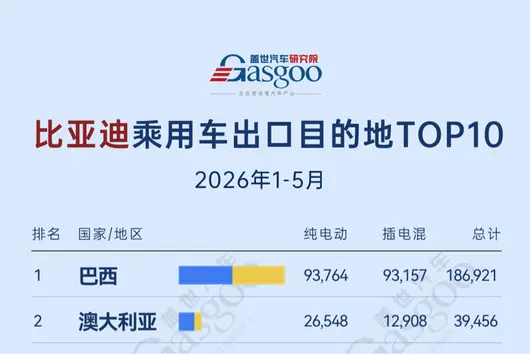
根据盖世汽车研究院出口数据库,2026年1-5月比亚迪乘用车出口前十目的地如下:
NO.1 巴西,2026年1-5月,向巴西出口纯电动乘用车93,764辆,插电混合动力乘用车93,157辆,总计186,921辆。
NO.2 澳大利亚,2026年1-5月,向澳大利亚出口纯电动乘用车26,548辆,插电混合动力乘用车12,908辆,总计39,456辆。
NO.3 英国,2026年1-5月,向英国出口纯电动乘用车10,731辆,插电混合动力乘用车19,177辆,总计29,908辆。
NO.4 比利时,2026年1-5月,向比利时出口纯电动乘用车13,507辆,插电混合动力乘用车16,240辆,总计29,747辆。
NO.5 德国,2026年1-5月,向德国出口纯电动乘用车8,657辆,插电混合动力乘用车7,685辆,总计16,342辆。
NO.6 阿联酋,2026年1-5月,向阿联酋出口纯电动乘用车627辆,插电混合动力乘用车15,450辆,总计16,077辆。
NO.7 菲律宾,2026年1-5月,向菲律宾出口纯电动乘用车5,029辆,插电混合动力乘用车10,437辆,总计15,466辆。
NO.8 西班牙,2026年1-5月,向西班牙出口纯电动乘用车6,879辆,插电混合动力乘用车6,934辆,总计13,813辆。
NO.9 泰国,2026年1-5月,向泰国出口纯电动乘用车12,817辆,插电混合动力乘用车14辆,总计12,831辆。
NO.10 中国香港,2026年1-5月,向中国香港出口纯电动乘用车10,467辆,插电混合动力乘用车78辆,总计10,545辆。

根据盖世汽车研究院出口数据库,2026年1-5月,比亚迪乘用车海外出口呈现出“巴西断层领先、欧洲多点布局、纯电与插混双线并进”的特点。
巴西以186,921辆稳居第一,纯电(93,764辆)与插电混动(93,157辆)规模几乎持平,成为比亚迪全球最大的海外市场,也体现出其双动力技术路线在当地市场的广泛适应性。值得关注的是,随着巴西整车进口政策调整,未来中国车企或将加快由整车出口向KD组装及本地化生产模式转型。
欧洲市场占据重要地位,英国、比利时、德国和西班牙均进入前十。其中,英国、比利时以插电混动车型占比较高,德国纯电与插混布局相对均衡,西班牙两种动力形式基本持平,反映出比亚迪正根据不同国家市场需求灵活调整产品结构,持续深化欧洲市场布局。
亚太及中东市场则呈现明显的差异化特征。澳大利亚以39,456辆位列第二,纯电车型占据主导;泰国和中国香港市场几乎由纯电车型贡献销量;阿联酋则以插电混动车型为主,菲律宾市场同样呈现插混占优态势。整体来看,比亚迪正依托纯电与插混双技术路线,针对不同市场需求实施差异化产品策略,全球化布局持续深化。

喺馬來西亞嘅 SUV 市場,好多買家喺揀車嗰陣都會拿 Perodua Aruz 同 Chery Tiggo Cross 做比較。佢哋兩款車喺價位同定位上都好接近,今日我哋就從多個方面做詳細比較,幫你省卻做功課嘅時間。
Perodua Aruz 喺馬來西亞嘅 OTR 售價係 RM 72,900 - 77,900,總共有 2 個版本,包括 1.5L X(RM 72,900)、1.5L AV(RM 77,900) 等。
Chery Tiggo Cross 喺馬來西亞嘅 OTR 售價係 RM 88,750 - 99,750,總共有 2 個版本,包括 2025 HEV 1.5L CSH(RM 99,750)、2025 1.5T Standard(RM 88,750) 等。
從價錢睇,Perodua Aruz 嘅起步價確實比 Chery Tiggo Cross 平咗 RM 15,850。如果你預算有限,Perodua 嘅入門版已經可以滿足日常需要。但要留意,平嗰幾千塊,可能喺配備上有取舍,具體要睇你嘅需求。
Perodua Aruz 嘅安全評級係 5★ (ASEAN NCAP),主動安全系統包括 。
Chery Tiggo Cross 嘅安全評級係 TBD,主動安全系統包括 基本。
Perodua Aruz 保修 5 年/150,000km,保養間隔 每 10,000km 或 6 個月。
Chery Tiggo Cross 保修 3 年/100,000km,保養間隔 每 10,000km 或 6 個月。
Perodua Aruz 同 Chery Tiggo Cross 都係馬來西亞市場嘅主流選擇,適合家庭使用、日常通勤。如果你更看重品牌口碑同二手價,可以優先考慮口碑更好嗰一款;如果你更在意性價比同配備,那就揀配置更豐富嗰款。最終都係建議兩款都去試駕,親身體驗先至最重要嘅。

總括嚟講,Perodua Aruz 同 Chery Tiggo Cross 都係馬來西亞市場幾唔錯嘅車型。揀邊台,關鍵始終係要睇你嘅個人需求同預算。建議大家做好功課,多比較幾間車行嘅報價,再去試駕做最終決定。買車係件大事,花少少時間做功課絕對無錯。

In May, China's automotive market overall presented a gentle recovery trend, with domestic brands still being the sales backbone of the market. Recently, BYD, Geely, Chery, Changan, and Great Wall, the top 5 domestic automakers, successively released their monthly performance reports. From the data, these five companies show a general characteristic of "stable total growth, divergence between domestic and international markets, and accelerated new energy penetration". Overseas exports and new energy vehicles have become the most core growth engines; export business has evolved from a "bonus item" to the "core foundation" for some companies. BYD's "dominant leader" status is further consolidated, Chery achieved high growth via exports, Geely's new energy penetration rate broke 56%, Changan focused steadily on balanced development, while Great Wall appeared slightly under pressure during structural transformation.
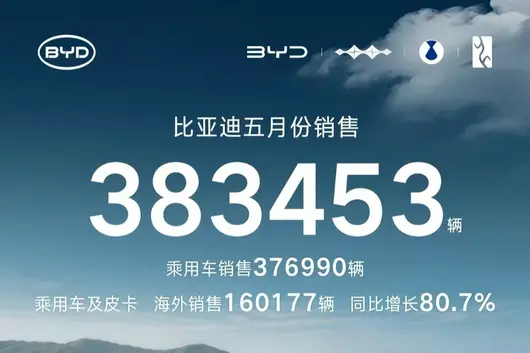
BYD: Export Hits New High Becomes Biggest HighlightIn May, BYD stood firmly at the top of domestic brands with a monthly sales volume of 383,500 vehicles, maintaining positive growth both year-on-year and month-over-month under a large base. Its two main brands, Dynasty and Ocean, sold a combined 330,200 vehicles, contributing 86.1% of total sales; Fangchengbao's monthly sales broke 30,000 units to reach 30,200, a year-on-year increase of 139.7%, setting a new high for the year; Denza sold 16,300 vehicles, and Yangwang delivered 286 vehicles. From a model perspective, BYD had eight models in May with monthly sales exceeding 20,000 vehicles. The Song Family and Yuan Family both broke 50,000 units, selling 51,370 and 56,691 vehicles respectively. The Sea Lion Family followed closely with 42,615 vehicles, and Seagull sales were also close to 40,000 vehicles.

BYD's biggest highlight in May was exports. Overseas new energy vehicle sales reached 160,600 units, an 80.4% year-on-year increase, accounting for about 42%. The sharp expansion of export scale effectively countered the phased weakness in domestic demand. Cumulative exports from January to May exceeded 620,000 vehicles. High export growth mainly benefited from continued ramping up of overseas factory capacity, improved ocean shipping capacity, and accelerated channel network expansion. In the domestic market, BYD promoted Megawatt Super Charging and intelligent strategies simultaneously—Megawatt charging achieved about 90% charge in 9 minutes; 20,000 super charging stations are planned to be built by 2026; all series models are available with Sky Eye B intelligent driving solutions and city navigation safety fallback plans, accelerating the popularization of high-level intelligent driving. As Gen 2 Blade Battery capacity gradually releases, the company's orders are expected to continue rising.
Chery: Sales Growth Leads the Top 5Chery Group's total sales volume in May was 247,800 vehicles, a significant year-on-year increase of 20.5%, ranking first in growth speed among the top 5. Exports remained its most core growth engine—May exports reached 181,900 vehicles, an 80.5% year-on-year increase, accounting for 73.4% of total sales that month, continuously breaking the single-month export record for Chinese brands for three months. In terms of new energy, Chery New Energy sold 100,300 vehicles, a 58.8% year-on-year increase. April and May consecutively saw monthly new energy sales breaking 100,000 vehicles.

The strong performance in exports benefited from Chery's long-term deep cultivation of overseas channel advantages and localized operation capabilities. While overseas orders continued to rise, high export growth formed a sharp contrast with domestic sales—Chery's domestic sales in May were only 60,000 vehicles, accounting for one-quarter of total sales. From cumulative data, Chery Group accumulated 1.101 million sales from January to May, but against the annual goal of 3.2 million vehicles, monthly averages need to reach about 420,000 vehicles later, and pressure remains significant.
Geely: New Energy Penetration Rate Breaks 56%Geely Auto's total sales volume in May was 237,600 vehicles, a 1% year-on-year increase, achieving month-over-month double growth for three consecutive months. In terms of structure, Geely's "New Four Transformations" transformation showed significant results: new energy vehicle sales reached 133,400 units, accounting for 56% of total sales, with new energy share exceeding 50% for four consecutive months.

From sub-brands, performance was significantly divergent. Zeekr brand sales in May reached 34,400 vehicles, a 82% year-on-year increase; Zeekr 9 Series and 8 Series models combined sales approached 50% of total sales, showing bright performance in the high-end market; Galaxy brand sales were 81,700 vehicles; Geely brand sales were 182,500 vehicles, among which China Star Series sales reached 100,800 vehicles; Lynk & Co brand sales were 20,700 vehicles, with new energy vehicle sales share rising to 71%.
In terms of exports, Geely's overseas vehicle exports in May reached 85,100 vehicles, a explosive 184% year-on-year increase, setting a brand single-month export record high. Among exported products, new energy vehicles reached 40,800 units, accounting for nearly half; hybrid and pure electric products have successively landed in Southeast Asia, Middle East, Latin America, and other markets, highlighting the results of global strategy implementation.
Changan: Multi-brand Matrix Balanced EffortChangan Auto's delivery volume in May was 209,100 vehicles, among which new energy deliveries were 92,400 vehicles, a 5.8% year-on-year increase, with new energy share about 44%. In terms of exports, overseas deliveries reached 70,700 vehicles, a 38% year-on-year increase, becoming another major growth highlight for Changan in May.
In the sub-brand matrix, Changan Qiyuan delivered 34,500 vehicles in May; All-New Q05 delivered 15,800 units, with orders breaking 3,000 units within three days of listing in Thailand; Deepal sales in May were 33,200 vehicles, a 30% year-on-year increase; January to May overseas cumulative sales were 28,700 vehicles, a significant 167% year-on-year increase; Avatr delivered 7,336 vehicles in May; Changan Auto (Gravity) delivered nearly 49,000 vehicles in May.

Changan Auto's balanced layout was fully reflected in May: the fuel car base remained stable, new energy brands Deepal and Qiyuan accelerated volume growth, high-end brand Avatr continued to break through in technical cooperation, and overseas markets simultaneously achieved breakthrough growth. The pattern of five brands working together, driven by both new energy and exports, is initially taking shape.
Great Wall: Overseas Sales Growth Year-on-Year 46.75%Great Wall Motor's sales in May were 100,400 vehicles, slightly down compared to last May's 102,200 vehicles, making it the only company among the top 5 to show a year-on-year negative growth. From sub-brands, Haval brand sales in May were 55,500 vehicles, remaining Great Wall's most important sales pillar; Tank brand sales were 17,100 vehicles; both Haval and Tank brand sales showed year-on-year declines; Wey brand sold 8,119 vehicles, a 31.78% year-on-year increase, achieving growth against the trend; Ora brand performance was most stunning, with sales of 6,018 vehicles, a significant 206.88% year-on-year increase. In terms of new energy, Great Wall sold 30,400 new energy vehicles in May, with new energy vehicle transformation gradually accelerating.

The overseas market became Great Wall's biggest highlight in May, with overseas sales growing 46.75% year-on-year. Against the background of pressure on the domestic market, strong growth in overseas business effectively made up for the decline in the domestic market. Great Wall Motor's current core contradiction lies in: Haval and Tank, the two traditional main-selling brands, face weak growth, while Wey and Ora brands, although growing notably, have relatively small volume and are not yet enough to support overall growth. How to complete the "relay" between old and new brands is the key issue Great Wall must solve subsequently.
Final ThoughtsFrom May data, the growth pattern of the top 5 domestic brands has clearly diverged, but there are three common trends worth noting: First, exports have become a key engine for domestic brands to seek stability and growth. Second, new energy transformation is still accelerating, but paths differ among enterprises. Third, technological innovation continues to deepen brand moats. Looking ahead to the second half of the year, competition in the automotive industry will continue to upgrade around these three trends. Although everyone has a common direction, these three trends are all competing for the entire enterprise's industrial chain strength, and the strong will remain strong, which has almost become an inevitable outcome.