首頁price

搜尋歷史
熱門搜尋
經銷商登入 / 註冊

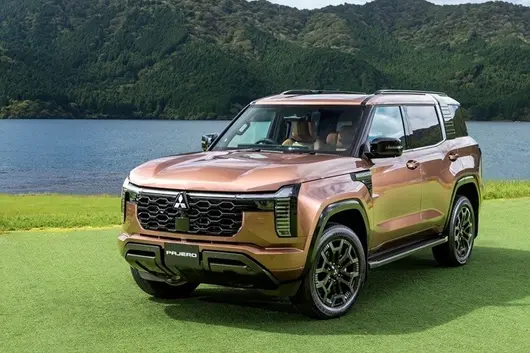
Mitsubishi officially unveiled the new generation Pajero in early September, followed by the Thailand market launch on October 19, and today (October 29) Mitsubishi also announced the new car will be sold in Japan on December 17, with 4 models offered in the lineup: GLS, GSR, Exceed, and Super Exceed, all models feature four-wheel drive, prices range from 6.193 million yen to 7.9508 million yen, the manufacturer stated that after opening pre-orders for the new Pajero starting October 1, accumulated about 5,500 orders by October 28, exceeding the annual sales target.

As the flagship off-road SUV Pajero, the 5th generation model is about to launch in the Japanese market in mid-December, offering a total of 4 models to choose from: GLS, GSR, Exceed, and Super Exceed, with slight differences in equipment among the models. Starting with the exterior, the new generation Pajero features two types of grille designs on the front: horizontal slat and honeycomb, among them only the top-spec Super Exceed model features the honeycomb style, while the other models all feature the horizontal slat design; additionally, Exceed and Super Exceed models are equipped with ALH intelligent headlights.
Regarding the wheels, Exceed and Super Exceed share the same wheel design with a size of 255/55R20, but differ in wheel color, while GLS and GSR models share the same wheel design with a size of 255/65R18.

Regarding colors, the entire lineup has 7 solid color options available, including newly developed Armored Metal Copper and Iridescent Metal Blue, additionally, the top-spec Super Exceed offers 4 two-tone versions with black roofs. Regarding body dimensions, the new generation Pajero length and width are 4,920mm and 1,925mm respectively, GLS and GSR height is 1,900mm, while Exceed and Super Exceed are 1,910mm.

Inside the cabin, the new generation Pajero features a digital tech layout, depending on the model grade, the central control screen has 12.3-inch and 14.3-inch configurations, while the top-spec Super Exceed interior combines camel and black colors, additionally Super Exceed models come standard with panoramic electric sunroof, front seat ventilation, 12-speaker Yamaha audio, and other exclusive features; front and rear seat heating functions are standard on all models except the entry-level, additionally, the entire lineup is configured as 3 rows with 7 seats, the manufacturer emphasizes that except for the windshield, the front and rear use sound-insulated glass designs, further enhancing the quietness inside the cabin.

The new generation Pajero adopts a high-rigidity ladder frame chassis architecture, regarding power specifications, the 2.4-liter turbo diesel engine delivers a maximum of 204 horsepower and 480 Nm of torque, paired with an 8-speed automatic transmission, the average fuel consumption measured locally in Japan is 12.1 km/L. The Japanese-spec Pajero entire lineup is equipped with the S-AWC four-wheel drive system, offering 4 drive modes to choose from: 2H, 4H, 4HLc, 4LLc, as well as 7 driving modes: Normal, Eco, Gravel, Snow, Mud, Sand, and Rock, further enhanced by AYC active yaw control and ASTC active stability and traction control systems, creating excellent handling performance.
Additionally, the Japanese-spec new generation Pajero entire lineup comes standard with the Mi-Pilot driver assistance system and 8 airbags, including the SRS center airbag adopted by Mitsubishi Motors for the first time.



The European automotive market in 2026 is undergoing a subtle shift in power dynamics.
Data from the European Automobile Manufacturers Association (ACEA) shows that in May this year, the combined new car registrations of five Chinese automakers—BYD, SAIC MG, Geely, Chery, and Leapmotor—in 31 European countries reached 138,400 units, up 64.59% year-over-year. This achievement marks the first time Chinese cars have surpassed Japanese cars in Europe. In the pure electric segment, the share of Chinese brands in European pure electric sales has approached 15%.
JPMorgan's research report suggests that the share of Chinese automakers in the Western European market could reach 20% by 2028. Accelerated European electrification and the generational advantage in product definition by Chinese automakers are the core supports for this structural growth.
Along with sales growth, the overseas prices of Chinese cars also seem to prove the strength of this European strategy: the BYD Dolphin, starting domestically under 120,000 RMB, sold in the UK for 270,000 RMB. The Denza Z9GT, priced at 360,000 RMB domestically, was priced in Europe at over 900,000 RMB. BYD Seal and XPeng G6 prices were also generally 50% to even 100% higher than domestic.

Prices doubled, yet sales are skyrocketing. In this prosperous scenario, many views optimistically believe that Chinese EVs have successfully broken into the European market.
But in reality, have Chinese automakers truly taken root in Europe?

Sales prosperity supported by 'Relative Value'
The 'expensiveness' of Chinese EVs in Europe is largely a currency illusion.
Taking the BYD ATTO 3 sold in the German market (known as Yuan PLUS domestically) as an example, its terminal selling price is about €38,000. This includes the EU 10% base tariff, up to 35.3% countervailing duties on Chinese EVs, and Germany's 19% VAT. Plus WVTA EU Type Approval, Euro NCAP crash test compliance, logistics, and local marketing costs. After a Chinese EV crosses the ocean to arrive in Europe, the cost structure has undergone drastic changes.

Rhodium Group analysis believes that even with the EU 10% base tariff and up to 35.3% countervailing duties added, Chinese automakers' per-vehicle profit in Europe remains significantly higher than domestic. This 'European premium' constitutes a short-term profit buffer.
But if the reference is switched from 'domestic price' to 'local European market', Chinese cars in Europe have not departed from the old route of ultimate cost-performance.
The starting price of the Volkswagen ID.4 in the German market is about €45,000, which is about €7,000 more than the same-class BYD ATTO 3. In terms of configuration, the ID.4 base version often lacks panoramic sunroofs and heated seats; these require consumers to pay extra thousands of euros for option packages.
In contrast, Chinese cars usually adopt a 'fully equipped' strategy. Dataforce data shows that Chinese brand pure electric sales in Europe doubled year-on-year, and market share surpassed 15% for the first time. The core driver is precisely this 'same price, higher spec' relative cost-performance.
However, in the high-end market representing brand height, the situation is completely different.

Products like Denza Z9GT and NIO ET7 are widely discussed in the media, and their pricing also rivals same-class models of BBA (Mercedes-Benz, BMW, Audi), but actual sales are still in the climbing phase. In the first half of 2026, NIO's sales in Europe were only in the hundreds, while Zeekr and XPeng sales were only in the thousands.
Behind the huge gap in high-end product sales lies a gap in brand awareness. Most European users are still completely unfamiliar with Chinese cars. With brand awareness nearly at 0, there is no foundation for discussing brand premium and so-called 'premium'. Market research firm Civey data shows that BYD's aided awareness in Germany reached 64%, MG was at 26%, but most new Chinese brands entering Europe (Leapmotor, Lynk & Co, Deepal, Jaecoo, etc.) awareness remains between 1%-11%, mostly under 10%.
It is worth noting that in mature European markets, 'premium' is the collective subconscious forged by century-old reputation + racing history + celebrity owners + magazine long-term tests + used car value retention. The 'premium' of Mercedes-Benz, BMW, and even DS did not start in 2020; it is the accumulation of nearly a century of development and generations of use.
Denza Z9GT product strength is extremely high, but when it appears on European streets, passersby will not automatically think 'this car is really expensive' as they do seeing a Panamera.

So, the prosperity of sales data did not change a fact: the underlying color of the offensive of Chinese automakers in Europe remains cost-performance. In the past few years, the relative advantage built by Chinese cars in supply chain efficiency and technology happened to hit the window period of sluggish electrification transformation by European local automakers, but this still cannot be said to be the strategic foothold of Chinese cars in Europe.
While brand awareness is still climbing and the residual value system still needs to be established, holding the basic platform of cost-performance and respecting the mature rules of the local market is more important than hastily declaring 'conquering Europe'. After all, sales can be leveraged by pricing, but brands can only be boiled out by time.

Beware of 'Involution' Spillover
For Chinese automakers going overseas on a large scale, the real test lies not in whether high prices can create the illusion of 'high-end', but in whether they can restrain the impulse to trade short-term share using 'involution' logic.
'We need to be vigilant about signs of involution; we must not bring price wars to Europe,' said a Chinese automaker's German sales head.
The strategy of 'losing money to gain praise' might swap for beautiful report data in the short term, but in the long run it is no different than quenching thirst with poison.

Europe is a mature and rational market. Consumers, dealers, and industry associations have extremely high sensitivity to 'predatory competition'. Once Chinese automakers are seen as 'troublemakers' disrupting market order, what will follow will be stricter trade barriers and public opinion counterattacks.
The EU 'Industrial Accelerator Act' has attempted to link public subsidies with 'Made in EU' localization content. This is exactly a defensive reaction to market disorderly shocks.
Leapmotor Senior Vice President Xu Jun believes that if the price war prevalent domestically is copied overseas, it could lead to overseas profit margins lower than domestic, and brand Chinese brands with the 'low price low quality' label. Any company having issues overseas could affect the reputation of the entire Chinese brand, creating a situation of 'glory for one, glory for all; damage for one, damage for all'.
Looking back at history, the rise path of Korean cars in Europe has extremely strong reference value for Chinese automakers.
When Hyundai-Kia first entered Europe in the 1980s, their situation was more difficult than today's Chinese automakers, called 'refrigerators on wheels'. To open the market, Hyundai-Kia adopted an extremely long 'water storage' strategy. Over a period of 15 to 20 years, Korean cars were basically in a no-profit state in Europe.

They invested nearly €2 billion to build production bases in Czechia and Slovakia, set up R&D centers in Frankfurt, Germany, and employed a large number of European local engineers, just to build a car that fits European tastes. Facing consumer doubts on quality, Hyundai-Kia launched unprecedented '5 year/10 year super long warranty', using corporate credit to endorse products, rather than relying on bottomless price cuts.
Subsequently, they poached Audi designer Peter Schreyer, established family design language, set up a test center at Nürburgring Nordschleife, and hired BMW engineers to tune the chassis, gradually taking off the 'cheap' hat. Hyundai-Kia's European R&D branch also developed exclusive Hyundai Kona and Kia Ceed products for European users.
To this day, Korean cars are already an undeniable force in the European market. In 2025, the European market share of Korean pure electric cars reached 8%, second only to Volkswagen, Stellantis, and BMW Group. EV6 and IONIQ 5 even won the 'European Car of the Year' award.
In a mature automotive market, there are no shortcuts for brand elevation, only 'slow work'. Korean cars' data today is exchanged for the persistence of quality, R&D, and service for decades like one day. Current popularity of Chinese EVs in Europe is undoubtedly a phased victory achieved by industry lane change overtaking. However, high sales growth does not equal brand foundation, and price advantage does not equal brand premium.
'We would rather go slower, clumsier, but must hold the red line. For example, we registered subsidiaries in Thailand to deepen local management. Forecasting possibly losing for 8 years, but still building the system solidly, rather than trading for scale with low prices,' said Xu Jun.

Beware of involution spillover and adhere to long-termism. This should not just be a slogan. It means respecting local market rules and cultural customs, taking the time to build localized R&D, production, and after-sales service networks, and daring to sacrifice short-term sales benefits to maintain brand health.
After all, Korean cars took 45 years to get to today. The marathon of Chinese automakers in Europe might have just finished the first five kilometers.