


首頁environmental

搜尋歷史
熱門搜尋
經銷商登入 / 註冊

In Malaysia's SUV market, many buyers compare Proton X70 and Toyota Corolla Cross when choosing a car. These two cars are quite close in price and positioning. Today, we will make a detailed comparison from multiple aspects to help you save time doing research.
The OTR price of Proton X70 in Malaysia is RM 106,800 - 122,300, with a total of 3 versions, including 1.5L Standard 2WD (RM 106,800), 1.5L Executive 2WD (RM 115,800), 1.5L Premium 2WD (RM 122,300), etc.
The OTR price of Toyota Corolla Cross in Malaysia is RM 133,800 - 148,800, with a total of 3 versions, including 2026 HEV 1.8L GR Sport (RM 148,800), 2026 HEV 1.8L Standard (RM 140,800), 2026 1.8L Standard (RM 133,800), etc.
Looking at the price, the starting price of Proton X70 is indeed RM 27,000 cheaper than Toyota Corolla Cross. If your budget is limited, Proton's entry-level version can already meet daily needs. But be aware that the cheaper few thousand might involve compromises on features, depending on your needs.

Proton X70 safety rating is 5★ (ASEAN NCAP), active safety systems include ADAS (ACC, AEB, LKA, LDA, BSM, RCTA).
Toyota Corolla Cross safety rating is 5★ (ASEAN NCAP), active safety systems include TSS (PCS, LDA, ACC, LTA).
Both cars have the same safety rating, and safety features are quite comprehensive for this class. New cars nowadays are not lacking in safety, so no need to worry too much about this point.

Proton X70 adopts FWD drive system.
Toyota Corolla Cross adopts FWD drive system.
Both cars have the same drive system, both FWD, there won't be much difference in daily driving experience.

Proton X70 warranty 5 years/150,000km, service interval 10,000km or 6 months.
Toyota Corolla Cross warranty 5 years/unlimited mileage, service interval 10,000km or 6 months.
Overall, Proton X70 and Toyota Corolla Cross are both very good models in the Malaysian market. Which one to choose mainly depends on your personal needs and budget. It is recommended to do your homework, compare quotes from several car dealers, and go for a test drive to make the final decision. Buying a car is a big matter, spending some time doing research will never be wrong.


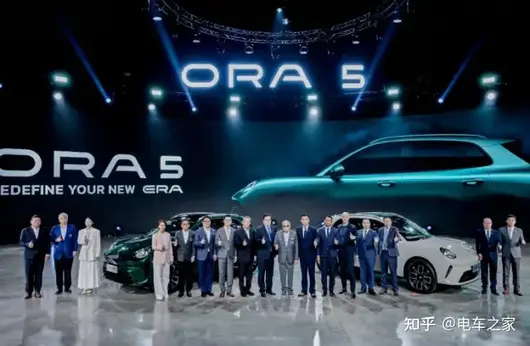
Recently, the Great Wall Motor ORA brand arrived at EMSphere, a trendy landmark in Bangkok, Thailand, officially completing the global premiere of the strategic new vehicle ORA 5 (ORA 5). This press conference was not just the unveiling of a new car, but also a heavyweight systematic launch marking the comprehensive upgrade, technological iteration, and deep cultivation of the global market by the ORA brand, injecting new vitality into the export of Chinese boutique automobiles.

Relying on the reputation accumulated from over 600,000 users globally, the ORA brand, having cultivated the market for seven years, has officially completed a strategic renewal and upgrade. The brand says goodbye to a single female niche positioning, fully upgrading from "New Energy Vehicles That Love Women More" to a global fashion boutique automobile brand. The target audience has also expanded to young urban users worldwide, with the brand concept upgraded to "Live Your Shine", adopting a new posture of "POP ORA, Fashion ORA" to fit the aesthetics and lifestyle of young people globally.
This renewal is not a subversion of the past, but a breakthrough of development boundaries. ORA 5 continues the brand's award-winning "Fluid Sculpture" design, with its appearance fitting the aesthetics of global young consumers. Now, the brand is based on four core concepts: "Global, Fashion, Boutique, Multi-Choice", upgrading cars from simple transportation tools to fashion items that showcase personal attitude and lifestyle taste, striving to enter the global mainstream mass automobile market.

To adapt to different road conditions, recharging conditions, and driving habits around the world, ORA has thoroughly broken the single limitation of pure electric vehicle models. Relying on the new intelligent multi-power platform, comprehensive technical breakthroughs have been achieved. ORA 5 supports BEV pure electric, HEV hybrid, PHEV plug-in hybrid, ICE fuel all-power layouts, and can derive multiple models such as SUV, Coupé, Wagon, etc., truly achieving "One Car, Multiple Powers, One Car, Multiple Categories", precisely adapting to global diversified driving scenarios.
Targeting the current situation of the Thai and Southeast Asian markets, ORA has mainly launched the HEV hybrid version, marking that Great Wall Motor has officially shifted from a single pure electric route to a flexible development model with multi-power parallelism in the local area, perfectly adapting to the local charging infrastructure status. It is reported that Great Wall Motor will continue to deeply cultivate the Thai market, planning to achieve a 40% sales growth in Thailand in 2026, adding an investment of 10 billion Baht, and ORA 5 is exactly the core main model to achieve this goal.

For ordinary consumers, this new platform technology brings tangible usage benefits. Users can freely choose cars based on their own travel scenarios, choosing pure electric for daily urban commuting, hybrid for long-distance trips, and fuel for areas with inconvenient recharging, without passively compromising for vehicle power. At the same time, compared to same-class models, ORA 5 reduces purchase costs by 5% and maintenance costs by 15%. Paired with global unified quality control standards, the resale value and driving stability are comprehensively upgraded.
2026 will become a big product year for ORA. The brand will perfect the product matrix relying on the new platform. In addition to the ORA 5 family covering all levels of mainstream models, classic models such as Ballet Cat, Lightning Cat, and Good Cat will also complete a full renewal. Taking Thailand as the core fulcrum, ORA will gradually open up global markets including Europe, Oceania, Middle East, Latin America, Africa, etc., letting Chinese fashion boutique cars go to the world's six continents.
In terms of power, ORA 5 is equipped with two mature and reliable practical solutions, taking into account the travel needs of different users. Among them, the HEV hybrid version is equipped with Great Wall's self-developed two-speed DHT hybrid architecture. Relying on the dual-motor layout and exclusive disconnection mechanism, it achieves a balanced performance in power, smoothness, and energy saving. The comprehensive fuel consumption is as low as 4.5L/100km, saving fuel and worry-free for long-distance travel.

The fuel version is equipped with a million-level installed capacity certified 1.5T+7DCT golden power combination. It has undergone rigorous testing in multiple extreme environments such as extreme cold, high temperature, and plateau. The performance is stable and reliable. The comprehensive fuel consumption is only 6.4L/100km, providing a cost-effective and highly reliable travel choice for users in areas with inconvenient recharging.
It is worth noting that ORA 5 achieves industry-leading "Oil and Electricity Same Intelligence", completely eliminating the smart experience gap between different power models. The entire vehicle series is standard-equipped with Coffee OS 3 intelligent cockpit, 15.6-inch 2.5K ultra-clear central control screen and 4nm high-performance chip, 20 TOPS super computing power, boot speed less than 3 seconds. Paired with Coffee GPT voice large model, supporting dialect recognition, one sentence ten meanings, intelligent chat, and other rich functions, human-machine interaction is smoother and more convenient.
In terms of intelligent driving, the new car series is equipped with Coffee Pilot 3 assisted driving system, with simple operation and easy to get started. It supports all-scenario map-less NOA, 200+ parking scenarios, 100-meter trail reverse, 3km multi-floor memory parking and other practical functions. Paired with configurations such as transparent chassis, panoramic image, automatic parking, etc., it easily solves daily driving difficulties such as urban commuting, highway cruising, and complex basement parking.
From brand renewal, platform upgrade to multi-power layout, oil-electric intelligence equity, ORA 5, globally premiered in Bangkok, has completed a comprehensive value leap from product to brand. This model not only showcases Great Wall Motor's mature technical strength and open globalization thinking, but also interprets the new globalization concept of Chinese car companies: not doing a one-size-fits-all product output, but respecting market differences in various places, using diversified adaptive product solutions to create high-quality, highly adaptive fashion boutique cars for global users.
With ORA 5 officially setting sail, the ORA brand will conquer the global market with a brand new posture, carrying the fashion aesthetics and hardcore technology of Chinese automobiles, continuously shining on the global stage, and opening a new chapter of global development of Chinese boutique automobiles.


On the day Momenta listed, the auto industry was unusually calm.
More than twenty automakers posted posters congratulating Momenta's listing on the same day. Including BMW, Mercedes-Benz, Audi, Cadillac, SAIC, GAC, etc., the scene was truly spectacular.
Beijing Benz CEO Rainer Dinkelmann specifically mentioned Momenta's listing at the Mercedes-Benz EQ GLC launch event, believing this is an important milestone defining the future of smart mobility. SAIC Volkswagen CEO Tao Hailong also congratulated Momenta's listing separately.

The auto industry's collective 'Team Building' is very rare.
First, in today's fiercely competitive Chinese auto industry, automakers are rivals to each other, so endorsing the same company is already rare.
The last time the auto circle had a 'Grand Unity' scene was during Mercedes-Benz's 140th anniversary, where many brands gathered to celebrate its birthday.
Second, multiple automakers posting posters to endorse the same supplier, celebrating its listing, is very novel and belongs to the first time in the Chinese auto circle.
Momenta receiving such favor from major mainstream automakers indicates that the relationship between Momenta and automakers differs from traditional client-vendor relationships. In the smart car era, Momenta has transformed from an automaker supplier to a 'infrastructure service provider'.
Among this, everyone reached a consensus: Major-brand intelligent driving will make cars sell better.
Momenta's ability to IPO is just outer information; the books, substance, and positioning that support Momenta's IPO are its industrial moat.
01. Momenta's Books, Three Special Features
Listing is a wonderful opportunity to peek at the core financial data of the first echelon of intelligent driving.
Opening Momenta's books, First, Momenta's financial data is very healthy, and closer to break-even than outsiders imagined.
From 2023 to 2025, Momenta maintained a triple-jump in revenue and gross profit. Company revenue grew from 743 million in 2023 to 2.413 billion in 2025, with an average annual revenue growth rate of over 80%.
At the same time, Momenta's gross profit margin climbed for three consecutive years, rising from 17.5% in 2023 to 71.6% in 2025.
One detail is worth noting, Momenta's revenue sources have changed significantly. Before 2024, Momenta was mainly focused on one-time project fee technical development services, where the number of projects undertaken in a year determined company revenue.

The turning point occurred in 2024, after which Momenta's main revenue became software licensing service revenue. The company can continuously benefit from automaker sales volumes. This means Momenta can rely on automakers to continuously repurchase and grow a snowball effect.
The change in revenue structure led to the improvement of the profit structure, this is the beginning of the business flywheel turning.
Therefore, in 2025, Momenta's adjusted net loss was only 303 million, close to the break-even point. Calculating at this pace, Momenta could achieve profitability first as early as this year.

Second, lies in the massive scale of this IPO.
This Momenta IPO raised a total of 5.89 billion HKD, ranking among the largest IPOs in the HK market, with a glamorous lineup of 14 cornerstone investors.
The Singaporean sovereign fund GIC among them deserves detailed explanation. GIC style is extremely conservative, rarely participating in new share cornerstone subscriptions, but this time GIC invested 100 million USD, becoming the largest share among cornerstone investors, its determination is evident.
So much so that Momenta was locked in advance before the IPO, the 14 cornerstone investors subscribed to 375.75 million USD in total, accounting for nearly 50% of the offered shares.

Third, the characteristic of customers being investors is extremely prominent.
Among the cornerstone investors, the names of Mercedes-Benz and BYD are particularly conspicuous.
These two automakers are both Momenta customers and investors. Data shows Mercedes-Benz contributed 25 million USD, BYD invested 15 million USD through associated entities.
Mercedes-Benz is the representative of the most demanding high-end manufacturing standards globally, BYD is the representative of the largest scale new energy mass production globally.
Two top automakers of different styles simultaneously chose the same supplier as a capital layout target, betting on the same target at the same time, meaning top automakers invested real money to identify the winner.
With the support of 40 million USD, there was a hint of reverse locking.
To this day, Momenta's intelligent driving is not a cost item, but a profit item. Automakers realize intelligent driving and even Physical AI will become core competitiveness, only by seizing the initiative first with capital to form a community of interests with suppliers can they seize the opportunity.
02. Only Data Flywheel Can Leverage Physical AI
After Momenta IPO, Cao Xudong's most memorable sentence was: 'I really believe in the data flywheel'.
Cao Xudong believes there are two kinds of belief: one is 'believing', the other is 'really believing'.
'Believing' means encountering problems without trying fully, retreating quickly to old methods,
'Really believing' means encountering all problems and first finding ways to change architecture and systems, making data-driven work.
The unchanging concept through the past decade of Momenta is the data flywheel.

The data flywheel can be broken down into three levels:
The first level is the 'One Flywheel, Two Legs' at the business level.
Using the data flywheel to feed back Momenta's two major business lines, one is mass production business, L2+ high-level assisted driving, L4 autonomous driving. The other is Scalable Robo, including Robovan, Robotruck and Robotaxi.
The reason why the data flywheel can drive two major businesses is that the technology concept of data-driven itself has universality.
Cao Xudong mentioned, Momenta has already verified on R7 World Model that the same set can support multiple downstream applications.
The second level is the 'Data Flywheel Acceleration' generated by data-driven.
From 2023 to 2026, Momenta technology experienced four stages: Rule Control, Deep Learning Control, Full Stack End-to-End, R6 Reinforcement Learning Model to R7 World Model.
The underlying logic is the same, data-driven models brought more reliable and predictable performance improvements.
This improvement has 'acceleration' characteristics. According to Cao Xudong's introduction, two years ago internal model performance saw 'tenfold improvement in two years', but the latest judgment is 'tenfold improvement per year'.
Expected by the end of the year, the R7 World Model will perform in par with the latest Tesla FSD.
The third level is the data flywheel leveraging Physical AI.
The data flywheel will also become the basic operation mode of Physical AI.
AI is divided into two categories, one is Digital AI, processing input and output as symbolic information, such as ChatGPT. The other is Physical AI, processing interactions with the real physical world, such as Momenta's World Model which predicts and reasons what will happen in the future by understanding laws and common sense of the physical world.
The reason Digital AI had the ChatGPT moment first is because internet data is easier to acquire.
Momenta listed as the first Physical AI stock, which is firm belief that Physical AI's GPT moment is coming soon.
The data flywheel is the food for the world model, using massive data from the physical world allows models to have common sense, which can then be reused to different business layers of Physical AI.
But as Jensen Huang said 'The physical world may be the larger part'.
The competitiveness of Physical AI compares who accumulates more and earlier real physical interaction data, whose model is more reliable. If the data flywheel is carried out to the end, the value ceiling of Physical AI is higher.
03. High-level Intelligent Driving Competition Window, Closing
Momenta's listing announced that the window period for high-level intelligent driving competition is closing, and the door to Physical AI is opening.
In the next 2-3 years, the mass production scale of leading autonomous driving manufacturers will grow exponentially, entering the stage where business revenue feeds back into robot R&D.
The core reason is that leading companies with first-mover and scale advantages have clarified the industry pattern, after 2026 the industry will trend towards convergence, the leading share will further expand.
From the current trend of Momenta, one can see a little.
Currently, mass production models equipped with Momenta assisted driving solutions have exceeded 1 million units, with cumulative targeted models exceeding 210 models.
According to CIC Zhongshi Consulting 'Autonomous Driving Industry Blue Book' shows, from March 2025 to February 2026, in the Chinese third-party urban NOA supplier market, Momenta's sales market share was 65%, among the top 10 automakers globally, 9 of them have already started cooperation.

One judgment is, scale itself will become obsolete, but the compounding speed of scale will not.
Momenta's highlights lie not only in scale, but also in the compounding speed of exponential growth.
From 2017 to 2024 Momenta lurked for 8 years, until the end of 2024 crossed the critical point and exploded with full force, that year it took Mercedes-Benz's all electric car and fuel car businesses at once.
2022 mass production 1 car model, 2023 about 8 car models, 2024 cumulative 20+ car models delivered. As of now, on-hand targeted models exceed 200. Calculating at this pace, expected to serve 10 million mass production cars by 2029.
The window left for mid-tier players to challenge the top status head-on is rapidly narrowing.
From a longer-term perspective, Momenta's listing this time previews the industry's upcoming moves - 2025 to 2027 is the peak period for high-level intelligent driving mass production on vehicles, after 2027 the industry will enter the stage where intelligent driving revenue feeds back into robot R&D.
Currently the robot industry is exceptionally lively, but mainly relies on Demo iterations and massive financing to advance.
Cao Xudong believes, limited by edge computing power and robot industry chain maturity, home robots will scale only by 2027, to do robots well, at least billions of USD investment is needed.
Momenta's strategy is very clear.
On one hand, improve base model capabilities, drive the performance of lower-layer applications of Physical AI.
On the other hand, as the Matthew effect in intelligent driving intensifies, leading intelligent driving companies can use revenue and gross profit to invest in robot R&D, the R&D model is healthier.
It can be foreseen, due to possessing technological universality, cash flow, what is truly worth expecting in the industry is actually automakers and intelligent driving players.


Frankly speaking, the competition in the current domestic high-end new energy vehicle track is becoming increasingly intense, with many brands falling into the dilemma of price wars and homogeneous configurations. Achieving both large-scale market sales and recognition from the global high-end circle simultaneously has become an industry difficulty.
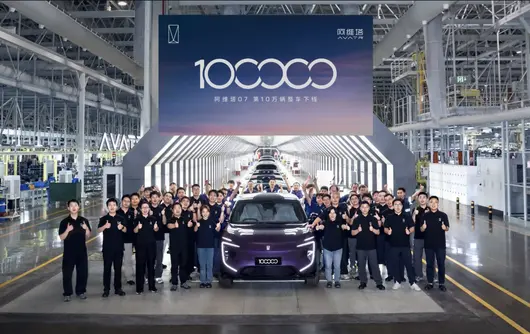
 Just when the industry is generally seeking a way to break through, on July 8, 2026, two landmark events landed simultaneously, providing a differentiated breakthrough model for Chinese high-end new energy brands: the Chongqing Avatr Digital Intelligence Factory welcomed a milestone moment, and the 100,000th Avatr 07 vehicle was officially rolled off the production line; at the brand experience store in Singapore, Nobel Prize in Physics laureate and graphene discoverer Professor Konstantin Novoselov officially became the 100,000th owner of Avatr 07.
 To be honest and objective, a market performance report of 100,000 units in mass production for a single model, combined with the authoritative endorsement of a top global scientist purchasing the car autonomously, these two highlight events resonating at the same frequency are not only concentrated evidence of the single product strength of Avatr 07 but also a landmark signal of Chinese high-end new energy vehicles breaking out of involution and moving towards the global high-end market.
The 100,000th Avatr 07 rolling off the production line is a vote of trust cast by the market with real money. Since its launch in September 2024, Avatr 07 has stably occupied the brand's main sales seat. Rapidly achieving a mass production scale of 100,000 units is by no means accidental, but the result of the product's all-dimensional hard power and top smart manufacturing system jointly holding it up.
 As a smart and beautiful urban luxury SUV jointly created by the combined strength of Changan, Huawei, and CATL technology, Avatr 07 achieves a leap in the four dimensions of intelligence, performance, luxury, and safety, breaking the industry convention of "high specifications only have core technology" for high-end models.
At the intelligence level, equipped with Huawei Qiankun ADS 4 high-level intelligent driving, achieving full-link assistance from parking spot to parking spot, smooth passage through complex scenarios such as narrow roads, roundabouts, and toll gates, letting city commuting say goodbye to cumbersome operations; HarmonySpace 5 Smart Cockpit builds full-scenario emotional interaction, making human-car communication more natural and smooth.
At the performance end, relying on the full-domain 800V Silicon Carbide platform, combined with CATL Shenxing Super Charging Battery, strong range, fast charging, dissolving pure electric users' mileage anxiety.
 In terms of luxury experience, original future aesthetic body, five natural car paints, also dual zero-gravity seats, Meridian audio, electric suction doors, car refrigerator can be selected, creating mobile first-class cabin experience; also Taihang Smart Control Chassis, balancing comfort and handling.
In terms of safety, it is fully loaded, Huawei CAS 4.0 All-dimensional Anti-collision System, C-NCAP Five-star Body, full car 9 Air Bag support, making Avatr 07 form a closed loop from active avoidance to passive protection.
 Digging deeper, supporting the stable mass production of this fully-equipped product is the world's first full-domain 5G Digital Intelligence AI Flexible Super Factory. Avatr Digital Intelligence Factory relies on Huawei Digital Infrastructure to build a Dark Factory production system, stamping workshop 0.1mm extreme body precision, one-piece die-casting workshop, 471 welding robots build over 90% high-strength steel and aluminum alloy body, 8-layer three-coat two-bake car paint process, full-cycle quality control, making every Avatr 07 rolled off the production line have unified world-class quality.
Over-hard product power combined with stable and reliable smart manufacturing jointly creates 100,000 units of market results. Undoubtedly, Avatr 07 has already stood firm in the mainstream high-end new energy track, winning consistent good reviews from users at home and abroad.
If the roll-off of the 100,000th Avatr 07 represents the widespread recognition of the mass market, then the choice of the Nobel Prize winner is the most weighty authoritative endorsement from the global top technology circle.

This May, Novoselov visited Chongqing, experienced Avatr models up close, highly recognizable original design, enveloping intelligent cockpit, warm human-car interaction, all left him with a deep impression. After returning to Singapore, he actively chose Avatr 07 as his daily commute ride, and this is also his first Chinese car in his life.

Top scientists willing to pay for Chinese high-end electric vehicles, behind which transmits a clear industry signal: Chinese new energy brands have long got rid of the "low price commuting" stereotype label, relying on original design, underlying technology innovation, unique luxury tuning, successfully breaking through overseas high-end circle barriers, obtaining global top user circle value recognition.
III. Global Breakout: Dual-Line Highlight Empowerment, Solidifying Avatr's Global "New Luxury" Positioning
From the market milestone of 100,000 units roll-off to the tech certification of Nobel Prize owners, the double highlight events simultaneously confirm Avatr "Global New Luxury" brand positioning's accelerated implementation. Avatr has already walked out a path to high-end localization belonging to Chinese brands: shaping aesthetic differentiation with original design, building experience moat with top technology, solidifying quality foundation with Digital Intelligence Factory, using balanced luxury experience to move global consumers.
 Looking overseas, this product hard power has been transformed into actual globalization results. As of May 2026, Avatr has entered 43 countries and regions, layout 95 overseas distribution nodes, overseas model average price broke through 300,000 Yuan, achieving high-value outbound and continuous profitability; 2025 overseas revenue 1.398 billion Yuan, year-on-year increase over 5 times, first 5 months of 2026 overseas sales year-on-year improvement 33.4%.
Brand globalization pace is still continuing to accelerate, Avatr 2026 will formally enter European market, planned to enter over 110 countries and regions by 2030, achieve wider overseas layout.
 It is worth mentioning, besides the two major core events this time, Avatr new car will arrive soon: Avatr 07L will start pre-sale in mid-July, continuing family original aesthetics, integrating top technology strength, forming product complement with current Avatr 07, covering different sizes, different car usage needs high-end family users, further enriching brand product matrix, continuously lifting brand market potential.
Jianghu Car Review:
When a model 100,000 units mass production lands, when global top scientists actively choose Chinese intelligent manufacturing, the answer paper handed in by Avatr 07 belongs not only to a single model but also is a metaphor for the high-end, globalization process of the entire Chinese new energy vehicle industry. In the past, Chinese car companies' outbound mainly won on price-performance ratio, now Avatr proves, relying on original design, self-developed intelligence, top three-electric, stable manufacturing, Chinese brands are completely capable of standing on the global luxury electric car track, winning sales, reputation, high-end circle triple recognition.
 Facing the future, relying on clear globalization strategy, continuous iteration product matrix, continuously solidifying technology base, Avatr will continue to take technology as blade, take luxury as base color, continuously output Chinese high-end travel solutions to global, walk into global users' life.100,000th Vehicle Roll-off + Nobel Laureate "Endorses", How Did Avatr 07 Break Through?

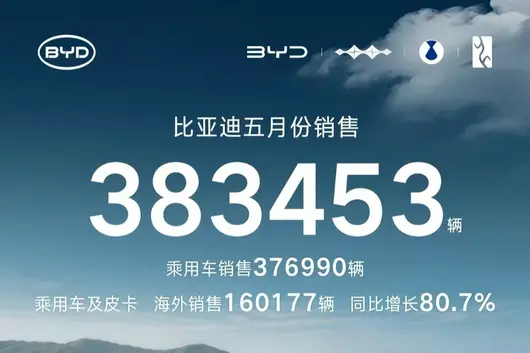
比亞迪正式發布 2026 年 5 月產銷快報,全品牌新能源汽車單月銷量 383453 輛,同比微增 0.26%,時隔十個月實現單月銷量同比轉正;其中乘用車交付 376990 輛,環比大漲 19.4%,一掃前期車型換代陣痛,呈現國內基本盤穩固、海外銷量狂飆、高端品牌全線放量的全新格局,在國內新能源內捲加劇、特斯拉 FSD 入華、自主新品密集上市的市場環境中,走出獨有的結構性增長路線。

王朝 + 海洋兩大主力品牌 5 月合計售出 330215 輛,佔據集團總銷量超八成,仍是比亞迪銷量壓艙石,全系列共 8 款車型單月銷量突破 2 萬台,產品從 5 萬入門代步到 20 萬家用 SUV 實現全覆蓋。

王朝網內部,元家族 56691 輛、宋家族 51370 輛。雙雙跨過五萬門檻,成為品牌兩大銷量支柱,兼顧家用代步與城鄉出行需求;秦家族緊隨其後交出 28360 台穩定表現,漢、唐系列月銷維持六千級體量,深耕中大型家用轎車、SUV 細分市場;全新車型夏處於市場培育期,單月交付 1810 台,後續隨渠道鋪開有望穩步上量。
海洋網增長勢頭更為迅猛,全系五款車型跨入兩萬俱樂部:海獅 42615 台、海豹 34117 台、海鷗 39919 台、海豚 22260 台、宋 PLUS 27755 台。其中海鷗憑藉 6-8 萬親民定價穩居入門代步銷冠,海獅作為全新走量車型上市即站穩四萬量級,補齊海洋網中型 SUV 產品空白,完善海洋產品梯隊佈局。從代步小車到緊湊 SUV,兩大主品牌依托 DM-i 混動與純電雙線技術,牢牢鎖住 15 萬以內國內主流家用市場份額。
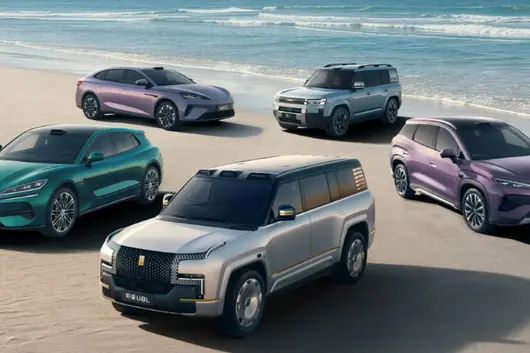
方程豹同比暴漲 139.7% 品牌向上落地見效騰勢、方程豹、仰望組成的高端矩陣 5 月合計銷售 46489 輛,正式擺脫小眾定位,成為比亞迪品牌溢價與利潤增長新支點,打破自主品牌高端化難破局的行業魔咒。

越野品牌方程豹單月 30186 輛,同比暴漲 139.7%,創下品牌上市以來月度銷量新高,旗下鎦 7 單月 18280 台,豹 5、豹 8 穩定輸出,在 25-40 萬硬派越野細分市場持續擠壓合資、進口車型生存空間。

騰勢 5 月交付 16303 台,MPV 標桿 D9 售出 6721 台,Z9 系列近 6000 台,MPV、中大型轎車雙線發力,站穩豪華新能源賽道;百萬元級超豪華品牌仰望穩步爬坡,當月交付 286 台,同比增幅 105.8%,完成自主品牌天花板產品的市場驗證,形成從十幾萬家用、三四十萬越野、五十萬豪華 MPV 到百萬元級旗艦的全價格帶產品佈局。

5 月比亞迪乘用車和皮卡海外銷量 160177 輛,同比大漲 80.7%,出口佔全系總銷量突破 42%,創下品牌出海歷史新高,成為穩住 5 月整體銷量、實現同比轉正的核心驅動力。
東南亞、歐洲、拉美成為主力增量市場,海鷗、宋 PLUS、元系列持續登頂多國新能源熱銷榜單,SHARK 皮卡連續兩月單月出口突破 4000 台;依托泰國、巴西、匈牙利、烏茲別克斯坦四大海外整車工廠落地投產,本地化生產持續落地,規避關稅同時快速下沉終端渠道。在國內車市存量競爭、價格戰常態化背景下,高速擴容的海外市場有效對沖國內車型換代帶來的銷量波動,正式從補充市場升級為比亞迪核心增長引擎。截至當前,比亞迪新能源汽車全球累計銷量已經突破 1650 萬輛,全球化版圖持續拓寬。
智駕賦能產品迭代 下半年新品蓄力衝量5 月比亞迪智能化落地迎來關鍵節點,天神之眼智駕系統成為車型核心加分項:全品牌搭載高級智駕車型保有量突破 315 萬輛,日均路測數據超 2 億公里;當月比亞迪落地城市領航、智能泊車雙安全兜底服務,成為全球首家實現兩項智駕兜底的車企,政策落地三天後,搭載天神之眼系統車型的城市 NOA 激活率暴漲 50%,智能化體驗升級直接拉動終端到店訂單轉化,為後續車型持續走量築牢產品競爭力,直面 FSD 入華帶來的智駕市場衝擊。
從數據細節來看,2026 年 1-5 月比亞迪累計銷量 1405039 輛,同比下滑 20.32%,核心誘因是全系主力車型集中換代、第二代閃充刀片電池產能爬坡受限。新款閃充電池升級快充與低溫性能,全系換代車型優先換裝新電池,但產線改造拖累產能釋放,熱門車型訂單積壓、交付延後,一定程度壓縮 5 月交付體量。
隨著二季度末二代刀片電池產能持續釋放,疊加騰勢 N8L、方程豹鎦 7 純電版、海獅 05、夏 L 等多款新車陸續登陸市場,業內普遍預判比亞迪 6 月全品牌銷量有望突破 40 萬輛。依托低端走量鎖份額、高端提利潤、海外衝增量、智能化提產品力的四維發展邏輯,在國內新能源淘汰賽加劇的當下,比亞迪全品類佈局優勢持續放大,坐穩國內新能源龍頭,加速向著全球頭部車企穩步邁進。

In May, China's automotive market overall presented a gentle recovery trend, with domestic brands still being the sales backbone of the market. Recently, BYD, Geely, Chery, Changan, and Great Wall, the top 5 domestic automakers, successively released their monthly performance reports. From the data, these five companies show a general characteristic of "stable total growth, divergence between domestic and international markets, and accelerated new energy penetration". Overseas exports and new energy vehicles have become the most core growth engines; export business has evolved from a "bonus item" to the "core foundation" for some companies. BYD's "dominant leader" status is further consolidated, Chery achieved high growth via exports, Geely's new energy penetration rate broke 56%, Changan focused steadily on balanced development, while Great Wall appeared slightly under pressure during structural transformation.
BYD: Export Hits New High Becomes Biggest HighlightIn May, BYD stood firmly at the top of domestic brands with a monthly sales volume of 383,500 vehicles, maintaining positive growth both year-on-year and month-over-month under a large base. Its two main brands, Dynasty and Ocean, sold a combined 330,200 vehicles, contributing 86.1% of total sales; Fangchengbao's monthly sales broke 30,000 units to reach 30,200, a year-on-year increase of 139.7%, setting a new high for the year; Denza sold 16,300 vehicles, and Yangwang delivered 286 vehicles. From a model perspective, BYD had eight models in May with monthly sales exceeding 20,000 vehicles. The Song Family and Yuan Family both broke 50,000 units, selling 51,370 and 56,691 vehicles respectively. The Sea Lion Family followed closely with 42,615 vehicles, and Seagull sales were also close to 40,000 vehicles.

BYD's biggest highlight in May was exports. Overseas new energy vehicle sales reached 160,600 units, an 80.4% year-on-year increase, accounting for about 42%. The sharp expansion of export scale effectively countered the phased weakness in domestic demand. Cumulative exports from January to May exceeded 620,000 vehicles. High export growth mainly benefited from continued ramping up of overseas factory capacity, improved ocean shipping capacity, and accelerated channel network expansion. In the domestic market, BYD promoted Megawatt Super Charging and intelligent strategies simultaneously—Megawatt charging achieved about 90% charge in 9 minutes; 20,000 super charging stations are planned to be built by 2026; all series models are available with Sky Eye B intelligent driving solutions and city navigation safety fallback plans, accelerating the popularization of high-level intelligent driving. As Gen 2 Blade Battery capacity gradually releases, the company's orders are expected to continue rising.
Chery: Sales Growth Leads the Top 5Chery Group's total sales volume in May was 247,800 vehicles, a significant year-on-year increase of 20.5%, ranking first in growth speed among the top 5. Exports remained its most core growth engine—May exports reached 181,900 vehicles, an 80.5% year-on-year increase, accounting for 73.4% of total sales that month, continuously breaking the single-month export record for Chinese brands for three months. In terms of new energy, Chery New Energy sold 100,300 vehicles, a 58.8% year-on-year increase. April and May consecutively saw monthly new energy sales breaking 100,000 vehicles.

The strong performance in exports benefited from Chery's long-term deep cultivation of overseas channel advantages and localized operation capabilities. While overseas orders continued to rise, high export growth formed a sharp contrast with domestic sales—Chery's domestic sales in May were only 60,000 vehicles, accounting for one-quarter of total sales. From cumulative data, Chery Group accumulated 1.101 million sales from January to May, but against the annual goal of 3.2 million vehicles, monthly averages need to reach about 420,000 vehicles later, and pressure remains significant.
Geely: New Energy Penetration Rate Breaks 56%Geely Auto's total sales volume in May was 237,600 vehicles, a 1% year-on-year increase, achieving month-over-month double growth for three consecutive months. In terms of structure, Geely's "New Four Transformations" transformation showed significant results: new energy vehicle sales reached 133,400 units, accounting for 56% of total sales, with new energy share exceeding 50% for four consecutive months.

From sub-brands, performance was significantly divergent. Zeekr brand sales in May reached 34,400 vehicles, a 82% year-on-year increase; Zeekr 9 Series and 8 Series models combined sales approached 50% of total sales, showing bright performance in the high-end market; Galaxy brand sales were 81,700 vehicles; Geely brand sales were 182,500 vehicles, among which China Star Series sales reached 100,800 vehicles; Lynk & Co brand sales were 20,700 vehicles, with new energy vehicle sales share rising to 71%.
In terms of exports, Geely's overseas vehicle exports in May reached 85,100 vehicles, a explosive 184% year-on-year increase, setting a brand single-month export record high. Among exported products, new energy vehicles reached 40,800 units, accounting for nearly half; hybrid and pure electric products have successively landed in Southeast Asia, Middle East, Latin America, and other markets, highlighting the results of global strategy implementation.
Changan: Multi-brand Matrix Balanced EffortChangan Auto's delivery volume in May was 209,100 vehicles, among which new energy deliveries were 92,400 vehicles, a 5.8% year-on-year increase, with new energy share about 44%. In terms of exports, overseas deliveries reached 70,700 vehicles, a 38% year-on-year increase, becoming another major growth highlight for Changan in May.
In the sub-brand matrix, Changan Qiyuan delivered 34,500 vehicles in May; All-New Q05 delivered 15,800 units, with orders breaking 3,000 units within three days of listing in Thailand; Deepal sales in May were 33,200 vehicles, a 30% year-on-year increase; January to May overseas cumulative sales were 28,700 vehicles, a significant 167% year-on-year increase; Avatr delivered 7,336 vehicles in May; Changan Auto (Gravity) delivered nearly 49,000 vehicles in May.

Changan Auto's balanced layout was fully reflected in May: the fuel car base remained stable, new energy brands Deepal and Qiyuan accelerated volume growth, high-end brand Avatr continued to break through in technical cooperation, and overseas markets simultaneously achieved breakthrough growth. The pattern of five brands working together, driven by both new energy and exports, is initially taking shape.
Great Wall: Overseas Sales Growth Year-on-Year 46.75%Great Wall Motor's sales in May were 100,400 vehicles, slightly down compared to last May's 102,200 vehicles, making it the only company among the top 5 to show a year-on-year negative growth. From sub-brands, Haval brand sales in May were 55,500 vehicles, remaining Great Wall's most important sales pillar; Tank brand sales were 17,100 vehicles; both Haval and Tank brand sales showed year-on-year declines; Wey brand sold 8,119 vehicles, a 31.78% year-on-year increase, achieving growth against the trend; Ora brand performance was most stunning, with sales of 6,018 vehicles, a significant 206.88% year-on-year increase. In terms of new energy, Great Wall sold 30,400 new energy vehicles in May, with new energy vehicle transformation gradually accelerating.

The overseas market became Great Wall's biggest highlight in May, with overseas sales growing 46.75% year-on-year. Against the background of pressure on the domestic market, strong growth in overseas business effectively made up for the decline in the domestic market. Great Wall Motor's current core contradiction lies in: Haval and Tank, the two traditional main-selling brands, face weak growth, while Wey and Ora brands, although growing notably, have relatively small volume and are not yet enough to support overall growth. How to complete the "relay" between old and new brands is the key issue Great Wall must solve subsequently.
Final ThoughtsFrom May data, the growth pattern of the top 5 domestic brands has clearly diverged, but there are three common trends worth noting: First, exports have become a key engine for domestic brands to seek stability and growth. Second, new energy transformation is still accelerating, but paths differ among enterprises. Third, technological innovation continues to deepen brand moats. Looking ahead to the second half of the year, competition in the automotive industry will continue to upgrade around these three trends. Although everyone has a common direction, these three trends are all competing for the entire enterprise's industrial chain strength, and the strong will remain strong, which has almost become an inevitable outcome.

比亞迪正式發布 2026 年 5 月產銷快報,全品牌新能源汽車單月銷量 383453 輛,同比微增 0.26%,時隔十個月實現單月銷量同比轉正;其中乘用車交付 376990 輛,環比大漲 19.4%,一掃前期車型換代陣痛,呈現國內基本盤穩固、海外銷量狂飆、高端品牌全線放量的全新格局,在國內新能源內捲加劇、特斯拉 FSD 入華、自主新品密集上市的市場環境中,走出獨有的結構性增長路線。
王朝 + 海洋兩大主力品牌 5 月合計售出 330215 輛,佔據集團總銷量超八成,仍是比亞迪銷量壓艙石,全系列共 8 款車型單月銷量突破 2 萬台,產品從 5 萬入門代步到 20 萬家用 SUV 實現全覆蓋。
王朝網內部,元家族 56691 輛、宋家族 51370 輛。雙雙跨過五萬門檻,成為品牌兩大銷量支柱,兼顧家用代步與城鄉出行需求;秦家族緊隨其後交出 28360 台穩定表現,漢、唐系列月銷維持六千級體量,深耕中大型家用轎車、SUV 細分市場;全新車型夏處於市場培育期,單月交付 1810 台,後續隨渠道鋪開有望穩步上量。
海洋網增長勢頭更為迅猛,全系五款車型跨入兩萬俱樂部:海獅 42615 台、海豹 34117 台、海鷗 39919 台、海豚 22260 台、宋 PLUS 27755 台。其中海鷗憑藉 6-8 萬親民定價穩居入門代步銷冠,海獅作為全新走量車型上市即站穩四萬量級,補齊海洋網中型 SUV 產品空白,完善海洋產品梯隊佈局。從代步小車到緊湊 SUV,兩大主品牌依托 DM-i 混動與純電雙線技術,牢牢鎖住 15 萬以內國內主流家用市場份額。
方程豹同比暴漲 139.7% 品牌向上落地見效騰勢、方程豹、仰望組成的高端矩陣 5 月合計銷售 46489 輛,正式擺脫小眾定位,成為比亞迪品牌溢價與利潤增長新支點,打破自主品牌高端化難破局的行業魔咒。
越野品牌方程豹單月 30186 輛,同比暴漲 139.7%,創下品牌上市以來月度銷量新高,旗下鎦 7 單月 18280 台,豹 5、豹 8 穩定輸出,在 25-40 萬硬派越野細分市場持續擠壓合資、進口車型生存空間。
騰勢 5 月交付 16303 台,MPV 標桿 D9 售出 6721 台,Z9 系列近 6000 台,MPV、中大型轎車雙線發力,站穩豪華新能源賽道;百萬元級超豪華品牌仰望穩步爬坡,當月交付 286 台,同比增幅 105.8%,完成自主品牌天花板產品的市場驗證,形成從十幾萬家用、三四十萬越野、五十萬豪華 MPV 到百萬元級旗艦的全價格帶產品佈局。
5 月比亞迪乘用車和皮卡海外銷量 160177 輛,同比大漲 80.7%,出口佔全系總銷量突破 42%,創下品牌出海歷史新高,成為穩住 5 月整體銷量、實現同比轉正的核心驅動力。
東南亞、歐洲、拉美成為主力增量市場,海鷗、宋 PLUS、元系列持續登頂多國新能源熱銷榜單,SHARK 皮卡連續兩月單月出口突破 4000 台;依托泰國、巴西、匈牙利、烏茲別克斯坦四大海外整車工廠落地投產,本地化生產持續落地,規避關稅同時快速下沉終端渠道。在國內車市存量競爭、價格戰常態化背景下,高速擴容的海外市場有效對沖國內車型換代帶來的銷量波動,正式從補充市場升級為比亞迪核心增長引擎。截至當前,比亞迪新能源汽車全球累計銷量已經突破 1650 萬輛,全球化版圖持續拓寬。
智駕賦能產品迭代 下半年新品蓄力衝量5 月比亞迪智能化落地迎來關鍵節點,天神之眼智駕系統成為車型核心加分項:全品牌搭載高級智駕車型保有量突破 315 萬輛,日均路測數據超 2 億公里;當月比亞迪落地城市領航、智能泊車雙安全兜底服務,成為全球首家實現兩項智駕兜底的車企,政策落地三天後,搭載天神之眼系統車型的城市 NOA 激活率暴漲 50%,智能化體驗升級直接拉動終端到店訂單轉化,為後續車型持續走量築牢產品競爭力,直面 FSD 入華帶來的智駕市場衝擊。
從數據細節來看,2026 年 1-5 月比亞迪累計銷量 1405039 輛,同比下滑 20.32%,核心誘因是全系主力車型集中換代、第二代閃充刀片電池產能爬坡受限。新款閃充電池升級快充與低溫性能,全系換代車型優先換裝新電池,但產線改造拖累產能釋放,熱門車型訂單積壓、交付延後,一定程度壓縮 5 月交付體量。
隨著二季度末二代刀片電池產能持續釋放,疊加騰勢 N8L、方程豹鎦 7 純電版、海獅 05、夏 L 等多款新車陸續登陸市場,業內普遍預判比亞迪 6 月全品牌銷量有望突破 40 萬輛。依托低端走量鎖份額、高端提利潤、海外衝增量、智能化提產品力的四維發展邏輯,在國內新能源淘汰賽加劇的當下,比亞迪全品類佈局優勢持續放大,坐穩國內新能源龍頭,加速向著全球頭部車企穩步邁進。

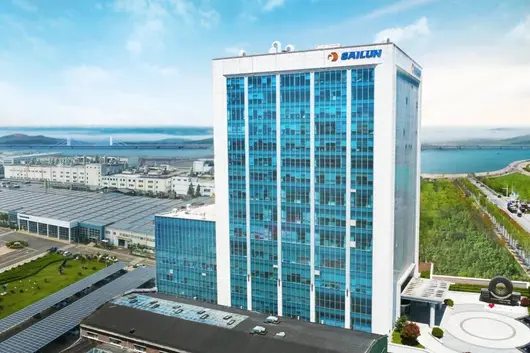
On June 1, Sailun Tire (601058) released the implementation announcement for the 2025 annual equity distribution, stating that the company will distribute a cash dividend of 0.18 yuan per share to all shareholders (tax included), totaling nearly 592 million yuan in cash dividends. The record date for equity is June 4, and the cash dividend distribution date is June 5.
Behind this generous dividend distribution lies the strong financial confidence of this private tire giant, which rose to the first tier globally within just over 20 years of establishment. Facing the sharp increase in costs brought by the escalation of global trade barriers since 2025, Sailun still delivered a response with great resilience.

Revenue Hits Record High, Profitability Quality Continues to Improve
In 2025, Sailun Tire's annual revenue reached 36.792 billion yuan, a year-on-year increase of 15.69%, setting a new historical record. Although operating costs for tire products increased by 21.02% year-on-year, the company stabilized the gross profit margin at a relatively high level of 24.63% thanks to product structure and pricing advantages.
Net profit attributable to the parent company and net profit after deducting non-recurring gains and losses for the year reached 3.522 billion yuan and 3.458 billion yuan respectively, with both profitability indicators reaching their second-historical levels. More noteworthy is that the company's net operating cash flow reached 4.179 billion yuan, a year-on-year surge of 82.58%, indicating substantive improvement in profitability quality.

Liquid Gold Breakthrough, ESG Rating Jumps to AA Level
The support for resilient performance stems from hardcore technical barriers. The 'Liquid Gold' technology (Ecopoint3) developed by Sailun after a decade of in-depth research adopts a world-first chemical rubber vulcanization method, successfully breaking through the 'Devil's Triangle' problem in the tire industry where rolling resistance, wet traction, and wear resistance could not be improved simultaneously. It not only achieves a balance of energy saving, safety, and wear resistance, but also achieves green low-carbon across the entire lifecycle from raw materials to production and usage.

This persistence in green sustainability has also won Sailun recognition from international capital markets. Recently, the international authoritative index institution MSCI upgraded Sailun's ESG rating from A to AA, solidifying its top position in China's tire industry and placing it among the global forefront. This marks that Sailun's sustainable development strength in global operations, R&D innovation, and supply chain management has received high international recognition.
Capacity Expansion Both Domestic and Overseas, Brand Value Rising Yearly
Going against the current, stagnation means retreat. While consolidating the technological moat, Sailun has pressed the accelerator on global capacity expansion. Since establishing China's first overseas tire production base in Vietnam in 2012, Sailun has continued to increase investment since 2026: in April, it announced an investment of about 1.95 billion yuan to build an expansion project for a 7.05 million radial tire annual production capacity in Egypt; meanwhile, the Indonesia factory also received a capital increase of about 336 million yuan to expand PCR and TBR capacity.

The resonance between capacity and performance boosted the rapid rise in brand value. In the 2025 'China 500 Most Valuable Brands', Sailun ranked 105th with a brand value of 112.896 billion yuan, an increase of 12.3 billion yuan compared to last year; in Brand Finance's Top 25 Global Tire Brand Values, Sailun ranked in the top ten for the first time, continuing to be the most valuable tire brand in China.
From a new enterprise on the Shandong Peninsula to a global giant competing with century-old foreign strong enterprises, Sailun, driven by technology and capacity on two wheels, is accelerating towards a new height in the global tire industry.

In May, China's automotive market overall presented a gentle recovery trend, with domestic brands still being the sales backbone of the market. Recently, BYD, Geely, Chery, Changan, and Great Wall, the top 5 domestic automakers, successively released their monthly performance reports. From the data, these five companies show a general characteristic of "stable total growth, divergence between domestic and international markets, and accelerated new energy penetration". Overseas exports and new energy vehicles have become the most core growth engines; export business has evolved from a "bonus item" to the "core foundation" for some companies. BYD's "dominant leader" status is further consolidated, Chery achieved high growth via exports, Geely's new energy penetration rate broke 56%, Changan focused steadily on balanced development, while Great Wall appeared slightly under pressure during structural transformation.
BYD: Export Hits New High Becomes Biggest HighlightIn May, BYD stood firmly at the top of domestic brands with a monthly sales volume of 383,500 vehicles, maintaining positive growth both year-on-year and month-over-month under a large base. Its two main brands, Dynasty and Ocean, sold a combined 330,200 vehicles, contributing 86.1% of total sales; Fangchengbao's monthly sales broke 30,000 units to reach 30,200, a year-on-year increase of 139.7%, setting a new high for the year; Denza sold 16,300 vehicles, and Yangwang delivered 286 vehicles. From a model perspective, BYD had eight models in May with monthly sales exceeding 20,000 vehicles. The Song Family and Yuan Family both broke 50,000 units, selling 51,370 and 56,691 vehicles respectively. The Sea Lion Family followed closely with 42,615 vehicles, and Seagull sales were also close to 40,000 vehicles.
BYD's biggest highlight in May was exports. Overseas new energy vehicle sales reached 160,600 units, an 80.4% year-on-year increase, accounting for about 42%. The sharp expansion of export scale effectively countered the phased weakness in domestic demand. Cumulative exports from January to May exceeded 620,000 vehicles. High export growth mainly benefited from continued ramping up of overseas factory capacity, improved ocean shipping capacity, and accelerated channel network expansion. In the domestic market, BYD promoted Megawatt Super Charging and intelligent strategies simultaneously—Megawatt charging achieved about 90% charge in 9 minutes; 20,000 super charging stations are planned to be built by 2026; all series models are available with Sky Eye B intelligent driving solutions and city navigation safety fallback plans, accelerating the popularization of high-level intelligent driving. As Gen 2 Blade Battery capacity gradually releases, the company's orders are expected to continue rising.
Chery: Sales Growth Leads the Top 5Chery Group's total sales volume in May was 247,800 vehicles, a significant year-on-year increase of 20.5%, ranking first in growth speed among the top 5. Exports remained its most core growth engine—May exports reached 181,900 vehicles, an 80.5% year-on-year increase, accounting for 73.4% of total sales that month, continuously breaking the single-month export record for Chinese brands for three months. In terms of new energy, Chery New Energy sold 100,300 vehicles, a 58.8% year-on-year increase. April and May consecutively saw monthly new energy sales breaking 100,000 vehicles.
The strong performance in exports benefited from Chery's long-term deep cultivation of overseas channel advantages and localized operation capabilities. While overseas orders continued to rise, high export growth formed a sharp contrast with domestic sales—Chery's domestic sales in May were only 60,000 vehicles, accounting for one-quarter of total sales. From cumulative data, Chery Group accumulated 1.101 million sales from January to May, but against the annual goal of 3.2 million vehicles, monthly averages need to reach about 420,000 vehicles later, and pressure remains significant.
Geely: New Energy Penetration Rate Breaks 56%Geely Auto's total sales volume in May was 237,600 vehicles, a 1% year-on-year increase, achieving month-over-month double growth for three consecutive months. In terms of structure, Geely's "New Four Transformations" transformation showed significant results: new energy vehicle sales reached 133,400 units, accounting for 56% of total sales, with new energy share exceeding 50% for four consecutive months.
From sub-brands, performance was significantly divergent. Zeekr brand sales in May reached 34,400 vehicles, a 82% year-on-year increase; Zeekr 9 Series and 8 Series models combined sales approached 50% of total sales, showing bright performance in the high-end market; Galaxy brand sales were 81,700 vehicles; Geely brand sales were 182,500 vehicles, among which China Star Series sales reached 100,800 vehicles; Lynk & Co brand sales were 20,700 vehicles, with new energy vehicle sales share rising to 71%.
In terms of exports, Geely's overseas vehicle exports in May reached 85,100 vehicles, a explosive 184% year-on-year increase, setting a brand single-month export record high. Among exported products, new energy vehicles reached 40,800 units, accounting for nearly half; hybrid and pure electric products have successively landed in Southeast Asia, Middle East, Latin America, and other markets, highlighting the results of global strategy implementation.
Changan: Multi-brand Matrix Balanced EffortChangan Auto's delivery volume in May was 209,100 vehicles, among which new energy deliveries were 92,400 vehicles, a 5.8% year-on-year increase, with new energy share about 44%. In terms of exports, overseas deliveries reached 70,700 vehicles, a 38% year-on-year increase, becoming another major growth highlight for Changan in May.
In the sub-brand matrix, Changan Qiyuan delivered 34,500 vehicles in May; All-New Q05 delivered 15,800 units, with orders breaking 3,000 units within three days of listing in Thailand; Deepal sales in May were 33,200 vehicles, a 30% year-on-year increase; January to May overseas cumulative sales were 28,700 vehicles, a significant 167% year-on-year increase; Avatr delivered 7,336 vehicles in May; Changan Auto (Gravity) delivered nearly 49,000 vehicles in May.
Changan Auto's balanced layout was fully reflected in May: the fuel car base remained stable, new energy brands Deepal and Qiyuan accelerated volume growth, high-end brand Avatr continued to break through in technical cooperation, and overseas markets simultaneously achieved breakthrough growth. The pattern of five brands working together, driven by both new energy and exports, is initially taking shape.
Great Wall: Overseas Sales Growth Year-on-Year 46.75%Great Wall Motor's sales in May were 100,400 vehicles, slightly down compared to last May's 102,200 vehicles, making it the only company among the top 5 to show a year-on-year negative growth. From sub-brands, Haval brand sales in May were 55,500 vehicles, remaining Great Wall's most important sales pillar; Tank brand sales were 17,100 vehicles; both Haval and Tank brand sales showed year-on-year declines; Wey brand sold 8,119 vehicles, a 31.78% year-on-year increase, achieving growth against the trend; Ora brand performance was most stunning, with sales of 6,018 vehicles, a significant 206.88% year-on-year increase. In terms of new energy, Great Wall sold 30,400 new energy vehicles in May, with new energy vehicle transformation gradually accelerating.
The overseas market became Great Wall's biggest highlight in May, with overseas sales growing 46.75% year-on-year. Against the background of pressure on the domestic market, strong growth in overseas business effectively made up for the decline in the domestic market. Great Wall Motor's current core contradiction lies in: Haval and Tank, the two traditional main-selling brands, face weak growth, while Wey and Ora brands, although growing notably, have relatively small volume and are not yet enough to support overall growth. How to complete the "relay" between old and new brands is the key issue Great Wall must solve subsequently.
Final ThoughtsFrom May data, the growth pattern of the top 5 domestic brands has clearly diverged, but there are three common trends worth noting: First, exports have become a key engine for domestic brands to seek stability and growth. Second, new energy transformation is still accelerating, but paths differ among enterprises. Third, technological innovation continues to deepen brand moats. Looking ahead to the second half of the year, competition in the automotive industry will continue to upgrade around these three trends. Although everyone has a common direction, these three trends are all competing for the entire enterprise's industrial chain strength, and the strong will remain strong, which has almost become an inevitable outcome.


