首頁engine

搜尋歷史
熱門搜尋
經銷商登入 / 註冊

Xinhua AUTO: In 2026, the Chinese new energy vehicle market is undergoing an unprecedented restructuring. As the industry shifts from widespread incremental expansion to fierce stock competition, an August sales report not only announces a complete reshuffle of the ranking among new car manufacturers, but also demonstrates the strong momentum of Chinese new energy automakers on the global track.

Leapmotor delivered 103,129 vehicles globally, with a year-on-year increase of 80.7%, solidly standing at the 100,000 monthly sales mark for the second consecutive month, unhesitatingly retaining the sales champion among new forces. What is more shocking is the gap of over 60,000 vehicles opened between it and the second-place Harmony Intelligence (42,101 vehicles) — Leapmotor's single monthly sales exceeded the sum of the second to fourth places. According to the comparable terminal registration data for the first 5 months of this year, Leapmotor ranks fourth globally among new energy passenger car brands, behind BYD, Tesla, and Geely, ranking third among Chinese new energy passenger car brands.
From 879 units sold per month in 2019 to 100,000 units today, Leapmotor took six years. This is not luck, but a manufacturing logic that has been repeatedly verified.
Sales Gap Leading, New Force Structure Faces Reshaping
First, let's look at how drastic the tier differentiation is in August's chess game.
Above Leapmotor, no one; below Leapmotor, crowded. Harmony Intelligence ranks second with 42,101 units, while Xpeng, Li Auto, Zeekr, and Nio are densely packed in the 35,000 to 40,000 unit range — the gap between them is less than 4,000 units. A production fluctuation in a key model or the launch of a new car is enough to rewrite monthly rankings. This is a typical "close-quarters combat" zone.
And Leapmotor has completely left this quagmire, pushing the new force competition threshold directly to the 100,000 units monthly scale.

Supporting this gap is the A, B, C, D four major product series covering the entire price band from 60,000 to 300,000 yuan. A series sold nearly 30,000 units in October, taking the sales champion of Chinese brand SUVs, and is the absolute main force in the entry market; B series monthly sales broke through 20,000 units, catering to the mid-range needs of young families; C series is a global model, C10 monthly sales continued to break 10,000, with the series global cumulative sales exceeding 850,000 units, among which C11 cumulative sales reached about 350,000 since its launch in 2021; the flagship sequence also achieved significant breakthroughs — D19 delivered 10,043 units in July, retaining the sales champion of large SUVs within 400,000 yuan for three consecutive months, the first MPV D99 first batch order average price broke through 300,000 yuan.

Four vehicles selling in volume simultaneously, without relying on a single hit, anti-risk ability is far stronger than opponents who "support the whole situation with one car". This is the product-end foundation for Leapmotor to stand out in the battlefield.
Stretching the time axis is more astonishing: 596,600 units delivered in full year 2025, up 103.1% year-on-year; 560,900 units reached in the first 8 months of 2026, up about 70% year-on-year; as of the end of July, Leapmotor's global cumulative delivery broke through 1.6 million units.
Jumping to Fourth Globally, Going Overseas Builds Second Growth Curve
If it's only price-performance ratio in the domestic market, Leapmotor can at most be a "China Sales Champion". What truly pushes it to fourth globally is the steep growth curve overseas.
In the first half of 2026, Leapmotor exported 96,294 units, a violent increase of 372.6% year-on-year — this number has already exceeded its total export volume for all of 2025, accounting for 27% of total sales in the first half. Equivalent to about one out of every four Leapmotor sold is sent overseas. Cumulative exports in January to July reached 113,863 units, the annual target has been adjusted from 100,000 to 150,000 units to 200,000 units, 2027 challenges 350,000 to 400,000 units.

The key lies in path selection: ride the boat to go out to sea, instead of building boats themselves.
In 2023, Stellantis obtained about 20% equity of Leapmotor for about 1.5 billion euros; in 2024, the two parties established a joint company "Leapmotor International" (Stellantis holding 51%, Leapmotor 49%), responsible for sales and production outside Greater China. Leapmotor's sales outlets are directly embedded into the dealer system of brands under Stellantis, channel costs are close to zero.
What does this mean? As of the end of June, Leapmotor International has entered more than 45 international markets, establishing more than 1,000 sales and after-sales outlets, among which Europe exceeds 900 — the same channel volume level, BYD spent nearly three years, Leapmotor only used one and a half years.
The battle results are very real: Italy pure electric registration 23,000 units in the first half, market share over 25%, ranking first in local pure electric sales for consecutive periods; June became the Chinese brand with the highest new pure electric vehicle registration volume in the German market; ranked third in Chinese brand pure electric retail in the UK. Revenue from markets outside mainland China in the first half reached 9.099 billion yuan, accounting for about 23.9% of total revenue, among which Europe contributed 8.875 billion yuan.

Another deeper step is local production: Malaysia Kedah factory C10 has completed mass production, Spain Zaragoza factory B10 starts production in the third quarter, Brazil Goiania factory is selected as the South American assembly base (mass production in the second half of 2027). This is both a passive choice to cope with EU tariff barriers, and an active layout rooted in the overseas market — CFO Li Tengfei said very clearly: "The improvement of local net profit is not in the present, but in the near future."
The Trump Card: Turn "Cost Structure" into a Moat
The majority of people's impression of Leapmotor stays at "cheap". But cheap is just the result, the real reason is that it re-disassembled the whole vehicle cost structure.
Leapmotor insists on "Full Domain R&D + Deep Self-Manufacturing": grasping more than 65% of the core components of the whole vehicle BOM cost, building 18 parts factories, whole vehicle architecture generalization rate exceeds 88% — more than a dozen cars only used 3 types of battery cells, 2 intelligent driving solutions.

The "Super Five-Electric Factory" in Huzhou, Zhejiang is the entity of this logic: total construction area about 500,000 square meters, concentrating Battery, Drive, Domain Control, Headlights, Electronic Power five key components in one park, is the largest area and highest integration pure core component R&D and self-manufacturing cluster in the global new energy field.
Traditional automobile industry has evolved over decades, forming a pyramid supplier system — whole vehicle factories mainly responsible for design and assembly, about 60% to 80% of the total vehicle cost comes from outsourcing and purchasing, suppliers on average take about 15% gross margin. Leapmotor internalized these links, whole vehicle cost is about 10% lower than pure purchasing schemes.
Specific to details, every cent has an origin:
Drive: Stator manufacturing, rotor manufacturing, controller manufacturing and drive assembly four processes concentrated in one factory, full process "zero transfer", saving 3 times packaging, 3 times cross-factory transport and 3 times entry and exit, single set manufacturing cost saves about 50 yuan — calculated at annual production of 1 million sets, one year is 50 million yuan. It is precisely because of this that Leapmotor dares to promise lifetime warranty for electric drive.
Domain Control: A circuit board the size of A4 paper integrates about 8,000 electronic components, any one sticking crooked 10 microns may affect driving safety. Leapmotor moved the chip manufacturing environment into the car factory, ultra-high speed precision pick and place accuracy reaches ±15 microns, better than industry mainstream ±25—30 microns, nitrogen vacuum reflow soldering yield exceeds 99.995%.

Battery: Follow "self-developed battery pack + purchased cells" route, annual production capacity over 380,000 sets production line has been put into production, module line automation rate as high as 90%, from cell to CTC battery pack through 56 processes, 100% full inspection and data traceability.
This 10% cost advantage is finally converted into pricing power. Zhu Jiangming said this very plainly: "We do not pursue high gross margin, this is not a result, but a choice." He set the target gross margin at 15%, "among which 10% is saved by self-research and self-manufacturing, users actually only pay 5%."
He compared Uniqlo to Zegna — Zegna gross margin is high, but must be placed in the best malls in top tier cities, operating costs high, sales low; Uniqlo gross margin low but turnover fast, scale large. "Zegna and Uniqlo who makes money? Answer is Uniqlo."
This is not "losing money to make noise", but by full domain self-research to reassign the money originally to be earned by others on the supply chain to users and itself.
Breaking Profit Curse, but Only Earn 589 Yuan Per Car
In the automobile industry, enterprises with 100,000 monthly sales often face huge profit tests. Leapmotor broke the new forces "sell more, lose more" curse.
In the first half of 2026, Leapmotor achieved operating revenue 38.11 billion yuan, up 57.2% year-on-year, creating a historical high for the same period; net profit 210 million yuan, up about 600%, maintaining profitability for three consecutive half-years. Second quarter gross margin increased 3.2 percentage points quarter-on-quarter to 12.6%, showing scale effect is being released.
Expense end data can illustrate the problem better: first half sales expense increased 41.1%, management expense increased 27.8%, R&D expense increased 22.8%, three expense growth rates were all lower than revenue 57.2% growth — R&D, production line depreciation, management these fixed costs were diluted by the rapidly expanded production and sales volume, full domain self-research heavy investment started entering return cycle.

But taking the financial report apart, under the halo there are three cracks.
First, profit making ability is far worse than selling cars ability. Calculating by net profit divided by sales, first half car net profit only about 589 yuan. More noteworthy structure: first half other revenue reached 1.08 billion yuan, financial income net 131 million yuan, while operating profit only 128 million yuan — deducting other revenue, main business operating level actually in loss state.
Gross margin decreased from 14.1% of the same period last year to 11.7%, company attributed to raw material cost increase and whole vehicle product combination changes (low price A series volume release). Management team has lowered annual net profit target from 5 billion yuan to 3 billion yuan, Li Tengfei said frankly, even if second half gross margin repair, only "basically back to last year same period level", "this cannot be called a particularly excellent performance".
Second, quality and after-sales arrears are catching up. 2025 Leapmotor complaint index grew 37% year-on-year, ranked third in new forces complaint list, C11, C10, C16 three cars accounted for 64% of total complaints. Chezhiwang data shows, 2026 C11, B10, C16 manufacturer reply rate respectively 72%, 81.7%, 86.9%, while same list many brands reached 100%; C11 and C16 user satisfaction only 2.0 points and 1.9 points.
100,000 monthly sales is a sales milestone, also after-sales system pressure test. Repair workstations, parts reserve and service response, run faster than orders? This bill, Leapmotor must make up as soon as possible.

Third, overseas structural dependence. Europe one place accounted for most of Leapmotor overseas volume, market highly single. While DAT data shows, April 2026 Chinese brand pure electric and plug-in hybrid models in Germany three-year second-hand car residual value only original price 47%, down 14 percentage points from 61% at beginning of 2024 — Chinese brand depreciation speed is twice industry average. In European market with loan car purchase, long-term lease, second-hand exchange mainly, residual value every drop is real cost.
In addition, carbon points are an undeniable "policy dividend": 2025 Leapmotor transferred EU carbon points to Stellantis, annual revenue reached 1.11 billion yuan, equivalent to Leapmotor annual profit two times; 2026 transaction amount limit has been raised to 2.8 billion yuan. This is cooperation dividend, not sustainable profit — once cooperation relationship changes, this profit source can be cut off at any time.
Next Challenge: From "Price-Performance" to "Technology Accessibility"
Facing new challenges in industry transformation period — extended range dividend gradually fading, low price product proportion expanding, raw material cost rising, overseas expansion high investment, Leapmotor is not satisfied with "price-performance" single label.
September 16, Leapmotor will hold 2026 annual technology conference in Huzhou, Zhejiang, release official preview as "entire industry first tier level" intelligent assisted driving world model, and new battery, new motor results in three electric field.
Leapmotor has always been a "late arrival" in intelligence. Zhu Jiangming judgment is: route not stable do not rashly heavy investment — from high precision map to map-less, to embodied model, large model, direction changed several times, Leapmotor choose to wait for direction clear, 2025 second half just increased investment.

It bets on self-developed VLA world model route: multi-modal input, not just relying on text, also through vision, sound and other perception understand world; code does not have if-else rules, but also different from fully unexplainable end-to-end "black box".
Its product goal is not to do strongest intelligent driving, but to make sufficient intelligent driving cheapest — put four or five ten thousand luxury car world model solution, down to 100,000 yuan entry model. This road needs to run smoothly, rely on cumulative 1.6 million delivery accumulated data loop.
Further back, Leapmotor has confirmed planning positioning 300,000 yuan above second brand, plan 2027 launch, adopt independent sales channel, role similar to Lexus to Toyota, Denza to BYD; brand warm-up expected 2026 year end launch. Zhu Jiangming long term goal is 10 years inside annual sales 4 million units.
Conclusion: Scale is Ticket, Not Endgame
Leapmotor story, essentially is a manufacturing logic defeating internet narrative sample. In a financing scale, founder halo dominant discourse industry, Leapmotor chose the most stupid path: make parts themselves, build factory themselves, press gross margin to lowest, use scale exchange survival. Its success proves one thing: in fully competitive manufacturing, cost structure difference is more reliable than brand premium.

But must also see clearly, global fourth this position, currently is sat on by "sales", not yet by "profit" or "brand" sit stable. 589 yuan car profit, run lose peer after-sales satisfaction, highly concentrated overseas market, not yet verified intelligent driving ability — these four questions, any one do wrong, will let "Unleashed" narrative suddenly stop.
True watershed may be in September 16, when saved costs start to convert into visible technology, not just visible configuration, Leapmotor just from "Price-Performance King" to "Technical Player". At that time, global fourth is not finish line, but new starting line.

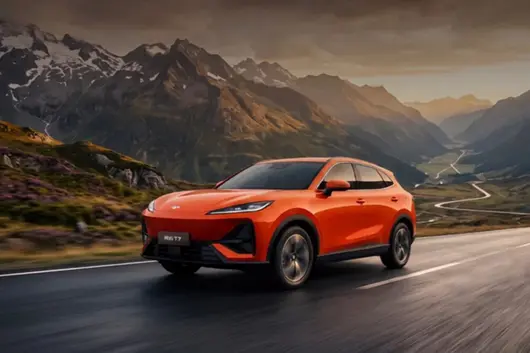
With the new energy market entering a phase of intensive product iteration, consumer expectations for a pure electric SUV have long exceeded mere parameters or a single price point. Whether range is stable, safety has redundancy, products can withstand long-term use, and whether intelligent experience truly serves daily life are becoming important considerations in purchase decisions. On August 26, Chery Fengyun brand's "Steady Happiness" new product launch event was held, and the globally-quality pure electric SUV Fengyun T7 officially launched. The new car offers three models: 600km Joy Edition, 600km Comfort Edition, and 600km Intelligent Edition, with an official guide price of 97,900 Yuan - 118,900 Yuan, and a priority trade-in price of 94,900 Yuan - 115,900 Yuan.

From a product positioning perspective, Fengyun T7 does not simply understand "global model" as an export model, but instead advances global standards to the product development stage. From R&D, design to verification, to adaptation for different market usage scenarios, a more complete development logic has become an important part of the Fengyun T7 product system. This also allowed it to form a relatively distinct product logic in the 100,000 RMB-level pure electric SUV market.
Starting from "Slow Work Makes Good Cars", Fengyun T7 Advances Global Standards
"Slow Work Makes Good Cars" is not just a simple product slogan; for Fengyun T7, it is more directly reflected in the development cycle and verification system.

According to launch event information, Fengyun T7 underwent a 3-year exclusive R&D cycle, relying on Chery's global 1+7+N R&D system and 10 global design centers, with over 100 international designers participating in the product creation. In the early development stage, the project completed 5,000+ global user surveys and conducted on-site visits to vehicle usage scenarios in 15 typical countries. Meanwhile, global regulations were researched 2 years in advance, and development followed the 2026 version E-NCAP five-star safety standards.

What truly determines a model's long-term performance also includes verification after R&D. Fengyun T7 invested 81 exclusive durability test vehicles, completing 1.45 million kilometers of specialized durability verification and 6 million kilometers of comprehensive vehicle road tests. Test coverage spans over 100 extreme road conditions globally and environments from -40°C to 55°C. From Nordic low temperatures and Middle East high temperatures to Southeast Asian rainy season wading and durability tests on different road surfaces, Fengyun T7 attempts to verify the vehicle's adaptability in different environments through more extensive real-world scenarios.

As of now, Fengyun T7 has completed 212 global regulation certifications and 80+ exclusive adaptations for overseas usage habits. The homologue model Lepas L6 has also entered markets such as South Africa and Thailand, and has landed in Indonesia, the European Union, the UK, and other markets starting from August.
For a pure electric SUV aimed at domestic consumers, this product development path means that its product standards are not built only around a single market, but consider different regions, environments, and usage habits from the very beginning.
From Range Equality to Safety Redundancy, Behind the Parameters is Long-term Usage Logic
In the 100,000 RMB-level pure electric SUV market, range is often one of the core indicators consumers focus on. The approach Fengyun T7 provides is quite direct: all three models are equipped with 65.05kWh Rhino batteries and uniformly provide CLTC 600km range, without creating differences between entry-level and high-spec models through different range versions.

According to launch event announcement information, Fengyun T7 actual test range can reach 681.6km, supporting 30%-80% fast charging in about 20 minutes; battery cycle life exceeds 2,500 times, and design service life can reach 15 years. Meanwhile, the entire series is equipped with dual-source wide temperature range heat pump air conditioning + high-voltage PTC, and through AGS intelligent grille and 14 low wind resistance optimization designs, wind resistance coefficient is controlled at 0.286Cd, and electricity consumption per 100km is 12.9kWh.

If range equality solves the selection problem between different versions, then safety redundancy corresponds more to the uncertainty in long-term vehicle use.
Fengyun T7 adopts a nine-cross-five-long cage-like rock body structure, high-strength steel accounts for 80%, and is equipped with Shotgun structure, dual-frame subframe + Pack crash beam, and 1088mm through-type roll-formed threshold reinforcement beam, dispersing collision impact through multiple force transmission paths. The entire series is equipped with standard 9 airbags, including far-end airbags, providing multi-directional protection for occupants.

Regarding battery safety, Fengyun T7 is equipped with a 6D Locking Armor 31-layer three-dimensional protection structure, possessing IP68 waterproof capability, side anti-compression capability reaching 2 times the national standard, and completing 1,008 hours salt spray corrosion test and national standard 1.5 times duration fire test. Beyond safety guarantees, the vehicle also launches dual safety bottom-line protection for power batteries and intelligent driving. If the power battery thermal runaway occurs due to its own reasons, a brand-new car of the same model will be compensated; in intelligent driving assistance scenario accidents, compensation up to 5 million can be made.
These configurations do not exist in isolation but together form a multi-layer safety system ranging from body, battery to intelligent driving assistance.
From "Global Aesthetics" to Real Scenes, Products Begin to Return to Daily Life
A car must ultimately return to the user's daily usage scenarios.
Fengyun T7 body dimensions are 4570×1852×1694mm, wheelbase 2700mm, interior space utilization rate reaches 84%, rear floor is completely flat. After the rear seats are folded down, it can form a 1955mm×1310mm completely flat large bed mode. Standard trunk volume is 450L, max extendable to 1550L. 9-layer cloud-sensing composite seats support heating and ventilation, multiple storage spaces, umbrella slots, multiple charging interfaces, and other designs further correspond to family travel, camping, and daily commuting scenarios.

From a design perspective, Fengyun T7 adopts design languages such as Wind-riding front face, Wind-blade headlights, Wind-sculpted satin body, and Skyline sunrise tailgate. It offers 6 car colors: Fiery Orange, Mountain Smoke Purple, Cloud Pink Beige, Flowing Light Silver, Green Bamboo Grey, and Ink Stone Black. Among them, Fiery Orange adopts Tri-coat three-layer luxury car coating technology.

Intelligent experience also unfolds around actual usage. Fengyun T7 Intelligent Edition is equipped with a 4nm process 8775 cabin-integrated chip, possessing 72TOPS NPU computing power, system response latency as low as 80ms, and equipped with a 15.6-inch 2.5K HD anti-glare screen. Lingxi Smart Cockpit 2.0 connects with Doubao large model, supporting full-scenario fuzzy voice interaction, and provides six whole vehicle scenario modes: Nap, Wake Up, Sentry, Baby, Pet, Camping.

At the assisted driving level, the Falcon 500 cabin-driving-parking integrated intelligent driving system is equipped with 22 high-precision sensors, including 3 millimeter-wave radars, 7 cameras, and 12 ultrasonic radars. It supports highway pilot assistance, 300+ scenario automatic parking, multi-floor intelligent parking, and 100-meter track reversing, allowing intelligent functions to be integrated more into frequent usage links such as parking and highways.

From Launch Price to Full-Cycle Rights, How Does Fengyun T7 Respond to User Expectations?
For this launch, Fengyun T7 not only brought an official guide price of 97,900 Yuan - 118,900 Yuan, but also gave a priority trade-in price of 94,900 Yuan - 115,900 Yuan. Targeting the first batch of users, the vehicle simultaneously launched limited-time purchase rights. The activity ends on September 30, and the advance booking period 1,000 Yuan deposit offsetting 2,000 Yuan purchase price inflation benefit is extended to August 31, 24:00.

Specific rights include free limited-time exclusive personalized car color worth 6,000 Yuan, 2-year 60,000 Yuan 0% interest or 5-year 100,000 Yuan 3-year interest-free finance plans, 3,000 Yuan/unit trade-in subsidy regardless of brand, and power battery and intelligent driving dual safety bottom-line protection. Meanwhile, providing whole vehicle lifetime warranty (including three-electric), 666 Yuan purchase 3,999 Yuan lifetime basic maintenance package, first owner base traffic lifetime free, entertainment traffic 3 years 5G free, etc., totaling eight benefits.
At the launch event, famous musician Wu Kequn served as Fengyun T7 "Happiness Experience Officer", and communicated with Chery Automobile Executive Vice President Li Xueyong around "Steady Happiness", while launching Fengyun T7 "Happiness Co-creation Plan". The first batch of foreign owners officially picking up cars also became an on-site footnote after Fengyun T7's global product path implementation.
Summary: From unified 600km range to global standard development, to multi-level protection covering the whole vehicle, three-electric system, and intelligent driving assistance, Fengyun T7 attempts to answer not just "what should a 100,000 RMB-level pure electric SUV be equipped with", but "at this price point, can the product still be made more solid".
When price competition gradually moves from simple number comparison to comprehensive product value competition, Fengyun T7 chooses long-termism as the starting point of product development, uses global standards as the verification scale, and then transforms technology into range, safety, space, and intelligent experience. Returning to the original question: Fengyun T7 launch, how does the 100,000 RMB-level pure electric SUV achieve global quality? The answer may lie within this complete system from R&D to verification, from product to service.

Fu Rong, Interns Fang Weibo, Cheng Siyu
On the evening of August 26, Sunwoda (300207.SZ) released its 2026 Semi-Annual Report. In the first half of the year, the company achieved revenue of 381.79 billion yuan, a year-on-year increase of 41.48%, setting a historical high for the same period; however, net profit attributable to shareholders was 6.03 billion yuan, a year-on-year decline of 29.59%, and deducted non-recurring net profit was only 0.97 billion yuan, a sharp year-on-year drop of 83.32%. The company exhibited the characteristic of "revenue growth without profit growth", and the profitability of the battery main business is under pressure.

From the perspective of business structure, Sunwoda is accelerating the shift away from dependence on a single business. As the core business, consumer batteries achieved revenue of 144.52 billion yuan in the first half of the year, up 4% year-on-year, firmly ranking first in global mobile phone battery market share. However, affected by weak global consumer electronics demand and rising upstream material prices, the gross margin of this sector declined year-on-year.
Power battery and energy storage businesses have become the core engines driving revenue. Regarding power batteries, the company's HEV hybrid battery installation volume jumped to first place globally in the second quarter, with 28.36GWh shipments in the first half of the year, revenue reaching 141.34 billion yuan, a year-on-year surge of 85.87%. The energy storage business is also in a period of accelerated scale release, benefiting from the explosion of global AIDC backup power demand, with relevant orders reaching a historical high. However, despite the significant increase in shipments of the power and storage businesses, profits are yet to be realized in the future, affected by industry price wars and high capital expenditures during the scale expansion period.
In the first half of the year, the company's R&D investment reached 23.63 billion yuan, with an R&D expense ratio exceeding 6%, continuously delving into electrochemical basic research and material innovation. At the same time, Phase I of the Thailand base has been put into production, and Phase II has also been launched simultaneously. The Hungary and Vietnam bases are currently in the orderly construction phase, the proportion of overseas customers continues to increase, and the company's profit elasticity is also expected to be released further. However, high R&D investment and globalization layout also test the company's cash flow.
Looking ahead to the second half of the year, Liang Rui, Vice President and Chief Sustainability Officer of Sunwoda Electronics Co., Ltd., stated in an interview with media that the consumer market is basically saturated, and the combined proportion of Sunwoda electric vehicle batteries and energy storage system businesses will exceed that of consumer batteries.
Under industry cycle fluctuations, whether Sunwoda can improve deducted non-recurring net profit, convert the high market share of HEV into more pure electric design wins, and whether AIDC energy storage orders can continue to land, will be the key points to watch for its subsequent breakthrough.


Fu Rong, Interns Fang Weibo, Cheng Siyu
According to data from the China Passenger Car Association, domestic car sales continued to decline under pressure in July, while overseas markets maintained significant growth, especially the overseas sales of several top automakers have accounted for "half of their total sales". Car going global has leaped from a supplementary channel to the core engine for automakers to digest capacity and maintain growth.
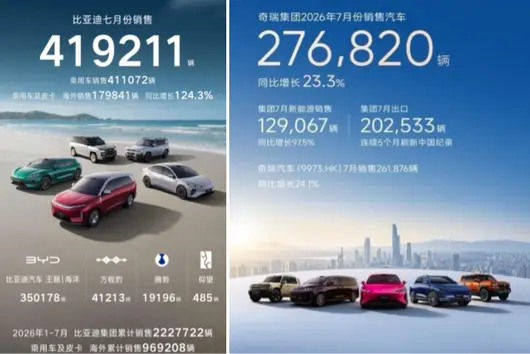
From July data: Chery Holding total sales 276,800 units, exports 202,500 units, overseas share as high as 73%, nearly 3 times the domestic market; BYD total sales 419,200 units, exports 179,800 units, overseas share 42.8%; Geely Auto sales 250,200 units, exports 106,700 units, share 42.6%; SAIC Group sales 338,600 units, exports 141,700 units, share 41.9%. In comparison, sales of various automakers in the domestic market showed different degrees of decline, one rising and one falling, allowing the overseas market to leap from being a "minor player" in the past to become the pillar supporting performance growth for mainstream automakers.

According to data from the China Association of Automobile Manufacturers, domestic car sales in July were 1.541 million units, down 13.1% month-on-month and down 23.6% year-on-year. Data from the China Association of Auto Trade Dealers shows the auto dealer inventory warning index climbed to 61.1% that month, far exceeding the 50% threshold, with over 60% of dealers finding it hard to be optimistic about the market trend in the second half of the year, and industry inventory reduction pressure increased significantly.
In stark contrast, overseas markets continued to perform well during the same period. Mainstream automakers that implemented the going global strategy all saw significant growth in overseas sales. Data from the China Association of Automobile Manufacturers also shows: In July, China's car export volume reached 1.043 million units, surging 81.3% year-on-year, breaking the million-unit mark for two consecutive months. Among them, new energy vehicle exports reached 553,000 units, a surge of 145.5% year-on-year, with their share exceeding 50% for two consecutive months, becoming the absolute main force of exports. From January to July, China's cumulative car exports reached 6.14 million units, a 66.8% year-on-year increase, among which new energy vehicle exports increased 1.2 times year-on-year.
Behind this structural change lies the deep layout of global strategies by top automakers. The going global model of Chinese automakers is gradually shifting from "complete vehicle exports" to combining with "industrial rooting". BYD's factories in Brazil and Thailand have started production successively; Chery is advancing multi-base projects in Spain, Vietnam, etc.; Changan's factory in Brazil has also been completed and put into production. Top automakers are rooting deeply in global core markets through a "three-in-one" approach of building factories, laying out channels, and integrating supply chains. Europe, Southeast Asia, and South America have become the three major core pivots of Chinese automaker globalization. Looking forward, tariff barriers and local operational capabilities will become the watershed of competition. From satisfying domestic demand to driving the global market, a profound transformation from "Made in China" to "Chinese Globalization" is taking place.

[Car Insight Industry] Let's review the major events that occurred in the automotive sector on July 23, 2026.
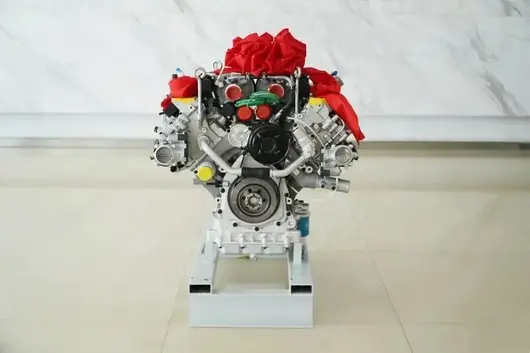
Automotive Event One: Horse Power V6 Engine Prototype Successfully Ignited

Recently, the first prototype of Horse Power HORSE W30 successfully ignited. This model is expected to be paired with the Lotus sports car product line, further perfecting its full-spectrum product matrix from home efficient power to high-end performance power.
As a core product designed for the high-performance hybrid market, HORSE W30 balances ultimate performance, multi-scenario adaptation, and platform expansion capabilities. It can meet the demand for continuous power output in track scenarios and adapt to diverse scenarios such as complex terrain and daily commuting thanks to its flexible hybrid architecture, providing a new technical choice for high-performance hybrid vehicles.
Automotive Event Two: Tesla Releases Q2 Financial Report

On July 23, Tesla released its Q2 2026 financial report. Tesla produced over 451,000 pure electric vehicles globally this quarter, a year-over-year increase of about 10%; deliveries exceeded 480,000, a year-over-year increase of about 25%. The Shanghai Super Factory delivered over 89,000 electric vehicles in June, up 24.4% year-over-year, setting a new high for the year; deliveries in the first half of the year totaled nearly 468,000, up 28.4% year-over-year. Tesla's total revenue for the second quarter increased by 26% year-over-year, reaching $28.2 billion.
As of the second quarter, Tesla's global paid assisted driving users have reached 1.48 million, with the assisted driving option rate in the North American market reaching a historic high, and over half of new vehicles subscribed to assisted driving upon delivery.
Automotive Event Three: The First iCAR V23 Officially Rolls Off the Line in Malaysia

On July 22, ICAR Automotive officially announced that the first iCAR V23 in Malaysia officially rolled off the line, and the new car will arrive at dealerships by the end of July. According to previous reports, in November 2025, the sub-brand iCaur under Chery Automobile Group officially launched the iCaur V23 in Malaysia (domestically iCAR V23), launching a total of 2 models, priced at 119,800-132,800 Malaysian Ringgit (approximately 205,300-227,600 RMB).
'Daily Car News', here you have the latest daily car news, please continue to follow 'Car Insight'