首頁car companies

搜尋歷史
熱門搜尋
經銷商登入 / 註冊

For independent brands, expanding into overseas incremental markets has long been not an optional direction, but an unavoidable choice.
In the first nine months of this year, the total insured amount of domestic passenger cars reached 13.401 million, a 20.2% drop compared to the same period last year. Looking at September alone, the insured amount was only 1.657 million, down 26.4% year-on-year.
The "Golden September" highly anticipated in the industry failed to meet expectations; "cars are harder to sell than last year" has become the status quo accepted by everyone in the automotive industry.
More tricky than unsold cars are the increasingly thin profit margins. Data from CPCA shows that from January to May this year, the total profit of the domestic automotive industry reached 144 billion yuan, with an industry profit margin of only 3.4%, significantly lower than the 6.1% average profit margin of downstream industries.
To make matters worse, the "arms race" in the intelligent sector cannot stop. Car companies are continuously pouring money into R&D for core technologies like assisted driving and intelligent cockpits, while also facing the dilemma of difficult sales volume and low profits, further amplifying the already tight cash flow pressure.
It is precisely for this reason that overseas markets have become the outlet everyone collectively hopes for; many consider it the optimal solution to break the deadlock.

But going global has never been simply selling cars in a different place; it is a completely new business game where rules, costs, and risks are entirely different from domestic ones. Behind high growth, many invisible risks are hidden, and exchange rate shock is the one that surfaced first.
Those overseas risks that can change faces at any time
Just looking at the paper data, layout overseas markets can both open up a second growth curve and greatly relieve domestic competition pressure, looking like a sure-win deal.
But judging from the H1 report performance, the profit backlash brought by exchange rate fluctuations has already covered a large group of independent car companies that invested heavily in overseas markets.
Data shows that Chery recorded a net foreign exchange loss of 2.092 billion yuan in the first half; Geely's loss was also very obvious. In the same period last year, it received 2.64 billion yuan in exchange gains, but this year it turned into a net loss of 550 million yuan; Great Wall Motor also failed to avoid the impact. This year, after deducting hedging for locked exchange, it recorded a loss of about 266 million yuan, whereas in the first half of last year it harvested 1.493 billion yuan in exchange gains; Changan also didn't escape. The net foreign exchange loss in the first half was about 230 million yuan; some brokerages expect that BYD also incurred foreign exchange losses.
The book shock brought by exchange rates has indeed affected many car companies. After all, domestic car production costs are settled in RMB, orders sold overseas receive foreign currency. From signing orders to delivery and final settlement, there is a long cycle in between.

As long as exchange rates undergo a reverse fluctuation, the gross profit earned hard previously could be directly swallowed at the exchange settlement stage. Many brands' overseas sales are climbing steadily, but when the final account is settled, profits actually shrink.
And in 2026, the RMB appreciated against the US dollar, directly causing car companies' exchange items to change from gains to losses.
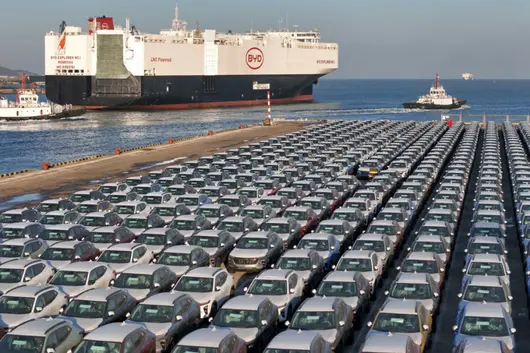
Besides foreign exchange losses, car companies going overseas also face several more difficult hurdles to circumvent. The foremost is the transportation problem. Ro-Ro ships are the mainstream channel for cars going overseas. In the past, Chinese cars' overseas volume was not large, and Ro-Ro ships were quite abundant. But with the explosive growth of Chinese cars going overseas, this problem has also become increasingly serious.
According to data from the China Association of Automobile Manufacturers, from January to August 2026, car exports reached 7.153 million, a 66.7% year-on-year growth. Following this trend, there is not much suspense about whole vehicle exports exceeding 10 million this year. In 2020, car whole vehicle exports were only 1.082 million, a huge scale gap.

The phenomenon of "Chinese car exports being throttled by shipping" has become a consensus. Car companies that cannot book Ro-Ro ships can only adopt other methods like detours or container transport, but once the method changes, transportation costs rise directly. These increased costs directly affect the overseas profits of car companies.
One netizen joked, "The cars haven't arrived at the port yet, but the profits have already been thinned."
If the transportation problem is that visible freight costs are eating profits, then the uncertainty of tariffs means even the account can't be calculated clearly. After all, tariff issues can change at any time. The per-car profit calculated well today could be wiped out by a notice tomorrow.
Superimposing local policy changes, local culture integration, and a series of problems, going overseas has become a complex game. No matter how good going overseas is, it cannot withstand exchange rate changes, soaring freight rates, and tariffs arriving all at once.
Using existing stock to fight uncertain variables
Since car companies clearly know freight is rising, tariffs are changing, and exchange rates will vary, why still rush into it?
The answer lies in the completely different attributes of two groups of things. That is, freight, tariffs, exchange rates, and local policies all belong to short-term variables, while continued implementation of overseas localization layout is existing assets that can be held long-term.
Transportation costs will rise, but will also decline with cycles. Exchange rates will swing back and forth. Policies of various countries and regions will also be continuously revised according to local demand. They are all things that may change.
If simply doing whole vehicle exports, car companies have almost no chips to fight these variables. Cars are loaded onto ships from domestic factories, costs are locked domestically, returns are foreign currency. Fluctuations in every link in between must be borne by car companies alone. Once the external direction changes suddenly, order profits could disappear instantly.

Therefore, more and more car companies are shifting towards ecological overseas expansion with localization layout.
Overseas production bases built by car companies with huge investments, sales outlets spreading bit by bit, localized after-sales maintenance systems polished for years, and brand perception slowly built up in the hearts of local consumers. Once these assets take root and establish themselves, they won't be directly cleared to zero with one round of exchange rate fluctuations or one round of freight rate hikes.
Taking BYD's performance in the Thai market as an example, on July 12, 2026, BYD Thailand market cumulative deliveries officially broke through 130,000 units. Its Thailand factory design annual capacity is 150,000 units, achieving localization production of multiple car models. The proportion of Thai staff reached about 93%, and the proportion of local parts procurement reached 50%.

Therefore, Chinese car companies going overseas are not gambling that freight will drop, exchange rates will stabilize, tariffs will fall. They are betting that when these variables push the overseas threshold higher and higher, whether they have something that doesn't rely on variables to eat. This data set of BYD in the Thai market best illustrates what "not relying on variables to eat" actually looks like.
From this round of fluctuations, a change in the industry can also be seen, which is that going overseas is changing from "who sends out more cars" to "who is rooted deeper overseas".
Sending out more cars earns money from the window period. Once the window closes, one must find a way again. Only by rooting deep can one harvest the value of long-termism.
This is the real answer to "knowing difficulties yet still rushing in". Car companies believe difficulties will pass, and after they pass, those who have existing assets in hand are the only ones qualified to discuss the next round.
Epilogue
Declining domestic sales and thinning profits made more and more car companies realize the importance of going overseas. Various difficulties encountered while going overseas gave all overseas car companies a finance class.
But the correct way to read this class is not "going overseas is wrong", but "going overseas without rooting in overseas is wrong".
Simply selling cars overseas is just outputting capacity. Profits are completely bound to external variables like exchange rates, shipping, and trade policies, with no bottom chassis to fight risks.
Ecological localization rooting is essentially slowly settling controllable existing assets. Although rooting also has to bear high sunk costs for building factories and supply chain integration, it is a more resilient way of survival.
After all, fluctuations will eventually pass. Before the weather gets better, those who plant themselves into the soil first are the only ones qualified to wait for the next spring.
Reference materials:
1. [September car insured amount 1.657 million, dropping 26.4% to probe bottom again, BYD 250,000, Leapmotor exceeds FAW-Volkswagen for the first time], Zhinen Auto
2. [Chinese car companies going overseas accelerating], 21st Century Business Herald