首頁Yin Tongyue

搜尋歷史
熱門搜尋
經銷商登入 / 註冊

Recently, Chery Chairman Yin Tongyue said some ill-timed words at the 2026 World Intelligent Connected Vehicle Conference: "We should learn from the experience of motorcycles going global; we must firmly avoid a price war; prepare well and do not go global blindly." He also reminded peers not to become "overseas boasters" abroad.
The reason these words were piercing was not because they were harsh, but because they were timely. In 2026, the global expansion of Chinese cars is at its most frenzied moment: exports will break 12 million units, 20 out of 60 brands at the Paris Motor Show are from China, overseas factory planned capacity is close to 7 million units, and almost every car company has "go global or get out" on their lips. At this moment, China's largest car exporter said: Don't learn from motorcycles.
Someone who has already sold cars to over 130 countries could have talked only about achievements. He insisted on talking about lessons. Few people in the industry understood the weight of this sentence.
Over twenty years ago, Chinese motorcycles experienced a complete demise in Vietnam. In 1998, Japanese brands accounted for 98% of the Vietnam market, selling cars for $2,000 each; Jialing, Zongshen, and Loncin rushed in with wholesale prices of $700 to $800, capturing nearly 90% of the market share by 2002. Then the price war began: $800 dropped to $700, then to $600, and finally fell to $170; selling a car only earned over thirty yuan. Steel sheets became thinner, engines used non-standard parts, and after-sales service points were not built. In 2003, a frame fracture accident was exposed by television, triggering an avalanche of trust. By 2006, Japanese brands regained over 95%, and Chinese motorcycles were left with less than 1%.
What killed Chinese motorcycles was not low prices, but the lack of a retreat after low prices: profits were too thin to invest in quality, service, and brand; a single accident could cause the entire category to perish.
Cars are not motorcycles. But that transmission chain—price wars, thinning profits, quality and service hemorrhaging, trust collapse, policy backlash—has already appeared in Thailand, Europe, and Russia simultaneously.
More exports, more like motorcycles back then
The underlying logic of domestic price wars is overcapacity, product homogenization, and dealers holding inventory. In the first half of 2026, domestic passenger car retail sales slid 20% year-on-year, industry profit margin was 3.3%, and capacity utilization was 70.8%, below the 80% break-even line. Cars are not selling well, so exports became the pressure relief valve.
Exports in the first 9 months of 2026 reached 8.63 million units, with the proportion of total production moving from two tenths close to three tenths. Chery exported 1.344 million units in 2025, and BYD exported 1.054 million units. The numbers look good, but the pressure relief valve has side effects: the domestic tactics will go out with the cars.
More alarming is that going global has become a collective sprint. Over 130 overseas production bases, 7 million units of planned capacity, and 20 Chinese brands at the Paris Motor Show; everyone is racing for the window. Yin Tongyue's warning came at this moment of collective sprint, when suddenly someone shouted: There is a cliff ahead.
The cars are the same batch, the dealers are the same rebates and inventory pressing, the sales pitch is still "drop a bit more to increase volume." The only change is that overseas market depth is shallower, consumer patience is shorter, and policy hands are harder.
In August 2026, the Ministry of Commerce, Ministry of Industry and Information Technology, and State Administration for Market Regulation jointly issued the "Guidelines on Overseas Competitiveness Behavior and Compliance Construction for the Automotive Industry," clearly requiring car companies to avoid "frequent and significant price fluctuations affecting overseas consumer interests and brand image," and to respect local dealer independent pricing rights. The regulatory layer saw the danger before the companies.
Exports are not a cure, they are painkillers. Cars that don't sell domestically won't become good business just with a different customs.
Thailand acted it out first: subsidy withdrawal, share dropped from 47% to 11%
In 2025, Chinese brands sold 134,000 units in Thailand, market share 22.2%, Japanese brands first dropped below 70%. In January 2026, Chinese brands won 47.34% to 47.33%, a narrow victory of 0.01 percentage points, topping Thailand.
A month later, Thailand subsidies were withdrawn, import car consumption tax adjusted back from 2% to 10%. Chinese brand share plummeted from 47.3% to 11.6%.
Of that 47%, a significant portion was not brand loyalty, but policy rent. Price wars spent the rent early.
BYD ATTO 3 dropped from 1.19 million Baht to 900,000, and dropped another maximum of 340,000 in July 2026; Dolphin dropped from 800,000 to over 500,000. BYD used one year of free charging to soothe old car owners, but still some brands were complained about due to price drops.
Even worse was Neta. The Thai government wanted to recover 2 billion Baht in subsidies because Neta failed to fulfill local production commitments: 2024 target 16,000 units, actually only produced about 4,000 units. 18 dealers sued jointly, showrooms shrank from over ten to three, and some insurance companies stopped underwriting. When a brand explodes, the whole "Chinese car" category perishes along with it.
Chinese car companies' planned capacity in Thailand exceeds 550,000 units, while the entire Thai market is only 600,000 units. Factories are built, the market is not that big, price drops to swap volume became a "helpless choice".
Prices can buy market share, not loyalty; subsidies can create a market, but can also be taken back overnight. Using domestic methods to fight overseas means market share is rented.
European residual value accounting: The bill for price wars arrives three years later
In the first half of 2026, Chinese brands sold 643,000 units in Europe, market share rose from 4.5% to 8.9%, year-on-year growth 111.5%. Entry-level models are 20% to 30% cheaper than European competitors.
But Europe has an account rarely calculated domestically: residual value.
Data from German DAT shows that Chinese brand plug-in hybrids retain only 47% of car price after three years of use, it was 61% at the beginning of 2024; dropped 14 percentage points in two years, while German EVs overall only dropped 7 percentage points in the same period. Chinese car depreciation speed is twice the market.
Residual value is the foundation of European auto finance. Europeans use loans, leases, and trades heavily; every point drop in residual value becomes a monthly payment. A 38,000 Euro car, with residual value dropping 14 percentage points in three years, means selling 5,320 Euros less; amortized over 36 months of lease, adding 148 Euros per month. Large leasing companies have started to increase leasing prices for Chinese brands.
More troublesome is expectations. DAT survey shows nearly half of German consumers believe some Chinese brands will exit Europe within five years. Used car buyers squeeze prices, financial institutions increase down payments, brands try to fill the pit with subsidies—a self-reinforcing negative cycle.
Chinese car companies haven't not calculated this account. BYD invested 4 billion Euros in its Hungary factory, initial capacity 150,000 units, depreciation per vehicle amortized 2,600 Euros alone; annual sales need to reach 120,000 to 150,000 units to cover fixed costs. If continuing to drop prices to grab share, residual value will break the financial model first.
Dropping prices domestically hurts old car owners' hearts, dropping prices in Europe hurts the financial model's life. The former can be soothed with one year of free charging, the latter takes three or five years to fix.
Russia and Mexico remind: Markets will close, policies will turn face
The biggest risk of Chinese car global expansion is not cars not selling, but markets suddenly not letting you sell.
Russia imported over 1.16 million Chinese cars in 2024, dropped to 632,000 units in 2025, nearly halved; Chinese brand share dropped from 58.5% to 51.7%. In Q1 2025, Russia closed 274 car showrooms, 213 were Chinese brands, accounting for 78%. Chery has already sold some assets and distribution channels in Russia.
The reason is not complex: scrap tax increased 70% to 85%, tariffs adjusted to 20% to 38%, parallel imports blocked, certification cycles lengthened. When policies turn, the number one market becomes number three.
Mexico was still China's number one export destination for cars in 2025, from January 2026 tariffs of up to 50% on Chinese cars; Chinese exports to Mexico dropped 33.7% in the first half. After the EU imposed tariffs of up to 45.3% on pure EVs, it is now discussing expanding restrictions to hybrids.
These policies target not just one enterprise, but the "export model" itself. Cars shipped from China to earn manufacturing efficiency and exchange rate differences; the host country adds tax, changes certification, or collects subsidies, the advantage is gone.
The only thing to hedge against is leaving manufacturing, R&D, supply chain, and employment locally. But Chinese car companies' overseas fully integrated factory planned capacity is close to 7 million units, overseas production in 2025 was only about 1.2 million units; of over 130 production bases, only 17 are truly fully integrated; overseas localization rate is about 30%, while European, American, and Japanese car companies are over 80%.
7 million units of planning is like moving domestic overcapacity exactly as is to other ports. Localization is not a panacea, but without localization, there is not even the qualification to get sick.
Cars are not motorcycles, but there is no immunity badge
Cars and motorcycles are not the same. Motorcycles have no core technology, sell and leave; Chinese cars have three electrification technologies, smart cockpits, smart driving; in Thailand can sell Seal for 270,000 Yuan, in Brazil can sell BYD to single month retail first.
But "not the same" does not equal "having immunity badge".
Motorcycles died from "no ability to do three things after low price": make quality steady, make after-sales dense, make brand go up. These three things, Chinese cars have not fully achieved. Australia has already seen Chinese EVs under regulatory attention due to closed maintenance data, consumers complaining about long parts wait times; Cui Dongshu's judgment is direct: Chinese cars overseas are still "cost advantage main, technology premium auxiliary, brand premium not yet formed", difficult to break through above 400,000 Yuan.
Price wars happen to destroy these three things. Profits thinned, no money for quality verification, building after-sales, investing in brand; residual value not rising, financial costs cannot go down; full lifecycle cost more expensive, low price finally becomes "expensive".
Hyundai Motor is the opposite reference. Excel entered the US in 1986, sold 168,000 units in the first year; years later quality collapsed, became a talk show joke, sales dropped to 90,000 units in 1998. That year Hyundai launched 10-year/100,000-mile warranty, by 2004 new car quality caught up with Honda. But warranty was just a signal, Hyundai took twenty years to truly make products good.
Japanese cars are another reference. Forced to accept voluntary export restraints to the US in 1981, 1.68 million units annually, lasting until 1994. Japanese car companies did not continue to drop prices, but went to build factories in the US: from 1985 to 1990, US production increased from 820,000 to 1.8 million units, share rose from 18% to over 25%, and launched Lexus, Acura, Infiniti at the same time.
Trade barriers did not stop Japanese cars, localization and brand upgrade did. These two things, Chinese cars are still on the way.
Yin Tongyue's warning is first for Chery itself
Chery is one of the biggest beneficiaries of going global. 2025 revenue 300.29 billion Yuan, overseas revenue 157.42 billion Yuan, accounting for 52.4%—overseas revenue exceeded domestic for the first time; exports 1.344 million units, number one for 23 consecutive years.
But in the first half of 2026, Chery exports grew 71.5%, net profit attributable to the parent company dropped 11.7%. Revenue almost stood still, gross margin rose to 16.1%, net profit actually decreased. Going global scale is rising, making money is harder.
Chery's gross margin was originally not high. Q1 2025 12.4%, lower than BYD 20.1%, Geely 15.9%, Great Wall 17.84%. It relies on scale, channels, and cost-performance to sell cars globally, fears overseas becoming domestic-like price wars.
So Yin Tongyue's warning is not moral persuasion, it is accounting. Chery has half revenue overseas, overseas gross margin higher than domestic; overseas price war, Chery's income statement will hurt first.
Chery is also finding a retreat for itself. Barcelona, Spain, Chery and EV MOTORS joint venture restarted original Nissan factory, producing EBRO S700, one car out of line every 75 minutes, first phase annual capacity 50,000 units, creating over 1,000 local jobs; as of May 2026, EBRO registered 11,131 units in Spain.
Yin Tongyue has spoken of Chery's "cat philosophy": "We are like cats, entered quietly, then quietly became part of his family." This sentence is exactly opposite to "sea braggers". It is not posture, it is method: sell cars first, then build channels, then localize, finally become part of local industry.
Yin Tongyue is not singing doom, it is warning.
He brought out the old accounts the industry is most unwilling to hear, because he knows, if this account is not reviewed, it will be paid sooner or later.
Epilogue
In 2002, when Chinese motorcycles took 80% share in Vietnam, no one thought that was the end. In 2026, when Chinese car exports stood at 12 million units, no one thought that was the end.
The difference is, motorcycles have no second chance, cars do. The timeliness of Yin Tongyue's words is not because it exposed some secret, but because it exposed too early—early enough for the industry to still have time to change.
Chinese cars have technology, have supply chain, have local factories, also have profit space to fix quality, after-sales, brand. But opportunities will not automatically redeem, it depends on one choice: treat overseas as a sewer to digest domestic inventory, or as a second entrepreneurial venture.
Next to verify is only one thing: when domestic retail continues to slide, which car company dares to be the first to stop using overseas markets to digest inventory?
The answer to this question will better explain the substance of Chinese cars going global than 12 million units.

Written by | AUTO Xinqiu
Author | AUTO Xinqiu Team
In the vast family of Chinese automobiles, there is a "non-typical" leading enterprise.
It has ranked first in exports among Chinese brand passenger cars for 23 consecutive years, with almost half of its annual sales sold abroad, recognized as the No. 1 exporter.
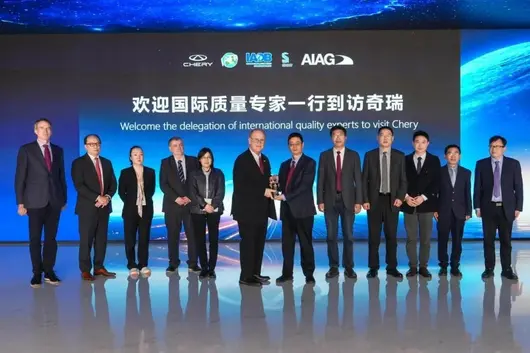
You might not know, what is the status of it in the hearts of overseas consumers? On April 23 this year, the International Automotive Quality Expert Group, consisting of the International Automotive Task Force (IATF), International Automotive Oversight Bureau (IAOB), Automotive Industry Action Group (AIAG), and Society of Motor Manufacturers and Traders (SMMT), followed it, personally visited and presented the "Automotive Industry Peak Award: Quality Innovation Figure" to the chairman of this enterprise.

Not to mention, winning the ICQCC Quality Gold Medal, regarded as the "Olympic" grade of international quality, for three consecutive times, proved its popularity in overseas markets has already "far surpassed" domestic peers.
If the above does not give you a sense, let me tell you, the recently in-the-spotlight Land Rover Freelander's engine is manufactured by it.
Congratulations, you answered correctly! Yes, what I am referring to is Chery Automobile.
So, why is Chery so radiant? What did Chairman Yin Tongyue do right?
"Technology Fanatic" Dual-Drive: R&D Obsession, Honest Collaboration
Yin Tongyue graduated from Hefei University of Technology, known as the "Huangpu Military Academy" of Anhui's automotive industry. After graduating in automotive manufacturing major in 1984, Yin Tongyue directly joined FAW Hongqi Sedan Plant, working as an automotive process engineer. Due to his diligence and outstanding performance, he was quickly identified as core talent and sent to Germany and the US for further study.
After returning to China, Yin Tongyue served as Director of the Final Assembly Workshop and Chief of the Logistics Section at FAW-Volkswagen. He was also awarded the "FAW Top Ten Outstanding Youth" title, with a bright future ahead.

However, a visit and study tour organized by Wuhu City completely changed Yin Tongyue's life trajectory.
At that time, Wuhu City was planning to build an Auto City, and also received strong support from the provincial government. Yin Tongyue, who had already shown his锋芒, was talent scarce in Wuhu City. Thus, the visit group invited him to return home to develop and lead the local auto project. What truly moved Yin Tongyue was a sentence from the visit group: Always working for foreigners is not worthwhile. It was this sentence that ignited his "Dream of Domestic Brand" deep in his heart.
So, he quit and handled the procedures, carrying luggage from Changchun, the Automobile Capital of China, to Wuhu which seemed unrelated to automobiles.
Heaven will assign great responsibility to this person. Yin Tongyue deeply felt the heavy responsibility, only able to exert all efforts and give whole heart.
Chery started from the "Heart of the Automobile", the engine. To ensure this project would be won, Yin Tongyue even made a hardcore commitment: If it failed, I would jump into the Yangtze River.
Possessing this persistence and resilience, he recruited 288 cadres and over 1,000 employees from FAW. It was also with this persistence and resilience that, facing a foreign production line assembly team shirking and slacking, they loudly shouted: "Get back to your home, let us do it ourselves!"
Thus, after 500 days of hard fighting, on April 27, 1999, Chery's first engine successfully rolled off the line, ignited successfully in one try. 7 months later, the first Chery sedan - Fengyun 000001 successfully rolled off the line.

From then on, under Yin Tongyue's leadership, Chery hit models emerged one after another. In 2003, Chery launched the generation mythic car Chery QQ, with annual sales revenue exceeding 8 billion RMB.
How popular was Chery QQ back then? Describing it as a "Phenomenal National Mythic Car" was no exaggeration, because it was the first true "Hit" among Chinese independent brands. Before Chery QQ ceased production in 2014, cumulative sales reached 1.40-1.54 million units, exported to over 100 countries and regions, with cumulative exports exceeding 500,000 units.

In 2013, under a new system and process, Chery created another classic model - Tiggo 5. To strictly control quality, before listing, Yin Tongyue even invited a Japanese expert for acceptance check. This Japanese expert scratched the inside of the car door handle with his fingernail and found a mark, saying: "This is unacceptable."
So without a word, they remade it. During the second inspection, the Japanese expert said the material formula needed re-adjustment and re-certification.
Thus, Yin Tongyue led the team to repeatedly tear down and start over. When Tiggo 5 passed rigorous verification, it also meant Chery bid farewell to the primary stage of "Assembling Parts to Build Cars", and car manufacturing technology and systems truly approached international standards.
Taking engine thermal efficiency as an example, this is a hard indicator measuring core capability of fuel vehicles. Currently, mainstream engine thermal efficiencies mostly range between 38%-45%, while Chery Kunpeng Tiqing Engine achieved 48%. According to Chery internal data, cumulative global installations of its Kunpeng Power Engine Upgraded Version has exceeded 3.1 million units. So, does Made in China fuel engine work? Currently, only Chery dares to pat their chest and say "Yes".
Nowadays, Chery engine thermal efficiency has stabilized at 44.5%, which is top-tier in the industry. With this unique skill, Chery won the favor of two major international luxury car benchmarks, Jaguar and Land Rover. Both parties jointly established a new company, and the new energy vehicle brand "Freelander" directly equipped with Chery's 1.5-Liter Range Extender.
The cooperation with Huawei is a strong alliance. Yin Tongyue has a sentence often mentioned: "When opinions differ, listen to Huawei; when opinions align, listen to Chery." This is not surface-level flattery nor deliberate humility, but a truest respect for technology and the most pragmatic posture of an entrepreneur with an engineer background.
In fact, since Zhijie S7/R7, both sides have been satisfied and mutually appreciative. Why did HarmonyOS Intelligent Mobility select Zhijie V9 as its first MPV? It is precisely due to comprehensive consideration of Chery's manufacturing hard power, a need for deep integration of "Technology Definition + Top Manufacturing".

Firstly, in capacity and quality control aspects, Chery specially created a Super Factory and Brand New Welding Line for Zhijie V9, investing over 20 billion RMB in special funds, capable of delivering this large size MPV and models with high craft requirements with quality and quantity. Secondly, in supply chain cost control, Chery possesses a perfect supply chain system, capable of effectively balancing the high BOM cost brought by Huawei Advanced Smart Driving (such as 896-line LiDAR), supporting V9 being fixed in the 389,800 RMB starting price range, possessing strong market impact.
Global Layout: Not "Sold Out", but "Grown Out"
As early as 1999, Yin Tongyue determined one thing: Chinese automobiles must go out, but not in the way of dumping at cheap prices, but in the way of long-termism.
What was the result? Chery has held the No. 1 position in Chinese brand passenger car exports for 23 consecutive years. In 2025, exports reached 1.344 million units, nearly half of annual sales, cumulative exports exceeding 5.85 million units. More rarely, for Chery exported new energy vehicles, for every 5 sold, 1 is sold to Europe with the strictest regulations, meaning Chery Automobiles' quality is globally top-tier.
Yin Tongyue summarized Chery's globalization philosophy with one sentence: "In somewhere, For somewhere, Be somewhere — Wherever, For Wherever, Become Part of Local." Considering deep integration into local market as the core goal of car exporting.
This is not a slogan. Chery has 10 overseas factories globally. Like Russia, Brazil, Egypt, etc. KD factories achieved "Parts Export, Local Assembly", which both avoids tariffs and drives local employment, deeply welcomed and supported by local governments.
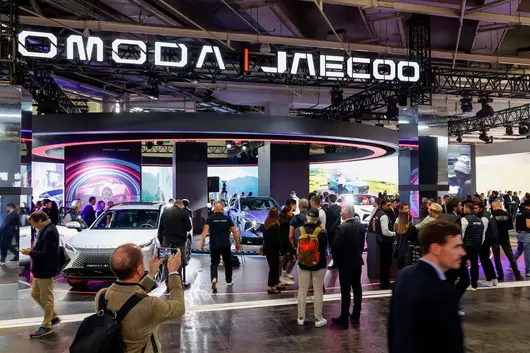
For the extreme cold of Russia and Middle East, Chery strengthened car AC and engine cooling functions; for Brazil and Latin America market, Chery developed flexible fuel engines capable of adding ethanol and gasoline; for Europe market, entering with OMODA, JAECOO New Brands, fully meeting Euro NCAP 5-Star Safety Standard; for Southeast Asia market, Chery developed RHD models using local factories.

Besides, Chery developed multiple modular platforms like T1X, M1X, Mars Architecture, letting products quickly adapt to different countries' regulations, road conditions, and climate.
In April this year, Chery established its first Overseas Regional Operation Center in Barcelona, Spain, and simultaneously launched Spain Research Institute, main focus is Electrification, Smart Mobility and Sustainable Development, with the goal to develop "Cars with More Local Flavor".
In the overseas market, Chery did not consider itself as a "Foreign Manufacturer", but also voluntarily undertook corporate social responsibility for locals. For example, cooperated with World Conservation Union (IUCN), conducted a Mediterranean Posidonia Seagrass Bed Restoration Project, to protect local "Lungs of the Ocean"; Chery also organized local owners in Malaysia, conducted Afforestation Public Welfare Activities, doing all for protecting local ecological environment.

When many companies still "Chase Trends, Make Quick Money", Chery has already built supply chain and layout R&D network overseas for years. This persistence has now finally turned in a shining report card.
Conclusion: Not a Stroke of Genius, but 23 Years of "Hard Work"
What Yin Tongyue did right was never any one "Stroke of Genius", but determined 23 years ago that "Chinese Automobiles Must Go Out", then using Engineer's Rigor, Merchant's Patience, Long-termist's Steadfastness, brick by brick built the "Made in China" reputation into Global Market.
When domestic car companies still race price and configuration, Chery has already completed the transformation from "Cheap Alternative" to "Quality Choice" in overseas market - this is the fundamental reason and confidence of the International Quality Expert Team "Chasing Awards": Not because of what you said, but because in the global market, using over 20 years time, you truly achieved what.
Objectively speaking, Chery Helmsman Yin Tongyue is not only the Top Domestic Car Exporter, but also the Founder and Torchbearer Promoting Chinese Cars to the World, this honor will be written into Chinese Auto Industry Chronicles.
Hope Chery Automobiles Advance Further!
*Images in this article sourced from Internet
Focusing on Smart Cars, Assisting Key Decisions.