首頁Wuling Yanguang Pro

搜尋歷史
熱門搜尋
經銷商登入 / 註冊
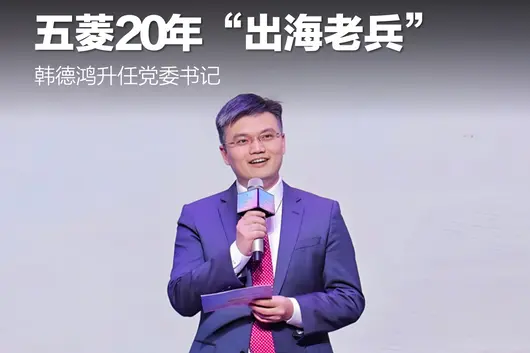
Recently, SAIC-GM-Wuling completed a highly watched high-level personnel adjustment. Former Deputy Party Secretary and Vice President Han Dehong officially succeeded Yao Zoping as the Company Party Secretary, while continuing to serve as Vice President. This 44-year-old executive born in the 1980s has thus completed a key leap from "Deputy Secretary" to "Party Secretary".

The other side of this adjustment is Yao Zoping moving to a secondary role. Yao Zoping was born in May 1964, has reached 62 years of age, exceeding the statutory retirement age. Following the adjustment, he was transferred to Consultant to the General Manager of SAIC-GM-Wuling and Chairman of the Technical Committee of the Smart Island Manufacturing System, no longer specifically responsible for operational matters, gradually transitioning toward retirement.
It is worth noting that Han Dehong has served SAIC-GM-Wuling for over twenty years and is a veteran with rich "overseas" experience. According to his resume, Han Dehong joined SAIC-GM-Wuling in 2005, was sent to India around 2010, served as Assistant General Manager of the India Joint Venture, and participated in developing the Indian market. The direct leader at that time was Yao Zoping.

After returning to China, Han Dehong successively served as Director of Administration and Public Relations of SAIC-GM-Wuling, Vice President of the Sales Company, etc. In June 2016, at the age of 34, he was promoted to Vice President of the Sales Company. After the New Baojun brand was launched in 2019, he transferred to Vice President of New Baojun Sales Company and Director of Brand Communication, accumulating rich experience in brand building.
In 2021, Han Dehong went overseas again to take up a post, serving as Assistant General Manager of SAIC-GM-Wuling Indonesia Branch, later promoted to Vice President of Indonesia Automotive Co., Ltd. This experience further solidified his management capabilities in the overseas market. Upon returning to headquarters, he successively served as Deputy Party Secretary and Assistant General Manager, and began appearing publicly as Vice President in September 2024.
Placing Han Dehong's resume against the backdrop of the current Chinese automotive industry, the deep meaning of this personnel layout is self-evident. With the domestic market陷入 fierce competition and major car companies regarding overseas expansion as a "second growth curve", a young leader with rich overseas market experience stepping into a core position is undoubtedly a key move by SAIC-GM-Wuling for the next stage of strategic transformation.

The Chinese automotive industry is experiencing an unprecedented wave of overseas expansion. According to data from the China Association of Automobile Manufacturers, in August 2026, China's car exports reached 1.01 million units, a year-on-year increase of 65.3%, marking the third consecutive month that Chinese car exports exceeded 1 million units. Cui Dongshu, head of the China Passenger Car Association, predicted that total car exports in 2026 are expected to reach 11.5 million to 12 million units.
More noteworthy is that new energy vehicles have become the absolute main force of exports, with an export share exceeding 50% for three consecutive months. This means that the globalization of the Chinese automotive industry is no longer the initial model of "low price for high volume", but rather high-quality overseas expansion centered on technology, brand, and intelligent capabilities.
However, the path to overseas expansion is not smooth. The "Guidelines on Overseas Competitive Behavior and Compliance Construction for the Automotive Industry" jointly released recently by the Ministry of Commerce, Ministry of Industry and Information Technology, and State Administration for Market Regulation clearly pointed out that some Chinese car companies face risks of disorderly competition in overseas markets. Simply copying the logic of domestic price competition overseas not only damages their own brand value but also lowers the overall perception of Chinese cars in the global market. This hints to us: true globalization capability is far more complex and arduous than the growth of export volume.

In this wave of overseas expansion, SAIC-GM-Wuling has performed impressively. As of August 2026, the company's cumulative overseas sales have officially broken the 1.6 million unit mark, with products sold to over 110 countries and regions. From January to August this year, Wuling exports exceeded 30,000 units monthly for 5 consecutive months, and overseas business has become an important engine for brand growth.
Currently, Chinese automotive overseas expansion is upgrading from "product overseas" to "brand overseas", shifting from simple trade exports to localized operations. SAIC-GM-Wuling's overseas strategy is also undergoing this transformation. Relying on the "India-Malaysia-Thailand" integrated strategy and the layout of three major brand channels, the enterprise is accelerating the upgrade from "product overseas" to "brand overseas".
At this critical juncture, Han Dehong possesses multiple experiences in sales, branding, and overseas markets, as well as a pragmatic background growing from the grassroots. He is undoubtedly the suitable choice to drive this strategic transformation. His deep understanding of overseas markets will help the enterprise better cope with complex challenges such as tariffs, compliance, localization, and supply chain security during the globalization process.

From a broader perspective, SAIC-GM-Wuling's personnel adjustment also reflects the enterprise's emphasis on and cultivation of young management talent. Han Dehong's growth from a grassroots employee to Party Secretary is both a manifestation of personal ability and reflects the company's strategic layout in talent ladder construction.
Going overseas is a marathon, not a sprint. The challenges faced by Han Dehong and his team have just begun. But at least from the personnel layout, SAIC-GM-Wuling is already prepared for this long run.