首頁Tiggo

搜尋歷史
熱門搜尋
經銷商登入 / 註冊

Never would one have imagined! First, an overseas wheel detachment accident occurred, and Malaysia initiated a recall first; now the domestic announcement has finally been implemented! Chery is recalling 53,882 Tiggo 5x and Omoda units, with the same root cause: poor rear axle welding!

Many people should still remember that recently, an OMODA5 in Malaysia directly suffered a rear axle tear and rear wheel detachment on the road, and the video spread across the entire internet. At that time, Chery immediately initiated a recall in Malaysia, a total of 8,878 overseas OMODA5 units. It was the same issue: insufficient welding strength of the rear axle trailing arm and sleeve. Under extreme operating conditions, the weld seam tore directly, causing the wheels to lose control!
And now, this domestic recall announcement is officially here! Reference number S2026M0146V. Starting from November 27th, recalling Tiggo 5x and Omoda models produced from June 6, 2022 to December 31, 2023, totaling 53,882 units!

The hazard is exactly the same: a rear axle manufacturing welding defect. Under extreme conditions, the weld seam detaches, and the wheels directly lose control. This is not a minor noise or a minor electronic fault; it involves a core chassis structural component, which is a safety risk that can directly lead to major accidents!
Solution: Visit the store to check the rear axle production date code for free. If it is a defective batch, the entire rear axle assembly will be replaced for free.
As you can see! This time, it is not handled separately overseas while domestically pretending nothing is wrong. It is the same problem. Overseas recalled first after the incident occurred, domestically followed up with a filed recall. At least, the same problem triggers the same recall for both China and foreign markets; for this, Chery deserves a thumbs up.
However! The root cause of the problem is indeed very clear: poor welding, which is a quality control failure on the manufacturing side. As a global model mainly focused on exports, Omoda (OMODA5) is Chery's main force for going global. A basic process like chassis welding should never have such a low-level blunder. What do you think?
I also want to remind all Tiggo 5x and Omoda owners again, please verify your vehicle's factory production date immediately! If you fall within this interval, do not take chances, chassis hazards cannot be delayed. Usually when driving, if rear wheel shaking or chassis noise appears, do not drive on highways, go to the dealership immediately to check and eliminate the hazard!
It is not easy for domestic brands to go global. While sales are climbing, the quality control bottom line cannot be loosened. A recall is a remedial measure, not a pardon. Car manufacturers must attach great importance to this, and users must keep a sharp eye.

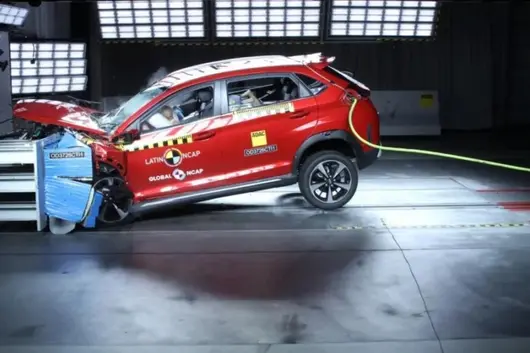
As a leading domestic automotive export enterprise, Chery has recently been deeply scrutinized by public opinion regarding quality and safety standards. The trigger was the poor performance of its models in the crash tests of the latest Latin America New Car Assessment Program (Latin NCAP).

Latin NCAP: Tiggo 2 Receives Zero-Star Rating
On October 28, 2026, the Latin America and Caribbean New Car Assessment Program (Latin NCAP) released the first batch of crash test reports adopting the 2026 version of the new testing protocol. Chery Tiggo 2 (corresponding to the Chery Tiggo 3x in the domestic market, named Tiggo 2 Pro, Tiggo 2 Pro Max, and Chery Tiggo 2 in the Mexican market) received a zero-star (0 star) rating.

The vehicle comes standard with four airbags and an Electronic Stability Control System (ESC), but still failed to meet basic safety requirements. The report shows that Tiggo 2 scored 0% for adult occupant protection, 0% for child occupant protection; pedestrian protection scored 49%, and safety assistance system scored 45%.

Latin NCAP pointed out several key safety defects:
Body structure instability: During the frontal collision, the vehicle body and footwell area deformed and became unstable, causing severe crushing injury to the driver's chest;

Fire risk: Fire hazards were detected during the frontal collision test, posing a major threat to occupants inside the vehicle and rescuers;
Lack of safety features: The vehicle does not come standard with side curtain airbags for head protection; rear seat belts are not equipped with pretensioners and load limiters; simultaneously, the vehicle is not equipped with any Advanced Driver Assistance Systems (ADAS).

Latin NCAP Secretary-General Alejandro Fulas stated that the test results have pushed Chery into the spotlight — the safety performance of products launched by the brand for hot-segment markets is worrisome.
Another quality incident occurred in Malaysia: On October 6, a Chery Omoda 5 suffered an accident where the entire rear suspension assembly detached while driving. The Malaysian Land Transport Authority (JPJ) immediately suspended the model certification (VTA) for this model and stopped new vehicle registration and licensing services.

In response, Chery initiated a recall, involving 8,878 Omoda 5 C and H version vehicles. On October 21, Chery Chairman and General Manager Yin Tongyue publicly apologized at the World Intelligent Connected Vehicles Conference (WICV) regarding this quality incident. Yin Tongyue emphasized that Chery is committed to "deeply rooted" in overseas markets, rather than pursuing short-term windfall profits; at the same time, he called on Chinese automakers going overseas to maintain humility and respect local regulations and systems.

Since the Chery Tiggo series was launched in 2005, products have been exported to more than 80 countries and regions. The Tiggo 2 series is the entry-level model with the lowest price threshold in this product line, focusing on practicality and high cost-performance ratio. In the first half of 2026 alone, Chery exported more than 115,028 vehicles to the Central and South American market.