首頁Tiggo 7

搜尋歷史
熱門搜尋
經銷商登入 / 註冊

In the most competitive A-class fuel SUV sub-segment ranging from 70,000 to 120,000 yuan, where real skill is most tested, buyers fear two things: first, a specification sheet looks full but minor issues arise after two years; second, domestic pricing and standards differ from export standards, where the term "global car" is just marketing. The Tiggo 7 series' market feedback over the past few years happens to address these two pain points. Since its launch in 2016, the Tiggo 7 has entered over 100 countries and regions globally, with cumulative series users breaking one million. Recently, official communication mentioned a global user scale of 1.93 million, consistently ranking among the top for Chinese brand A-class SUV exports. More importantly, its reputation wasn't built by single hit models but is driven by both domestic commuting families and overseas users in multiple climates.

Global Quality: Standards aren't made just for export, but for home use by global standards
The Tiggo 7's "global car" attribute is reflected in standards rather than slogans. Chery's public data states the Tiggo 7 series R&D phase covered regulations and usage scenarios in multiple regions including China, ASEAN, Australia, and Europe, with targeted verification in environments like complex roads in Brazil, high temperature and humidity in Indonesia, and high temperature/dust storms in the Middle East. Tiggo 7 PLUS related communication also emphasized passive safety configurations like high-strength body, 6 pieces of Benteler hot-formed steel in key areas, and 6 airbags with wraparound protection. Regarding safety certification, series communication frequently mentioned multiple 5-star safety evaluations including China, ASEAN, Australia, and Europe. The Tiggo 7 PLUS official website and early global car materials involve international endorsements like Australia A-NCAP 5-star. On the design side, it won the German Red Dot Award, avoiding the stereotype that "cheap = shoddy".

Third-party reliability data added a second layer of credibility. In J.D. Power's "2026 China Vehicle Dependability Study (VDS)", Tiggo 7/Tiggo 7 PLUS ranked first in the mid-size economy SUV sub-segment. This study is based on feedback from real car owners 13–48 months after purchase, focusing on long-term use rather than the first test drive. For editors finalizing the article, this statement is harder than "lifetime warranty": lifetime warranty is what the manufacturer dares to promise, VDS is what owners are willing to rate.

User Reputation: 190,000 kilometers and 25,000 kilometers a year both say "worry-free"
A domestic Tiggo 7 owner shared a 190,000 kilometer mileage, concluding with just one phrase "never let us down", used for commuting, long-distance, and full-load family travel. In dealer-collected owner feedback in Shaanxi, Gansu and other places, the 1.5T version is often mentioned as "light and brisk in the city, enough for school runs, 7+ MPG on display", the second row is not cramped for a family of five, baby strollers, camping gear, and supermarket shopping fit in one car. Some first-time buyers mentioned the 1.5T Enjoyment version, priced over 80,000 yuan on the road, emphasizing "no decoration add-ons, transparent insurance and registration fees", such reviews are most relatable to 70k-90k level users.

Overseas reputation is even more direct. A South American owner drove a Tiggo 7 Sport for nine months and commented "only happiness"; another overseas user drove 25,000 kilometers a year, evaluating "maintenance doesn't hurt the wallet, insurance is cheap, must be full marks"; an experienced driver in Brazil with 50 years of driving experience described it as "comfortable, strong power, value far exceeds expectations" after trying it; European owners focus more on the whole vehicle warranty policy, believing manufacturers dare to offer long-term support, only then do they dare to buy Chinese brand fuel SUVs. From 190,000 km domestically to tens of thousands of kilometers overseas in a year, the keywords pieced together from cross-market samples are highly consistent: reliable, cheap to maintain, large space.


A-Class Body: 2670mm Wheelbase, 475—1500 Liters, 70k-Level Automatic
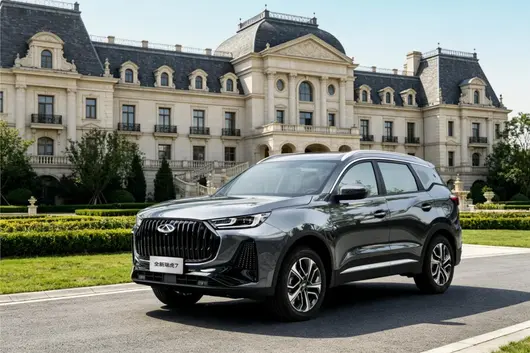
Back to the product itself, Tiggo 7 makes "A-Class Value" very tangible. Based on the new Tiggo 7 and Tiggo 7 PLUS on sale: body approx 4530x1862x1695mm, wheelbase 2670mm, positioning compact/A-class; rear legroom is approx two fists for a 175cm tester, floor is nearly flat, a family of five won't feel knee-bumping on long trips; trunk is standard 475L, expands to 1500L with seats folded, baby strollers, folding bikes, camping boxes can all fit, PLUS higher version also provides 24.6-inch curved surround screen, Lion car internet, 8155 chip, CarPlay/HiCar, 360°or 540°camera view.

The Tiggo 7's low trim isn't just "enough is good", but defines a new entry-level comfort standard with solid hardware—multi-link chassis, zero-gravity seats, remote temperature control, and flat rear seat are the four pillars, allowing an 80,000 yuan budget to experience crossover-level driving quality. If you value daily commuting and family travel comfort sensation, it truly achieves "low trim without compromise".

Power and Cost of Use: 1.5T for Commuting, 1.6T for Long Distance
Tiggo 7 power splits into two lines by scenario. When the whole family departs fully loaded, the golden combination of 1.5T high-efficiency turbo engine and 9-speed CVT transmission is enough for use, max power 115kW, max torque 230N·m, light start, stable high-speed cruise, smooth shifting without jerking. Meanwhile, the boulder-like body built by global 5-star safety standards protects family safety.

To let users completely eliminate worries, Tiggo 7 launched that the first non-operating owner can enjoy a whole vehicle lifetime warranty. This means, compared to the common 3 years or 100,000 kilometers warranty on the market, Tiggo 7 extends this guarantee to the vehicle's entire lifecycle. Discounts at purchase time are visible benefits, while lifetime warranty is real money saved in the vehicle use life of the next ten years or even longer.

Why it Deserves the Name A-Class Value Benchmark
The benchmark for A-class SUVs is not about how many screens are piled up, but whether "price, space, reliability, safety, ownership volume" are all balanced. Tiggo 7, through a "low price, high spec" strategy and global technology endorsement, precisely meets family users' needs for comfort, safety, and intelligence. Its sales performance of consecutively reigning as the A-class SUV export champion of Chinese brands for three years further confirms its market recognition as a "value benchmark". It may not be the most aggressive in every individual item, but it does everything family SUVs care most about: "don't break, don't be expensive, don't be cramped, don't cut specs".

For young families, the first car often determines trust in the brand for the next ten years. The A-Class Value Benchmark shouldn't be defined by joint venture brands, nor by individual parameters, but should be defined by long-term real-world user reputation.

Conclusion
A-Class family SUV users have never wanted the flashiest, but the most stable; global quality plus local reputation is the truly irreplaceable benchmark at this price point. In one sentence: Tiggo 7's reputation is not that a certain parameter explodes, but making "upgrade specs + global verification + lifetime warranty" a long-term account for family use.

On average, 17 seconds. In the time it takes you to read this pause, another Chery-made vehicle roars toward a port on the other side of the Earth.
To be honest, half-year exports nearing 950,000 units, single month nearing the 200,000 unit mark, these numbers are indeed substantial. But if you only look at sales volume, you fall into a data trap. What we see is not how many cars Chery sold, but how this enterprise is forcibly rooting the car manufacturing roots into the soil of the global market. This is no longer simple trade export, but a fundamental restructuring of the globalization survival model.
 From Product Transit to Industrial Rooting
In the past, when we talked about going global, the essence was door-to-door delivery. Domestic production, ocean shipping, terminal sales, short chains, weak stickiness. Chery's current approach has clearly changed the logic.
Spain's European Operation Center, UK Liverpool Commercial Vehicle Headquarters, are not simply offices, but have moved the decision-making brain of market operations, compliance management, supply chain coordination, and financial control to the local level. Even more significant is the South Africa Rosslyn Plant, fully taken over from foreign enterprises, retaining all 692 original employees, and driving 3,000 supply chain jobs in the surrounding area.
 It can be said that this deep cultivation of the whole value chain is more penetrating than spending heavily on advertising. You place manufacturing on their land, taxes into their treasury, employment links to locals. This "In somewhere, For somewhere" (Here, For Here, Becoming a Local Member) deep binding is the true moat for going global.
 From Single Product Breakout to Group Strategy
Look at the product side again. Early Chinese brand global expansion often relied on one or two cost-performance models to open the market, concentrated risk, insufficient follow-up. Chery has now formed a blockbuster matrix with multiple lines advancing together.
Tiggo 7 monthly overseas sales broke 30,000 units, Tiggo 4 took the runner-up spot in South Africa monthly rankings; JAECOO 7 topped the UK full market monthly leader, JAECOO 5 led in three lines: Australia small pure electric SUV, Indonesia pure electric, Thailand markets; JETOUR T2 even secured the South Africa Car of the Year award, an authoritative award with a 40-year history. Also, OMODA 5 and iCAR V23 continue to sell well in the UK and Thailand respectively.
 Yes, this is the true meaning of the matrix. From fuel to pure electric, from entry-level home to light off-road, every segment has a capable main product. This multi-point supported product structure is the true portrayal of capacity and demand behind one car every 17 seconds.
 From Compliance Adaptation to Rule Participation
The European market is a benchmark-level arena for the global auto industry, with strict regulations and dense barriers. Chery has not only achieved sales breakthroughs but also completed advancements at the standards level.
Jan-May Europe cumulative sales 138,800 units, year-on-year growth 216.69%; in the UK for three consecutive months ranked second overall brand, second only to Volkswagen. More critically, Chery became one of the Chinese car companies to obtain the China-Europe Automotive Carbon Footprint Mutual Recognition Report, and officially entered the IATF (International Automotive Task Force) Board of Directors, directly participating in the formulation and revision of global automotive quality standards.
 From Trade Going Global to System Export
In the end, Chery's over 940,000 unit export volume in these half years marks that China's automotive global expansion has entered a new stage.
In the past it was trade going global, revenue counted per car sold; now it is system going global, while exporting products, synchronously exporting technical standards, manufacturing systems, brand culture, and localized operational capabilities. New energy export grew 1.6 times, in the European market for every 2 Chery cars sold, 1 is new energy; commercial vehicle sector June export year-on-year growth 146%, 1000 Mojia robots also opened up commercial service tracks in over 50 countries and regions.
 Zhang Guan's Comment: One car every 17 seconds, sounds very fast. But for Chinese brands aspiring to become global car companies, this rhythm perhaps has just entered the stable zone. True globalization has never been as simple as shipping cars out, but rather making oneself truly a local enterprise in every local market.