首頁Tang

搜尋歷史
熱門搜尋
經銷商登入 / 註冊

 Discussing how to evaluate BYD's August 2026 sales exceeding 440,000 units, a year-on-year increase of 17.84%? First, state the viewpoint: this sales figure must be viewed dialectically. Flash charging boosted sales explosion; behind BYD sales exceeding 440,000 units is global market competition driven by technological change.

Overseas markets were the biggest highlight in August. Overseas sales of 189,000 units saw a year-on-year increase of 134.6%, breaking records for five consecutive months. Cumulative overseas sales from January to August of 1.158 million units have already exceeded the full year of 2025. BYD adopted an industrial going-global strategy by building factories in places like Thailand, Hungary, and Brazil. According to the "2026 H1 China Auto Going Global Insight Report" jointly released by CAITC and Yiche, BYD ranked first in market share in the Italian PHEV market in the first half of the year. Dolphin MINI retail sales were close to 30,000 units, firmly maintaining market first place. UK sales in the first half of the year were 38,000 units, nearly doubling compared to the same period, while Australia's June market share reached 13.5%, setting a new historical high, ranking second in sales for three consecutive months, with 3 model lines entering the top 10 for the first time.
 Staying at the top of the new energy sector for 63 consecutive months, what does this record mean? It is the dominance established by BYD starting from April 2021. In over five years, regardless of market fluctuations or fierce competition, BYD has always stood at the top of the industry. BYD employs about 110,000 R&D personnel, making it the automotive enterprise with the most R&D personnel globally. Blade Battery, DM-i Super Hybrid, YiSifang Platform, 2nd Gen Blade Battery, and Flash Charging Technology, every technical innovation is continuously widening BYD's moat.
 Battery Electric Vehicle (BEV) sales leading Plug-in Hybrid (PHEV) significantly for the first time is a positive signal. BEV sales in August were 256,000 units, PHEV were 177,000 units, with BEV accounting for 59%. The increase in BEV proportion indicates that Blade Battery and Flash Charging Technology are mature and charging infrastructure is well-established, but on the other hand, it reflects intensified competition in the PHEV market. From the competitive landscape of the China New Energy Sales List, the data of 440,000 units leading by a large margin shows a lead of nearly 250,000 units over the second-place SAIC. While predicting, we see intensified competition in the new energy market. Geely's August exports were 110,000 units, a 205% year-on-year surge, with cumulative January to August exports of 691,000 units, up 170% year-on-year. Chery's August exports were 197,000 units, accounting for 70.3%, with cumulative exports breaking 7 million units, firmly holding the champion position in Chinese automaker exports.
 Technical innovation is BYD's ace card. 2nd Gen Blade Battery charges well in 5 minutes, fully charged in 9 minutes. 10,000 Flash Charging stations cover 332 cities. In terms of intelligence, Divine Eye 5.0 City Navigation + Intelligent Parking provides dual backup. The underlying competitive moat includes the systematic capabilities of 110,000 R&D personnel and 900,000 employees, and fully independent R&D and large-scale mass production of the entire industry chain including chips. Next, we will watch the capacity ramp-up of Flash Charging Batteries and the application of the 4nm smart driving chip Xuanji A3 in vehicles.
 From the product structure perspective, the gold content of 440,000 units is constantly increasing. August data shows Tang EV broke 10,000 units for the second consecutive month, Qin MAX sales exceeded 10,000 units, Yuan Family sales were 84,000 units, Seal Family 47,000 units, Sea Lion Family three major series monthly sales all broke 10,000 units. Blooming in multiple points indicates BYD has broken the dependence on a single hit model, forming a complete product matrix covering the 70,000 to 300,000 price range. In August, Fang Cheng Bao and Denza combined sales were 58,000 units, more than doubling compared to the same period last year. Fang Cheng Bao sales were 42,000 units, up 155.6% year-on-year, becoming the sales leader among new forces brands with an average price over 200,000. BYD is breaking through upwards.
 The performance of high-end brands is commendable. Fang Cheng Bao 42,000 units, up 155.6% year-on-year, became the sales leader among new forces brands with an average price over 200,000. From the industry chain perspective, BYD's full industry chain vertical integration is a unique advantage. Batteries, motors, electronic controls, and chips are self-controlled and can also be exported. Where are the future growth points? Product reserves are indeed rich. New cars such as Denza Z9S, Da Han, Sea Lion 08, 3rd Gen Tang, Titanium 9, etc., cover the 200,000 to 1,000,000 price range. Of course, there are strong rivals surrounding every sub-market. Whether BYD's complete product matrix can win in every sub-market needs market verification.
 How will sales go next? Xiao Xing made a simple prediction using algorithms. The process of switching from fuel to electricity is accelerating, and the market share of traditional fuel cars is being rapidly eroded. An important turning point for China's automotive industry from trading market for technology to trading technology for market. When BYD's monthly sales exceed 440,000 units, former monarchs like Tesla, Volkswagen, and Toyota must face the rise of China's new energy vehicle enterprises.
 What we see is the shock and attention of foreign media towards BYD entering the top 5 annual sales for the first time. Especially when BYD's first K-car model Sea Otter entered Japan, it caused a sensation among the media. If looking at the year-on-month sales trend changes, we can find the beginning of 2026 looks very similar to 2024. Due to production capacity and market environment factors, although the start was slow, the second half of the year ushered in robust and high-speed growth in production and sales. And looking at the months where BYD's sales exceeded 400,000 units so far, there are 11 in total. Coincidentally, they appeared in the year-end period from September to December in both 2024 and 2025. The reason 2026 is special is that the 400,000 unit sales target was achieved earlier than before; this capacity ramp-up was clearly visible since June. Let's wait and see the development trend of the last four months.
 Overall, BYD's August 2026 performance of 440,000 units, with a year-on-year increase of 17.84%, is a report card with highlights that must be viewed dialectically. Highlights lie in overseas volume explosion, high-end volume increase, technology leadership, and systematic capabilities. BYD's path to global rise depends on whether it can find a new balance point between technical innovation, brand upward movement, overseas deep cultivation, and cost control. The competition in China's new energy vehicles has shifted from grabbing land in the incremental market to close-quarters fighting in the stock market. Flash charging boosted sales explosion; BYD's 440,000 monthly sales achieved a phased victory.
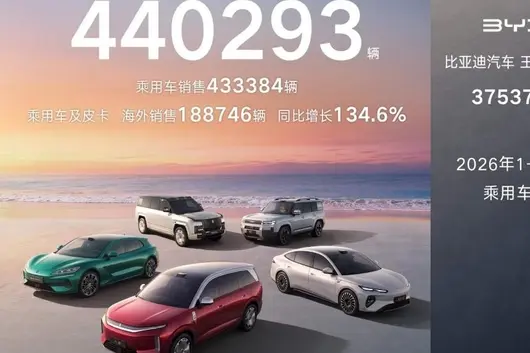

August sales hit 440,000 units, BYD takes China auto sales champion title again
Others worry about orders, it worries about batteries

To be honest, seeing "440,000 units, +17.84% YoY, once again first", this result is not unexpected. The truly worth pondering is another question: 440,000 units, is this BYD's ceiling?

In total volume, BYD sold over 440,000 NEVs in August, ranking #1 in China NEV sales for 63 consecutive months. Dynasty, Ocean bases are stable: Yuan series 84,000, Seal 47,000, Sea Lion three series all exceed 10,000, Tang EV, Qin MAX continue to exceed 10,000.

This is all basic, nothing much to discuss, there are 2 obvious changes.

First is overseas. August 189,000 units, +134.6% YoY, fifth consecutive month breaking record; first 8 months cumulative 1.158 million units, already exceeded full year 2025. Some say "Is it piling cars at the dock" — people thinking like that, probably haven't checked customs export data, nor looked at license plate registrations in Brazil, Thailand. Tang L renamed Atto 8 exported to Mexico, Middle East, Brazil, equivalent to 450,000-500,000 RMB, more expensive than domestic. This is real premium pricing.

Second is premium. Fang Cheng Bao 42,000 units, +155.6% YoY, single month exceeded Zeekr, Li Auto, AITO, Xiaomi, became sales champion among new EV brands with average price over 200,000 RMB; Denza 16,000 units, +33.4%. These two added up, 440,000 units, might not have reached BYD's true ceiling.

Because FinDreams Battery capacity is still being bottlenecked. When Gen 2 Blade first went into mass production, cell yield rate was only 60%~70%, production line capacity was 0 during retrofitting, belonging to dismantling, building, producing simultaneously. 12 bases retrofitting lines simultaneously, relying on core team running back and forth, capacity could only climb steadily. Fast charging boosted sales explosion.
Understood this way makes sense: Demand side orders exploded — sub-brands fighting for battery quotas, execs stationed at factory urging orders; Supply side is squeezing toothpaste — new cars parked in open lots waiting for battery packs, battery arrives then can go off line. Run after capacity and still sell 440,000, exactly shows demand is really hard.
Wait until line retrofit completed, yield rate maxed out, Gen 2 Blade capacity released again, that month sales, is BYD's true trump card.
So the question arises: Wait until that moment truly arrives, what will BYD's monthly sales be? 500,000, or more?

Editor's Note: BYD sales achieved positive year-over-year growth for three consecutive months. The overall operation shows signs of recovery. Among them, the explosion in overseas markets has become the biggest highlight of BYD's development this year. However, at the same time, the situation where its domestic market sales declined by over 30% has not yet been reversed, and achieving comprehensive stability still faces multiple challenges.
Three Consecutive Sales Increases, Recovery Signals Emerge
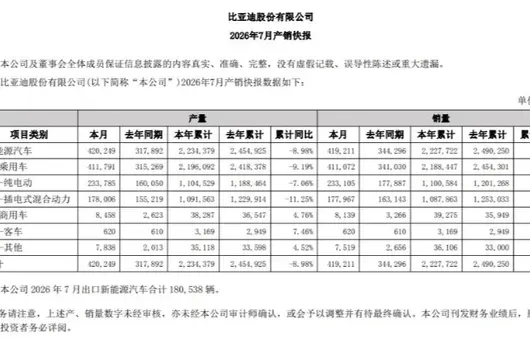
On August 1, BYD released the latest production and sales data. July sales reached 419,000 units, a year-over-year increase of 21.8%, achieving positive year-over-year growth for the third consecutive month.

In May, BYD sales were 383,000 units, a slight year-over-year increase of only 0.2%. June sales were 403,000 units, with the year-over-year increase expanding to 5.4%, and July's year-over-year growth rate increased to 21.8%. The significant expansion of single-month increments shows that the strength of BYD's recovery has strengthened month by month. Before this three-month consecutive year-over-year growth trend appeared, BYD experienced continuous year-over-year deep decline. The industry growth leader fell into a continuous period of deceleration.
From September 2025 to April 2026, BYD experienced an 8-month cycle of consecutive year-over-year declines in overall vehicle sales. In January, February, March, and April this year, BYD's overall vehicle sales dropped significantly with two-digit figures for four consecutive months. Among them, January sales dropped 30.67% year-over-year, February's year-over-year drop widened to 36%, March year-over-year declined 30.13%, and April's year-over-year drop narrowed but still remained in the two-digit decline range at 26.17%.
The eight consecutive year-over-year declines for BYD were caused by the resonance of multiple factors: The expiration of new energy vehicle purchase tax incentives at the end of 2025 caused a large amount of car buying demand to be prepaid into the fourth quarter; Since 2026, the policy of halving the purchase tax was implemented, causing market purchasing power to contract in phases at the beginning of the year; At the same time, the competition in the domestic new energy market has fully upgraded, and competitor hybrid and pure electric new products were launched centrally, eroding BYD's market share, and overseas local production capacity has not been fully released.
With the market performance recovery starting in May, BYD officially bid farewell to the low-level market trend of continuous multiple-month year-over-year decline. The repair effect of cumulative sales for the year also appeared synchronously. Data shows that from January to July 2026, BYD's cumulative overall vehicle sales reached 2.22 million units, with the year-over-year decline narrowing to 10.5%. Compared to the significant decline of around 30% in the first quarter, the overall operating pressure has been significantly alleviated.
However, looking at the sales structure, the growth momentum of this round of BYD recovery is not balanced. Its overseas markets contributed the main increments. The performance in the domestic market has not yet walked out of the downward channel. The overall recovery shows a differentiated pattern of 'strong abroad, weak domestically'. The recovery in growth rate is largely due to the explosive growth of overseas businesses supporting it. The domestic basic floor has not yet returned to the positive growth track. The foundation of recovery still needs to be further solidified.
Overseas Supports Growth, Domestic Still Faces Pressure
The overseas market is the core engine for this round of BYD sales recovery. Official data shows that in July alone, BYD's overseas market contributed about 180,000 units of sales, a year-over-year increase of 125%. From January to July this year, BYD's cumulative export sales reached 970,000 units, a significant year-over-year increase of 76.1%. The proportion of overseas sales in total sales continued to increase, rising from 22% year-on-year at the same period last year to the current 43%.
According to the current progress, BYD's original overseas target of 1.6 million units has completed 64%. The remaining 5 months with a monthly average overseas sales of 126,000 units can achieve the target. Under this trend, BYD has already given a higher expectation than 1.6 million units. Previously, BYD Chairman Wang Chuanfu stated, 'The overseas sales target set for 2026 at the beginning of the year was 1.5 million units. Now it is expected that it will exceed this target.'

The high-speed growth of BYD's overseas business is the concentrated realization of its long-term global layout over the past two years. In recent years, BYD has accelerated the implementation of global production capacity, successively building whole vehicle manufacturing bases in many places such as Thailand, Brazil, Hungary, etc. Localized production not only avoids tariff barriers but also better fits the consumption demands and policy rules of local markets. On the product level, BYD has also laid out dual technology routes for pure electric and plug-in hybrid. Vehicle models cover entry-level commuting, home commuting to multiple levels of mid-to-high-end, which can adapt to consumption levels of different markets such as Southeast Asia, Latin America, and Europe.
However, what needs to be paid attention to is that, in sharp contrast to the high growth overseas, the weak state of the domestic market has not been fundamentally reversed. Apart from BYD's overseas sector, from January to July this year, BYD's domestic cumulative sales were about 1.25 million units, a year-over-year decline of 35.5%. July domestic sales were 239,000 units, a year-over-year decline of 9.4%. Although the decline narrowed compared to before, it has not yet returned to the positive growth track.
The pressure in the domestic market mainly stems from the continuous intensification of industry competition. Over the past two years, independent car companies have fully turned to new energy. New products in the hybrid and pure electric tracks were launched intensively. Price wars ran through the full price range of 100,000 to 300,000. BYD's previously established cost and cost-performance advantages based on vertical integration were gradually diluted. At the same time, the main models of the Dynasty series entered the middle-to-late stage of the product lifecycle, and product attractiveness decreased;
Including the slow implementation pace in the field of intelligence compared to leading competitors. The insufficient popularity of high-level intelligent driving also affected the brand's competitiveness in the mid-to-high-end market to a certain extent.
Stabilization Still Awaits Breakthrough on Domestic and International Lines
For BYD, although the high growth in the overseas market is able to support the overall sales volume, the domestic market, as the core basic floor of the brand, still needs stable market performance. Currently, the domestic new energy market has entered the stage of stock competition. For BYD to hold the share of the mainstream home market, it faces dual squeezing from new forces and traditional car companies, and operating pressure remains significant.
Facing the challenges in the domestic market, BYD has launched multi-dimensional adjustments to break through the situation.

On the product end, the main models of the Dynasty series will usher in replacement modifications one after another. Including products such as 'Tang, Han' have been launched into the market or are waiting to be launched, reactivating terminal attraction; On the intelligence level, BYD is accelerating the implementation and popularity of high-level intelligent driving systems, making up for intelligence shortcomings, and narrowing the experience gap with leading competitors. On the brand matrix side, relying on the three high-end brands of Denza, Fang Cheng Bao, and Yang Wang to continue to exert force, covering the 200,000 to 1 million level market, pulling up brand premium ability, and getting rid of the low-end price involution.
Overall, the positive signals in BYD's adjustment process are the year-over-year growth for the past three consecutive months, marking that BYD has passed the previous downward cycle, but it does not mean that BYD has comprehensively stabilized.
Especially the overseas market it currently relies on, growth is not without risks either. Trade protectionism is rising in many places globally. Tariff policies and localized access rules may change. Global traditional car companies are also accelerating electrification transformation. Competition between local brands and other multinational car companies will gradually intensify. Superimposed with uncertainty factors such as exchange rate fluctuations, whether BYD's high growth rate in overseas sales can be maintained long-term still has many uncertainties.
This actually means that for BYD's true stabilization and recovery, it is inseparable from substantial recovery in the domestic sector as support. Subsequently, with the implementation of new product iterations and intelligent upgrades, whether BYD can re-activate domestic terminal demand and finally achieve balanced development of domestic and foreign markets will be the core indicator to observe whether BYD can continue to lead the market in the future after standing on the height of scale.