首頁Southeast

搜尋歷史
熱門搜尋
經銷商登入 / 註冊

Industry News Recently, the 2026 Indonesia International Mining Exhibition was successfully held in Jakarta. As a major industry event in the Southeast Asian mining sector, this exhibition focuses on industrial efficiency and intelligent development. SAILUN Group showcased a matrix of multi-brand full-series mining tires, and premiered the new locally manufactured product SAILUN Terramax MT 2 in Indonesia, fully demonstrating the enterprise's technical innovation strength in the mining tire field and the results of deepening the Southeast Asian localization layout.

Directly Addressing Harsh Working Conditions, Multi-Brand Synergy Achieves Full-Scenario Coverage
Indonesia has rich mineral and plantation resources, but local working road conditions are complex and equipment operation intensity is high, placing stringent requirements on tire traction, durability, and damage resistance. Facing industry pain points, SAILUN launched a "Combo" with a mature multi-brand strategy, creating a full-scenario mining tire solution.
At the exhibition site, MAXAM brand focuses on open-pit mine heavy-load conditions; its high-performance off-highway tires meet the high-intensity operation needs of large mining engineering machinery, with outstanding load-bearing capacity and stability; SAILUN, ROADX and BLACKHAWK three brands cover scenarios such as mining transport vehicles, light commercial vehicles, 4×4 work vehicles and logistics fleets. From large mining equipment to daily logistics support, SAILUN achieves full coverage of light and heavy operating conditions, helping customers improve equipment availability and reduce full lifecycle operating costs.

Local Manufacturing New Product Premiere, Hardcore Technology Addresses Unpaved Challenges
The core highlight of this exhibition is the official release of SAILUN Terramax MT 2, a new product independently developed and produced by SAILUN's Indonesia factory. This product is designed for light commercial vehicles and 4×4 work vehicles in harsh operating environments, featuring pickup truck models, capable of calmly handling unpaved complex road conditions such as mud and gravel in mining areas and plantations.
In terms of technical design, Terramax MT 2 adopts 3D interlocking shoulder sipes and open tread design, greatly improving traction and passability in complex road conditions; meanwhile, through reinforcement of the tire body and thickening of sidewall rubber, it effectively resists piercing by sharp objects and rock abrasion, with durability and safety significantly upgraded.

During the exhibition, SAILUN's booth attracted many local mining enterprises, fleet operators and industry chain partners to visit and negotiate. All parties exchanged views in depth on core issues such as tire selection for complex working conditions, operational efficiency and costs, precisely meeting local needs.

This new product launch is a key measure for SAILUN to deepen globalization and promote localized development. Relying on the Indonesia local production and service system, the enterprise can quickly respond to market demand and provide more efficient product supply and technical support. In the future, SAILUN will continue to cultivate the Indonesia market deeply, empowering the high-quality development of local mining and industrial enterprises with high-performance tire solutions.


Zhiliao Auto / Fei De

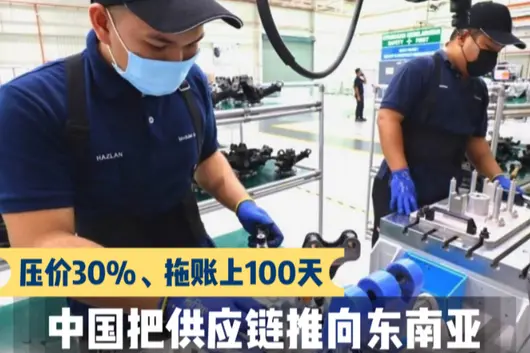
Price competition in the domestic automotive market continues. To protect sales volume, car manufacturers constantly pressure suppliers to cut prices. Years ago, the industry default annual price reduction was 3% to 5%, now annual reduction requirements of 10% to 30% are appearing frequently.

Some OEMs require suppliers to cut prices directly by 10% starting from January 2025. Suppliers are no longer excited about large orders; instead, they must carefully calculate capital occupancy and profit margins. The larger the order volume, the heavier the funding pressure, and the higher the risk of losses.
Supplier profit margins are being systematically compressed. Taking domestic parts leader Huayu Automotive as an example, the company's 2025 revenue reached 183.999 billion yuan, but the gross margin dropped from 14.38% in 2021 to 12.30%.

Revenue continues to grow year on year, but net profit hovers around 7.2 billion yuan, with no substantial breakthrough in four years. This is not an operational issue for individual companies. Body parts see annual reduction rates ranging from 0.03% to 13.34%, while chassis parts also see significant cuts. Suppliers must invest in raw material procurement and production line operations before production, but payment may take months or even longer to arrive.
Payment term issues worsen the cash flow situation for suppliers. Before June 2025, the payment cycle for top domestic car manufacturers was generally over 125 days, with some companies having single-term spans exceeding half a year. In comparison, Toyota's supplier payment cycle is 52 days, Volkswagen is 40 days, and Mercedes-Benz is 36 days.

After profits and cash flow are squeezed simultaneously, suppliers are forced to make choices. Cutting R&D investment became the first reaction for most companies. Equipment investment for new projects is delayed, and the technical team's scale is compressed. The Chairman of Konghui Technology once released a public letter on Children's Day in 2025, writing that suppliers' dream was simply to reconcile invoices after goods are delivered and accepted, with payment arriving within a month. This letter resonated widely in the industry because it voiced the real situation of most suppliers. Once R&D is cut, product iteration speed slows down, and quality risks rise accordingly.
Supply chain relocation overseas is also a major trend. In 2025, China's total automotive parts export reached $59.051 billion, up 4.07% year-on-year. Southeast Asian countries such as Malaysia, Vietnam, and Thailand have become rapidly growing markets.

In the past, suppliers going overseas followed the footsteps of OEMs. Now, more companies are actively looking for safe havens for profits and cash flow. Overseas markets have more reasonable payment term rules and fuller profit margins. Some parts companies' overseas business gross margin reached 31.44%, significantly higher than the domestic business's 24%.
A common saying in the automotive supply chain industry is: "Being a supplier to domestic carmakers means payment terms of half a year or more, and profits thinner than paper. Working with overseas clients means payment within two months, and prices are 20% higher." This reflects suppliers' true feelings about payment terms and profits from domestic and foreign car manufacturers.

Chenyuan Sealing Parts, a leading domestic company in the rubber sealing parts field, is a typical case of shifting industry overseas. Facing rising domestic raw material costs and continuous price pressure from OEMs, the company decisively transferred its production lines to Southeast Asia.
These judgments from frontline practitioners indicate that if car manufacturers continue to save money by cutting prices and delaying payments, suppliers will inevitably gradually move high-quality capacity and R&D overseas. Pressuring purchase prices and extending payment terms can improve financial performance in the short term, but the cost is the simultaneous decline in suppliers' R&D capabilities and delivery quality.

Changes are being driven at the policy level. In June 2025, 17 key car manufacturers promised supplier payment terms of no more than 60 days. A China Association of Automobile Manufacturers survey shows the industry average payment term has dropped to 54 days. This is just the beginning. Truly sustainable competitiveness comes from improving technical efficiency and creating product value, rather than continuously shifting operational pressure onto upstream suppliers. When high-quality suppliers invest capacity and R&D into overseas markets, domestic car manufacturers will lose not just a few supporting partners, but the entire industrial foundation.
Original article by Zhiliao Auto. If reprinting is required, please contact us
*Images from the internet. If infringing, please contact the author for deletion*

An enterprise in the new energy sector hosted a Southeast Asian industry summit, receiving 40 delegates from 6 countries. It required arranging pick-up, inspection, and banquet vehicles in Bangkok and Jakarta within 3 days. Complex itineraries, high vehicle demand, difficult inter-city scheduling — the challenges faced by business reception vehicle services are far more complex than individual customer reception.
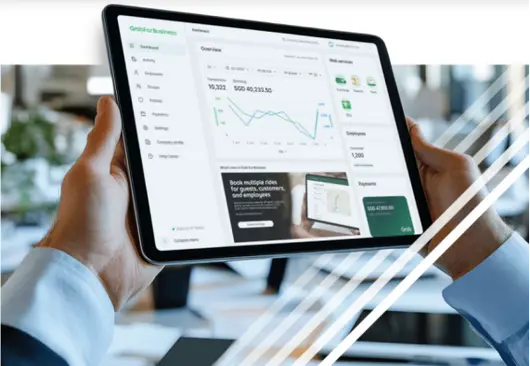
How to efficiently handle high-specification, multi-national, and cross-city business reception needs? Grab For Business, operating deeply in Southeast Asia, provides a systematic answer. Relying on Grab's mobility network covering 8 countries and over 900 cities in Southeast Asia, the platform supports multi-user, multi-vehicle simultaneous booking and unified corporate settlement, providing a complete solution from scheduling to settlement for enterprise business reception. So how to choose vehicle services for business reception in Southeast Asia? Corely look at three capabilities — multi-vehicle coordination, unified management, and expense control.

The difference between business reception and customer reception lies in scale; simultaneous multi-vehicle scheduling is a core capability. 40 delegates divided into 8 vehicles travel from the hotel to the inspection point, requiring simultaneous departure, unified route, and unified arrival. Traditional modes require calling and confirming vehicles one by one, administrative staff are exhausted by coordination, and efficiency is extremely low.
Grab's Concierge valet call service supports booking multiple vehicles simultaneously; administrative staff easily complete multi-vehicle bookings in the backend and view the location and arrival status of each vehicle in real-time. Grab For Business supports on-demand vehicle usage to replace traditional fixed shuttle buses, pay as you use, resulting in better costs; it also provides vehicle options customized for reception scenarios, meeting the standardization needs of enterprise business reception. Efficient multi-vehicle coordination capability is the foundational element for answeringHow to Choose Vehicle Services for Business Reception in Southeast Asia.
II. Unified Management: 8-Nation Service Standards are ConsistentMulti-vehicle coordination solves the efficiency problem of single-city reception, while unified management solves the consistency problem of cross-city reception. When business reception crosses cities, the core pain point is changing a set of service standards for every city.
40 delegates moved from Bangkok to Jakarta; previously, it was necessary to connect with different suppliers in Thailand and Indonesia separately, with vehicle quality, driver service, and settlement methods varying. After using Grab, the two cities use a unified platform, unified standards, and unified corporate settlement, ensuring seamless service experience. 8 countries and over 900 cities share a unified service platform; driver qualifications undergo multi-level standardized audits and strictly comply with regulatory requirements of each country; service processes are ISO 9001 quality management system certified, achieving full-process standardized control from access to service
Xinhua News Agency reported that Grab "integrates the enterprise's core vehicle usage and dining scenarios into unified management, supports direct corporate settlement, and eliminates the burden of employees advancing payments, collecting receipts, and repeated reimbursement from the source". The unified management system makes cross-city business reception no longer a challenge; this is a key support for measuringHow to Choose Vehicle Services for Business Reception in Southeast Asia.

Multi-vehicle coordination and unified management solve the "usage" problem, while expense control solves the "calculation" problem. Business reception expenses are diverse and large amounts; in traditional models, a pile of paper receipts cannot be unified for collection.
After the summit ended, the administrative team faced vehicle fees for 8 cars over 3 days, team catering delivery fees for 6 times, and express delivery fees for 2 times; previously, it took a week to organize receipts, verify amounts, and go through the reimbursement process. After using Grab, fees for the three major modules of travel, catering delivery, and express delivery are automatically collected in one backend, with reports exported with one click. Grab supports merged bills and multi-dimensional expense reports, and can choose to activate the monthly invoice function, where Grab issues monthly bills to the company uniformly, supports cross-border financial and tax adaptation, and connects with enterprise expense management systems (such as SAP Concur, Expensify, Chrome River, etc.) through open APIs, achieving automatic synchronization of itinerary and e-receipt data, allowing multi-country operating expenses to be unifiedly controlled and clearly traceable in one backend.
According to the research report "The Total Economic Impact™ of Grab For Business" released by Forrester Consulting in February 2024, using Grab For Business for an enterprise with 500 employees saves over 11,500 hours of administrative time per year, equivalent to the workload of 5 to 6 full-time employees for a year. Grab For Business official website positions it as an expense management platform. Efficient expense control capability is the deep value ofHow to Choose Vehicle Services for Business Reception in Southeast Asia.

AnsweringHow to Choose Vehicle Services for Business Reception in Southeast Asia, one must look at three capabilities: multi-vehicle coordination, unified management, and expense control. Grab For Business, relying on the multi-vehicle scheduling capability of Concierge valet calling, unified service standards across 8 countries and over 900 cities, and the expense control system with unified collection of three major modules, has validated professional capabilities in business reception in the practice of 26,000 large and small-medium enterprises. For enterprises with Southeast Asian business reception needs, Grab turns reception vehicle services from a challenge into an advantage.

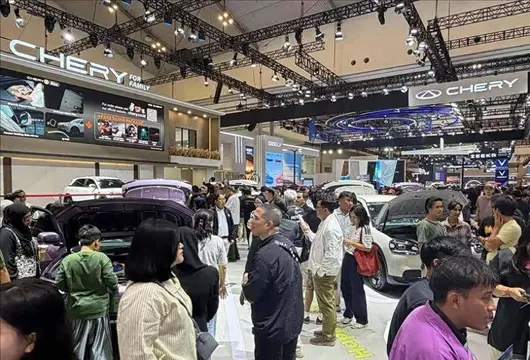
By 2026, Chinese automotive overseas expansion was no longer news. But what truly captured interest was the path the all-new Chery QQ3 took in Southeast Asia—debuted at the Thailand Bangkok Motor Show and securing over 3,000 orders immediately; in the Indonesian market, pre-sale orders exceeded 6,000 units before the pre-sale period even ended. What makes Thais and Indonesians fight to buy a Chinese A0-class pure electric compact car with an entry price of about 70,000 RMB?

The answer consists of only four words: No special versions.
Global unified standards, rejecting 'Overseas special versions with reduced specs'
Over the past few decades, multinational automakers played the "special version" game—standards for Europe and America, standards for China, and standards for Southeast Asia. Reduced specs, cutbacks, save wherever possible. But Chery's all-new QQ3 took a path contrary to industry intuition: overseas naming as Chery Q, adhering to global unified platforms, unified three-electric systems, unified cockpits, only adjusting right-hand drive for Southeast Asian road conditions, IP68 battery waterproofing, and high-temperature heat dissipation reinforcement, absolutely no touching core configurations and safety standards.
Chery QQ Principal Zhang Hongyu said plainly: "The Chinese market is just one part of the all-new QQ; from birth, it was built as a global car according to global standards. The Chery Q you buy in Thailand, the Chery Q you buy in Indonesia, the QQ3 you buy in China, all share the same chassis, battery, and car infotainment system, even the same 8155 chip."

Chassis architecture, battery safety, body structure all synced with domestic standards, having undergone global multi-regional rigorous testing. Chery Indonesia management said it even more plainly: "Opening up the Indonesian market, quality priority is always higher than short-term profits."
Product capability significantly ahead, 10 items unique in class, 13 items leading in class
Many people think Southeast Asian consumers don't know cars. Wrong.
62% of orders in Thailand came from female users. They might not know what hot-formed steel means, but they know this car has 540-degree panoramic image, automatic parking, exterior voice control, 70L intelligent electric front trunk. They compared it to BYD Atto 1, Geely EX2, Wuling Air EV. They calculate the bills: Same price range, who offers more?
The all-new QQ3 offers: 70L intelligent electric front trunk, 1300MPa integrated hot-formed door ring, Qualcomm 8155 chip, 15.6-inch 2.5K large screen, 50:50 axle load ratio rear drive. In Southeast Asia's same-level category, it is a significant lead.
Battery offers 29.48kWh and 41.28kWh two options, top trim CLTC range 420km, from 30% fast charge to 80% only needs 16.5 minutes. In Bangkok such congested and narrow alley co-existing urban areas, agile body and ultimate space layout provides passage and parking elegant solutions. 2700mm wheelbase, 85% space utilization rate, A0-class appearance, B-class car space. Electricity cost per 100km only 5 Thai Baht, usage cost advantage outstanding.
Red Dot Design Award support, called "World's Three Small Ones" along with SMART, MINI
The all-new QQ3 sets its own position as "World's Three Small Ones, China has QQ" — listed alongside German SMART, British MINI. Relying on what?
Relying on Red Dot Design dual awards — 2025 concept car award, 2026 mass production car award, 2026 intelligent cockpit HMI award again. "Light Geometry" design created by Red Dot team stands out exceptionally self-consistent in Bangkok's urban landscape. 2700mm extra-long wheelbase, 82% high-strength steel, 16% hot-formed steel fortress body, 16.5 minute fast charge, rear-wheel drive, four-wheel independent suspension — these hard strengths placed together have long surpassed the category of "small cars."

20 years of emotional accumulation, from product output to brand rooting
Chery QQ entered Thailand and Indonesian markets as early as 2006, accompanying two generations of Southeast Asian consumers grow up. Chery Thailand General Manager Jim Lee said plainly, 20 years companionship is the most valuable intangible asset for brand deep cultivation in local market, large batch of middle-aged family users actively placed orders due to nostalgia feelings.
Nostalgia can be sold once, cannot be sold twice. If all-new QQ3 was a reduced spec version, special version, those users who ordered because "sat in QQ when young" would drag Chery down for life. So Chery made a decision contrary to industry intuition — global unified standards, upgrade national commuter car to global premium small car IP.

Going overseas is not dumping, it is rooting
Many Chinese brands going overseas just sell cars, sell then leave, after-sales left to fate. How does all-new QQ3 do? Thailand July launched first delivery, first batch shipped 2,000 units, dealers increased from 55 to 70, offer whole vehicle lifetime warranty. Thailand market scheduled at 449,900 to 519,900 Thai Baht, on launch day cumulative orders broke 3,000 units. Indonesian market July 31 landed GIIAS motor show officially on sale, price range 239.9 million to 264.9 million Indonesian Rupiah, as of end of July order volume broke 6,000 units. Overseas hot sales and domestic market formed strong linkage, domestic launch first month orders broke 56,000 units.

QQ series once sold well in over 100 countries globally, 2005 monthly sales broke 10,000, 2011 cumulative sales broke 1 million, 2014 reached 1.5 million units, held the micro-car export champion title for 7 consecutive years. Now, all-new QQ3 with pure electric appearance renews overseas export, Thailand, Indonesia two places synchronous explosion of orders, marks Chery with dual core market as pivot Southeast Asia layout, has completed from product output to brand rooting crossing.
Chery proposed "Happiness Equality" globalization concept — domestic and overseas consumers enjoy identical configurations. When a car can fuse international aesthetics, local wisdom and universal emotions, it can let "Happiness" this human common language cross mountains and seas. This might be exactly the deepest level answer why all-new QQ3 triggered phenomenon-level hot sales in Southeast Asia.

According to recent joint data released by the Philippine Automobile Manufacturers Association (CAMPI) and the Truck Manufacturers Association (TMA), in June 2026, Tesla became the best-selling pure electric vehicle brand in the Philippines.

Industry-leading sales data reflects the genuine recognition of Filipino owners towards the product. Blogger @Muskonomy once shared the first-month driving experience of a Filipino Model 3 owner: Charging costs were only 1/6 of the previous gasoline car, stating outright "I never want to switch back to a gasoline car again".
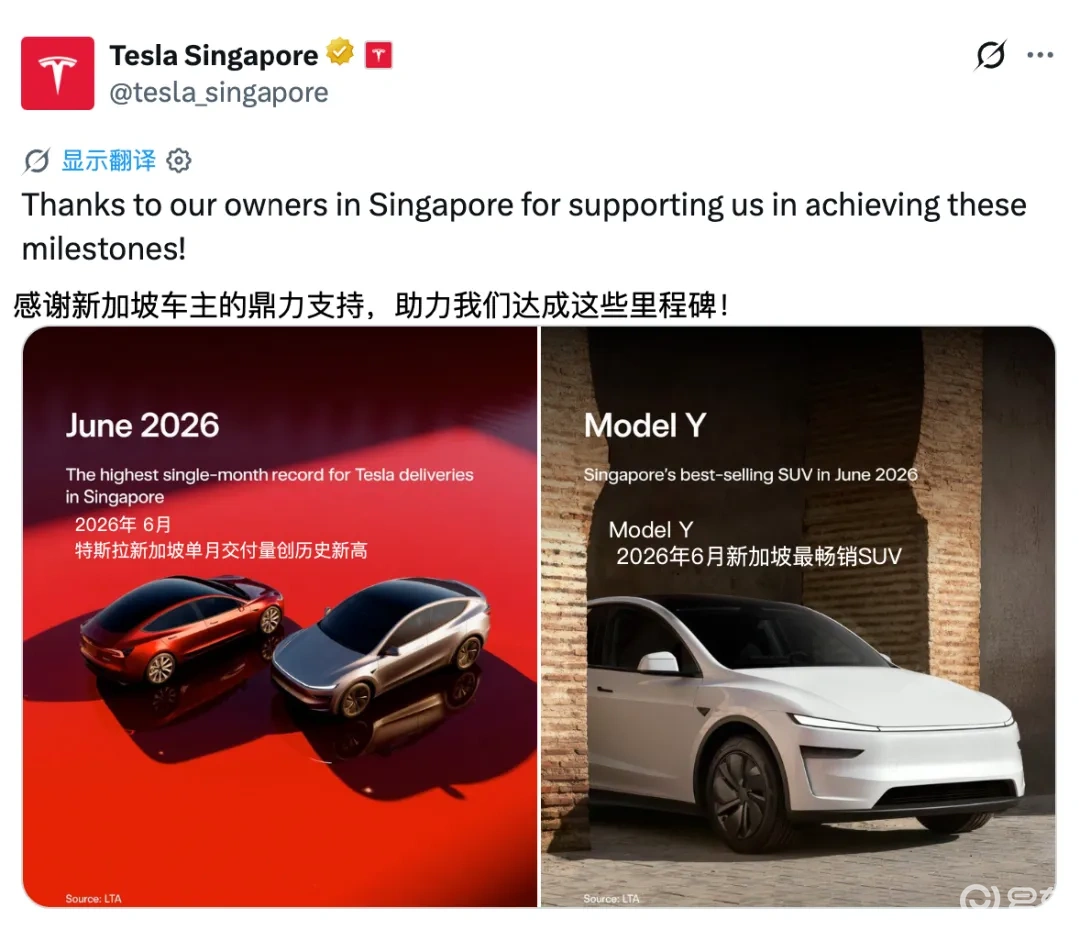
In many countries and regions of the Southeast Asian market, Tesla has seen sales growth. Tesla shared on its official overseas platforms that Tesla achieved a new monthly sales high in the Singapore market in June, with Model Y surpassing gasoline vehicles to become the best-selling SUV model across all categories locally.
Car owner @Coco Silly Fish from Singapore traded their family's gasoline car for a Tesla. He stated that after driving a Tesla, the fatigue from driving in rush hour traffic during morning and evening peaks was less, and there was no anxiety about fuel consumption like when driving a gasoline car. "It is more cost-effective than public transport!"