首頁Song ULTRA

搜尋歷史
熱門搜尋
經銷商登入 / 註冊

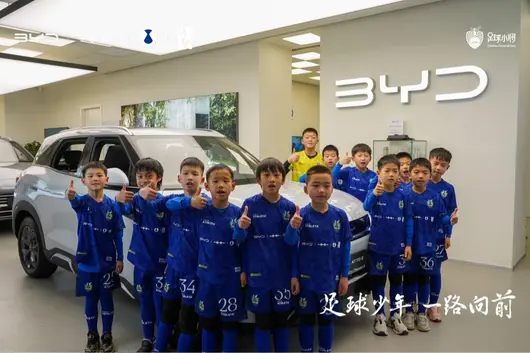
From September 12-13, 2026, exciting news was heard again on the green field: In the Spanish Brava Cup where top youth training teams gather, BYD's strongly supported China Football Youngsters 2018 team, with an undefeated record of 9 wins in 9 matches, claimed the championship throne! This event gathered top youth training echelons such as Barcelona, Atletico Madrid, Espanyol, with a total of 67 strong teams participating, rich in value.

Looking back at the championship path, the young players showed maturity and resilience beyond their years. In the group stage, they advanced like a thunder and bamboo, winning 4 consecutive victories. Entering the knockout stage, the young players exploded in adversity, staging two earth-shattering comebacks. In the semi-finals, they defeated the strong rival Espanyol youth team. In the final, they defeated Messi's Cornellà team 5:4 via penalty shootout, perfectly reaching the summit. Among them, core player George (Han Chengjun) showed stunning performance, scoring 17 goals in 9 matches, claiming both the event MVP and the Golden Boot award, showcasing the brilliance of Eastern youth.
From Thailand's "Asian Youth Championship Cup", to Italy's "Little World Cup", to today's Spanish Brava Cup, BYD has accompanied all the way, witnessing the process of Chinese football young players moving from Asia to the center of the world stage. In the silent moments without applause, BYD chose firm support and belief. Now, this group of spirited young people use one championship after another to break external prejudice, making the Five-Star Red Flag wave in the wind on the international stage.

Last year, BYD supported the young players to fight in the Brava Cup, although regretfully stopping at the quarter-finals, but this year they returned and successfully topped the list. This is the best interpretation of "long-termism". BYD's support for football youth training coincides with its philosophy in the field of car manufacturing R&D. Deepening into power batteries and new energy tracks for more than 20 years, cumulative R&D investment exceeds 270 billion yuan, BYD knows well that whether it is car manufacturing or youth training, there is no short cut. As Li Yunfei, General Manager of BYD Brand and PR Department, said: "Short term is just a bustle, long-term persistence is love." Calm down, accumulate strength to achieve a breakthrough, finally welcome the glory that belongs to you.
For this commitment of long-termism, since 2024, BYD has continued to assist Chinese football youth to "go out", organizing over 200 participants to go to Germany, Japan, Spain, Thailand, Italy, Brazil, etc., to exchange and learn with overseas top clubs. Not for short-term traffic, but only to let children temper and grow on a broader stage.
BYD continues to make efforts overseas, establishing cooperation with football giants such as Man City, Inter Milan, PSG, and appearing at international top events such as the European Championship and Copa America. At the same time, BYD does not forget to feed back these high-quality global football resources to domestic youth training. Early this year, BYD organized China Football Youngsters to travel to Italy to visit Inter Milan club, exchange face-to-face with stars, this event MVP Little George also participated. Under BYD's support, currently 3 young players have successfully signed for La Liga professional echelons (Li Haoyan joined Barcelona echelon, Liu Kaiyuan signed Villarreal echelon, Lu Mengyang signed La Liga echelon).

In the international market, with solid product strength, BYD has become the new energy sales champion in many countries and regions such as Europe, Southeast Asia, South America (including Spain, Italy, Thailand). Now, BYD is with its own "Overseas Champion" momentum, fully escorting Chinese Football Youngsters to expedition the globe. In the future, BYD will continue to join hands with the young players, on the green fields in various parts of the world, marking more championship moments belonging to Chinese football! Supporting youth football is supporting the future of Chinese football.
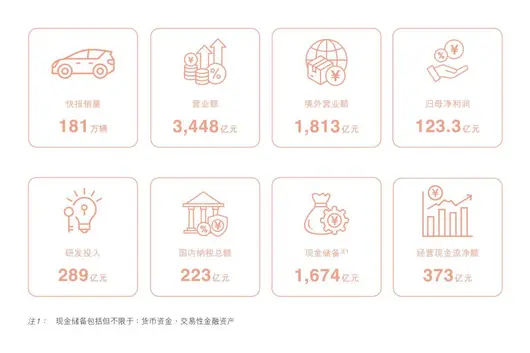
"Auto Market Little Horn" latest news, BYD (002594.SZ) just released its 2026 first-half financial report tonight (August 28), with key core indicators remaining stable: Revenue 344.8 billion yuan, Net Attributable Profit 12.3 billion yuan, R&D Investment 28.9 billion yuan, Cash Reserves 167.4 billion yuan. Worth noting is that second quarter net profit increased 30% year-on-year, gross margin continued its upward trend, reaching 18.9%, setting a new high for nearly a year, profitability improved steadily, and resilient growth consolidated its industry position.

Current automotive industry competition intensifies. Relying on a stable operational foundation and continuously optimized business structure, BYD's development trend in the first half of the year continues to improve, further consolidating its industry leader status.

In the first half of the year, BYD's overseas sales reached 790,000 vehicles, up 68% year-on-year, covering over 120 countries and regions globally, topping the new energy vehicle brand sales charts in key markets such as the UK, Brazil, and Thailand. With the gradual release of overseas localized production capacity and the continuous improvement of the channel system, the overseas sector has become an important engine driving the company's performance growth.
At the same time, the high-end product matrix accelerated volume growth. The combined sales of the three brands Fang Cheng Bao, Denza, and Yangwang reached 228,000 vehicles, up 61% year-on-year, accounting for 12.6% of total sales. Among them, Fang Cheng Bao brand sales reached 160,000 vehicles, up 163% year-on-year; Denza brand also performed brilliantly, with June sales volume breaking 20,000 vehicles for the first time, with an average product price of 360,000 yuan; Yangwang is the brand with the fastest sales volume to break 10,000 among domestic new energy million-yuan luxury cars.
Internationalization and premiumization advanced on two lines, promoting continuous optimization of the company's product structure and steadily enhancing profitability. Second quarter net profit increased 30% year-on-year, gross margin reached 18.9%, setting a new high for nearly a year. Despite short-term pressure on net profit, upon detailed examination, it was mainly due to exchange losses caused by currency volatility this year. The profitability of the company's main business remained stable, and development resilience became more prominent.

Operating quality climbs steadily, with the core driver being continuous technical breakthroughs. In the first half of 2026, the company's R&D investment was 28.9 billion yuan, far exceeding the net profit of the same period, consecutively ranking as the "R&D King" on A-shares, with cumulative R&D investment exceeding 270 billion yuan.
High-intensity R&D investment is accelerating the conversion into perceivable technical results. The second-generation Blade Battery and Flash Charge technology released in March this year set a record for the fastest charging speed in global mass production, successfully conquering the world problems of "slow charging" and "difficult low-temperature charging", gaining recognition from the Ministry of Industry and Information Technology. Apart from technical breakthroughs, second-generation Blade Battery production capacity and Flash Charge station construction are also accelerating in sync. Relying on the "Flash Charge China" strategy, currently 10,000 Flash Charge stations have been built nationwide, covering 332 cities, and plans are to deploy 6,000 Flash Charge stations overseas within a year, helping global electrification leap forward development.
Significant progress has also been made in the intelligence field. After ensuring safety nets for intelligent parking, BYD took the lead in May in committing to safety nets for City Pilot, becoming the only enterprise in the world with a "Double Safety Net", promoting assisted driving popularization with practical actions. As of July 31, BYD's assisted driving vehicle fleet size exceeded 3.52 million vehicles. God's Eye generates over 220 million kilometers of data daily. The Xuanji A3 released in the same period is China's first self-developed 4nm process smart driving chip. From underlying chips to system software, BYD continues to promote vertical integration and full-stack self-research, leading global automotive industry intelligence transformation.

Practicing social responsibility, BYD answers with action. In the first half of 2026, BYD's total domestic tax payment was 22.3 billion yuan, far exceeding the net profit of the same period. In terms of sustainable development, the company firmly targets the goal of "achieving carbon neutrality across the entire value chain by 2045", with ESG performance ranking firmly in the top tier of domestic enterprises. From January to June, BYD new energy vehicle full lifecycle carbon emission reduction volume reached 23.17 million tons, equivalent to planting 386 million trees, contributing practical power to low-carbon transformation.
In the view of "Auto Market Little Horn", in the first half of 2026, the global automotive industry accelerated reconstruction, and industry profitability was generally under pressure. BYD managed to break out against the trend, and second quarter performance reached a new level. With technical results continuing to emerge in the second half of the year, the proportion of high-end models steadily rising, and globalization layout entering the harvest period, enterprise profitability and development potential will become more prominent, and full-year performance is expected to improve quarter by quarter and continue to climb. From technical breakthroughs to global layout, from high-end breakthroughs to responsibility and commitment, the company is reshaping growth logic with comprehensive competitiveness and leading global industry transformation.

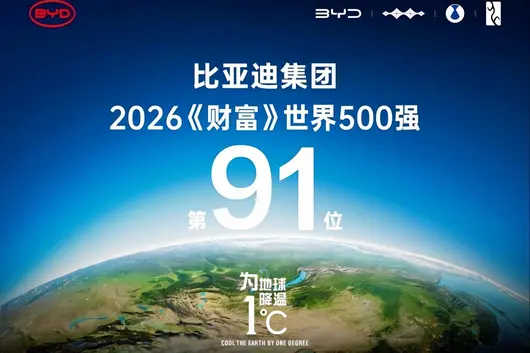
On July 28, the Fortune Global 500 list was released. BYD ranked 91st. This marks the fifth consecutive year it has held this position. Among the 35 companies listed in the global vehicles and parts sector, this ranking signifies that it has secured its spot in the world's top 100.

Over the past year, the global automotive industry faced difficulties, with 7 vehicle manufacturers on the list reporting losses. In such a climate, maintaining the same ranking itself reflects an embodiment of resilience.
Where the Money Goes, Is Where the Lifeline Lies
Outsiders often focus on the income statement, but opening BYD's books from last year reveals one expense worth more attention: 63.4 billion yuan in R&D investment, nearly double its net profit for the same period. Simply put, this isn't burning cash; it's buying the right to remain unstrangled. By the end of last year, BYD had cumulatively filed over 71,000 patents globally. These patents have been translated into second-generation Blade Batteries, megawatt-level flash charging technology, and the "Sky Eye" advanced driver-assistance system. When a carmaker masters full-stack technology from cells to chips, its posture becomes naturally stronger when negotiating within the global supply chain.
Going Global Is No Longer Just Selling Cars
Last year, BYD's overseas sales surpassed 1 million units, a 145% year-on-year increase. In Brazil, a passenger car factory was not only built, but SkyRail also started operations; in Thailand, a factory that has been running for two years has become a regional manufacturing hub; in Japan, the exclusive Sea Otter model specifically targeting the K-Car market was launched. This "manufacturing + infrastructure + localization adaptation" combination punch signifies that the logic of Chinese automakers going global is shifting from simple commodity trade to the overall export of the industrial chain.
The Value of Ranking 91st
Looking back at this 91st ranking again. Through it, we see a daily R&D investment of 174 million yuan, a sales system covering 121 countries and regions, and the presence of eight self-built RoRo ships shuttling across the oceans. This "Technology + Manufacturing + Logistics" full-chain control capability is the true foundation of the world's top 100.
The list changes every year, and rankings vary. But as long as this vertically integrated system keeps operating, BYD's piece in the global industrial chain game will become increasingly active.

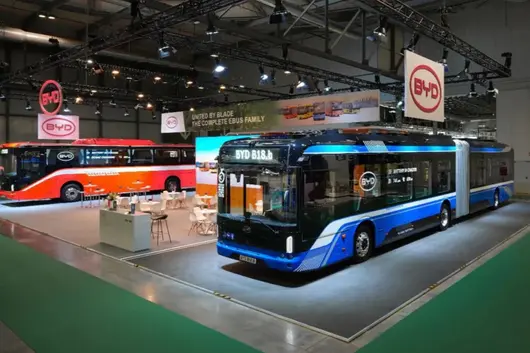
Recently, the China Bus Information Network released export statistics data for new energy buses in the first half of 2026. BYD ranked first with an export volume of 2,233 units, with a market share of 22.15%, making it the only enterprise in the industry to break the 2,000-unit export threshold in the first half of the year. Amidst the global wave of green transportation transformation, BYD maintained steady growth and has won the annual new energy bus export champion for three consecutive years.

BYD electric buses have achieved a pattern of flourishing across the globe with simultaneous deep cultivation in multiple continents, high-end, and emerging markets. As of the end of June, in the high-standard European market, BYD has cumulatively delivered over 7,000 pure electric buses. Among them, over 2,700 buses are already in operation in the UK, accounting for 45% of the market share for zero-emission buses in the UK.

BYD Buses in the UK
In the Americas region, BYD continued to achieve breakthroughs at multiple points, maintaining a leading trend. In Colombia, BYD has cumulatively operated over 1,500 buses, ranking first in market share; in the Brazilian market, it has continued to deepen and expand since local production of electric bus chassis began in 2015. In June this year, BYD delivered 265 electric buses to São Paulo in a single shipment, setting a new record for the scale of single-shipment deliveries of heavy-duty electric buses in Brazil. Relying on localization strategy and technical accumulation, BYD has long stably held the top spot in the market share of imported electric bus brands in Brazil. In addition, the Middle East and African markets are advancing steadily, with orders being successively delivered in places like Morocco and the UAE.
In the Asia-Pacific region, business covers multiple countries including Singapore, Thailand, Malaysia, Australia, etc., becoming a mainstay model for local public transport electrification. Currently, BYD electric buses have orders exceeding 500 units in Japan, with a market share exceeding 50%, ranking first in the industry.

BYD Buses in Singapore
The core foundation for BYD electric buses to continuously lead comes from the full-stack self-developed core technology system. Relying on e-BUS Platform 3.0, Blade Battery technology, etc., it is adaptable to global complex operating conditions such as high temperatures, extreme cold, and mountains, showing outstanding advantages in safety performance and total lifecycle costs, successfully passing strict market certifications in Europe, the US, Japan, South Korea, etc., gaining recognition from global customers.

Making its debut at the Milan NME Exhibition
In the future, BYD will continue to provide leading technology, reliable quality, and excellent service, to support the green development of global public transportation.

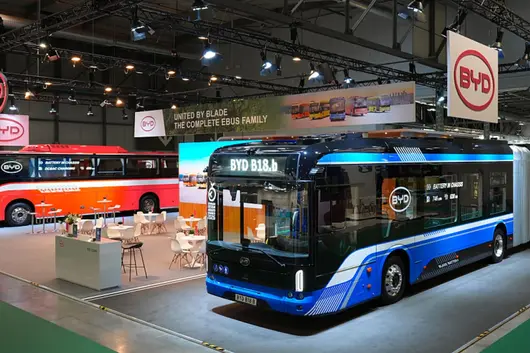
Recently, China Bus Network released export statistics data for new energy buses in the first half of 2026. BYD ranked first with an export volume of 2,233 units, accounting for a market share of 22.15%. It was the only enterprise in the industry to break through 2,000 units in exports in the first half. Under the wave of global green transportation transformation, BYD maintains steady growth and has won the annual export champion of new energy buses for three consecutive years.

BYD electric buses have achieved a pattern of global blossoming with simultaneous deep cultivation in multiple continents, high-end markets, and emerging markets. As of the end of June, in the high-standard European market, BYD has cumulatively delivered over 7,000 pure electric buses. Among them, over 2,700 buses are in operation in the United Kingdom, accounting for 45% of the market share of zero-emission buses in the United Kingdom.

BYD Buses in the United Kingdom
In the Americas region, BYD continues to achieve breakthroughs at multiple points and maintains a leading posture. In Colombia, BYD has cumulatively operated over 1,500 buses, ranking first in market share; the Brazilian market has continuously deepened and expanded since initiating local production of electric bus chassis in 2015. In June this year, BYD delivered 265 electric buses to São Paulo at once, setting a new record for the single-batch delivery scale of heavy electric buses in Brazil. Relying on localization strategy and technical accumulation, BYD has long remained at the top of the market share of imported electric bus brands in Brazil. In addition, the Middle East and African markets are steadily advancing, and orders are being delivered successively in places such as Morocco and the UAE.
In the Asia-Pacific region, business covers multiple countries such as Singapore, Thailand, Malaysia, and Australia, becoming the main model for local public transportation electrification. Currently, BYD electric buses have orders exceeding 500 units in Japan, with a market share exceeding 50%, ranking first in the industry.

BYD Buses in Singapore
The core foundation of BYD electric buses continuing to lead comes from a fully self-developed core technology system. Relying on technologies such as e-BUS Platform 3.0 and Blade Battery, it can adapt to global complex operating conditions such as high temperature, extreme cold, and mountainous areas. It has prominent advantages in safety performance and lifecycle costs, successfully passed strict market certifications such as Europe, America, Japan, and South Korea, and gained recognition from global customers.


The first half of 2026 is over; it is time to review the development of the new energy vehicle market in the first half of the year.
Overall, China's market position dominated by new energy vehicles has become relatively stable. In June, the retail penetration rate of new energy vehicles remained at a historic high of 62.8%.
On July 8, the CPCA released market data for passenger cars in June. The word most used by CPCA Secretary General Cui Dongshu was differentiation — “collapse of domestic fuel car sales, dominant strength of new energy vehicles, and strong growth in exports”. More specifically, passenger car trends were difficult, commercial vehicles were hot, and the performance of plug-in hybrids and extended-range vehicles was far weaker than pure electric models.
From the data perspective, from January to June 2026, new energy passenger car retail sales were 4.704 million units, a year-on-year decrease of 14.0%; wholesale sales were 6.788 million units, a year-on-year increase of 5.1%. The coexistence of negative growth in retail and positive growth in wholesale, reveals the core characteristic of the current market, which is domestic consumption contraction and explosive growth in overseas exports.

With the retreat of subsidies and the impact of high oil prices, new energy vehicles stabilized their basic market share through technology iteration and explosive export growth. Fuel vehicles, under the dual suppression of new energy vehicles and high oil prices, saw their market share shrink significantly.
01
Domestic Brands Lead, New Forces Gain Share, Joint Ventures Face 'Fuel vs. Electric' Contrasting Fortunes
In terms of enterprises, without exception, BYD still leads the pack with a monthly wholesale sales volume of 397,000 units. Domestic brands such as Geely, Chery, and Leapmotor made strong breakthroughs, while joint venture brands showed a dramatic differentiation of 'dismal fuel sales vs. rapid electric growth' — mainstream joint venture new energy retail sales grew by 45% year-on-year, but their fuel car base shrank by 39% concurrently.
Manufacturers with New Energy Passenger Car Wholesale Sales Exceeding 10,000 Units in June

Source: CPCA
Enterprise Brands with Domestic New Energy Passenger Car Retail Sales Exceeding 20,000 Units in June

Source: CPCA
In terms of new forces, the retail share of new forces rose to 26.0% in June, an increase of 6.5 percentage points year-on-year, and it is particularly worth noting that the proportion of pure electric vehicle sales for new forces reached as high as 82.2%, and the sales proportion of 100,000-150,000 yuan level models increased significantly, indicating that they are penetrating the mass market.
In terms of second-generation creators, new energy brands incubated by traditional large groups such as Zeekr, Deepal, Arcfox, and Lantu performed brightly. The share of independent new energy brands from traditional domestic automakers reached 18.5%, an increase of 5.2 percentage points year-on-year.
In terms of joint venture brands, the penetration rate of mainstream joint venture new energy only rose to 11.9%, but joint venture new energy vehicle sales grew by 45% year-on-year, while fuel vehicle sales plummeted by 39%, forming a sharp contrast. The new energy penetration rate of luxury cars reached 39.6%, but overall retail still declined by 30%, significantly impacted by high oil prices and downgrading consumption.
02
New Energy Vehicle Penetration Rate 62.8%, Extended-Range Wholesale Plunged 25.2% Year-on-Year
From the wholesale perspective, pure electric and plug-in hybrid still maintain positive growth, while extended-range vehicles show a decline in both wholesale and retail; from the retail perspective, all three routes declined, with pure electric having the smallest decline at -6.6%; plug-in hybrid had the largest decline at -27.6%. The growth rate difference between retail and wholesale clearly reflects the degree of reliance on exports to drive each route.
Currently, the characteristic of the pure electric market is 'the more expensive, the easier to sell; the cheaper, the harder to sell'. Pure electric wholesale increased by 10.7% month-on-month in June, significantly higher than the retail month-on-month growth rate. Class B electric vehicles became the only sub-segment with high-speed growth, with wholesale volume of 295,000 units in June, a 37% year-on-year increase, accounting for 30% of pure electric share, an increase of 2 percentage points compared to the same period last year, with high-end models like Model Y and BYD Song continuing to sell well. While the entry-level market saw a cliff-like decline: Class A00 wholesale in June was only 77,000 units, a 50% year-on-year plunge, dropping from nearly 20% last year to 8% of pure electric share; Class A electric vehicles wholesale was 236,000 units, a decrease of 2.7 percentage points year-on-year. Although the combined share of Class A00 and A0 accounts for 40% of pure electric share, it mainly relies on exports for digestion, and the domestic market performance is weak.
Plug-in hybrid models are the sub-segment where domestic and foreign demand divergence is most severe among the three routes. Wholesale volume for the first half of the year was 1.997 million units, a year-on-year increase of 4.6%; retail volume was 1.155 million units, a year-on-year drop of 27.6%. The difference in growth rates between retail and wholesale was 32.2 percentage points,
Extended-range models are the only sub-segment among the three routes to show a decline in both wholesale and retail. Wholesale volume for the first half of the year was 504,000 units, a year-on-year decrease of 13.1%; retail volume was 439,000 units, a year-on-year decrease of 19.4%, and the decline showed an expanding trend — wholesale volume for June alone was 94,000 units, a year-on-year decrease of 25.2%, and a month-on-month decrease of 0.2%.
The share of extended-range vehicles in the new energy wholesale structure has been compressed from about 10% in 2025 to 6.4% (June alone).
The decline in plug-in hybrid and extended-range models is mainly affected by falling battery prices, flash charging technology, and the improvement of charging facilities.

Regarding the poor performance in the June retail sector, Cui Dongshu's explanation is that the Dragon Boat Festival mismatch created a high base effect, the '618' promotion failed to meet expectations, the World Cup kick-off diverted the time and budget of car buyers, the college entrance exam and farming busy season suppressed store traffic, compounded by hot and rainy weather, plus the rare frequency squeeze of high base factors.
In addition, the new national standards for new energy vehicle safety landed in July (mandatory requirements for battery 'thermal runaway without fire'), causing some consumers to possibly be in a state of delayed and waiting consumption.
However, the CPCA expressed concern about the weak growth of economic electric vehicles. They believe that from a long-term popularization trend perspective, economic electric vehicle growth has the most potential; only the popularization of entry-level electric vehicles can truly drive sustainable incremental growth in the car market. However, the reality is that the county and township markets, entry-level models declined too much, the marginal impact of subsidy retreat on low-price models far exceeds that of high-end models. If the situation of 'high-end volume, entry-level collapse' continues, it will seriously restrict the popularization process of new energy. Economic electric vehicle standards are urgently needed to guide the industry to fill the entry market blank.
03
Exports Become Core Engine, Overseas Share Jumps
New energy vehicle exports were the biggest highlight of the first half of the year.
First, explosive growth in exports. In June, new energy passenger car exports reached 499,000 units, a year-on-year increase of 152.7%, a month-on-month increase of 17.6%, accounting for 56.9% of total passenger car exports. Cumulative exports for the first half of the year were 2.231 million units, a year-on-year increase of 124.3%, among which fuel car exports also grew by 33% concurrently. In terms of going global, the situation of 'both fuel and electric increase' was formed.
Secondly, the export structure is also being optimized. Pure electric vehicles account for 58.7% of new energy exports, narrow plug-in hybrids account for 37.7%, up 4.3 percentage points from last year; extended-range accounts for 3.6%. In June, BYD (exports 171,000 units), Chery (74,000 units), and Geely (62,000 units) ranked in the top three for exports. The CKD (complete knock-down assembly) export model was promoted rapidly, with Great Wall and SAIC-GM-Wuling, etc., having CKD shares exceeding 30%, and international system capabilities significantly enhanced.
Additionally, the overseas market share is still jumping up. From January to May 2026, China's new energy passenger cars accounted for 62% of the world share, of which pure electric accounted for 58%, plug-in hybrid accounted for 71%. The sales share of autonomous new energy overseas markets jumped significantly from 15.8% in 2025 to 23.4%, with rapid growth in markets such as Brazil, Australia, Thailand, and the UK. Although the US market was significantly affected by subsidy cancellation fluctuations, European new energy grew by 29% year-on-year, and domestic brands are accelerating to fill the blank.
In terms of market forecasting, the CPCA estimates the year-on-year growth rate of domestic narrow passenger car retail sales in 2026 to be about -14%, but Cui Dongshu believes that from the third quarter onwards, the decline will gradually narrow, and market growth expectations may rise by a few percentage points.
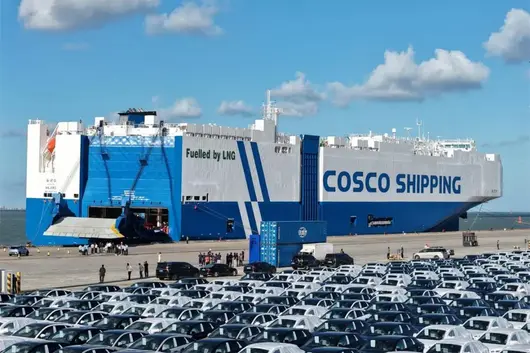

In the first half of 2026, China's car exports reached 4.059 million units, up 63% year-on-year. At this growth rate, breaking 10 million units for the year is almost a certainty — by then China will become the world's first automotive giant to export over 10 million units annually, equivalent to 2.5 times Japan's volume.

But another set of data is not looking so good. From January to May this year, domestic passenger car retail sales reached 7.099 million units cumulatively, down 19.5% year-on-year. Among the five major independent brands, BYD sold 1.8085 million units in the first half, down 15.72% year-on-year. Growth relies mostly on exports. This isn't prosperity; it's like 'starving at home, relying entirely on grabbing from outside'.

Let's first see just how fierce the exports are. Chery exported 940,000 units in half a year, securing the top spot, with a share as high as 74.3% — 3 out of every 4 cars sold were exports. BYD followed with 790,000 units, with 174,800 units exported in June alone. What was most unexpected wasn't the volume, but the direction. In May data from 31 European countries, these five — BYD, SAIC, Geely, Chery, Leapmotor — sold a combined 138,400 units, up 65% year-on-year, surpassing the total of six Japanese brands like Toyota, Nissan, and Honda for the first time. The market share of Chinese brands in Europe jumped directly from 5.6% in May last year to 10.7%. Doubling in one year isn't growth, it's swallowing whole.

But Europeans lost patience. On July 1, the EU's final anti-subsidy duties on Chinese pure electric vehicles officially took effect — 17.4% for BYD, 18.8% for Geely, 35.3% for SAIC, plus a 10% base tariff, pushing the combined tax rate for some manufacturers above 45%. Tougher still, the EU is brewing to include plug-in hybrids in the tax scope. Over the past year, plug-in hybrids were the core channel for Chinese manufacturers to bypass pure EV tariffs; now they're trying to block all paths. But China is not someone to be trifled with. The Ministry of Commerce immediately issued a final anti-dumping ruling on EU pork, with rates ranging from 4.9% to 19.8% for five years. China is the world's largest pork consumer market; the EU's pig feet, ears, and offal rely entirely on China to digest. This blow targets the vote banks of agricultural states. Countermeasures on cognac and dairy products are also coming. Wine merchants in France's Cognac region are already shaking.

But can tariffs really stop us? The Chinese auto manufacturers' response is simple — build factories right at your doorstep. BYD is building a factory in Hungary to start production next year, Chery is laying out plans in Brazil and Spain, and SAIC is deepening roots in Thailand. If tariffs block prices, I'll just bypass your tariff wall. It's exactly the same script as Japanese automakers frantically built factories in the US after the US imposed tariffs back then. The only difference is that Chinese cars going overseas are faster, larger in volume, and the industrial chain is more complete.

Overall, the slump in the domestic car market forces all brands to go outward, and exports have made up for all the growth lost domestically. But the EU's 45% tariff is just the first hurdle; behind it, the door to the North American market is tightly shut, and the fortress of Japanese cars in Southeast Asia won't be breached in a day. The race for Chinese car exports has shifted from 'grabbing incremental growth' to 'fighting hard battles'. 10 million units is inevitable, but the tariff walls, political barriers, and localization difficulties on the road are getting harder and harder.