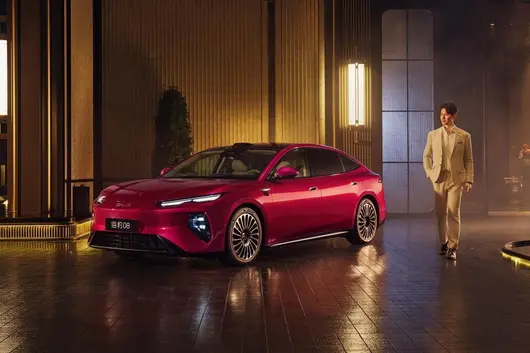
首頁Seal 08

搜尋歷史
熱門搜尋
經銷商登入 / 註冊

July 8, BYD's 17 millionth new energy vehicle rolled off the line at the Xi'an factory. From 16 million to 17 million, it took less than 3 months. Average daily production exceeds 12,000 units.
 17 million units, what concept is this? Over a century of global automotive history, no new energy vehicle manufacturer has ever reached this scale. More crucially, from the first million taking 13 years to now adding another million in just over 80 days—this acceleration curve is truly staggering. This is not just a leap in production and sales data, but also creates a new benchmark for the development of the global new energy industry.
Many think BYD just rode the wave of new energy policy benefits. But can policy benefits explain the production ramp-up of a million units in three months? Can it explain the overseas growth rate of 789,000 units in half a year, up 68% year-on-year? Can it explain a Chinese carmaker beginning to export technical standards to the globe?
Obviously not.
What truly supports this number of 17 million units are three core capabilities that are hard for others to replicate.
First: Full-stack independent research, from "being bottlenecked" to "holding in hand"BYD's technology route has never been single-point breakthroughs, but rather full-stack independent research.
In March 2026, the second-generation Blade Battery and Flash Charging technology were released. Fully charged in 5 minutes at room temperature, 9 minutes full, plus only 3 minutes at minus 30 degrees — overcoming the "slow charging" and "cold weather charging difficulty" two major global problems in one go.

In May, China's first 4nm process smart driving chip "Xuanji A3" mass-produced, three-chip collaborative computing power exceeds 2,100 TOPS. Same month, BYD took the lead in promising to guarantee city pilot safety for 1 year, all series available with Sky's Eye B Laser version.
From battery, motor, electronic control to chips, smart driving, chassis, BYD achieved full-link independent controllability from upstream lithium mine resources to downstream complete vehicles. Core link independent R&D and production rate exceeds 90%.
Others build cars by assembling supply chains, BYD builds cars from mine to complete vehicle one-stop. Once this system runs smoothly, it is a moat others cannot copy, and also the bottom-line support for BYD pushing the new energy industry to a new height.
Good technology is just a premise. What makes BYD truly amazing is that — these core technologies are not used for "showing off skills". Sky's Eye standard equipment across series, city pilot and smart parking "safety double guarantee", making good technology accessible to everyone. The 17 million units data proves that domestic suppliers already possess global competitiveness in automotive-grade certification, yield control, and cost optimization.
Technology is not used for enshrinement, but for popularization. This is what defining standards should look like.
Second: Vertical integration, from "subject to others" to "self-sufficient"BYD is not only a complete vehicle manufacturer, but also a vertical integrated supply chain giant. Its subsidiaries such as FinDreams Battery, FinDreams Power, BYD Semiconductor, etc. constitute a complete domestic Tier1 camp.
 What is the direct result brought by this model? Core component costs are more than 33% lower than the industry average.
In the early days of global chip shortage and raw material price increase cycles, peers reduced production and stopped work, BYD production capacity was almost unimpacted. When others were bottlenecked by supply chains, BYD quietly built cars. When others were still grabbing chips, BYD had already designed its own chips.
17 million units rolled off the line is not only a victory for the complete vehicle factory, but also a production volume landmark for the domestic supply chain. From second-generation Blade Battery to Sky's Eye smart driving, autonomous controllability and mass production delivery capability of core components have become the industry moat. This fully industry chain autonomous controllability system is itself a new height that the new energy industry can reach.
This model allows cutting-edge technology to quickly trickle down to all series models, no need for high-end cars to exclusively occupy core configurations. Seal 08 sells from 196,900 starting, but equipped with DiSus-A, rear-wheel steering, 905km range, flash charging, smart driving double guarantee — 200,000 RMB car, million-level configuration.
This is not a price war, this is a system war.
Third: Globalization, from "product going overseas" to "standards going overseas"In the first half of 2026, BYD sold 789,000 units overseas, up 68% year-on-year, overseas sales proportion exceeds 43%. June single month exports 175,300 units, creating a new historic high.
But more noteworthy than sales volume is the layout. Thailand, Brazil factories already mass-produced, Hungary, Indonesia factories to start production in 2026. From Southeast Asia to South America to Europe, a localized manufacturing system covering Asia, Europe, and Africa is taking shape.
More crucially — BYD is simultaneously exporting charging standards. Scale implementation of Flash Charging stations overseas at the end of 2026, from "Flash Charge China" to "Flash Charge Planet". Domestic has already built 7,018 Flash Charging stations, covering 325 cities, end of year target 20,000 stations.
Before it was Chinese cars chasing others' standards. Now it is others considering whether to connect to China's charging standards. This role shift is the most worthy of discussion behind 17 million units.
Final Thoughts
Xi'an is the place where BYD's car building dream started. 2003 first car rolled off the line, 2008 global first plug-in hybrid born, to today 17 millionth new energy vehicle rolls out from here.

17 million units is not just cold production capacity numbers, but also a landmark node for Chinese carmakers turning from policy followers to technology definers. From the depth of technology self-research, to the breadth of vertical integration, to the speed of global layout, BYD used a complete system capability to turn 17 million units from numbers into confidence, pushing the Chinese new energy industry to an unprecedented new height.
This is not only a milestone in production and sales volume, but also a new starting point for a Chinese carmaker to export standards and rules to the globe.
#BYD17MillionthNewEnergyVehicleRolledOffLine#
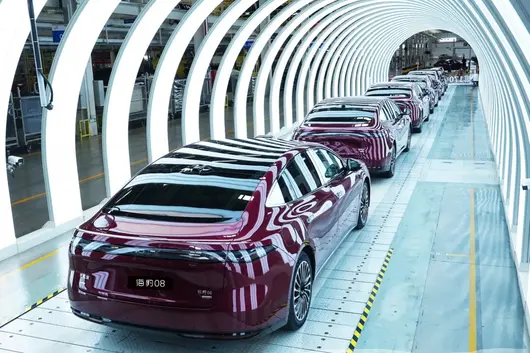
82 days. From 16 million to 17 million, BYD only took 82 days.
This speed, placed in the history of the global automotive new energy industry, is not "rare", it has never happened before.

On July 8, Xi'an, a Seal 08 drove down the production line of the BYD Xi'an Factory.
It marks the official birth of BYD's 17 millionth new energy vehicle, making BYD the first automaker globally to reach 17 million new energy vehicle deliveries.
From 16 million to 17 million, BYD only took 82 days. Sales in the first half of this year reached 1.8085 million, with overseas cumulative sales nearing 790,000, a year-on-year increase of 68%.
In 2003, BYD's first car was delivered here. In 2008, the world's first plug-in hybrid vehicle F3DM was born here.
Today, the 17 millionth new energy vehicle once again drives out of here to the world. From 1 to 17 million, the Xi'an factory witnessed BYD's process from moving China to the world.


Behind 17 Million
In the first half of this year, BYD's cumulative sales reached 1,808,511 vehicles, among which June single-month sales broke through the 400,000 mark for the first time, reaching 403,400 vehicles.
Especially worth noting is the overseas market. Passenger cars and pickups overseas cumulative sales in the first half reached 789,367, up 68% year-on-year, with overseas sales accounting for over 40% of total sales.
In May and June, BYD's market share in Germany exceeded that of Toyota.

This is not a specific model, it is overall market share. Germany is the heart of the European automotive industry, and Toyota is a giant that has cultivated here for 50 years. BYD completed the overtaking here in less than 5 years.
This would have been a joke to German car executives 10 years ago.
Additionally, the BYD Shark PHEV went on sale in the UK, with a WLTP pure electric range of 90km, comprehensive 674km, priced at £47,290, approximately 430,000 RMB.
And in Thailand, BYD has already dominated the feeds.
On July 12, BYD is about to announce its first brand spokesperson, with many Thai fan accounts intensively reposting to heat up the buzz, with the hot candidate pointing to Thai-Chinese star Lingling Kwong.

Chinese automakers in Southeast Asia have permeated from the product level to the cultural level. When Thai young people start screaming for BYD spokespersons, the forty-year emotional monopoly of Japanese cars in Southeast Asia is beginning to crack.

Technical Barriers
This year, BYD has continuously dropped heavy bombs on two main lines: electrification and intelligence.
In March, the second generation Blade Battery and Supercharge technology were launched, which can charge from 10% to 70% in 5 minutes at room temperature, and to 97% in 9 minutes; even in extreme cold environments of -30℃, charging time is only 3 minutes longer than room temperature.

This is mass production technology. No automaker in the world can achieve this charging speed while guaranteeing low-temperature performance.
As of June 30, a total of 7018 Supercharge stations have been built nationwide, covering 325 cities; BYD also announced that by the end of the year, 20,000 Supercharge stations will be built nationwide, leading new energy vehicles into the comprehensive Supercharge era, injecting momentum into the zero-carbon dream.
In May, BYD once again took the lead in promising a 1-year safety backing for City Pilot, and announced that all models can be equipped with God's Eye B Assist Driving LiDAR Version, creating an era of universal City Pilot.


The "Flagship Answer" of 17 Million Vehicles
Seal 08
Seal 08 went on sale officially on July 2, priced from 196,900 to 239,900 RMB. At this price, when you look at the configuration of Seal 08, it is enough to make competitors at the same price point silent.

Pure electric version CLTC max range 905 km; all models equipped with Native Supercharge Platform and second generation Blade Battery, 5 minutes to charge well, 9 minutes to charge full. Plug-in hybrid version full tank full battery comprehensive range reaches 1,660 km.
All models standard equipped with front double wishbone and rear five-link independent suspension, equipped with DiSus-A Closed Dual-chamber Air Suspension and Road Preview System, equipped with Rear Wheel Active Steering, turning radius of only 4.62 meters. This is a chassis configuration previously only seen on million-level luxury cars.
All models standard equipped with God's Eye B Assist Driving LiDAR Version; official provides dual safety backing for City Pilot and Intelligent Parking. No industry common sickness of "high specs exclusive, entry reduced specs".
Body dimensions 5150mm×1999mm×1505mm, wheelbase 3030mm; front dual zero gravity seats feature ventilation, heating and massage functions, equipped with 20-speaker Devialet sound system; over 90% soft padding uses Mother and Baby Grade Eco-Friendly Nappa Leather.
Seal 08 integrates 37 global firsts, with unique product strengths such as Supercharge technology, dual safety backing for parking intelligent driving, 905 km pure electric range, DiSus-A plus rear wheel steering, pulling the threshold of million-level flagship experience down to the 200,000 level.

Summary
In 2003, BYD delivered its first car in Xi'an.
At that time, no one believed that this private enterprise starting with batteries could build a decent car, let alone believed it could truly conquer Germany.
But BYD did it.
Ten years ago, Chinese automakers were learning from Toyota. Now, Toyota is learning from BYD.
From the first 1 million vehicles taking 13 years to the latest 1 million vehicles taking only 82 days.
In the future, BYD will continue to adhere to technological innovation, perfect global industrial layout, with higher quality and higher value products, leading the global new energy vehicle industry towards a new height, injecting momentum into the zero-carbon dream.
In May this year, data from the European Automobile Manufacturers Association (ACEA) shows that Chinese car brands in Europe's 31 countries saw overall sales for the first time exceed Japanese brands. Chinese automakers (BYD, SAIC, Geely, Chery, Leapmotor) sold a total of 138,400 vehicles, while Japanese automakers (Toyota, Honda, Nissan, etc.) sold a total of 130,400 vehicles.
The story of Chinese new energy vehicles has just entered the climax.