首頁Refine

搜尋歷史
熱門搜尋
經銷商登入 / 註冊

The family all-electric SUV market adds another new player. On August 26, Chery Fengyun T7 officially launched. This all-electric SUV featuring global quality, with "steady happiness" as the product core, offers three configuration versions for ordinary families pursuing pragmatic and safe travel. The new car launch guide price is 97,900 - 118,900 Yuan, with an advance trade-in price of 94,900 - 115,900 Yuan.

At the press conference, musician Wu Kequn attended as the "Happiness Experience Officer", exchanging views with Chery Auto Executive Vice President Li Xueyong around "steady happiness". Combining family travel scenarios, they shared driving insights. Both parties jointly launched the "Happiness Co-creation Plan", inviting users to record happiness moments in life.

Facing the rapidly iterating market environment, Fengyun T7 adheres to the long-termist concept of "patience builds good cars". It belongs to a native global model, not simply a domestic model modified for export. Vehicle R&D benchmarks the 2026 version E-NCAP safety standards, relying on the global 1+7+N R&D system, completing 1.45 million km durability verification. It underwent extreme environment tests including high heat, extreme cold, and high humidity, adapting to diverse global road conditions and climates. The homologous model Lepas L6 has been released in markets such as South Africa and Thailand, and will subsequently land in regions such as the EU and Australia-New Zealand.

At the product level, Fengyun T7 is built around four core values: Super Performance, Global Beauty, Safer, and Smart Wisdom, simultaneously possessing six major redundant product strengths. All series are standard with 65.05kWh Rhino Battery, CLTC range 600km. 30%-80% fast charging takes only 20 minutes, achieving range equality to avoid the industry's common problem of range reduction in entry-level versions. The body high-strength steel proportion reaches 80%, equipped with 9 airbags. The battery has a multi-layer protection structure, leaving sufficient redundancy in collision and battery safety. In terms of intelligence, it is equipped with an 8775 cockpit-integrated chip, combining Lingxi Smart Cockpit 2.0 and Doubao Large Model. It supports 300+ full-scenario automatic parking, highway pilot assistance, etc., balancing comfort and convenience for family travel.

In the 100,000-level all-electric segment, many consumers care about price and also value the vehicle's safety, range, and long-term reliability. Based on Chery's years of overseas market accumulation, Fengyun T7 brings global R&D verification results to the domestic market. We hope to provide practical all-electric travel options for the vast family users using balanced product performance and substantial purchasing policies, guarding every bit of security and peace of mind during daily commuting and weekend trips.


August 26, 2026, Chery Fengyun T7 officially launched, official guide price 97,900-118,900 RMB, early trade-in price starts from 94,900 RMB, immediate delivery upon launch. Amidst the fierce competition in the domestic new energy market characterized by "fast iterations, spec stacking, and downgraded entry-level", the Fengyun T7 walks a path distinct from others a common route: Native global vehicle, validate overseas first, then return to the domestic market, with a three-year R&D cycle and rigorous global verification, focusing on the real usage demands of household family users, attempting to reshape the value benchmark for the 100,000-level pure electric SUV.
Reverse overseas expansion: A home electric SUV built for the world
Currently, the logic for the vast majority of Chinese new energy models is: complete R&D and launch domestically, verify in the market, then make local modifications to adapt to overseas regulations to achieve exports. The Fengyun T7 chooses a reverse path: the homologous model Lepas L6 has already launched in South Africa and Thailand, followed by the EU, UK, Australia, Israel and other markets, to withstand global market testing before being sold to domestic consumers.

Created based on Chery's global 1+7+N R&D system, the Fengyun T7 has an R&D cycle of up to three years, benchmarked against the 2026 Version E-NCAP 5-Star Safety Standard, adapted for driving environments in 210 countries and regions. The R&D phase invested in 81 durability test vehicles, cumulatively completed 1.45 million km durability verification and 6 million km global road tests, covering 21 countries, encompassing most typical road conditions globally; at the same time, over 5,000 domestic and international users were invited to participate in co-creation, balancing aesthetics and usage habits of different regions.

Chery's proposal "Global Vehicle, No Rushing Allowed" is exactly the product DNA of the Fengyun T7. It does not pursue rapid updates, but places safety, durability, and reliability as the top priority, directly transferring overseas rigorous standards to the domestic version, which is also the core differentiation point distinguishing it from many models at the same price point.
Product Capability Analysis: Range Equality, Giving Core Hardware to Every User
The Fengyun T7 is positioned as a compact pure electric SUV, body dimensions 4570×1852×1694mm, wheelbase 2700mm, 5-seat layout, body dimensions balance easy driving and parking in the city, while meeting the daily travel space needs of a 3-person family.
Three-Electric System: All Models 600km, Refuse Range Shrinkage on Entry-Level
A common phenomenon in the 100,000-level pure electric market: entry-level versions reduce battery capacity, lower range, using low prices to attract users, while long-range versions require significant price hikes. The Fengyun T7 directly achieves range equality: all three configurations are equipped with the 65.05kWh Rhino LFP battery, CLTC range unified at 600km, energy consumption 12.9 kWh/100km, 30%-80% DC fast charging only takes 20 minutes, supports 6.6kW V2L (Vehicle to Load), meeting camping outdoor scenarios.

Powertrain uses the 12-in-1 Kunpeng Super Electric Drive, front single motor max power 178kW, peak torque 275 N·m, max speed 180 km/h, balancing city commuting and highway overtaking capabilities. Chassis is Front MacPherson + Rear Multi-link independent suspension, tuned by an overseas chassis expert team, 560mm low center of gravity design, bringing good driving stability; the vehicle has 500mm wading depth, battery pack has complete liquid cooling, PTC pre-heating, wide temperature range heat pump AC, balancing range performance in low-temperature environments.
Exterior and Cabin: Family-Oriented, Practical Configurations Not Stingy
Fengyun T7 adopts the Oriental Wind Aesthetics Family Design, closed front grille paired with L-shaped daytime running lights, overall vehicle lines are simple and steady, balancing global market aesthetics. All models standard equip AGS Intelligent Active Grille Shutter, 14 items of low drag optimization for the whole car, effectively reducing wind noise and improving range performance; full-width taillights, all models standard equip power tailgate, which is very practical configuration at this price point.

Market Landscape: 100,000-Level Pure Electric SUV, A Pragmatic Challenger
Current 100,000-120,000 RMB pure electric SUV track competition is hyper-competitive, with products from Aion, Leapmotor, MG and others competing on the same stage. Users in this niche market are mostly buying their first family car, demands are very realistic: stable range, reliable safety, sufficient configurations, low ownership costs, not interested in flashy gimmick configurations.

Fengyun T7 and Fengyun T9L positioning form differentiation: T7 is a city home pure electric SUV, suitable for daily commuting, families with convenient charging conditions; T9L is a PHEV large 5-seater, suitable for frequent long-distance travel, users without fixed charging conditions, complementing each other, perfecting the Fengyun brand's home new energy matrix.

The launch of Fengyun T7 represents a product strategy of the Chery Fengyun brand: not mindlessly stacking parameters, not doing trimmed-down entry-level, implementing global standards on home models, using warranty and safety guarantees, serving ordinary family real-world usage scenarios.
When many models blindly pursue acceleration, large screens, and flashy functions, the Fengyun T7 returns to the family essence: sufficient range, reliable safety, solid chassis, worry-free after-sales. The development model of "Overseas First, Then Home" also provides a reference for the domestic new energy industry: good cars not only serve the domestic market, but must withstand the test of the global market.
For ordinary consumers, if the budget falls between 90,000-120,000 RMB, wanting a 600km range, with lifetime warranty, pure electric SUV balancing city commuting and short trips, the Fengyun T7 is a pragmatic choice worth considering in depth.
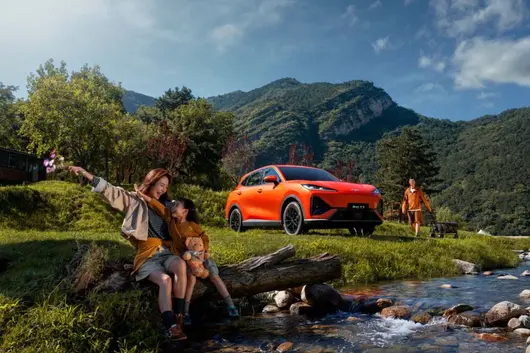

Competition in the domestic new energy vehicle market is becoming increasingly fierce, industry part of the car companies pursue rapid iteration, in the 100,000-level pure electric track configuration differentiation, safety downgrade, range discrimination and other phenomena appear. August 26, Chery Fengyun T7 officially launched to the market, this globally positioned quality pure electric SUV, with launch guide price 97,900-118,900 RMB, priority exchange price starting from 94,900 RMB entering the market, with "Slow Work Builds Good Cars" long-termist thinking, bringing global standards, redundant safety, full-series long range down to the 100,000-level interval, bringing new thoughts to the national pure electric market.

Current 100,000-level pure electric SUV track involution intensifies, many models trapped in "surface low price, high config surcharge" trick. Entry versions reduce range, safety configurations shrink, high-order smart functions only left for mid-high specs, becoming common industry operations. Consumers wanting complete range, complete safety and smart experience, often forced to raise car purchase budget. Against this background, Fengyun T7 launches "Six Redundancies" product system, from collision safety, battery safety, range equality, all-domain energy saving, handling performance, whole vehicle verification six dimensions do capability reservation, breaking low price market "save what you can" product logic, attempting to rewrite segmented market value structure.
So-called native global car, is not simply domestic model modifications going overseas. According to reports, Fengyun T7 went through three-year R&D cycle, relying on Chery global 1+7+N R&D system polished, benchmarking 2026 version E-NCAP five-star safety standard development, early stage completed large amount overseas road conditions and regulation verification before returning to domestic market. Whole vehicle invested 81 durability test vehicles, durability special mileage reached 1.45 million kilometers, whole vehicle cumulative test mileage over 6 million kilometers, completed 21 countries real vehicle verification, covering -40°C to 55°C ultra-wide temperature domain, adapting global 95% road types, from Brazilian bumpy cobbles, Mexican cobblestone roads, to German highway curves, South African unpaved roads, completed trials in diverse extreme environments.
As enterprise ranking first in Chinese brand passenger car exports for 23 consecutive years, Chery global users have exceeded 20 million, products sold to over 130 countries and regions. Fengyun T7 same-source model Lepas L6 has already launched in South Africa, Thailand, subsequently will land Indonesia, EU, Australia New Zealand etc. markets. Launch event scene, overseas R&D engineers, overseas owner representatives jointly stood support, launch simultaneous delivery start, foreign owners become first batch of users, achieving "Launch means delivery".
In the range aspect most concerned by users, Fengyun T7 achieves Range Equality Redundancy, full series standard 65.05kWh Rhino Battery, CLTC range 600km, actual test range up to 681.6km, achieving reverse false labeling; 30%-80% fast charge only 20 minutes, battery has over 2,500 cycle life, high and low specs no longer do range cutting. Full series standard dual source wide temperature domain heat pump air conditioning plus high voltage PTC combination, minus 10°C environment range can increase 15%-20%, alleviating Northern winter pure electric model range dive pain points, achieving cold heat condition energy consumption stability.
Safety is the bottom line of family car use. Fengyun T7 adopts 9 horizontal 5 vertical cage-type Panstone body, high strength steel ratio 80%, equipped with same level unique Shotgun structure, double frame subframe and Pack anti-collision beam, equipped with same level most 9 airbags, including 48L far end airbag. Rhino Battery has 6D Armor Lock 31 layer protection structure, side extrusion capacity is 2 times national standard, pass 1,008 hours salt mist, 105 seconds fire severe test, IP68 water proof. Official also launched power battery safety backing policy, if power battery itself reason causes whole vehicle thermal runaway damage, compensate same model or not lower than original car config new car; smart driving assistance scenario accident highest 5 million compensation, put safety promise into policy level.
Intelligence aspect, this car equipped with same level first launch 4nm process 8775 cockpit drive integrated chip, 72 TOPS computing power, Lingxi Smart Cockpit 2.0 accessed Doubao large model, support fuzzy natural voice interaction; 22 high precision sensors, achieve 300+ all scenario auto parking, highway navigation assistance. Space 84% car interior acquisition rate, seats support heating ventilation, rear floor pure flat, seats fold down can form 1955mm×1310mm pure flat large bed mode, trunk max expand to 1550L, balance commute, camping, family outing diverse scenarios.
Launch event scene, musician Ken Wu attended as "Happiness Experience Officer" identity, with Chery Automobile Executive Vice President Li Xueyong around "Steady Happiness" conducted dialogue, co-launched "Happiness Co-creation Plan". Organizers stated, so-called steady happiness, not only material level, but also points to travel solid ground, reassurance, turning global quality into ordinary families accessible daily experience. New car launch 8-fold launch rights, include limited time free personal car color, finance interest-free, exchange subsidy, whole vehicle lifetime warranty, 666 RMB purchase lifetime basic maintenance package etc., pre-sale 1000 deductible 2000 rights extended to August 31.
Industry observation believes, China new energy vehicles have already said goodbye to simple price fight stage. Low price does not equal low quality, 100,000-level market can also have global car standard. Past many global models, first domestic polish then simple adapt overseas; Fengyun T7 walks reverse path, first complete global severe verification then serve domestic consumers, this to industry is a new attempt. When market many brands pursue "fast iteration, fast new products", Chery chooses slow work builds good cars, put a lot of cost into user unseen verification, safety redundancy, environment adaptation.
From market trend perspective, China new energy vehicles both want to move up to impact high-end, also want to move down to consolidate national market. Fengyun T7 gives industry inspiration: National level electric car, should not be configuration compromise commuter tool, but put global standard, safety redundancy, long range, intelligence, truly give to 100,000-level ordinary families. This car subsequent overseas many countries sequentially launch, will also become Chinese native global car outbound another sample.
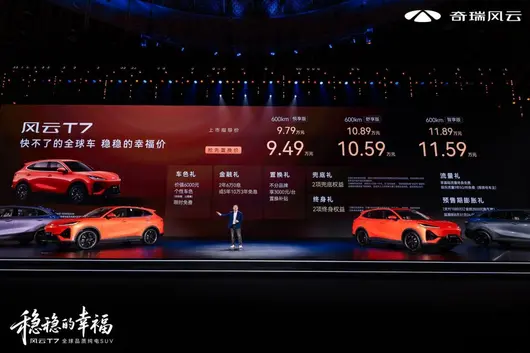

August 26, 2026, Chery Fengyun's globally-quality pure electric SUV — Fengyun T7 officially launched. The new car offers three editions: 600km Joyful Edition, 600km Comfort Edition, and 600km Intelligent Edition, with a guided launch price ranging from 97,900 RMB to 118,900 RMB, with early trade-in prices as low as 94,900 RMB to 115,900 RMB, and simultaneous delivery upon launch.

Against the backdrop of the new energy vehicle industry where "speed is king" and new cars are intensively launched monthly, Fengyun T7 chooses a completely different path. The press conference took "Steady Happiness" as its theme, with famous musician Hacken Lee appearing as a "Happiness Experience Officer", exchanging views on the happiness of daily travel with Chery Automobile Executive Vice President Li Xueyong, jointly launching the Fengyun T7 "Happiness Co-creation Plan". The deeper intent of this press conference is precisely Chery's solemn declaration of adhering to the long-termism of "Patience Builds Quality Cars" in the impulsive industry.

Patience Builds Quality Cars: Three Years to Forge a Sword, Refined Through Reverse Global Expansion
When the industry generally pursues "crash-course car manufacturing", Fengyun T7 uses the "slow" character throughout the full chain of R&D, design, standards, and verification.
Slow in R&D. Fengyun T7 underwent 2 years of planning and a 3-year R&D cycle, forged based on Chery's global "1+7+N" R&D system. Different from the conventional path of domestic premiere followed by overseas follow-up, Fengyun T7 takes the unique path of "Reverse Global Expansion" — the overseas same-source model Lepas L6 already landed in the Thai market as early as July 24, first pre-selling in South Africa, then entering Indonesia, arriving in the EU in September, covering Australia and New Zealand and UK markets in October, before returning to China for official launch. This "run through the whole world first, then return home" approach allows Chinese users to purchase a mature product verified by global markets.
Slow in Design. 5000+ domestic and international users co-created throughout, with Chery's top 10 global design centers and over 100 designers collaborating. The same-source model Lepas L6 received widespread acclaim when it debuted at Milan Design Week, and Fengyun T7 integrates global aesthetics and Oriental elegance, becoming a design work that "global users find durable to look at".
Slow in Standards. Fengyun T7 was developed directly aligned with the 2026 E-NCAP 5-star safety standard, with functional safety level reaching the highest ASIL D level, entering high-regulation European markets soon. The body adopts 80% high strength steel plus 18.84% hot formed steel to create a nine-transverse five-longitudinal cage structure, with 9 airbags standard across the lineup.
Slow in Verification. Chery simultaneously invested 81 dedicated durability cars for global road tests, with accumulated vehicle testing mileage exceeding 6 million km, and durability-specific actual testing 1.45 million km. Testing covers EU, Australia and New Zealand, Middle East, South Africa, Mexico, Brazil and other 100+ extreme road conditions. Crosses five major extreme environmental tests including high temperature, extreme cold, high humidity, and high salinity, adapting to an ultra-wide temperature range of -40°C to 55°C. Tropical rainy humid zones can calmly cope with 500mm deep water wading, and Nordic extreme cold conditions see dual-source heating efficiency doubled.

Global Quality: Born Global, Unified Standard Delivery
Chery ranked first among Chinese brand passenger car exports for 23 consecutive years, with products sold to 130+ overseas markets. As of the end of July 2026, Chery's global cumulative users broke 20.16 million, among which overseas users exceeded 6.99 million. Fengyun T7 is the culmination of Chery's global car-making system.
Fengyun T7 is not a simple domestic model modification for overseas export, but rather aligned with global standards from the R&D source, completely building an integrated car-making system of global R&D, global standards, global verification, and global quality. Covering 95% global road types verification: Brazil high speed bumps, Mexico cobblestone roads, Germany high-speed large-curvature curves, South Africa unpaved mud roads, etc. Before the Fengyun T7 officially debuted domestically, it had already completed strict real-car road tests spanning continents, with users all over the world performing scenes of "Global Encounter Fengyun T7". At the press conference site, three foreign vehicle managers came on stage to tell stories with Fengyun T7, covering design, chassis tuning, and other fields. Overseas real owner testimonials and endorsements from overseas verification engineers, chassis engineers, and design engineers jointly confirmed the global strength of Fengyun T7's four core values of "Super Range, Beautiful Globally, Safer, and Smarter".

Four Core Values, Six Redundancy Strengths
As a native global car, Fengyun T7 brings reliable and reassuring pure electric travel choices for global users with product strengths of "six redundancies": crash safety, battery safety, range equality, all-domain energy saving, handling performance, and vehicle verification.
Super Running. The entire lineup is standard with 65.05kWh Rhino Battery, CLTC pure electric range 600km, actual range breakthrough 667km, realizing "Reverse False Marking". 30%-80% fast charge takes only 20 minutes. Entire lineup equipped with dual-source wide temperature range heat pump air conditioning, -30°C to 55°C ultra-wide temperature range stable operation.
Safer. Rock-solid body high strength steel accounts for 80%, hot formed steel 18.84%; Rhino Battery owns 31 layers of 6D lock armor protection, IP68 waterproof capability reaches 96 times national standard. At the press conference, Chery launched two hard-core backing rights: if the power battery is damaged due to thermal runaway for its own reasons, compensate with a new car of the same model; in autonomous driving scenarios, maximum compensation for accidents is 5 million RMB. Writing responsibility into commitments shows the brand's absolute confidence in its own technology.
Smart. Equipped with Qualcomm Snapdragon 8775 Cockpit-Drive Integrated Chip, Lingxi Smart Cockpit 2.0 and Doubao Large Model, 15.6-inch 2.5K central control screen supports mainstream mobile phone interconnection. Falcon 500 Driver Assistance System integrates 22 high-precision sensors, supporting 300+ all-scenario automatic parking.
Beautiful Globally. Oriental Wind Aesthetics design, 6 elegant car colors paired with luxury-level paint craft, interiors provide Warm Black Brown and Polar Night Black Obsidian two styles.

Delivered at Launch, Sincere Pricing Delivers Global Quality
Fengyun T7 releases the product momentum of "Global Quality Pure Electric SUV" with sincere selling price and global strength. From now until September 30, ordering enjoys 8-layer gift package rights: value 6,000 RMB Blaze Orange, Mountain Smoke Purple personalized car colors limited time free; 2-year 60k 0% interest or 5-year 100k low interest financial solutions; regardless of brand enjoy 3,000 RMB/car trade-in subsidy; simultaneously enjoy whole vehicle lifetime warranty (including powertrain, battery, and motor), lifetime basic maintenance and other benefits.

At the new car launch site, handover ceremony was conducted simultaneously, a batch of foreign users living in China for a long time became Fengyun T7's first owners. From pre-sale leading, global standards, global verification, global adaptation to delivered at launch, Fengyun T7 delivers global quality commitments with solid product strength.
Against the backdrop of "crash-course cars" controversy intensifying, Fengyun T7 submitted an answer sheet on "Long-termism" using three years of patience polishing and global strict verification. Fengyun T7's "Quality Global Car" is not only a communication slogan, but also Chery's 23 years of globalized technology accumulation and millions of kilometers of real-car verification piled up hard-core strength. 100,000 RMB level price, 200,000 RMB level global quality, Fengyun T7 is unlocking "Super Beautiful Better" car life for global users, guarding every bit of steady happiness.
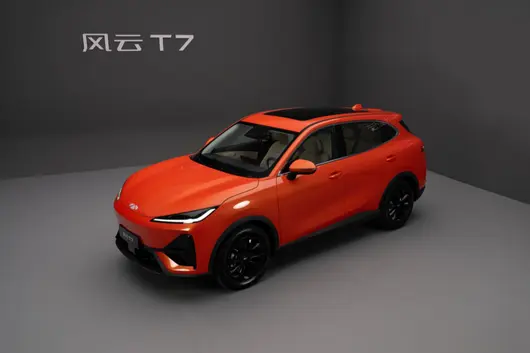

On August 26, at the Yanqi Lake International Convention Center in Beijing, Chery held a press conference to officially launch the global quality pure electric SUV Fengyun T7, introducing three versions: Enjoyment Edition, Comfort Edition, and Intelligence Edition, with an official launch price ranging from 97,900 yuan to 118,900 yuan, and a priority trade-in price from 94,900 yuan to 115,900 yuan.

At the press conference, well-known musician Hank Wu appeared as a surprise guest as a "Happiness Experience Officer", chatting with Chery Automotive Executive Vice President Li Xueyong on the topic of "Steady Happiness", sharing driving experiences and interpreting the steady happiness brought by Fengyun T7. Both parties agreed on the philosophy of "Slow Craftsmanship Builds Good Cars", officially launching the Fengyun T7 "Happiness Co-creation Plan" on-site, calling on everyone to discover happiness moments in life.
From pre-sale leadership, global standards, global verification, and global adaptation to delivery upon launch, Fengyun T7, with sincere pricing and global strength, released the product momentum of "Global Quality Pure Electric SUV", unlocking a "Beautiful and Better" car life for global users and guarding every bit of steady happiness.

"Global quality extracts refined craftsmanship, slow work and fine details are not compromised. Thousands of hammerings reveal the truth, steady happiness lasts longer," introduced Chery Executive Vice President Li Xueyong. Fengyun T7, with global quality as the foundation, relies on four core values: Super Performance, Global Aesthetics, Safer, and Smart Intelligence, as well as six major redundant product strengths including crash safety, battery safety, range equity, full-domain energy saving, handling performance, and whole-vehicle validation, providing a reliable and reassuring pure electric travel choice for global users.

Super Performance, Global Aesthetics, Safer, and Smart Intelligence, Four Core Values,
At the press conference scene, Li Xueyong focused on introducing the four core values of Fengyun T7.
Super Performance: All series standard 65.05kWh Rhinoceros battery, CLTC range 600km, tested range 667+km with reverse false labeling, 30%-80% fast charging only 20 minutes; dual-source wide-temperature range heat pump + 14 low drag designs, winter range increased by 30%, 12-in-1 Kunpeng Electric Drive comprehensive efficiency 90.8%, leading in the class.
Global Aesthetics: Relying on 10 global design centers, over 100 designers collaborated to create, 5,000+ users co-created, blending Eastern elegance with global aesthetics, 6 Eastern elegant paint colors, unique in-class Blazing Orange Tri-coat three-layer luxury car grade craftsmanship; Cloud Wing wrap-around cockpit transparent and premium, two interior colors adapt to different aesthetics, balancing aesthetics and home practicality, long-term use does not easily appear old.
Safer: High-strength steel accounts for 80%, unique in-class shotgun structure, world premiere dual-frame subframe + Pack anti-collision beam; maximum 9 airbags in class; 6D Armored Lock 31-layer battery protection, IP68 waterproofing reaches 96 times the national standard, side anti-compression reaches 2 times the national standard, guarding family travel comprehensively.
Smart Intelligence: World premiere 4nm process 8775 cockpit-integrated chip, 72TOPS computing power, system response as low as 80ms; Lingxi Smart Cockpit 2.0 x Doubao Large Model, full-scenario fuzzy voice interaction; 22 high-precision sensors, support 300+ full-scenario automatic parking, highway pilot assistance, all series standard AGS Intelligent Grille.

Upholding Three "Cannot Rush" Commitments and Promising Two Bottom-Line Policies
"Cars are not fast-moving consumer goods, they carry the travel safety of millions of families, facing different road conditions in all parts of the world, high temperature and cold, salt alkaline and damp tests. Sometimes, we really dare not save time," Li Xueyong introduced. 1. R&D cannot rush, whole vehicle, three-electric, and intelligent driving must be repeatedly polished and iterated; 2. Validation cannot rush, reliability must be run out through real global scenarios; 81 test vehicles, 21 countries, 1.45 million km extreme durability tests, developed according to 2026 Edition E-NCAP European five-star safety standards, no paper parameters; 3. Global user co-creation cannot rush, visiting users in multiple countries, listening to real vehicle usage demands of different families.
Li Xueyong said, Fengyun T7 is not late, it is just the time a good car should take. A true global car is not built domestically then modified and sold overseas, but developed according to global standards from the first day of the project, verified through overseas markets first, then returned to China for Chinese consumers. The overseas same-source model Lepas L6 has already been launched in Thailand and South Africa, later landing in EU, Indonesia, and Australia/New Zealand markets.
Finally, Li Xueyong promised users two bottom-lines:
1. Battery safety guarantee: If thermal runaway is caused by quality issues with the Chery battery pack itself, we will compensate with a brand-new car of the same model;
2. Intelligent driving guarantee: Falcon 500 assisted driving, within 1 year of purchase, if the accident is caused by system issues, compensation up to 5 million.
"At the same time, providing users with whole vehicle + three-electric system lifetime warranty; 666 yuan optional purchase of lifetime basic maintenance package, reducing family car maintenance pressure. Trade-in subsidies, 2 years 0-interest financing, free exclusive paint and other rights and interests are given to everyone," Li Xueyong said.

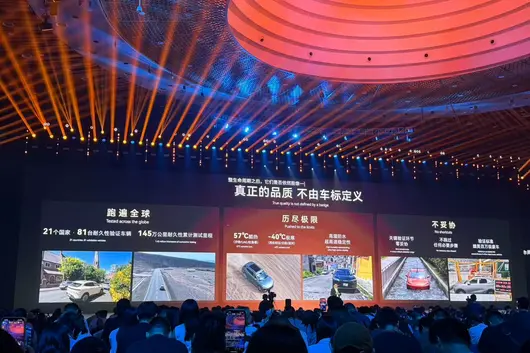
August 26, Chery Fengyun T7 officially launched. The theme of this launch event is a bit special, called 'Steady Happiness'. A pure electric SUV, not talking about specs but happiness, Chery's move is quite interesting.

First, look at the price. Fengyun T7 launches 3 models, all are 600km range versions: 600km Enjoyment Edition launch guide price 97,900 yuan, 600km Comfort Edition 108,900 yuan, 600km Smart Edition 118,900 yuan. If counting trade-in subsidies, the advance trade-in price is as low as starting from 94,900 yuan. A pure electric SUV with all-trims 600km range, pushed price under 100,000, this pricing is indeed aggressive.

At the launch event, Wu Kequn appeared as a 'Happiness Experience Officer' and chatted with Chery Auto Executive Vice President Li Xueyong about 'Steady Happiness'. The two talked from driving experience to understanding of happiness, and together launched Fengyun T7 'Happiness Co-creation Plan'. Wu Kequn himself also became the No. 001 owner of Fengyun T7.
What makes this car claim 'Steady Happiness'?
Chery's positioning for Fengyun T7 is 'Global Quality Pure Electric SUV'. This isn't just casual marketing jargon — Fengyun T7's sibling model Lepas L6 is already launched in South Africa and Thailand, next August landing in Indonesia, September entering EU, October landing in Australia/New Zealand and UK market. Run through the world first then return home, this 'reverse export' path is indeed rare in domestic cars.

Chery Executive Vice President Li Xueyong said one sentence at the launch: 'A true global car is not developed in China and then modified for export.' Fengyun T7 benchmarked the 2026 version E-NCAP Five-Star Safety Standard from the beginning of R&D, adapted to vehicle usage needs in 210 countries and regions. For this, Chery invested 81 durability test cars, whole vehicle cumulative test mileage over 6 million kilometers, durability special test 1.45 million kilometers. From Nordic extreme cold to Middle East high temperature, from Brazil gravel roads to Mexico cobblestone roads, all 100+ global extreme road conditions were driven.
Simply put, this car wasn't huddled out in a domestic lab, but forged on real roads across the globe.
How is the product capability exactly?
Regarding range, Fengyun T7 standard equips 65.05kWh Rhinoceros Battery, CLTC range 600km. Interestingly, media tests achieved over 667km results — official label 600km, actually can run more, this 'reverse false labeling' is indeed rare. 30% to 80% fast charge takes only 20 minutes, battery cycle life over 2,500 times. All trims also standard equipped with dual-source wide temperature range heat pump air conditioning + High Voltage PTC, range at minus 10°C can increase 30%.

In terms of safety, Fengyun T7 put in considerable effort. Body 80% high-strength steel, 18.84% hot-formed steel, nine transverse five longitudinal cage body structure. Whole vehicle equipped with 9 airbags, including 48L far-end airbags — most in class. Battery is 6D Lock Shield 31-layer protection structure, IP68 waterproofing is 96 times national standard. At launch, two hard-core bottom-line rights were launched: Power battery thermal runaway damage due to self-reason, compensate same new car; within one year of purchase due to intelligent driving system reasons causing accident, highest compensation 5 million. Car companies dare to promise like this, indeed not many.

In terms of intelligence, Fengyun T7 is equipped with same-class first launch 4nm process 8775 Cockpit-Driving Integrated Chip, 15.6-inch 2.5K large screen, Lingxi Smart Cockpit 2.0 combined with Doubao Large Model. 22 sensors support 300+ full-scenario automatic parking and high-speed pilot assistance.

Space and looks are not left behind. 2700mm wheelbase, 84% interior living space ratio. Rear seats folded down can become 1955mm×1310mm pure flat large bed — camping, long-distance rest are very practical. Exterior adopts 'Eastern Wind Riding Aesthetics', 6 car colors, Blazing Orange used Tri-coat three-layer luxury car paint process.
The 100,000 yuan level pure electric SUV market starts competing for 'Real Value'
The 100,000 yuan level pure electric SUV market has always had a problem: entry-level range shrinks, safety configurations discounted, high-level intelligence requires money for higher trim. Fengyun T7's approach is — all trims 600km range, all trims 9 airbags, all trims heat pump AC, all trims AGS smart front grille. Give high-level configurations directly to entry users, don't play the 'low trim shrinking' set.

From market response, Fengyun T7 pre-sale 9 days orders broke through 16,787 units. This launch price is dropped more than 10,000 compared to pre-sale price (109,900 - 129,900), sincerity is indeed fully shown.
At this price point, able to provide global car quality, all-trims 600km range, 9 airbags, 8775 chip pure electric SUV, indeed not many. Whether Fengyun T7 can become a dark horse in the 100,000 yuan pure electric SUV market is worth watching.
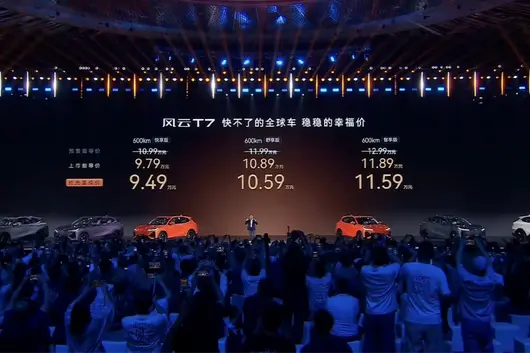

"Exceeding 200,000 units exported in a single month, over 20 million global users, ranked first in the automotive category in Kantar's Global Top 50 Brands, 383rd in the Fortune Global 500, and ranking first in net asset return on equity among Chinese enterprises!"
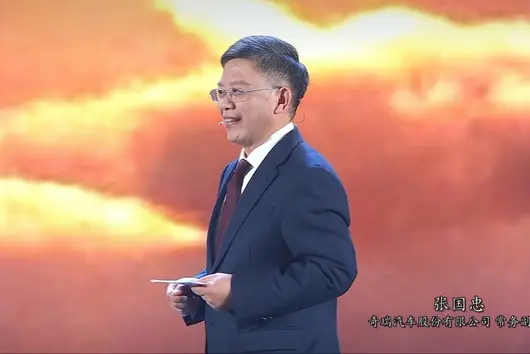
On August 26, Zhang Guozhong, Executive Vice President of Chery Automobile Co., Ltd., listed several exciting data points in a row at the Chery Fengyun T7 launch event, saying, "The Chery Fengyun T7 is a global car crafted with 'slow craftsmanship'. The confidence comes from our multiple 'firsts' in quality and brand!"

From project initiation to R&D, from global universality, global tuning, global development to global testing, Chery Fengyun T7 launched with an early replacement price of 94,900 to 115,900 Yuan. It also included two major safety nets for power battery safety and assisted driving, plus multiple launch benefits such as a lifetime warranty for the entire vehicle and lifetime maintenance available for 666 Yuan. It created a steady sense of happiness for family users. Li Xueyong, Executive Vice President of Chery Automobile Co., Ltd., said about this brand new model full of happiness: "By the end of this year, we hope to sell Fengyun T7 in over 100 countries and regions worldwide."
In fact, before the Fengyun T7 launched domestically, it had already been launched in South Africa and Thailand with the overseas name Lepas L6, and will subsequently launch in multiple countries and regions such as Indonesia, the EU, Australia/New Zealand/UK, Israel, Malaysia, and more.

"Slow Work" Adapts to Global Standards
"The Fengyun T7 went through 2 years of planning and 3 years of forward development, it is definitely not a 'fast-track car'!" Li Xueyong said. When introducing vehicle verification, design, chassis tuning, etc., at the launch event for this all-new pure electric SUV, all the engineers on stage presenting were "overseas faces". One of them was Marco, a chassis expert from the "National Thousand Talents Plan" (not single automotive industry), a Chery chassis engineer who has tuned chassis for multiple brands such as Alfa Romeo. Using heavy "Italian English", he introduced the Fengyun T7 chassis technology. The core point is just one: "Calibrate 'stability' into every drive."
Fengyun T7 relies on Chery's "1+7+M" global R&D system, with 10 major design centers collaborating, co-created by over 5,000 global users. A total of 857 production vehicles were invested in for testing, and the cumulative road test mileage exceeded 6 million kilometers!

As the saying goes, "You can't please everyone." To be a true global car, it must adapt to regulations, road conditions, and consumer habits of various countries and regions, so it "cannot be fast at all". After 5 years of hard work, Fengyun T7's hardcore strength is no longer limited to China. Whether it is high-speed humps in Brazil, cobblestone roads in Mexico, high-speed high-curvature curves in Germany, or unpaved muddy roads in South Africa... Fengyun T7 can give consumers of different skin tones a steady sense of happiness.

Global Universal High-Performance Pure Electric
Fengyun T7 features an Eastern wind-harnessing aesthetics design, combining the wisdom of 10 global design centers and over a hundred designers. Through wind-harnessing front face, wind-blade headlights, wind-sculpted satin body, sky-line tailgate, and wing-style brake lights, it shapes an Eastern charm integrating sports and texture. Li Xueyong said: "Eastern beauty is global beauty. After the Fengyun T7 launched in South Africa and Thailand, it also received consistent praise from consumers and media!"
The Fengyun T7 with a wheelbase of 2700 mm has body dimensions reaching 4570 x 1852 x 1694 mm. The entire series is equipped with AGS intelligent air intake grilles. Its drag coefficient is as low as 0.286Cd, bringing stronger energy-saving performance.

The Fengyun T7 series is standard equipped with a 65.05 kWh large-capacity Rhino battery. CLTC comprehensive range is 600 km. Pre-launch actual test range reached 681.6 km. It is also paired with SOC charging. 80% energy replenishment can be completed in 20 minutes. A cup of coffee time for 300 km range.
While the entire series is equipped with long-range large batteries, the Fengyun T7 is equipped with the 12-in-1 Kunpeng Super Energy Electric Drive System. Its motor peak power reaches 178 kW, maximum torque reaches 275 N.m. At the same time, it is equipped with four-wheel independent suspension, 70mm large bushings, 26mm large diameter front stabilizer bar, One-Box wire control braking, 560mm low center of gravity, and the unique 50.8:49.2 gold axle load ratio in its class. Li Xueyong mentioned twice consecutively: "Our motor power is equivalent to three times that of other small electric cars!" With an electric drive efficiency as high as 90.8%, the Fengyun T7 can firmly drive at 180 km/h on the high-speed ring, forming a significant difference with other pure electric models that "cannot run fast due to speed".

As always, Li Xueyong completed full-function testing of the Fengyun T7: The moose test score reached 80 km/h, and the safe water wading depth reached 500 mm. The chassis and power have sufficient performance redundancy - responsible enterprise executives gave everyone more confidence.
Of course, to give everyone more confidence, a pure electric SUV must be safe and reliable. The Fengyun T7's safety standards are designed according to global regulations researched 2 years in advance, benchmarking the 2026 version E-NCAP standards. Besides accounting for over 80% high-strength steel, the class-unique shotgun structure, the launch-first double-frame subframe and Pack anti-collision beam, and the most 9 airbags in its class, its Rhino battery also comes with 6D Lock Armor 31-layer battery protection, IP68 waterproofing - no matter how you look at it, it doesn't seem like "standard configuration for a 100,000 Yuan level pure electric SUV", but more like the level of a 200,000 Yuan level pure electric SUV.

Hacken Lee's Super Favorite Smart Technology
The No. 001 owner of Fengyun T7 is Hacken Lee. He is also the Fengyun T7 Happiness Experience Officer. At the press conference, he told his understanding of happiness: "I found that when you go to the countryside, if you praise the melons they planted as very sweet, they will all have a face full of happiness. Sometimes, happiness is just that simple."
And on Fengyun T7, Hacken Lee also found his own happiness: "My dad was especially worried about me driving because I have a habit of dozing off after driving for more than 1 hour." The Fengyun T7's Lingxi Smart Cabin 2.0 is equipped with the class-first cabin-驾驶 integrated chip, 4nm Qualcomm Snapdragon 8775. Its 72 TOPS NPU computing power, 1.3 TFLOPS GPU computing power, and 230K CPU computing power, startup speed increased by 33%, system response latency reduced to imperceptible 80 ms, startup speed is faster.
With the support of powerful computing power, besides the built-in Doubao AI large model, the Lingxi Smart Cabin 2.0 is also equipped with six major scene modes. Besides the five modes of Nap, Sentry, Baby, Pet, and Camping, it also uniquely has a Wake-up Mode - "With this mode, my dad is not worried anymore." And Li Xueyong said that the Wake-up Mode saved the cost of a case of Red Bull.

And as a global car, the Fengyun T7's Lingxi Smart Cabin 2.0 supports direct connection of all brand mobile phones. Whether it is Apple, Huawei, or Xiaomi phones, 99% of phones can one-key project screen.
Actually, the screen projection function is mostly not needed, because the Fengyun T7 series is standard equipped with a 15.6-inch 2.5K high-definition large screen. It not only has 1000 nits high brightness, but also has 3A protective coating. When switching between light and dark, screen content can remain clear and non-reflective.

Besides the Lingxi Smart Cabin 2.0, Hacken Lee, this old driver, actually would "fear parking". On Fengyun T7, it is equipped with 22 high-precision sensors. Coupled with the 8775 chip, it constitutes the end-to-end algorithm, cabin-act-parking integrated Falcon 500 driving assistance system.
Li Xueyong demonstrated Highway Pilot, Remote Parking Entry, Multi-level Parking and other functions at the launch event. Hacken Lee deeply felt that happiness came too suddenly for the intelligent parking function supporting 300 scenarios.
Of course, actually the happiness of Fengyun T7 goes far beyond this. Besides the core powertrain, intelligence, safety, and driving control technologies, the Fengyun T7 is also standard equipped with dual-source wide temperature range heat pump AC + high-voltage PTC. It can increase range by 30% under -10°C, and adapt to -30°C to 55°C ultra-wide temperature range, letting pure electric car owners no longer worry about cold winter and scorching summer.

In addition, the Fengyun T7's interior space efficiency rate reaches up to 84%. Flat floor matching with the class-largest pure flat bed mode. 9-layer cloud-sensation comfortable seats are equipped with 3-gear heating and air suction function. In addition, there is a 450-liter conventional volume, expandable to 1550-liter ultra-large trunk, and 99-liter trunk "basement". Also SONY pebble floating speakers and other all-around comfortable practical configurations. Actually, as Hacken Lee himself said, "Happiness is just that simple." A brand new pure electric smart good car does not necessarily require people to pay too much cost. 94,900 to 115,900 Yuan early replacement price, matching with multiple launch rights, can be easily owned by consumers. The launch of Fengyun T7, rather than saying it is a new car launch, can be said to have met "Happiness Comes Knocking"!
#FengyunT7EarlyReplacementPriceStartsFrom94900Yuan#
#FengyunT7QualityGlobalCar#
#UnlockSteadyHappinessWithHackenLee#
Author: Liu Jungang

On August 26, Chery Fengyun, with the theme "Steady Happiness", held the Fengyun T7 launch event at Yanqi Lake, Beijing. This globally quality pure electric SUV, refined over five years, officially entered the domestic market. Hacken Lee served as the Happiness Experience Officer to support the event, bringing a heavyweight contender to the 100,000-yuan tier home pure electric market.

This launch introduced three configurations, with an official guide price of 97,900 - 118,900 Yuan, and a preemptive trade-in price as low as 94,900 Yuan, completely breaking the industry tactics of range shrinkage and configuration stratification in the same class. All series come standard with 600km CLTC range, equipped with a 65.05kWh Rhino Battery. Actual tested range surpassing the label claim can reach 667km, with 30%-80% fast charging requiring only 22 minutes, refueling efficiency comparable to the refueling rhythm of a fuel car.

As an original global model, Fengyun T7 is homologous with the overseas Lepas L6 and has already landed in the Thailand and South Africa markets first. R&D strictly benchmarks against the 2026 version E-NCAP five-star safety standard. The body uses 80% high-strength steel paired with a cage structure. The Rhino Battery has 31 layers of protection, IP68 waterproof rating far exceeds national standards, wading depth can reach 500mm. It has undergone 1 million kilometers of global strict road tests, comprehensively verified in high cold, high temperature, and salt-alkali environments.

The dual commitment policies released at the launch event are extremely sincere: Power battery thermal runaway damage compensation for a new car of the same model, up to 5 million Yuan compensation for intelligent driving assistance accidents within one year of purchase. Meanwhile, enjoy whole-vehicle lifetime warranty including three-electrics. Plus launch rights such as limited-time free car color, 2-year 0% interest finance, 3,000 Yuan trade-in subsidy, lifetime basic data flow, etc., significantly lowering the threshold for home car purchasing.

In terms of space, the new car has a wheelbase of 2700mm and a space utilization rate of 84%. It is equipped with a 450L trunk and 38 storage spaces. The interior uses soft material covering and minimalist cockpit design, balancing home practicality and ride quality. Fengyun T7, with global car building standards, no-tricks range and configuration, and ultimate safety protection, redefines the product baseline of the 100,000-yuan pure electric SUV, becoming a high cost-performance choice for ordinary family commuting travel.

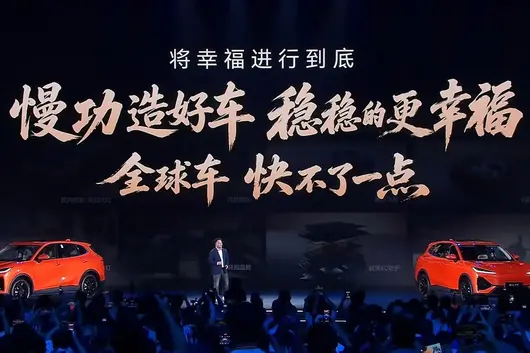

August 26, 2026, Chery Fengyun T7 officially launched with prices ranging from 97,900 to 118,900 Yuan (early trade-in price 94,900 to 115,900 Yuan). In today's era where new energy vehicles iterate by the month, the theme of this launch event was somewhat counter-trend: "Slow craftsmanship builds good cars, long time no see." When competitors race to publish speed, Chery puts the character "slow" on the table; the logic behind this is worth deep investigation.

"Reverse Global Expansion": Suffer Globally First, Then Sell Back in China
Fengyun T7's most core differentiating tag is "Native Global Car". It did not walk the old path of "launch domestically then modify for export", but chose the hardcore path of "Reverse Global Expansion": its sibling models have already launched in South Africa and Thailand, and will sequentially land in markets such as EU, Australia & New Zealand.

This "slow" is reflected in R&D and verification: Relying on the global "1+7+N" R&D system, 2 years of planning, 3 years of R&D; invested 81 durability vehicles, cumulative testing over 6 million km in 21 countries globally, covering extreme environments from -40°C to 55°C and complex road conditions such as Brazilian speed bumps and German highway curves, covering over 95% of global complex road conditions. This practice of "accepting global tests first, then returning domestically" means what Chinese users buy is no longer fast-moving consumer goods piled with parameters, but a durable good tempered by global standards.
Full Series Equality: Range and Safety Do Not Play Tricks
Chery directly downgraded the technical dividends of global verification to the 100,000-level market. In the core aspects of range and safety, Fengyun T7 achieved "equal treatment for all series":

First is "Range Equality". All series standard with 65.05kWh Rhino battery, CLTC range is 600km, actual test can reach above 667km, jokingly called "Reverse False Labeling" by netizens. 30%-80% fast charge only needs 20 minutes, combined with dual-source wide temperature range heat pump, winter range performance improves by 30%.
Second is "Safety Redundancy". The new car is developed according to the 2026 version E-NCAP five-star standard, 80% high-strength steel body, standard 9 airbags (including far-end airbags). Battery has IP68 waterproofing and 6D protection structure, and gives a "battery thermal runaway damage compensates new car" backup commitment.
Competitor Comparison: Launching a Direct Challenge to Yuan PLUS and Galaxy E5
In the 100,000-150,000 Yuan pure electric SUV market, Fengyun T7 directly benchmarks BYD Yuan PLUS and Geely Galaxy E5.

Fengyun T7's advantage lies in the "Entry Level is High Spec" strategy. Yuan PLUS entry-level range is only 430km and airbag configuration is lower, Galaxy E5 entry-level range is 440km and intelligent driving features need optional selection. In comparison, Fengyun T7 starting price is lower (from 97,900), but achieved 600km range across series, 9 airbags, 8775 chip and Falcon 500 intelligent driving. Although Galaxy E5 has a slight advantage in wheelbase (2750mm), Fengyun T7 achieved cross-level suppression in power power (178kW) and core safety configurations.

Conclusion
In the current industry crazy involution on "Refrigerators and Large Screens" and shortening R&D cycles, Chery Fengyun T7 chose a more solid path: using the global "Slow Craftsmanship" to grind a car for the domestic "Fast-Moving Consumer" market. It not only redefined the value standards of the 100,000-level SUV with full series 600km range and safety equality, but also through the global verification system, conveyed the "Reliable and Durable" long-termism value to users. Whether this car can become a catfish stirring the market is worth looking forward to.
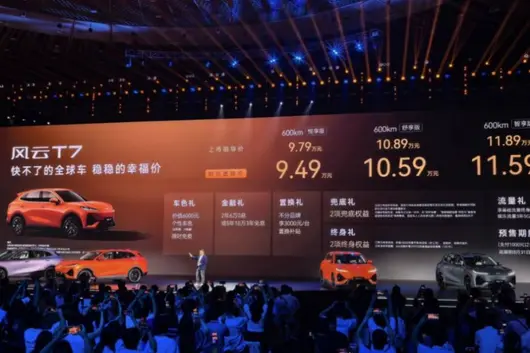

 On August 26, Chery Fengyun officially launched the all-new global quality pure electric SUV — Fengyun T7. The new car comes in three models: 600km Enjoyment Edition, Comfort Edition, and Intelligence Edition. The official guide price ranges from 97,900 to 118,900 Yuan, with priority exchange prices starting as low as 94,900 Yuan. Bulk delivery begins immediately upon launch. With global car-making strength, it offers family users a new travel choice of "Steady Happiness".
At this launch event, well-known musician Nick Wu attended as a "Happiness Experience Officer". Together with Li Xueyong, Executive Vice President of Chery Automobile, they held a dialogue centered on "Steady Happiness" and jointly launched the "Happiness Co-creation Plan" to explore the little joys of travel in daily life. This steady happiness is the best annotation of the Fengyun T7's product power. As a native global vehicle, Fengyun T7 adheres to the R&D philosophy of "Slow craftsmanship builds good cars". After three years of refinement, it relies on the global 1+7+N R&D system and was developed against the 2026 E-NCAP five-star safety standard. The vehicle completed 1.45 million kilometers of durability special verification, crossing extreme environments from -40°C to 55°C, traversing various complex road conditions in 21 countries globally. It only returned to the domestic market after thorough validation. Its homologous model, Lepas L6, has already launched in overseas markets such as South Africa and Thailand, and will subsequently land in the EU, Australia/New Zealand, and other regions.

Fengyun T7 proposes four core values: Super Performance, Global Aesthetics, Enhanced Safety, and Intelligent Wisdom, using "Six Major Redundancies" strength such as crash safety, battery parity, and range parity to break industry involution. In terms of range, which users care about most, the new car refuses differentiation between high and low configurations. All trims are standard equipped with the 65.05kWh Rhino Battery. CLTC range reaches 600km, while measured range can reach 681.6km, achieving no false advertising. Fast charging from 30%-80% takes only 20 minutes. Paired with a dual-source wide temperature range heat pump air conditioner, range performance remains stable even in winter.
Safety is equally sincere. The fortress cage body is built with 80% high-strength steel, equipped with the industry-unique 9 airbags. The Rhino battery has 31-layer 6D armor protection, with anti-squeeze ability reaching twice the national standard. At the same time, a major bottom-line policy is introduced: if the power battery experiences thermal runaway, a brand-new car of the same model will be compensated; intelligent driving assistance scenarios come with up to 5 million Yuan accident compensation. Additionally, rights such as lifetime warranty for the whole vehicle including the three-electric system are provided, fully dispelling user concerns about vehicle usage.

Regarding intelligent configuration, Fengyun T7 is equipped with the peer-premier 4nm process 8775 cockpit-driving integrated chip. The Lingxi Smart Cockpit 2.0 connects to the Doubao Large Model, supporting 300+ full-scenario automatic parking and highway navigation assistance, handling narrow parking spots and long-distance highways with ease. The car interior features an 84% ultra-high space utilization rate, with a 1955mm×1310mm pure flat bed mode, catering to multiple scenarios including commuting, camping, and family outings.
In the 100,000 Yuan class pure electric SUV market, Fengyun T7 redefines the family pure electric value benchmark with global standard product power, extremely sincere pricing, and rich purchasing rights. Bringing global quality to ordinary families, making reliable and safe pure electric travel truly enter the daily lives of more people.
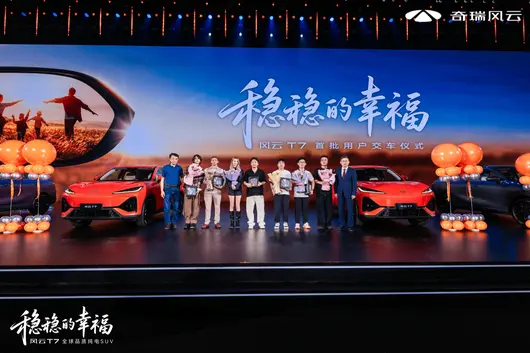

August 26, Global Quality Pure Electric SUV Fengyun T7 officially launched, the new car offers three versions, launch guide price 97,900 yuan-118,900 yuan, priority trade-in price 94,900 yuan-115,900 yuan. The model relies on global vehicle manufacturing standards, with four core values of Super Driving, Global Aesthetics, Enhanced Safety, Smart Intelligence, as well as six major redundancy product strengths, bringing users a reliable, peace of mind high-quality pure electric travel choice.

This launch event is themed "Steady Happiness", famous musician Wu Hequn attended as Happiness Experience Officer, having an in-depth dialogue with Chery Automobile Executive Vice President Li Xueyong, exchanging around family travel and driving happiness, agreeing with the brand's "Crafting Excellent Cars with Patience" long-termist philosophy, jointly launching Fengyun T7 "Happiness Co-creation Plan". The event also achieved delivery immediately upon launch, several foreign users became the first owners, intuitively confirming the model's excellent global product strength.
Different from the industry's rapid fierce competition vehicle building mode, Fengyun T7 insists on fine craftsmanship, it is a native global model, not domestic model modifications for overseas markets. The new car went through three years of R&D, relying on Chery Global 1+7+N R&D system, benchmarking 2026 Version E-NCAP Five-Star Safety Standard to build, through 5,000+ Global User Surveys, visiting 15 typical countries, deeply adapting to regulations and driving scenarios of 210 countries and regions, first completing overseas rigorous verification, then returning to domestic market, quality is more guaranteed.

To solidify global quality, Fengyun T7 completed rigorous whole vehicle validation across all domains. The brand invested 81 dedicated durability test vehicles, completed 1.45 million kilometer specialized durability test, whole vehicle cumulative test mileage exceeds 6 million kilometers. The vehicle adapts to -40°C to 55°C wide temperature range environment, can handle 95% global road types, passed through Brazil, Mexico, Germany, South Africa and other countries' complex road trials, at the same time completed seven extreme environment tests such as extreme cold, high temperature, high humidity, deep water wading etc. Currently, the model homologue overseas vehicle Lepas L6 has landed in South Africa, Thailand, subsequently will enter Indonesia, EU, Australia New Zealand and other overseas markets, continuously accept global user inspection.
For the common pain points of range shrinkage, configuration reductions in the 100k pure electric market, Fengyun T7 breaks industry conventions with range equality and redundancy advantage, achieving fully equipped at entry level. The new car comes standard with 65.05kWh Rhinoceros Battery, CLTC Range 600km, tested range 681.6km, achieving actual exceeding claim, completely bidding farewell to range anxiety. The vehicle 30%-80% fast charge only needs 20 minutes, battery has 2,500 high durability cycle life. At the same time all series equipped with 178kW high-power motor, AGS Smart Grille, Dual-Source Wide-Temp Heat Pump AC, minus 10°C environment range can increase 15%-20%, hot and cold seasons range stable, effort-free travel across all domains.

Safety level, Fengyun T7 relies on six major redundancy strengths to build an all-around protection system. The new car adopts Nine Horizontal Five Vertical Cage Body, high-strength steel ratio 80%, carries same-class unique Shotgun Structure, first launch dual-frame subframe and Pack Bumper Beam, cooperating with 9 Airbags, all-around buffering collision shock, guarding driving space. Rhinoceros Battery equipped with 6D Locking Armor 31-Layer Protection Structure, IP68 Waterproof, side anti-crush performance reaches 2 times National Standard, passed rigorous Fire, Salt Spray tests, from source avoid battery safety risks. At the same time the model launches double major safety net rights, power battery thermal runaway damage can compensate same model new car, within one year of purchase smart driving scenario accidents highest compensation 5 million Yuan, for family travel build a safety barrier.
Intelligent experience, Fengyun T7 hardware strength is cross-class, carrying same-class first launch 4nm 8775 Cockpit-Driving Integrated Chip, 72 TOPS ultra-high computing power, system response as low as 80ms. The new car equips Lingxi Smart Cockpit 2.0 System, integrates Doubao Large Model, supports full-scenario intelligent voice interaction, built-in Napping, Camping, Pet, Baby and other six scenario modes, one-key adapt diverse travel scenarios. Whole vehicle carries 22 high-precision sensors, carries Falcon 500 Intelligent Driving Assistance System, can realize 300+ full-scenario automatic parking, 100-Meter Track Reverse and Highway Pilot Assist, greatly reduce driving difficulty, alleviate commute and long-distance travel fatigue.

Space and comfort precisely adapt to family travel needs, 2700mm wheelbase plus 84% ultra-high interior utilization rate, rear space spacious, floor flat. Interior can expand 1955mm x 1310mm flat bed mode, adapt camping rest, long-distance parking rest. 9-Layer Cloud Feel Seats support heating, ventilation functions, heating fast, ventilation quiet, sitting long time comfortable. Trunk conventional volume 450L, maximum can expand to 1550L, cooperating with whole car 38 storage spaces, exclusive umbrella slot, multi-device charging ports and other thoughtful configurations, all-around meet family travel storage and daily use needs.

Exterior aesthetics blend global aesthetics and Oriental Elegance, designed by over 100 designers collaborating from Global Top 10 Design Centers, polished by 5,000+ user co-creation, homologue model appearance at Milan Design Week received wide praise. New car provides six Oriental Elegance exclusive paint colors, among which Blaze Orange adopts same-class unique Tri-coat Three-Layer Luxury Car Spray Process. Whole vehicle drag coefficient as low as 0.286Cd, cooperates with Cloud Wing Embracing Cockpit, exquisite interior craftsmanship, balancing high looks, low energy consumption and home practicality, outstanding texture, good looking and durable.
Launch benefits aspect, from now until September 30, users ordering Fengyun T7 can enjoy eight major heavyweight rights. Blaze Orange, Mountain Smoke Purple exclusive paint colors limited time free, can enjoy 2 Years 60,000 0% Interest or 5 Years 100,000 3 Years Interest-Free financial plans, brand-agnostic trade-in can enjoy 3,000 Yuan subsidy. At the same time enjoy Battery Power, Smart Driving double safety safety net, whole vehicle lifetime warranty rights, only 666 Yuan can purchase value 3,999 Yuan Lifetime Basic Maintenance Package. First owner can enjoy Base Data Lifetime Free, Entertainment Data 3 Years Free. In addition, 1,000 Yuan Deposit Off 2,000 Yuan Car Price pre-sale expansion gift, extended to August 31, 24:00 deadline, sincere purchasing intent.

Relying on perfect global R&D, Standards, Verification, Adaptation System, Fengyun T7 with 94,900 Yuan starting priority trade-in price, creates 100,000 Level Price, 200,000 Level Value cross-class strength, reshaping 100k-level Pure Electric SUV market value benchmark. The model with four core values and six major redundancy hard-core strengths, step out of industry homogeneous involution, focus on real family travel needs, with global rigorous verified reliable quality, for users unlock high-quality pure electric travel life, guard the steady happiness of every daily trip.
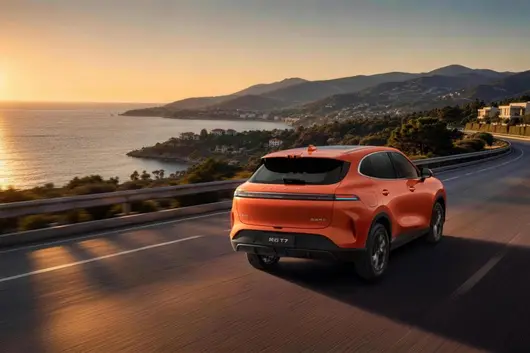

August 26, Chery Fengyun Series' first global quality pure electric SUV—Fengyun T7 officially launched. This launch event themed "Steady Happiness" not only revealed the sincere price of 97,900 Yuan to 118,900 Yuan, but also invited famous musician Wu Kequn to serve as "Happiness Experience Officer". In an era when the automotive industry shouts "Fast is the only way", Chery instead spent three years on this global vehicle "crafting slowly". From the Arctic Circle to the Equator, from Milan Design Week to European 5-Star Safety Standards, this 100,000 Yuan class SUV "pre-approved" by global users, what happiness interpretation did it bring to domestic families after all?

On August 26, Chery Fengyun T7 officially launched. The new car launches three models: Yue Xiang, Shu Xiang, and Zhi Xiang editions. The guide price is 97,900 Yuan to 118,900 Yuan. After stacking trade-in subsidies, the early bird price is only 94,900 Yuan to 115,900 Yuan. From now until September 30, ordering users can also enjoy eight benefits including limited-time free personalized paint color worth 6,000 Yuan, 2-year 60,000km 0% interest financial plan, 3,000 Yuan trade-in subsidy, and lifetime warranty for the entire vehicle.

Different from conventional new car launches, the keywords of this event are not "disruption" or "revolution", but "Steady Happiness". Famous musician Wu Kequn appeared in the role of "Happiness Experience Officer" and held a dialogue with Chery Automobile Executive Vice President Li Xueyong about car making and life. Wu Kequn admitted that after visiting many places, he found true happiness is not a far-away goal, but hidden in the safety of daily commute, the comfort of family trips, and the coziness of outdoor camping. Fengyun T7, relying on globally crafted reliable quality, turned these "little certain happiness" into travel daily life. Both sides also launched the "Happiness Co-creation Plan" on site, inviting users to discover happiness details in life together.
As a pure electric SUV positioned in the 100,000 Yuan class market, Fengyun T7 dared to emphasize "Global Quality" due to its "slow craft makes good cars" R&D logic. According to official introduction, Fengyun T7's R&D cycle reached 3 years. Relying on Chery's global "1+7+N" R&D system, under the collaboration of 10 major design centers globally and over 100 designers, it experienced deep co-creation with 5,000+ users. More importantly, before returning to the domestic market, Fengyun T7's homologue model Lepas L6 had already landed in overseas markets such as South Africa, Thailand first, and is about to enter global highland markets such as EU, Australia/New Zealand. This means it is not a simple "China-special vehicle", but designed from the beginning of R&D according to 2026 Version E-NCAP 5-Star Safety Standards, simultaneously adapting to the usage needs of 210 countries and regions globally.

To verify this "Global Quality", Chery invested 81 durability test vehicles on Fengyun T7, with the whole vehicle cumulative test mileage exceeding 6 million kilometers. It covers the extreme temperature domain from Nordic extreme cold -40°C to Middle East high heat 55°C, as well as over 100 types of complex road conditions globally such as Brazilian high-speed bumps, Mexican cobblestone roads, German highway high-curvature turns, etc. In the Southeast Asia rainy season, it possesses 500mm off-road wading capability. On Siberian ice and snow roads, the dual-source wide-temperature heat pump AC increases winter range by 15%-20%. And at the invisible durability level, the vehicle completed 1.45 million km special durability verification, ensuring issues like noise, failure etc. are completely closed-looped during the R&D phase.

Precisely based on such strict global verification, Fengyun T7 dared to present "Super Range, Global Appeal, Safer, Smarter" four core values unreservedly to users. Regarding range, Fengyun T7 all series standard equip 65.05kWh large capacity Rhino Battery, CLTC range 600km, actual test range reached 681.6km, which can be called "Reverse False Advertising", completely breaking the industry entry-level "range shrinking" tacit rule. 30%-80% fast charge only needs 20 minutes. Combined with AGS Intelligent Grille and Dual-Source Wide-Temperature Heat Pump AC, regardless of North/South regions, Cold/Hot seasons, range performance remains stable and reliable.
Safety is the firmest bottom line of "Steady Happiness". Fengyun T7 built according to 2026 Version E-NCAP 5-Star Standard, high-strength steel proportion reaches up to 80%. Industry-unique Shotgun structure, Double-frame subframe and Pack Anti-collision Beam form 6 complete force transmission paths for front impact, 9 for side impact. At the same time, the new car is equipped with 9 airbags, the most in its class, including 48L dual-chamber remote airbag. Combined with 6D Lock-Armor 31-layer battery protection system, IP68 waterproof rating reaches 96 times national standard, side anti-crushing ability is 2 times national standard, truly realizing full domain safety redundancy from body to battery.

In smart experience paid attention to by young users, Fengyun T7 launched the 4nm process 8775 Cabin-Driving Integrated Chip in its class first. 72 TOPS computing power supports deep integration of Lingxi Smart Cockpit 2.0 and Doubao Large Model. 15.6-inch 2.5K HD large screen, all-scenario fuzzy voice interaction, 300+ all-scenario automatic parking and Highway Pilot Assist, let 100,000 Yuan class SUV also enjoy smart convenience previously only available for 200,000 Yuan class vehicles.

As a strategic vehicle for Chery conquering the global market, Fengyun T7 this time launched domestically and simultaneously started delivery. A batch of foreign users living long-term in China became the first batch of owners. From the world back to China, this pure electric SUV "tested" by global road conditions, is trying to use solid quality and sincere price to redefine the value standard of the 100,000 Yuan class pure electric market. After all, true Steady Happiness never needs to be packaged by gimmicks.
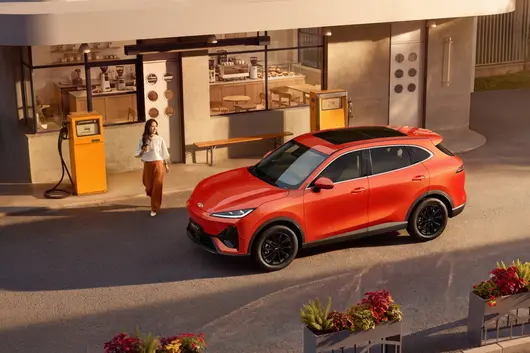

August 26, Chery Fengyun T7 officially launched, 97,900 yuan starting price (early trade-in price 94,900 yuan) announced, plus 100,000 yuan class native global pure electric SUV quality, made competitors instantly nervous! New car launched 24 hours, national orders exceeded 23,188 units, once again proving Chery's hard power in building global cars.
What's more praiseworthy is: Fengyun T7 is a model that took three years to carefully polish. In a trend where the whole industry competes on "18 months from project launch to mass production", it tells everyone with the common sense of "making good cars with slow work" that truly global high-quality models can never be rushed.

Defying Industry Inertia: Trading a Three-Year Slow Cycle for Global-Level Access Qualifications
Nowadays in the domestic new energy vehicle track, "fast iteration, fast launch, fast volume" has almost become the survival method for some car companies. Many brands take "quick shell modification, piling up large screens, parameter inflation" as core competitiveness, relying on high-frequency iteration new push rhythm to seize traffic, but left behind the underlying elements that determine long-term vehicle quality such as durability, global regulation adaptability, extreme working condition reliability.
This time Chery went against the grain, Fengyun T7 refuses "short, flat, fast" — it is by no means a "pseudo global car" simply modified right-hand drive, changed overseas badge and exported from a domestic special model, but from the first day of project launch, it wrote into the development outline the EU E-NCAP 2026 version, Australia-New Zealand ADR, Middle East GSO etc. global harshest regulation standards, is a thoroughly custom-made global car for the global market.

Throughout the R&D cycle, Chery invested 81 exclusive durability test vehicles, did not take the shortcut of "simplifying verification process, mass production launch ahead", but scattered test vehicles into different road conditions of 21 countries globally, completed equivalent 1.45 million km real vehicle durability verification. From Mohe -40℃ extreme cold environment, to Turpan 55℃ high temperature Gobi desert, from South Africa's gravel unpaved road, to Thailand's high humidity high salt coastal zone, the duration and intensity of every test far exceeded national standard requirements, finally successfully obtained EU WVTA vehicle type certification — this is also one of the few models in 100,000 yuan class pure electric SUVs to obtain this certification, equivalent to directly obtaining access tickets to the vast majority of global developed markets.
Triple Slow Work: Welding Global Standards into Every Detail
Fengyun T7's "slow" is reflected in the relentless pursuit of safety standards at the R&D end.
A global R&D team specially formed with over 500 people, among which nearly 100 foreign engineers from Germany, Australia-New Zealand, and Middle East deeply participated in the development process throughout. At the press conference scene, three chassis and safety engineers who specifically rushed from overseas took the stage, dissected the development details of this car: to adapt to the EU market's strict side collision standards, the team completed 17 rounds of body structure optimization in front and back, just the Shotgun front longitudinal beam structure iteration took 8 months, directly boosted the passenger compartment's impact resistance capability by 27%; to meet the Australia-New Zealand market right-hand drive adaptability and gravel road durability requirements, the chassis team specially re-adjusted steering ratio and suspension stroke, front and back cumulative completed over 1200 rounds of chassis calibration tests, finally achieved 50.8:49.2 golden axle load ratio, handling stability far exceeded most models of the same level.

Fengyun T7's "slow" is reflected in the comprehensive coverage of global scenarios at the design end.
This car did not follow the trend to do the currently popular "exaggerated fastback, full screen touch" design, but carried out generalization balance around the real usage needs of global different market users. On appearance, adopted low wind resistance high passability middle-way design, 0.278 wind resistance coefficient balanced European highway section range performance, 190mm minimum ground clearance can also easily cope with Southeast Asia, Australia-New Zealand unpaved roads; interior did not pile up flash but useless functions, but polished the 9-layer cloud feel seat ergonomics design to the extreme, front and rear row seat foam hardness passed global different body type users thousands of tests, finally achieved continuous sitting 4 hours will not appear obvious fatigue; even the air conditioning system specially did exclusive optimization targeting Middle East high temperature, Nordic low temperature, dual-source wide temperature range heat pump air conditioning covers -30℃to 55℃super wide temperature range, no matter if it is exposed to sun in Dubai desert, or driving in Norway snow, can maintain stable temperature control efficiency.

Fengyun T7's "slow" is more reflected in the compromise-free verification end towards extreme working conditions.
In Mohe's extreme cold environment, the team continuously did 3 months cold start and range degradation tests, optimized heat pump working efficiency under low temperature to industry top level, under minus 10℃environment range can still improve 20%; in Xinjiang Turpan high temperature environment, continuously 6 months did full sun exposure power system stability test, battery management system temperature control strategy iterated 23 versions; in Thailand's high humidity high salt environment, completed 1008 hours salt spray test, far exceeded national standard requirements. This verification without calculating time cost, let Fengyun T7's same source models after launch in South Africa, Thailand etc overseas markets, user complaint rate compared to same level models lower by 62%, truly used global-level reliability got overseas user recognition. Full series standard configuration 65.05kWh Rhino Lithium Iron Phosphate battery, CLTC range solidly achieved 600km, 2500 times above battery cycle life, design service life up to 15 years, let user most concerned about range and durability problems thoroughly covered.

Entering with Dimensional Reduction: Redefining 100,000 Yuan Class Pure Electric Market Competition Ruler
When such a global-tempered native global car is launched into the domestic market at 90,000 plus price, its market advantage immediately manifested. In the 100,000 yuan class pure electric SUV track, can pull E-NCAP five-star safety standards, full series 600km range, 84% car interior space utilization rate all full, also 9 airbags, IP68 level battery protection these configurations, caused huge pressure to same level cars.

And from the industry long-term development perspective, the launch of Fengyun T7, also gave the current involution distorted new energy vehicle market a foot of emergency brake. It tells all peers, true involution is never compared whose price lower, whose launch faster, but compared whose willing in user invisible R&D, verification link do hard work. 90,000 plus price can buy a global road condition verified native global car, for domestic ordinary family users is solid welfare, for the whole industry, is more a value return — slow work made good cars, will become the business card of Chinese car going global!
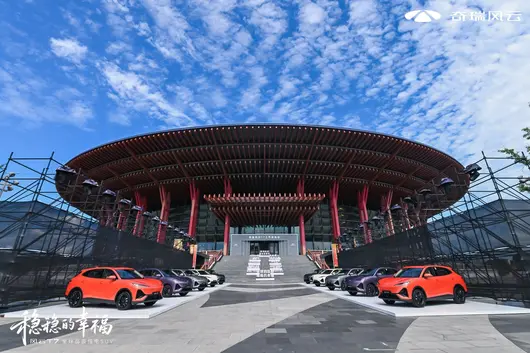

When it comes to the current 100,000-class pure electric SUV market, homogeneity is serious. Most models blindly pile up configurations and focus on marketing gimmicks, yet overlook the core quality, range, and safety needs of family users. Against this backdrop, Chery Fengyun T7 makes a grand entrance, reshaping the new standard for family pure electric travel with its affordable starting price of 94,900, global-grade hard-core quality, and top-tier after-sales guarantee.
On August 26, Chery Fengyun T7 officially launched, with Hacken Lee appearing on-site to ignite the hype. But compared to traffic support, what truly makes it stand out is Chery's hard-core strength in global car manufacturing, as well as the all-around product power and sincere policies tailored for family users.

Different from the industry's "First Domestic, Then Going Global" conventional route, Fengyun T7 adheres to Global Trial First, Then Return to Domestic differentiated car-building path. The new car has already landed in Thailand, South Africa markets, and will subsequently layout in Spain, UK, Australia, and many other countries. Since the beginning of R&D, it benchmarks against global strict road conditions, regulations, and usage standards.
Hard-core strength comes from extreme polishing. Fengyun T7 underwent 5 years of R&D precipitation, relying on 81 exclusive durability vehicles, completing 1.45 million kilometers of all-domain durability testing, undergoing extreme cold and heat, complex road conditions comprehensive tempering. The model gathers global car building elite teams, jointly co-created with 5,000+ global users. Milan Design Week research on appearance satisfaction reached 97%, appearance fits global mainstream aesthetics.

Focusing on core family needs, Fengyun T7 achieves appearance, space, and comfort three-in-one comprehensive advancement. The new car launches six elegant car colors, diverse styles, fitting all age group aesthetics.
2,700mm extra-long wheelbase brings cross-level spacious cockpit, easily fits multi-member family travel and long-distance self-driving. All series standard 9-layer Cloud-feel Seats, supporting backrest heating, ventilation functions, comfortable driving in four seasons, thoroughly solving daily usage seating pain points.

Aiming at users' biggest range anxiety, Fengyun T7 breaks industry high/low configuration range differentiation tricks, achieving Full Series Range Equality, entry-level means full configuration.
The new car all series equips 65.05kWh Rhino Battery, CLTC range 600km, actual range breaks 681.6km, actual range better than announced, refuse range false marking.
With 14 aerodynamic optimizations, overall vehicle drag coefficient as low as 0.286Cd. Paired with wide-temperature range heat pump system, fear not extreme cold and heat, all-domain stable range. Simultaneously charging efficient, 30%-80% fast charge only needs 20 minutes, daily commute, long-distance travel no power anxiety.
In smart experience, Fengyun T7 equips 4nm Qualcomm 8775 chip, paired with 15.6-inch 2.5K ultra-clear large screen, built-in Lingxi Cockpit 2.0&Doubao Large Model, interaction smooth and smart. Falcon 500 Intelligent Driving System equipped with 22 sensors, supports Highway NOA, Full-scenario Automatic Parking, reducing driving difficulty.
In power level, 178kW Max Power + 275Nm Peak Torque power sufficient, paired with Front MacPherson + Rear Multi-link Independent Suspension, balancing family comfort and driving stability.
In safety aspect, overall vehicle adopts Nine Horizontal Five Vertical Cage Body, 80% high-strength steel reinforcement, standard 9 airbags, passive safety full loaded. Even more industry top-tier bottom line policy: Battery thermal runaway compensates new car, Smart driving max compensation 5 million, plus overall vehicle lifetime warranty, lifetime basic maintenance, thoroughly dispel users buying car usage concerns.

Relying on Chery's strong global market strength, January-July this year Chery new energy vehicle sales, export volume continued to surge, firmly standing in domestic export top tier camp. Hard-core global reputation, extreme product polishing, makes 94,900 starting Chery Fengyun T7, become 100,000-class family pure electric SUV high cost-performance ratio first choice, makes high-quality pure electric travel walk into thousands of households.
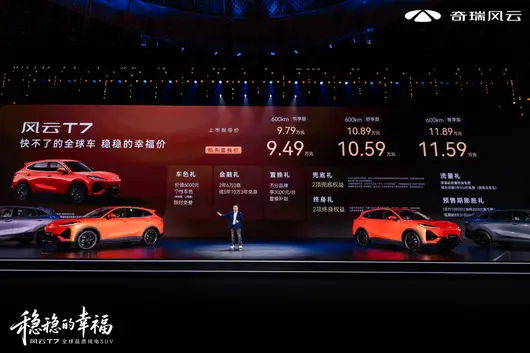

Recently, the Chery Fengyun T7 officially launched in the domestic market. The new car is positioned as a family compact pure electric SUV. Three trim levels were launched. The official guide price is 97,900-118,900 RMB, and the exclusive early exchange price is 94,900-115,900 RMB. Mass delivery work started simultaneously with the launch. As a core model in Chery New Energy's global layout, the Fengyun T7 injects new variables into the white-hot 100,000-level pure electric track with its overseas-first verification system and full-configuration product strength.

Against the backdrop of accelerated overseas expansion for domestic brand new energy vehicles, the Fengyun T7 has forged a differentiated product path. The new car adopts a model of global synchronous R&D, overseas precedence in landing, and domestic finale launch. Initially, it has completed deployment in overseas markets such as Thailand and South Africa, and will continue to expand into Southeast Asia, Europe, Oceania, and other overseas territories. Relying on Chery's global R&D and testing systems, the whole vehicle has undergone 6 million kilometers of strict testing in all scenarios, adapted to complex road conditions and extreme climates worldwide. Vehicle manufacturing and safety standards benchmark against international high-end regulations, possessing a mature global product heritage.

Product core highlights focus on the three-electric systems required by users. Currently, the 100,000-level pure EV market generally suffers from battery shrinkage and range downgrade in entry-level versions, leading to polarized user purchase experiences. The Fengyun T7 breaks industry conventions, standardizing a 65.05kWh large-capacity battery across the range, unifying 600km CLTC range, ensuring consistent range benefits regardless of trim level, fundamentally solving the core pain points of entry-level users.

Practical configurations fully align with home scenarios; a 30%-80% fast charge is completed within 20 minutes, significantly improving travel energy replenishment efficiency; a wide-temperature-range heat pump system effectively optimizes all-season range performance, reducing energy consumption losses in extreme weather. The high-efficiency electric drive system balances power and energy saving, with comprehensive efficiency exceeding 90.8%, balancing the economy of daily commuting with travel power needs.
In terms of safety and intelligence, the new car adheres to the bottom line of family vehicles. An 80% high-strength steel body frame is equipped with full-coverage airbag protection to build a solid vehicle safety barrier; battery multi-layer safety protection design improves vehicle fault tolerance. Smart cockpit and assisted driving systems support it, adapting to modern family diversified travel needs.
From an industry perspective, with the price war continuing to ferment, the market urgently needs high-quality products focusing on quality without gimmicks. The launch of the Fengyun T7 not only completes the Chery Fengyun New Energy family SUV matrix but also sets a new quality benchmark for the 100,000-level pure EV market with global quality, balanced product power, and equitable configurations. The subsequent market performance is worth continuous attention.
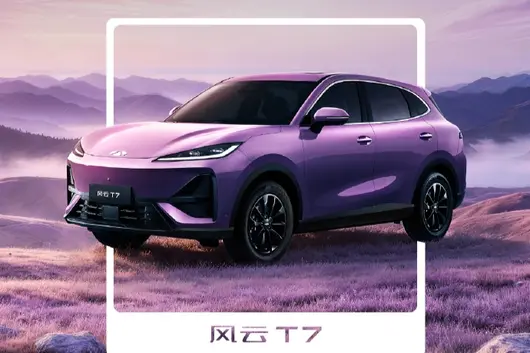
Global Quality, Unlocking Steady Happiness for Families
On August 26, 2026, at Yanqi Lake, Beijing, the Chery Fengyun Brand "Steady Happiness" new product launch event officially kicked off, with the Native Global Pure Electric SUV Fengyun T7 formally entering the domestic market. The new car offers three configurations: 600km Enjoyment Edition, 600km Comfort Edition, and 600km Intelligent Edition. The official guide price is 97,900 - 118,900 CNY, with a limited-time priority trade-in price of 94,900 - 115,900 CNY. Delivery was achieved at launch during the event, bringing global manufacturing standards to the 100k-level pure electric SUV segment.
At this launch event, well-known musician Kelvin Wu attended as Fengyun T7's "Happiness Experience Officer", conversing with Chery Executive Vice President Li Xueyong on family travel and quality manufacturing. They jointly launched the "Happiness Co-creation Plan", interpreting the product philosophy of "Slow work builds good cars" and explaining the family travel happiness embodied by the Fengyun T7.

As a native global model, Fengyun T7 is built upon Chery's "1+7+N" global R&D system. Sibling models have already landed in overseas markets such as Thailand and South Africa, completing development verification for regulations and usage environments in 210 countries and regions globally. It benchmarks the 2026 E-NCAP 5-Star Safety Standards, has accumulated over 6 million kilometers in global road tests, and brings export-level manufacturing standards down to the domestic home market.
Super Performance Run: Stable Range Across the Series, Say Goodbye to Range Anxiety
Fengyun T7 achieves rare range equity across the series in the 100k-level market. All three versions are equipped with the 65.05kWh Rhinoceros Lithium Iron Phosphate Battery. The CLTC range is 600km, with official tested range exceeding 667km, achieving true range "reverse labeling" (Actual > Claimed). Fast charging from 30% to 80% takes only 20 minutes; a cup of coffee can replenish about 300km of range. The battery cycle life is greater than 2,500 cycles, with a design service life of up to 15 years.
The series comes standard with dual-source wide-temperature heat pump air conditioning. In low-temperature environments, range increases by 30%, making it more friendly for winter use in northern regions. It is equipped with the 12-in-1 Kunpeng Super Energy Electric Drive, with a maximum power of 178kW, maximum torque of 275N·m, and combined efficiency of 90.8%. Through 14 aerodynamic optimizations, the drag coefficient is as low as 0.286Cd, with energy consumption of 12.9kWh per 100km, balancing power performance and energy saving.
Vehicle dimensions are 4570×1852×1694mm, with a wheelbase of 2700mm. The interior usable space ratio is 84%, featuring a flat rear floor, providing spacious home space. A 50.8:49.2 Golden Axle Load Ratio achieves excellent driving stability, suitable for commuting, long-distance, and outdoor camping scenarios. It supports 6.6kW external discharge, expanding outdoor life fun.

Global Beauty: Global Aesthetics, Balancing Practical Quality
Fengyun T7 adopts family sculptural aesthetic design. The wind-riding front face and streamlined body are paired with sky glow through-body taillights, offering 6 trendy body color options. The interior features the Cloud Wing Cocooning Cockpit with large-area soft wrapping. All interior materials have passed anti-aging tests, balancing aesthetics and durability. Equipped with a 15.6-inch 2.5K central control screen + 8.8-inch full LCD instrument cluster, the cockpit is powered by the Lingxi Cockpit 2.0 system. Interaction is smooth, supporting smartphone connectivity, creating a comfortable digital cockpit experience.
More Safety: Multi-layer Protection, Securing Travel Baseline
The whole vehicle uses a nine-horizontal five-vertical cage body structure. 80% high-strength steel ratio and 18.84% hot-formed steel ratio are adopted. It is equipped with 9 airbags, including far-end dual-chamber airbags and rear side airbags, providing comprehensive protection for all occupants. The Rhinoceros Battery features IP68 waterproofing and a 6D Global Protection System, resisting risks such as crushing, puncturing, and high temperatures, building a complete safety barrier from the vehicle to the battery.

Great Intelligence: High-Level Intelligent Driving Extended to Home Use, High Configuration for Family
Fengyun T7 is equipped with the Falcon 500 Intelligent Driving Assistance System. High-end versions support Highway NOA Pilot Assist and automatic parking in 300+ scenarios. From adaptive cruise control and lane centering to automatic parking, high-level intelligent driving configurations are brought into the 100k segment, lowering the intelligent driving experience threshold for family users.

Chery Executive Vice President Li Xueyong stated at the launch: "Global Quality, Crafted with Precision, Slow Work, Fine Details, No Compromise. Thousands of Refinements Reveal True Quality, Steady Happiness Lasts Longer. Fengyun T7 adheres to Six Major Redundancy Standards: Crash Safety, Battery Safety, Range Equity, Global Energy Saving, Handling Performance, and Whole Vehicle Validation, creating a reliable and secure pure electric car for family users."
With the official launch of Fengyun T7, the 100k-level pure electric SUV market welcomes a "Global Quality" new contender. With its native global vehicle strength verified overseas, 600km range equity across the series, comprehensive safety configuration, and honest pricing, Fengyun T7 is committed to bringing a worry-free and secure new choice for pure electric travel to a wide range of family users.
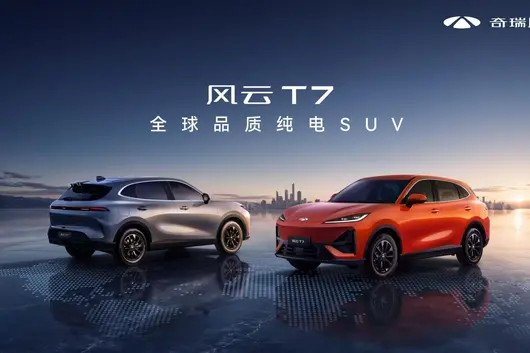
August 26, Global Quality Pure Electric SUV Fengyun T7 officially launched, the new car offers 3 versions, launch guide price 97,900 CNY—118,900 CNY, priority trade-in price 94,900 CNY—115,900 CNY. Fengyun T7, with global quality as the foundation, relies on Super Performance, Global Aesthetics, Safer, Smart Intelligence four core values, as well as Crash Safety, Battery Safety, Range Equality, All-domain Energy Saving, Handling Performance, Whole Vehicle Validation "Six Major Redundancies" product strength, brings reliable and secure pure electric travel choices for global users.

At the launch event, well-known musician Wu Kequn appeared as "Happiness Experience Officer" unexpectedly, conversing with Chery Automobile Executive Vice President Li Xueyong on the topic of "Steady Happiness", sharing vehicle experience, interpreting the steady happiness brought by Fengyun T7. Both parties agreed on the philosophy of slow craftsmanship for quality cars, and jointly launched the Fengyun T7 "Happiness Co-creation Plan" on site, calling on everyone to discover happiness details in life. From pre-sale leading, global standards, global verification, global adaptation to delivery at launch, Fengyun T7, with sincere pricing and global strength, releases the product potential of "Global Quality Pure Electric SUV", unlocks "Super Beautiful and Better" car life for global users, and guards every bit of steady happiness.

As Chery Smart Electric Era's first native global vehicle, Fengyun T7 has undergone 3 years of R&D polishing, absorbing co-creation opinions from over 5,000 users, the vehicle strictly benchmarked against 2026 Edition E-NCAP EU safety standards for development. The same-origin model has already landed in overseas markets such as Thailand, South Africa, etc., and will subsequently enter European, Australia and New Zealand global high-regulation markets. It is a quality vehicle truly facing global users. The whole vehicle completed 1.45 million kilometers of all-domain durability testing, experienced validation of five extreme environments: high temperature, extreme cold, high humidity, high salinity, product reliability underwent severe testing.

In the core three-electrics field, Fengyun T7 breaks the industry convention of "entry-level short range, long range only for high trim", all series standard equipped with 65.05kWh Rhino LFP Battery, CLTC working condition pure electric range uniformly reaches 600km, actual range can reach above 667km, thoroughly eliminating home user range anxiety. The vehicle is equipped with 178kW high-power drive motor, peak torque 275N·m, top speed 180km/h, city commute, highway overtaking power is sufficient; 30%-80% fast charging takes only 20 minutes, simultaneously supports 6.6kW external discharge, meeting outdoor camping power requirements. Dual-source Wide-Temperature Heat Pump AC paired with High Voltage PTC Temperature Control System, can adapt to -30°C to 55°C extreme environments, low temperature range performance is more stable.

In space and comfort levels, Fengyun T7 body size is 4570mm×1852mm×1694mm, wheelbase reaches 2700mm, rear floor purely flat, seating space is spacious; 450L regular trunk volume, rear seats folded down expanded space is considerable, matching 38 humanized storage spaces inside the car, fully meeting family daily travel, outdoor travel loading requirements. Chassis tuned by international team professionals, Gold Ratio axle weight paired with large damping suspension, vibration filtering performance is class-leading, driving quietness is excellent,兼顾 handling stability and seating comfort.
In intelligent configuration, new car equipped with Lingxi Smart Cockpit 2.0 system, high trim models equipped with Qualcomm 8775 Cockpit-Driver Integration Chip, voice interaction, in-vehicle machine fluency maxed out; Falcon 500 Intelligent Driving Assistance System, relying on 22 high-precision sensors, achieves Highway NOA Pilot Assistance, 300+ all-scenario automatic parking, covering dead-end road parking, multi-level memory parking and other complex scenarios, greatly reducing daily driving difficulty. Entry-level version standard equipped with 9 Airbags, ACC Adaptive Cruise Control, Sony Audio, basic configuration no cut, truly achieving entry-level not cheap version.

To thank consumers, Fengyun T7 launches multiple sincere purchase benefits simultaneously
From now until September 30, placing an order enjoys 8 benefit packages:
1. Color Gift: Value 6,000 CNY Personal Colors (Crimson Orange, Mountain Smoke Purple) Limited Time Free
2. Finance Gift: 2 Years 0% Interest on 60,000 CNY or 5 Years (3 Years Interest-Free) on 100,000 CNY
3. Trade-in Gift: Any Brand, 3,000 CNY/Unit Trade-in Subsidy
4. Safety Net Gift: 2 Safety Net Benefits
① Power Battery Safety Guarantee: If whole vehicle thermal runaway damage caused by power battery issues, Chery will compensate with same model new car or new car with no lower than original configuration;
② Driving Assistance Guarantee: Within one year from purchase date, in "Parking Scenarios" or "Smart Pilot Scenarios" judged as "Intelligent Driving Assistance System Fault" causing accidents resulting in injury to occupants and third-party losses, max compensation 5,000,000 CNY
5. Lifetime Gift: 2 Lifetime Benefits
① Whole Vehicle Lifetime Warranty: Value 10,000 CNY Whole Vehicle Lifetime Warranty (Including Three Electrics), excluding wear and tear/special parts;
② Lifetime Maintenance Package: 666 CNY to purchase Value 3,999 CNY Lifetime Basic Maintenance Package (1 Time/Year)
6. Data Gift: Enjoy Free Lifetime Basic Data, Entertainment Data 3 Years 5G / Free (Limited to First Owner)
Note: Pre-sale Period Expansion Gift (Pay 1,000 CNY Deposit Deduct 2,000 CNY Purchase Price) Extended to August 31st 24:00 Deadline

To Wrap Up: The 100,000-level pure electric market competition is increasingly fierce, Fengyun T7 with core advantages of "No Compromise across All Series, Global Quality, Ultra-long Range", breaks traditional ideas of configuration arm race, downgrades core hardware, safety standards, smart experience to entry-level price. With Fengyun T7 official launch, Chery will further solidify home pure electric market layout, with global quality product strength, bring more reliable, more secure pure electric travel solutions for Chinese families.
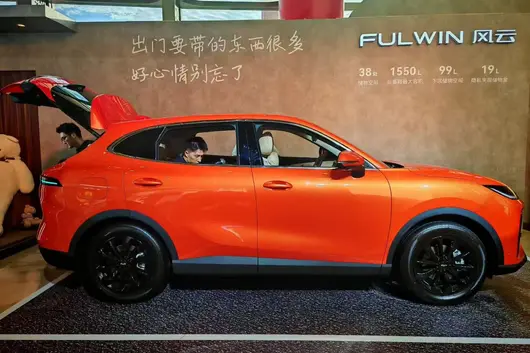

Evening of August 26, Chery Automobile's highly anticipated "Global Quality Pure Electric SUV" — Fengyun T7 officially launched globally at Yanqi Lake, Beijing. The new car launched with 3 trim configurations: 600km Joy Edition, 600km Comfort Edition, 600km Smart Edition, with an Official Guide Price of 97,900 Yuan — 118,900 Yuan, and the Priority Trade-in Price directly dropped to 94,900 Yuan — 115,900 Yuan. In the "Fast Era" where the auto industry generally races in speed and gimmicks, Chery Fengyun T7 goes against the trend, with the car-building philosophy of "Slow work builds good cars, global cars cannot be rushed at all", a long-termist approach. After rigorous durability verification across 21 countries and 1.45 million kilometers globally, carrying "Crash Safety, Battery Safety, Range Equality, All-domain Energy Saving, Handling Performance, Whole Vehicle Verification" six major product redundancies and four core values, it has set a new global quality benchmark for the 100,000-yuan level pure electric SUV market.

Slow work builds good cars: Reject "Fast Food Car Building". Under the current extremely competitive new energy vehicle market wave where "one model change a year, one generation change every half year" is impetuous, many car companies compressed R&D cycles to seize the trend, leading to users frequently suffering betrayal and quality hazards. As a leading car company ranked first in Chinese brand passenger car exports for 23 consecutive years, with global users exceeding 20 million, Chery gave a completely different answer sheet on Fengyun T7 — "Slow work builds good cars, global cars cannot be rushed at all". Fengyun T7 is not a domestic modified car going overseas in the traditional sense, but a "Native Global Car" that strictly benchmarks the 2026 E-NCAP Global Five-Star Safety Standard from the beginning of product definition. Before the new car landed in the Chinese market, its same-source global model Lepas L6 had already launched in Thailand and South Africa, and shocked at Milan Design Week, then will accelerate into Spain, Italy, UK, Greece, Australia and other 210 countries and regions globally.

Exterior length, width, height dimensions are 4570mm, 1852mm, 1694mm respectively, wheelbase is 2700mm, minimum ground clearance is 190mm. Interior space utilization rate reaches 84%, maximum front headroom is 991mm, rear legroom reaches 911mm, rear floor adopts a pure flat design, ensuring leg stretch comfort when fully occupied. Trunk conventional storage volume is 450L, equipped with a 99L sunken storage compartment under the cover, and a 19L independent privacy compartment storage box. Rear seats support 4/6 split folding, after seats folded it can expand to form a pure flat loading/bedding space with depth 1955mm, width 1310mm, maximum storage volume expanded to 1550L.


Body adopts a nine horizontal and five vertical cage structure, high strength steel usage ratio reaches 80%, among them hot-formed steel proportion reaches 18.84%, and extensively applied double-sided galvanized steel plates on front hood, four doors, and tailgate. Battery pack adopts 6D Lock-in Armor 3D Protection Design, including 31 layers of structural protection (bottom 8 layers, side 7 layers, insulation and heat insulation 16 layers) and internal three horizontal one vertical skeleton and independent electrical compartment. Battery protection meets IP68 waterproof sealing standard (passing 48-hour 1-meter water depth immersion test), lateral anti-compression load reaches 200kN, passed 1008-hour high-concentration salt spray corrosion test and 105-second continuous direct fire test.


Smart cockpit equipped with 4nm process manufacturing Qualcomm Snapdragon 8775 cockpit-integrated chip, NPU neural network computing power reaches 72 TOPS, GPU computing power 1.3 TFLOPS, CPU computing power 230K, system architecture integration increased by 60%, system interaction response delay as low as 80ms. Equipped with 15.6-inch 2.5K resolution ultra-clear floating central control screen, peak brightness 1000nit, surface covered with anti-glare, anti-reflect, anti-fingerprint 3A protection coating, supports CarPlay, Huawei HiCar, and CarLink full protocol wireless phone interconnection. Car machine built-in Lingxi Smart Cockpit 2.0 Operating System and deeply integrated with Doubao Large Model, supports Xiaoqi chatting multi-role and multi-dialect voice interaction. Cockpit equipped with Sony custom pebble floating speakers, seats adopt 9-layer cloud feeling composite structure, driver supports 10-way electric adjustment, front row supports 3-level seat cushion and backrest dual heating and 3D-mesh suction soft ventilation function. Car machine presets 7 exclusive scenario strategies such as Nap mode, Baby mode, Pet mode, Storage mode, Awake mode, Sentry mode, and Camping mode.

Driving assist hardware equipped with Falcon 500 Smart Driving System, integrated 22 high-precision sensor hardware (including 3 mmWave radars, 7 HD cameras, and 12 ultrasonic radars), supports Highway Pilot Assist (Highway NOA, covering autonomous on/off ramps, autonomous overtaking lane change, close-range Cut-in avoidance and forward 500m path prediction) as well as a full-scenario automatic parking system covering over 300 working conditions (Supports off-vehicle parking, remote parking out, cross-floor memory parking and 100m tracking reverse function).

Within just 14 days of pre-sale opening, Fengyun T7 secured 23,668 orders, among them female users account for 36.5%, young family users under 35 years old up to 64.7%, this bright achievement has already proven the strong appeal of global quality. As discussed by Vice President Li Xueyong and Wu Kequn at the press conference, the "steady happiness" pursued by today's young people and families is not an ethereal concept, but peace of mind and calm in every specific scenario — it is a range that doesn't fail on long trips in winter, it is a white body as solid as a rock for family outings, it is the ease of parking in narrow spaces with one click, it is the sincere respect brought by standard high specifications across the series.

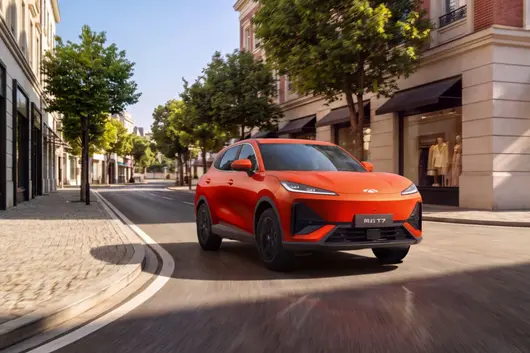

On August 26, Chery Fengyun T7 was officially launched. This is a native global pure electric SUV with a development cycle of 3 years. It is not a domestic model modified and exported directly. Before the vehicle is finalized, a large amount of verification for overseas market environments, regulations, and road conditions has been completed. Homologous models have already been launched and sold in regions such as South Africa and Thailand. The domestic version is a product that returns to the local market after global testing. The longer development cycle means solving a large number of problems before launch. 81 durability test vehicles were invested, completing 1.45 million kilometers of specialized durability verification. Cumulative vehicle testing mileage exceeds 6 million kilometers, covering global extreme conditions such as high temperature, extreme cold, high salinity, and accumulated mud. 21 countries of real vehicle road testing and 212 regulatory certifications have also been completed. This pre-positioned verification mode aims to reduce the probability of users encountering abnormal noise, poor environmental adaptation, and component failures during later use.
In the under 100,000 pure electric SUV market, a relatively common industry status is range grading strategy. Most models in the same price range have small battery capacities for entry-level versions. CLTC range concentrates in the 430-500 km interval. If you want 600 km level long range, you usually need to upgrade the configuration grade and pay an additional 10,000-20,000 yuan in car purchase costs. The unique point of Fengyun T7 is that all three versions are uniformly equipped with the 65.05 kWh Rhino battery. All series have a CLTC range of 600 km, without the situation of range shrinking in the entry-level version, which is the so-called range equality in the industry. In daily life, for users mainly commuting in the city, calculating 30-50 km daily commute, a full battery state can support one week or even ten-plus days without charging, reducing the trouble of frequently going to charging piles; encountering weekend short-distance self-driving or cross-city travel, no need to worry excessively about remaining range; 30%-80% fast charging in 20 minutes capability can also complete recharging during a brief rest at service areas; meanwhile, the battery has over 2,500 cycle lives. From a parameter level, it can match the full lifecycle use of the vehicle, reducing concerns about excessive battery decay later Auto Home ID. Additionally, all series are equipped with dual-source wide temperature range heat pump air conditioning plus high-pressure PTC. Facing northern winter low-temperature environments, it can alleviate the problem of pure electric vehicles' winter range dropping significantly. In -10°C environments, the range can achieve a certain level of improvement. In southern high-temperature and sweltering environments, it can also take into account cooling energy consumption, allowing users in different regions to have relatively stable range performance.
Apart from range-related hardware, this car has many practical hardware configurations in chassis, body, and intelligent systems. The body is developed according to the 2026 version E-NCAP five-star safety standard, adopting a nine-transverse and five-longitudinal cage-type body. The proportion of high-strength steel reaches 80%. It is equipped with the unique Shotgun structure in the same class, as well as the first-time dual-frame subframe and battery pack anti-collision beam, used to disperse collision impact force. Airbag configuration is given 9 units, including far-side airbags and long-size integrated side curtain airbags, further protecting the safety of personnel in the cockpit. The battery pack adopts 31-layer 6D lock armor protection structure, side squeeze resistance ability is twice the national standard. It completed IP68 waterproof, long-time salt mist, fire burning and other strict tests. Redundant designs are made for daily car use risks such as bumps, wading, and corrosion. Regarding the chassis, it uses four-wheel independent suspension. 50.8:49.2 front-to-rear golden axle load ratio, paired with large-diameter stabilizer bars and large bushings, tuned by an international chassis team. The official gives an 80 km/h Elk Test score, 500mm wading depth, accommodating both urban paved roads and complex unpaved road conditions' driving stability. On intelligent hardware, this car is equipped with the same-class first launch 4nm process 8775 cabin-driving integrated chip, achieving cabin-driving fusion. Coupled with Doubao Large Model to achieve voice interaction; the whole perception system includes 22 sensors, supporting 300+ scenario automatic parking, highway pilot assistance. Facing narrow parking spaces, cross-floor parking, highway long-distance driving, it can reduce driver operation burden. Inside the car, settings for nap, camping, baby, and other preset scenarios are set, one-click adjustment of car interior air conditioning, lighting, etc., settings, adapting to family diversified car use scenarios.
Overall, Fengyun T7 summarizes six major redundant product design concepts externally, corresponding to collision safety, battery safety, range equality, all-domain energy saving, handling performance, and whole vehicle verification. In plain language, it means hardware standards are higher than basic regulatory requirements, reserving a certain performance margin. Not only to meet the standard, but to cope with complex and changing real-world car use environments. This idea is also a product brought by long-cycle R&D. Many testing and verification work are completed before the product is launched, not after delivery to users to find problems. In terms of space, 2700mm wheelbase brings 84% interior space utilization rate. Rear floor is purely flat. Trunk conventional volume 450L, supports seat folding to form 1955mm×1310mm pure flat large bed. Whether it is daily loading of family supplies, or camping parked resting, it has a certain practicality. Car interior multiple storage compartments, multi-interface charging configuration, also lean towards family daily use needs.
From the consumer group perspective, the target user profile of this car is relatively clear. The core group is young first-time purchase families with a budget of 100,000-130,000 yuan, mostly three-person families, using vehicles for daily commuting, picking up and dropping off children, weekend short-distance outings, pursuing balanced comprehensive performance, unwilling to pay higher prices for long range or safety configurations; next is users who need cross-city commuting, often run highways, value real range, fast charging, and winter range stability; there is also a part of users who like camping, short-distance outdoor travel, need car interior expansion space, and good chassis passability; additionally, there is a part of pragmatic consumers, planning to use one car for a long time, value the whole vehicle after full verification, after-sales guarantee is perfect, lower sensitivity to flash marketing configurations, more focus on vehicle battery, motor, and electronics such core hardware reliability. For these types of users, its attractiveness mainly comes from range not having high-low distinction, safety hardware configuration complete, whole vehicle after multi-environment verification, plus corresponding car purchase rights, suitable for car buying people who put worry-free durability in priority.
 Regarding price, Fengyun T7 has three car models. 600km Enjoyment Edition, Comfort Edition, Intelligent Enjoyment Edition launch guide prices are 97,900 yuan, 108,900 yuan, 118,900 yuan respectively. Early bird trade-in price corresponds to 94,900 yuan, 105,900 yuan, 115,900 yuan. After launch to September 30, placing an order can enjoy eight items gift pack, including limited-time free custom car colors, financial interest-free plans, 3,000 yuan trade-in subsidy regardless of brand; simultaneously launching two safety bottom-line policies, power battery thermal runaway due to its own reasons damage, compensate same model or new car not lower than original car configuration; parking and intelligent pilot scenarios, due to intelligent driving assistance system reasons causing accidents, up to 5 million compensation; additionally can choose whole vehicle including battery, motor, and electronics lifetime warranty, 666 yuan purchase lifetime basic maintenance package, first owner enjoys basic traffic lifetime free, entertainment traffic 3 years free; pre-sale period 1,000 yuan deposit deduct 2,000 yuan car purchase policy extended to August 31 deadline. It can be seen that the manufacturer sincerity is full. So the question arises, such a car Fengyun T7 that seems ordinary but has been tempered by time, do you like it?
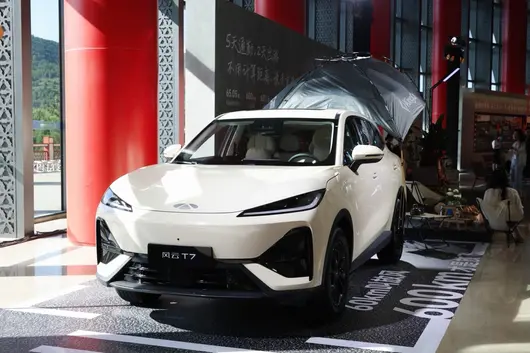

Fengyun T7, distinguishing itself from the majority of the industry's "developed for domestic market, later modified for export" products, adopts Native Global Vehicle as its foundational positioning. Breaking out of the spec wars, it relies on upfront global regulations, comprehensive real-world vehicle verification, and global market trial runs to establish differentiated value in the 100,000 RMB-level pure electric SUV track. The core unique highlights concentrate on three levels: underlying development logic, four major product core values, and value pricing models.

Underlying Development Logic: Native Global Vehicle, Careful Craftsmanship Builds Quality Cars, Differentiated Reverse Trial Route
This is Fengyun T7's most core product foundation and the essential difference from same-class competitors. In the industry's involution environment, rushed car making prevails; most models prioritize meeting domestic market needs first, with minor modifications later to adapt for overseas markets. Fengyun T7 was defined from the outset for 210 countries and regions globally, completing global multi-regional verification first, then launching domestically. This belongs to a "Global Standards Implemented Inwards" reverse development model.
Development Upfront Global Standards, Rather than Late-stage Patches
Pre-research global regulations 2 years in advance, benchmarking 2026 Version E-NCCAP Five-Star Safety Standards. Conduct 5,000+ global user surveys, covering 15 typical country driving scenarios, incorporating road conditions, climates, and user habits of different regions into early product definition. Completing over 80 localization adaptations, including right-hand drive calibration, physical button preferences, strong light low-reflection interiors, special market safety features, etc., not patch-style modifications after launch.

Real Vehicle Comprehensive Rigorous Verification, Rejecting Laboratory Simulation
3-year complete R&D cycle, 81 durability test vehicles, cumulative 1.45 million km global real vehicle road testing, covering -40°C to -55°C extreme temperature range, 7 categories of extreme environments, 100+ global road conditions, adapting to 95% of global road types. Southeast Asia 500mm water wading, Middle East high-temperature sun exposure, Nordic extreme cold, Brazil gravel roads, Mexico cobblestone roads—all real vehicle trials. Tens of thousands of braking, steering, chassis impact tests all achieve problem closed-loop. Homologous model Lepas L6 launched first in South Africa and Thailand, about to enter EU, Australia & New Zealand, debuting at Milan Design Week. After being truly tested by overseas markets, overseas engineers, and overseas car owners, it is then given to domestic consumers. Quality is voted by global road conditions, not just marketing concepts.
Third-party Multi-dimensional Testimony, Value Fulfillment upon Launch
Obtained authoritative reporting by Associated Press. Overseas chassis, styling, and R&D engineers provided on-site support. Overseas influencers and foreign domestic first batch of car owners gave real feedback. Breaking the industry's time gap between new car launch and delivery, launch synchronously opens delivery. Users do not need to wait, global quality lands on site immediately. Stacked with Chery's 23 years of #1 Chinese Brand Passenger Vehicle Export and 20 million global user system backing, product reliability is supported by brand export accumulation.

Four Major Core Product Values' Unique Advantages
(1) Super Range: Rare Range Equality at 100,000 RMB Level, Reliable Power Range System Across All Environments
Industry entry-level pure electrification generally suffers from entry version battery shrinkage and large range gaps between high/low specs. Fengyun T7 achieves range equality, standardizing 65.05kWh Rhinoceros Battery across the full system. CLTC range 600 km, actual range over 667 km, achieving reverse reverse-marking, eliminating range anxiety for entry-level users from the source.
Battery and Recharging Balance Lifecycle and Efficiency
Battery cycle life greater than 2,500 times, service life up to 15 years, vehicle lifecycle battery replacement not needed. 30%-80% fast charge completed in 20 minutes, one cup of coffee refueling 300 km range. Battery -40°C to 60°C wide temperature range stable operation, not prone to degradation or breakdown in winter or summer.
Standard Dual-Source Wide Temperature Range Heat Pump AC for Full Series
Rare full-series standard in 100,000 RMB-level models. Range increased 30% in -10°C environment, stable operation at -30°C to -55°C, solving the pain point of pure electric range loss in Northern winters. Paired with 14 items of low drag optimization, drag coefficient 0.286Cd; 12-in-1 Kunpeng Super Electric Drive comprehensive efficiency 90.8%, peak power 178kW, balancing power output, energy consumption control, and quietness.
Space and Comfort Balance All Home Scenarios

(2) Global Beauty: Global Co-creation Design, Eastern Aesthetics Compatible with International Markets
Design is not just catering to domestic preferences, but balancing aesthetics for different global regions. Homologous model appeared at Milan Design Week gaining international recognition. 10 global design centers, hundreds of designers collaborate. Stacking 5,000+ overseas and domestic users co-creation, forming Eastern Wind Riding Aesthetics, achieving dual compatibility of domestic and overseas aesthetics.

(3) Safer: Benchmarking European Five-Star Standards, Over-spec Body, Chassis, and Battery Triple Safety Redundancy at 100,000 RMB Level
Fengyun T7 safety standards directly align with European high-level regulations. Hardware investment higher than 100,000 RMB-level SUV industry average. Include global complex collisions, harsh environment corrosion, bumpy road risks into protection design.
Rock Solid Cage-like Body Structure
High-strength steel proportion 80%, hot-formed steel proportion 18.84%. Nine horizontal five vertical cage-like body. Equipped with class-exclusive shotgun structure, class-first dual-frame subframe + Pack anti-collision beam. Front collision 6 paths, side collision 9 paths collision energy transmission paths, dispersing impact, protecting occupant compartment and battery pack. Equipped with class-most 9 airbags, including far-side airbags, covering front and rear row occupants, side collision protection ability further improved.
6D Chainmail Ultra-strong Battery Protection System
31-layer 3D protection structure. IP68 waterproof capability reaches 96 times national standard. Side anti-crush 200kN is 2 times national standard. 1,008-hour salt spray corrosion test, fire test is 1.5 times national standard. Specialized reinforcement for battery bumping and corrosion risks brought by overseas high-salt alkaline, rainy, bumpy road conditions.

International Chassis Tuning, Balancing Safety and Handling Feel
International chassis team led by Maserati former chassis tuning expert. Special optimization targeting highway conditions above 160km/h. Class-unique 50.8:49.2 Golden Axle Load Ratio, 560mm low center of gravity. One-Box drive-by-wire braking 136ms rapid pressure build-up, balancing braking avoidance and kinetic energy recovery. 70mm large size bushings suppress bump noise. Chassis not only comfortable, but also adapts to global gravel, bumpy, highway and other complex road conditions, not only tuned for domestic paved roads. Launch synchronously includes battery thermal runaway compensation, smart driving accident compensation safety net rights and benefits. Bringing safety promises down to rights and benefits level.

(4) Good Intelligence: Class-First Cockpit and Driving Integration 8775 Chip, Intelligent Experience No High/Low Spec Segmentation
In 100,000 RMB market, most models have obvious high/low spec chip hardware differentiation. Fengyun T7 equips class-first 4nm process 8775 Cockpit-Driving Integration Chip. 72TOPS NPU compute power, system response latency as low as 80ms, boot speed increased 33%. Achieving cockpit-driving hardware fusion, avoiding user experience lag brought by cockpit and smart driving separate chip segmentation.
Smart Cockpit Equips Lingxi Cockpit 2.0 Combined with Doubao Large Model, Possessing Multi-style Human-like Voice Interaction, CarPlay, HiCar Full Brand Mobile Direct Connection. Six Scenario Modes, One-Key Switch Nap, Camping, Baby, Pet Modes. Smart Driving Equipped with 22 Sensors (3R7V12U), Supporting 300+ Full Scenario Parking, Multi-floor Parking, 100-meter Track Reversing, Highway Pilot Assist. Full Series Standard AGS Intelligent Grille, Balancing Heat Dissipation and Drag Optimization. High-end Smart Hardware Downgraded, No Longer Only Appears in High-spec Versions, Reducing Threshold for Ordinary Families to Experience High-end Intelligence.

Business Value Unique Highlights: Global Quality Downgraded to 100,000 RMB Level, Reconstructing Market Quality-Price Ratio Logic
Value Misaligned Competition: Market 100,000 RMB-level pure electric SUVs are mostly based on domestic needs, focusing on low price, stacking single items parameters. Fengyun T7 takes Native Whole Vehicle Standards facing EU, Australia & New Zealand and other developed markets, down to 100,000 RMB Price Range. Domestic users buy whole vehicles under gone rigorous global verification, not export product downgraded versions.
Configuration Logic Reverse Industry Involution: Core Hardware Full Series Standardized. Battery, Heat Pump AC, etc. Core Hardware All Standard. Do not cut range in entry version, remove key comfort safety configurations. Avoid users forced to add budget to upgrade basic experience.