首頁Ranger

搜尋歷史
熱門搜尋
經銷商登入 / 註冊

August 2026, Australia new car market deliveries reached 108,760 units, up 4.9% year-on-year. Behind the stable figures lies a historic shift in powertrains: 27,078 Battery Electric Vehicles (BEVs) were delivered, surging 169.4% year-on-year. With a market share of 24.9%, BEVs surpassed petrol, diesel, and hybrid for the first time, becoming the top powertrain type in Australia; Plug-in Hybrid Electric Vehicles (PHEVs) also grew 171.1% to 10,591 units. The Tesla Model Y topped the overall model sales list, while BYD secured second place among brands with 8,231 units (+68.8%), making New Energy brands the biggest winners of the month.

As pickups bear heavy-load tasks such as hauling, towing, and off-roading, their requirements for range and power are far higher than ordinary passenger cars; consequently, their electrification lags significantly behind the overall market — but August data shows they can no longer stay isolated.

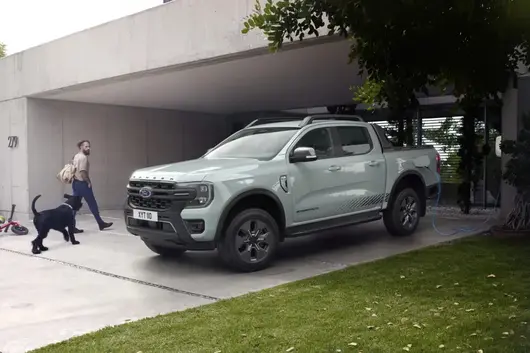
Toyota Hilux retained the pickup title with 4,833 units, but saw only a slight increase of 0.2% year-on-year, essentially standing still. Ford Ranger suffered a cliff-like drop, delivering only 2,440 units, plummeting 50.6% year-on-year — primarily due to a temporary delivery halt caused by safety concerns with side air curtains, resulting in a monthly loss of about 2,500 units, which is a supply-side shock rather than a demand collapse.

Isuzu D-Max delivered 1,708 units (-26.2%), Mitsubishi Triton 1,161 units (-23.8%), and Mazda BT-50 recorded 804 units (-29.4%); all three Japanese diesel pickups declined by double digits. Volkswagen Amarok 306 units (-27.7%), Nissan Navara 277 units (-53.2%), and Kia Tasman performed the worst with only 312 units, down 61.1% year-on-year.

Pickups manufactured in China continued to expand their presence. BYD Shark 6 led Chinese brand pickups with 1,385 units, followed closely by Great Wall Cannon with 827 units. Adding Maxus LDV pickups (T60 + Terron 9 totaling 423 units), Foton Tunland V7 (124 units), MG U9 (115 units), JAC T9 (77 units), and others, total Chinese pickups reached approximately 2,951 units, accounting for about 18.5% of the Australian pickup market. In contrast, vehicles manufactured in Thailand delivered 15,658 units in August, down 24.7% year-on-year, driven almost entirely by the contraction of the pickup segment — Thailand is the main production base for Japanese pickups.

Amidst the general decline, BYD Shark 6 grew 9.8% year-on-year, reaching a year-to-date total of 12,094 units, becoming one of the few mainstream pickups with positive growth. Its PHEV positioning balances electric driving experience with pickup utility needs, coupled with BYD's strong brand power and more competitive pricing, opening up new volume outside of traditional diesel pickups. Notably, New Energy itself is not a guarantee of growth; brand momentum, pricing, and supply rhythm are key.

The full-size pickup market showed clear divergence. Ford F-150 delivered 152 units (surged from a low base), Chevrolet Silverado 1500 delivered 148 units (-6.9%), and RAM 1500 fell 32.6% to 149 units. Premium pickups above A$100,000 overall grew 18.1% to 764 units, forming a contrast with mainstream market weakness.

Final thoughts: August data clearly shows that even in the pickup segment where electrification is inevitably lagging, traditional fuel powertrains are also feeling a clear chill. Ranger's delivery halt amplified the decline. BYD Shark 6's growth against the trend validated the viability of PHEVs in the pickup market. Chinese brands like Great Wall Cannon, Maxus LDV, and others became an undeniable force in the Australian pickup market through stable sales volumes and forward-looking new energy layouts. With Ranger resuming deliveries in September and more hybrids and EV pickups entering the market, how the Australian pickup landscape will change again remains to be seen.


Recently, an exclusive report from US media sent shockwaves through the global pickup community: Ford is developing a Bronco pickup, while the production prospects of the currently sold Ranger in the US are clouded.

According to the report, Ford "currently has no plans" to produce the next-generation Ranger at the Michigan Assembly Plant in Wayne, Michigan. This factory, which also produces the Bronco SUV and Ranger, is set to transform into an exclusive Bronco production base by around 2030. Taking over the Ranger production line will be a midsize pickup based on Bronco, expected to launch between 2029 and 2030.

However, there is disagreement among media outlets regarding whether Ranger will stay or go in the US. Some believe Ranger will be completely discontinued and directly taken over by the Bronco pickup; others believe Ranger will be relocated to the Blue Oval City plant in Tennessee and continue to exist in a new generation by 2029 - Ford has confirmed it will produce a fuel pickup with a size close to Ranger in Tennessee, but has not specified if it will still be called Ranger. Industry forecasting firms judge: A Bronco-styled midsize pickup will replace Ranger at the Michigan plant in fall 2029.

In response to the reports, Ford's official response was vague, stating only that they do not comment on "future product speculation, much of which is inaccurate".
In April 2026, Ranger US sales volume was only 5,245 units, a year-on-year plunge of 25%, even being surpassed by Mustang; while the Bronco brand's sales volume in Q3 2025 grew 41.3% year-on-year, achieving its best quarterly performance in history. Using a high-premium Bronco pickup to replace the weak-selling Ranger makes complete financial sense.

For overseas consumers, the biggest concern is whether US market changes will affect the global market. The answer is: Ranger is basically unaffected. Ranger is a true global model, with independent production lines set up in Thailand, South Africa, Argentina, etc., supplying Southeast Asia, Australia, Europe, Africa, and South American markets. The US Michigan plant only supplies North America; its production line adjustments have no direct relation to overseas Ranger.
However, the situation for the Bronco pickup is different. The Bronco brand has accelerated its global expansion in recent years, and Bronco SUVs have already entered markets like Europe and Australia. If the Bronco pickup succeeds in the US, Ford is very likely to push it overseas, forming a "two-car strategy" with Ranger - Ranger focuses on utility attributes and value for money, while the Bronco pickup focuses on off-road lifestyle and brand premium. The two cover different groups, rather than simple substitution.

Final Thoughts: The changes surrounding the Ranger and Bronco pickups are currently still in the rumor and prediction phase. What is certain is: the Bronco pickup is on the way, and the Michigan plant will turn into an exclusive Bronco base; what is not yet determined is whether Ranger will be completely discontinued in the US or continue at another plant. For overseas markets, Ranger's production line independence means it will not be impacted in the short term; but in the long term, the globalization of the Bronco pickup may change the global midsize pickup competitive landscape, complementing rather than substituting Ranger. In 2029, everything will be revealed.