首頁Qin MAX

搜尋歷史
熱門搜尋
經銷商登入 / 註冊

——From the Dongrun Cup Finals: How an Auto Company Embeds Sports Marketing into Grassroots Soil
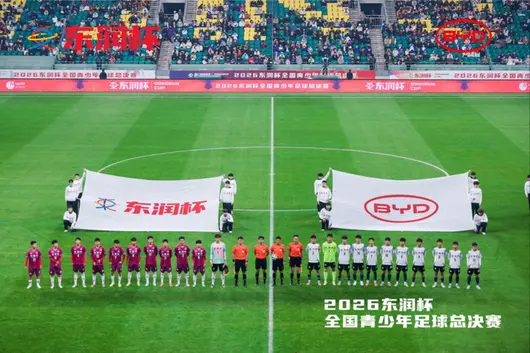
On October 24, Beijing Workers' Stadium welcomed a slightly different final. No professional elite clubs, no astronomical-price superstars. Standing under the spotlight were campus soccer teenagers from across the country. The 3rd Dongrun Cup National Youth Soccer Finals concluded here. Tsinghua High School and Shijiazhuang No. 2 High School staged a peak showdown, ultimately Tsinghua High School lifted the champion trophy. Dongrun Public Welfare Foundation Founder and Chairman Kong Dongmei, and BYD Head of Brand and PR Li Yunfei presented awards on-site to the winning teams and individuals, completing a highlight moment for campus soccer together with the children.

From an automotive media perspective, the most noteworthy aspect of this final is not "who won the title," but "who stood on the Workers' Stadium". The Workers' Stadium has hosted too many professional events and commercial matches. Fans are used to watching top foreign players and elite club showdowns here. But this time, ordinary high schoolers are running on this turf. Top-tier venues are no longer exclusive to a few. Ordinary teenagers who love soccer can also seriously complete their own finals under the same lights, with the same standards. This detail itself is a reconfirmation of the value of Chinese youth soccer: the fact that thousands of ordinary children play soccer deserves serious attention.

As the Dongrun Cup's top strategic partner, BYD partnered with Dongrun Public Welfare Foundation this time to let campus soccer teenagers step onto the Workers' Stadium stage. Event data also shows this isn't an isolated final show. This Dongrun Cup covered more than 20 provinces (districts, municipalities), reached 352 schools, benefited about 5,000 players and coaches; the finals gathered 22 teams in Beijing. Dongrun Public Welfare Foundation launched the Dongrun Cup National Youth Soccer Tournament in 2022, officially started in 2023, covered more than 20 provinces nationwide, cumulatively attracted over 1,000 campus teams, over 10,000 players and coaches to participate, over 30 participating players were selected for the National Youth Team, National Middle School Team, and U-series Elite Training Camps. In other words, the Workers' Stadium finals are the tip of the pyramid, while the base has spread to county-level campuses and ordinary high school teams.

This is exactly the missing link in current Chinese youth soccer. We often say we must respect the laws of soccer development, but the first law is to let more children have balls to kick and high-quality games to play. Shortage of high-level competition supply, grassroots campus teams lack equipment, teachers, and participation opportunities. These problems cannot be solved by one elite club's visit to China. Dongrun Cup attempts to make up for the resource shortages of grassroots campus soccer by a trinity of "event funding, teacher support, equipment donation," benchmarking international competition standards. BYD's involvement allows corporate power to enter this relatively slow-heating, but more patience-testing field.

From the sports marketing perspective, BYD's soccer layout presents a clear "dual-line structure". On the overseas end, it continues to connect with top soccer IPs, successively cooperating with Manchester City, Inter Milan, PSG and other elite clubs, appearing at the European Championship, Copa America and other international events. The previous "BYD Derby" Manchester City vs Inter Milan matchup received global fan attention, promoting brand globalization through soccer. On the domestic end, it directs resources to more grassroots campuses and counties: since 2024, it has continued to organize soccer teenagers to go to Germany, Japan, Spain, Thailand, Italy, Brazil, Mexico, over 200 person-times exchanged and sparred with overseas top clubs, and brought children into top courts like the European Championship, World Cup, etc. to broaden horizons; at the same time, it organized owner volunteers to go to remote areas such as Xinjiang and Guizhou, sent materials to children who love soccer, and opened public welfare classrooms. Ili, Xinjiang soccer teenagers went to Japan for exchange, Guizhou Yuanbao female team received equipment donations and public welfare classes. These moves are not as traffic-attracting as elite partnerships, but are closer to the daily routine of soccer public welfare.
A background worth noting is that BYD established a charity foundation as early as 2010, deepening its work in education support, poverty alleviation and disaster relief; at the 30th anniversary, it set up a 3 billion yuan education charity fund, covering 127 universities nationwide, motivating over 6,000 students. This cooperation with Dongrun Public Welfare, a national 5A-level foundation supervised by the Ministry of Civil Affairs, is essentially a combination of "public welfare platform + corporate power": Dongrun Public Welfare has focused on rural education for more than ten years, projects cover 31 provinces and regions, 324 counties nationwide, possessing mature county-level landing networks and youth assistance systems; BYD brings corporate resources, brand influence and international connections in the soccer field. What both sides want to fill is the resource gap in grassroots campus soccer, not just doing a one-time brand exposure.
As automotive media, we have seen too many sports marketing stopping at Logo exposure and stadium fencing. But the signal released this time by BYD is a bit different: it did not only focus on a few talented players, but balanced elite elevation and campus popularization; on one hand, creating opportunities for promising children to go abroad and exchange with overseas strong teams, on the other hand building the court into county-level campuses, expanding the participation base. This "pyramid-style" investment logic, short-term may not be as intuitive as sales conversion, but is more in line with the growth laws of youth soccer, and more in line with the long-term image a Chinese brand needs to establish in the globalization stage.
The hope for Chinese soccer will not come only from one Workers' Stadium final, but certainly from more ordinary children being seen, respected, and given opportunities for high-quality matches. When car companies string top courts, overseas resources, and public welfare networks into a chain, allowing campus soccer teenagers to stand on professional-level stages, the significance of this matter has exceeded sponsorship itself. BYD's soccer ledger calculates not only brand exposure, but also the soil of Chinese youth soccer. Once the soil is thicker, there will be more possibilities in the future.
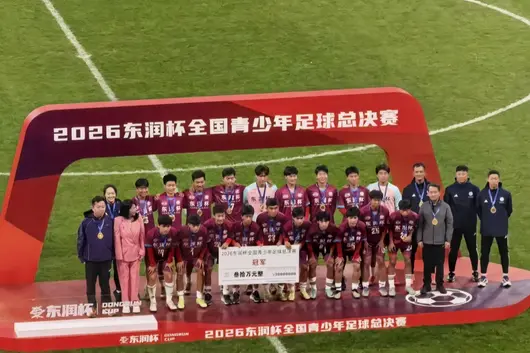

When talking about Beijing Workers' Stadium, what people might think of are professional leagues, star players, and massive TIFOs. But this time, standing on the pitch is a group of high school students.

On October 24, the 3rd Dongrun Cup National Youth Football Finals concluded at Beijing Workers' Stadium. Tsinghua University High School ultimately defeated Shijiazhuang No. 2 Experimental High School 2:0 to take the championship. For these children who play football, playing a national final on a pitch like this is probably unforgettable for a lifetime.

However, compared to who won the championship, I think what is more worth attention in this Dongrun Cup is how many ordinary football-playing children it gave a larger stage.
Because not every child who likes football has the opportunity to enter a professional youth training system. Many people just play football in school, attend training classes normally, and participate in inter-school competitions. What kind of coach they meet, and what level of competitions they can play, largely also affects how far they can go.
I used to play campus football myself. Seeing Licheng No. 2 High School and Shandong Normal University High School in the teams this time, I felt quite emotional. Back then I often went to Shandong Normal University High School to play, I never thought one day I could go out of province to compete. Just being able to play in the Mayor's Cup or Quancheng Cup was already quite satisfying.
Now looking at these high school students, representing their school all the way to Beijing Workers' Stadium to participate in a national-level campus football event, this stage is much bigger than what we had back then. This is the significance of the Dongrun Cup.
This edition of the tournament covered more than 20 provinces, municipalities, and regions across the country, 352 schools, benefiting approximately 5,000 players and coaches. Ultimately, 22 teams came to Beijing to participate in the finals. As the event's top strategic partner, BYD, along with the Dongrun Charity Foundation, provided these campus football teams with opportunities to step onto bigger stages. BYD joins hands with Dongrun to build football dreams together.

To be honest, for playing football, just liking it is not enough. No matter how seriously you practice daily, if high-level matches are missing, many things still cannot be trained out. Taking on teams from different regions and styles is how you know where the gaps are, and learn things not accessible in daily training.
I used to think that campus football doesn't lack kids who like playing, but lacks better game opportunities. Especially for teams from ordinary schools, being able to go out to broaden horizons and play against strong teams is truly not an easy thing.
What BYD does goes beyond just supporting this Dongrun Cup tournament. Starting in 2024, BYD has organized football youths to visit countries such as Germany, Japan, Spain, Thailand, Italy, Brazil, Mexico, and South Korea to exchange with overseas clubs, totaling over 200 participant-trips. Meanwhile, it has always been focused on grassroots football development in regions like Xinjiang and Guizhou, delivering football equipment and other support to local children.

On one hand, allowing talented children to have opportunities to experience higher-level football; on the other, enabling more ordinary campus teams to participate in quality matches. These two things are actually indispensable to each other.
After all, for Chinese football to truly develop, we cannot just focus on the few players who have already made it. We must also let more children have the chance to play balls and matches. With more participants and a solid grassroots foundation, it becomes possible to cultivate more promising young talents.
In the past, when we played football, we felt it was good enough to participate in city-level competitions; now, more campus teams have the opportunity to leave their local areas and even stand on stages like Beijing Workers' Stadium.

And BYD's continuous investment in youth football is simply to bring such opportunities to more children.
For these high school students, this might be just one match, but it is also a rare experience on their football journey. As for whether they can become professional players in the future, it may still be uncertain. But at least, they have the opportunity to stand on a larger stage and see how far they can go. Today, there is a Zhou Yuno in the team; perhaps through this match, everyone will improve their game, and there will be more national-level players later on.


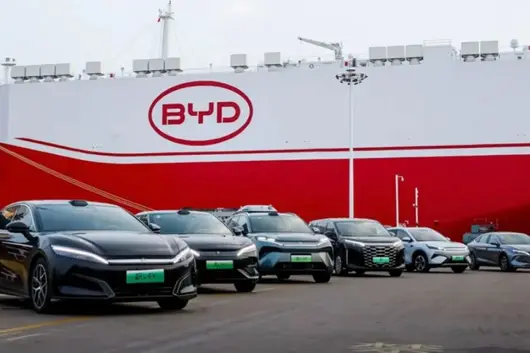
463,600 units. BYD's single-month sales volume in September hit a new high for the year. But more worth analyzing than the total is that nearly 180,000 units were sold overseas—two and a half times the figure from a month ago. When a car company's 'money bag' starts moving from domestic to overseas, this is no longer just sales news, but a shift in business model.
First, let's clarify the numbers. BYD sold approximately 463,600 new energy vehicles in September, a year-on-year increase of about 17%; among them, overseas sales (passenger cars and pickups) reached about 179,900 units, a huge year-on-year increase of 153.9%, accounting for nearly 40% of total sales. Breaking down the extra 67,000 units from the September year-on-year increase, about half came from overseas—meaning for every additional car sold domestically, one more was sold overseas. Looking at January to September, BYD's overseas cumulative sales reached about 1.3378 million units, a year-on-year increase of about 90.7%, with overseas sales share exceeding 40%.

This incremental structure is key—it shows BYD's growth engine is switching from 'volume created by domestic competition' to 'volume seized from overseas'. No matter how fierce the price war in the domestic market, BYD has this overseas cushion.
But what's more explosive than sales volume is the reversal of revenue structure. BYD's overseas revenue in the first half of 2026 was approximately 181.268 billion yuan, a year-on-year increase of about 33.9%, accounting for about 52.57% of total revenue—for the first time in history, overseas revenue exceeded domestic. Some reports calculate that BYD's overseas average vehicle revenue is about 184,400 yuan, about 1.45 times that of the domestic market, with a significantly higher unit price.

This is the true turning point. The domestic new energy vehicle market has become a red ocean, with price wars compressing vehicle profits to extreme thinness; whereas overseas, the same cars can sell for much higher unit prices. In other words, BYD is not just selling cars abroad, it is moving the 'profit cow' abroad—domestic operations focus on scale and market share, while overseas operations focus on profit and valuation logic.
So how was this wave of going global implemented? Not by hard-forcing through sea transport, but by bypassing tariffs through localized factory construction. Public data shows that BYD's Rayong, Thailand factory was its first overseas passenger car base, with a designed annual capacity of 150,000 units. In two years since production started, local cumulative deliveries have broken 130,000 units, with 5 models produced locally; the Brazil factory went into production in 2025, initial annual capacity 150,000 units, continuing to expand, serving Latin America; on the Europe side, the Szeged, Hungary factory has started pilot production with a target of mass production by year-end, with a planned annual capacity of about 200,000 units, being BYD's first foothold in the EU; the Turkey factory is also planned to land, although it is not an EU member, it has a customs union with the EU, just right for radiating the European market.
This 'localized factory construction' strategy is essentially trading heavy assets for tariff permits—in the background of the EU imposing additional tariffs on Chinese electric vehicles, relying on whole vehicle exports to force through is becoming harder. Some car companies calculate that tariffs in Europe and the US alone eroded over 10% of costs. BYD started laying out overseas factories two years in advance, and now it is just in time to handle this export volume surge.

This is a typical 'happy problem'—demand runs ahead, while capacity and local production cannot keep up. Short-term this is a growth constraint, but long-term it is actually good, indicating overseas demand is real and sustainable, not a one-time volume spike. What really needs monitoring is whether factories in Thailand, Brazil, Hungary, etc., can ramp up production on schedule, turning 'cars blocked at sea' into 'cars parked in dealer courtyards'.

For consumers, the direct impact of this is actually not great—you are still buying that same car, that same domestic after-sales network. But there are two indirect signals worth noting. First, BYD sells cars abroad at higher prices with thicker profits, meaning it has more confidence to withstand price wars domestically, which is a benefit for domestic buyers; Second, when a car company tilts its focus overseas, its resource allocation and new product rhythm in the domestic market may also be fine-tuned, the attention domestic consumers can get might not always be 100%. However, this is all for later, in the short term BYD's domestic basic foundation will not loosen.
This round of BYD's 'overseas revenue first exceeding domestic' is a landmark node for the Chinese automotive industry moving from 'product going global' to 'capacity going global, brand going global'. For those waiting to buy BYD, don't think the domestic market will be neglected because it is 'busy going global'—on the contrary, money earned overseas will feed back into domestic R&D and pricing.
What you need to do is return to your own budget and scenarios: valuing cost-effectiveness and selection range, BYD domestic models are still the top tier worth test driving in the 200,000 yuan price range; just next time when you see its news, remember not to only stare at the domestic sales list—this company's story has already been written half in overseas.

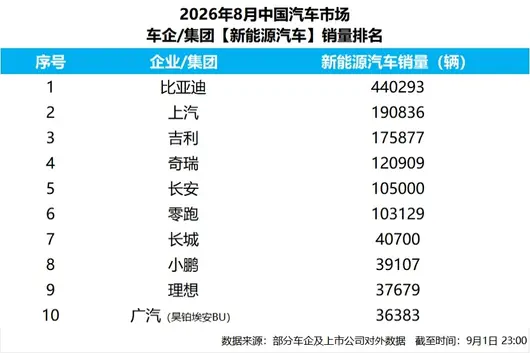
The 1st of every month has become an unshakeable "Sales Release Day" in the auto industry. On September 1st, new energy vehicle manufacturers revealed their August sales figures. When seeing the number 440,293 units for BYD, everyone took a deep breath. This isn't just leading, it's a "cliff-like" presence.

What is the concept of 440,000 units? Let's put it this way, the sum of the 2nd to 4th on the leaderboard has only just touched its taillights. Sales reached a new milestone again, BYD, without controversy, once again took the sales champion of Chinese automakers and new energy sales champion, more strongly continuing the record of "No. 1 for consecutive 63 months".
In today's global auto market, why can BYD still sell so much? This is no longer just a product power issue, but a comprehensive overwhelm of system power. In short, BYD has almost "welded" various vehicle usage needs of global users into its product matrix.

What we see most daily is still the Dynasty and Ocean series, regulars for city commuting, grocery shopping and picking up kids. The newly listed Qin MAX broke 10,000 in its first month, indicating that A-segment family sedan users who were debating Sylphy and Lavida find it hard not to be moved after seeing the space and fuel consumption of Qin MAX.
What is more interesting is high-endization. Fang Cheng Bao sold 42,000 units in a single month, a 155.6% surge year-on-year, actually reaching first place among new EV brands with an average price of over 200,000 yuan. Denza is even more capable, 16,000 units in August, managing to stand firm in the MPV and luxury sedan market, with higher value.

The most surprising is exports. 189,000 units in August, 5 consecutive months of record highs, cumulative 1.158 million units in the first 8 months, already exceeding last year's full year. In countries like Thailand, Brazil, Israel, Dolphin and Song PLUS have become street cars, BYD has become a synonym for Chinese cars abroad.
Of course, the sales behind cannot be separated from the technical moat. The 2nd Gen Blade Battery and Flash Charging technology released in March this year, have received widespread recognition. As of August 28, 10,000 charging stations have covered 332 cities. "5 minutes to charge well, 9 minutes to charge full", this saying is not false.

This means in the time it takes to go to the service area to use the toilet, buy a coffee, the battery is full, range anxiety is being quickly diluted before the flash charge speed and flash charge network. This forward-looking technical strength and super-fast charging station construction speed, gave the market and users great confidence, is the confidence for BYD to continuously rise.
August is just the mid-game. With Denza Z9S, Denza Han starting pre-sales, Sealion 08, Denza N8L Pure Electric version, Fang Cheng Bao S series launching in September, plus the new cars like 3rd Gen Tang, Ti 9 etc. bombing sequentially, this chess game in the second half, BYD obviously still needs to continue expanding results.

Final Thoughts
When an automaker presses the gas pedal simultaneously on product, technology, brand, and overseas dimensions, the competitors behind it see not just a gap, but a chasm difficult to cross in the short term. For consumers, this might be a good thing. After all, that era of "fuel and electricity same price" or even "electricity lower than fuel", was really driven by it to this extent. To summarize in one sentence: BYD's best performance is still ahead.