首頁Paris Auto Show

搜尋歷史
熱門搜尋
經銷商登入 / 註冊


In early October 2026, a familiar name appeared on the test drive schedule of European media: Geely. At the carefully designed test venue, multiple new cars waited for inspection by European professional media. With flawless driving quality and a tech luxury cabin exceeding expectations, discussions beside the cars quickly shifted from "How is this car" to a more topical question: What exactly does a Chinese automotive group rooted in Europe for nearly two decades want to achieve by making a high-profile appearance at the Paris Auto Show?

The answer given by Geely is much longer than a list of participating models. At this edition of the Paris Auto Show, Geely Automobile Holdings presented its three brands—Geely, Lynk & Co, and Zeekr—in a joint premiere, with a new energy product matrix ranging from mainstream to luxury lined up in a row. The exhibition lasts only seven days, but the commitment is calculated in ten-year units.

Three booths, three strategies, placing "from mainstream to luxury" on the same table
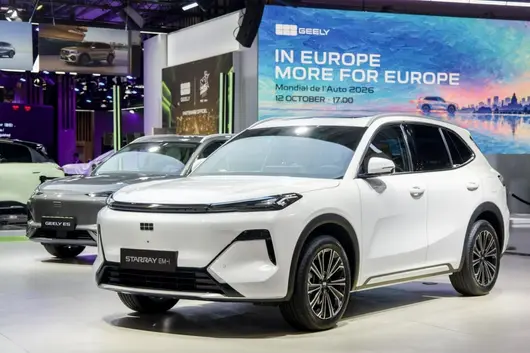
To understand Geely, look at brand segmentation first. Three booths represent three markets, executing a combination of "front-end segmentation, back-end sharing". The message Geely wants to convey is straightforward: for its first participation in the Paris Auto Show, it pushed the Geely Monjaro EM-i to the European premiere slot and simultaneously launched it in the high-spec market. This car is Geely's first D-segment PHEV global vehicle. Choosing to premiere in Paris and prioritize overseas launch, the attitude itself speaks volumes.

Also on display was the Galaxy Starship 700, premiering in Europe after its global release on October 10th, along with models like Geely E5, Geely E2, and Geely Starray EM-i, filling the booth with new energy product lines ranging from household to off-road.

The highlight of the Lynk & Co booth is the European premiere of Lynk & Co 07GT. As the brand's first B-segment PHEV Wagon, it is the core product of the brand's "Broadening Strategy", entering the travel car consumption scenario familiar to Europeans with trendy sporty design. This means Lynk & Co's product matrix in Europe has formally expanded from SUV to the wagon category favored by local users.

The Zeekr booth appeared steadier, placing the flagship Zeekr 9X, positioned as luxury within the group system, in the center. This vehicle was designed by the Gothenburg design team and is a key strategic model for Zeekr entering the European luxury SUV niche market. The new Zeekr 7X beside it was equally significant: achieving comprehensive advancement in dimensions such as ADAS, cabin, exterior, color, range, and performance, it is planned to commence first deliveries in Q1 2027, while its global cumulative production has already broken 200,000 units.

Three brands, three positioning: Geely targets the global mainstream mass market, Lynk & Co targets the high-end new energy market, and Zeekr targets the luxury market. Together, the three booths are a microcosm of Geely's global expansion.
2.23 million, 798,000: Globalization is not a slogan, it's the numbers
To judge whether an automaker's globalization is serious or just posing, the numbers are the baseline.

First, the scale. From January to September 2026, Geely Automobile Holdings' cumulative sales exceeded 2.23 million units, setting a new historical high for the same period; among which overseas exports were 797,670 units, up 169% year-on-year. A more noteworthy rhythm is that overseas exports exceeded 100,000 units monthly for 4 consecutive months, with September single-month exports reaching 106,685 units, up 162% year-on-year. Because the pace achieved in the first 9 months, the annual export target was raised from 640,000 to 920,000 units, sprinting towards the million-unit level.

Next, the network. The group's business covers over 100 countries and regions, with over 2,300 sales and service outlets built; Geely brand entered 88 countries and regions with overseas outlets over 1,200; Lynk & Co business expanded to 53 overseas countries; Zeekr covers over 60 countries and regions with nearly 800 global stores. The R&D and manufacturing footprint also landed overseas: 5 major design centers and 5 major engineering R&D centers arranged in Shanghai, Hangzhou, Ningbo, Gothenburg, Milan, Coventry, Frankfurt, etc.; and 11 overseas manufacturing plants in operation in Malaysia, UK, Brazil, etc.

The technical foundation supporting these figures is also displayed on the booth: i-HEV Smart Engine Hybrid achieved engine thermal efficiency of 48.41% and comprehensive fuel consumption per 100km as low as 2.22L, breaking Guinness World Records; 5th Generation Geely Smart Charging Pile single gun peak power 2.2MW, 4 minutes ready to drive, 8 minutes fully charged; New Generation Shield Gold Brick Battery is at the forefront of mass-produced vehicle level with 12C peak charging rate; Thunder 16-in-1 Smart Electric Drive overall efficiency 93.8%, first equipped with Geely Galaxy TT, creating two Guinness World Records: "Lowest Energy Consumption Around Qinghai Lake" and "Longest Continuous Dual-Car Drift on Wet Roads". On technical routes, pure electric, plug-in hybrid, extended range, hybrid, and alcohol hydrogen five routes run in parallel, with core three-electric systems fully self-developed. To summarize in one sentence, "Technology independence, full market coverage".
"One Geely" Going Global: Why systemic operation is more resilient than single-product breakthrough
Single brand going global bets on a hit car; system going global bets on risk resilience and localization speed. Geely's going global logic obviously belongs to the latter. It relies on the "One Geely" system of the group's complete industrial ecosystem: back-end R&D and supply chain highly shared, front-end three brands maintain independent positioning and user operations, precisely covering different niche markets.

This system has more obvious advantages when facing European market barriers. Geely follows an "Industrial Symbiosis" light-asset cooperation path: not building new factories, not building new capacity, but sharing capacity, sharing market, sharing results with global peers. Deep cooperation with partners like Volvo, Renault, and Ford covers technology, channels, manufacturing, powertrains, able to handle tariffs and investment barriers, and quickly scale up localization.

Starting from January 2027, Volvo Cars will become Lynk & Co's exclusive dealer in Europe. The significance of this cooperation goes beyond channel agency: relying on the group's internal asset portfolio, mobilizing operational and channel capabilities of mature luxury brands within the system to empower Lynk & Co, achieving deeper localized operations. This "incubating brands using the system" approach is hard for single brands to replicate.
From product export to local manufacturing, Geely's globalization is shifting gears: relying on global capacity layout and partner factory network, from "selling to Europe" to "making in Europe, selling in Europe".
Europe wants not just "Exhibitors", but "Co-builders"
At the auto show, products are compared; off the show, compliance, R&D, and responsibility are compared. The landing point of "Long-term" is exactly outside the booth. Europe's test for outsiders, product capability is just one link; Geely's response is to become a co-builder on the industrial chain.

Compliance first. In March 2026, Geely's Vast Horizon G-ASD System obtained UN R171 certification, becoming the first Chinese automaker to obtain this certification, securing the "passport" to the European high-end ADAS market first, bringing high-end ADAS solutions meeting UNECE regulatory requirements to Europe.
Also in March 2026, Geely Tech Europe Company was established, integrating R&D businesses in Gothenburg, Sweden and Frankfurt, Germany, with the goal of compressing the new car release interval between China and abroad to within 6 months. Gothenburg's design and R&D centers serve Zeekr and Lynk & Co, Italian design center serves Geely brand. Europe is not just Geely's sales market, but also an R&D and design stronghold.

ESG and Safety are another yardstick for "long-term" measured by European partners. Geely was selected in S&P Global "Sustainability Yearbook 2026", is the only Chinese automaker shortlisted; carbon emissions per vehicle over its full lifecycle in 2025 decreased by 25.5% compared to 2020, exceeding the 25% phase target, continuously promoting 2045 Carbon Neutrality target; Lynk & Co conducted lifecycle assessments for 01, 02, 08, European self-operated facilities use 100% renewable power.

At the safety level, the group already has 10 car models with Euro NCAP 5-star rating, covering products from Zeekr 007GT to Geely E2 of different positioning; Global All-Domain Safety Center holds five Guinness World Records, open to the entire industry; Geely is also the first Chinese automaker to join the European Road Safety Information System (DFRS), participating in Europe's real-time road hazard information network via anonymized data sharing.
Conclusion
Auto show ends, spotlights fade, cars on the booth will change one after another. But what Geely brought to Europe—nearly 20 years of cooperation depth, 11 factories, 5 major R&D design centers, network covering over 100 countries and regions, and the stance of "Grow together with European industry"—will not disappear with the end of the exhibition period.

The three booths at the Paris Auto Show are a mirror of Geely's globalization: long-term deep cultivation, so dare to stretch the timeline to 20 years; systemic operation, so three brands can fight their own battles, sharing the same back-end; industrial symbiosis, so can turn the European market from "Destination" to "Co-building Place".
This "Long-Term Commitment" cannot be written in the participation list, must be fulfilled with the next 20 years.

The Paris Auto Show has just concluded, but discussions around the display of Chinese intelligent driving solutions continue.
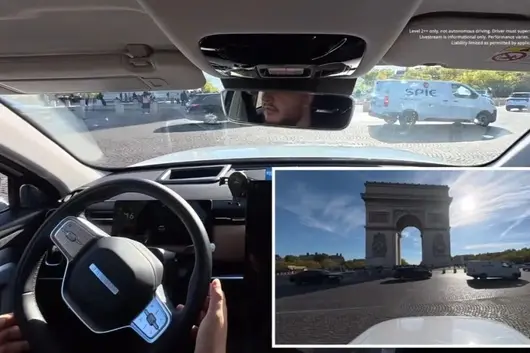
During the show, multiple Chinese companies drove their intelligent driving solutions on Paris streets, including Xpeng NGP, BYD God's Eye, etc., competing alongside Tesla FSD. Among them, Momenta and Chery JAECOO 7 jointly completed the first Arc de Triomphe intelligent driving challenge without manual intervention, bringing the adaptability of Chinese intelligent driving solutions in complex European traffic environments into the spotlight.

It is worth noting that the Arc de Triomphe roundabout is known as the 'world's most devilish roundabout' due to complex traffic. According to media reports, multiple companies have conducted intelligent driving tests here, but manual intervention occurred to varying degrees during the process. The challenge route selected by Momenta this time is the longest, with the most complex road conditions. Its performance of 'no manual intervention' throughout provides a valuable real-world sample for observing the adaptability and operational stability of Chinese intelligent driving solutions in complex European traffic environments.
But what is more worth discussing than a successful challenge is: how can an intelligent driving system that has accumulated mass production experience in China quickly master European road conditions and accelerate implementation? How will intelligent driving capabilities become a new trump card for Chinese cars competing in overseas markets?
Intelligent driving technology demonstrations can indeed bring attention to Chinese companies, but to convert this attention into competitive advantages in overseas markets, multiple thresholds such as local adaptation, vehicle integration, compliance verification, and mass delivery need to be crossed. Momenta's Arc de Triomphe challenge provides a specific sample for observing this process.
What does the 'no manual intervention' challenge on the 'world's most devilish roundabout' indicate?
During the Paris Auto Show, Chinese companies pushed their intelligent driving solutions under the global media's magnifying glass, almost a 'naked exam' without any 'rehearsal'.
Choosing the Arc de Triomphe roundabout as the challenge venue is undoubtedly an active 'increasing difficulty'. 12 avenues converge here, clear lane markings are lacking within the roundabout, vehicle driving trajectories intertwine, plus the implementation of a special 'yield to right rule' (i.e., those entering the roundabout first must yield to those entering later), which puts high demands on the driving system's environmental understanding, intent judgment, and real-time decision-making capabilities.
In this test, the JAECOO 7 test vehicle equipped with the Momenta R7 World Model departed from La Défense, crossed the Seine, passed through Neuilly-sur-Seine, entered the Arc de Triomphe roundabout and surrounding blocks, with a total distance of about 11.38 kilometers.
The route involved no-marking roads, 12 exits of the roundabout and multi-directional traffic merging, as well as construction detours, and complex scenarios such as pedestrian and cyclist interaction. The continuously changing road environment not only tests the system's ability to handle complex road conditions but also examines whether it can maintain stable and coherent driving performance between different scenarios.
More noteworthy, according to foreign media reporters, traffic flow on French streets often stops and goes, vehicles vie to find gaps to merge, and motorcycles weave through narrow gaps alongside cars. Faced with such traffic conditions, Momenta demonstrated response capabilities like a local 'old driver' at the Arc de Triomphe roundabout during peak hours, smoothly shuttling through intersecting traffic flows, entering the roundabout and accurately selecting target exits to drive out.
For Chinese companies, driving intelligent driving systems onto Paris streets involves more than just deploying models that have been heavily trained and verified domestically onto European vehicles. In relatively standardized scenarios like highways, intelligent driving capability migration is relatively easy; but what truly widens the experience gap is understanding local rules, interaction habits, and low-frequency but complex long-tail scenarios in different markets. Just as the unique 'priority to the right' traffic logic of the Arc de Triomphe roundabout requires the intelligent driving system to adapt to local traffic regulations and make reasonable and expected decisions in unfamiliar scenarios.
For Momenta, the key to breaking the deadlock in globalization is precisely to solidify this cross-regional adaptability into deliverable and reusable products; only when experience can be consistently delivered across different vehicle models and markets can intelligent driving solutions step out of single road demonstrations and gradually move towards scaled applications.
Chery & Momenta Join Forces: How to Go from Road Demonstrations to Mass Production Implementation
For intelligent driving solutions going global, establishing local consumer awareness is a key step, with the goal of creating a technology label similar to 'Intel Inside' on automotive products.
Based on this, Momenta and Chery chose JAECOO 7, which is expanding its influence in the European market, as the display carrier. It is reported that since JAECOO officially entered the French market in April this year, brand new car registrations reached 2,589 units in September, with market share rising to 1.6%; in the same month, JAECOO 7 topped the sales list of all car models in the UK market. As the brand and models gradually accumulate a user base, Momenta's intelligent driving technology will also, relying on existing product awareness, enter the view of local consumers.

But for Chinese intelligent driving solutions to move from technical demonstrations to scaled applications in overseas markets, a complete product implementation chain needs to be connected. The European market has strict requirements for vehicle safety, data protection, and product compliance, and road conditions, traffic rules, and driving habits vary from country to country. For intelligent driving solutions to truly serve local users, vehicle integration, local adaptation, testing verification, and access certification need to be advanced in coordination, and a continuous operation and iteration mechanism after delivery needs to be established.
For Chery, which has ranked first in Chinese brand passenger car exports for 23 consecutive years, deep cooperation with Momenta helps combine its own global market experience with intelligent driving technology, further enhancing overseas product competitiveness. Supporting the completion of the 'no manual intervention' challenge this time is precisely Momenta's long-term accumulation in algorithm R&D, engineering delivery, and mass production practice, as well as the cross-regional adaptability continuously expanded on this basis.
This capability is first reflected in the technical path. Momenta's mapless solution reduces the system's dependence on high-precision maps for specific regions, reducing some preliminary work for entering new markets; the R7 World Model further focuses on the road environment, traffic participants, and dynamic interaction itself, providing support for prediction and decision-making in unfamiliar scenarios. At the same time, Momenta's L2 mass production intelligent driving and L4 autonomous driving have always shared a set of underlying models, technical investment can be reused bidirectionally, improving technology iteration efficiency.
As of now, Momenta's mass production solutions have accumulated installations exceeding 1.3 million units, with cumulative delivery of mass production models exceeding 110, and fixed-point models exceeding 230; the actual vehicle mileage accumulated in mass production business exceeds 15 billion kilometers, and over 100 million segments of high-value training data have been screened, achieving over 10 million kilometers of daily simulation. The accumulation of these data and simulations is not only to cover richer road and driving scenarios, but more importantly to extract transferable driving knowledge from them, providing capability support for systems to enter new markets and adapt to new road conditions.
When the 'export sales champion' and the intelligent driving 'first tier' join forces, both sides are expected to form a new growth flywheel: Chery's overseas market and product layout provide implementation scenarios for Momenta's intelligent driving technology; local verification and user feedback drive continuous system optimization, and a more mature intelligent driving experience in turn enhances vehicle model attractiveness, providing support for market expansion.
For Chery and Momenta, the Arc de Triomphe challenge is a starting point. A longer-term goal is to let vehicle exports and intelligent driving exports promote each other, jointly opening up new space for Chinese cars in global competition.
Intelligent Driving Going Global: How to Form Long-Term Value for the Chinese Automotive Industry?
Inside and outside the venue of this Paris Auto Show, a clear trend has already emerged: intelligent driving going global has become a mandatory question for Chinese car companies to go global.
Among the 59 whole vehicle exhibitors, Chinese brands occupied 22 seats, reaching 37.3%, exceeding the sum of French and German exhibitors. Export data for the same period was equally bright. Data from the China Passenger Car Association shows that from January to September 2026, China's automotive exports reached 8.63 million units, a significant increase of 52% year-on-year, already surpassing the scale of whole vehicle exports for the entire year of 2025.

However, the growth in booth size and whole vehicle sales does not equate to intelligent driving going global achieving the same frequency breakthrough. Among the participating Chinese car companies, 9 can directly place orders in France, but the models they sell in Europe are still mostly basic L2 driving assistance. Some models equipped with city NOA domestically have not yet opened corresponding features for overseas versions.
At the same time, the price advantage of Chinese car companies in overseas markets is being flattened by tariffs, and competition has further extended to brands, services, and user experiences, while intelligent driving experiences are becoming an important entry point for establishing differentiated competitiveness.
It can be said that whole vehicle exports send Chinese cars into European showrooms, while intelligent driving exports are what keep Chinese cars on European streets, providing support for sustained growth.
For Momenta, going global is not just outputting a solution, but deeply integrating into the global automotive industry chain. Previously, Momenta had already established cooperation with European automakers such as Daimler. Not long ago, Momenta and Dongfeng Peugeot-Citroën launched a global strategic cooperation, promising to deeply participate in the product requirement definition and project development process of Peugeot and Jeep. This is the first time that the advanced World Model technical paradigm is going global, which also means Momenta is integrating Chinese algorithms and Chinese R&D capabilities into global models, deeply into the European market interior.
At the same time, localization testing and compliance verification for Europe are also steadily advancing. On July 29 this year, Momenta obtained L4 autonomous driving test approval from the German Federal Motor Transport Authority (KBA). This is the first time a Chinese enterprise has obtained such national qualification in Germany, representing a key step for Chinese intelligent driving in the European high-standard access system.
Momenta's global layout is also extending to product applications in more markets. Currently, models equipped with Momenta intelligent driving solutions have covered 10 countries and regions globally, including markets such as Norway, UK, UAE, Singapore, Australia, New Zealand, Thailand, etc.
The Arc de Triomphe challenge opens a window for the world to observe the globalization capabilities of Chinese intelligent driving. However, from going overseas to building long-term competitive advantages, more companies like Momenta are needed to solidify technical capabilities into scalable and continuously iterated products, so that more car companies are willing to equip and more consumers are willing to trust, which can promote "China Intelligent Driving Inside" from technical cooperation to experience recognition. Casting sustainable product competitiveness through technological innovation and deeply participating in the global intelligent transformation is the ultimate significance of Chinese intelligent driving going global.