首頁Overtaking

搜尋歷史
熱門搜尋
經銷商登入 / 註冊

The 2026 first-half global automaker sales rankings are out: BYD (4.8%), Geely (4.6%), and Chery (4.1%) ranked sixth, seventh, and ninth respectively, the three combined account for 13.5%, surpassing VW in second place for the first time—this marks the first time three Chinese automakers appear simultaneously in the global top ten. If counted by group, SAIC ranks fourth with 2.045 million units, making four Chinese automakers actually present in the top ten. From "market for technology" to "technology for market", Chinese autos have achieved a leap from zero to the global forefront through changing lanes to overtake. So, will the future global automotive industry landscape be rewritten again?

From Zero to Top Ten: The Differentiated Path of Changing Lanes to Overtake
In the fuel vehicle era, patent barriers for engines and transmissions were long held by Europe, America, and Japan, while Chinese automakers trailed behind.
The wave of new energy and intelligence gave China a chance to "redraw the track": in core areas such as power batteries, electric drives, and intelligent driving, China achieved a paradigm shift in technology from trailing to leading, bypassing the moat of traditional internal combustion engines.

It is this differentiated track that allowed Chinese automakers to complete a path that traditional giants took half a century in ten years—not directly confronting internal combustion engines, but starting a new table with electrification and intelligence, pulling competition into the opponent's weak areas.
Five Levels of Global Auto Landscape Restructuring
This historic breakthrough implies major changes on five levels (see table below), rather than a single enterprise's victory:

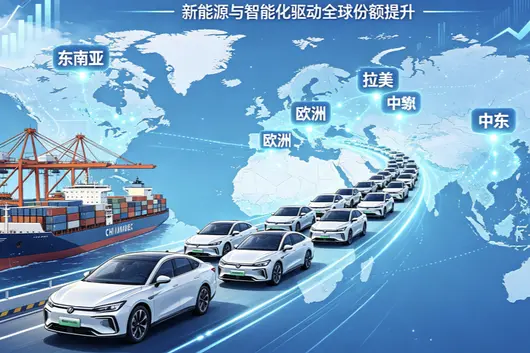
The core growth pole of the global automotive industry is shifting; Chinese automakers have won the initiative in the division of new technologies; at the same time, through the localization of "overseas factories + supply chain", they export capacity, technology, and standards, building an integrated ecosystem of "cars + chargers + services", significantly enhancing risk resistance. The clustering effect of the super-large market and the most complete industrial chain continues to amplify R&D cycles and cost advantages.
Multi-point Bloom of Chinese Cars in Five Major Global Regions
Southeast Asia:
Already an absolute leader in new energy. Thai brand share for pure electric is over 75%, EV market share in Indonesia 91.7%; in January 2026, Thai brand share reached 47.34%, historically surpassing Japanese brands (47.338%) for the first time, ending the 60-year Japanese monopoly.
Europe:
In May, top five Chinese brands registered 138,000 units with 12% share, surpassing Japanese automakers (130,000 units/11.3%) for the first time in history, expanding further in June; facing EU tariffs, accelerating deep localization through joint ventures and technology exports.

Chery Automobile First-Half Monthly Export Details
Latin America:
Brazilian pure electric Chinese share once exceeded 92%, BYD Dolphin Mini topped the Brazilian retail list in February 2026; Mexico exported 625,000 units in 2025, surpassing Russia for the first time to become China's largest export destination; Chile's light vehicle share exceeded half (51.6%).
Middle East:
Upgrading from "low price" to "high-end". Saudi brand sales broke 100,000, market share over 15%; UAE import volume in first two months 103,900 units, +53% YoY. Thermal management upgrades for high temperatures and dust, premium brands like Zeekr, Voyah, Nio won over the wealthy.

BYD First-Half Monthly Export Details
Russia:
Europe, America, Japan, Korea withdrew leaving space, Chinese brand share reached 54.6% (peak 54.9% in June); Chery, Great Wall, Geely rank at the forefront, using technology licensing + local assembly (e.g., TENET, XCITE) to avoid scrappage tax and 22% VAT.
End-of-Year Global Auto Market Top 10 Forecast
First half China exports 5.307 million units, +53% YoY, June single month 1.069 million units; New energy exports +68.7% (360.68 billion yuan). July continues volume and value growth—first 5 months exports volume +48.7%, value +45.5%, ports like Ningbo doubled new energy vehicle export volume and value. Annual exports expected to break 10 million for the first time, providing ammunition for more Chinese groups to break into the top ten.
Who will break through again at year-end? Based on BYD, Geely, Chery (independent brand basis) already on the list, the strongest new entrants are Changan and Great Wall: Changan releases in multiple points including Brazil, Mexico, Thailand, Russia; Great Wall digs deep in Russia, Thailand, Brazil and stays at the forefront locally, both export growth rates in the top tier.

Geely Automobile First-Half Monthly Export Details
Need to note statistical basis differences: In the user context, "three" focuses on independent brands, while under group basis SAIC has long been firmly fourth—this means the expansion of the "Chinese formation" at year-end is more considerable than surface numbers. As for Leapmotor, Xiaomi, etc., new energy dark horses growth is fierce (Leapmotor first half 260,000 units, +29% YoY), full year group total still has distance to top ten for all categories, more likely to first challenge new energy sub-lists.

Conclusion
From zero to squeezing into global top ten, Chinese autos took twenty years; from one exclusive show to three joining hands, only three years were needed. But the real challenge has just begun—from "sales champion" to "brand champion" and "technology champion", from "price war" to "value war", Chinese automakers need to establish emotional connection surpassing price-performance ratio in the hearts of global consumers. The power shift in the global automotive industry has already occurred, and the next story will be written by how Chinese automakers write it.