首頁Nissan

搜尋歷史
熱門搜尋
經銷商登入 / 註冊

Under the combined pull of new energy transition and growth in overseas demand, pickup market sales grew steadily. Wholesale data from China Passenger Car Association (CPCA) shows (including exports), from January to June 2026, cumulative pickup sales in China reached 343,000 units, a year-on-year increase of 11.9%, among which exports were 188,000 units, up 34% year-on-year. The overseas sales share rose to 55%, becoming an important engine driving overall growth; cumulative new energy pickup sales reached 45,000 units, a slight increase of 8% year-on-year.

In terms of corporate performance, the top 10 pickup manufacturers in the first half of 2026 showed distinct differentiation. Great Wall Motor sold a total of 92,512 pickups, a slight year-on-year decline of 3.9%, but remained number one in the industry. SAIC Maxus accumulated 36,804 units, up 28.1% year-on-year, rising from third place last year to second. Changan Automobile totaled 35,734 units, up 43.9% year-on-year, ranking rising to third in the industry. JAC and Zhengzhou Nissan had similar sales volumes, ranking fourth and fifth respectively. Among them, Zhengzhou Nissan led the top ten industry enterprises with a 51% year-on-year increase.
JMC ranked sixth with 28,704 units, and Foton ranked seventh with 23,288 units; BYD sales were 20,037 units, ranking eighth; Radar New Energy sales were 11,111 units, up 40.5% year-on-year, surpassing Jiangxi Isuzu to take ninth and tenth seats respectively.
Compared to the list from the same period last year, market positions showed significant adjustments. Companies that expanded overseas early and had complete new energy products achieved rapid growth. Brands focusing mainly on the domestic fuel market and with lagging transformation progress faced sales pressure. The pickup industry competitive landscape is undergoing a structural adjustment.
In the first half of 2026, pickup wholesale sales in China generally rose. As the industry leader, Great Wall Motor sold a total of 92,512 pickups in the first half. Despite a 3.9% year-on-year decline, it still ranks first in the industry with absolute advantage. As a leading domestic pickup brand, Great Wall Motor relies on a full series product layout in the 70,000-300,000 price range, advancing together in commercial, passenger, off-road, new energy, and export fields, building a systemic advantage.

SAIC Maxus, ranked second, sold a total of 36,804 pickups in the first half, up 28.1% year-on-year, rising from third place in the industry last year to second. The continuous expansion of export advantages was key to SAIC Maxus's ranking leap. In May, the pickup export scale reached first place in the industry. The monthly sales in June reached 7,871 units, up 83% year-on-year, leading the growth speed in the domestic pickup sub-sectors.
Changan Automobile's market performance was equally bright. Cumulative pickup sales in the first half reached 35,734 units, up 43.9% year-on-year, jumping from sixth place in the industry last year to third. In March, Changan pickup monthly sales exceeded 10,000 units, up 112.4% year-on-year; June sales reached 6,595 units, up 42.7%. The launch of new products such as Changan Hunter K50, combined with continuous expansion of the export market, jointly drove the rebound of Changan pickups.
JAC Pickup, ranked fourth, sold 33,188 units in the first half, a slight increase of 0.8% year-on-year. Long-term deep dive into agriculture, forestry, engineering, and commercial sub-sectors, stable existing customers, but new energy model iteration speed is relatively slow, insufficient new volume support, exiting the top three in the industry.
Zhengzhou Nissan ranks fifth in the industry. Sales were 32,987 units in the first half, up 51% year-on-year. The brand concurrently advanced off-road, new energy, and internationalization layouts. Updated King Ray and Navara fuel models within the year; launched Fengtian plug-in hybrid and Ruiqi pure electric pickups to perfect the power matrix; new energy model sales increase was prominent, Fengtian series went overseas in batches and secured orders from multiple South American countries. Products and overseas channels jointly drove sales growth.

JMC sold 28,704 pickups in the first half, up 1.0% year-on-year. Ranking dropped from fourth place last year to sixth. In the first half, JMC launched two core models: the brand new Baodian and Dadao. But it did not reverse the market landscape. The brand new Baodian faces intense price competition in the commercial tool vehicle market; although the Dadao series saw obvious product capability upgrades, the launch time was late, combined with poor export performance, overall sales faced pressure.
Foton Motor sold 23,288 pickups in the first half, up 21.6% year-on-year, ranking seventh. Exports became the main driver of Foton pickup growth. Public data shows that from January to May 2026, pickup exports exceeded 15,000 units, growing rapidly year-on-year, focusing on deepening regional markets such as Latin America, Africa, and Oceania.
BYD sold 20,037 pickups in the first half, down 25.8% year-on-year. Ranking dropped from fifth place last year to eighth. As a new entrant in the pickup industry, BYD previously relied mainly on overseas exports to drive sales, but since 2026, competition in export markets has intensified. Combined with its "Shark" pickup not yet scaling up domestically, overall sales faced pressure. However, from a new energy dimension, BYD remains an important force in the pickup market. In June, new energy pickup overseas sales reached 4,000 units, maintaining leadership in the new energy pickup sub-sector.

Radar New Energy, under Geely, sold 11,111 pickups in the first half, up 40.5% year-on-year, surpassing Jiangxi Isuzu to rise to ninth place in the industry. This year, Geely Radar launched the King Kong EV pure electric pickup, supplying nationwide markets for commercial scenarios such as agriculture, forestry, and urban-rural distribution. It simultaneously laid out Thailand and Philippines overseas markets, achieving continuous rise in sub-sector market share.
Jiangxi Isuzu sold 11,008 pickups in the first half, a slight decrease of 0.8% year-on-year, falling back to tenth place in the industry. Jiangxi Isuzu relies on diesel hard-core pickups to stabilize engineering and off-road fixed customers, but development has multiple constraints: vehicle iteration update rhythm is relatively slow, new energy model implementation progress lags behind peers, meanwhile product pricing lacks competitiveness, lacking effective volume support, overall growth space is hard to open.


Last year, China's passenger vehicle exports surpassed Japan to take the global top spot; in the first half of this year, exports increased by another 65.3%, with the full year expected to break the 10 million vehicle milestone. This number is striking, but behind the glamour, an awkward reality is emerging: cars are selling in increasing volumes, but the walls of regulations are getting higher and higher.
The EU imposed countervailing duties of up to 35.3% on pure electric vehicles made in China, pushing the combined tax rate above 45%; Brazil raised import tariffs for electric vehicles uniformly to 35% starting from July 1st; Thailand implemented a 'production wager' mechanism, requiring the local production of 2 vehicles for every 1 imported; South Africa is also considering raising the import tariff for complete vehicles from China and India to 50%.
From Europe to Latin America, from Southeast Asia to Africa, Chinese automobiles are facing encirclement on all sides. The light-asset model of producing domestically and selling overseas has hit its ceiling.

On July 3, 2026, Chery made a move in Pretoria, South Africa, formally taking over the Rosslyn Plant, which Nissan had operated for nearly 60 years. This appears to be an ordinary transaction for Nissan to cut losses and Chery to expand production, but viewed under the proposition of 'how Chinese automakers can truly take root overseas', its weight is quite different.
Nissan Sheds Burden, Chery Takes Capacity
The sale of the Rosslyn Plant is part of Nissan's global restructuring plan 'Re:Nissan'. In the 2024 and 2025 fiscal years combined, Nissan reported a total loss exceeding 1.2 trillion yen. According to the restructuring plan, Nissan will close 7 plants globally and lay off about 20,000 people before the 2027 fiscal year, reducing global production bases from 17 to 10.

This factory previously produced models such as the Navara pickup and NP200, with products covering more than 40 African nations. However, capacity utilization rates have continued to decline in recent years. After the NP200 stopped production in March 2024, Navara became the factory's only in-production model, yet monthly sales were only a few hundred units. In May 2025, Nissan announced that local production of Navara would also cease. For Nissan, this factory has transformed from an asset into a burden.

For Chery, taking over an existing factory is more efficient than building from scratch. Chery entered the South African market in 2021, showing a steep growth curve. At this node of rapid expansion, local capacity means avoiding exchange rate and tariff risks, and also provides a hardware foundation for the next step of expanding market share.

More importantly, this acquisition is a piece in Chery's 'systematic overseas expansion' chess game. Since the beginning of this year, Chery has not just been selling cars but has deeply planted the roots of an entire industrial chain, including R&D, manufacturing, operations, and standards, into overseas markets.
In Europe, the European Operation Center and Research Institute in Barcelona, Spain, have been commissioned, and the joint venture factory with EBRO has also started production and operations; in Southeast Asia, a new factory in Vietnam worth 800 million USD is under promotion. The South African Rosslyn Plant is positioned as a comprehensive automotive hub radiating to Southern Africa.
The layout of these three locations supports each other, and a global manufacturing network is taking shape.
The Real Challenges of the South Africa Move
With the factory handover complete, the real test may have just begun.
Chery committed to retaining all 692 employees, planning to start production in mid-2027, with a future single-shift capacity of 50,000 units, and striving to achieve a 40% localization rate before 2028. This 40% is the core challenge.
Currently, South Africa imposes import tariffs of about 25% on complete vehicles, with the government considering raising the tax rate to the WTO-allowed limit of 50%. Once implemented, imported models dominated by Chinese and Indian brands will face direct cost pressures.
This is actually a positive for Chery. However, there are concerns; if the localization progress cannot keep up, the cost of importing parts will rapidly increase the overall vehicle manufacturing cost.

More realistically, the South African domestic market size is limited, with new car sales of about 550,000 per year, far insufficient to absorb large-scale production capacity. If the capacity of the Rosslyn Plant is to be fully utilized, Chery must treat South Africa as an export base, selling cars to Southern Africa and even farther markets. However, the automotive market size in most African countries is extremely small, infrastructure is weak, and export channels are not smooth.
Meanwhile, the foundation of the South African local parts industry is not optimistic. Data from the Motor Industry Association of South Africa shows that in 2025, only 33% of vehicles were manufactured locally in South Africa, a significant drop from the previous level of over 50%.
The South African local parts industry has long relied on orders from multinational automakers. As brands such as General Motors, Ford, and Nissan successively withdrew or reduced local production, the parts supplier system has already begun to shrink.

For Chery to achieve a 40% localization rate within three years, it means building or restoring an entire supply chain from scratch, introducing Chinese parts suppliers, and completing localization certification and production preparation. The schedule is quite tight.
Conclusion
Once this chess piece, the Rosslyn Plant, is placed, the situation on the chessboard begins to change. This is a landmark node for Chinese automotive export shifting from 'trade-type' to 'rooted-type'.
Against the background of tariff barriers encircling on all sides, the light-asset model relying on complete vehicle exports is unsustainable. Chery has chosen a more sustainable path, deeply planting an entire industrial root system including R&D, manufacturing, supply chain, and standards into overseas markets.
This path is not smooth. The 40% localization rate, the fragile parts system, and limited market capacity, each is a threshold that needs to be crossed. But Chery is not starting from zero.

The operational experience accumulated over more than 20 years of struggling overseas, as well as the global competitiveness of the Chinese automotive supply chain providing cost and technical support, its layout in Spain, Vietnam, and South Africa is forming a network effect.
Perhaps the most fitting conclusion is the words from Chery itself on social media: 'A new era is coming. From this moment on, Chery Automobile will proudly serve South Africa, manufactured in South Africa.'
This statement speaks not only of the fate of a factory but also of a fundamental transformation that Chinese automotive export is undergoing: from selling a car to rooting in a place. This is true globalization.


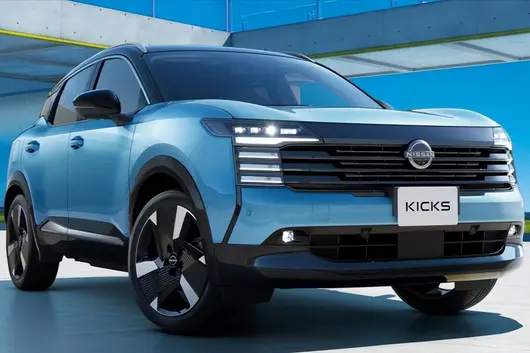
Nissan has officially launched the all-new Nissan Kicks in Japan. Unlike the crossover launched in the Thai market which is a heavily facelifted first-generation model, this Japan Domestic Market (JDM) model is the second-generation all-new product that has already debuted in North America.
This design may have been made considering the North American market demand; Nissan pointed out that the new car's design inspiration comes from an American football helmet.


Borrowing Nissan Serena's bold design language, the second-generation Nissan Kicks significantly replaced the brand's signature V-Motion grille with a more modern, boxy, and rugged aesthetic style.
At the front, the front fascia features daytime running lights directly integrated into the horizontal grille bars. At the rear, the profile is defined by upright, geometric lines and unique taillights, which contrasts sharply with the softer, rounder lines of the first-generation model.
Stepping into the cabin, the second-generation Nissan Kicks interior is equipped with a 12.3-inch dual-screen display and features an infotainment system with built-in Google services. The brand's famous zero-gravity seats are now available not only for the front row but also extended to the outer rear seats. To perfect the cabin experience, the dashboard, center console, and door panels are wrapped in soft-touch materials such as synthetic leather and fabric.


Under the hood, the all-new Japanese-spec Kicks is equipped for the first time with the brand's third-generation e-POWER powertrain. A 1.4-liter naturally aspirated three-cylinder engine serves solely as a generator to charge the battery and power the front-mounted drive motor, which delivers a maximum output of 143hp and a peak torque of 315Nm.

For comparison, the front drive motor equipped in the previous Nissan Kicks e-POWER powertrain could only produce 129hp and 280Nm of torque. Paired with it is a 1.2-liter naturally aspirated three-cylinder engine (82hp/103Nm), which also serves solely as a generator to charge the onboard 2.06kWh battery.
In addition, the new car also offers a model option equipped with the e-4ORCE all-wheel drive system. This version adds an extra drive motor to the rear axle, capable of outputting 68hp and 140Nm of torque.

All Nissan Kicks in the Japanese market come standard with an upgraded ProPILOT driver assistance suite. The Intelligent Around View Monitor now features a front wide-angle view, Invisible Hood view-through function, and 3D view function. To enhance side-rear safety, Nissan has also introduced functions such as Enhanced Intelligent Emergency Braking, Intelligent Blind Spot Intervention, Blind Spot Warning, and Rear Cross Traffic Alert.