首頁New Energy Vehicle

搜尋歷史
熱門搜尋
經銷商登入 / 註冊

The lack of core product power means intelligent driving overseas needs to accelerate implementation.
With the announcement of October sales for automakers, unsurprisingly, exports are becoming the core sales volume for domestic automakers, and Chinese car exports are showing an explosive growth trend.
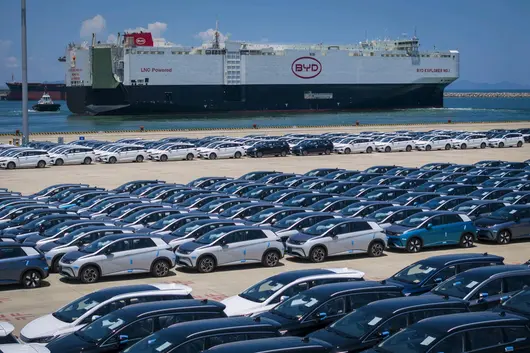
According to China Association of Automobile Manufacturers data, total Chinese car exports from January to September 2026 reached 8.63 million vehicles, up 52% year-on-year. In October, the proportion of new energy passenger car exports alone reached 44.2%.
At the same time, domestic automakers are becoming the main force at overseas auto shows. Selling points like cabins and intelligent driving, which are commonplace at domestic auto shows, continue to attract overseas consumers.

Before the Paris Auto Show this year, He Xiaopeng brought Xpeng's NGP to the European market and had a direct showdown with Tesla's FSD.
Recently, He Xiaopeng proposed a new testing ground for domestic automakers and intelligent driving companies, stating that if an automaker wants to prove its intelligent driving technology is truly robust, the most direct verification method is to drive the product to overseas markets and undergo actual tests in different road conditions and traffic rule scenarios around the world.
Setting aside how Xpeng's intelligent driving actually performs, behind He Xiaopeng's viewpoint is the common status quo faced by Chinese new energy vehicle overseas expansion: cars go out, but intelligent driving cannot be used.
Intelligent Driving Untapped Market
With the intensification of price wars and the manifestation of supply chain scale advantages, the prices of domestic new energy vehicle intelligent assisted driving solutions are gradually decreasing, and penetration rates are also climbing. Ministry of Industry and Information Technology data shows that in 2026, the penetration rate of new passenger cars equipped with L2-level integrated driving assistance functions reached 70.5%, and the penetration rate of models equipped with Pilot Driving Assistance functions (NOA) also broke through 34.2%.
Looking at Europe, although it is the birthplace of the automotive industry and the region most actively promoting assisted driving, the penetration rate is still not high.
At the L2 level, under the EU GSR2 regulation framework, the L2 installation rate was forcibly pushed to 100% in 2026. However, this 100% mainly corresponds to basic ADAS functions such as intelligent speed assist and emergency lane keeping, which are not entirely equivalent to the L2 that domestic consumers perceive as simultaneously controlling steering and acceleration/deceleration.

Data from JATO Dynamics statistics of five European countries (Germany, France, Italy, Spain, UK) shows that the penetration rate of new L2 cars that truly possess the ability to control steering and acceleration/deceleration simultaneously is about 35%. In 2022, this figure was 22%, an increase of only 13 percentage points over five years.
As for the penetration rate of high-order urban NOA in Europe, it is less than 1%. The EU's UN R171.02 regulation requires system behavior to be 100% consistent with the written declaration thresholds submitted by the manufacturer to the regulatory authorities in advance, and does not allow any autonomous decision-making behavior beyond the declared scope.
As for the closer Southeast Asian market, although the growth rate has accelerated, it is still lagging in infrastructure, regulations, and after-sales verification systems.
Data shows that the overall ADAS penetration rate in Southeast Asia jumped from 18% in 2025 to 24% in the first quarter of 2026. The rate of pre-installation in pure electric vehicles has reached 42%, and 29% in plug-in hybrid models.

Behind this, the gradual improvement of regulations in Southeast Asian countries. Thailand took the lead in stipulating that new registered electric passenger cars must be equipped with at least three basic ADAS functions starting from January 2026. Indonesia plans to follow up in 2027. Regulations are the primary driver for current penetration rate increases.
However, high-order functions still remain at the verification stage, and test cars are mainly concentrated in closed testing parks in Thailand and Malaysia. Mass-produced urban NOA for consumers basically does not exist.
As for the Middle East and Latin America regions, they are still in the popularization stage of L2 basic functions. There is still a long way to go before reaching high-order intelligent driving.
As for the only region that truly achieved NOA penetration, it is the North American market. Driven by Tesla, the penetration rate of new cars equipped with North American NOA is expected to break through 45% in 2026. Q2 data shows that 55% of users in newly delivered Tesla vehicles in North America activated FSD subscriptions at the time of pickup. As for data on truly realizable urban NOA, it is also less than 5%, contributed entirely by Tesla.

Overall, currently the European and Southeast Asian markets where new energy vehicles mainly export have gaps in the field of high-order assisted driving. For domestic automakers, this is undoubtedly another area of technical dividends. There is no stock competition; once successful, it will become an absolute technical barrier.
But the reality is that intelligent driving overseas faces dual pressure from regulations and infrastructure, and there is still a long way to go before landing.
Three Ways to Seek Breakthroughs
Currently, major domestic automakers exporting overseas have already laid out landing points for intelligent driving solutions overseas to achieve breakthroughs locally. The main paths are divided into three categories, corresponding to these different solution models.
First is the self-developed + localization adaptation solution, which is also one of the current mainstream implementation paths. Tesla's global layout also follows the same solution. A set of core models combined with local data can theoretically achieve adaptation quickly.
Taking Xpeng mentioned at the beginning of intelligent driving overseas as an example, it adopts the "one model eats all globally" strategy. The second-generation VLA model uses world models and reinforcement learning to support L2 assisted driving and L4 autonomous driving with the same architecture.
At the same time, Xpeng has established a local data center in Europe to meet GDPR compliance requirements and has passed the German TÜV Rheinland UN R171 certification, becoming the first Chinese intelligent driving system to receive this certification. It plans to deliver intelligent driving systems adapted to the local environment to European users in 2027, and is also the automaker domestically that has provided a definite timeline so far.

Traditional automaker Changan Automobile also follows the same solution. In details, Changan Automobile adopts a "layered layout" strategy in Europe. The European version uses the Tiandu System + Horizon chip adapted to UN R171 regulations. It plans to launch highway NOA in Europe in 2027, while urban NOA is suspended due to insufficient local verification.
At the same time, Changan established a R&D center in Munich and cooperates with Qualcomm to develop the European data training system, which will accelerate the verification and landing of urban NOA.
The second path is starting from scratch, re-walking the domestic training route in overseas markets. Currently, BYD mainly adopts this solution. Currently, all of BYD's export models are downgraded to basic L2-level functions, and Sky Eye System has not landed overseas.
Intelligent driving technology adapts to the market by cooperating with local companies and building data training centers locally. It uses physical isolation and full-stack localization strategies to cope with GDPR compliance requirements, ensuring European user data is 100% stored in EU data centers and cutting off the data return link.

As for the third route, it is the easiest to implement, which is to directly adopt locally compliant intelligent driving solutions. Just like the Aito export version. Aito models in China are equipped with Huawei Qiankun solutions, but due to regulatory limitations, in order to land overseas as soon as possible, the European version of Aito models plans to adopt the Bosch intelligent driving solution. It plans to mass-produce highway NOA functions in September 2027.
This third path also triggered the rhythm of solution suppliers accelerating landing overseas. Horizon entered the European market through CARIZON, a joint venture with Volkswagen. At the same time, Horizon is accelerating the landing of HSD. It has already secured design wins for 11 automakers and more than 40 export models.
Zhuoyu Technology activated its European headquarters located in Braunschweig, Germany in May 2026, promoting the "In Europe, For Europe" localization strategy. It used ID.Buzz for highway NOA, urban NOA, and automatic parking road trials, planning to complete verification by the end of 2026.

Momenta, one of the four giants in intelligent driving, is the fastest to place its pieces. On the one hand, it has obtained L4 testing permits in the Europe and Middle East region. On the other hand, with cooperation with local European automakers, Momenta's high-order solutions are also accelerating landing. After signing a global strategic cooperation agreement with Dongfeng Peugeot-Citroën Technology, it directly entered Stellantis's global supply chain.
As for true landing, it actually lies in the periodicity of local data training and multiple regulatory certifications. Facing the EU's GDPR compliance requirements, whether it is automakers or solution suppliers, they can only choose to build local data processing and training capabilities locally, slowing down the landing speed.
On the other hand, under the multi-country road conditions overseas, various regulations and certification systems are the issues that currently most affect landing. The EU's WVTA certification takes an average of 12-18 months. Under such a long period of time, intelligent driving solutions have already iterated several versions, making it difficult to truly achieve global synchronization.
The competition of intelligent driving going overseas is no longer about whose technology is more advanced, but about who can complete a mass-producible system-level closed loop under the multiple constraints of the target market, with acceptable costs and cycles. The proof of intelligent driving going overseas is not only technical strength, but also the efficiency competition in local layout under globalization strategies.

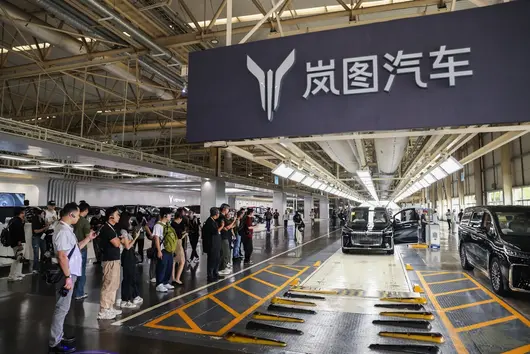
On September 21, the "VOYAH Premium Intelligence Tour" event kicked off in Wuhan. Overseas media representatives from Southeast Asian countries such as Singapore, Thailand, Malaysia, Indonesia, etc., visited VOYAH, explored the smart factory, experienced VOYAH series high-end new energy products, and personally felt the manufacturing strength and global development potential of China's new energy vehicles.

The overseas media delegation visited VOYAH's Golden Factory and toured the intelligent flexible production line on-site. Inside the assembly workshop, automatic material conveying lines and AGV robots carried out operations in an orderly manner. The vehicle "digital ID" on the digital large screen completely recorded the entire production trajectory of each vehicle from parts to the whole vehicle. The intelligent production scene made visiting media stop frequently to take photos. Leveraging cutting-edge technologies such as 5G, Big Data, and AI, VOYAH's Golden Factory can achieve random mixed-flow production of multiple models including sedans, MPVs, and SUVs on the same line. The Golden Factory and Cloud Peak Factory operate in tandem, with an annual production capacity of 450,000 vehicles, with one whole vehicle coming off the line every 40 seconds on average, demonstrating strong large-scale manufacturing capabilities.

At the VOYAH Golden Mouth Factory All-Function User Center, overseas media learned about the brand's full-cycle service model. As the largest flagship store of VOYAH in the country, the venue covers an area of over 30,000 square meters, integrating functions such as new car display, customization, brand culture, after-sales maintenance, and supercharging. It covers the full life cycle of users from car selection, purchase to usage. Many overseas media showed strong interest in VOYAH's direct sales service system and hope this flagship-level service model can go global.
Overseas media experienced the Dreamer 9's "One Cabin Eight Scenarios" cabin space on-site. The vehicle's second-row zero-gravity seats support 180-degree multi-angle rotation, allowing seamless switching between business, rest, and travel scenarios. Media representatives adjusted the seats to experience the flexible and varied cabin experience. During the visit, overseas media also test-drove models such as VOYAH Pursuit S and VOYAH Taishan X8, fully contacting VOYAH's complete product matrix of "SUV+MPV+Sedan".

Since the brand's inception, VOYAH has focused on core areas such as Three-Electric Systems, chassis, smart cockpit, smart driving, and whole vehicle manufacturing, adhering to full-stack self-research. It possesses full value chain autonomous control capabilities, and its products have gained the trust of over 400,000 users globally. As a high-end new energy vehicle brand of central state-owned enterprises, VOYAH takes globalization as an important engine to promote high-quality development. Currently, VOYAH's business has entered 40 countries and regions, with the number of overseas sales outlets exceeding 240. Focusing on the three directions of "Deepening in Europe, Layout in Middle East, Entering Right-hand Drive Market", VOYAH's globalization strategy is accelerating implementation. Right-hand drive models are also ready to launch, preparing to further explore overseas markets.
This time, overseas media visited VOYAH, and through the production workshop and real vehicle experience, visually saw the technical accumulation of China's high-end new energy vehicles. Chinese automobiles going global are shifting from pure product output to comprehensive value output of technology, manufacturing, and services. Relying on self-developed technologies, a complete smart manufacturing system, and a perfect service concept, Chinese automobile brands represented by VOYAH continue to transmit China's smart manufacturing power to the global market.

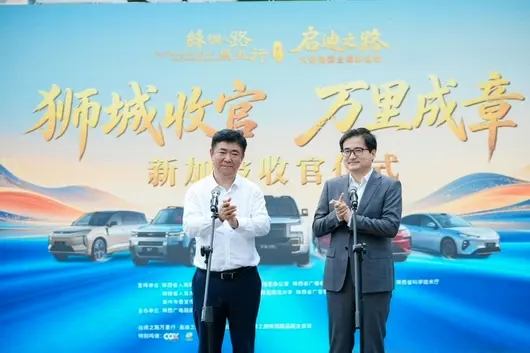
With the successful conclusion of the '2026 Silk Road 10,000 Li Journey · Enlightenment Road' in Singapore, BYD, as the travel partner throughout the journey, departed from Xi'an, passed through Thailand and Malaysia, and finally arrived in Singapore, truly achieving 'Silk Road Long Journey with Green Energy Companion'.


A full 33 days, the convoy ran over 10,000 kilometers, not only speeding on highways but also experiencing complex road conditions such as mountain roads and city traffic jams. This time, models from brands like Dynasty, Ocean, Denza, Fangchengbao, and Yangwang went on the expedition together, equivalent to BYD's full product line going up together, truly undergoing cross-border long-distance testing.


Along the way, the 'Charge Fully in 5 Minutes, Charge Full in 9 Minutes' Flash Charging Technology easily solved the most worrying charging anxiety for long-distance travel. Plus, with the Divine Eye Assisted Driving, even after running over 10,000 kilometers, it greatly reduced fatigue for the convoy while also ensuring safety and comfort.


Precisely because of its strong product performance, BYD has secured the top position in local passenger car sales in the Singapore market for 19 consecutive months. This Silk Road 10,000 Li Journey activity fully proved that Chinese New Energy Vehicles are not just for city commuting, but can also run long distances across borders. I just want to say, Chinese car brands are becoming increasingly capable, and this will also promote green transportation to more countries.

GAC Group officially released July production and sales data on August 4. Overall, the first seven months of this year saw the group's cumulative vehicle sales cross the 886,000 units threshold, achieving a 1.28% year-on-year growth. Notably, cumulative sales of new energy vehicles reached 311,700 units, a surge of 66.20% year-on-year, further increasing the proportion of energy-saving and new energy vehicles in total sales to 63.96%. Meanwhile, the pace of overseas exports for independent brands accelerated significantly, with cumulative exports reaching 145,000 units in the first seven months, a 130% year-on-year soar; this figure has already surpassed the 2025 full-year target. Additionally, in the recently passed July, GAC Group welcomed a major milestone of cumulative production and sales breaking 30 million units.

Focusing on the independent brand segment, its cumulative sales from January to July exceeded 400,000 units, a year-on-year increase of 33.31%. Looking at July alone, independent brand sales exceeded 54,200 units, with a year-on-year growth of 19.91%. By brand, the Hyper Aion BU performed strongly, with cumulative sales reaching 210,400 units in the first seven months, up 62.08% year-on-year; July single-month sales were 28,807 vehicles, up 36.37% year-on-year. As for GAC Trumpchi, cumulative sales this year exceeded 187,100 units, up 9.83% year-on-year, with July sales at 22,739 vehicles. Of note, the newly launched Enjing GT7 delivered 2,658 units in its first full sales month, preliminarily gaining market and consumer recognition.

In the joint venture sector, GAC Toyota's cumulative sales from January to July exceeded 402,500 units, with July sales at 46,500 vehicles. The three flagship models composed of Camry, Highlander, and Sienna sold a combined 22,843 units in July, accounting for a high of 49% in the brand's total sales. Meanwhile, the bZ Series continued a stable monthly sales over 10,000 trend, contributing 12,002 vehicles in July, accounting for over 25%; its main model, the bZ3X, had single-month sales of 9,546 vehicles. GAC Honda achieved sales of 11,686 vehicles in July and welcomed a milestone of cumulative sales breaking 11 million units during this period. More importantly, both shareholders of GAC Honda have officially signed a renewal agreement, extending the cooperation period to 2038, aiming to jointly accelerate electrification and intelligence transformation. According to the established plan, GAC Honda will launch 5 new vehicles within the next two years, including two locally developed new energy vehicles and brand new iteration of hybrid products.


Regarding overseas market expansion, GAC's independent brands reached single-month exports of 23,575 vehicles in July, a 119% year-on-year growth. Reviewing the first seven months, the cumulative export of 145,000 units has already exceeded the annual target. Entering July, GAC's layout in the five major regional markets sped up significantly, focusing on three directions: localization production, new product launch, and policy coordination simultaneously. In the American market, terminal sales increased by 139% year-on-year, with vehicle sales in countries like Uruguay, Costa Rica, Colombia, and Brazil all achieving several-fold growth. Additionally, GAC successfully approved joining Brazil's "Green Mobility and Innovation Plan," marking its deep integration into local green development strategies. In the CIS region, terminal sales increased by 112% year-on-year, and the world's 7th KD factory has officially landed in Kazakhstan, with the first model rolled off the line being the GS8.

Good news continued to spread in the Asia-Pacific market, with terminal sales increasing by 78% year-on-year in July. The Thailand factory has cumulatively achieved over 10,000 complete vehicles rolled off the line, and multiple new models have also landed in the Philippines market. In the Middle East and Africa region, GAC terminal sales increased by 51% year-on-year, and it has officially entered the Morocco market; the first three SUVs launched will cover fuel, hybrid, and plug-in hybrid powertrain types. Meanwhile, GAC maintains a steady breakthrough trend in the European market; especially in the Greek pure electric passenger car market, its market share has increased to 7.7%, ranking second in that market, with model promotion and listing preparation work in multiple countries also being steadily promoted.

In terms of infrastructure, so far, GAC's "9 Verticals and 10 Horizontals" recharging network has covered 31 provinces and 213 cities across the country, achieving the goal of "a station within 1 km in the core urban area". The number of self-operated charging piles exceeds 27,000 units, with supercharging piles breaking 20,000 units. Looking forward to the second half of the year, GAC's product offensive remains strong, planning to heavily launch multiple models including Trumpchi's first hardcore off-road SUV Yue 7, Aion's all-new pure electric coupe RAY 7, and Enjing GX7.
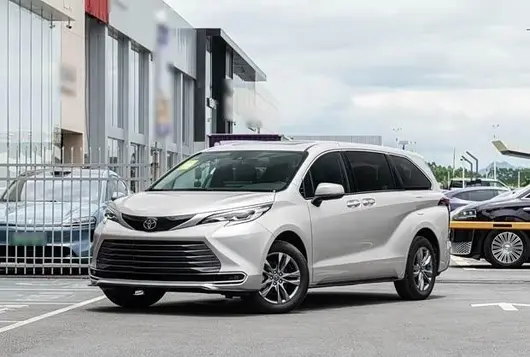

[CNMO Tech News] July 16, @NEVData released observation data on the Southeast Asia automotive market: Chinese brand market share in the six ASEAN countries (Indonesia, Malaysia, Thailand, Vietnam, Philippines, Singapore) exceeds 60% in the new energy sector. Among them, Indonesia reached as high as 91%.

Chinese New Energy Vehicles
According to statistics, cumulative sales of passenger cars and pickups in the six ASEAN countries in the first half of the year totaled 1.9246 million, up 7.2% year-on-year. Specifically for June data, retail sales of passenger cars and pickups were 332,700, up 9.7% year-on-year. Indonesia (passenger cars, same for subsequent mentions) sales were 74,507 units, up 10.5% year-on-year; Malaysia sales were 72,943 units, up 23.1% year-on-year; Thailand sales were 68,912 units, up 11.2% year-on-year; Vietnam and Philippines sold 51,366 and 38,124 units respectively, up 6.4% and 4.1% year-on-year; Singapore was the only country with sales declining year-on-year, selling 6,948 units, down 1.8%.

Data shows, June NEV penetration rates varied significantly across countries. Singapore ranked first with a penetration rate of 66.4%, up 19.2% year-on-year; Vietnam and Thailand ranked second and third with penetration rates of 41% and 30.3% respectively, up 94.7% and 31% year-on-year. Although Indonesia and Malaysia penetration rates were under 20%, they surged 78% and 122% year-on-year. The Philippines lagged severely due to a lack of charging infrastructure, with a penetration rate of only 2.1%. These market increments were mainly contributed by Chinese new energy vehicle brands.
In the new energy sector, Chinese brand market share exceeds 60%. Among them, Malaysia reached 62%, Thailand 78%, Indonesia 91%. However, in the overall market, Japanese brands still lead with 68%. However, the overall market share of Chinese brands increased by 6.2 percentage points year-on-year (reaching 13.7%), reaching 17.3% in Thailand, surpassing Japanese and South Korean brands to become the largest group.

[CNMO Tech News] On June 3, SAIC Motor announced that recently, the State Administration for Market Regulation officially published the list of the first batch of national quality standard laboratory training and construction candidates. The "National New Energy Vehicle Quality Standard Laboratory" applied by SAIC-GM-Wuling was successfully selected, becoming the only one approved to be built among car manufacturer applications for national quality standard laboratories.

SAIC Motor
According to CNMO Tech, the "National New Energy Vehicle Quality Standard Laboratory" approved by SAIC-GM-Wuling gathers over 4,000 R&D personnel, covering PhDs, Masters, and foreign experts. It features multiple national-level innovation platforms, including postdoctoral research stations, national enterprise technology centers, and national industrial design centers. It owns 14 laboratories of international first-class standards, covering full-chain verification capabilities in three-electric systems, crash testing, NVH, EMC, thermal management, intelligent connectivity, lightweight materials, etc. It has obtained 275 CNAS accreditations (including 81 ECE international accreditations) and possesses full-link testing capabilities from complete vehicles to components.


Three-Electric System Laboratory
Relying on scenario data from 32 million base users and a big data center for new energy vehicles at the million-vehicle level, the laboratory can reproduce real user operating conditions, achieving full-chain quality prediction and closed-loop iteration from R&D testing to user usage, comprehensively supporting the test verification of electrification and intelligence technologies for new energy vehicles.

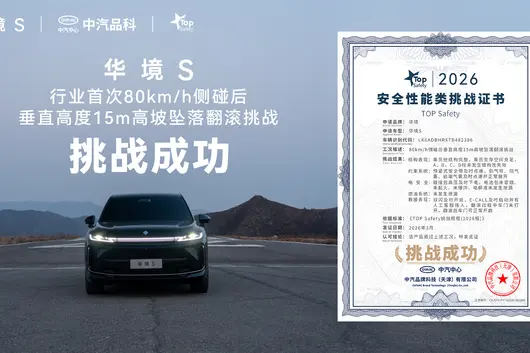
Currently, the laboratory has formed a batch of global first, internationally leading, and industry-advanced landmark achievements, including the global first intelligent island manufacturing system, which was selected into the national first batch of "Navigator-level Smart Factory" training list; Huanjing S passed the industry's first 80km/h side collision 15m high slope drop challenge; Shenlian Battery achieved a record of 0 spontaneous combustion over 76.6 billion kilometers. In addition, the Wuling Air ev safety design was included in ASEAN official technical specifications, the DC charging standard obtained Indonesian SNI certification, achieving a "zero breakthrough" for Chinese car manufacturers in the ASEAN standard-setting field, and successfully breaking the standards barriers of Europe, the US, and Japan.

Recently, the State Administration for Market Regulation released the first batch of National Quality Standard Laboratory Cultivation and Construction Lists. SAIC-GM-Wuling successfully selected, becoming the only automobile enterprise in this country approved to undertake this platform. This approval marks that SAIC-GM-Wuling's New Energy Vehicle Quality Technology System Construction has officially entered a new national development stage.
National Quality Standard Laboratory is a national-level core innovation platform established relying on the "Outline for Building a Strong Nation in Quality". It focuses on core work such as industrial quality standard basic research, high-end technology application, industry standard development and promotion, and professional talent cultivation and gathering. It is an important carrier for implementing the Quality Strong Nation strategy, empowering manufacturing quality improvement and upgrade, providing key support for domestic New Energy Vehicle industry to consolidate technical foundation and enhance industry discourse.

SAIC-GM-Wuling Laboratory possesses strong scientific research strength and complete innovation system. Team scale exceeds 4000 people, gathering large batches of Master's/Doctoral talents and foreign technical experts. Relying on Postdoctoral Workstations, National Enterprise Technology Centers, National Industrial Design Centers and other multiple national-level innovation carriers, it has constructed a multi-level, all-around scientific research pattern. Laboratory layouts 14 international first-class test sites, fully covering core fields such as Three-Electric Systems, Whole Vehicle Collision, NVH, EMC, Thermal Management, Intelligent Connectivity, Lightweight Materials, etc., capable of achieving full-chain, full-dimension test verification for New Energy Vehicle whole vehicles and components. Currently, Laboratory has won 275 CNAS recognized qualifications, containing 81 ECE international recognized items, testing verification results possess authoritative international credibility.


Relying on massive scenario data of 32 million users and million-level New Energy Vehicle big data center, Laboratory can precisely replicate user full-scenario real driving conditions. By connecting the full process of R&D testing, mass production landing, terminal use, realizing quality product pre-judgment and dynamic iterative upgrade, building test verification foundation for New Energy Vehicle electrification, intelligence core technology landing.

Long-term deep-diving into technical breakthroughs and quality polishing, Laboratory has produced multiple global first, internationally leading landmark achievements. Global first intelligent island manufacturing system landed and applied, helping enterprise selected in National First Batch "Leading-Level Intelligent Factory" Cultivation List; Model Huajing S successfully completed industry's first 80km/h high-speed side collision, 15-meter high slope drop limit safety test; Independently developed Shenlian Battery created 76.6 billion kilometers driving zero spontaneous combustion high-quality market record. In international standard output field, enterprise achieved breakthrough leap, Wuling Air EV safety design included in ASEAN official technical norms, self-developed DC charging standard passed Indonesia SNI certification, filled blank of Chinese auto enterprises in ASEAN industry standard formulation field, effectively breaking global automotive standard barriers long dominated by Europe, America, and Japan.
This national-level laboratory successful approval is the inevitable result of SAIC-GM-Wuling long-term adhering to Original R&D and deep-diving into quality infrastructure construction. This upgrade lets enterprise quality technology system fully benchmark national-level highest standards, complete critical transformation from "Precision Crafting Good Cars" to "Defining Industry Standards", achieving technology, standard, quality, safety full-spectrum autonomous control. In the future, Laboratory will integrate four core capabilities of technical breakthrough, standard guidance, test verification, industry empowerment, innovate quality management and service model, promote Chinese Auto Standards following industry chain going overseas, assisting "Belt and Road" quality standard interconnection. For consumers, this national-level platform will become top verification position for product quality, full series models from Three-Electric Safety, Body Structure to Intelligent Connectivity, Whole Vehicle Durability, all passed national-level rigorous standards layer by layer polishing, product safety and quality guarantee fully upgraded.
Standing on a brand new development stage, SAIC-GM-Wuling will take national-level laboratory construction as core strategic pivot, continuously deep-diving New Energy Vehicle quality innovation and technical breakthrough. Enterprise will fully promote Chinese New Energy Vehicle industry from scale leadership to standard leadership, with autonomous core technology and rigorous quality standards, providing safer, higher quality, more intelligent mobility solutions for global users.
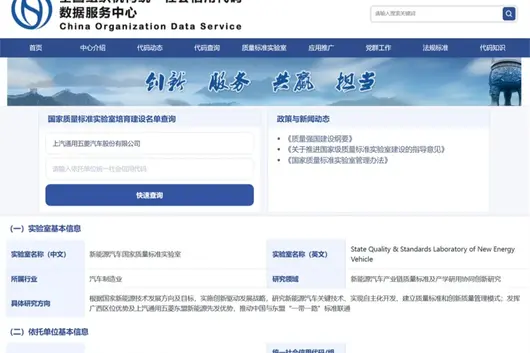

Recently, the State Administration for Market Regulation officially announced the list of the first batch of National Quality Standard Laboratory cultivation construction projects. The "National New Energy Vehicle Quality Standard Laboratory" declared by SAIC-GM-Wuling Motor Co., Ltd. successfully entered the list, becoming the only state-quality standard laboratory approved for construction declared by an automaker. This marks that the enterprise has entered a new national stage in the construction of the new energy vehicle quality technology system.
The National Quality Standard Laboratory is a national-level technical innovation platform established according to the "Outline for Building a Quality Powerhouse". It mainly undertakes tasks such as basic research and application of major industry quality standards, development and promotion of high-level quality standards, and cultivation and gathering of quality standard talents. It has important strategic significance for promoting the construction of a Quality Powerhouse.

[SAIC-GM-Wuling "National New Energy Vehicle Quality Standard Laboratory" Successfully Selected]
The "National New Energy Vehicle Quality Standard Laboratory" approved for SAIC-GM-Wuling gathers over 4,000 R&D personnel, including PhDs, Master's holders, and foreign experts. It features multiple national-level innovation platforms such as a Postdoctoral Research Station, National Enterprise Technology Center, and National Industrial Design Center. It possesses 14 laboratories of international first-class standards, covering full-chain verification capabilities in Three-Electric Systems, Crash, NVH, EMC, Thermal Management, Intelligent Connected Networks, and Lightweight Materials. It has received 275 CNAS accreditations (including 81 international ECE accreditations) and possesses full-link testing capabilities from whole vehicles to components.
Relying on scenario data from 32 million base users and a big data center for million-vehicle level new energy vehicles, the laboratory can replicate users' real usage conditions, achieving full-chain quality prediction and closed-loop iteration from R&D testing to user usage. It fully supports the experimental verification of new energy vehicle electrification and intelligence technologies.

[Vehicle Test Site]

[Crash Laboratory]

[Three-Electric System Laboratory]
Currently, the laboratory has formed a batch of world-first, internationally leading, and industry-advanced landmark achievements. These include the world-first Intelligent Island Manufacturing System, which was selected for the country's first batch of "Pioneer-level Smart Factory" cultivation list; the Hongjing S passed the industry's first 80km/h side collision 15m high slope drop challenge; the Shenlian battery achieved a 76.6 billion km zero spontaneous combustion record. In addition, Wuling Air EV safety design was incorporated into ASEAN official technical specifications, and the DC charging standard obtained Indonesian SNI certification, achieving a "zero breakthrough" for Chinese vehicle enterprises in the ASEAN standard-setting field, successfully breaking the barriers of US, European, and Japanese standards.

[Hongjing S Passes Industry's First 80km/h Side Collision 15m High Slope Drop Challenge]
This selection in the first batch of National Quality Standard Laboratories is the result of SAIC-GM-Wuling's long-term persistence in positive R&D and deep cultivation of quality infrastructure construction. It means that the enterprise's new energy vehicle quality technology standards will align with the highest national benchmarks, achieving a key leap from "making good cars" to "defining good car standards", truly realizing technological autonomy, standard autonomy, quality autonomy, and controllable safety. At the same time, the laboratory will achieve technical breakthroughs, standard leadership, experimental verification, and industry empowerment through innovative quality management and service models, allowing "Chinese Standards" to go global along the industrial chain, contributing Wuling's strength to the "Belt and Road" standard connectivity. For users, the National Quality Standard Laboratory will become the "highest verification field" for SAIC-GM-Wuling product quality - from Three-Electric safety to body structure, from intelligent connectivity to whole vehicle durability, every model will undergo rigorous refinement under a high-standard, high-starting-point quality system.
Looking to the future, SAIC-GM-Wuling will use the construction of the National Quality Standard Laboratory as strategic support, promoting Chinese new energy vehicles from scale leadership to standard leadership, bringing higher quality mobility experiences to global consumers.