首頁Motorcycles

搜尋歷史
熱門搜尋
經銷商登入 / 註冊

On September 1, 2026, the Ministry of Commerce, the Ministry of Industry and Information Technology, and the State Administration for Market Regulation jointly released a document titled "Guidelines for Overseas Competition Behavior and Compliance Construction in the Automotive Industry."

The document consists of four chapters and twenty articles, with clear core requirements: establish a cost-based overseas pricing strategy to avoid affecting the interests of overseas consumers and brand image due to frequent and significant price fluctuations; at the same time, require automakers to strengthen product overseas assessment to avoid launching products that do not meet the needs of the target market and usage environment.
Going global has been one of the themes of the automotive industry in recent years. In 2025, China's automobile exports reached 8.32 million units, sold to over 200 countries and regions. Meanwhile, Chinese automakers have also invested in the local automotive manufacturing industry in over 80 countries and regions.
However, at this time, the issuance of such a document related to overseas market competition for automobiles might indicate a problem: behind the scale expansion, concerns about overseas order are surfacing. Why this timing? The answer may be hidden in an event from more than twenty years ago: the entire process of Chinese motorcycles going from peak to collapse in Southeast Asia.
#Motorcycle Tragedy: Lessons from Market Share Dropping from 80% to Less Than 1%#
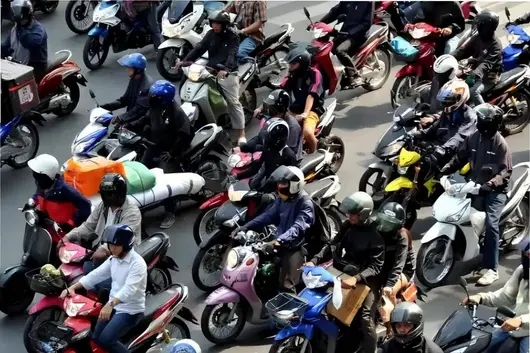
In the late 1990s, Chinese motorcycles had already gone abroad and welcomed a highlight period in the Southeast Asian market.
Previously, the motorcycle market in Southeast Asia was firmly held by Japanese brands. Top brands like Honda, Yamaha, and Suzuki monopolized over 90% of the Southeast Asian motorcycle market. The average unit price at that time was around $2,000.
After 1997, Chinese motorcycle brands such as Loncin, Jialing, and Zonsun sequentially went out in batches. Relying on significantly lower prices than Japanese brands, they quickly seized the market with extremely low pricing of $500-$700. By around 2002, Chinese motorcycles completely suppressed Japanese brands in market share in core areas like Vietnam.

Motorcycle companies at that time produced parts in China and assembled them in local markets like Vietnam. Market share rose rapidly from 23.8% in 1999 to 75.2% in 2000, reaching 80.5% in 2001. In 2001, the market share of Chinese brands exceeded 60%; in 2002, the export value reached 1.92 billion US dollars, and the overall market share climbed to 80%.
However, such prosperity did not last long. Seizing the market through price made these motorcycle companies taste the sweetness. The short-term rising market share also made them believe that this extensive competition logic would continue to work.
Thus, bottomless price involution appeared. Competitors frantically snatched orders and continuously cut prices. The profit per vehicle export was directly compressed to single-digit US dollars. Motorcycle companies no longer valued quality, only volume; some even started one-off deals, dumping unsold domestic products in the local market, selling off inventory and running away, with absolutely no after-sales service.
The result of such competition was predictable. Product quality experienced a systemic collapse in the short term. Cost pressure forced them to cut corners on parts. Vehicles普遍 showed serious faults such as engine oil leaks, frame fractures, and uncontrolled fuel consumption. In the eyes of Southeast Asian consumers at that time, Chinese motorcycles had a very high repair rate, frequent minor faults, requiring major repairs in less than 3 years, and being scrapped after 4-5 years.

In 2004, a motorcycle made in China suddenly fractured its frame while driving in Ho Chi Minh City, causing serious injuries to the rider. Vietnamese media reported wildly, and the country was swept up in a hot discussion about the durability of Chinese products.
Against this background, Japanese brands began to fight back. Honda launched affordable models, combined with buyout after-sales, deep localized supply chains, building a full-cycle service barrier that Chinese manufacturers could not resist. Finally, within the two years from 2004 to 2006, the market share of Chinese motorcycles plummeted from 80% to less than 1%. Subsequently, Japanese motorcycles regained 95% of the market share with stable quality.
Chinese motorcycles failed in Southeast Asia. The root cause here might not be that Japanese brands have an absolute technological gap in the motorcycle field, but simply endless involution. As of 2025, the total annual motorcycle sales in the Thai market reached 1.7118 million units. Japanese brands like Honda and Yamaha had a market share as high as 96.2%, while mainland Chinese brands retained only 0.69%.
Twenty years have passed, and this lesson seems to be being forgotten, especially as today's Chinese automotive industry seems to be a mirror image of the motorcycle industry twenty years ago.
#Chinese Automobiles: Running Wild While Planting Mines#
In recent years, after the Chinese automotive industry started industrial transformation, domestic car companies have not slowed down on this runaway road, especially in the overseas field. Starting from less than a million units in 2020, Chinese automobile exports completed a stunning leap in just a few years.
Total car exports in 2025 reached 7.098 million units (data from China Association of Automobile Manufacturers), up 21.1% year-on-year. Among them, new energy vehicle exports reached 2.615 million units, doubling year-on-year; and calculated by the broader statistical scope of the China Passenger Car Association, total exports in 2025 were as high as 8.32 million units.

Entering 2026, this momentum did not decrease at all. Car exports in the first half of the year reached 5.096 million units, a猛增 of 65.3% year-on-year, breaking the 5 million unit mark for the first time in half a year; July single-month exports were 918,000 units, up 87.8% year-on-year. Multiple forecasts predict that Chinese car exports in 2026 are expected to break through 10 million units for the first time.
It has to be said that these data look very eye-catching, but behind the brilliance, Chinese cars going overseas are encountering risks highly similar to the motorcycle tragedy back then.
Chinese automakers have already involutioned to the limit domestically. In the first half of 2026, the profit margin of the automotive industry's whole vehicle manufacturing dropped to 1.5%, reaching a new low in nearly ten years; 630 new cars clustered to launch, 95% monthly sales did not exceed 10,000; domestic sales dropped more than 20% year-on-year. Involution cannot continue in the domestic market, so many automakers turned their attention overseas.
Overseas markets are undoubtedly blue oceans compared to the domestic market,本该 be a incremental market with larger survival space and broader prospects. But the bad thing is, some automakers took the domestic tactics overseas as well.
Signs of 'involution' spillover have already appeared. In incremental markets such as Southeast Asia, the Middle East, and South America, some Chinese automakers concentrated into the A-level new energy passenger car track. Prices overlapped heavily in the 100,000-150,000 yuan range. The domestic tactic of 'trading price for volume, rapid distribution' was translated over, forcing other automakers to adopt similar response strategies.
In some regional channels, disorderly marketing behaviors such as cross-regional siphoning by dealers belonging to the same Chinese brand and frequent price cuts appeared; even more, some enterprises compressed after-sales spare parts reserves and user service investments to rush short-term sales rankings, simplifying overseas channel construction into an extensive model of 'finding agents, selling wholesale'.

In the Thai market, the selling price of Chinese brand electric vehicles has dropped from an average of about 1.2 million baht in 2023 to an 800,000 baht range in 2026. The BYD Dolphin partial version price dropped from 800,000 baht to more than 500,000 baht. The price plunge triggered a chain of negative effects: vehicle second-hand residual value significantly shrunk, a large number of owners' loan balances exceeded vehicle valuation, and some brands faced consumer complaints for dropping prices too aggressively.
From 2024 to 2026, the Thailand Consumer Protection Committee and Consumer Committee collectively accepted 1,348 complaints related to electric vehicles. The complaints focused on four aspects: frequent price drops destroying user asset expectations, resource mismatch of emphasizing sales over after-sales, instability of new forces' operations causing consumer anxiety, and vehicle actual performance not matching promotion.
The new version of the 'Lemon Law' (Draft Law on Product Defect Liability) being promoted in Thailand has clearly included electric vehicles in the scope of key protection, implementing inverted burden of proof. If a fault occurs within 1 year of vehicle delivery, it is directly presumed that the defect existed at delivery, and the automaker/seller must prove the defect was not factory-integrated, without consumers needing to collect evidence themselves.
At the same time, issues and doubts such as chassis rust and missing after-sales are emerging. A foreign car review website summarized the five high-frequency problems of Chinese electric vehicles: unstable software, insufficient after-sales network, spare parts supply delays, ADAS calibration weaknesses, and rapid depreciation of residual value. Doubts such as 'chassis rust through in two years', 'missing after-sales', 'parts supply interruption' continue to ferment on overseas social media.
#Signals of the Motorcycle Tragedy Have Already Appeared#
Chinese automobile brands are facing multiple challenges in overseas markets. With exports aiming for the 10 million unit mark in 2026, some problems also began to expose concentrated.
From the perspective of the product itself, product quality concerns are the most direct and also have a relatively large impact factor. Many models exported overseas are basically developed in China's native land. However, overseas markets differ from China's native environment. After entering overseas markets, some adaptability issues will occur.
For example, high electricity consumption on unlimited speed highways in Germany; in Russia, Northern Europe, etc., chassis is prone to rust due to de-icing agents; in Mexico and other areas with complex road conditions, power and noise control performance is poor. Overseas user complaints include battery faults, range shrinkage, unstable software, intelligent driving assistance system (ADAS) calibration defects, etc. Multiple Chinese automakers have had recalls overseas.

In addition, Chinese cars ran overseas, but the entire after-sales service system has not caught up. Currently, overseas markets generally suffer from insufficient after-sales outlets, delayed spare parts supply, lack of repair technicians, etc. Moreover, inconsistent charging standards across different countries and fragmented APP ecosystems also increase service difficulty.
One point worth noting is that if after-sales related issues do not catch up, it brings a series of chain reactions.
Recently, several overseas insurance companies have tightened or even refused to provide insurance services for Chinese new energy vehicles. In mid-August, Dutch top insurer Univé (members over 1.8 million) updated underwriting rules citing 'shortage of parts, imperfect repair network, lack of technical data'.
Brands like Hongqi, Changan, Voyah, Leapmotor, Jetour, OMODA, and Mengshi, the insurance company completely refused coverage; brands like Dongfeng, Nio, Firefly, Zeekr could only purchase the legally minimum third-party liability insurance; BYD, MG, Lynk & Co have complete localized service systems locally and are currently unaffected.

Univé emphasized that this move has nothing to do with vehicle quality or country of origin. The root cause is that some brands' 'after-sales service system construction did not catch up with the expansion rhythm', for example, a repair shop waited for a Chinese brand electronic control unit for nearly 200 days, during which additional costs like replacement cars, parking fees, etc. approached 18,000 euros, equivalent to five months of wages for a regular full-time employee in the Netherlands.
The same situation exists in the UK. Due to lack of historical claims data, high repair costs, and immature supply chains, insurance companies generally hold a cautious attitude towards Chinese brand vehicles. A survey shows that half of Chinese brand insurance requests were rejected, and even for insurable policies, prices were sometimes nearly double that of equivalent fuel cars.
Like Jaecoo 7 with an average annual premium of 1,103 pounds, while the equivalent Skoda Karoq is only 577 pounds. The reason also comes down to after-sales. The UK Association of British Insurers report shows that repair costs for some Chinese brand models are 30%-50% higher than equivalent European brands. These issues all point to one factor: selling the product is just the first hurdle; building a perfect, reliable localized service system is the key to whether one can truly stand in the overseas market.
#Involution Domestically Then Overseas, Why Lose Rationality?
Chinese automakers clearly know the harm of involution. Whether it's industry gatherings or national appeals, everyone actually knows involution does harm and no benefit. However, domestic appeals have been made for so many years, without a single person stopping. As for why still take the fire overseas? This is actually a question worth thinking about.
The reasons behind this are nothing more than these points.
First, involution has become unviable domestically. The total volume of the domestic market has basically stabilized at the current magnitude. New incremental volumes will definitely not appear in the near future. The data that domestic sales dropped more than 20% year-on-year already illustrates the problem. However, under such circumstances, domestic automakers dare not stop, because stopping means exiting the market. Then going overseas is no longer a choice for new incremental volume, but a choice to survive.
Secondly, overseas might have higher profit margins. Currently, the pricing of Chinese brand products overseas is generally higher than domestic. Moreover, whether new energy or intelligence, compared to products in overseas markets, this is still considered a differentiated advantage of Chinese automakers. So with the domestic industry profit margin left at only 1.5% now, the opportunity in the overseas market forces people to have a gambling mentality.
Finally, domestic capacity needs an outlet. Now the total design capacity of domestic whole vehicles is to exceed 40 million units, but the current capacity utilization rate is only less than 60%. These capacities no longer have space in the domestic market to consume. So going overseas actually becomes the only choice.
But the problem is that now many automakers go overseas to make money, to survive. From a human nature perspective, we all know that under extreme conditions, people are very likely to make some irrational things. So the means of involution naturally some people will not let go. However, the most critical problem is that overseas markets are by no means a simple externalization of the Chinese market.
But as mentioned before, 'Chinese medicine' cannot cure involution, but there are plenty of 'Western medicine' means. Chinese cars going overseas好不容易 gained the current scale. If we never remember the historical lessons before, then it is very likely that due to short-sighted behaviors of some enterprises, the achievements and credit accumulated by the whole industry over the years will be destroyed.
#Where is the Solution? Only Refined Operations Can Leverage the Market#
The 'Guidelines for Overseas Competition Behavior and Compliance Construction in the Automotive Industry' released by the three departments is exactly the official response to this problem. The document emphasizes the basic principles of compliance with laws and regulations, fair competition, and mutual benefit and win-win. Essentially, it is guiding automakers to shift from 'price-driven' to 'value-driven'.
To truly achieve benign expansion overseas, there is only one road: refined operations coupled with deep local planting.
BYD's approach in Japan is an example worth referencing. In July this year, BYD's pure electric K-Car 'Otter' (RACCO) exclusively designed for the Japanese market officially launched, with a guide price of 2.145 million to 2.497 million yen. This is not selling Chinese models under a new name to Japan, but a car developed 'from scratch' targeting Japanese consumption scenarios.

Right-hand steering, column shifter, four seats, vertical umbrella slot, A-pillar triangular window to reduce blind spots. To adapt to K-Car specifications, length, width, height do not exceed 3400/1480/2000mm. BYD redesigned body dimensions, battery layout, and space plans. More importantly, BYD gave up the tactic Chinese markets are best at in Japan: not fighting on price, fighting on configuration.
Otter is equipped with two blade battery types of 22.4kWh and 35.84kWh. Range reaches 210 km and 320 km respectively, the longest range among Japanese pure electric K-Cars. The whole series comes standard with V2L external discharge and V2H car-to-home power supply. In comparison, Nissan Sakura and Mitsubishi eK XEV are equipped with 20kWh batteries, range 180 km, starting price 2.33 million to 2.39 million yen. The Otter entry-level version not only has a price about 190,000 yen lower, but range increased by 30 km instead.
Within two weeks, 1,000 orders were secured, about 80% from the top configuration version. In the context of the Japanese domestic market imported car total market dropping 10% year-on-year, the Otter grew by 69%.
Furthermore, Chery partnered with EBRO in Spain to revitalize the former Nissan factory in Barcelona; Geely acquired 34% equity of Ford's Spain factory for 221 million euros; BYD's production base in Bahia, Brazil has officially gone into production, over 50,000 vehicles went off the line. From whole vehicle exports to localized production, from selling products to building systems. Although this road is harder than whole vehicle exports, it is also the only road that can be passed through currently.
Anyway, the 'Guidelines for Overseas Competition Behavior and Compliance Construction in the Automotive Industry' released by the Ministry of Commerce and three other departments is the first normative document for this industry to systematically reflect on 'how to go overseas'. It also reflects that the current Chinese automotive industry has realized the reality that it cannot continue this way.
However, the document is still just a document. What can truly stop 'involution spillover' still relies on the consciousness of every overseas automaker. The story of Chinese motorcycles in Southeast Asia going from 80% to less than 1% is still before our eyes.
Chinese car exports are standing at a critical turning point connecting the past and future. The victory or defeat of long-term competition depends not on whose price is lower and who ships faster, but on the comprehensive ability of localized operations, global compliance governance, industrial chain synergy, and brand building. Refusing involution spillover is not a slogan, it is the bottom line Chinese car exports must maintain.